 INGESTIVE BEHAVIOR OF NATIVE SHEEP KEPT UNDER A CONTROLLED ENVIRONMENT AT DIFFERENT TEMPERATURES
ABSTRACT
The purpose of this research was to evaluate the ingestive behavior of 24 adult male sheep from the Santa Inês, Morada Nova, Soinga, and without defined racial standard breeds, kept in a controlled environment (climatic chamber), at thermoneutral temperatures (TNT: 20.0; 24.0 and 28 .0 °C) and thermal stress (TSH: 32.0 and 36.0 °C), with its behavior being analyzed at each temperature over a 24-hour period. The design used was randomized with a 4x5 factorial scheme, with four breeds at 5 temperatures. The thermal stress index at temperatures of 20.0, 24.0 and 28.0°C were classified as comfortable, at a temperature of 32.0°C defined as mild to moderate discomfort and at a temperature of 36.0°C classified as alarming. Behavioral changes were similar between breeds, with feeding time being similar among breeds, with an increase in idle time and drinking water and a reduction in rumination time with the elevation of temperature. The animals kept the ability to maintain their ingestive behavior, even in situations of heat stress.
ambience; thermal stress; ethology
INTRODUCTION
Woolly sheep native to the Brazilian semi-arid region are rustic, homeothermic animals, capable of tolerating high temperatures and, in this region, they have undergone adaptations through natural selection and crossbreeding, which have promoted high adaptive value in relation to the environment, processes that have given rise to native breeds, such as Santa Inês, Soinga and Morada Nova, and sheep with No Defined Racial Standard (Silva et al., 2023). Its small body size, reduced water consumption and feed requirements, good feed conversion rate, and maternal ability, are positive characteristics of sheep (Shalloo et al., 2018).
Ingestive behavior is the expression of animals' efforts to adapt or adjust to different internal or external circumstances, or the animal's response to certain stimuli, involving not only what the animal is doing, but also when, how, why and where (Ribeiro et al., 2006; Macedo Junior et al., 2019), and can be used to analyze the quality of production systems, the physiological and behavioral activities of animals in their social, physical and ethological environment (Custodio et al., 2017). It is also fundamental for improving feeding strategies and animal management, with a significant impact on performance and feed efficiency, essential for increasing animal profitability (Llonch et al., 2018; Shalloo et al., 2018).
The variables analyzed in the animals' ingestive behavior include feeding time, rumination, standing or lying down, idleness, feed efficiency, number of chews per meal and time spent chewing in the rumen (Costa et al., 2019; Nobre et al., 2021). Factors such as time of day, genotype, husbandry system, animal density (Costa et al., 2019), temperature and relative humidity can interfere with the thermoregulatory responses of animals (Leite et al., 2019), leading them to changes in their ingestive behavior. In order to analyze this behavior under different climatological conditions, they can be kept in a controlled environment and subjected to various environmental conditions, analyzing their responses and ways of solving them (Leite et al., 2019; Furtado et al., 2020). Air temperature between 15 and 30 °C and relative humidity between 50 and 70% are considered to be within the thermal comfort zone for sheep (Eustáquio Filho et al., 2011; Furtado et al., 2020).
The aim of this research was to evaluate the ingestive behavior of sheep of the Santa Inês, Morada Nova, Soinga breeds, and those without a defined breed standard, kept in a controlled environment (climate chamber), at thermoneutral temperatures and under heat stress.
MATERIAL AND METHODS
Experimental site and animals
The research was carried out at the Laboratory of Rural Constructions and Ambience at the Federal University of Campina Grande, approved by the UFCG Research Ethics Committee (Protocol REP No. 097.2019).
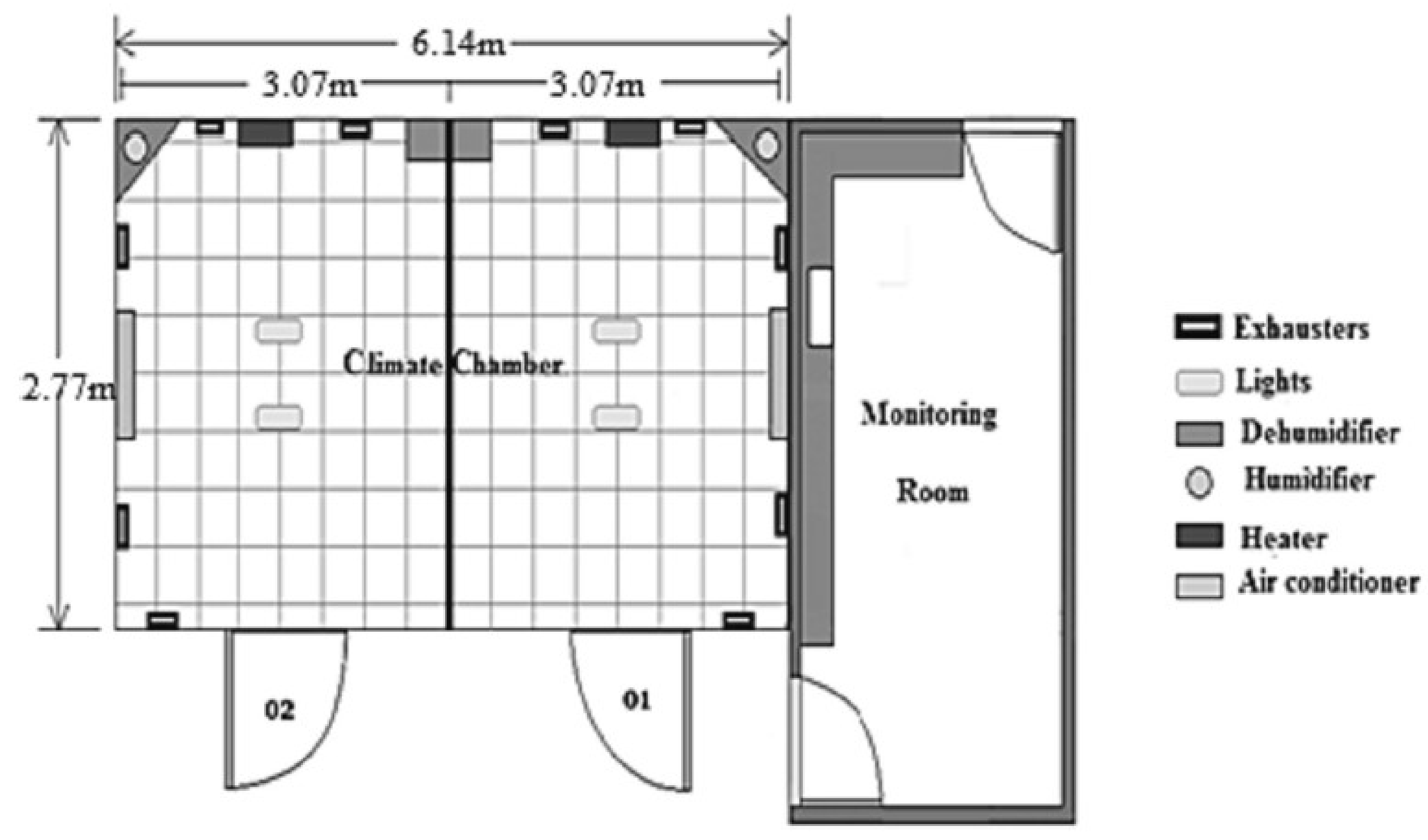
A number of 24 sheep comprised of Santa Inês, Morada Nova, Soinga and without defined standard breeds, six animals from each breed, with an average of 5.0 ± 0.5 months of age, and an average weight of 18.5 ± 2.9 kg, kept in a climate chamber (Figure 1) was used. They were exposed for 12:00 hours to five different temperatures: 20.0; 24.0; 28.0; 32.0 and 36.0°C (from 06:00 to 18:00 hours) and 12:00 hours at room temperature, with the experimental period lasting 14 days, 13 days for the animals to adapt to the environment, feeding, handling, etc., and on the 14th day the experimental data was collected.
Diet
The animals were fed with a volume: concentrate ratio of 50:50, aiming for a weight gain of 250g day-1 (NRC, 2007). The feed consisted of Tifton hay (Cynodon dactylon (L) Pers), which comprised 39.94% of the total volume of feed, ground corn (43.41%), soybean meal (11.15%), urea (0.89%), calcitic lime (0.89%) and vegetable oil (3.59%). Feed consumption was ad libitum and the amount of feed ingested was estimated to establish a surplus of 20.0%, with each animal receiving two portions of 0.400 kg per day, totaling 0.800 kg-1 day-1 ewe-1. The feed was placed in the trough at 07:30 and 16:00, leaving it available for the animal until the next feed.
Environmental variables
The environmental variables inside the chamber were collected and calculated following the methodology of Rodrigues et al. (2023). The sheep were exposed to five temperatures: 20.0; 24.0; 28.0; 32.0 and 36.0°C. The experiment was characterized as cyclical heat stress, with the animals kept at the experimental temperatures for 12 uninterrupted hours (from 06:00 to 18:00) for 15 days, with the lights being switched on from the 10th day and the behavior carried out from the 14th to the 15th day. From 18:01 to 05:50 hours, the animals were kept at room temperature.
Instrutherm® HT-500 datalogger thermo-hygrometers were used to determine air temperature and relative humidity, located at the height of the animals' center of mass (Table 1). temperature was obtained using black globes made with a plastic sphere and a mercury thermometer, and calibrated using a standard black globe with a copper sphere from Instrutherm, positioned in the center of the facility, approximately 1 meter above the floor.
The equation proposed by Mascarenhas et al. (2023) for sheep was used to calculate the heat stress index (HSI):
Where:
AT= air temperature (°C);
BGT= black globe temperature (°C);
Pv= partial vapor pressure.
Ingestive behavior
The behaviors (feeding, rumination, leisure and drinking activities; Table 2) were recorded according to the methodology proposed by Nobre et al. (2021) by means of instantaneous and continuous sampling, using the focal sampling method and sampling intervals of 5:00 min directly, with continuous periods of 24:00 hours from 08:00 to 08:00 hours.
The number of times the animals defecated, urinated and fetched water was observed visually and continuously over a 24-hour period, by trained observers strategically positioned in alternation so as not to alter the animals' routine. During the collection of data from the nocturnal observation of the animals, the environment was kept under artificial lighting.
Statistical analysis
A completely randomized design was used with a 5x4 factorial, with five temperatures (20.0, 24.0, 28.0, 32.0 and 36.0 °C) and four breeds (Morada Nova, Santa Ines, Somalis and SPRD).
The data was submitted to analysis of variance (ANOVA) and the means were compared using PROC GLM in SAS on demand (2024) with the Tukey test at 5% probability
RESULTS AND DISCUSSION
For the HSI, the averages were 45.3, 50.0 and 55.4 at temperatures of 20.0, 24.0 and 28.0°C, respectively, environments classified as comfortable, the value of 63.5 at 32.0°C is defined as mild to moderate discomfort and 70.2 at 36.0°C, classified as alert according to Mascarenhas et al. (2023).
The behavioral variables showed no significant difference (P>0.05) between the breeds (Table 2), but there was a significant difference (P<0.05) between the temperatures (Table 3). This similarity in ingestive behavior between the breeds may be due to the sheep used, which are hardy, free-ranging animals capable of tolerating high temperatures and thermal amplitudes, characteristics resulting from the process of natural selection and/or crossbreeding, possessing behavioral and heat dissipation mechanisms to maintain homeostasis in the most diverse environments (Ribeiro et al., 2006; Silva et al., 2023).
In the averages of the total time dedicated to behavioral activities at the different temperatures, the animals spent more time idle (47.4%), followed by rumination (28.1%), eating (15.5%) and water consumption (9.0%). Between temperatures of 20.0 and 36.0°C, there was a decrease in food consumption and rumination time of 23.0 and 28.0%, respectively, while idle time and water consumption increased by 35.0 and 8.0%, respectively.
Idle activities may be associated with climatic factors, where in high temperatures animals tend to stand still to avoid the formation of endogenous heat, and confined animals reduce movement in search of food and water. In ruminating activity there was a reduction of 18.9% at 36.0°C compared to 20°C, and at higher temperatures animals reduce food consumption and rumination, as a way of reducing the production of endogenous heat to maintain their homeothermia (Leite et al., 2019; Furtado et al., 2020).
In the drinking activity between the temperatures of 20 and 36oC, there was an increase of 54.8%, and this higher consumption at the heat stress temperature is due to the need to replace fluids lost through skin evaporation and respiration, as ways of eliminating body heat. Leite et al. (2019) analyzed the ingestive behavior of Morada Nova sheep subjected to temperatures of 26°C and 32ºC and found that at the highest temperature there was a reduction in rumination time and an increase in idle time and water consumption. As the air temperature rises, the efficiency of sensible heat loss decreases, but if the air temperature continues to rise, the animal becomes dependent on evaporative heat loss through respiration and/or sweating (Marques et al., 2021).
Cardoso et al. (2021) in a study of native goats kept at thermoneutral and heat stress temperatures, reported that behavioral activities were similar between the breeds, where the animals spent most of their time in idleness, eating, ruminating and drinking, although there was a variation in relation to the present experiment, where rumination activity came second, which may be due to the species used. This similarity in ingestive behavior between the breeds may be due to the sheep used, which are hardy, shorn animals capable of tolerating high temperatures and thermal amplitudes, characteristics resulting from the process of natural selection and/or crossbreeding, which have promoted high adaptive value in relation to the semi-arid environment, possessing behavioral and heat dissipation mechanisms to maintain homeostasis in the most diverse environments (Silva et al., 2021; Silva et al., 2023, Rodrigues et al., 2023).
This high adaptability of sheep was mentioned by Matos Júnior et al. (2021), where the supply of water with salinity of up to 9.0 dSm-1 did not affect the performance and ingestive behavior of mixed-breed sheep, ½ Dorper x ½ Santa Inês confined in the Brazilian semi-arid region.
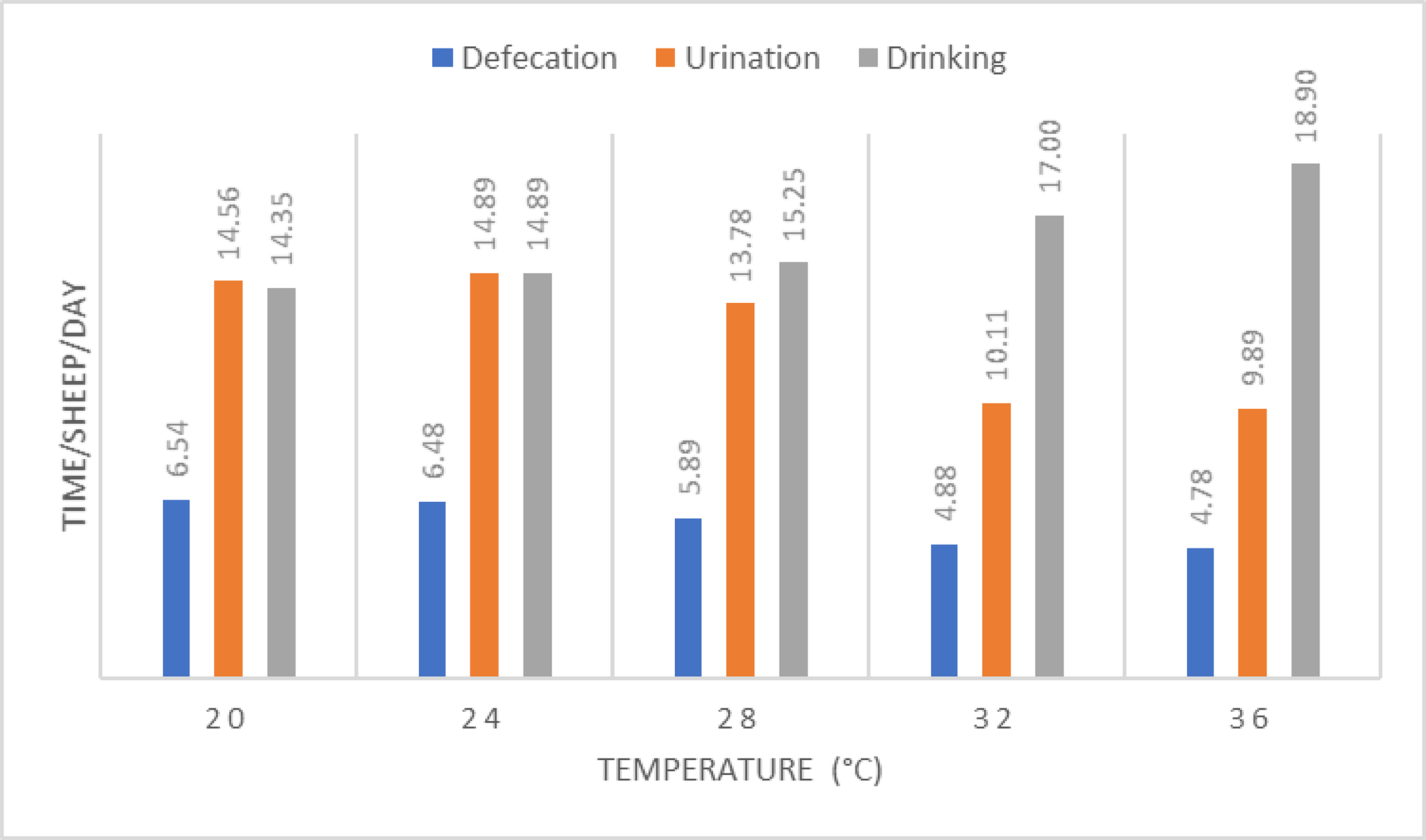
In the point variables (Figure 2), it can be seen that defecating and urinating behaviors decreased with the increase in air temperature, with an increase in the number of visits to the water trough. Even with the increase in time spent drinking water, there was a reduction in urinating activity, demonstrating that under high temperatures animals use latent mechanisms to eliminate excess body heat (Marques et al., 2021).
The blood cells showed no significant difference (P>0.05) as a result of the increase in temperature (Table 4). The values of the white blood series are within the standard recommended by Jain (1993), and the averages were similar to those described in the literature (Weiss & Wardrop, 2010; Pugh & Baird, 2012).
CONCLUSIONS
Among temperatures, feeding time was similar between the breeds, with an increase in idle time and drinking water and a reduction in rumination time as the temperature rose. Animals of the Santa Inês, Morada Nova, Soinga breeds and those with no defined breed standard were able to maintain their ingestive behavior, even in situations of heat stress.
ACKNOWLEDGEMENTS
The authors are grateful to CAPES (Coordination for the Improvement of Higher Education Personnel) and CNPq (National Council for Scientific and Technological Development) for the master's and doctoral scholarships, and to FAPESQ (Paraiba Research Funding Foundation) for the financial support for the project.
REFERENCES
-
Cardoso, E.A., Furtado, D.A., Ribeiro, N.L., Saraiva, E.P., Nascimento, J.W.B., Medeiros, A.N., Sousa, F.A., & Pereira, P.H.B. (2021). Intake salinity water by creole goats in a controlled environment: ingestive behavior and physiological variables. Tropical Animal Health and Production, 53, 333. https://doi.org/10.1007/s11250-021-02754-8
» https://doi.org/10.1007/s11250-021-02754-8 -
Custodio, S.A.S., Tomaz, M.P.P., Silva, D.A.L., Goulart, R.O., Dias, K.M., & Carvalho, E.R. (2017). Feeding behavior of beef cattle fed different forages and housed in individual or collective pens. Journal of Animal Behaviour and Biometeorology, 5, 20-28. http://dx.doi.org/10.14269/2318-1265/jabb.v5n1p20-28
» http://dx.doi.org/10.14269/2318-1265/jabb.v5n1p20-28 -
Costa, R.G., Ribeiro, N.L., Nobre, P.T., Carvalho, F.F.R., Medeiros, A.N., & Martins, F.E. (2019). Ingestive behavior and efficacy of male sheep housed in different stocking densities. Revista Brasileira de Zootecnia, 48, e20180219. https://doi.org/10.1590/rbz4820180219
» https://doi.org/10.1590/rbz4820180219 -
Eustáquio Filho, A., Teodoro, S.M., Chaves, M.A., Santos, P.E.F., Silva, M.W.R., Murta, R.M., Carvalho, G.P., & Souza, L.E.B. (2011). Thermal comfort zone of Santa Inês sheep based on physiological responses. Revista Brasileira de Zootecnia, 40,1807-1814. https://doi.org/10.1590/S1516-35982011000800026
» https://doi.org/10.1590/S1516-35982011000800026 -
Furtado, D.A., Carvalho Júnior, S.B., Lopes Neto, J.P., Souza, B.B., & Dantas, N.L.B. (2020). Adaptability of sheep to three salinity levels in different environments. Semina: Ciências Agrárias, 41, 285-294. https://doi.org/10.5433/1679-0359.2020v41n1p285
» https://doi.org/10.5433/1679-0359.2020v41n1p285 - Jain, N.C. (1993). Essentials of veterinary hematology. Editora Lea & Febiger, Philadelphia.
-
Leite, P.G., Marques, J.I., Furtado, D.A., Lopes Neto, J.P., Souza, B.B., & Nascimento, J.W.B. (2019). Ethology, physiological, and ingestive responses of sheep subjected to different temperatures and salinity levels of water. International Journal of Biometeorology, 1, 1-8. https://doi.org/10.1007/s00484-019-01724-y
» https://doi.org/10.1007/s00484-019-01724-y -
Llonch, P., Mainau, E., Ipharraguerre, I.R., Bargo, F., Tedo, G., Blanch, M., & Manteca, X. (2018). Chicken or the egg: the reciprocal association between feeding behavior and animal welfare and their impact on productivity in dairy cows. Frontier Veterinary Science, 5, 5-305. https://doi.org/10.3389/fvets.2018.00305
» https://doi.org/10.3389/fvets.2018.00305 -
Macedo Junior, G.L., Ruela, P.A.C., Oliveira, K.A., Araújo, C.M., Varanis, L.F.M., & Assis, T.S. (2019). Avaliação do desempenho e comportamento ingestivo de ovinos recebendo ração extrusada em diferentes relações volumoso e concentrado. Veterinaria Notícias, 25, 144-160 https://doi.org/0.14393/VTN-v25n2-2019-38920
» https://doi.org/0.14393/VTN-v25n2-2019-38920 -
Marques, J.I., Leite, P.G., Lopes Neto, J.P., Furtado, D.A., Borges, V.P., & Sousa, W.S. (2021). Estimation of heat exchanges in Boer crossbred goats maintained in a climate chamber. Journal of Thermal Biology, 96, 102-132. https://doi.org/10.1016/j.jtherbio.2020.102832
» https://doi.org/10.1016/j.jtherbio.2020.102832 -
Mascarenhas, N.M.H., Furtado, D.A., Fonsêca, V.F.C., Souza, B.B., Oliveira, A.G., Leal, Morais, F.T.L., Silva, R.S., Silva, M.R., Batista, L.F., Dornelas, K.C., Bezerra, C.V.C., & Silva, J.A.C. (2023). Thermal stress index for native sheep. Journal of Thermal and Biology, 115, 103607. https://doi.org/10.1016/j.jtherbio.2023.103607
» https://doi.org/10.1016/j.jtherbio.2023.103607 -
Matos Júnior, J.L., Furtado, D.A., Ribeiro, N.L., Medeiros, G.R., Lopes Neto, J.P., Leite, P.G., Rodrigues, L.R., & Miranda, J.R. (2021). Salinity-water levels on productive performance, physiological and behavioral responses of ½ Dorper x ½ Santa Inês crossbred sheep. Semina: Ciências Agrarias, 42, 1825-1836 https://doi.org/10.5433/1679-0359.2021V42N3SUPL1P1825
» https://doi.org/10.5433/1679-0359.2021V42N3SUPL1P1825 - National Research Council. (2007). Nutrient Requirements of Small Ruminants: Sheep, Goats, Cervids, and New World Camelids. The National Academies Press, Washington, DC
-
Nobre, P.T., Costa, R.G., Ribeiro, N.L., Carvalho, F.F.R., Cruz, G.R.B., Martins, F.E., & Silva, A.C.R. (2021). Ingestive behavior of lambs fed with guava agro-industrial waste ( Psidium guajava). Revista Brasileira de Saúde e Produção Animal, 22, e2122192021. https://doi.org/10.1590/S1519-99402122192021
» https://doi.org/10.1590/S1519-99402122192021 - Pugh, D.G., Baird, A.N. (2012). Sheep and goat medicine. 2.ed. Maryland Heights: Elsevier Saunders.
-
Ribeiro, V.L., Batista, A.M.V., Carvalho, F.F.R., Azevedo, M., Mattos, C.W., & Alves, K.S. (2006). Comportamento ingestivo de caprinos Moxotó e Canindé submetidos à alimentação à vontade e restrita. Acta Scientiarum Animal Science, 28, 331-337 https://doi.org/10.4025/actascianimsci.v28i3.50
» https://doi.org/10.4025/actascianimsci.v28i3.50 -
Rodrigues, R.C.M., Furtado, D.A., Ribeiro, N.L., Silva, R.S., Silva, M.R., Mascarenhas, N.M.H., Cavalcanti, C.R., Chiodi, J.E., Ayres, G.D.J., Dornelas, K.C., & Oliveira, B.D. (2023). Blood biochemical, hormonal, and hematological responses of native sheep submitted to different environmental conditions. Research and Veterinary Science, 165, 105067 https://doi.org/10.1016/j.rvsc.2023.105067
» https://doi.org/10.1016/j.rvsc.2023.105067 - SAS OnDemand. (2024). System for Windows. Version 9.1. SAS Institute Inc., Cary.
-
Shalloo, L., O' Donovan, M., Leso, L., Werner, J., Ruelle, E., Geoghegan, A., Delaby, L., O'Leary, N. (2018). Review: grass-based dairy systems, data and precision technologies. Animal, 12, S262-S271 https://doi.org/10.1017/S175173111800246X
» https://doi.org/10.1017/S175173111800246X - Silva, J.A.P., Souza, B.B., Silva, M.R., Furtado, D.A., Mascarenhas, N.M.H., Benicio, T.M.A., Rodrigues, R.C.M., & Silva, R.S. (2023). Adaptabilidade dos genótipos Soinga, Morada Nova, Santa Inês e animais sem raça definida em condições de estresse por calor. Revista Coopex, 14, 2119-2138.
-
Silva, M.G.T., Costa, M.G., Medeiros, M.C., Difante, G.S., Azevedo, P.S., Gurgel, A.L.C., Emereciano Neto, J.V., Veras, E.L.L., & Itavo, L.C.V. (2021). Use of spineless cactus associated with legume hay in the feedlot-finishing o lambs in semi-arid regions. PLoS One, 16, 1-14 https://doi.org/10.1371/journal.pone.0261554
» https://doi.org/10.1371/journal.pone.0261554 - Weiss, D.J., Wardrop, K.J. (2010). Schalm's veterinary hematology. 6.ed. Ames: Wiley-Blackwell.
Edited by
-
Area Editor:
Welington Gonzaga do Vale
-
Edited by
SBEA