 A high-speed transplanting machine for plug seedlings with integrated mechanical and pneumatic drive
Abstract
The existing plug seedling transplanters that are used for large-scale vegetable cultivation in China are faced with three main issues: the poor reliability of electrical control systems in the harsh conditions in the field, low efficiency of single-row operations, and low success rates for the picking and depositing of seedlings. To address these issues, this paper presents a high-speed transplanter for plug seedlings equipped with a mechanical and pneumatic synergistic drive system. A kinematic analysis is conducted to determine the main parameters, including the numbers of teeth for the seedling supply ratchet and for the driving sprocket, and a mechanical analysis shows that the minimum clamping force for the seedling picking gripper is 2.0 N. Simulations with FluidSIM software verify that the cylinder action sequence meets the design requirements. The optimal values for the parameters are a picking frequency of 112 seedlings/min, a working pressure of 0.4 MPa, and a seedling height of 145 mm. Field tests of the transplanter with these values indicate that the average success rate for picking and depositing of seedlings, the average missed planting rate, and the single-row transplanting frequency of the transplanter are 96.48%, 3.65%, and 124 seedlings/min, respectively. This study provides theoretical guidance for the design and optimisation of high-speed transplanters.
Keywords:
agricultural machinery; high speed; automatic transplanter; pneumatic; chili pepper nursery tray
Introduction
To improve the survival rate and quality of transplanted crops, the planting process of peppers typically involves plug seedlings, which are then transplanted (Li et al., 2025; Paradkar et al., 2021; Sharma & Khar, 2024). The transplanting technologies that have been developed around the globe are highly mature, featuring high planting efficiency and supporting multi-row automated operations involving picking, seeding, and transplanting. (Ishizaki et al., 2024; Khadatkar et al., 2023; Miah et al., 2023). Indian researchers have developed an automated plug seedling transplanter that combines mechatronics with embedded systems, gripper fingers and propulsion systems. When applied to 30-day-old chili/tomato seedlings, these transplanters have achieved picking success rates of 91%–98.6%, leakage rates of 1.7%–13.9%, uniform spacing, and higher field capacities than manual methods (Khadatkar et al., 2018, 20, 2021a, 2021b, 2022, 2024). Ajit Pralhad Magar et al. (2025) designed an automated transplanting device for multi-cell plug vegetable seedlings that had two key components: a mechanical elbow-joint seedling picking mechanism, and a closed-loop control embedded system. In field tests, this device achieved a picking rate of 96.05% for tomato and cabbage plug seedlings. Transplanters that are currently available from companies such as Ferrari in Italy, Transplant Systems in Australia, and Pearson in the UK include various forms of automated and sensor technology; however, although these are suitable for smart field transplanting, they are expensive and bulky (Pérez-Ruiz & Slaughter, 2021).
To reduce the labour intensity involved, and to improve the operational quality and efficiency, extensive research has been carried out on automated transplanting technologies by Chinese scholars, agricultural machinery companies and research institutions (Han et al., 2019). Ye et al. (2020) proposed a new rotary seedling picking mechanism with combined gears, which achieved a 96.3% success rate at 50 r/min, representing a significant improvement in the efficiency of vegetable transplanting. Ji et al. (2024) designed a traction-type dual-row automatic transplanter for tomato plug seedlings, and reported that at a planting frequency of 80 seedlings/(min·row), this machine achieved a transplant success rate of 93.89% and a skip-planting rate of 1.58%.
Despite these promising developments, however, current transplanting machines still lack sufficient operational stability under the challenging conditions in the field, and have a relatively low working efficiency. The aim of the present research was to address these limitations by enhancing both the level of mechanisation and the operational reliability of a transplanting system, via the development of a four-row high-speed transplanter for plug seedlings. The proposed design includes three primary improvements: (i) redundant electrical control systems are removed to improve the reliability of the machine during field operations; (ii) a whole-row seedling picking mechanism is used, followed by individual seedling separation and planting processes; and (iii) the device operates on four rows simultaneously, which significantly increases the working efficiency.
Material and Methods
Structure and working principle of the whole machine
Structure of the machine
The structural components of the proposed high-speed plug seedling transplanter are illustrated in Fig. 1, and include an air compressor, a main frame, four planting units, four fully automatic seedling picking and depositing systems, and a ground wheel.

The fully automatic systems for the picking and depositing of seedlings are illustrated in Fig. 2. These systems combine three main components: (i) a seedling picking mechanism; (ii) a seedling transfer mechanism; and (iii) a mechanical and pneumatic synergistic drive control system. The system has specific design requirements: it must accommodate the large lateral dimensions required for whole-row picking and ejection of seedlings, while at the same time, the overall dimensions of the machine must be compact. To meet these requirements, an innovative configuration is used in which two sets of automatic seedling handling systems are arranged in a staggered pattern, and are distributed symmetrically along both the front-rear and left-right axes.

Performance parameters
The detailed specifications of the proposed high-speed plug seedling transplanter are presented in Table 1.
Working principle of the machine
The proposed high-speed plug seedling transplanter is towed by a tractor, and all four sets of the fully automatic seedling picking and depositing systems and planting units operate at the same time. The power take-off shaft of the tractor drives the air compressor, which supplies power to the fully automatic seedling picking and depositing systems. Meanwhile, the planting mechanism and seedling conveyor are driven by a chain from the ground wheel system. As shown in Fig. 3, field workers place the plug trays in the designated position of the seedling supply mechanism, which then moves the trays intermittently to the seedling transfer mechanism. The transfer mechanism takes an entire row of seedlings from the plug tray, and transfers them to the ejection position. Individual picking grippers then distribute the seedlings into the corresponding seedling cups on the conveyor mechanism. The conveyor system transports the plug seedlings to the dibber mechanism of the planting unit, one after another, and this mechanism achieves precise planting of the seedlings in the soil.

Design and analysis of the seedling supply mechanism
To ensure a high success rate for the seedling picking mechanism, the position of the seedling on the conveyor is fixed. A seedling supply mechanism therefore needed to be designed that would operate with the picking mechanism to achieve the automatic supply of seedlings. The structure of the seedling supply mechanism is shown in Fig. 4, and consists of a driving sprocket shaft, a driving sprocket, a ratchet device with a variable step angle, a cylinder, a chain, and a push rod for the supply of seedlings. During operation, an operator manually places the plug seedlings onto the supply mechanism, ensuring that the corresponding push rod engages with the gap at the bottom of each plug tray. The reversing valve, referred to here as DT1, controls the seedling supply cylinder in driving the seedling tray supply mechanism to achieve intermittent motion.

Kinematic analysis of the seedling supply push rod and seedling cell
The feeding action of the tray of the seedling supply mechanism is divided into two main stages, as shown in Fig. 5. In the first stage, the seedling tray moves linearly, and feeds plug seedlings to the picking position. In the second stage, when picking of the seedlings is complete, the seedling tray moves along a curved path defined by the guide plate, and is sent out from the bottom of the seedling supply mechanism and returned to the operator. To analyse the process of movement of the seedling supply push rod and seedling cell, an appropriate diameter for the driven sprocket is selected to ensure that there is no interference between the seedling tray and the seedling supply push rod during linear and curved movements.

Using the geometric relationships illustrated in Fig. 5, the expressions in [eq. (1)] can be derived based on the kinematic analysis method for the seedling supply mechanism (Liu et al., 2020):
Where:
Z1 - Number of teeth on the driven sprocket;
r - Radius of the driven sprocket, mm;
lab - Distance from the centre a of the seedling supply push rod to point b, mm;
lac - Distance from the centre a of the seedling supply push rod to point c, mm;
θ1 - Included angle between Oa and Ob, °;
θ2 - Included angle between ab and bO, °;
θ3 - Included angle between the side and bottom of the seedling cell, °.
The conventional dimensions for a standard 128-cell soft plug tray give a value of θ3=100°. The longitudinal spacing of the seedling cells is 31.75 mm. Since lac is half of the longitudinal seedling cell spacing, we have lac=15.875 mm, and from [eq. (1),] we obtain Z1>36. To ensure smooth operation of the seedling supply mechanism, and given that the number of sprocket teeth is usually an odd number, a value of Z1=51 is selected here. Calculations show that when r=129 mm, there is no mutual interference between the seedling supply push rod and the seedling cell.
Kinematic analysis of the ratchet device with variable step angle
During the feeding process of the seedling tray, the spacing between seedling cells in the same tray differs from that between adjacent connected trays, meaning that the seedling supply mechanism must achieve variable-step feeding. A ratchet device with a variable step angle was therefore designed as the driving unit of the seedling supply mechanism, which enables variable-step feeding of plug seedlings with a single cylinder drive. As shown in Fig. 6, the ratchet device consists of a seedling supply ratchet, a pawl rocker arm, a seedling supply pawl, a rotating shaft for the seedling supply pawl, and a tension spring. The seedling supply cylinder drives the pawl rocker arm and seedling supply pawl to swing reciprocally. Under the action of the tension spring, the seedling supply pawl always slides along the outer edge of the seedling supply ratchet. The seedling supply ratchet is equipped with both variable-pitch teeth and normal teeth, with the former being shorter than the latter. Each time the seedling supply cylinder pushes the seedling supply pawl, the sliding distance is less than the distance between two normal teeth but greater than the distance between one normal tooth and one variable-pitch tooth. When the seedling supply pawl slides over the back of a variable-pitch tooth, it drives the seedling supply ratchet to rotate by two step angles, whereas when it slides over a normal tooth, it drives the seedling supply ratchet to rotate by one step angle.

The main parameters of the seedling supply ratchet were calculated based on the requirements for the supply of seedlings. Each indexing motion (an advance by one tooth) of the ratchet moves the plug tray forward by one cell spacing. A complete revolution of the ratchet, consisting of 17 such indexing motions, is required to feed one entire tray and the gap between it and the next tray. Hence, the number of teeth on the seedling supply ratchet is Z3=17. The method used to calculate the main parameters for the seedling supply ratchet was based on prior work by Du et al. (2014), using the expressions in [eq. (2)]:
Where:
k - Number of ratchet teeth pushed by the seedling supply pawl in a single stroke;
S1 - Seedling supply stroke, mm;
Z2 - Number of teeth on the driving sprocket;
p - Pitch, mm;
m - Module of the seedling supply ratchet;
da - Diameter of the addendum circle of the seedling supply ratchet, mm;
h - Height of the ratchet teeth, mm;
df - Diameter of the dedendum circle of the seedling supply ratchet, mm;
p1 - Pitch of the ratchet teeth, mm;
l1 - Working length of the seedling supply pawl, mm;
h1 - Height of the seedling supply pawl, mm.
The selected seedling supply chain is a 10A roller chain, which has a standard pitch of p = 15.875 mm (equivalent to 5/8 inch). The longitudinal seedling cell spacing is 31.75 mm, yielding values of S1=31.75 mm and m=7. Substituting these values for S1, p, m, and k into the expressions in [eq. (2)] gives the following results:
Step angle of the seedling supply ratchet ψ≈21°;
Number of teeth on the driving sprocket Z2=34;
Addendum circle diameter of the seedling supply ratchet da=119 mm;
Height of the ratchet teeth h=5.25 mm;
Dedendum circle diameter of the seedling supply ratchet df=108.5 mm;
Rounded pitch of the ratchet teeth p1=22 mm;
Working length of the seedling supply pawl l1=44 mm;
Height of the seedling supply pawl h1=10.5 mm.
As shown in Fig. 6, a coordinate system was established with the centre of ratchet rotation O as the origin and the vertical direction as the Y-axis. Based on this, the following positions were defined: H denotes the hinge point between the seedling supply cylinder rod (in the retracted state) and the connecting rod of the rocker arm; V represents the hinge point between the seedling supply cylinder rod (in the retracted state) and the seedling supply pawl; H' is the hinge point between the seedling supply cylinder rod (in the extended state) and the connecting rod of the rocker arm; and V' indicates the hinge point between the seedling supply cylinder rod (in the extended state) and the seedling supply pawl. The other parameters are defined as follows: e is the distance from the centre line of the seedling supply cylinder to the X-axis; φVV′ is the swing angle of the pawl rocker arm; and θ is the angle between the X-axis and the pawl rocker arm when the seedling supply cylinder rod is in the retracted state.
Based on the motion relationship and structural design scheme, the known parameters are as follows: XH=e=148 mm; the range of the rotation angle of the seedling supply pawl is 42°–68°; and the selected rotation angle is 50°. Since the seedling supply pawl swings reciprocally with the pawl rocker arm, the swing angle of the pawl rocker arm is also 50°.
To enable the ratchet device with variable step angle to work normally, the following constraints must be satisfied:
-
(i) When the seedling supply cylinder rod is retracted, there is a need to ensure that the seedling supply pawl stays on the dedendum circle of the ratchet. The constraint equation is:
-
(ii) To ensure normal rotation of the pawl rocker arm when the seedling supply cylinder rod is extended, the constraint is:
The inequality in [eq. (4)] was used as the optimisation objective for the design; solving this inequality and rounding the results gives values of lHV=25 mm and lVO=146 mm.
Design and analysis of the seedling picking mechanism
The seedling picking mechanism is the core component of the proposed high-speed automatic plug seedling transplanter, and acts to replace the use of manual labour in automatically picking plug seedlings from plug trays and dropping them into the seedling cups of the seedling conveying mechanism. To enable whole-row picking and deposition, the seedling picking mechanism operates in two stages: it first picks an entire row of seedlings simultaneously, and then separates and deposits them individually.
As shown in Fig. 7, this mechanism mainly consists of longitudinal cylinders, longitudinal slide rails, transverse cylinders, transverse slide rails, picking grippers for seedlings, lifting cylinders, baffles for depositing seedlings, and reversing valves. At the seedling picking stage, the transverse and longitudinal cylinders drive the picking grippers to converge at the seedling picking position. where they clamp a full row of eight seedlings. The lifting cylinders then drive the seedling picking grippers to rise and take out these plug seedlings. At the seedling deposit stage, the transverse and longitudinal cylinders drive the picking grippers to move and separate above the corresponding seedling cups; they then open to drop the eight seedlings simultaneously. This completes one cycle of the picking and depositing of seedlings.

The picking grippers are mounted on horizontal linear guide rails, and each gripper is connected by a limiting plate for separation of the seedlings. Two transverse cylinders drive the eight picking grippers to move along the horizontal linear guide rails. As shown in Fig. 7(b), when seedlings are picked, the spacing between adjacent seedling picking grippers is Lq=32 mm, a value that matches the spacing of adjacent seedling cells in the plug tray. It can be seen from Fig. 7(a) that when depositing seedlings, the spacing between adjacent seedling picking grippers is Lt=127 mm, which is equal to the spacing of adjacent seedling cups in the seedling conveying mechanism. This structural design ensures proper alignment and functionality during both the picking and depositing stages.
A structural analysis gives rise to the following equation:
Where:
L2 -Transverse cylinder stroke, mm;
Lt - Spacing between two seedling picking grippers (during depositing), mm;
Lq - Spacing between two seedling picking grippers (during picking), mm;
n - Number of picking cylinders;
m - Number of transverse cylinders.
Substituting Lq, Lt, n, and m into [eq. (5)] and rounding the result gives a value for the transverse cylinder stroke of 333 mm.
Seedling picking gripper
The seedling picking gripper is shown in Fig. 8(a). The use of this gripper can replace manual seedling picking and give better performance, as it is specifically designed to address challenges in the handling of plug seedlings, such as tilting or falling of the seedlings, intertwining of branches and leaves, and high susceptibility to damage. The main components of the picking grippers are the seedling cylinders, a fixed base, connecting blocks, connecting rods, and clamping jaws. They also include flexible materials composed of a foam substrate and acrylic adhesive, which offer resistance to high and low temperatures, waterproof and moisture-resistant properties, and a soft texture.

To enable the picking grippers to clamp and drop seedlings from the plug tray, cylinders are used to control the opening and closing of the clamping jaws. This enables automated control of the clamping and depositing operations. A schematic diagram of the gripper mechanism is shown in Fig. 8(b) (Jiang et al., 2017). To ensure successful picking of seedlings, a force analysis of the grippers during their operation was conducted based on prior research (Han et al., 2013), and the expression for the force relationship when the gripper is in the clamping state is shown in [eq. (6)].
Where:
Lg - Length of the clamping jaws, mm;
Lc - Width of the clamping jaws, mm;
F - Thrust of the seedling picking cylinder, N;
F1, F2 - Bilateral clamping forces on the plug seedling, N;
δ1 - Angle between the cylinder thrust direction at the hinge and the vertical direction, (°);
G - Gravitational force on the seedling, N;
μ - Friction coefficient.
When the pepper seedling has a small friction coefficient but a high mass, the grippers can still clamp it firmly, proving that the system can ensure successful picking. The values for the parameters are selected as Lg=50 mm, Lc=20 mm, μ=0.49, G=0.4 N, δ1=5°; by substituting these into [eq. (6)], the theoretical minimum thrust required for the cylinder (F) is obtained as 2.0 N.
Design of the mechanical and pneumatic synergistic drive control system
Based on the operational process of picking, separating, and depositing the seedlings for the whole-row seedling picking mechanism, a mechanical and pneumatic synergistic drive control system was designed, with the configuration shown in Fig. 9. The pneumatic components include the seedling picking cylinder (A), lifting cylinder (B), longitudinal cylinder (C), transverse cylinder (D), and seedling supply cylinder (E). As shown in Fig. 9, the pneumatic control valve V2 controls the lifting cylinder, and the speed of the lifting cylinder is regulated by the throttle valves, J1 and J2. The mechanical valve V4 controls the seedling transfer cylinder, longitudinal cylinder, and transverse cylinder, and the speed of these three cylinders is regulated by the throttle valves, J3 and J4. The seedling picking cylinder is controlled by the mechanical valve V0 and the pneumatic mechanical valve V1.

The four control valves are primarily responsible for governing the mechanical and pneumatic synergistic drive control system. The triggering methods for each valve are summarised in Table 2. Mechanical valve V0 is triggered by the rotating sprocket of the seed transfer mechanism, with one trigger per rotation. Pneumatic mechanical valve V1 is controlled by air pressure, and its other end is driven by the fixed frame of the seed-picking gripper, which is actuated by the longitudinal cylinder. Pneumatic control valve V2 is regulated by the air pressure from mechanical valve V0, and features a spring-return design. The up-and-down movement of the stroke slot plate triggers the mechanical valve V3.
Simulation analysis of the pneumatic system
To verify whether the action sequence of each cylinder in the mechanical and pneumatic synergistic drive control system met the design requirements, and to design an optimal circuit with a simple structure, reliable operation and high efficiency, we used FluidSIM to simulate and analyse the entire mechanical and pneumatic synergistic drive control system. As shown in Table 3, the main parameters for each pneumatic component were determined based on the design scheme.
The sequence of response times for the lifting cylinder, seedling picking cylinder, transverse cylinder and longitudinal cylinder were simulated and analysed, and the results are shown in Fig. 10. As can be seen from the figure, the designed pneumatic system meets the requirements for the action sequence of each executive cylinder, as follows: depositing of seedlings → descending → gripper convergence → seedling picking → lifting → gripper divergence → longitudinal tray movement → depositing of seedlings, with a gas source pressure of 0.4 MPa, and a throttle valve opening of 100%. This analysis does not take into account the time interval for triggering of the mechanical valve V1, which is a single cycle time of about 4 s.

Performance evaluation of the transplanting system
Experiments were conducted in Yanqi Hui Autonomous County, Xinjiang Uygur Autonomous Region. In bench tests and field tests, the main instruments and equipment used included a tractor, non-contact tachometer, speed-regulating motor, and an air compressor, with the parameters shown in Table 4.
As shown in Fig. 11, the test materials used were 128-cell trays of pepper plug seedlings, which were cultivated by greenhouse growers in Yanqi Hui Autonomous County, Xinjiang Uygur Autonomous Region.

Experimental scheme
Bench tests of the seedling picking and supply mechanisms were first conducted. The aim was to verify two aspects: (i) whether the action sequences of the two mechanisms were coordinated and consistent with the simulation results of the mechanical and pneumatic synergistic drive control system; and (ii) whether the performance in terms of picking and depositing of seedlings met the design requirements. Finally, in accordance with the dryland planting machinery industry standard (JB/T 10291-2013), field tests were carried out on the high-speed plug seedling transplanting machine. The experimental metrics included the success rate for depositing seedlings, the missed planting rate, replanting rate, rate of falling of seedlings, rate of damage to the seedlings, and the planting frequency.
Bench tests
The first part of the experiment consisted of a bench test, using the equipment shown in Fig. 12. This was conducted with the aim of investigating the effects of the working pressure, average seedling height, and working frequency on the success rate of the proposed system in regard to picking and depositing seedlings.

The working pressure, seedling picking and depositing frequency, and average seedling height were found to affect the seedling picking and depositing success rate. Table 5 lists the experimental factors and their corresponding levels.
In this test, the seedling picking and depositing success rate was used as the test index. This rate reflects the probability that the seedling picking gripper successfully picks and places seedlings, and a higher rate indicates better picking and depositing performance. The method used to calculate this success rate was based on prior studies of agricultural mechanisation (Khadatkar et al., 2024), based on the formula in [eq. (7)]:
Where:
S - overall seedling picking and depositing success rate,%;
Q - total number of nursery seedlings in the nursery tray;
R - number of seedlings successfully extracted from the nursery tray.
Verification tests for the seedling picking and supply mechanisms were conducted using the optimal combination of parameters. The test indicator was the success rate for picking and depositing of seedlings. The experiment was repeated three times, and the average value of the seedling picking and depositing success rate from the three repetitions was calculated. The results were then compared to check that they were consistent with the results of the orthogonal test.
Field test
Following the bench test, a field test was conducted, with the primary purpose of enabling a more comprehensive verification of the working performance of the high-speed plug seedling transplanting machine. The field test took place in Yanqi Hui Autonomous County, Xinjiang Uygur Autonomous Region, and the test subjects were locally cultivated 128-cell pepper plug seedlings. Photographs of the equipment and seedlings used in the field tests are presented in Fig. 13.

Following the dryland planting machinery industry standard (JB/T 10291-2013) for tests of high-speed plug seedling transplanters, the performance evaluation indices were the success rate for depositing seedlings (S), missed planting rate (M), seedling falling rate (D), replanting rate (T), rate of damage to seedlings (W), and planting frequency (F). Before the test, the transplanter was connected to the tractor via a three-point hitch; when the transplanter was in place, the power take-off shaft was then engaged to drive the air compressor through a belt, and compressed air was pumped into the air storage tank. Once the pressure gauge indicated that the working air pressure had reached 0.4 MPa, the transplanter was then started. During the test, the prototype device was used to transplant 128 plug seedlings at the test site, and a stopwatch was used to record the duration of the test. The number of successful seedling depositions was counted, and the test was repeated six times. After the test, the numbers of missed, replanted, fallen, and damaged seedlings were counted, and the final test results were taken as the average values for the six tests.
RESULTS AND DISCUSSION
Analysis of variance for the bench test results
This study was structured based on an L9 (3×3) orthogonal test design. The results are presented in Table 6. A range analysis indicated that the factors influencing the seedling picking and depositing success rate, in descending order of significance, were A, C, and B. The optimal parameter combination that yielded the highest performance was A2B1C1, corresponding to a seedling picking frequency of 96 seedlings/min, a working pressure of 0.4 MPa, and an average seedling height of 145 mm.
Range analysis for the bench test results
The experimental results were analysed using an ANOVA, as shown in Table 7. The picking success rate was used as the evaluation index, with a 95% confidence level. The picking frequency and average seedling height were found to exert a significant influence on the picking success rate, whereas the working pressure had no significant effect. One important finding from observations and analysis of the orthogonal test process was that the air compressor used in the bench test to supply air to the seedling picking mechanism operated intermittently: when the air pressure in the storage tank dropped below a set value, the motor started to rotate and drove the air compressor, leading to fluctuations in the working pressure displayed on the pressure gauge of the picking mechanism during the continuous process of picking and depositing seedlings. To a certain extent, these pressure fluctuations affected the impact of the working pressure on the success rate of picking and depositing seedlings.
Verification tests of the seedling picking and supply mechanisms were conducted using the optimal combination of parameters, consisting of a picking and depositing frequency of 112 seedlings/min, a working pressure of 0.4 MPa, and an average seedling height of 145 mm. The test index was the success rate for picking and depositing seedlings, and the tests were repeated three times. The results showed that the average success rate for the mechanisms was 97.92%, a value that met the design requirements.
Analysis of the field test results
The calculated results for each index for the field test of the prototype are shown in Table 8. It can be seen that the average success rate for picking and depositing seedlings is 96.48%, the average missed planting rate is 3.65%, the average replanting rate is 0.91%, the average fall rate is 1.56%, and the average seedling damage rate is 0.52%.
Table 9 shows that the average planting frequency (F) for single-row high-speed nursery tray transplanting machines is 124 plants/min. In the table, z represents the number of successfully planted seedlings, and t is the corresponding planting time. The planting frequency for a single row is ≥90 seedlings /min, which meets the requirements set out in the industry standard JB/T 10291-2013 for dry land planting machinery.
During the field operation of the proposed high-speed plug seedling transplanter, two problems arose due to the high density of the branches and leaves of some test pepper plug seedlings: (i) two plug seedlings were sometimes clamped simultaneously; and (ii) plug seedlings occasionally hung on the seedling picking gripper. To a certain extent, these issues affected the seedling picking and depositing success rate.
A further limitation was associated with the frequency of picking and placing of seedlings. When the stroke of the transverse cylinder in the seedling picking mechanism was set to 333 mm, this enabled the seedling picking gripper to move to the precise position for the picking and placing of pepper seedlings, and the sequence of movement of the cylinders was consistent with the simulation results for the mechanical and pneumatic synergistic drive control system. However, when the seedling picking mechanism was operated at a higher frequency, the transverse cylinder driving the seedling picking gripper vibrated, generating a certain degree of impact, which caused a loss of the substrate of the plug seedlings during the seedling picking and placing process.
Conclusions
In this study, a four-row high-speed plug seedling transplanter was developed in order to address the issues of the poor stability and low efficiency of existing machines under harsh field conditions. The main innovations that were introduced included a mechanical-pneumatic synergistic drive system, a whole-row seedling picking mechanism, and a ratchet seedling supply device with a variable step angle, which solved problems such as unreliable electrical control and mismatched seedling spacings.
The operational parameters were optimised through theoretical analysis, kinematic simulations, and bench tests, and it was found that a picking frequency of 112 seedlings/min at a pressure of 0.4 MPa yielded the highest success rate. Field tests in Xinjiang confirmed that the transplanter met the requirements set out in industry standards, with an average seedling success rate of 96.48% and a single-row planting speed of 124 seedlings/min. The proposed transplanter shows improvements in terms of its adaptability to harsh environments and its efficiency, and can provide a technical reference for high-performance vegetable transplanting equipment.
This research has several limitations that warrant further exploration, and avenues for future research will involve intelligent upgrading and adaptation to a wider range of scenarios. Firstly, the field tests and performance evaluations conducted here focused exclusively on 128-cell trays of pepper plug seedlings, and the adaptability of the transplanter to other plug specifications or crops with varying seedling sizes or substrate characteristics remains untested. In future work, the seedling picking mechanism will be optimised to increase its versatility. Secondly, there were problems associated with pressure fluctuations arising from the intermittent operation of the air compressor and substrate loss caused by vibration of the transverse cylinder at high frequencies. Further research will involve topology optimisation and the design of shock absorbers to resolve these issues. In addition, IoT and big data analytics will be integrated to enable remote monitoring and predictive maintenance.
Acknowledgments
This work was supported by Qilu Institute of Technology's university-level research projects (QIT22NN018) and Qilu Institute of Technology's university-level research projects (QIT24NN037).
References
-
Du, L. H., Yu, G. H., Zhang, G. F., Li, G., & Liu, D. Q. (2014). Design and experiment of longitudinal seedling feeding device for pot mat seedlings in high-speed rice transplanter. Transactions of the Chinese Society of Agricultural Engineering, 30 (14), 17-25. https://doi.org/10.3969/j.issn.1002-6819.2014.14.003
» https://doi.org/10.3969/j.issn.1002-6819.2014.14.003 -
Mao, H., Hu, J., & Kumi, F. (2019). Development of a riding-type fully automatic transplanter for vegetable plug seedlings. Spanish Journal of Agricultural Research, 17(3), e0205 - e0205. https://doi.org/10.5424/sjar/2019173-15358
» https://doi.org/10.5424/sjar/2019173-15358 - Han, L. H., Mao, H. P., Miao, X. H., Hu, J. P., & Yang, X. J. (2013). Design of automatic seedling picking end-effector based on mechanical properties of plug seedlings. Transactions of the Chinese Society for Agricultural Machinery, 44 (11), 260-265.
-
Ishizaki, S., Hirai, H., Sakagaito, T., Takeyama, T., Oido, N., Tamura, T., Mizutani, M., Watanabe, Y., & Umeda, M. (2024). Development of a transplanter-based transplanter for vegetable seedlings cultured in a cuttable nursery mat. Journal of Agricultural Engineering. https://doi.org/10.4081/jae.2024.1571
» https://doi.org/10.4081/jae.2024.1571 -
Ji, D., Liu, L., Zeng, F., Zhang, G., Liu, Y., Diao, H., Tian, S., & Zhao, Z. (2024). Design and experimental study of a traction double-row automatic transplanter for Solanum Lycopersicum seedlings. Horticulturae, 10 (7), 692. https://doi.org/10.3390/horticulturae10070692
» https://doi.org/10.3390/horticulturae10070692 -
Jiang, Z., Hu, Y., Jiang, H., & Tong, J. (2017). Design and force analysis of end-effector for plug seedling transplanter. Plos One, 12(7), e0180229. https://doi.org/10.1371/journal.pone.0180229
» https://doi.org/10.1371/journal.pone.0180229 -
Khadatkar, A., Magar, A. P., Sawant, C. P., & Modi, R. U. (2024). Development and testing of automatic seedling extractor in robotic transplanter using mechatronics for nursery seedlings. Discover Applied Sciences, 6(51), 1-14. https://doi.org/10.1007/s42452-024-05670-2
» https://doi.org/10.1007/s42452-024-05670-2 -
Khadatkar, A., Pandirwar, A. P., & Paradkar, V. (2023). Design, development and application of a compact robotic transplanter with automatic seedling picking mechanism for plug-type seedlings. Scientific Reports, 13(1), 1883. https://doi.org/10.1038/s41598-023-28760-4
» https://doi.org/10.1038/s41598-023-28760-4 -
Khadatkar, A., & Mathur, S. M. (2022). Design and development of an automatic vegetable transplanter using a novel rotating finger device with push-type mechanism for plug seedlings. International Journal of Vegetable Science, 28(2), 121-131. https://doi.org/10.1080/19315260.2020.1848962
» https://doi.org/10.1080/19315260.2020.1848962 -
Khadatkar, A., Mathur, S. M., Dubey, K., & Magar, A. P. (2021a). Automatic ejection of plug-type seedlings using embedded system for use in automatic vegetable transplanter. Journal of Scientific & Industrial Research, 80(12), 1042 - 1048. http://nopr.niscair.res.in/handle/123456789/58742
» http://nopr.niscair.res.in/handle/123456789/58742 -
Khadatkar, A., Mathur, S. M., Dubey, K., & BhusanaBabu, V. (2021b). Development of embedded automatic transplanting system in seedling transplanters for precision agriculture. Artificial Intelligence in Agriculture, 5, 175 - 184. https://doi.org/10.1016/j.aiia.2021.08.001
» https://doi.org/10.1016/j.aiia.2021.08.001 -
Khadatkar, A., Mathur, S. M., & Gaikwad, B. B. (2018). Automation in transplanting: A smart way of vegetable cultivation. Current Science, 115(10), 1884-1892. https://doi.org/10.18520/cs/v115/i10/1884-1892
» https://doi.org/10.18520/cs/v115/i10/1884-1892 -
Li, M., Zhu, X., Ji, J., Jin, X., Li, B., Chen, K., & Zhang, W. (2025). Visual perception enabled agriculture intelligence: A selective seedling picking transplanting robot. Computers and Electronics in Agriculture, 229, 109821. https://doi.org/10.1016/j.compag.2024.109821
» https://doi.org/10.1016/j.compag.2024.109821 -
Liu, N. C., Yang, C. W., Liu, B. L., Jiang, H., Wu S., Huang, H. (2020). Development of automatic single pendulum vegetable pot seedling picking and feeding system (in Chinese with English abstract). Transactions of the Chinese Society of Agricultural Engineering (Transactions of the CSAE), 36 (22), 87-95. https://doi.org/10.11975/j.issn.1002-6819.2020.22.010
» https://doi.org/10.11975/j.issn.1002-6819.2020.22.010 -
Miah, M. S., Rahman, M. M., Hoque, M. A., Ibrahim, S. M., Sultan, M., Shamshiri, R. R., Ucgul, M., Hasan, M., & Barna, T. N. (2023). Design and evaluation of a power tiller vegetable seedling transplanter with dibbler and furrow type. Heliyon, 9 (8). https://doi.org/10.1016/j.heliyon.2023.e17827
» https://doi.org/10.1016/j.heliyon.2023.e17827 - Magar, A. P., Nalawade, S. M., Walunj, A. A., Gaikwad, B. B., Shelke, G. N., Khadatkar, A., Sawant, C. P., & Modi, R. U. (2025). Development and optimization of an automatic transplanting device for plug tray vegetable seedlings using embedded system. Scientific Reports, 15 (1), 22483.
-
Paradkar, V., Raheman, H., & Rahul, K. (2021). Development of a metering mechanism with serial robotic arm for handling paper pot seedlings in a vegetable transplanter. Artificial Intelligence in Agriculture, 5, 52-63. https://doi.org/10.1016/j.aiia.2021.02.001
» https://doi.org/10.1016/j.aiia.2021.02.001 -
Pérez-Ruiz, M., & Slaughter, D. C. (2021). Development of a precision 3-row synchronised transplanter. Biosystems Engineering, 206, 67 - 78. https://doi.org/10.1016/j.biosystemseng.2021.03.014
» https://doi.org/10.1016/j.biosystemseng.2021.03.014 -
Sharma, A., & Khar, S. (2024). Design and development of a vegetable plug seedling transplanting mechanism for a semi-automatic transplanter. Scientia Horticulturae, 326, 112773. https://doi.org/10.1016/j.scienta.2023.112773
» https://doi.org/10.1016/j.scienta.2023.112773 -
Ye, B., Zeng, G., Deng, B., Yang, C., Liu, J., & Yu, G. (2020). Design and tests of a rotary plug seedling pick-up mechanism for vegetable automatic transplanter. International Journal of Agricultural and Biological Engineering, 13 (3), 70-78. https://doi.org/10.25165/j.ijabe.20201303.5647
» https://doi.org/10.25165/j.ijabe.20201303.5647
-
Data Availability Statement:
The datasets generated during and/or analyzed during the current study are available from the corresponding author on reasonable request.
Edited by
-
Area Editor:
João Paulo Arantes Rodrigues da Cunha
The datasets generated during and/or analyzed during the current study are available from the corresponding author on reasonable request.

 (1) Ground wheel; (2) fully automatic seedling picking and depositing systems; (3) planting units; (4) main frame; (5) air compressor
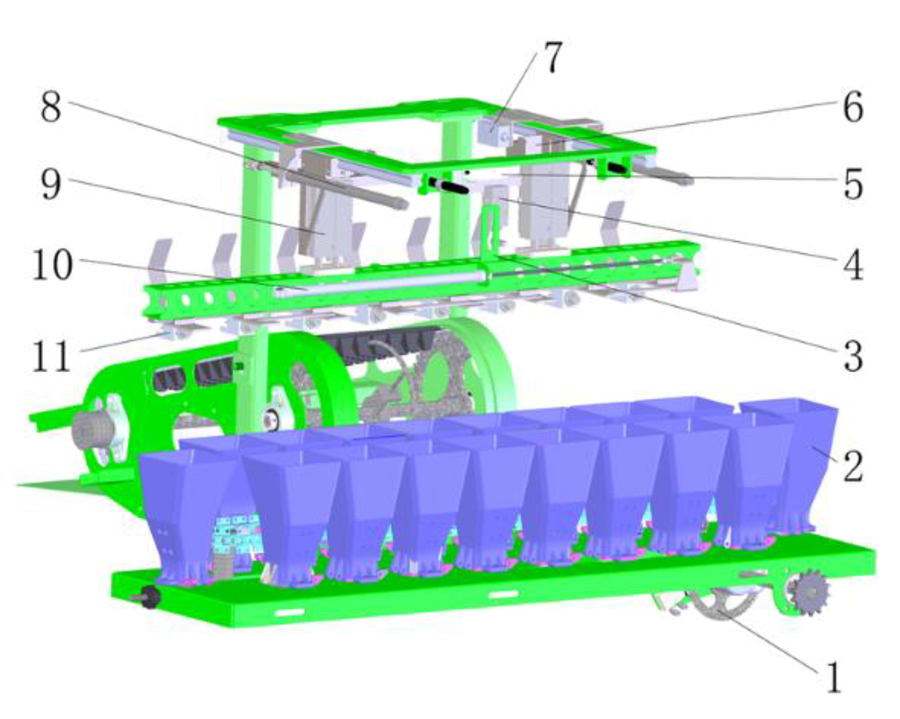 (1) Seedling feeding control device; (2) seedling cup; (3) stroke groove plate; (4) reversing valve V2; (5) reversing valve V1; (6) Mounting frame for the seedling picking gripper; (7) reversing valve V3; (8) longitudinal cylinder; (9) lifting cylinder; (10) transverse cylinder; (11) seedling picking gripper

 (1) Driving sprocket shaft; (2) driving sprocket; (3) ratchet device with variable step angle; (4) seedling supply cylinder; (5) seedling supply chain; (6) seedling supply push rod; (7) limit rod for the seedling tray; (8) driven sprocket shaft; (9) driven sprocket

 (1) Driving sprocket shaft; (2) seedling supply ratchet; (3) tension spring; (4) seedling supply pawl; (5) pawl rocker arm; (6) seedling supply cylinder; (7) rocker arm connecting rod; (8) rotating shaft for the seedling supply pawl; (9) variable-pitch tooth
 (1) Longitudinal cylinder; (2) lifting cylinder; (3) transverse slide rail fixed tube; (4) seedling picking gripper; (5) stroke groove plate; (6) transverse cylinder; (7) reversing valve DT1; (8) reversing valve DT2; (9) longitudinal slide rail; (10) fixed frame for the seedling picking gripper; (11) reversing valve DT0; (12) limiting plate for seedling separation; (13) seedling depositing baffle
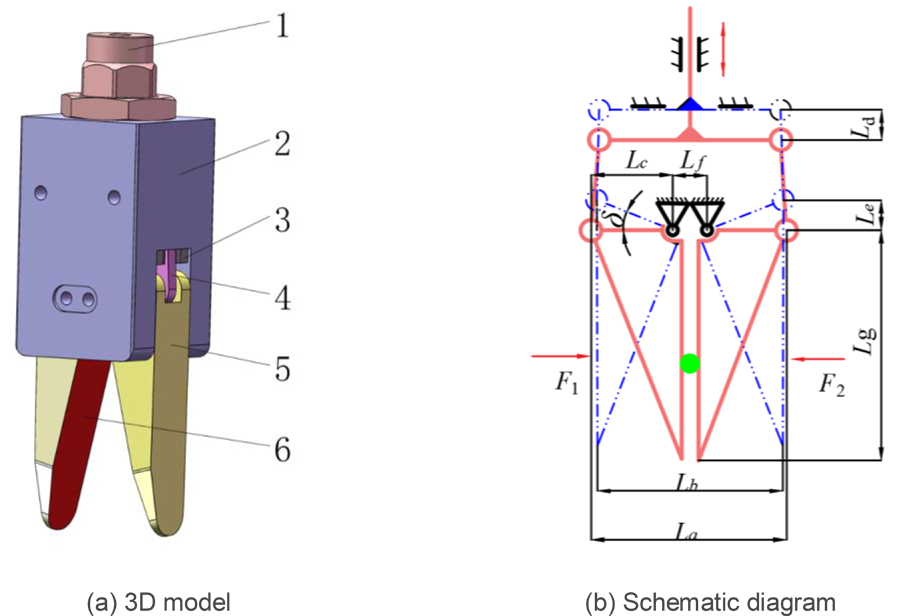 (1) Seedling cylinder; (2) fixed seat; (3) connecting block; (4) connecting rod; (5) clamping jaws; (6) area covered by flexible materialNote: The solid line represents the gripper state during picking, while the double-dotted line represents the state during the depositing of seedlings
 Note: S1~S3 represent the relationships between the movement of each part and the trigger position of the mechanical valve.


 (1) Picking and supply mechanisms for seedlings; (2) pneumatic filter/regulator unit; (3) speed control motor