| AUTOMATED DETECTION OF TMJ OSTEOARTHRITIS BASED ON ARTIFICIAL INTELLIGENCE |
Lee et al.,2020, Korea44 |
Retrospective |
314 (3,514 images) |
mean ± SD age, 39.5 ± 18.2 y |
CBCT |
to develop a diagnostic tool to detect condylar resorption from CBCT images with AI |
A single-shot detector (SSD)-a deep learning framework designed for object detection |
Accuracy, precision, recall, and F1 score |
additional imaging modalities, such as contrast enhanced MRI and bone scintigraphy, could provide more information with higher accuracy over TMJ's inflammation. |
Only 1 observer classified the TMJ images in the training data set. |
TMJ osteoarthritis on CBCT on adult patients |
The average accuracy, precision, recall, and F1 score over were 0.86, 0.85, 0.84, and 0.84, respectively. |
TMJOA from sagittal CBCT images is possible by using a deep neural networks model. |
| AUTOMATED SKELETAL CLASSIFICATION WITH LATERAL CEPHALOMETRY BASED ON ARTIFICIAL INTELLIGENCE |
Yu et al., 2020, Korea43 |
Retrospective |
5890 patients |
mean 25.4 y |
Lateral radiographs |
Propose a novel deep learning system that provides the fully automated, 1-step, end- to-end diagnosis for skeletal classification solely from the lateral cephalogram. |
A multimodal convolutional neural network architecture with a modified DenseNet with pretrained weights for the ImageNet data set |
Sensitivity, Specificity, AUC and Accuracy |
To optimize diagnosis, skeletal components and severity of the discrepancy should be evaluated in future studies. Also, further research comparing this system and the original approach with landmark detection and additional studies on enhancing model performance are needed. |
Data was collected from a single organization which may cause a selection bias |
Three different models to evaluate sagittal and vertical skeletal pattern of patients |
Sensitivity, Specificity, AUC and Accuracy for sagittal discrepancies were 93.55%, 96.77%, 0.965 to 0.991 and 95.70%, respectively. Sensitivity, Specificity, AUC and Accuracy for vertical discrepancies were 94.59%, 97.29%, 0.967 to 0.995 and 96.40% |
Skeletal classification can be made with an AI-aided tool for sagittal and vertical discrepancies |
| MACHINE LEARNING FOR IMAGE-BASED DETECTION OF PATIENTS WITH OBSTRUCTIVE SLEEP APNEA: AN EXPLORATORY STUDY |
Tsuiki et al., 2020, Japan45 |
Retrospective |
1389 patients (OSA = 867; control = 522) |
OSA = 49.7 ± 8.9 Control = 41.2 ± 13.0 |
Lateral radiographs |
test the hypothesis that a machine learning model could be used to differentiate severe OSA and non-OSA by 2-dimensional images |
DCNN model called Visual Geometry Group (VGG-19) |
Sensitivity, Specificity, Positive and negative likelihood ratio, Positive and negative predictive values and AUC area were evaluated for the three different groups |
By the combination of demographic characteristics, anthropometric features and lateral cephalometric images may provide different AI models that could contribute to detect OSA |
Data includes only Asian males from a single center |
If this DCNN model could be used to detect patients with OSA based on 2-D images using three different areas of interest: Original image, main region and head only |
Sensitivity, Specificity, Positive and negative likelihood ratio, Positive and negative predictive values and AUC area were evaluated for the three different groups: - Full image: 0.90, 0.77, 3.88, 0.14, 0.87, 0.82 and 0.89, respectively. - Main Region: 0.84, 0.81, 4.35, 0.20, 0.88, 0.75 and 0.92, respectively. - Head only: 0.71, 0.63, 1.91, 0.46, 0.85, 0.42 and 0.70, respectively |
The DCNN accurately identified individuals with severe OSA using lateral cephalometric radiographs |
| COMPARISON OF DEEP LEARNING MODELS FOR CERVICAL VERTEBRAL MATURATION STAGE CLASSIFICATION ON LATERAL CEPHALOMETRIC RADIOGRAPHS |
Seo et al, 2021, Korea42 |
Observational |
600 |
6-19 years |
Lateral radiographs |
evaluate and compare the performance of six state-of-the-art CNN-based deep learning models for CVM on lateral cephalometric radiographs, and implement visualization of CVM classification for each model using Grad-CAM technology |
Different CNN models (ResNet-18, MobileNet-v2, ResNet-50, ResNet-101, Inception-v3 and Inception-ResNet-v2) |
accuracy (1), recall (2), precision (3), F1-score (4), and area under the curve (AUC) values from the ROC curve |
Higher quality data and development of better CNN architectures may improve the model's performance. It would be easier to evaluate if cervical vertebrae were segmented from surrounding structures |
Small data |
If different CNN models can distinguish the CVM classification on lateral cephalometric radiographs |
Accuracy was higher than 90% for all models. |
Inception-ResNet-v2 showed the best results for all metrics |
| DEEP CONVOLUTIONAL NEURAL NETWORKS BASED ANALYSIS OF CEPHALOMETRIC RADIOGRAPHS FOR DIFFERENTIAL DIAGNOSIS OF ORTHOGNATHIC SURGERY INDICATIONS |
Lee et al., 2020, Korea25 |
Retrospective |
333 individuals |
23.1 ± 5.1 |
Lateral radiographs |
Create a model for the differential diagnosis of orthognathic surgery and orthodontic treatment with a DL algorithm using cephalometric radiographs. |
Three DL models were tested: Modified-Alexnet, MobileNet and Resnet50 |
Sensitivity, Specificity, AUC and Accuracy |
Future studies can be obtained when assessed with more data. Also, should analyze the impact of better model construction and their comparison with other models |
Comparison of the performance was limited due to the lack of data |
Differential diagnosis for orthognathic surgery based on cephalometric radiographs using three different DL models |
Modified-Alexnet: 0.852 (Sensitivity), 0.973 (Specificity), 0.969 (AUC) and 0.919 (Accuracy). MobileNet: 0.761 (Sensitivity), 0.931 (Specificity), 0.908 (AUC) and 0.838 (Accuracy). Resnet50: 0.750 (Sensitivity), 0.944 (Specificity), 0.923 (AUC) and 0.838 (Accuracy). |
DCNN can be applied to predict orthognathic surgery. Also it was possible to predict the most important diagnosis structures |
| DEEP LEARNING BASED PREDICTION OF NECESSITY FOR ORTHOGNATHIC SURGERY OF SKELETAL MALOCCLUSION USING CEPHALOGRAM IN KOREAN INDIVIDUALS |
Shin et al, 2021, Korea21 |
Observational |
840 (Class II:244, Class III: 477, Assimetry: 149) (Male: 461, Female: 379) |
23.2y |
Posterior and lateral radiographs |
Develop a deep learning network to automatically predict the need for orthodontic surgery using cephalogram. |
ResNet34, with convolution blocks stacked hierarchically (CNN) |
accuracy, sensitivity, and specificity. |
More studies should be encouraged to achieve public confidence. |
Involves only Korean patients from only one hospital and small number of cases. |
Exploited a deep learning framework to automatically predict the need for orthognathic surgery based on the cephalogram of the patients |
accuracy, sensitivity, and specificity were 0.954, 0.844, and 0.993, respectively |
DL can standardize the decision process and help orthodontists |
| DETERMINATION OF GROWTH AND DEVELOPMENT PERIODS IN ORTHODONTICS WITH ARTIFICIAL NEURAL NETWORK |
Kök et al., 2021, Turkey40 |
Retrospective |
419 patients (CVM1:70, CVM2:70, CVM3:69, CVM4:70, CVM5:70, CVM6:70 |
8 to 17y |
Lateral and hand-wrist radiographs |
Determine the growth-development periods and gender from the cervical vertebrae using the artificial neural network (ANN). |
Twenty-four ANN models were obtained and seven with success level and clinically applicable were selected |
Accuracy, Sensitivity, Specificity and F1 score |
Using all the information from cephalometric radiograph in addition to linear measurements can provide better results |
Hand-wrist age determination is more advanced than cephalometry and cervical vertebra. |
If the ANN models could determinate patient's cervical vertebral stage and gender. |
The accuracy for the testing set was: 71.4% (ANN-1), 49.2% (ANN-2), 76.1% (ANN-3), 50.7% (ANN-4), 69.8% (ANN-5), 81% (ANN-6), 90.4% (ANN-7), 90.5% (ANN-Gender) |
The growth-development periods and gender were determined from the cervical vertebrae by using ANN with satisfactory success |
| EARLY PREDICTION OF THE NEED FOR ORTHOGNATHIC SURGERY IN PATIENTS WITH REPAIRED UNILATERAL CLEFT LIP AND PALATE USING MACHINE LEARNING AND LONGITUDINAL LATERAL CEPHALOMETRIC ANALYSIS DATA |
Lin et al., 2021, Korea22 |
Retrospective |
56 patients |
T0: 6.3y and T1: 16.7y |
Lateral radiographs |
Determine the cephalo- metric predictors of the future need for orthognathic surgery in patients with repaired unilateral cleft lip and palate (UCLP) using machine learning. |
Boruta method to identify the most relevant features out of the cephalometric predictors at T0 and XGBoost algorithm to predict the future need for orthognathic surgery |
10-fold cross-validation accuracy with F1-score |
Multi-center study to increase the sample. |
Small sample size. |
The most important features of the cephalogram and the need for orthognathic surgery |
The prediction model had 87.4% accuracy and when ANB, PP-FH, CF and FCA variables are inserted |
At age of 6 years, it was possible to predict the future need for orthognathic surgery using cephalometric predictors with a good accuracy |
| INFLUENCE OF THE DEPTH OF THE CONVOLUTIONAL NEURAL NETWORKS ON AN ARTIFICIAL INTELLIGENCE MODEL FOR DIAGNOSIS OF ORTHOGNATHIC SURGERY |
Kim et al., 2021, Korea24 |
Retrospective |
960 patients (non-surgical: 640, surgical: 320) |
24.6 ± 4.9 |
Lateral radiographs |
investigate the relationship between image patterns in cephalometric radiographs and the need for orthognathic surgery, and report on a method for improving the accuracy of predictive models according to the depth of the neural network |
CNN models (ResNet-18, 34, 50 and 101) |
AUC, Accuracy, Sensitivity and Specificity |
Multi-center data to improve the model's performance. |
Single center study. |
Predict the need of orthognathic surgery using cephalometric radiographs |
AUC: 0.979 (ResNet-18), 0.974 (ResNet-34), 0.945 (ResNet-50), 0.944 (ResNet-101). Accuracy: 0.938 (ResNet-18), 0.936 (ResNet-34), 0.911 (ResNet-50), 0.913 (ResNet-101). Sensitivity: 0.882 (ResNet-18), 0.876 (ResNet-34), 0.806 (ResNet-50), 0.824 (ResNet-101). Specificity: 0.966 (ResNet-18), 0.966 (ResNet-34), 0.964 (ResNet-50), 0.958 (ResNet-101). |
ResNet-18 and 34 had better performance than ResNet-50 and 101 models. |
| ON CONSTRUCTION OF TRANSFER LEARNING FOR FACIAL SYMMETRY ASSESSMENT BEFORE AND AFTER ORTHOGNATHIC SURGERY |
Lin et al., 2021, Taiwan23 |
Retrospective |
71 patients |
- |
CBCT |
A CNN model with a transfer learning approach for facial symmetry assessment based on 3-dimensional (3D) features to assist physicians in enhancing medical treatments. |
CNN models (VGGNet16, VGGNet19, ResNet50 and Xception) |
Accuracy |
Larger number of data and more effective NN architectures can enhance the accuracy |
The model can only be used for small data sets and can't be trained by new DL architecture. |
Predict facial symmetry scores using the trained model. |
The accuracy for VGG16, VGG19, ResNet50 and Xception was: 80%, 86%, 83% and 90%, respectively. |
The most suitable model for the transfer learning was Xception model |
| PREDICTION OF HAND-WRIST MATURATION STAGES BASED ON CERVICAL VERTEBRAE IMAGES USING ARTIFICIAL INTELLIGENCE |
Kim et al., 2021, Korea31 |
Retrospective |
499 images from 455 patients |
9.9 ± 2.6 |
Lateral and hand-wrist radiographs |
Predict the hand-wrist maturation stages based on the CV images observed in lateral cepha- lograms, and to analyse the accuracy of the proposed algorithms. |
Various combinations of regression models were used |
Mean Absolute Error (MAE), round MAE, Root Mean Square of Error (RMSE) and Accuracy |
Further studies with a larger sample with na even distribution of sex, chronological age and skeletal maturation. More features can also improve the prediction accuracy. |
Small sample size and imbalanced data with a great number of patients whose SMI stage was 0. |
Patients hand-wrist maturation based on CV images and its accuracy. |
The final ensemble model consisted of eight machine learning models. The MAE, round MAE and RMSE were 0.90, 0.87 and 1.20, respectively. |
Chronological age and sex increased the accuracy. CV images can be used to predict hand-wrist SMI using machine learning. |
| USAGE AND COMPARISON OF ARTIFICIAL INTELLIGENCE ALGORITHMS FOR DETERMINATION OF GROWTH AND DEVELOPMENT BY CERVICAL VERTEBRAE STAGES IN ORTHODONTICS |
Kök et al., 2019, Turkey41 |
Retrospective |
300 patients |
8 to 17y |
Lateral radiographs |
determine cervical vertebrae stages (CVS) for growth and development periods by the frequently used seven artificial intelligence classifiers, and to compare the performance of these algorithms with each other. |
Seven algorithms were selected:k-nearest neighbors (k-NN), Naive Bayes (NB), decision tree, ANN, SVM, Random forest and logistic regression |
AUC, Accuracy, Precision, F1 score and Recall |
There are no author suggestions or recomendations for future studies. |
The author's did not mentioned any limitations over the study |
Use seven different algorithms to determine cervical vertebrae stages from cephalometric radiograph and compare their performance |
Decision tree had the highest accuracy for CVS1 to CVS4 (97.1%, 90.5%, 73.2%, 58.5%, respectively) and kNN for CVS5 (60.9%) and CVS6 (78.7%). ANN had the second-highest accuracy, except for CVS5. |
ANN is the preferred method for determining CVS because it was the most stable algorithm |

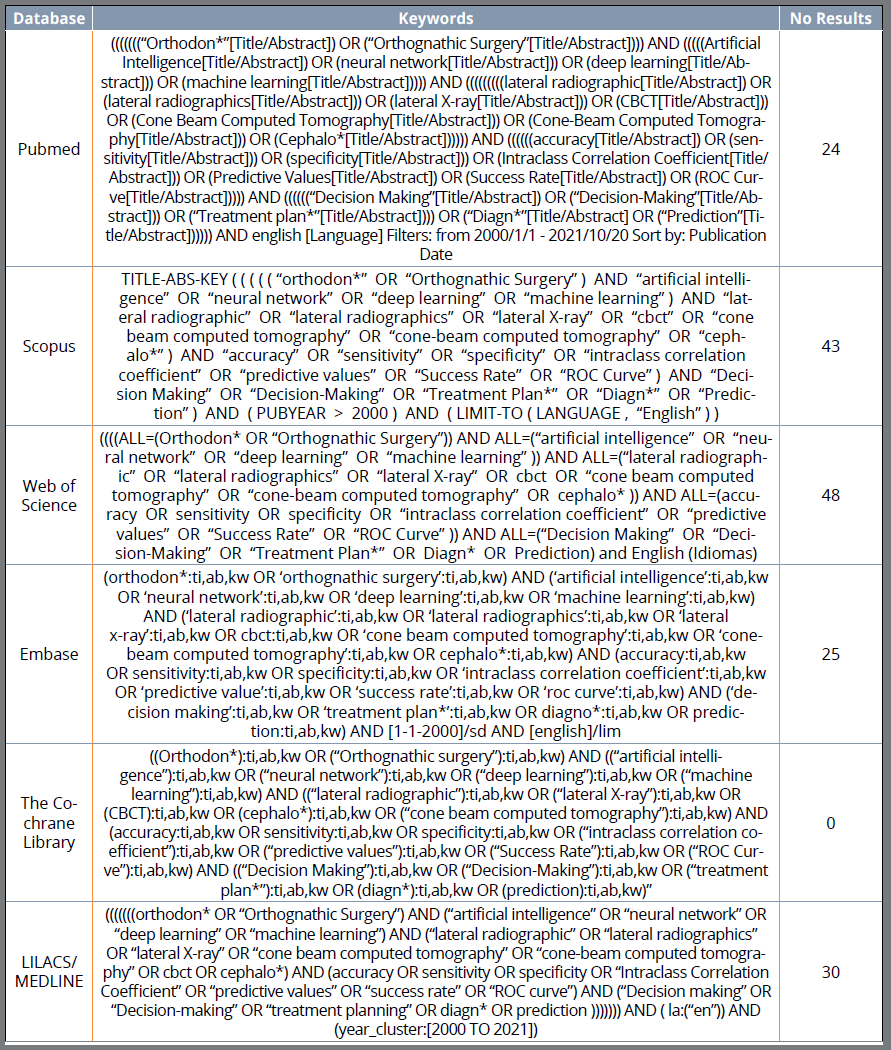
 Clinical decisions in Orthodontics using x-ray-based images and artificial intelligence approaches: a scoping review
 Thumbnail
 Thumbnail
 Thumbnail