 Is self-perception related to speech perceptual analysis measures in early- and late-onset Parkinson’s disease?
Dysarthria is prevalent in Parkinson’s disease (PD) and has negative effects on communication and social interaction. A gap exists in understanding whether patient-reported outcome measures can effectively identify speech disorders prematurely.
Objective: Compare the relationship between patients’ reported outcome measures and the speech objective outcome measure between early-onset (EOPD) and late-onset Parkinson’s disease (LOPD).
Methods: Thirty-nine participants diagnosed before age 50 (EOPD) and 32 diagnosed older than 50 (LOPD) were included. Self-perception was collected through the Radboud Oral Motor Inventory for Parkinson’s Disease questionnaire. The speech samples collected involved diadochokinesia (/pataka/) and monologue. Auditory perceptive analysis was performed through the degree of dysarthria and acoustic analysis of speech.
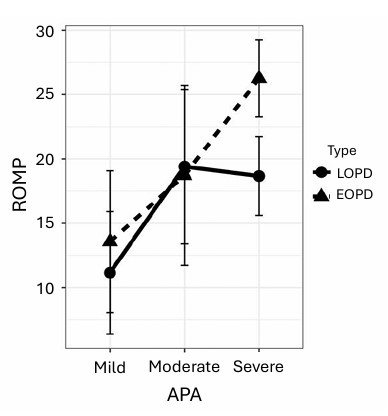
Results: Regarding speech characterization, there were also no significant differences in ROMP (p=0.462), degree of dysarthria (p=0.423), and acoustic variables. In EOPD, the ROMP self-perception scale was consistent with the degree of dysarthria assigned by professionals through perceptual auditory analysis. However, in LOPD, there were discrepancies when patients had a severe degree of dysarthria. Additionally, both groups had a positive and significant correlation between disease duration and the degree of dysarthria concerning ROMP
Conclusion: The results between clinical diagnosis of dysarthria and self-perception in the early and late onset groups showed no significant differences, indicating that self-perception may be a useful tool in identifying dysarthria.
Keywords
Parkinson Disease; Speech; Dysarthria; Speech Disorders; Self Concept
 Thumbnail