
 From language-specific perceptual strategies to phonetic drift: Perception of stops in L2 English and L1 Brazilian Portuguese
This study investigates interactions between L1-L2 phonetic systems at the perceptual level. Brazilian Portuguese speakers with English as their foreign language completed two listening tests in which they heard the same speech stimuli but were primed to perceive them as either English or Portuguese. The study examined whether listeners could shift perceptual boundaries along a voice onset time continuum from /b/ to /p/ as a function of perceived language context. The results indicate that phonetic boundaries (crossover points) and categorization sharpness (slope steepness) constitute distinct perceptual processes. For instance, evidence of phonetic drift was observed in L2 learners’ boundary locations in the perception of Portuguese stops, whereas no corresponding effects emerged for slope steepness. On the other hand, L2 learners exhibited language-specific slope patterns across Portuguese and English contexts, despite showing stable crossover points across modes. This asymmetry between boundary location and slope suggests that L2 learners attend to specific acoustic-phonetic cues that best support the differentiation of target-language categories. It also supports a view of speech perception in which L1 and L2 representations interact dynamically.
Keywords:
perception
;
second language
;
VOT
;
phonetic drift
 Thumbnail
 Thumbnail
 Thumbnail
 Thumbnail
 Thumbnail
 Thumbnail
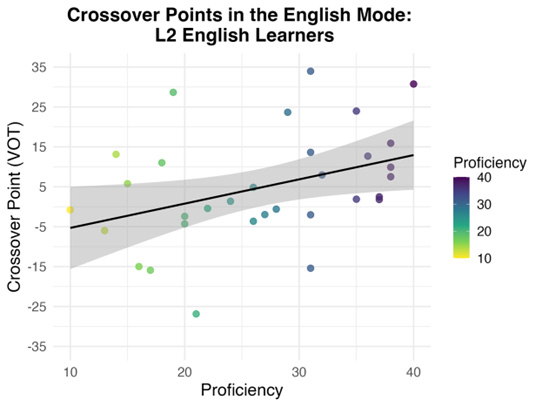 Source: Prepared by the author.
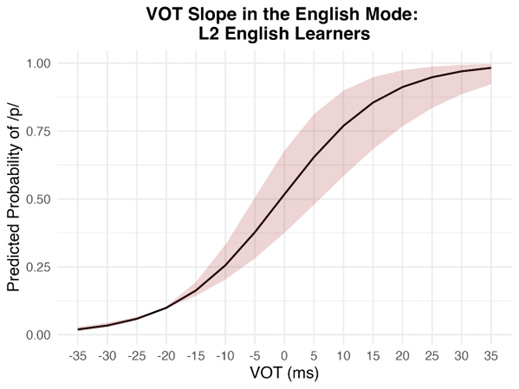 Source: Prepared by the author.
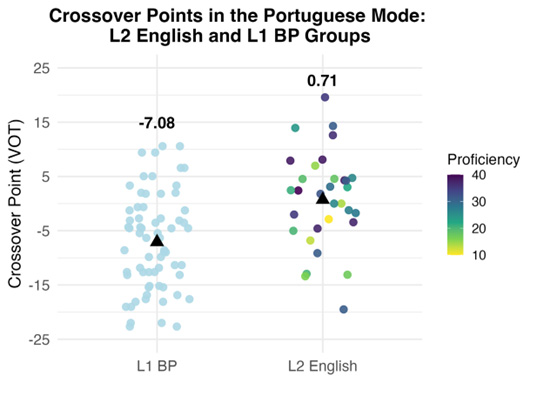 Source: Prepared by the author.
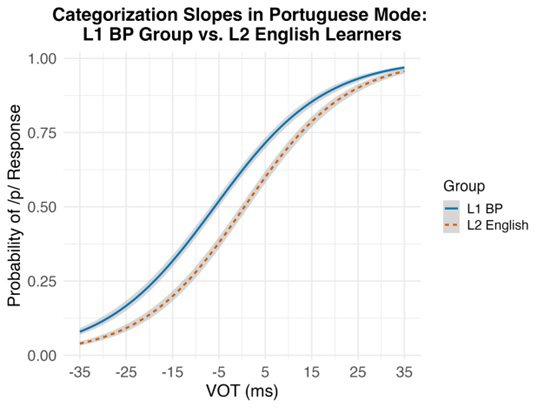 Source: Prepared by the author.
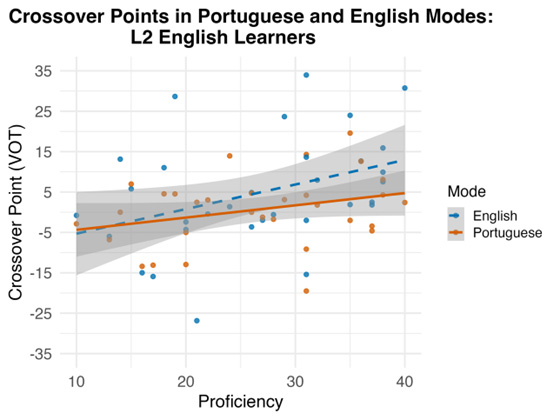 Source: Prepared by the author.
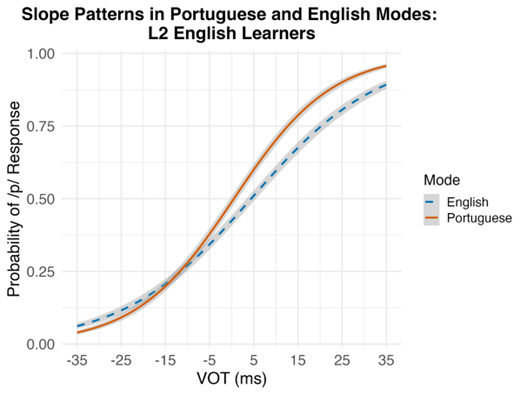 Source: Prepared by the author.