
 José Saramago’s reception in Türkiye: The case of Ensaio Sobre a Cegueira, Körlük
 Abstract
The Portuguese writer José Saramago has been very popular in Türkiye in recent years, especially with his dystopic novel Ensaio Sobre a Cegueira, Körlük in Turkish. The distance between Portuguese languages, literature, and cultures combined with Saramago’s distinct writing style, his atheism and communist worldview may make his positive reception in Türkiye seem somewhat unexpected. This paper aims to explain this phenomenon from a social psychological perspective by applying the social representations concept (Moscovici, 1988) to the reception of translated literature and relying on the netnographic method (Kozinets et al., 2014). The findings show that the success of Saramago and Körlük is not a coincidence but a result of trust and shared representations resulting from the interaction among the actors of reception, namely translation agents, professional and non-professional readers. The study also offers insights about how readers read translations and Turkish readers’ representations of translation and translators.
Keywords
reception; literary translation; social representations; Portuguese literature; Türkiye
1. Introduction
The Portuguese writer José Saramago is Portugal’s only Nobel laureate in literature, who published his first novel when he was 25 but had to wait about 30 years to be a fulltime writer. His oeuvre including novels, short stories, poetry, plays, chronicles and diaries have been translated into 48 languages while his works have been adapted into films, opera, picturebooks, and comicbooks. Saramago’s works deal with various themes such as human nature, religion, authority, death, among others. As he said in an interview, in his novels, he overturns the rocks to show what is hidden in plain sight (Saramago, 2005 as cited in Aguilera, 2010, p. 265). As a member of the communist party and an atheist, Saramago’s political and religious views caused him some troubles in Portugal and some of his works such as Memorial do Convento, Evangelho Segundo Jesus Cristo, In Nomine Dei among others were criticised by political and religious authorities, upon which he decided to leave his country in 1993 to spend the rest of his life in a Spanish island, Lanzarote.
José Saramago created most of his works in a unique style: long sentences, sometimes extending for pages, are connected through commas and separated only by full stops. His writing involves no other punctuation marks such as question or exclamation marks nor capitals for proper nouns. The conversations are embedded within long paragraphs without any speech marks, and the changes in turns are distinguished only through capital letters at the beginning of each new utterance. Saramago reported in various interviews that he wrote as people talked and in the way people told stories in the past. He thought that using punctuation would create obstacles in the natural flow of the narrative (Saramago, 1982 in Aguilera, 2010, p. 195). The commas and full stops in his works represent the natural short and long pauses we make when we talk. Hence, readers of Saramago’s works should read them as if they are narrated orally, hearing the narrator’s voice in their head.
The first book by Saramago published in Türkiye in 1999, a year after the Nobel prize win, was Todos os Nomes (translated into Turkish as Bütün İsimler) [both titles mean ‘all the names’]. Although the Nobel prize accelerated the introduction of his most known works into the target context, the publisher Gendaş actually bought the rights about six months before that upon the editor Ahmet Özer’s initiative originated from the rumours he heard from his European colleagues that Saramago could be awarded1. After the Nobel, Gendaş decided to share the rights with other publishers, hence four different publishers (Gendaş, Can, İş Bankası, Merkez/Turkuvaz) released the translations of 18 works until 2011. Since then, the current publisher Kırmızı Kedi has retranslated or reprinted the previous translations and continued to publish the remaining works of Saramago. Currently, most of his works including all of his novels, poetry, stories, a memoir, picturebooks, and blog-writings have been published while the remaining works (theatre plays, diaries, and chronicles) are scheduled to be published by the end of 2027.
This paper explores the Turkish reception of the novel Ensaio Sobre a Cegueira (Saramago, 1995) [Essay about blindness] because it has been Saramago’s most responded book in Türkiye2. According to The Association of Turkish Librarians, it became the most read book in 2023 (Hürriyet, 2024) and has appeared in some Turkish television series3 as an interesting read. For this purpose, I divided the reception study into two phases: primary reception and secondary reception. Primary reception is about the production of translations, that is, it is the study of the reception of a source text and its author by translation agents (editors, publishers, translators, and so on). Afterall, we cannot talk about the reception of translations without this first step. The reader-response to translations is a secondary reception because readers can only respond to them after foreign works pass through the filter of translation. Hence, the study relies on the peritextual analysis, i.e., the analysis of the elements that are physically attached to the text, such as covers, blurbs, prefaces, and notes (Genette, 1997), and textual analysis of the translations for the primary reception, i.e. production of translations, of Ensaio Sobre a Cegueira. The secondary reception, i.e. reader-response, study relies on data collected through a triangulation of netnographic methods (Kozinets et al. 2014): i) online archive research (books, theses, articles, reviews, BookTube videos) for professional reader4 responses; ii) a reader group interview, four individual interviews, and reader comments culled from online platforms such as an online bookstore (kitapyurdu.com), a book-logging platform (1000kitap.com), and Instagram for non-professional reader responses.
The study uses a social psychological approach to the reception of translations by employing Social Representation Theory (SRT)5. To explain briefly, SRT is a theory of social knowledge and meaning-making, and its aim is “focusing on everyday communication and thinking” and identifying “the link between human psychology and modern social and cultural trends” (Moscovici, 1988, p. 225). It highlights the role of interaction and communication in the formation of common knowledge or common-sense. Social representations can be defined as “ways of world making” (Moscovici, 1988, p. 230), “the ensemble of thoughts and feelings being expressed in verbal and overt behaviour of actors which constitutes an object for a social group” (Wagner et al., 1999, p. 96), and “modalities of knowledge” (Marková, 2008, p. 474) which can be in the form of opinions, knowledge, beliefs, images, and feelings. They formed through discourse that emerges when a group encounters a foreign object. Moscovici (1988) suggests that when an object looks like a representative of a common object in a group but consists of characteristics unfamiliar to the group, it is transformed by it to make it more familiar.
This transformation involves anchoring and objectification processes. The anchoring process involves naming and classifying unfamiliar concepts by relating them to familiar ideas and categories. Through anchoring, “a network of concepts and images” are transferred from one sphere to another, where it then serves as model” (Moscovici, 1988, p. 235). Objectification includes turning abstract notions of themata into concrete forms through symbols, metaphors, and personifications. These two processes are complementary to each other and the former always involves the latter (Marková, 2000 as cited in Liu, 2004). We can talk about four types of social representations: 1) Hegemonic representations are shared by a highly structured group such as a nation, party, or city and they reflect a society’s dominant understanding of a social object; 2) Emancipated representations result from the “circulation of knowledge and ideas belonging to subgroups that are in more or less close contact” (Moscovici, 1988, p. 224); 3) Polemical representations are created as a result of social conflict and controversy; in other words, they are determined by antagonistic relations (Moscovici, 1988); 4) Professional social representations emerge from the “unique relationship between representers and what is represented” (Morant, 1995, p. 3).
Social representations have been used in a few studies on translation and interpreting (cf. Gökce, 2018; Gökce Carvalho, 2021; Leanza et al., 2017; Lima, 2018) and recommended by Hokkanen (2020) to study how translators construct their opinions on source text authors and target text readers. This concept is used in this study to understand the factors influencing the ways foreign works are received by target readers departing from the following premises and hypotheses.
First, translation is a purposeful activity (Nord, 2018). It is through translation that foreign elements are introduced in a target context. Translation is an initiator of discourse among the receivers of the unfamiliar, starting the meaning-making process and creation of representations, and in the end, turning the foreign object into an object of the target context. Translations do not appear out of nowhere; instead, there is always “someone [who] finds themselves in the presence of a series of necessary elements” (Pym, 2012, p. 100). This includes “something to translate, a social reason to do so, ideas about the nature of translation, and the necessary time, space, money, and intellectual skills” (Pym, 2012, p. 100). Hence, translation is purposefully bringing a foreign object, a foreign text and author to the target context, an intentional ‘event’ (Harvey, 2014, p. 45) of making the unfamiliar familiar for a targeted readership. Translation agents, i.e., those who are responsible for making the unfamiliar text familiar for target readers, are producers and disseminators of knowledge with an agenda. This agenda may be ideological, aesthetic, financial, or combinations of these. Whatever the agenda is, the agents reframe (Faria et. al., 2023) the source text through (usually purposefully chosen) textual and paratextual solutions so that it can serve their agenda. Through the reframing process, translations create new representations or negotiate with the existing representations (and create trust or distrust through these processes) in the target context about a source text author and his works. The success of the reception depends on the chosen frames’ compatibility with the existing representations in the target context or the ability to change/reshape them.
Second, since target text readers interact with a foreign work and author through the filter of translation, their response is influenced by how translations are framed through paratextual and textual choices. However, this influence should be considered partial because readers’ meaning-making of texts is also influenced by their experiences (Iser, 1972, 1974) and by the interpretive communities (Fish, 1980) that readers belong to. Today, thanks to the technological advancements, readers are in contact with each other and these interpretive communities are much more far-reaching than ever. The digital platforms such as reading apps (e.g., Wattpad, Kobo), online booksellers (e.g., Amazon; Kitapyurdu in Türkiye), social media apps (Facebook, Instagram, YouTube, X (formerly Twitter)), and book-cataloguing websites (Goodreads, LibraryThing; 1000kitap in Türkiye) form social communities around texts as they enable many readers to interact with others regarding common interests without the restrictions of their social, cultural and economic background, gender or geographic location (Sedo, 2011). Thanks to these digital platforms, as Pianzola (2021, p. x23) highlights, we have access to millions of readers’ responses to books for the first time in history. Reading has always been a social activity, yet now, we read others’ comments before buying books on online bookstores, watch BookTube videos about writers and their books, publish photographs of the books we read on our social media accounts, share our own opinions and interpretations, follow Bookstagram accounts, and join in online groups related to books and literature on Facebook. A quick search on a new writer/book we come across produces numerous results and thanks to AI, they do not even have to be produced originally in the language we read.
Below, the findings of the primary reception study of Ensaio Sobre a Cegueira is followed by Turkish readers’ response to its translation, Körlük. The discussion offered afterwards offers a conceptualization of how readers read translations and a holistic view to the international reception of literature.
2. Methodology
The methodology of the study involves the triangulation of various data collection and analysis methods. First, I analysed the peritexts including the covers as well as copyright, title, and biography pages of the Turkish translations of Ensaio Sobre a Cegueira published by two different publishers: first by Publisher Can with the translation of Aykut Derman in 1999, and then by Publisher Kırmızı Kedi with the translation of Isik Ergüden in 2017. As paratextual elements, peritexts communicate comments on the text, present it to readers, and influence how it is received (Batchelor, 2018). The details of the covers in this corpus that may influence target readers’ reception (features such as colours, images, the placement and style of the author’s name, title, and translators’ names, and blurbs) were analysed from “the eye of a translator who is also a book buyer” (Mossop, 2017, p. 2).
The second step involved collecting data on the translation agents, i.e., publishers, editors, and translators, that took part in the primary reception of the novel. In this context, I obtained information from the editors through in-person meetings, email and WhatsApp exchanges. As for the translators, I had to rely on the information found in the peritexts and on the internet about the translator of the first edition since he passed away in 2022 and I could not reach him before. I obtained data from the second translator through a semi-structured interview that took place on Zoom on 26 October 2023.
The textual analysis consists of eleven excerpts taken from the first and second translations of Ensaio Sobre a Cegueira. The excerpts were chosen to be used in the reader interviews I conducted as part of the reader-response study explained below. The texts were selected randomly by comparing two translations without referring to their source texts and by finding the examples that offer a different reading as a result of lexical or grammatical choices, idiomatic, proverbial or vulgar expressions, and the existence or non-existence of footnotes. After selecting the excerpts, they were compared to the French translation as the source text of the first translation, and the Portuguese source text. This comparative analysis serves to identify the factors that may influence reader response.
The reader-response data include responses from professional readers including academics, reviewers, and BookTubers, and non-professional readers. The data on the response of academic readers was collected through the Turkish scientific journal database DergiPark6 and the national dissertation database7. The responses from the reviewers were collected through online research. I downloaded the articles/magazines I could find through Google searches; I also found issues of literary magazines and newspaper supplements sold on the online second-hand bookstore ‘nadirkitap.com’, bought the issues and scanned relevant pages. The second type of reviews consists of videos on Saramago’s works created by Turkish BookTubers to which I resorted upon hearing from some non-professional readers at the interviews that they follow certain BookTube channels to learn about the authors, books, and hear different perspectives about what they read. I selected 16 videos focusing on the Turkish translation of Ensaio Sobre a Cegueira. The videos were chosen randomly from those that appeared on the page after I had written ‘Saramago Körlük özet analiz’ [Saramago Körlük (Turkish title of the book) summary analysis] in the search bar and under the condition of including comments on the book (videos just summarising the book are not included) and having a minimum of 500 viewers. The video corpus consists of one video published in 2017, two videos in 2019, six videos in 2020, five videos in 2021, one in 2022, and one in 2023.
Finally, non-professional reader responses were collected from various sources. First, I prepared and disseminated an exploratory Google survey which includes multiple-choice and open-ended questions as well as some questions using a Likert scale8 on online platforms, which yielded fruitful insights regarding the general tendencies and opinions of the respondents. The survey aimed to discover who reads Saramago’s books, which books are read the most, and readers’ general opinions about Saramago’s books and translations. It was disseminated during the COVID-19 quarantine in July and August 2020 using various methods: inserting the link of the survey as a comment under the posts about Turkish translations of Saramago’s works found on Instagram; sending messages to the Turkish Facebook pages or groups related to books or literature; and publishing it as a post on my private Facebook and Instagram accounts. As a result, 69 responses were received between 10 July 2020 and 24 December 2021 (55 in 2020 and 14 in 2021).
The second data type come from an online group interview and four individual interviews. An online reader group interview took place with four participants and was recorded on the videoconference tool Zoom on 30 July 2021. The recording of the session lasts for an hour and 40 minutes. Two male and two female readers with an age range between 18 and 45 participated in the meeting. The participants for individual interviews were recruited by writing an invitation as a comment under the posts about Körlük on the social media application Instagram. I found the posts by writing the book’s name in the search bar and chose the first hits that appeared, which were the most recent posts, assuming these Instagrammers must have read it recently and would remember more details about the book. After sending 46 invitations this way, I found four readers willing to do a Zoom session with me. The interviews were conducted on 29 and 30 May, and 4 June 2022 and lasted 32:40, 41:07, 56:55, and 1:11:15, respectively. Both group and individual interviews had two parts. The first part of each session consisted of semi-structured questions about demographic information, reading habits, the interviewee’s opinions about the author and the book Körlük as well as their use of Instagram to share posts on books. In the second part, through a PowerPoint presentation, I showed the participants the selected excerpts mentioned above and asked them to make comments about each.
The third type of data in the same category involved the collection of readers’ comments on Körlük via online social platforms, including an online bookstore, a book-cataloguing platform, and the social media application Instagram. On the online bookstore Kitapyurdu, the users left 242 comments for the first translation between November 2001 and July 2022, while 5298 comments were left for the second translation between May 2017 and November 2022, hence the analysis covers reader reviews left on the platform during 21 years. The book-cataloguing social network 1000kitap was founded in 2012 in Türkiye. On the platform, the readers mark on their profile the books they have read, or they want to read. While doing this they can also add reviews about books and evaluate them with points from 1 to 10. In this manner, a profile page emerges for each writer and each book. All information including comments and reader profiles is accessible on the platform without signing up or logging onto the website.
According to the information on the website, Körlük is marked as ‘read’ by more than 90 thousand people and as ‘to be read’ by 39 thousand. At the time of the access to the website, 4243 readers were currently reading the book, and 25.5 thousand readers gave it 8.5 points out of 10. Since the structure of this website did not allow me to register all the comments in a chronological order, I decided to choose my sample according to the systemic sampling principle (Saldanha & O’Brien, 2013) by collecting only the longer comments that open in a new page for two days, specifically on 21 and 22 March 2023. As a result, I collected 48 comments left by readers between April 2017 and March 2023. The number of comments according to years is 1 in 2017, 2 in 2020, 8 in 2021, 23 in 2022, 14 in 2023. Finally, on Instagram, I searched for the posts using the hashtag #körlük, the title of the book in Turkish. The hashtag search gave 24,993 results on 28 April 2023. This number includes everything related to the concept of blindness, and it is impossible to study all posts in order because, in the event of leaving the page for any reason, such as a technical glitch or lack of battery, the search needs to start from the beginning. Therefore, I limited my sample to 100 posts based on the convenience sampling principle (Saldanha & O’Brien, 2013). Nevertheless, I applied three criteria while selecting the posts for analysis: 1) The post must be only about the book; 2) The post must include a genuine comment from the Instagrammer other than the information about the theme, the author, and/or the photo of the book; and 3) the post must have some interaction through likes and comments. As a result, I collected 100 posts shared on the platform by different users with public accounts between 28 December 2022 and 25 April 2023.
Thematic analysis was used to analyse the secondary reception data to find the representations of José Saramago and his works as well as the representations of translation and translation agents among José Saramago readers in Türkiye. The identification of the themes appearing in academic works, newspaper and magazine reviews, YouTube videos, the questionnaire, and the interviews was completed manually because the number of responses and the volume of the data were not large. Nevertheless, I needed to use the qualitative data analysis tool NVivo to processes the reader comments collected from online social platforms. The analysis of all types of data involved first getting familiar with the content through reading, and the identification of recurring themes. The data processed through NVivo were coded in three categories: general, agents, and themes. The category ‘general’ consists of general features of the comments such as positive or negative tone of the comments, references to readers’ familiarity with Saramago’s works, to other readers, to the movie adaptation, to the Nobel Prize, and so on. The category ‘agents’ includes references to translation agents including publishers, editors, and translators. Finally, the category ‘themes’ consists of references to readers’ opinions, perceptions, feelings about the novel. The codes created on NVivo were refined after the identification of themes through the manual analysis of previously mentioned documents, interviews and the questionnaire.
3. Findings
3.1. Ensaio Sobre a Cegueira in Turkish
Published in 1995, Ensaio Sobre a Cegueira is one of the most known works of José Saramago. It is a story of an unknown place where everyone loses their sight mysteriously in a short time. At first, the government quarantines anyone who goes blind in an old madhouse, but soon everything gets out of control when there is no one unaffected by the epidemic, except a woman. The novel explores and criticises the concepts of power, human dignity, civilisation, authority, morality among others by describing the dire conditions of the quarantine and narrating the survival story of people through seven main characters. Besides consisting of no proper names for places or people, the novel is written in Saramago’s trademark style described above. It has been translated into many languages, and it was adapted to a movie, Blindness (2008), and the opera Die Stadt der Blinden (2011).
Ensaio Sobre a Cegueira has been translated three times into Turkish. It was first published in 1999 by the publisher Can. A new translation was published by the publisher Kırmızı Kedi in 2017. Kırmızı Kedi published another retranslation in 2023, but this last translation is not included in the analysis as it was proofread by me.
The sale numbers show the translations’ success in Türkiye. According to the information on the publisher Can’s website, they released 31 reprints between 1999 and 2015, usually with 1000 but in some years with 2000 and 3000 copies. On the other hand, the second translation published by Kırmızı Kedi made 37 reprints between May 2017 and June 2022, which means the new version sold more in five years than the first one did in fifteen years. The sale numbers obtained from Kırmızı Kedi (Table 1) show that the sales doubled in the second year of its release, peaked in 2020 when it gained popularity as an example of pandemic literature. The number started to fall the following year but never fell below its first-year sales figure.
Below the analysis of the paratexts of the two translations is followed by a textual analysis of a selected excerpt.
3.1 .1 First translation: Can Edition
The first edition was translated from French by Aykut Derman (1942-2022). Derman graduated in French Language and Literature at the University of Istanbul and later worked as a lecturer at the Yıldız Technical University. He translated up to 70 books from various authors including Gaston Bachelard, Fernand Braudel, Françoise Balibar, Milan Kundera, Paulo Coelho, İsmail Kadare, Michel del Castillo, and Alina Reyes.
The title of the translation has lost the ‘essay about’ part and it is entitled Körlük (blindness). The same is observed in the first translation of Ensaio sobre a Lucidez, Görmek (seeing), also translated by Derman. The reason for this omission seems to be an influence of indirect translation from the French editions, L’aveuglement and La Lucidité. The same titles are still in use today, even after two retranslations. The reason for this is the fact that the novels became known with these titles not only in the Turkish context, but also in the English-speaking world as Blindness and Seeing, especially after the 2008 film adaptation Blindness, the influence of which on packaging is shown in the analysis of Kırmızı Kedi edition’s packaging.
The publisher Can did not create special covers for Saramago books. Instead, they were published with Can’s well-known white covers usually with stock images in a square placed on the bottom half of the cover. Saramago’s name is written at the top in block capitals, but its font is smaller than the title Körlük. As shown in Figure 1, Can changed the front cover images three times and back covers four times. The Nobel Prize is only placed at the top of the second front cover, but it is mentioned in capitals on all back covers. The translator’s name is placed below the cover image on all versions. The number of reprints is indicated on the front covers as well.
Can’s first cover includes a coloured picture of people wearing sunglasses standing up and looking in different directions. I discovered that this image consists of the half of the cover image of the French translation, which proves its influence as the mediating text (Figure 1 and 2). In the second cover image, there is a man’s head with his hands covering his eyes. The black and white image cues the man’s unwillingness to see. In the third image, we see half of a woman’s body. Her one hand is extending outwards, not like a blind person trying to find their way with their hands but as if she wants to block the light that makes her unable to see.

While the first cover is reminiscent of the physical blindness that is the explicit theme of the novel, the other two have a more symbolic relationship with the implicit themes of the book. This may lead to interpretations such as people not wanting to see the truth or being blind when faced with knowledge or a moment of enlightenment.
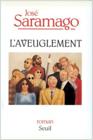
Figure 3 shows the back covers of Can editions where Saramago’s photograph was added as of the second from the left, and on the final cover (on the extreme right), there is a note introducing Saramago: “The great Portuguese novelist José Saramago is among the unforgettable not only for his unique literary works but also for his political personality, which bears the responsibility of an intellectual9” (My translation). In the blurb, the novel is introduced as the most impressive book that Saramago had written in recent years (this note was removed from the other covers). Along with the theme of the novel, the following excerpt also emphasises Saramago’s importance as a writer, describes his style and offers an interpretation which suggests that Körlük is a criticism of liberal democracy.
In this striking novel, José Saramago, the most important writer of Portugal alive, has used the phenomenon of blindness as a metaphor, without resorting to simple images and ordinary puns, with an intense narration, transforming the conversations of the narrator and the protagonists into a common monologue, and without naming the people in order to universalise the fiction, he created with extraordinary mastery the unhealthy environment into which liberal democracy has dragged people10 (My translation).

The other peritextual elements in this edition include short biographies of Saramago and the translator Derman, a copyright page including information about the international copyright agency and about the first publication date of the translation and print numbers, a title page including the translator’s name, and two footnotes. One of these footnotes was added by the translator to explain a biblical reference while the second one was added by the editor to give the Turkish meaning of a Latin phrase left untranslated in the text.
3.1.2 Second translation: Kırmızı Kedi edition
Kırmızı Kedi released Körlük with a new translation by Işık Ergüden. Ergüden has translated about 250 books mostly from French. He confirmed that he translated the book from Portuguese as the publisher requested to use and be faithful to the Portuguese source text11. According to his statement, Ergüden has passive knowledge of Portuguese language. He views translation as ‘hosting a guest’ and prefers being loyal to the author, reflecting the source text’s style and its foreignness with the means of the target language.
Kırmızı Kedi created a special design with a specific colour used for Saramago books. In these editions, the cover elements, such as the title, Saramago’s name, the image, etc. are always the same and occupy the same space in all-yellow covers, with which now Saramago’s books are known in Türkiye. Kırmızı Kedi may have been inspired by the earlier editions published in Portugal and Spanish released with a similar colour. At the top of the cover (Figure 4), we see the mention of the 1998 Nobel Prize. Below it, Saramago’s first name is written in block capitals, while his surname is placed under it in a larger font. The novel’s Turkish name Körlük is written in red capital letters, smaller than Saramago’s name. The translator Ergüden’s name is placed at the bottom left of the front cover. The reprint number is also mentioned on the cover.
The cover image of Kırmızı Kedi’s edition (Figure 4) features silhouettes of seven people, whose appearances enables us to identify three men, three women and a child, lined up from the eldest at the beginning to the youngest at the end. The old man at the beginning of the line holds a walking stick, and the others extend their arms to the person in front of them. The colour of the image has been changed from black to silver in the new retranslation.
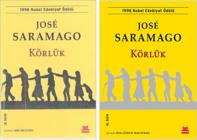
This cover image seems to be adapted from the covers of the Portuguese and Spanish editions of the novel published after the release of the movie adaptation. As seen in Figure 5, the original image is actually a scene from the book where the group of seven try to find a shelter in the city after leaving quarantine.

On the cover image of the Portuguese edition on the right, which represents a scene from the movie (Figure 5), the doctor’s wife leads the group at the beginning as she is the only one who has sight, then comes the doctor, the old man, the first blind man, his wife, the girl with dark glasses, and the little boy. The image on the covers of the Portuguese edition on the left and the Spanish edition in the middle (Figure 5) have a slightly different order where the girl with dark glasses and the little boy are lined up after the doctor, then the old man, the first blind man and his wife, as this is the way they are lined up in the book. Kırmızı Kedi’s cover image eliminates the leader status of the female protagonist while evoking a life-cycle-like story with the arrangement of characters from the old to the young.
The back covers of Ensaio Sobre a Cegueira’s Kırmızı Kedi editions changed over the years (Figure 6). The first edition included Saramago’s photograph with a long summary of the theme accompanied by a paragraph of editorial comment. The long summary in the first two versions include a sentence saying that the world described by Saramago ‘symbolises the dark side of humans’. The summary including this sentence was removed from the latest version maintaining only the editorial comment which, after praising the author, highlights the movie adaptation and emphasises the role of the female protagonist.

Perhaps the most impressive work of the master writer, Körlük, which was also adapted to the cinema, reveals with great detail how social life can turn into a savagery, and it has taken its place among the unforgettable works while exhibiting the last shred of hope for humanity with the example of solidarity and resistance organised by a woman alone12.
As for other peritexts, this edition does not include any footnotes or translator’s note, but it does include a note behind the title page that the publisher was ‘faithful to the author’s unique writing style in this book’13. Besides this, the edition also includes Saramago’s and the translator Ergüden’s short biographies, a copyright page including the information about the copyright agency and previous translation in Turkish. This translation is marked as ‘new translation’. The title page also includes the translators name besides the title and the author’s name.
3.1.3. Textual analysis
This part shares the general findings of the analysis of the eleven excerpts mentioned before. The comparison of the Turkish target texts with their source texts, i.e. the mediating French translation and the Portuguese original, reveals interesting findings. First of all, we can observe in Table 2 that Turkish target texts include fewer words in most of the examples compared to their source texts. This can be explained with the distance between the languages, in that, as an agglutinative language, in Turkish, most linguistic components are expressed through suffixes added to word roots, which results in lesser word counts compared to inflected languages such as Portuguese and French. What is interesting is that the first translation is much shorter than the second one in most cases.
It is significant to note that all Turkish translations of Saramago’s works since the first edition kept his trademark style. This is observed not only in the macrostructure of the translations but also in the few notes written about translator’s and publishers’ faithfulness to Saramago by some of his Turkish translators, in my communications with the editors and translators as well as in the before-mentioned note in Kırmızı Kedi editions stating that his style was maintained in the translations.
It is not possible to analyse all excerpts in this limited space, hence the texts below (Excerpt 2 in Table 2), taken from the Portuguese original and from the translations in French and Turkish, are copied here to exemplify the way source and target texts differ.
Portuguese original:
Quanto a nós, permitir-nos-emos pensar que se o cego tivesse aceitado o segundo oferecimento do afinal falso samaritano, naquele derradeiro instante em que a bondade ainda poderia ter prevalecido, referimo-nos o oferecimento de lhe ficar a fazer companhia enquanto a mulher não chegasse, quem sabe se o efeito da responsabilidade moral resultante da confiança assim outorgada não teria inibido a tentação criminosa e feito vir ao de cima o que de luminoso e nobre sempre será possível encontrar mesmo nas almas mais perdidas. Plebeiamente concluindo, como não se cansa de ensinar-nos o provérbio antigo, o cego, julgando que se benzia, partiu o nariz. (p. 26)
French translation:
Quant à nous, qu’il nous soit permis de penser que si l’aveugle avait accepté la deuxième offre du finalement vrai faux Samaritain en ce dernier instant où la bonté aurait pu encore prévaloir, nous nous référons à l’offre de lui tenir compagnie en attendant l’arrivée de sa femme, l’effet de la responsabilité morale résultant de la confiance ainsi octroyée eût peut-être inhibé la tentation criminelle et fait affleurer la luminosité et la noblesse que l’on peut toujours trouver même dans les âmes les plus égarées. Pour conclure sur une note plébéienne, comme ne se lasse pas de nous l’enseigner le proverbe ancien, en fuyant le loup l’aveugle a rencontré la louve. (pp. 35–36)
Turkish translation (TR1):
Bize gelince, kör adam, hem gerçek hem de sahte iyiliksever Samaralının(1) kendisine son anda yaptığı ikinci öneriyi kabul etmiş olsaydı – ki bu durumda iyilik yapma isteği ağır basabilirdi–, yani karısı gelinceye kadar yanında kalmasına izin verseydi, kendisine bahşedilen güven duygusunun sağlayacağı ahlaki sorumluluğun etkisi, onun suça eğilimini dizginler, böylelikle de en sefil ruhlarda bile her zaman rastlayabileceğimiz parıltıyı ve soyluluğu yüzeye çıkarırdı, diye düşünmemize izin verilmesini rica ediyoruz. Sonuç olarak, Pleblere özgü eski bir özlü sözün bize öteden beri bıkıp usanmadan öğrettiği gibi, kör adamın erkek kurttan kaçarken dişi kurda yakalandığını söyleyebiliriz. *(1) İncil’de adı geçen iyiliksever kişi (Ç.N.)14.
Turkish translation (TR2):
Bize gelince, kör adam, sonuçta sahte iyilikseverin ikinci teklifini kabul etmiş olsaydı – ki o son anda adamın iyilik yapma isteği ağır basabilirdi –, yani karısı gelinceye kadar yanında kalmak teklifinden söz ediyoruz, bu şekilde bahşedilen güvenin sonucu olan ahlaki sorumluluğun etkisinin onun suça eğilimini dizginleyip dizginlemeyeceğini, böylelikle de en sefil ruhlarda bile her zaman rastlanabilecek parıltıyı ve soyluluğu yüzeye çıkarıp çıkarmayacağını kimse bilemez. Bir halk deyişiyle sonlandırırsak, kadim bir atasözünün bize bıkıp usanmadan öğrettiği gibi, bizim kör, istavroz çıkaracağım derken gözünü çıkarmıştı15.
The divergences between the two Turkish translations usually result from the influence of the French mediating text on TR1, in other words, in these cases, both deviate from the Portuguese source text. Most of the time TR1 is a literal translation of the French which is a close rendition of the Portuguese source text except for the idiomatic and proverbial expressions. For instance, the Portuguese proverb ‘julgando que se benzia, partiu o nariz’ at the end of the excerpts above was translated with a cultural equivalent in the French text which was copied in TR1. In TR2 the Portuguese proverb was partly adapted. None of the solutions in TR1 and TR2 exist in Turkish language, yet they both sound familiar and remind of two different expressions in Turkish. For example, the expression ‘erkek kurttan kaçarken dişi kurda yakalanmak’ (getting caught by the female wolf while escaping from the male wolf) in TR1 evokes the Turkish expression ‘yağmurdan kaçarken doluya tutulmak’ (getting caught to the hail while escaping from the rain) which means to find oneself in a worse situation while trying to escape from a difficult situation. On the other hand, the expression ‘istavroz çıkaracağım derken gözünü çıkarmak’ (removing one’s eye while crossing oneself) in TR2 evokes the expression ‘kaş yapayım derken/yaparken göz çıkarmak/çıkartmak’ (removing the eye while making (trying to make) an eyebrow) which means to make things worse while trying to correct something.
Nevertheless, the faithfulness of TR1 to the mediating French text causes a wordier translation and sometimes awkward sounding expressions in Turkish. The foreignness of the text is also more apparent in this translation due to the presence of copied words/structures and the translator’s presence through the footnotes. This is observed, in the given excerpt, in the translation of the words ‘samaritano’ and ‘plebeiamente’ which are copied in TR1 (while the former is explained in a footnote) and rendered through omissions and cultural correspondences in TR2. The second translation deviates more from the Portuguese original but sounds more natural and familiar in the target language. The translator’s strategy of drafting the first target language text based on the source text and then rewriting the draft without referring to the source text until he is satisfied with the translation might have caused him to be more independent from the Portuguese source text.
Interestingly, TR1 and TR2 are similar in terms of translation solutions in some cases where various possible solutions exist in Turkish. As an example from the excerpts, the phrase “naquele derradeiro instante em que a bondade ainda poderia ter prevalecido” is translated through resegmentation and similar wording in both Turkis translations (“– ki bu durumda iyilik yapma isteği ağır basabilirdi–” in TR1 and “– ki bu durumda iyilik yapma isteği ağır basabilirdi–” in TR2). This makes one wonder whether the agents of the second translation referred to the first translation at any point. However, the translator claimed not to have read the previous Turkish translation nor to have used other source texts. Finally, some perspective differences between the Turkish target texts and some ambiguities shown in the examples might have resulted from a misunderstanding of the source texts. To illustrate, the phrase ‘nas almas mais perdidas’ was translated similarly in both TR1 and TR2 with the phrase ‘en sefil ruhlarda’ (in the most miserable souls) while the phrase was translated literally in the French translation, i.e., ‘dans les âmes les plus égarées’.
3.2. Reader-response to Körlük
As mentioned before, Turkish readers’ response to Saramago’s works were studied through a triangulation of various methods. The data has shown that Saramago’s Turkish readers became familiar with the Portuguese writer and his works, but mostly with Körlük, through other readers. More than five thousand comments on the online bookstore Kitapyurdu, thousands of entries on the book-logging platform 1000kitap and posts on Instagram as well as the interviews I conducted within the scope of this research revealed the influence of interaction among readers on their decision to read Saramago’s books and their interpretation of Körlük. They recommended books through their comments and posts on online platforms, made comments on others’ comments, watched BookTube videos and made Google searches about Saramago. Most of the reader comments are about the second translation, and they reflected the success of the yellow covers with which Saramago’s works are published by the current publisher Kırmızı Kedi, as now many readers associate them with Saramago.
The most mentioned theme found in the reader-responses was the style of the book which was praised for its uniqueness despite the complaints that it is difficult to read at first. It was interesting to observe that most readers defended the writing style found in translations in their comments, teaching those making negative comments about this that it is how Saramago wrote his works and not a translation or editorial mistake. This showed representations of translation and translators among the readers. That is, in general, readers trusted in the translation through their trust in the publishers, not in translators. Instead, the survey and interview findings revealed that Turkish readers think that complete equivalence between source and target texts is not possible, and translators tend to add their own interpretations while creating target texts. I will return to this topic later when I elaborate more on how Turkish readers read Körlük.
Other most mentioned themes revealed representations about Saramago as a writer. The findings regarding Saramago’s general reception have shown that Turkish readers’ responses to his works have been significantly positive. He is described as a skilled and important writer. His criticisms of authority and politics are well received because people seem to be able to relate with him either through the historical experiences with politics and governments within Türkiye or through Saramago’s opinions on European Union and Israeli-Palestinian conflict. On the other hand, his religious criticism and atheism are not seen as a threat by most Turkish readers because he is either seen as a knowledgeable person in religious matters or as a critic of religions other than Islam. The first representation as a knowledgeable writer in religious matters extends in a way that some readers relate Körlük with Islamic teachings and myths. For example, some BookTuber reviews on Körlük and their viewers come up with some interpretations that involve the myth of Seven Sleepers16.
The reviewers mentioning the similarity between the seven protagonists and their dog and the characters of this Anatolian myth involving antique Christians refer to the Koran and some verses about it. Some BookTube reviews refer to the similarities between Koranic verses about those who cannot see the realities and the metaphor of blindness in Körlük. These reviewers claim that their interpretations based on Islamic resources make sense because, according to them, Saramago knew about different religions, and he would know about Islamic and Anatolian references and may have used them in his novels. Although non-professional reader comments about Körlük on online platforms do not consist of mentions about religious associations, one emerges in the individual reader interviews. In this example, the interviewee cites the same association with the myth of Seven Sleepers and says that she has found proof of the existence of the God and his prophets in Körlük. Nevertheless, this interviewee knows that Saramago was an atheist. According to her, Saramago unintentionally proves the existence of God and the prophets in Körlük, while trying to convince readers to the contrary.
Other readers tend to see Saramago more as a philosopher. Both professional and non-professional readers associate the novel Körlük with various philosophical and social themes. In the academic papers, the novel is discussed within the frameworks of different philosophical perspectives such as Hobbes and Spinoza’s philosophies, Lacan’s gaze and Real, Bentham’s panopticon prison, and Plato’s cave. Plato’s cave allegory also appears in BookTuber reviews. However, these themes do not appear in non-professional reader responses. Nevertheless, the novel’s more obvious themes such as social criticism, criticism of moral values, representation of endless hope, the evil in the human nature, humans’ need for authority appear in both professional and non-professional responses to the novel.
Another frequently mentioned theme by readers was human behaviour during pandemics and catastrophes. While some academic works, and reviews published after the COVID-19 pandemic began representing the novel as an example of pandemic literature, non-professional readers associate their own experience during the lockdown with the characters’ experiences. Other real-life catastrophic experiences such as major earthquakes and wars are also associated with the novel in terms of human behaviours in such situations. The importance of resistance and solidarity in difficult situations is another theme that appears both in professional and non-professional responses. It has been found that the fact that there are no names in the novel makes it easier for readers to relate to, universalising the themes of the novel. The blindness outbreak in the novel is usually interpreted as a metaphor used by Saramago to reflect the realities in today’s world; however, some readers also take it literally as a representation of blindness as a disability. In this context, the blindness theme is usually associated with empathy with the blind and acknowledging the importance of sight.
The female protagonist, the doctor’s wife as the only person who is not affected by the blindness outbreak, also appears in both professional and non-professional reader comments about Körlük. In an academic paper, she is described as a saintly figure, like a shepherd who directs Jesus’s flock to salvation. This interpretation is based on the scholar’s description of the doctor’s wife as a cultured, beautiful, intelligent woman who helps everyone and never gets tired or jealous. In another paper written within the perspective of feminism, the doctor’s wife is negatively evaluated being too forgiving and sacrificing herself for her husband and others and seen as the representation of female impulse for subjugation. On the other hand, the doctor’s wife is taken as an example of courage, selflessness, and loyalty in the BookTuber videos and non-professional reader responses. Her personality is shown as the reason why she is the only person who is not affected by the blindness outbreak. The emphasis on female experiences also appears in the reader comments on online platforms and in the interviews in the form of the disturbance felt at the representation of women’s suffering in the novel where women are raped in exchange for food.
Non-professional reader comments on Körlük also uncovered representations of the Nobel prize in literature among Turkish readers. The reader-response data did not include any comments about the influence of the Nobel prize on their decision to read or buy the book. However, it did reveal their opinions about the prize. Accordingly, some readers see it as a prestigious award and evaluate the novel as worthy of the prize while others think that its worth has been exaggerated. On the other hand, the readers with negative opinions about the novel, however few they are, also seem to have negative opinions about the prize since they criticise the religious themes and graphic content, claiming that the Nobel is always given to the works against Turkish values.
Finally, the survey results and the comparative reading of the selected excerpts with the interviewees could help us understand how readers read translations. When respondents talk about ‘good’ or ‘successful’ translations for them, they talk about texts that do not consist of ‘shifts in meaning’ or ‘tiring mistakes that prevent reading’ or ‘disturb’ them. As the respondents do not have access to source texts, translation ‘mistakes’ for them consist of incomprehensible, over-complicated, or meaningless expressions and sentence structures. The interview findings demonstrate that respondents mostly prefer easy-to-read, succinct, comprehensible texts with familiar expressions and structures. In the interviews, only respondents with more experience in reading difficult texts, as in the example of the interview participants with higher academic backgrounds, have chosen excerpts with copied word and expressions from the source texts. The others, while expressing their opinion that they are not happy to see that there were omissions in the translations they liked better, still preferred the translations with structures and expressions closer to homegrown Turkish texts, offering a smoother reading experience for them. On the other hand, if they are exposed to unfamiliar cultural or linguistic elements in texts, they prefer to be helped through notes and explanations rather than being left to their own means to find answers. However, the need for translations for texts in another language may depend upon the context. For example, one interviewee said that he did not need translations for the prayer phrases in Latin in another book by Saramago because the experience is similar to reading or hearing verses from the Koran without knowing and understanding Arabic.
Another interesting finding from the interviews is that the readers’ evaluation of a translation may be influenced by their perceptions about the source text author. For example, according to a reader, Saramago writes in a simple, clear and more artistic way, so complicated or unfamiliar structures and elements can only be the translator’s own interpretation of the source text. In another case, between two translations offering different meaning, a translation is preferred by the interviewee because according to him, Saramago must have meant that in the given context and not the other one. Of course, this kind of perceptions usually originate from the translations through which readers have become familiar with authors. For example, if a reader has read Saramago’s works from one translator, they associate him with that translator’s voice; in other words, it is Saramago’s voice for them and not the translator’s. In this case, reading other translators’ voices may sound unfamiliar or feel wrong.
4. Conclusion
José Saramago’s popularity in Türkiye, as a writer from a distant language and culture (Gökce, 2025) with his distinct writing style and his atheist and communist worldview, could be considered as somewhat unexpected. We cannot explain this phenomenon only with him being a Nobel laureate because even if awards usually create a hype for authors (Almeida e Pinho, 2014; Pickford, 2011; Spencer, 2013) it may not be always the case. For example, Tahir Gürçağlar (2013) demonstrates in her paper that the Nobel prize attracted the attention of Turkish public to the author Ivo Andric, but it did not help Yugoslav literature to become popular in Türkiye.17 Besides, according to Ahmet Özer, who first brought Saramago’s works to Türkiye, Nobel winner writers rarely become popular in Türkiye, and Saramago is one of the few that achieved it. Özer thinks that the popularity of Saramago among Turkish readers results from his attitude towards the EU and his dissident political views which attracted readers from all political views and ethnicities in Türkiye.
A social psychological approach to the study of the reception of translations focusing on how translations reframe source text authors and texts and how readers read translations can contribute to our understanding of the reception of translated literature. Translations introduce foreign objects into target contexts. As a purposeful activity, this introduction has its motives, be them ideological, financial, or of any other kind. In the case of Saramago’s introduction, we find two factors influencing the publisher’s decision to buy the first publication rights in Türkiye. The first one is the representations of Saramago and his works circulating among the professionals of the publication world that he was seen as a possible Nobel prize winner. The editor Özer’s trust in this made him suggest to the publisher to buy the publication rights. Another factor is the shared representations between Saramago and the Turkish editor and publisher: their leftist worldview. I do not think it is a coincidence that other publishers that published Saramago’s works so far can be also classified in the left side of the political spectrum.
Indeed, the role of shared social representations and trust created through them can be considered as an influential factor in Saramago’s positive reception in Türkiye. We see an effort to create representations for Saramago and Körlük on the covers of both editions. First, both publishers try to make the reader familiar with Saramago by using his photograph, highlighting the Nobel prize, and using phrases such as ‘the great Portuguese novelist’, ‘the most important writer of Portugal alive’, and ‘the master writer’. Körlük is described as ‘the most impressive work’ by Saramago ‘created with extraordinary mastery’. Publisher Can’s covers additionally create political representations around Saramago via the phrases including ‘his political personality’, ‘responsibility of an intellectual’ while presenting Körlük as a criticism of liberal democracies. On the other hand, Kırmızı Kedi’s first blurb presents the novel’s theme as the representation of the dark side of human nature. This is removed in the most recent edition which focuses only on the themes of hope and solidarity, and the resistance led by the female protagonist. This more neutral representation of Saramago and Körlük alongside the specifically crafted yellow covers for Saramago may have been influential on the fact that he has become popular among a wider readership in Türkiye.
Nevertheless, we find more clues about this when we look closely to how readers read and responded to Körlük. First, according to the data, the readers in this study have read Körlük actively by seeking information and comments left by other readers on online environments and/or by sharing their own opinions. This interaction has shaped Saramago’s representations among readers. Some of these representations originate from the peritexts as in the case of the comments about Saramago’s writing style and circulate among readers. In other cases, representations are born and disseminated solely through reader interactions as the association of Islamic teachings and an Anatolian myth, the interpretations of the female protagonist, and relating COVID-19 pandemic with the blindness pandemic. In other words, Turkish readers who came across a foreign author could adopt Saramago and his works, in this case Körlük, as an object of their world because they could find relatable aspects with their own representations.
The fact that the majority of readers trust in the translations could also be a contributing factor in Saramago’s positive reception. Nevertheless, the findings showed that the readers’ trust is not placed in translators, but in publishers in the form of institutional trust resulting from the publisher’s reputation. They do not trust in translators because they tend to think translators add their own interpretations or make mistakes. Therefore, although they start reading with a readily given institutional trust, they question the faithfulness and credibility of the translation while reading according to their representations of the original author. Comments such as ‘I think Saramago must have meant that and not the other’ and ‘This does not sound like Saramago’ or ‘I don’t think Saramago said it this way’ indicate that they have assumptions regarding Saramago’s authorial intentions. In these instances of interpretation, where readers’ representations about Saramago come to surface during comparative reading, we can infer that readers consider translators as readers of the source text, i.e., interpreters of the source text, and rewriters who, according to them, have distorted the author’s intentions. In this case, it is clear that readers’ assumptions about Saramago’s intentions are influenced by the representations they build through interaction with other readers as well as the translations.
In conclusion, José Saramago and Körlük achieved huge success among Turkish readers, and it is not coincidental. While positive representations among publishing professionals paved Saramago’s way into Turkish literary system, his popularity among readers is partly the result of the compatibility of shared representations created and circulated through the translations. As for the rest, readers have filled in the gaps in the text and shaped their expectations based on their representations of Saramago, translation, and the themes found in Körlük which are constructed through a discourse emerging around writers and their works in the digital interpretive communities.
-
Research dataset
The data used in this research is a part of the doctoral thesis "José Saramago in Türkiye: A Social Psychological Approach to the Reception of Literary Translation" completed at the Universidade Nova de Lisboa in March 2025 and supervised by Dr. Karen Bennett and Dr. Şehnaz Tahir Gürçağlar.
-
Funding
This work was financed by the Foundation for Science and Technology (FCT) within the scope of a doctoral scholarship with the reference 2021.05834.BD (DOI 10.54499/2021.05834.BD).
-
Image copyright
References to the images used in this article are indicated in the text.
-
Approval by ethics committee
The study, its methodology and the data gathered for this research were approved by the NOVA FCSH Ethics Committee on February 15, 2004, with the process reference CE-NOVA_2024/09.
-
1
An informal conversation with Ahmet Özer on WhatsApp in 2023.
-
2
This paper is a part of a larger doctoral study on the reception of José Saramago’s works in Türkiye completed in 2024.
-
3
An example is here: https://www.youtube.com/watch?v=luTH_mFayU8&t=28s (accessed on March 16, 2026).
-
4
In this study, I preferred using Chan’s (2014) distinction of professional and non-professional readers. Professional readers are those who give specialised advice and have influential power and non-professional readers do not read books for a living but for pleasure.
-
5
The creator of SRT, French social psychologist Serge Moscovici (1925-2014), in his seminal work La Psychoanalyse, son image, son public. Étude sur la representation sociale dela pschoanalyse (1961), posited how psychoanalysis became part of everyday understanding and discourse, i.e., how it was received by the French public in the 1950s.
- 6
- 7
-
8
The questions type, developed by the American psychologist Rensis Likert, of which answer is a scale consisting of “a series of five, seven, or nine responses [in my case, it is five] along a continuum of ‘strongly agree to strongly disagree’ (Saldanha & O’Brien, 2013, p. 157).
-
9
Original: Portekizli büyük romancı José Saramago, benzersiz edebi eserlerinin yanı sıra aydın sorumluluğunu taşıyan politik kişiliğiyle de unutulmazlar arasındadır.
-
10
Original: Portekiz’in yaşayan en önemli yazarı José Saramago, bu çarpıcı romanında, körlük olgusunu bir metafor olarak kullanmış, basit imgelere, sıradan sözcük oyunlarına başvurmadan, yoğun bir anlatımla, anlatıcının ve kahramanların konuşmalarını ortaklaşa bir monoloğa dönüştürerek, kurgunun evrenselleşebilmesi açısından kişilere ad vermeksizin “liberal demokrasi”nin insanları sürüklediği sağlıksız ortamı olağanüstü bir ustalıkla yaratmış ve yaşatmıştır.
-
11
Interview with Ergüden on Zoom, October 26, 2023.
-
12
Original: Usta yazarın belki de en etkileyici yapıtı olan, sinemaya da uyarlanmış Körlük, toplumsal yaşamın nasıl bir vahşete dönüşebileceğini müthiş bir incelikle gözler önüne sererken, insana dair son umut kırıntısını da bir kadının tek başına örgütlediği dayanışma ve direniş örneğiyle sergileyen unutulmaz eserler arasında yerini almıştır.
-
13
Original: Bu kitapta, yazarın kendine özgü yazım şekline sadık kalınmıştır.
-
14
“As for us, we request to be allowed to think that if the blind man had accepted the second suggestion that the both real and false benevolent Samaritan(1) made to him at the last moment – and in this case the desire to do a kindness might have outweighed - that is, if he had let him stay with him until his wife arrived, the effect of the moral responsibility which the feeling of trust bestowed upon him would have produced would have restrained his inclination to crime and thus brought to the surface that lustre and nobility which we can always find even in the most miserable souls. In conclusion, we may say, as the old Plebeian proverb has long and tirelessly taught us, that the blind man, escaping from the male wolf, got caught by the female wolf. *(1) The benevolent person mentioned in the Bible” (My translation).
-
15
“[As for us, if the blind man had in the end accepted the second offer of the false benefactor – and at that last moment the man’s desire to do a kindness might have outweighed – that is we are talking about the offer to stay with him until his wife arrived, no one can know whether the effect of the moral responsibility resulting from the trust thus bestowed would have restrained his inclination to crime, and thus brought to the surface the brilliance and nobility that can always be found even in the most miserable souls. If we conclude with a popular saying, as an ancient proverb teaches us tirelessly, our blind man removed his eye when he meant to make a cross” (My translation).
-
16
The myth of Seven Sleepers of Ephesus tells the story of seven Christians who were persecuted by the Roman emperor Decius around 250 CE. The emperor who orders their death finds them sleeping in a cave of which entrance he makes his soldiers seal. One day they wake up and understand that 300 years have passed although it feels like one-night’s sleep for them. The miraculous sleep protects them from being paganised, and after explaining the purpose of the miracle, they all die. These seven men have different names depending on various resources. In Islamic resources, they are called Ashab-ı Kehf (people of the cave), and their names are Debernuş, Mesliha, Kafeştateyyuş, Sazınuş, Mekselina, Mermuş, Yemliha, and their dog is called Kıtmir. The cave in question is in the ancient city of Ephesus in today’s Izmir, however, there are also other caves attributed to this legend which are located in Mersin, Kahramanmaraş, and Diyarbakır, all in Türkiye.
-
17
A quick search on the popular online bookstore Kitapyurdu also shows the little attention given to Andric’s books by Turkish readers. Cf. https://www.kitapyurdu.com/index.php?route=product/search&filter_name=ivo%20andric (accessed on April 10, 2025).
Data availability statement
The data from this research, which are not included in this work, may be made available by the author(s) upon request.
References
- Aguilera, F. G. (2010). As palavras de saramago: catálogo de reflexões pessoais, literárias e políticas (R. F. d’Aguiar, B. Ajzenberg, E. Brandão & F. Carotti, Trans.). Companhia das Letras.
- Almeida e Pinho, J. M. C. (2014). A tradução para edição: viagem ao mundo de tradutores e editores em Portugal (1974-2009) U. Porto Press.
- Batchelor, K. (2018). Translation and Paratexts Routledge.
- Chan, L. (2014). Readers, Reading and Reception of Translated Chinese Fiction Routledge.
- Faria, D., Pinto, M. P., & Moura, J. (2023). Reframing Translator, Translators and Reframers Routledge.
- Fish, S. (1980). Is There a Text in This Class? The Authority of Interpretive Communities Harvard University Press.
- Genette, G. (1997). Paratexts. Thresholds of Interpretation (J. E. Lewin, Trans.). Cambridge University Press.
-
Gökce, İ. (2018). The Norms of Sign Language Interpreting in Turkey: The Interpreters’ Self- Perceptions on Their Role. [MA Thesis]. Dokuz Eylül University. https://acikbilim.yok.gov.tr/handle/20.500.12812/551794?show=full
» https://acikbilim.yok.gov.tr/handle/20.500.12812/551794?show=full -
Gökce, İ. (2025). An Overview of a Peripheral Literary Exchange: A Bibliography of Portuguese Literature in Turkish Translation. TransLogos, 8(1), 41–62. https://doi.org/10.29228/transLogos.75
» https://doi.org/10.29228/transLogos.75 -
Gökce Carvalho, İ. (2021). The Factors Influencing the Role of Sign Language Interpreters: The Case of Turkey. In E. Perez, M. Djovčoš & M. Kusá (Eds.), Translation, Interpreting and Culture: Old Dogmas, New Approaches (pp. 79–99). Peter Lang. https://doi.org/10.3726/b18335
» https://doi.org/10.3726/b18335 -
Harvey, K. (2014). ‘Events’ and ‘Horizons’ Reading Ideology in the ‘Bindings’ of Translations’. In M. Calzada Pérez (Ed.), Apropos of Ideology: Translation Studies on Ideology – Ideologies in Translation Studies (pp. 54–85). Routledge. https://doi.org/10.4324/9781315759937
» https://doi.org/10.4324/9781315759937 -
Hokkanen, S. (2020). Social Representations Theory: An Approach to Studying Translators’ Socio-cognitive Processes. Linguistica Antverpiensia, New Series: Themes in Translation Studies, 19, 94–110. https://doi.org/10.52034/lanstts.v19i0.546
» https://doi.org/10.52034/lanstts.v19i0.546 -
Hürriyet. (2024, March 20). Geçen yıl en çok körlük okuduk. Hürriyet https://www.hurriyet.com.tr/gundem/gecen-yil-en-cok-korluk-okuduk-42428117
» https://www.hurriyet.com.tr/gundem/gecen-yil-en-cok-korluk-okuduk-42428117 -
Iser, W. (1972). The Reading Process: A Phenomenological Approach. New Literary History, 3(2), 279–299. https://doi.org/10.2307/468316
» https://doi.org/10.2307/468316 - Iser, W. (1974). The Implied Reader: Patterns of Communication in Prose from Bunyan to Beckett John Hopkins University Press.
-
Kozinets, R., Dolbec, P., & Earley, A. (2014). Netnographic Analysis: Understanding Culture Through Social Media Data. In U. Flick (Ed.), The Sage Handbook of Qualitative Data Analysis (pp. 262–276). Sage. https://doi.org/10.4135/9781446282243.n18
» https://doi.org/10.4135/9781446282243.n18 -
Leanza, Y., Rizkallah, E., Michaud-Labanté, T., & Brisset, C. (2017). From Concern for Patients to a Quest for Information: How Medical Socialization Shapes Family Physicians’ Representations of Interpreters. Interpreting, 19(2), 232–259. https://doi.org/10.1075/intp.19.2.04lea
» https://doi.org/10.1075/intp.19.2.04lea - Lima, É. (2018). An Analysis of the Representation of the Translator and Translation Process into Brazilian Social Networking Groups. International Journal of Information and Communication Engineering, 12(6), 467–471.
-
Liu, L. (2004). Sensitising Concept, Themata and Sharedness: A Dialogical Perspective of Social Representations. Journal for the Theory of Social Behaviour, 34(3), 249–264. https://doi.org/10.1111/j.0021-8308.2004.00247.x
» https://doi.org/10.1111/j.0021-8308.2004.00247.x -
Marková, I. (2008). The Epistemological Significance of the Theory of Social Representations. Journal for the Theory of Social Behaviour, 38(4), 461–487. https://doi.org/10.1111/j.1468-5914.2008.00382.x
» https://doi.org/10.1111/j.1468-5914.2008.00382.x -
Moscovici, S. (1988). Notes Towards a Description of Social Representations. European Journal of Social Psychology, 18(3), 211–250. https://doi.org/10.1002/ejsp.2420180303
» https://doi.org/10.1002/ejsp.2420180303 -
Mossop, B. (2017). Judging a Translation by Its Cover. The Translator, 24(1), 1–16. https://doi.org/10.1080/13556509.2017.1287545
» https://doi.org/10.1080/13556509.2017.1287545 -
Morant, N. (1995). What is Mental Illness? Social Representations of Mental Illness Among British and French Mental Health Professionals. Papers on Social Representations, 4(1), 1–52. https://eprints.lse.ac.uk/24975/
» https://eprints.lse.ac.uk/24975/ - Nord, C. (2018). Translating as a Purposeful Activity: Functionalist Approaches Explained (2nd ed.). Routledge.
-
Pianzola, F. (2021). Digital Social Reading: Sharing Fiction in the 21st Century. Works in Progress https://doi.org/10.1162/ba67f642.a0d97dee
» https://doi.org/10.1162/ba67f642.a0d97dee -
Pickford, S. (2011). The Booker Prize and the Prix Goncourt: A Case Study of Award-winning Novels in Translation. Book History, 14, 221–240. https://www.jstor.org/stable/41306537
» https://www.jstor.org/stable/41306537 - Pym, A. (2012). On Translator Ethics: Principles for Mediation between Cultures. John Benjamins.
- Saldanha, G., & O’Brien, S. (2013). Research Methodologies in Translation Studies Routledge.
- Saramago, J. (1995). Ensaio Sobre a Cegueira Porto Editora.
- Saramago, J. (1997). L’aveuglement (G. Leibrich, Trans.). Éditions du Seuil.
- Saramago, J. (1999). Körlük (A. Derman, Trans.). Can.
- Saramago, J. (2008a). Ensaio Sobre a Cegueira Caminho.
- Saramago, J. (2008b). Körlük (A. Derman, Trans.). Can.
- Saramago, J. (2009a). Ensayo Sobre la Ceguera (B. Lousada, Trans.). Alfaguara.
- Saramago, J. (2009b). Körlük (A. Derman, Trans.). Can.
- Saramago, J. (2010). Körlük (A. Derman, Trans.). Can.
- Saramago, J. (2013). Ensaio Sobre a Cegueira Caminho.
- Saramago, J. (2017). Körlük (I. Ergüden, Trans.). Kırmızı Kedi.
- Saramago, J. (2020). Körlük (I. Ergüden, Trans.). Kırmızı Kedi.
- Saramago, J. (2021). Körlük (I. Ergüden, Trans.). Kırmızı Kedi.
- Saramago, J. (2023). Körlük (İ. Gürsoy Manavbaşı, Trans.). Kırmızı Kedi.
- Sedo, D. R. (2011). An Introduction to Reading Communities: Processes and Formations. In D. R. Sedo (Ed.), Reading Communities from Salons to Cyberspace (pp. 15–41). Palgrave Macmillan.
- Spencer, S. A. (2013). Prizing Translation: Book Awards and Literary Translation. In B. Nelson & B. Maher (Eds.), Perspectives on Literature and Translation: Creation, Circulation, Reception (pp. 195–209). Routledge.
-
Tahir Gürçağlar, Ş. (2013). Does the Drina Flow? Cultural Indifference and Slovene/Yugoslav Literature in Turkish. Across Languages and Cultures, 14(2), 183–198. https://doi.org/10.1556/Acr.14.2013.2.3
» https://doi.org/10.1556/Acr.14.2013.2.3 -
Wagner, W., Duveen, G., Farr, R., Jovchelovitch, S., Lorenzi-Cioldi, F., Marková, I., & Rose, D. (1999). Theory and Method of Social Representations. Asian Journal of Social Psychology, 2, 95–125. https://doi.org/10.1111/1467-839X.00028
» https://doi.org/10.1111/1467-839X.00028
Edited by
-
Section editors
Andréia Guerini – Willian Moura
-
Style editors
Alice S. Rezende – Ingrid Bignardi – João G. P. Silveira – Kamila Oliveira

 Source:
  Fonte:
 Source:
  Source:
  Source: