 Assessing intersectional disparities in obesity among Brazilian adults: a MAIHDA approach
Abstract:
Obesity disproportionately affects socially marginalized populations, but traditional analyses often fail to capture the complexity of intersecting social determinants. To address this limitation, we applied the intersectional Multilevel Analysis of Individual Heterogeneity and Discriminatory Accuracy (MAIHDA) to examine how combinations of different systems of power shape obesity prevalence among Brazilian adults. Data from 71,896 individuals from the 2019 Brazilian National Health Survey were analyzed. Obesity was defined as body mass index ≥ 30kg/m2. Individuals were categorized into 162 intersectional strata based on five dimensions (race, gender, age, income, and education). Two multilevel logistic models were estimated to account for additive and multiplicative effects of these dimensions, and predicted obesity prevalence values across different social strata were examined. The prevalence of obesity varied significantly within and across intersectional strata, with the highest prevalence concentrated among Brown and Black women with lower income and education. The explanatory effect of the intersectional strata decreased from 3.08% to 1.67% after including social dimensions in the model. With a proportional change in variance of 46%, the analysis showed that interaction effects are needed to capture the observed inequities between groups. While additive effects account for part of the variance in obesity, persistent intersectional disparities highlight the limitations of traditional models. These findings underscore the importance of intersectional frameworks in revealing how oppression systems are embodied in health outcomes.
Keywords:
Obesity; Intersectionality; Multilevel Analysis
Resumo:
A obesidade afeta desproporcionalmente populações socialmente marginalizadas, mas análises tradicionais frequentemente não conseguem captar a complexidade dos determinantes sociais que a cruzam. Para enfrentar essa limitação, aplicamos a Análise Multinível de Heterogeneidade Individual e Precisão Discriminatória (MAIHDA) interseccional para examinar como combinações de sistemas de poder moldam a prevalência da obesidade em adultos brasileiros. Foram analisados dados de 71.896 indivíduos na Pesquisa Nacional de Saúde de 2019. A obesidade foi definida como índice de massa corporal ≥ 30kg/m2. Os indivíduos foram categorizados em 162 camadas interseccionais com base em cinco dimensões (raça, gênero, idade, renda e educação). No todo, dois modelos logísticos multinível foram estimados para considerar os efeitos aditivos e multiplicativos dessas dimensões. As prevalências previstas de obesidade em diferentes camadas sociais foram examinadas. A prevalência da obesidade variou significativamente dentro e entre camadas interseccionais, com a maior prevalência concentrando-se em mulheres pardas e negras com menor renda e escolaridade. O efeito explicativo das camadas interseccionais diminuiu de 3,08% para 1,67% após a inclusão das dimensões sociais no modelo. Com uma variância proporcional de 46%, a análise mostrou que os efeitos da interação são necessários para capturar as desigualdades entre os grupos. Embora os efeitos aditivos expliquem parte da variância na obesidade, disparidades interseccionais persistentes destacam as limitações dos modelos tradicionais. Esses achados ressaltam a importância dos quadros interseccionais para revelar como os sistemas de opressão estão incorporados nos resultados de saúde.
Palavras-chave:
Obesidade; Interseccionalidade; Análise Multinível
Resumen:
La obesidad afecta de manera desproporcionada a las poblaciones socialmente marginadas, pero los análisis tradicionales a menudo no logran captar la complejidad de los determinantes sociales que se entrecruzan. Para abordar esta limitación, aplicamos el Análisis Multinivel de la Heterogeneidad Individual y la Precisión Discriminatoria (MAIHDA) interseccional para examinar cómo las combinaciones de diferentes sistemas de poder configuran la prevalencia de la obesidad en los adultos brasileños. Se analizaron los datos de 71.896 personas de la Encuesta Nacional de Salud de Brasil de 2019. La obesidad se definió como un índice de masa corporal ≥ 30kg/m2. Las personas se clasificaron en 162 estratos interseccionales basados en cinco dimensiones (raza, género, edad, ingresos y educación). Se estimaron dos modelos logísticos multinivel para tener en cuenta los efectos aditivos y multiplicativos de estas dimensiones, y se examinaron las prevalencias de obesidad previstas en los diferentes estratos sociales. La prevalencia de la obesidad varió significativamente dentro y entre los estratos interseccionales, concentrándose la prevalencia más alta entre las mujeres de los grupos de raza negra y morena con menores ingresos y nivel educativo. El efecto explicativo de los estratos interseccionales disminuyó del 3,08% al 1,67% tras incluir las dimensiones sociales en el modelo. Con un cambio proporcional en la varianza del 46%, el análisis mostró que los efectos de interacción son necesarios para captar las desigualdades observadas entre los grupos. Si bien los efectos aditivos explican parte de la varianza en la obesidad, las persistentes disparidades interseccionales ponen de relieve las limitaciones de los modelos tradicionales. Estos hallazgos subrayan la importancia de los marcos interseccionales para revelar cómo los sistemas de opresión se plasman en los resultados de salud.
Palabras-clave:
Obesidad; Interseccionalidad; Análisis Multinivel
Introduction
Obesity is recognized as a disease of pandemic proportions given its widespread and increasing prevalence worldwide. Projections estimate that by 2050, one in three adults aged over 25 will be living with obesity 1. In Brazil, the prevalence of obesity has grown rapidly, affecting 26% of the adult population in 2019 2. This figure is expected to rise to 29.6% by 2030 3. Its health burden is considerable: in 2019, high body mass index (BMI) was responsible for 2,404 disability-adjusted life years (DALYs), comprising 658 years lived with disability (YLDs) and 1,746 years of life lost due to premature death (YLLs), as well as 76 deaths per 100,000 inhabitants in Brazil 4.
Obesity is characterized by excessive accumulation of body fat and results from a complex interplay of factors influencing energy balance, including biological, behavioral, psychological, social, political, and commercial determinants 5,6. Although social determinants of obesity are increasingly recognized in academic and policy discourse, most empirical studies struggle to adequately address these dimensions methodologically. Research on obesity often relies on individual-level frameworks that emphasize behavioral and biomedical risk factors while neglecting the broader structural and systemic drivers that shape population health. As a result, public policies and health interventions tend to reproduce narratives that individualize responsibility for obesity, focusing predominantly on personal choices such as diet and physical inactivity 7. This individualistic approach not only overlooks complex social and economic contexts in which obesity develops but also risks reinforcing stigma and blame, particularly among marginalized populations disproportionately affected by the condition.
Obesity does not affect all populations equally. In countries from the Organisation for Economic Co-operation and Development (OECD), research has shown that obesity disproportionately affects socially and economically disadvantaged groups 8. In Brazil, similar patterns of inequality have been observed, and previous studies have demonstrated that obesity prevalence is disproportionately higher among women, racial-ethnic minorities, and poorer individuals 9.
Intersectionality, as a critical and analytic framework, has increasingly been applied in epidemiological research, particularly in the study of health outcomes 10,11,12.
At its core, intersectionality posits that individuals are situated within complex and interlocking systems of power that shape their lived experiences via mechanisms of oppression or privilege 13,14,15,16. Within social epidemiology, intersectionality enables a reconceptualization of individual-level categories (such as gender, race/skin color, income, age, and/or sexuality) as proxies for broader social and structural systems of power, like sexism, classism, ageism, and heteronormativity. The intersection of these categories may give rise to distinct intersectional social strata that reflect cumulative and multiplicative exposures to such systems of power.
Recently, multilevel approaches have enabled researchers to operationalize these theoretical premises in population-level studies. The Multilevel Analysis of Individual Heterogeneity and Discriminatory Accuracy (MAIHDA), introduced by Evans et al. 17, incorporates an intersectional lens by nesting individuals (level 1) within more abstract groupings, known as intersectional strata (level 2). Each individual is thereby nested within a unique social position formed by combinations of key social variables (e.g., gender, race, and class) 17,18.
This study builds on previous research applying MAIHDA to assess intersectional inequalities in obesity and nutrition-related outcomes in other populations 19,20,21,22,23, demonstrating the relevance of using an intersectional quantitative approach to measure social gradients in health outcomes. In our study, this modeling strategy allowed us to: (1) estimate the prevalence of obesity within each stratum; (2) assess variance between and within strata; and (3) examine the influence of intersecting social identities on obesity rates among Brazilian adults. These objectives are essential to elucidate the role of structural systems of power in shaping obesity 17,24,25,26.
Data and methods
Data source
This study uses data from the 2019 Brazilian National Health Survey (PNS, acronym in Portuguese), a nationwide survey with sampling conducted in three stages: selection of census tracts as primary sampling units (PSUs), selection of households, and selection of residents aged 15 years or older. The questionnaire was divided into household and individual data. The microdata are publicly available at https://ftp.ibge.gov.br/PNS/2019/Microdados/. The survey protocol was approved by the Brazilian National Research Ethics Committee (process n. 3,529,376). Participants were informed about relevant information in accordance with Resolution n. 466/2012 of the Brazilian National Health Council and provided written informed consent. More information on the survey methodology can be found elsewhere 27.
The initial sample comprised 94,114 individuals who completed the interviewer-administered questionnaire. We excluded 17,307 individuals under 18 years of age or over 65 years of age, as well as 738 pregnant women, as these groups may have distinct obesity dynamics or may not accurately reflect adiposity. From this sample, 3,017 individuals had no recorded height or weight, and 52 respondents had implausible BMI values (defined as BMI ≤ 15kg/m2 and ≥ 60kg/m2) (Supplementary Material - Figure S1; https://cadernos.ensp.fiocruz.br/static//arquivo/suppl-e00161425_5898.pdf) 28. Individuals who self-identified as Yellow (n = 523) or Indigenous (n = 552) were excluded due to an insufficient number of observations to construct corresponding intersectional strata. Considering an additional loss of 21 participants without data on household income, our final analytical sample comprised 71,896 individuals with complete data.
Outcome
Obesity was defined as the outcome of interest. We first calculated BMI as self-reported weight in kilograms divided by the square of self-reported height in meters (kg/m2). Individuals with a BMI ≥ 30kg/m2 were classified as having obesity 29.
Social strata dimensions
This study selected five sociodemographic variables to construct the social intersectional strata: age, gender, race, income level, and educational level. Age was categorized into tertiles: younger adults (18-34 years), middle-aged adults (35-48 years), and older adults (49-65 years). Gender was assessed via self-reported sex, with response options “male” and “female”, and subsequently classified as “man” and “woman” to reflect binary gender expressions. Self-reported race was assessed using the five categories of the Brazilian Institute of Geography and Statistics: White, Black, Yellow, Brown (“Pardos”), and Indigenous, with White, Black, and Brown included in the final analysis. Household per capita income was measured, excluding the income of individuals identified as pensioners, domestic workers, or relatives of domestic workers. This variable was assessed in relation to the minimum wage at the time of the survey (BRL 998.00) and subsequently categorized into “low income” (0-1 minimum wage), “middle income” (1-3 minimum wages), and “high income” (greater than 3 minimum wages). Educational attainment was grouped into “low education” (no schooling to incomplete middle school), “middle education” (complete middle to complete high school), and “high education” (incomplete higher education or above).
All possible combinations of the selected social variables resulted in 162 intersectional strata, with individuals nested within categories of age (three categories), gender (two categories), race (three categories), income (three categories), and education (three categories). Each stratum was labeled using a concatenated string that identified the specific combination of social positions - for example, “Middle-aged Male Brown Low Income Low Education”. Three intersectional strata had no observations: “Younger Women Brown High income Low education”, “Younger Women Black High income Low education”, and “Middle-aged Women Brown High income Low education”.
It is important to stress that the composition of the social strata variable does not imply a biological perspective at any level. Instead, this variable maps individuals’ social location within specific systems of power that shape privilege or oppression across social groups, such as women and men, or White and Black individuals. These categories serve as proxies for social and structural processes, such as racism and patriarchy, enabling interpretations of these systems and their association with obesity and other health disparities 15,16,30. It is also noteworthy that while age has an undeniable biological dimension, it is not solely a biological factor. The experience of aging is shaped by social contexts, giving rise to systems of power that can privilege or oppress individuals based on their age group. For instance, younger individuals may benefit from opportunities denied to older individuals due to ageism, while older adults may experience structural and cumulative discrimination in the workforce or healthcare settings.
Analytical approach
As a first step in the analytical process, we described relative frequencies of each social dimension according to the overall analytical sample, along with the prevalence of obesity and the corresponding 95% confidence intervals (95%CIs), accounting for the survey’s complex sampling design and sampling weights. We then conducted logistic MAIHDA, given the binary nature of the outcome. Over the past five years, this method has gained increasing prominence and is currently considered a “gold standard” for describing health inequities both between and within intersectional strata across a range of different health outcomes, including BMI 19,20,23. Since its introduction, several limitations and methodological concerns 31 have been raised; however, these have been increasingly addressed with clarification and support for its use 32.
First, we fitted the unadjusted null model (or variance component model), which serves as a simple intersectional model that estimates the total variance in the outcome between and within all 159 intersectional strata. Second, we specified the full model (or main effects model), incorporating the individual-level social variables used to construct the intersectional strata (age, gender, race, income, and education) as fixed parameters. This model enabled the assessment of the extent to which total variance can be explained by additive or interactive contributions of these social dimensions. For both models, we assigned second-order penalized quasi-likelihood estimates (PQL2) to define initial starting values, and models were subsequently fitted using Markov chain Monte Carlo procedures (MCMC) 33. Additionally, we fitted alternative models including only four social variables to define the intersectional strata (age, gender, race, and either income or education); however, these were discarded as they did not improve the main model performance indicators (Supplementary Material; https://cadernos.ensp.fiocruz.br/static//arquivo/suppl-e00161425_5898.pdf).
We also specified three key measures to understand the relationship between intersectional strata and the outcome, which is one of the main goals of the MAIHDA approach 18. The variance partition coefficient (VPC) was the first measure of discriminatory accuracy considered. In the null model, the VPC indicates the proportion of total variance in obesity attributable to differences between intersectional strata. In the full model, while the VPC retains the same interpretation, it also reflects the extent to which additive effects of social dimensions included in the intersectional strata explain variation between strata. Theoretically, a VPC close to zero in the full model would suggest that inequities in obesity are predominantly additive (i.e., driven by each social dimension rather than by interactions among these dimensions). Thus, the VPC serves as a global measure to assess whether the MAIHDA framework is necessary or whether traditional regression methods would suffice to estimate marginal effects and predict inequities in this sample. The proportional change in variance (PCV) was also assessed, as it measures the extent to which between-strata variance is explained while controlling for the additive main effects included in the full model. A PCV close to 100% suggests that the additive social dimensions fully account for the variance between strata, thereby minimizing interaction effects. Finally, we examined the area under the receiver operating characteristic curve (AUC), which reflects the probability that an individual with obesity belongs to a stratum with a higher predicted prevalence of obesity than an individual without obesity. The AUC ranges from 0.5 (no discriminatory ability) to 1.0 (perfect discrimination) 18.
All analyses were performed using Stata 18.0 (https://www.stata.com), and MAIHDA models were fitted using MLwiN 3.07 software (http://www.bristol.ac.uk/cmm/software/mlwin/) within Stata using the runmlwin function. The do-files used in this study will be available at https://github.com/marcosfanton/maihda_csp.
Results
The analytical sample was equally distributed across age groups (Table 1), with a mean age of 40.44 years (standard deviation - SD = 13.32). Slightly over half of the sample consisted of women (52.06%), and participants predominantly self-identified as Brown (45.57%) or Black (11.83%), had lower income (52.49%), and had low or middle levels of educational attainment (77.54%). The overall prevalence of obesity was 21.59% (95%CI: 20.80; 22.40), with higher prevalence values observed among middle-aged and older adults, women, Brown and Black individuals, and those with lower levels of education.
Results from both MAIHDA logistic models (null and main effects models) are presented in Table 2. In the null model, the VPC for obesity was estimated at 3.08%, suggesting that 3% of the total variance in obesity prevalence is attributable to differences between intersectional strata. When the social dimensions used to define the intersectional strata were added as fixed effects (full model), the VPC declined to 1.65%. Although the reduction in VPC indicates that part of the between-stratum variance in obesity prevalence is explained by the additive main effects of these social dimensions, the persistence of a non-negligible VPC in the full model suggests that intersectional (non-additive) effects remain. This interpretation is supported by the PCV, which was estimated at 46.42%. The fixed-effect regression coefficients from the full model (Table 2) represent odds ratios (ORs) from the additive component of the model. Although these are not the primary focus of MAIHDA, they help illustrate the additive (non-interactive) and unilateral influence of broader social dimensions on obesity prevalence. For example, compared to younger adults, middle-aged individuals (OR = 1.56, 95%CI: 1.41; 1.73) and older adults (OR = 1.53, 95%CI: 1.35; 1.69) had significantly higher odds of obesity. Black individuals (OR = 1.15, 95%CI: 1.02; 1.29) also had higher odds compared to white individuals, while no significant differences were observed for Brown individuals. Regarding gender, educational attainment, and income levels, no clear pattern emerged.
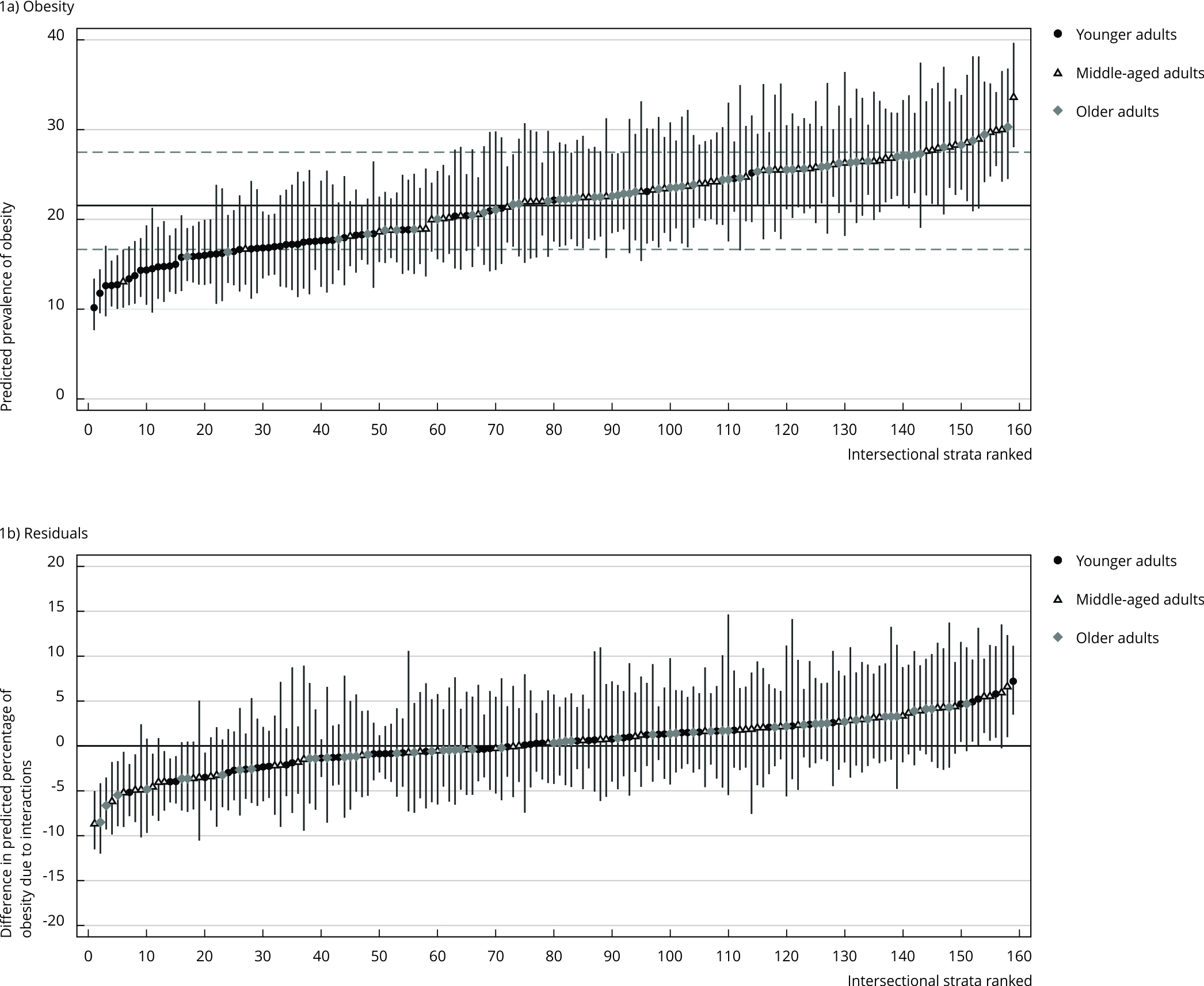
The predicted probabilities of obesity across intersectional strata following the full model are presented in Figure 1a, with highlights shown in Table 3. The lowest predicted prevalence of obesity was observed in “Younger Women White High income High education” (10.18%, 95%CI: 7.66-13.42), and the highest in “Middle Women Brown Low income Low education” (33.48%, 95%CI: 27.55; 39.97). Figure 1b shows that both groups had values that were statistically significantly different from the overall predicted prevalence (21.55%, 95%CI: 16.65; 27.48). The five strata with the lowest predicted prevalence of obesity (ranging from 10.18% to 12.72%) predominantly consist of younger individuals with high levels of education, particularly women. However, younger Black men with low income and lower educational levels are also among these five lowest-prevalence strata. Conversely, the five strata with the highest predicted prevalence (ranging from 29.63% to 33.48%) consisted exclusively of women who were middle-aged or older, from Brown and Black groups, all of whom had low or middle income and educational levels.

Predicted prevalence of obesity (body mass index - BMI ≥ 30kg/m2) and random-effects residuals of the full model across intersectional strata in the analytical sample (n = 71,896) from the 2019 Brazilian National Health Survey.
Discussion
This study aimed to analyze the extent to which different and mutually reinforcing systems of oppression and privilege (age, gender, race, class, and education) shape unequal population-level patterns of obesity and the magnitude of inequality across social strata in a representative sample of Brazilian adults. By implementing MAIHDA within an intersectional framework, we estimated obesity prevalence across intersectional social positions and calculated global measures to assess the contribution of interactive social effects. Our findings reveal stark intersectional inequalities in obesity prevalence, with the predicted prevalence among middle-aged Brown women with low income and low educational attainment three times higher than that among younger White women with high income and high education. Additionally, obesity prevalence varied significantly within and across intersectional strata, with the highest prevalence concentrated among Brown and Black women with lower income and educational levels.
Since the 2010s, studies have increasingly adopted broader theoretical frameworks from social epidemiology to understand trends in malnutrition, including political and social determinants of health 34,35,36,37,38. These frameworks consider not only individuals’ socioeconomic position but also the structure and dynamics of food systems, such as food security, presence of food deserts, public policies, and the implementation of the human right to adequate food 6. From this perspective, structural and systemic factors provide greater explanatory power than individual choices, even if such relationships are more indirect and interactive. This aligns with a growing consensus that rejects biological determinism and individualistic or culturally stereotyped explanations for disparities in obesity rates 39. Instead, ecosocial and social epidemiological theories emphasize that health inequalities reflect how individuals and social groups embody intersecting systems of privilege and oppression over the life course 36,37,38,40. These theoretical frameworks gain further empirical support in the Brazilian context, where evidence demonstrates how structural inequalities shape obesity patterns across intersecting social markers. Findings from both Canella et al. 9 and Araujo et al. 41, based on data from the 2008-2009 Brazilian Household Budget Survey, provide consistent evidence of associations between socioeconomic positions (such as age, gender, race/ethnicity, income, and education) and overall higher obesity rates. Araujo et al. 41 highlight that the association between obesity and race among Brazilian adults is significantly modified by sex and socioeconomic status. The authors reported that obesity prevalence was highest among Black women (20.6%) and lowest among Brown men (11.8%). Among men, obesity increased with higher socioeconomic status across all racial groups, with Black men showing the steepest gradient. Among women, however, white and Brown women showed decreasing odds of obesity with increasing socioeconomic status, whereas Black women exhibited the opposite pattern, presenting three times greater odds of obesity at higher socioeconomic status levels compared to their low-socioeconomic status counterparts. Canella et al. 9 observed a high overall prevalence of overweight and obesity among adult women with lower income and educational attainment and among those who self-identified as Black or Brown, compared with women from privileged social positions.
In our study, we assessed the influence of intersectional strata on obesity prevalence by considering each variable as distinct axes of power that are structurally and systematically embedded within social and political institutions, as articulated by Crenshaw 15, Collins 13, and Collins & Bilge 30, among others. Our MAIHDA models indicate that differences between intersectional social strata exert a modest influence on disparities in obesity prevalence. The results initially showed that only 3.08% of the total variance in predicted obesity prevalence is attributable to differences between intersectional strata defined by gender, race, class, education, and age. As emphasized in the literature, the VPC captures both between-strata variability and residual heterogeneity within strata. Values below 5% suggest that most of the observed variation in obesity occurs among individuals within the same stratum rather than between strata 32. However, while a low VPC suggests limited discriminatory accuracy of intersectional strata in predicting individual-level outcomes, it does not preclude the presence of meaningful interaction effects between social positions. Recent scholarship demonstrates that even modest between-strata variance can coexist with substantively important within-strata heterogeneity, especially when social categories intersect in non-additive and structurally embedded ways 18,42. From this perspective, MAIHDA models are not primarily intended to maximize predictive accuracy but rather to reveal patterns of social inequality emerging from intersecting systems of power and privilege 17. Consequently, low VPC values should not be interpreted as evidence against the relevance of intersectional effects; instead, they reflect the complex and diffuse ways in which structural determinants operate across and within social groups. In practical terms, these results suggest that these social categories are not precise predictors of individual risk (i.e., with high discriminatory accuracy). Nonetheless, at the population level, they still reveal unequal patterns in the distribution of obesity across social groups 18,43.
When focusing on the five intersectional strata with the highest predicted prevalence of obesity, a salient pattern emerges. Afro-Brazilian women are the only group consistently represented among these strata, especially those aged 35-48 years with low or intermediate income and educational attainment. The two strata with the highest obesity prevalence include middle-aged and older Brown and Black women with both low income and lower to middle levels of education. Conversely, the five strata with the lowest predicted obesity prevalence are less homogeneous. They predominantly include younger women with varying income levels but consistently high levels of education. Younger Black men with low income and middle to lower educational levels also appear among these groups. While no single intersectional group predominates, these strata share characteristics associated with younger age positioning. These last findings demonstrate how systems of power may generate similar patterns while being driven by entirely different mechanisms and dynamics, such as the formation of structures of oppression or, conversely, of privilege.
These disparities may be partially explained by the chronic activation of stress-related physiological systems in response to intersecting forms of discrimination, including racism, sexism, and classism. As shown in prior research 44, experiences of social exclusion and discrimination can activate the hypothalamic-pituitary-adrenal (HPA) axis, increasing levels of cortisol and related hormones. This biological response has been associated with increased visceral fat accumulation, dysregulation of appetite-related hormones, and a greater propensity to consume calorie-dense and highly palatable foods. From an ecosocial perspective, these processes reflect the embodiment of oppression, whereby adverse social conditions are biologically internalized and contribute to health disparities 35,37,38. At a structural level, institutional racism and other political determinants of health shape food environments and access to adequate nutrition 45. Discriminatory policies and unequal urban planning contribute to the creation of food deserts and limit the availability of fresh and minimally processed foods in predominantly Black and low-income neighborhoods 46,47,48. Additionally, targeted marketing of ultra-processed foods and the erosion of traditional food practices reinforce unhealthy dietary patterns. Rather than being random or isolated, these patterns reflect historically produced and structurally maintained inequities in living conditions, access to resources, and exposure to stressors. This intersectional analysis underscores the importance of moving beyond additive explanations to identify the compounding effects of systemic social oppression on health outcomes.
Strengths and limitations
This study presents four main strengths. First, it draws on data from the 2019 PNS, a large and nationally representative sample of Brazilian adults, enabling national-level estimates of obesity prevalence across diverse social strata. Second, the analysis incorporates sampling weights and accounts for the survey’s complex design, thereby increasing validity and generalizability of the results. Third, the implementation of the MAIHDA approach represents a significant methodological and theoretical innovation in Brazilian nutritional epidemiology. This model enables the estimation of prevalence values across all intersectional social strata, capturing both additive and interactive effects and quantifying heterogeneity within and between strata. Moreover, because multilevel models apply shrinkage based on stratum sample size and variance components, MAIHDA provides more reliable estimates for small or sparsely populated strata. Hence, it advances previous studies based on single-level models, which depend on a restricted number of pre-specified interactions and reference groups to remain interpretable and often encourage single-axis interpretations by modeling only additive effects 24. By adopting an intersectional perspective, MAIHDA also enables the reconceptualization of traditionally individual or biological variables as markers of social position, thereby expanding the scope of social and ecosocial epidemiological research in nationwide Brazilian studies. Fourth, the study highlights specific high-risk groups (e.g., low-income, middle-aged Black and Brown women), offering actionable insights for targeted public health interventions and equity-oriented policies.
Nonetheless, the study has some limitations. The intersectional strata were constructed using self-reported categorical variables (age, sex, race, income, and education) as proxies for larger structural forces, which may fail to fully capture the complexity of interwoven systemic oppressions such as sexism or racism. Second, despite the large sample size, small cell counts in some strata limited statistical power and required the exclusion of Indigenous and Yellow individuals, thereby reducing inclusivity and obscuring inequalities experienced by these populations. Third, gender was inferred from binary sex categories, restricting the capacity to represent non-binary and transgender individuals, whose interactions with health and social systems may differ substantially. Sexual orientation could also not be included due to insufficient sample size from the PNS 2019 thematic model. Fourth, obesity was estimated using BMI, which is subject to misclassification bias and does not capture body composition, fat distribution, or sociocultural meanings of body size. Finally, while the study adopts an intersectional and ecosocial perspective, the models do not directly incorporate meso- or macro-level variables (e.g., neighborhood food environments, regional policy differences), which could help elucidate structural pathways linking social position to obesity. Future studies should seek to address these limitations when possible.
Taken together, the study provides an important methodological and theoretical contribution to nutritional epidemiology in Brazil, highlighting how structural inequalities are embodied at the intersection of race, gender, age, income, and education. Despite the modest discriminatory accuracy of intersectional strata, our findings reveal clear patterns of vulnerability, with Black and Brown women from lower socioeconomic backgrounds consistently facing higher predicted obesity rates. These results reinforce the limitations of traditional analytical approaches and underscore the need to adopt intersectional and ecosocial frameworks.
Policymakers should prioritize intersectional strategies that address the upstream social and structural determinants of obesity, including racialized poverty, food deserts, and structural barriers to accessing healthy foods in marginalized communities. In the context of Brazil’s ongoing nutrition transition, marked by increasing consumption of ultra-processed foods, it is also essential to monitor social inequalities in obesity with intersectional approaches.
-
Disponibilidade de dados
The databases used in the study, including extraction codes, analyses, and results, are available in the repository: https://github.com/marcosfanton/maihda_csp.
Acknowledgments
To the Brazilian National Research Council (CNPq; grants codes: 306656/2022-1, 444331/2023-9, and 420360/2022-0).
References
- 1 GBD 2021 Adult BMI Collaborators. Global, regional, and national prevalence of adult overweight and obesity, 1990-2021, with forecasts to 2050: a forecasting study for the Global Burden of Disease Study 2021. Lancet 2025; 405:813-38.
- 2 Instituto Brasileiro de Geografia e Estatística. Pesquisa Nacional de Saúde 2019: informações sobre domicílios, acesso e utilização dos serviços de saúde. Rio de Janeiro: Instituto Brasileiro de Geografia e Estatística; 2020.
- 3 Estivaleti JM, Guzman-Habinger J, Lobos J, Azeredo CM, Claro R, Ferrari G, et al. Time trends and projected obesity epidemic in Brazilian adults between 2006 and 2030. Sci Rep 2022; 12:12699.
- 4 Rocha LP, Machado IE, Fogal AS, Malta DC, Velasquez-Melendez G, Felisbino-Mendes MS. Burden of disease and direct costs to the health system attributable to high body mass index in Brazil. Public Health 2024; 233:121-9.
- 5 World Obesity Federation. World obesity atlas 2025. London: World Obesity Federation; 2025.
- 6 Swinburn BA, Sacks G, Hall KD, McPherson K, Finegood DT, Moodie ML, et al. The global obesity pandemic: shaped by global drivers and local environments. Lancet 2011; 378:804-14.
- 7 Rodrigues LS, Miranda NG, Cabrini D. Obesidade e interseccionalidade: análise crítica de narrativas no âmbito das políticas públicas de saúde no Brasil (2004-2021). Cad Saúde Pública 2023; 39:e00240322.
- 8 Devaux M, Sassi F. Social inequalities in obesity and overweight in 11 OECD countries. Eur J Public Health 2013; 23:464-9.
- 9 Canella DS, Duran AC, Claro RM. Malnutrition in all its forms and social inequalities in Brazil. Public Health Nutr 2020; 23(S1):S29-38.
- 10 Bauer GR, Churchill SM, Mahendran M, Walwyn C, Lizotte D, Villa-Rueda AA. Intersectionality in quantitative research: a systematic review of its emergence and applications of theory and methods. SSM Popul Health 2021; 14:100798.
- 11 Guan A, Thomas M, Vittinghoff E, Bowleg L, Mangurian C, Wesson P. An investigation of quantitative methods for assessing intersectionality in health research: a systematic review. SSM Popul Health 2021; 16:100977.
- 12 Alghamdi NA, Dunn K, Cairns D, Melville C. Utilising quantitative methods to study the intersectionality of multiple social disadvantages in women with common mental disorders: a systematic review. Int J Equity Health 2023; 22:264.
- 13 Collins PH. Intersectionality as critical social theory. Durham: Duke University Press; 2019.
- 14 Collins PH, Bilge S. Intersectionality. 2nd Ed. Cambridge: Polity Press; 2020.
- 15 Crenshaw K. Demarginalizing the intersection of race and sex: a black feminist critique of antidiscrimination doctrine, feminist theory, and antiracist politics. Univ Chic Leg Forum 1989; (1):139-67.
- 16 Combahee River Collective. The Combahee River Collective Statement: black feminist organizing in the seventies and eighties. s.l.: Kitchen Table/Women Color; 1978.
- 17 Evans CR, Williams DR, Onnela J-P, Subramanian SV. A multilevel approach to modeling health inequalities at the intersection of multiple social identities. Soc Sci Med 2018; 203:64-73.
- 18 Evans CR, Leckie G, Subramanian SV, Bell A, Merlo J. A tutorial for conducting intersectional multilevel analysis of individual heterogeneity and discriminatory accuracy (MAIHDA). SSM Popul Health 2024; 26:101664.
- 19 Hernández-Yumar A, Wemrell M, Alessón IA, López-Valcárcel BG, Leckie G, Merlo J. Socioeconomic differences in body mass index in Spain: an intersectional multilevel analysis of individual heterogeneity and discriminatory accuracy. PLOS One 2018; 13:e0208624.
- 20 Beccia AL, Baek J, Austin SB, Jesdale WM, Lapane KL. Eating-related pathology at the intersection of gender identity and expression, sexual orientation, and weight status: an intersectional Multilevel Analysis of Individual Heterogeneity and Discriminatory Accuracy (MAIHDA) of the Growing Up Today Study cohorts. Soc Sci Med 2021; 281:114092.
- 21 Forrest LN, Bennett BL, Beccia A, Puhl R, Watson RJ. Prevalence of disordered eating behaviors among sexual and gender minority youth varies at the intersection of gender identity and race/ethnicity. Int J Eat Disord 2025; 58:635-46.
- 22 Bennett BL, Forrest LN, Puhl RM, Watson RJ. Prevalence of disordered eating behaviors varies at the intersection of gender identity and sexual orientation among sexual and gender minority youth. J Psychopathol Clin Sci 2025; 134:674-87.
- 23 Merlo J, Wagner P, Leckie G. A simple multilevel approach for analysing geographical inequalities in public health reports: the case of municipality differences in obesity. Health Place 2019; 58:102145.
-
24 Leckie G, Bell A, Merlo J, Subramanian SV, Evans C. The statistical advantages of MAIHDA for estimating intersectional inequalities. SocArXiv 2025; 1 oct. https://osf.io/preprints/socarxiv/dpyqm_v1
» https://osf.io/preprints/socarxiv/dpyqm_v1 - 25 Humbert AL. Methodological insights into multilevel analysis of individual heterogeneity and discriminatory accuracy: an empirical examination of the effects of strata configurations on between-stratum variance and of fixed effects across hierarchical levels. PLOS One 2024; 19:e0297561.
- 26 Bishnoi M, Chopra K, Rongzhu L, Kulkarni SK. Protective effect of curcumin and its combination with piperine (bioavailability enhancer) against haloperidol-associated neurotoxicity: cellular and neurochemical evidence. Neurotox Res 2011; 20:215-25.
- 27 Stopa SR, Szwarcwald CL, Oliveira MM, Gouvea ECDP, Vieira MLFP, Freitas MPS, et al. National Health Survey 2019: history, methods and perspectives. Epidemiol Serv Saúde 2020; 29:e2020315.
- 28 Johnson CL, Paulose-Ram R, Ogden CL, Carroll MD, Kruszon-Moran D, Dohrmann SM, et al. National Health and Nutrition Examination Survey: analytic guidelines, 1999-2010. Vital Health Stat 2 2013; (161):1-24.
- 29 WHO Expert Committee. Physical status: the use and interpretation of antropometry. v. 1. Geneva: World Health Organization; 1995.
- 30 Collins PH, Bilge S. Intersectionality. Hoboken: John Wiley & Sons; 2016.
- 31 Wilkes R, Karimi A. What does the MAIHDA method explain? Soc Sci Med 2024; 345:116495.
- 32 Evans CR, Borrell LN, Bell A, Holman D, Subramanian SV, Leckie G. Clarifications on the intersectional MAIHDA approach: a conceptual guide and response to Wilkes and Karimi (2024). Soc Sci Med 2024; 350:116898.
- 33 Leckie G, Charlton C. Runmlwin: a program to run the MLwiN multilevel modeling software from within Stata. J Stat Softw 2012; 52:1-40.
- 34 Armstead TL, Wilkins N, Nation M. Structural and social determinants of inequities in violence risk: a review of indicators. J Community Psychol 2021; 49:878-906.
- 35 Krieger N. Theories for social epidemiology in the 21st century: an ecosocial perspective. Int J Epidemiol 2001; 30:668-77.
- 36 Brown TH, Homan P. The future of social determinants of health: looking upstream to structural drivers. Milbank Q 2023; 101(S1):36-60.
- 37 Krieger N. Epidemiology and the people's health. Oxford: Oxford University Press; 2011.
- 38 Krieger N. Ecosocial theory, embodied truths, and the people's health. New York: Oxford University Press; 2021.
- 39 Ralston J, Brinsden H, Buse K, Candeias V, Caterson I, Hassell T, et al. Time for a new obesity narrative. Lancet 2018; 392:1384-6.
- 40 Krieger N. Measures of racism, sexism, heterosexism, and gender binarism for health equity research: from structural injustice to embodied harm - an ecosocial analysis. Annu Rev Public Health 2020; 41:37-62.
- 41 Araujo MC, Baltar VT, Yokoo EM, Sichieri R. The association between obesity and race among Brazilian adults is dependent on sex and socio-economic status. Public Health Nutr 2018; 21:2096-102.
- 42 Bauer GR, Scheim AI. Advancing quantitative intersectionality research methods: intracategorical and intercategorical approaches to shared and differential constructs. Soc Sci Med 2019; 226:260-2.
- 43 Borrel LN, Nieves CI, Evans CR. Making sense of MAIHDA's history and goals: a response to "Variance partition that eludes intuition". SSM Popul Health 2025; 30(S1):101779.
- 44 Lockwood KG, Marsland AL, Matthews KA, Gianaros PJ. Perceived discrimination and cardiovascular health disparities: a multisystem review and health neuroscience perspective. Ann N Y Acad Sci 2018; 1428:170-207.
- 45 Rodrigues YE, Fanton M, Novossat RS, Canuto R. Perceived racial discrimination and eating habits: a systematic review and conceptual models. Nutr Rev 2022; 80:1769-86.
- 46 Borges DC, Canuto R, Pasqual FM, Rosa GL, Vargas JCB. Social and ethnic-racial inequities of physical accessibility to farmers' markets in Porto Alegre, Brazil. Ciênc Saúde Colet 2025; 30:e09812023.
- 47 Borges DC, Vargas JCB, Honório OS, Mendes LL, Canuto R. Social and ethnic-racial inequities in the occurrence of food deserts in a Brazilian state capital. Food Secur 2024; 16:595-606.
- 48 Lima da Silva JM, Oliveira JS, Casagrande Borges D, Honório OS, Mendes LL, Canuto R. Social inequities in food deserts and food swamps in a northeastern Brazilian capital. J Biosoc Sci 2024; 56:493-503.
The databases used in the study, including extraction codes, analyses, and results, are available in the repository: https://github.com/marcosfanton/maihda_csp.