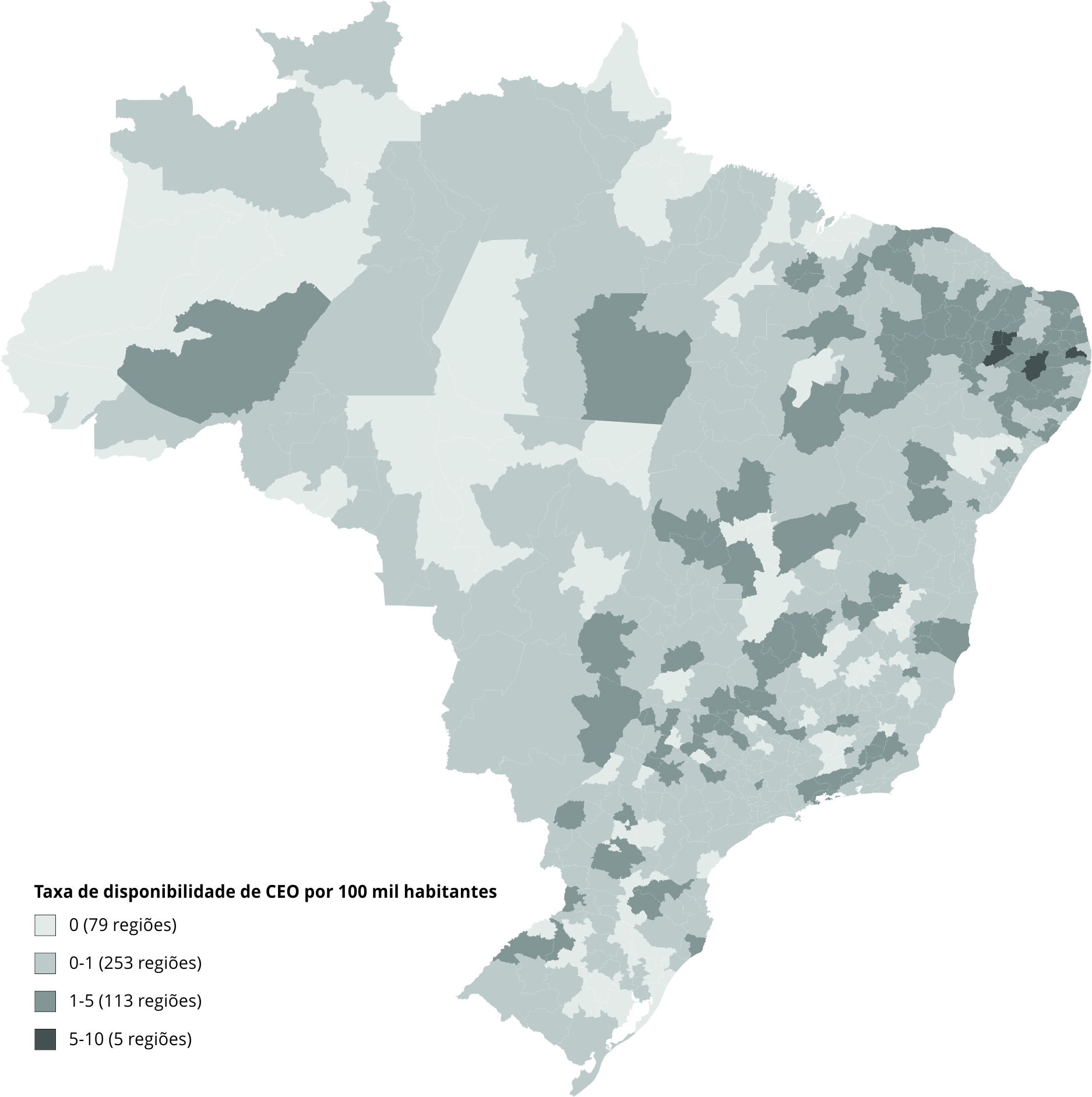
 Distribution of Dental Specialty Centers across health regions in Brazil, 2023
Abstract
This study aims to analyze the distribution of Dental Specialty Centers (CEOs, acronym in Portuguese) across Brazilian health regions and to identify contextual factors associated with this distribution. This ecological cross-sectional study used secondary data from 1,214 active CEOs in December 2023, extracted from the Brazilian National Registry of Health Establishments. The hurdle negative binomial model was applied to identify factors associated with the distribution of these services, considering demographic and socioeconomic characteristics, as well as the availability of oral health teams in primary care. The results showed that 82.44% of Brazil’s health regions have at least one CEO. The Northeast stood out, with 93.23% of its health regions housing CEOs, exceeding proportions observed in other regions. The social vulnerability index was associated with both the presence and the number of CEOs, showing paradoxical effects. Regions with higher vulnerability were less likely to have a CEO (OR = 0.905; 95%CI: 0.871-0.940), but among regions with at least one CEO, higher vulnerability was associated with an increased number of these services (RR = 1.023; 95%CI: 1.013-1.033). Although CEOs are predominantly implemented in less vulnerable regions, compensatory strategies appear to be emerging to ensure service availability in more vulnerable areas, consistent with the inverse equity hypothesis. However, significant challenges remain regarding Brazil’s territorial dimension, gaps in service coverage, and the need to optimize the use of CEOs. Although secondary oral healthcare must be considered within a regionalized context, the unequal distribution of health regions across states and geographic regions, variation in territorial area, and mobility constraints may affect access to CEOs.
Keywords:
Secondary Care; Regional Health Planning; Dental Health Services
 Thumbnail