
 Interrelationships of frailty, hemoglobin, cognition, and depressive symptoms in aging: a path analysis of the ELSI-Brazil study
Abstract
This study analyzed the interrelationships of anemia, depression, and cognition, as well as some of their associated factors to understand the paths to frailty. Data from 2,174 baseline participants of the Brazilian Longitudinal Study of Aging (ELSI-Brazil) were used. Path analysis was used to assess the relationships of exogenous variables (place of residence, education level, number of diseases, diet score, and number of natural teeth), one endogenous variable (frailty), and three mediators (cognition, depression, and hemoglobin level). Cognition and hemoglobin level showed a negative path to frailty, while depressive symptoms showed a positive path. Among the exogenous variables, rural area had a negative effect on hemoglobin, depressive symptoms, and frailty; a higher education level showed a positive path to cognition; number of diseases showed a negative path to hemoglobin and a positive path to depressive symptoms and frailty; diet score showed a negative path to hemoglobin and depressive symptoms; number of teeth had a positive effect on cognition and hemoglobin and a negative effect on frailty. Two paths without direct effects had significant indirect effects - rural area showed an indirect relationship with cognition via hemoglobin and depressive symptoms; and education level showed an indirect path to frailty, mediated by the three intermediate variables. These results show complex interrelationships of frailty, hemoglobin, cognition, and depressive symptoms, which help understand the syndrome in a broad way and support the planning of more comprehensive prevention and intervention measures.
Keywords:
Frailty; Anemia; Depression; Structural Equation Modeling
Resumo
Este estudo objetivou avaliar as inter-relações entre anemia, depressão e cognição, bem como alguns de seus fatores associados, para compreender os caminhos até a fragilidade. Foram utilizados dados de 2.174 participantes da linha de base do Estudo Longitudinal de Saúde dos Idosos Brasileiros (ELSI-Brasil). Utilizou-se análise de caminhos para avaliar as relações entre variáveis exógenas (local de residência, escolaridade, número de doenças, escore de alimentação e número de dentes naturais), uma endógena (fragilidade) e três mediadoras (cognição, depressão e nível de hemoglobina). Nas análises, cognição e hemoglobina tiveram caminho negativo para fragilidade, e sintomas depressivos, positivo. Entre as variáveis exógenas, zona rural teve efeito negativo sobre hemoglobina, sintomas depressivos e fragilidade; maior escolaridade apresentou caminho positivo para cognição; número de doenças teve caminho negativo para hemoglobina, e positivo para sintomas depressivos e fragilidade; escore de alimentação apresentou caminho negativo para hemoglobina e sintomas depressivos; número de dentes teve efeito positivo na cognição e hemoglobina, e negativo na fragilidade. Dois caminhos sem efeito direto tiveram efeitos indiretos significativos - zona rural apresentou relação indireta com cognição via hemoglobina e sintomas depressivos; e escolaridade teve caminho indireto para fragilidade, mediado pelas três variáveis intermediárias. Esses resultados mostram complexas inter-relações entre fragilidade, hemoglobina, cognição e sintomas depressivos, importantes para compreender a síndrome de maneira ampla, de modo que se possa planejar medidas mais abrangentes de prevenção e intervenção.
Palavras-chave:
Fragilidade; Anemia; Depressão; Modelagem de Equações Estruturais
Resumen
Este estudio tuvo como objetivo evaluar las interrelaciones entre la anemia, la depresión y la cognición, así como algunos de sus factores asociados, para comprender las trayectorias hacia la fragilidad. Se utilizaron datos de 2.174 participantes de la línea de base del Estudio Longitudinal sobre la Salud de Ancianos Brasileños (ELSI-Brasil). El análisis de la trayectoria se utilizó para evaluar las relaciones entre las variables exógenas (lugar de residencia, nivel de estudios, número de enfermedades, puntuación de alimentación y número de dientes naturales), una endógena (fragilidad) y tres mediadores (cognición, depresión y nivel de hemoglobina). Los análisis mostraron que la cognición y la hemoglobina tuvieron una trayectoria negativa para fragilidad; y que los síntomas depresivos presentaron una trayectoria positiva. Entre las variables exógenas, las áreas rurales tuvieron un efecto negativo sobre la hemoglobina, los síntomas depresivos y la fragilidad; mayor nivel de estudios tuvo una trayectoria positiva para la cognición; el número de enfermedades tuvo una trayectoria negativa para la hemoglobina, y positiva para los síntomas depresivos y la fragilidad; la puntuación de alimentos tuvo una trayectoria negativa para la hemoglobina y los síntomas depresivos; el número de dientes tuvo un efecto positivo sobre la cognición y la hemoglobina; y negativo sobre la fragilidad. Dos trayectorias sin efecto directo tuvieron efectos indirectos significativos: las áreas rurales mostraron una relación indirecta con la cognición a través de la hemoglobina y los síntomas depresivos; y el nivel de estudios tuvo una trayectoria indirecta para fragilidad mediada por las tres variables intermedias. Estos resultados muestran interrelaciones complejas entre la fragilidad, la hemoglobina, la cognición y los síntomas depresivos, elementos importantes para comprender el síndrome de una manera amplia, de modo que se puedan promover medidas de prevención e intervención más integrales.
Palabras-clave:
Fragilidad; Anemia; Depresión; Modelado de Ecuaciones Estructurales
Introduction
Geriatric syndromes, such as frailty, are of increasing concern to health professionals due to the exponential aging of the population in recent decades. The prevalence of frailty varies according to the diagnostic criteria used 1. In Brazil, a prevalence of 8.1% was found among individuals aged 60-69 years and 20.9% among individuals aged 70 years and older 2. It increases the risk of functional and cognitive decline, hospitalization, morbidity and mortality, leading to poorer quality of life, reduced longevity, and increased health care costs.
The pathophysiology of frailty is characterized by an imbalance in homeostasis, creating a pathological cycle in a negative spiral of functional decline, as proposed by Fried et al. 3, with clinical signs of reduced strength, fatigue, slowness, low physical activity, and weight loss; it is considered a complex and interconnected phenomenon 4.
Frailty has been associated with anemia 5,6, cognition 7,8, depression 9,10,11, diet 12,13, lifestyle 14,15, chronic noncommunicable diseases (CNCDs) 16, and sarcopenia 17, but to date, there is limited evidence of the complex relationships between these conditions and the clinical manifestation of frailty.
Understanding this complexity can contribute to the development of broader prevention and treatment actions for frailty and support the creation of public policies to improve the quality of life and longevity of the population. Therefore, this study aimed to analyze the interrelationships of anemia, depression, and cognition, as well as some associated factors to evaluate the paths to frailty.
Methods
This study uses baseline data from the Brazilian Longitudinal Study of Aging (ELSI-Brazil, acronym in Portuguese), a household-based survey conducted in 2015-2016 with a representative national sample of the population aged 50 years and older. Methodological details of the study (selection, sample, procedures) are described on the study website (https://elsi.cpqrr.fiocruz.br/) and in previous publications 18.
The study was conducted in 70 municipalities of the five major regions of Brazil, with a final sample of 9,412 participants. A subsample was also selected using probability sampling for blood collection, totaling 2,174 individuals. Blood samples were collected at the homes of participants; then they were prepared and sent to the central laboratory for analysis. To ensure sample quality and viability, a best practice protocol was observed, which included packaging with dry ice and temperature monitoring during transport 19.
ELSI-Brazil was approved by the Ethics Research Committee of the Oswaldo Cruz Foundation at Minas Gerais State (CAAE 34649814.3.0000.5091), and all interviewees signed an informed consent form to participate in the study 18,19.
The main outcome variable was frailty, defined as the sum of five criteria presented in previous publications 2,3,4: self-reported unintentional weight loss (last three months), weakness (grip strength in the lower quintile stratified by sex, and body mass index - BMI - quartiles), low gait speed (upper quintile of three-meter walk time, stratified by sex and height), fatigue (responses to two questions from the Center for Epidemiological Studies Depression Questionnaire - CES-D) 20,21; and low level of physical activity (lowest quintile of weekly caloric expenditure calculated using the Short Form of the International Physical Activity Questionnaire - IPAQ 22, stratified by sex).
Three conditions were selected as possible mediators: serum hemoglobin levels (mg/L), cognition (sum of immediate and delayed memory, and verbal fluency - the higher the score, the better) 23,24, and number of depressive symptoms, identified by the CES-D depression scale (ranging from 0 to 8 - the higher the score, the higher the number of depressive symptoms) 21.
The explanatory variables were: place of residence (urban area, rural area); education (no education, primary, secondary, high school, higher education); number of natural teeth in the mouth (none, 1-9, 10-19, ≥ 20); number of diseases (sum of 13 self-reported CNCDs: hypertension, diabetes, hypercholesterolemia, heart disease, stroke, chronic lung disease, arthritis/rheumatism, osteoporosis, chronic back problems, cancer, chronic kidney failure, Parkinson’s or Alzheimer’s disease); and food groups of adequate consumption (consumption of fruits/juice, vegetables, and meats at least five times a week and consumption of fish at least once a week; sum ranging from 0 to 4 adequate groups).
For descriptive analyses, mean (standard error), minimum and maximum values, and percentages were used. To assess the interrelationships of the variables and the frailty score, a structural equation model and path analysis were used considering five exogenous variables (place of residence, education, number of diseases, diet score, and number of natural teeth), one endogenous variable (frailty), and three mediators, which could be either exogenous or endogenous (cognition, depression, and hemoglobin level). The model adequacy was assessed using the chi-square test (root mean square error of approximation - RMSEA; values < 0.05 indicate excellent fit), standardized root mean square residual (SRMR; acceptable values < 0.08), Tucker-Lewis index (TLI), and comparative fit index (CFI), ranging from 0 to 1; the closer to 1, the better the fit.
Data were analyzed using Stata, version 14.0 (https://www.stata.com), with a significance level of 5%, using sample weights calculated specifically for those who provided a blood sample through the survey package for complex samples.
Results
Most participants of the ELSI-Brazil study live in urban areas, completed primary school (59.8%), have an average of 2.38 diseases, an average hemoglobin level of 13.71mg/dL, and 1.06 components of frailty (data not shown in the table).
Figure 1 shows the direct effects of the variables. Cognition and hemoglobin showed a negative path to frailty, while depressive symptoms showed a positive path to frailty. Among the exogenous variables, rural area showed a negative effect on hemoglobin, depressive symptoms, and frailty; higher education level showed a positive path to cognition; number of diseases showed a negative path to hemoglobin and a positive path to depressive symptoms and frailty; diet score showed a negative path to hemoglobin and depressive symptoms; and number of teeth had a positive effect on cognition and hemoglobin and a negative effect on frailty.
Table 1 shows the total effects of all path analyses and Table 2 shows data on indirect effects observed in the model.
Two paths without a direct effect had significant indirect effects: living in a rural area showed an indirect relationship with cognition via hemoglobin and depressive symptoms; and education level showed an indirect path to frailty, mediated by the three intermediate variables. The model proved to be adequate in terms of adjustment parameters.
Discussion
In this study, we demonstrated interrelationships among frailty, hemoglobin, cognition, and depressive symptoms, and direct and indirect pathways that some of their classic determinants present. To our knowledge, this is the first study to show all these effects in a single analysis using a representative sample of the population aged 50 and over in the country.
Frailty is a geriatric syndrome caused by pathophysiological mechanisms that deregulate multiple systems, depleting reserves and compromising homeostasis in the presence of stressors. It involves systems of energy production, distribution, and use, including hormonal, immunological, inflammatory, and neurological processes. Thus, the cycle of reduced energy supply and demand leads to impaired function within and between systems. In this scenario, anemia is involved in the pathophysiology of the syndrome, due to a reduction in oxygen transport capacity, which can lead to tissue hypoxia 25, and consequently sarcopenia, osteoporosis, cardiac dysfunction, and progression of kidney disease 26,27. Also, anemia can contribute to clinical manifestations of weakness and exercise intolerance 28, which are components of frailty.
However, most studies demonstrate the direct effect of already established anemia on frailty syndrome, and not on hemoglobin gradient; besides, these are studies with more local characteristics. In Brazil, the Study Health, Well-Being and Aging (SABE study, acronym in Portuguese) showed this relationship in older people from the city of São Paulo only, in which lower hemoglobin levels were associated with a higher number of positive criteria for frailty 6.
Lower hemoglobin levels also contribute to lower cognitive capacity and a higher chance of depressive disorders because tissue hypoxia has an important effect on the nervous system, with two possible types of association - of cause or consequence.
Anemia can lead to depression due to deficiency of vitamins such as folate and vitamin B12, which decrease the production of S-adenosylmethionine, or can increase the production of homocysteine. At the same time, fatigue and lack of interest in daily activities (such as shopping, cooking, and others), which are commonly seen in depressed individuals, can affect the quality of diet, favoring the development of anemia; and appetite can also be severely impacted 29,30,31,32. A cohort of Chinese individuals showed that the incidence of anemia in 4-year follow-up was higher in individuals with depressive symptoms, and the higher the score on the test, the higher the incidence of anemia 33. In this study, the higher the number of depressive symptoms, the lower the circulating hemoglobin concentration, but it was not possible to assess causal associations considering the cross-sectional nature of data.
The same may be observed in cognitive capacity - individuals with established cognitive impairment may find it difficult to buy and prepare foods, feed themselves, and may have poor swallowing and, therefore, poor nutrition, which may trigger nutritional anemia 34. However, anemia as a cause of cognitive impairment is the most accepted pathway. Two recent reviews show that anemia increased the incidence of both general cognitive impairment and dementia, possibly due to prolonged tissue hypoxia in brain tissue 35,36. Depression is also positively associated with physical and cognitive frailty 37,38 through several physiological mechanisms, with changes in synaptic function, protein transport, and mitochondrial function.
This interrelationship between the various conditions assessed in this study (frailty, low hemoglobin level, depression, and cognition) seems to have in common a condition named inflammaging, which is an inflammatory state related to aging that increases oxidative stress, negatively impacting the systems involved 39,40. Inflammation may be directly associated with frailty through independent mechanisms 41 and changes in the erythropoietic response 42; it is considered an important determinant in the development of chronic anemia in older adults 27,42,43. According to Guralnik et al. 44, at least one third of anemia cases in aging can be attributed to CNCDs (especially renal diseases) and/or inflammation.
In addition, environmental, social and demographic aspects, health factors and lifestyle contribute to the complexity of frailty 41,45.
Regarding the place of residence, living in a rural area had a direct negative effect on depressive symptoms, hemoglobin, and frailty; that is, residents of rural areas had a lower depression score, lower hemoglobin concentration, and a lower number of frailty components. Previous studies indicated a higher prevalence of frailty in rural areas, such as a cohort with older Chinese adults, with a significantly higher prevalence in rural areas (12% versus 5.3% in urban areas) 46. Another study conducted in South Korea found a prevalence of 17.4% in rural areas and 10.3% in urban areas 47. Xu et al. 48, in a review on the subject, highlight three main reasons for the higher prevalence in rural areas: lower socioeconomic status, limited accessibility to health services, and less healthy lifestyle in addition to limited awareness of health care.
However, other studies show a lower prevalence in rural areas, such as in England - in the English Longitudinal Study of Ageing (ELSA) cohort, a higher prevalence was observed in urban areas (7.3% versus 4.8% in rural areas) 49 - and in Brazil, where Pavarini et al. 50 reported a prevalence of 19.6% of frailty in older caregivers in urban areas versus 9.9% in rural areas. One possible explanation for this difference is that some of these studies showed better functional capacity of residents in rural areas 50, as they are more physically active when compared to residents in urban areas, which may also explain the lower frailty in this group. An additional hypothesis would be the migration of frail individuals to urban areas, seeking a better access to health services.
Regarding depression, the studies are not unanimous either, with results showing both higher and lower prevalence in rural areas. A meta-analysis including 18 studies from different regions of the world described a significantly higher prevalence of depression in urban areas in 10 studies, and only 3 studies showing a higher prevalence among rural residents (all Chinese studies) 51. In developed countries, the probabilities of depression were significantly higher among urban residents when compared to rural residents, but this association was not significant in developing countries 51. In a study with older caregivers from the countryside of the state of São Paulo, caregivers living in rural areas had better cognitive performance, less perceived stress and a higher level of hope 50.
Regarding the negative effect of rural areas on hemoglobin, previous studies are controversial, sometimes conducted in the same country. For example, two studies conducted in Ecuador showed distinct results - a study in the city of Cuenca showed a higher prevalence of anemia among older adults living in rural areas 52 while Orces 53 described a higher prevalence in urban areas, analyzing data from the SABE Ecuador Study, arguing that the higher rate of population aging observed in urban areas when compared to rural areas may explain this difference. Another consideration that could help explain a higher urban prevalence is that air pollution may be directly associated with decreased hemoglobin levels 54. Our hypothesis is that the lower hemoglobin levels in rural areas are explained by worse sociodemographic conditions of residents, including greater food insecurity and worse access to health services.
Education had a positive direct path to cognition and a negative direct path to frailty, as well as an indirect negative path to frailty via hemoglobin, cognition, and depressive symptoms. This variable was added to the model for control purposes, since education is one of the main determinants of health known in the literature, and its relationship with all these outcomes is well established in both international and Brazilian studies 55,56,57,58,59.
We found a direct negative effect of the diet score on depressive symptoms and hemoglobin, and indirect paths to cognition and hemoglobin mediated by depressive symptoms. Inadequate diet may have a relationship with cognition and depressive symptoms. This study promotes a deeper discussion in two aspects: first, we used a score for four food groups (fruits/juice, vegetables, meat, and fish), surpassing isolated analyses and assessing dietary diversity. Second, we identified an indirect path from the lowest diet score to worse cognition via depressive symptoms, which was not significant in the direct paths, revealing an interrelationship between these conditions that has not been captured in traditional analyses. Although inadequate food intake is identified as one of the main risk factors for the syndrome, as it is directly related to malnutrition and weight loss 3,60. Our instrument was not able to measure protein and caloric adequacy, which may have weakened the relationship and failed to show a significant effect.
In this sense, the number of teeth also had a direct positive effect on cognition, hemoglobin, and frailty, and indirect paths to cognition and frailty. Oral health is an important determinant of cognition in its various domains, as highlighted in a recent review 61. A 13-year cohort of older people in China (Chinese Longitudinal Healthy Longevity Survey - CLHLS) found that having more teeth was associated with better cognitive function. Also, the relationship between number of teeth and time was significant, as participants with more teeth showed a slower rate of cognitive decline than those with fewer teeth after assessing other covariates 62.
The relationship between number of teeth and frailty has also been assessed because malnutrition is one of the main risk factors for the syndrome. Another publication, with data from the National Health and Nutrition Examination Surveys (NHANES) 2011-2014, found that for each additional tooth, the relative risk of frailty was 0.99 (95%CI: 0.98-0.99) 63. A recent meta-analysis also revealed a negative association between the number of teeth and frailty, as older individuals with fewer than 20 teeth have a higher risk of frailty when compared to those with 20 or more teeth 64.
In this sense, the relationship between dentition and anemia could be explained by poor nutritional intake as well as a number of other mechanisms with “vicious circle” characteristics, such as diseases associated with both conditions, including cancer, HIV infection, bleeding gums, alcohol and tobacco abuse, among others. Anemia can also worsen the manifestations of oral diseases, as part of its clinical signs, including glossitis, recurrent canker sores, Candida infections, and angular cheilitis 65,66. Therefore, the relationship between these two conditions should be carefully analyzed and, if possible, using an individualized care plan.
Finally, the number of CNCDs was negatively associated with hemoglobin and positively associated with depressive symptoms and frailty and, although it did not show a direct path to cognition, it had an indirect effect via hemoglobin and depressive symptoms. Multimorbidity can be associated with depression through several mechanisms, including inflammaging and limitations imposed by the diseases 67. Then, the path to frailty was also expected - the authors of the frailty phenotype studied here claim that multimorbidity is a relevant stressor for the dysregulation of homeostasis, increasing the risk of frailty 68,69,70.
The reduction in hemoglobin in older people with CNCDs is also explained in the literature and can be attributed to distinct diseases, diagnosed or not, in addition to inflammation, hypogonadism, compromised hematopoiesis, among others 71,72.
Regarding the significant negative indirect path of the number of diseases to better cognition, the literature seems inconsistent. Several studies have reported multimorbidity as a risk factor for cognitive impairment, mainly due to oxidative stress 73. However, other studies have reported that this relationship is mediated by confounding or causal factors. Aarts et al. 74 studied a normally aging adult population and found that simply counting the conditions was not significant. Data from NHANES 1999-2002 demonstrated that the association between multimorbidity and cognition lost significance when considering those individuals who observed the minimum recommendations of physical activity, which seemed to modulate the relationship 75. Our results are in line with this finding, since the relationship described here was modulated by depressive symptoms and hemoglobin.
These results should be interpreted considering some study limitations. This is a cross-sectional study in which “effect” and “path” indicate only statistical association, not causality. Important variables were not included in the model due to the impossibility of considering all the characteristics of the questionnaires. Lifestyle variables, such as smoking and alcoholism, were not considered due to the lack of consistent interactions, but they may be relevant in the history of frailty. The strengths of this study include the fact that it uses a unique and innovative model that was able to identify the interrelationship of four factors - cognition, hemoglobin, depression, and frailty - in a large sample, representative of older Brazilian adults, with methodological rigor in data collection and management.
In terms of public health, the fact that some factors can be associated with frailty both directly and mediated by other conditions is important to help understand the syndrome and its various facets, so that broader prevention and intervention measures can be proposed, considering the provision of basic living conditions, such as access to health care and education, maintenance of healthy habits such as dietary variety, management of CNCDs, and oral health care.
Acknowledgments
To the Brazilian national Research Council (CNPq), the Coordination for the Improvement of Higher Education Personnel (CAPES), the Brazilian Ministry of Health, and the Pro-Rectory of Research of the University of Campinas (UNICAMP) for their financial support.
References
- 1 Ofori-Asenso R, Chin KL, Mazidi M, Zomer E, Ilomaki J, Zullo AR, et al. Global incidence of frailty and prefrailty among community-dwelling older adults: a systematic review and meta-analysis. JAMA Netw Open 2019; 2:e198398.
- 2 Andrade JM, Duarte YAO, Alves LC, Andrade FCD, Souza Junior PR, Lima-Costa MF, et al. Perfil da fragilidade em adultos mais velhos brasileiros: ELSI-Brasil. Rev Saúde Pública 2018; 52 Suppl 2:17s.
- 3 Fried LP, Tangen CM, Walston J, Newman AB, Hirsch C, Gottdiener J, et al. Frailty in older adults: evidence for a phenotype. J Gerontol A Biol Sci Med Sci 2001; 56:M146-57.
- 4 Duarte YAO, Nunes DP, Andrade FB, Corona LP, Brito TRP, Santos JLF, et al. Frailty in older adults in the city of São Paulo: prevalence and associated factors. Rev Bras Epidemiol 2019; 21 Suppl 2:e180021.
- 5 Esquinas-Requena JL, García-Nogueras I, Hernández-Zegarra P, Atienzar-Núñez P, Sánchez-Jurado PM, Abizanda P. Anemia y fragilidad en ancianos españoles. Estudio FRADEA. Rev Esp Geriatr Gerontol 2021; 56:129-35.
- 6 Pires Corona L, Drumond Andrade FC, Oliveira Duarte YA, Lebrão ML. The relationship between anemia, hemoglobin concentration and frailty in Brazilian older adults. J Nutr Health Aging 2015; 19:935-40.
- 7 Ellwood A, Quinn C, Mountain G. Psychological and social factors associated with coexisting frailty and cognitive impairment: a systematic review. Res Aging 2022; 44:448-64.
- 8 Borges MK, Canevelli M, Cesari M, Aprahamian I. Frailty as a predictor of cognitive disorders: a systematic review and meta-analysis. Front Med (Lausanne) 2019; 6:26.
- 9 Lenardt MH, Falcão AS, Hammerschmidt KSA, Barbiero MMA, Leta PRG, Sousa RL. Sintomas depressivos e fragilidade física em pessoas idosas: revisão integrativa. Rev Bras Geriatr Gerontol 2021; 24:e210013.
- 10 Marconcin P, Barak S, Ferrari G, Gouveia ER, Nascimento MM, Willig R, et al. Prevalence of frailty and its association with depressive symptoms among european older adults from 17 countries: a 5-year longitudinal study. Int J Environ Res Public Health 2022; 19:14055.
- 11 Soysal P, Veronese N, Thompson T, Kahl KG, Fernandes BS, Prina AM, et al. Relationship between depression and frailty in older adults: a systematic review and meta-analysis. Ageing Res Rev 2017; 36:78-87.
- 12 Dominguez LJ, Donat-Vargas C, Sayon-Orea C, Barberia-Latasa M, Veronese N, Rey-Garcia J, et al. Rationale of the association between Mediterranean diet and the risk of frailty in older adults and systematic review and meta-analysis. Exp Gerontol 2023; 177:112180.
- 13 Duan Y, Qi Q, Cui Y, Yang L, Zhang M, Liu H. Effects of dietary diversity on frailty in Chinese older adults: a 3-year cohort study. BMC Geriatr 2023; 23:141.
- 14 Sharma PK, Reddy BM, Ganguly E. Frailty syndrome among oldest old individuals, aged = 80 years: prevalence & correlates. J Frailty Sarcopenia Falls 2020; 5:92-101.
- 15 Zhao W, Hu P, Sun W, Wu W, Zhang J, Deng H, et al. Effect of physical activity on the risk of frailty: a systematic review and meta-analysis. PLoS One 2022; 17:e0278226.
- 16 Vetrano DL, Palmer K, Marengoni A, Marzetti E, Lattanzio F, Roller-Wirnsberger R, et al. Frailty and multimorbidity: a systematic review and meta-analysis. J Gerontol A Biol Sci Med Sci 2019; 74:659-66.
- 17 De Breij S, Van Hout HPJ, De Bruin SR, Schuster NA, Deeg DJH, Huisman M, et al. Predictors of frailty and vitality in older adults aged 75 years and over: results from the Longitudinal Aging Study Amsterdam. Gerontology 2021; 67:69-77.
- 18 Lima-Costa MF, Andrade FB, Souza Jr. PRB, Neri AL, Duarte YADO, Castro-Costa E, et al. The Brazilian Longitudinal Study of Aging (ELSI-Brazil): objectives and design. Am J Epidemiol 2018; 187:1345-53.
- 19 Lima-Costa MF, Mambrini JVM, Souza-Junior PRB, Andrade FB, Peixoto SV, Vidigal CM, et al. Nationwide vitamin D status in older Brazilian adults and its determinants: the Brazilian Longitudinal Study of Aging (ELSI). Sci Rep 2020; 10:13521.
- 20 Orme JG, Reis J, Herz EJ. Factorial and discriminant validity of the Center for Epidemiological Studies Depression (CES-D) scale. J Clin Psychol 1986; 42:28-33.
- 21 Batistoni SST, Neri AL, Cupertino APFB. Validade da escala de depressão do Center for Epidemiological Studies entre idosos brasileiros. Rev Saúde Pública 2007; 41:598-605.
- 22 Matsudo S, Araujo T, Matsudo V, Andrade D. Questionário internacional de atividade física (IPAQ): estudo de validade e reprodutibilidade no Brasil. Rev Bras Ativ Fís Saúde 2012; 6:5-18.
- 23 Castro-Costa E, Lima-Costa MF, Andrade FB, Souza Junior PRB, Ferri CP. Cognitive function among older adults. Rev Saúde Pública 2018; 52 Suppl 2:4s.
- 24 Seixas BV, Macinko J. Distinct domains of childhood disadvantage and cognitive performance among older Brazilians: evidence from ELSI-Brazil. SSM Popul Health 2023; 22:101416.
- 25 Cesari M, Penninx BWJH, Lauretani F, Russo CR, Carter C, Bandinelli S, et al. Hemoglobin levels and skeletal muscle: results from the InCHIANTI Study. J Gerontol A Biol Sci Med Sci 2004; 59:249-54.
- 26 Chaves PHM, Ashar B, Guralnik JM, Fried LP. Looking at the relationship between hemoglobin concentration and prevalent mobility difficulty in older women. Should the criteria currently used to define anemia in older people be reevaluated? J Am Geriatr Soc 2002; 50:1257-64.
- 27 Roy CN. Anemia in frailty. Clin Geriatr Med 2011; 27:67-78.
- 28 Morley JE. Frailty: diagnosis and management. J Nutr Health Aging 2011; 15:667-70.
- 29 Onder G, Penninx BWJH, Cesari M, Bandinelli S, Lauretani F, Bartali B, et al. Anemia is associated with depression in older adults: results from the InCHIANTI study. J Gerontol A Biol Sci Med Sci 2005; 60:1168-72.
- 30 Pan W-H, Chang Y-P, Yeh W-T, Guei Y-S, Lin B-F, Wei I-L, et al. Co-occurrence of anemia, marginal vitamin B 6, and folate status and depressive symptoms in older adults. J Geriatr Psychiatry Neurol 2012; 25:170-8.
- 31 Corona LP, Duarte YAO, Lebrão ML. Prevalence of anemia and associated factors in older adults: evidence from the SABE Study. Rev Saúde Pública 2014; 48:723-31.
- 32 Macedo BG, Dias PPR, Camara HS, Antunes CMF. Anemia in the elderly: neuropsychiatric repercussions. Adv Aging Res 2017; 6:11-6.
- 33 Liu C, Zhou R, Peng X, Zhu T, Wei W, Hao X. Relationship between depressive symptoms and anemia among the middle-aged and elderly: a cohort study over 4-year period. BMC Psychiatry 2023; 23:572.
- 34 Noma T, Kayo G, Kabayama M, Gondo Y, Yasumoto S, Masui Y, et al. Lower cognitive function as a risk factor for anemia among older Japanese women from the longitudinal observation in the SONIC study. Geriatr Gerontol Int 2023; 23:334-40.
- 35 Kim H-B, Park B, Shim J-Y. Anemia in association with cognitive impairment: a systematic review and meta-analysis. J Alzheimers Dis 2019; 72:803-14.
- 36 Kung W-M, Yuan S-P, Lin M-S, Wu C-C, Islam MM, Atique S, et al. Anemia and the risk of cognitive impairment: an updated systematic review and meta-analysis. Brain Sci 2021; 11:777.
- 37 Fabrício DM, Chagas MHN, Diniz BS. Frailty and cognitive decline. Transl Res 2020; 221:58-64.
- 38 Brown PJ, Rutherford BR, Yaffe K, Tandler JM, Ray JL, Pott E, et al. The depressed frail phenotype: the clinical manifestation of increased biological aging. Am J Geriatr Psychiatry 2016; 24:1084-94.
- 39 Deng M-G, Liu F, Liang Y, Wang K, Nie J-Q, Liu J. Association between frailty and depression: a bidirectional Mendelian randomization study. Sci Adv 2023; 9:eadi3902.
- 40 Salinas-Saavedra M, Febrimarsa, Krasovec G, Horkan HR, Baxevanis AD, Frank U. Senescence-induced cellular reprogramming drives cnidarian whole-body regeneration. Cell Reports 2023; 42:112687.
- 41 Sciacchitano S, Carola V, Nicolais G, Sciacchitano S, Napoli C, Mancini R, et al. To be frail or not to be frail: this is the question - a critical narrative review of frailty. J Clin Med 2024; 13:721.
- 42 Wacka E, Wawrzyniak-Gramacka E, Tylutka A, Morawin B, Gutowicz M, Zembron-Lacny A. The role of inflammation in age-associated changes in red blood system. Int J Mol Sci 2023; 24:8944.
- 43 Vanasse GJ, Berliner N. Anemia in elderly patients: an emerging problem for the 21st century. Hematology Am Soc Hematol Educ Program 2010; 2010:271-5.
- 44 Guralnik JM, Eisenstaedt RS, Ferrucci L, Klein HG, Woodman RC. Prevalence of anemia in persons 65 years and older in the United States: evidence for a high rate of unexplained anemia. Blood 2004; 104:2263-8.
- 45 Feng Z, Lugtenberg M, Franse C, Fang X, Hu S, Jin C, et al. Risk factors and protective factors associated with incident or increase of frailty among community-dwelling older adults: a systematic review of longitudinal studies. PLoS One 2017; 12:e0178383.
- 46 Seo Y, Kim M, Shim H, Won CW. Differences in the association of neighborhood environment with physical frailty between urban and rural older adults: the Korean Frailty and Aging Cohort Study (KFACS). J Am Med Dir Assoc 2021; 22:590-7.e1.
- 47 Jang IY, Jung HW, Lee CK, Lee YS, Kim KIL, Kim KW, et al. Rural and urban disparities in frailty and aging-related health conditions in Korea. J Am Geriatr Soc 2016; 64:908-11.
- 48 Xu R, Li Q, Guo F, Zhao M, Zhang L. Prevalence and risk factors of frailty among people in rural areas: a systematic review and meta-analysis. BMJ Open 2021; 11:e043494.
- 49 Sinclair DR, Maharani A, Chandola T, Bower P, Hanratty B, Nazroo J, et al. Frailty among older adults and its distribution in England. J Frailty Aging 2022; 11:163-8.
- 50 Pavarini SCI, Neri AL, Brígola AG, Ottaviani AC, Souza EN, Rossetti ES, et al. Elderly caregivers living in urban, rural and high social vulnerability contexts. Rev Esc Enferm USP 2017; 51:e03254.
- 51 Purtle J, Nelson KL, Yang Y, Langellier B, Stankov I, Diez Roux AV. Urban-rural differences in older adult depression: a systematic review and meta-analysis of comparative studies. Am J Prev Med 2019; 56:603-13.
- 52 Sanmartín-Calle YA, Mesa-Cano IC, Ramírez-Coronel AA, Reiban-Espinoza EA. Demographic and clinical characteristics associated with anemia in the older adult. Pro Sciences: Revista de Producción, Ciencias e Investigación 2021; 5:248-56.
- 53 Orces CH. Prevalence of anemia among older adults residing in the Coastal and Andes mountains in Ecuador: results of the SABE Survey. Curr Gerontol Geriatr Res 2017; 2017:4928786.
- 54 Honda T, Pun VC, Manjourides J, Suh H. Anemia prevalence and hemoglobin levels are associated with long-term exposure to air pollution in an older population. Environ Int 2017; 101:125-32.
- 55 Neri AL, Yassuda MS, Araújo LF, Eulálio MC, Cabral BE, Siqueira MEC, et al. Metodologia e perfil sociodemográfico, cognitivo e de fragilidade de idosos comunitários de sete cidades brasileiras: Estudo FIBRA. Cad Saúde Pública 2013; 29:778-92.
- 56 Kollia N, Caballero FF, Sánchez-Niubó A, Tyrovolas S, Ayuso-Mateos JL, Haro JM, et al. Social determinants, health status and 10-year mortality among 10,906 older adults from the English longitudinal study of aging: the ATHLOS project. BMC Public Health 2013; 18:1357.
- 57 Perez FP, Perez CA, Chumbiauca MN. Insights into the social determinants of health in older adults. J Biomed Sci Eng 2022; 15:261-8.
- 58 Pérez RA, Tejada CAO, Triaca LM, Bertoldi AD, Santos AMA. Socioeconomic inequality in health in older adults in Brazil. Dialogues Health 2022; 1:100009.
- 59 Tan V, Chen C, Merchant RA. Association of social determinants of health with frailty, cognitive impairment, and self-rated health among older adults. PLoS One 2022; 17:e0277290.
- 60 Sandoval-Insausti H, Pérez-Tasigchana RF, López-García E, García-Esquinas E, Rodríguez-Artalejo F, Guallar-Castillón P. Macronutrients intake and incident frailty in older adults: a prospective cohort study. J Gerontol A Biol Sci Med Sci 2016; 71:1329-34.
- 61 Nangle MR, Riches J, Grainger SA, Manchery N, Sachdev PS, Henry JD. Oral health and cognitive function in older adults: a systematic review. Gerontology 2019; 65:659-72.
- 62 Li J, Xu H, Pan W, Wu B. Association between tooth loss and cognitive decline: a 13-year longitudinal study of Chinese older adults. PLoS One 2017; 12:e0171404.
- 63 Hakeem FF, Bernabé E, Sabbah W. Association between oral health and frailty among American older adults. J Am Med Dir Assoc 2021; 22:559-63.e2.
-
64 Zhang X-M, Cao S, Teng L, Xie X, Wu X. The association between the number of teeth and frailty among older adults: a systematic review and meta-analysis. Research Square 2023; 14 aug. https://www.researchsquare.com/article/rs-3244685/v1
» https://www.researchsquare.com/article/rs-3244685/v1 - 65 Kossioni A. The association of poor oral health parameters with malnutrition in older adults: a review considering the potential implications for cognitive impairment. Nutrients 2018; 10:1709.
- 66 Antoniadou M, Varzakas T. Breaking the vicious circle of diet, malnutrition and oral health for the independent elderly. Crit Rev Food Sci Nutr 2021; 61:3233-55.
- 67 Skou ST, Mair FS, Fortin M, Guthrie B, Nunes BP, Miranda JJ, et al. Multimorbidity. Nat Rev Dis Primers 2022; 8:48.
- 68 Hoogendijk EO, Afilalo J, Ensrud KE, Kowal P, Onder G, Fried LP. Frailty: implications for clinical practice and public health. Lancet 2019; 394:1365-75.
- 69 Fried LP, Cohen AA, Xue Q-L, Walston J, Bandeen-Roche K, Varadhan R. The physical frailty syndrome as a transition from homeostatic symphony to cacophony. Nat Aging 2021; 1:36-46.
- 70 Howlett SE, Rutenberg AD, Rockwood K. The degree of frailty as a translational measure of health in aging. Nat Aging 2021; 1:651-65.
- 71 Girelli D, Marchi G, Camaschella C. Anemia in the elderly. Hemasphere 2018; 2:e40.
- 72 Guralnik J, Ershler W, Artz A, Lazo-Langner A, Walston J, Pahor M, et al. Unexplained anemia of aging: etiology, health consequences, and diagnostic criteria. J Am Geriatr Soc 2022; 70:891-9.
- 73 Kadambi S, Abdallah M, Loh KP. Multimorbidity, function, and cognition in aging. Clin Geriatr Med 2020; 36:569-84.
- 74 Aarts S, van den Akker M, Tan FES, Verhey FRJ, Metsemakers JFM, van Boxtel MPJ. Influence of multimorbidity on cognition in a normal aging population: a 12-year follow-up in the Maastricht Aging Study. Int J Geriatr Psychiatry 2011; 26:1046-53.
- 75 Loprinzi PD. Multimorbidity, cognitive function, and physical activity. Age (Dordr) 2016; 38:8.

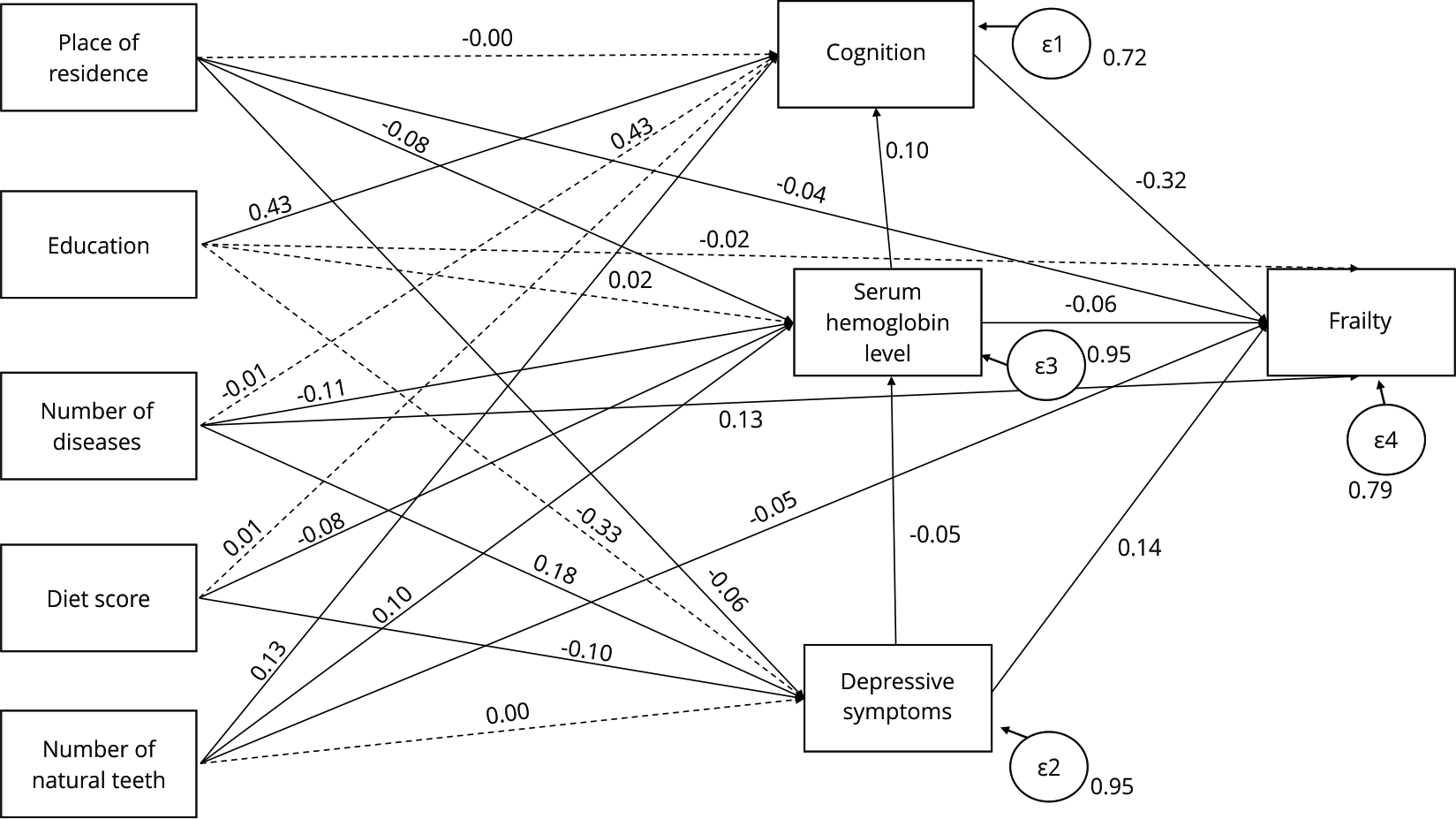 Note: only solid lines represent significant associations (p < 0.05). Reference categories of qualitative variables - age (50-59 years); place of residence (urban area); education (no education); number of natural teeth (none).