
 Health education: emphases of research published in the 2014-2024 period
Abstract
This review article aims to analyze the emphases addressed by research published in Health Education in the Journal Ciência & Saúde Coletiva over the last 10 years. Twenty-six of the 288 manuscripts submitted to Health Education from 2014 to 2024 and forwarded for peer review were accepted for publication. The published articles were analyzed under the hermeneutic-dialectical approach, and four themes were identified: (i) Health Training; (ii) Popular Education; (iii) Health Communication; and (iv) Relationships between Subjects, Knowledge, and Practices in Health. The themes were discussed to identify styles of thought and challenges in the production and publication of knowledge in Health Education within Collective Health.
Key words:
Health education; Education; continuing; Health communication; Health promotion; Public health
Resumo
Este artigo de revisão visa analisar as ênfases abordadas pelas pesquisas publicadas na área de educação em saúde da Revista Ciência & Saúde Coletiva nos últimos 10 anos. Dos 288 manuscritos submetidos à área de educação em saúde entre 2014-24 e encaminhados para a avaliação de pares, 26 foram aceitos para publicação. Os artigos publicados foram analisados segundo a abordagem hermenêutico-dialética, sendo identificadas quatro temáticas: (i) Formação em saúde; (ii) Educação popular; (iii) Comunicação em saúde; e (iv) Relações entre sujeitos, saberes e práticas em saúde. As temáticas foram problematizadas com vistas à identificação de estilos de pensamento, assim como desafios na produção e publicação de conhecimentos na área de educação em saúde, no contexto da saúde coletiva.
Palavras-chave:
Educação em saúde; Educação permanente; Comunicação em saúde; Promoção da saúde; Saúde Coletiva
Resumen
Este artículo de revisión tiene como objetivo analizar los énfasis abordados por las investigaciones publicadas en el área de educación en salud en la Revista Ciência & Saúde Coletiva, a lo largo de los últimos 10 años. De los 288 manuscritos enviados al campo de la educación en salud entre 2014 y 2024 y enviados para revisión por pares, 26 fueron aceptados para su publicación. Los artículos publicados fueron analizados según el enfoque hermenéutico-dialéctico, identificándose cuatro temas: (i) Formación en salud; (ii) Educación popular; (iii) Comunicación en materia de salud; y (iv) Relaciones entre sujetos, conocimientos y prácticas en salud. Los temas fueron problematizados con el objetivo de identificar estilos de pensamiento y desafíos en la producción y publicación de conocimiento en el área de la educación en salud, en el contexto de la salud colectiva.
Palabras clave:
Educación en salud; Educación continua; Comunicación en salud; Promoción de la salud; Salud Pública
Health education: emphases of research published in the 2014-24 period
In Brazil, the recognition of Collective Health as a field of knowledge that emerged amid movements focused on the country’s democratization, particularly between the 1970s and 1980s, highlights the social and historical nature of the construction of this scientific knowledge field. This premise reaffirms the role of culture, language, and communication in the production and dissemination of scientific facts1,2.
Considering the connection between social, economic, environmental, and cultural elements in producing health and disease, publishing knowledge in Collective Health has qualified both perspectives and investigative approaches on events that constitute social practices3-5.
In this sense, attention directed to social practices, as a human activity, considers the nature of the responses constructed in the face of social needs, and the knowledge that underpins explanations of the observed events and that promotes the construction of thought under a specific style or viewpoint in specific times and societies.
Even more explicitly, Fleck2 affirms that “the knowledge process is the human activity that most depends on social conditions, and knowledge is a social product par excellence” (p.85).
Still regarding knowledge production, Fleck2 differentiates between those who actually produce scientific facts and those who translate these facts into popular language. Through a topographical representation of two circles, one within the other, this author articulates the production, language, and means of disseminating scientific facts.
Thus, those producing or disseminating facts according to rules and technical-scientific language are called specialists and generalists and belong to the innermost circle, called the “esoteric”. Laypeople classified as “educated” are responsible for disseminating scientific facts in popular media and belong to the outermost circle, called the “exoteric”2 (Figure 1).

Regarding dissemination methods, Fleck’s categorization2 identifies reference books and scientific journals as the preferred means for technical-scientific communication among specialized researchers. Academic manuals and technical guidelines, and standards are examples of dissemination methods generally used by generalists. Finally, mass media are primarily used by laypeople to translate topics and events into more colloquial language.
Indeed, the advent of the internet and the emergence of social media have dramatically expanded access to information, enhancing the exoteric sphere’s ability to disseminate information. A side effect of these new media devices has been the increased visibility of lay opinions, which, without any regard for the veracity of the information conveyed, can disseminate false or unfounded news produced within the esoteric sphere.
Fleck2 calls the set of subjects and productions of the two circles within a given field of knowledge a “Thought Collective”. Thus, a community of people in a situation of mutual influence of thought and who interact intellectually, exchanging ideas, experiences, and reflections on events or facts within a given field of knowledge, is recognized as a thought collective.
At the same time, as a style of thought, Fleck2 identifies a singular way of seeing reality and acting upon it, rather than any other. A style is an approach, a preferred way of explaining problems that interest a thought collective, from which forms of intervention derive based on a given position and targeting specific objectives. From a thought collective, we can recognize complementary, contradictory, or even ambiguous thought styles, since reciprocal influence is dialogical in democratic environments7.
Focusing on the productions of the esoteric circle and based on the premise that researchers who publish reference books and scientific articles constitute a collective that constructs styles of thought, this article aims to investigate the thematic profile of publications in Health Education to identify the main challenges in producing styles of thought in this area of knowledge.
Health Education in the Journal Ciência & Saúde Coletiva (RC&SC)
Since its founding in 1996, RC&SC has published scientific papers in the form of debates, research, and new ideas, focusing on Collective Health with a multidisciplinary approach. The Journal’s academic relevance is evidenced by its current Qualis/CAPES ranking from the Coordination for the Improvement of Higher Education Personnel and its indexing and impact factor.
From 2014 and 2024, we identified 42,466 submissions and 4,715 scientific papers published in the RC&SC journal. The journal’s thematic fields have been progressively expanded, currently reaching 19, including critical reviews. Considering only these fields and critical reviews, 1,966 articles have been approved in the last 10 years, representing 13.36% of the total of 14,714 manuscripts submitted to the Journal in these same fields during the reference period (Table 1).
The most significant percentage of publications was in epidemiology (22.79%). This field, combined with the epidemiology of noncommunicable diseases, accounted for approximately 23.40% of the total publications in the RCSC’s thematic fields in the 2014-2024 period. In Health Education, 288 manuscripts were submitted for review, and 26 articles were approved, corresponding to 1.32% of the total publications in the Journal’s thematic fields during the period.
Methods
Twenty-six of the 288 manuscripts submitted to Health Education from 2014 to 2024 for peer review were accepted for publication in the RC&SC and subjected to analysis of their topics. Chart 1 presents these articles in chronological order of publication.
The analysis conducted was anchored in a hermeneutic-dialectical perspective as proposed by Minayo and Deslandes8, who highlights:
Hermeneutics offers the guidelines for understanding the meaning of communication between human beings; it starts with language as the common ground for achieving intersubjectivity and understanding8 (p.92).
[...] While hermeneutics seeks the bases of consensus and understanding in tradition and language, the dialectical method introduces the principle of conflict and contradiction into the understanding of reality as something permanent and explained in transformation8 (p.96).
This approach allows us to identify the extent to which published articles explored the meaning of the social events studied, considering historicity, context, and culture in social relations, which influence and determine the production of knowledge and health practices9.
In conjunction with the hermeneutic-dialectical perspective8, we aimed to identify styles of thought that could reveal meta-viewpoints of a thought collective2. In this sense, we identified hegemonic styles of thought, dissensions, and contradictions in the meanings and senses identified from the themes analyzed.
To this end, the main focuses explored by the respective authors were analyzed, considering the abstracts, keywords, investigative questions, methods employed, and discussions in the 26 articles analyzed to reveal the categories that circumscribe the themes of the set of publications. The full reading of the texts identified in which dimensions the exploration of social and historical-cultural elements in the events revealed styles of thought of the collective that chose RC&SC as a scientific space to disseminate knowledge in Health Education in the context of Collective Health.
Results and discussions
The analysis of the published articles revealed four principal themes into which the 26 articles were grouped: (i) Health Training; (ii) Health Communication; (iii) Popular Education; and (iv) Relationships between subjects, knowledge, and practices in health.
Health Training
Health Training was the topic addressed by the most significant number of articles published in Health Education from 2014 to 2024. From the ten articles linked to this topic, three analytical categories were identified: undergraduate education, postgraduate education, and continuing health education (Figure 2).

Across the board, health training was considered a critical element for improving health practices and interventions. Defined as a dynamic process that interacts with the world of work, health training was addressed across undergraduate, graduate, and professional practice levels.
Three articles focused on undergraduate education. They chose Brazilian undergraduate programs in Collective Health and other health professions and Spanish university training programs for future early childhood education teachers as their research subjects. As a thought process, these articles highlight the need to expand the connections between work and education and between technical and humanistic knowledge, highlighting the gaps or inadequacies of specific educational content or experiences relevant to the training of health professionals10-12.
The undergraduate curricula in Collective Health were analyzed in light of the National Curricular Guidelines for this field, highlighting the disciplines of Epidemiology, Health Planning and Management, and Humanities and Social Sciences as this training’s structuring axes. Based on this analysis, we underscore the lack of discussions on the challenges oriented toward a consolidated Unified Health System (SUS) and the limited availability of practical experiences in real Collective Health work scenarios11.
For other Health degrees, we highlight the incipient approach to elements related to art, culture, and aesthetics, with reflections on the predominance of the technical approach in the training of health professionals12.
Regarding the training of future early childhood education teachers, we underscore the predominance of the preventive approach regarding the health promotion concept, with reflections on the notion of health limited to the lack of disease10.
Regarding the five articles that focused on graduate programs, whether in initiatives for updating or specialization lato sensu13-15 or in residency programs16,17, the challenges explored revolved around expanding the capabilities of the profile being trained and the use of methodological innovations in educational processes. Challenges identified included positions of resistance, stemming from traditional educational models and disease-centered models; the confinement of care to the biological dimension of health-disease processes; and the disconnect or lack of qualification between management and care processes within health services.
The competing models in this field reflect different educational intentions and desired consequences for the behavior of individuals exposed to educational processes, based on the content and models chosen to approach knowledge. Regarding traditional educational models, Davini18 highlights that:
In the field of healthcare personnel training, conceptual shifts have failed to overcome the focus on knowledge transmission through classes. On the contrary, this focus continues to develop several proposals, either in parallel or simultaneously with alternative proposals. Its persistence over time can be explained, among other reasons, by the persistent school model in ways of thinking about education and by a simplified view of people and practice in the organizational field. The persistent school models are due not only to cultural factors or “mental models”, but also to a very restricted view of the concepts of learning and adult learning in organizations, according to educational theory itself18 (p.45).
Regarding the strength of the biomedical model and the difficulties of movements attempting to expand this model, Campos and Amaral19 considers that:
Traditional medicine is responsible for treating diseases; for the expanded clinic, there would be a need to broaden this scope, adding to it, besides diseases, health problems (situations that increase people’s risk or vulnerability). The most important expansion, however, would be considering that, concretely, there is no health problem or disease without them being embodied in subjects, in people19 (p.852).
As a style of thought, the discussions and considerations in this set of articles advocate strategies and tools aimed at developing critical-reflective capacities toward increasing engagement and creativity among students in the process of training and providing health care to individuals and populations. Thus, reflective narratives, collective discussions, social cartography, experimentation boxes, conceptual maps, contextualization and customization of interventions, interprofessionality, intersectorality, and the valorization of practice as a space for knowledge production were explored.
Regarding the Continuing Education category, although four of the ten articles analyzed under the heading “Health Training” included the term “Continuing Education” as a subject descriptor, two were considered in this category, and two in the postgraduate education category. In this sense, the approach to Continuing Health Education (CHE) revealed ambiguous elements in identifying thought styles. This polysemy seems relevant, since one of the articles in this category focused precisely on debating the principles that should underpin CHE initiatives20. The principal point of discord lies in the presentation of continuing education initiatives21, typically training/refresher courses or residency programs, as being lifelong learning experiences22.
In the categorization employed here, educational initiatives whose program and content are predefined and not linked to an institutional transformation strategy are inconsistent with the principles that characterize CHE and should be designated as continuing education, even if offered periodically. CHE initiatives were considered those consisting of actions aimed at debating the challenges that healthcare teams identify in their work processes. Based on these challenges, teams receive institutional support in a critical, reflective, and creative manner to develop new knowledge and improve interventions in real-life situations to improve healthcare quality20,23. In this sense, Davini18 emphasizes that the problems identified by teams in their daily work should guide reflection on practice, rather than the topics chosen by managers and organized into classes or workshops with schedules based on content or practice updates:
Bringing education closer to everyday life is the result of recognizing the educational potential of the work situation. In other words, we also learn at work. This situation involves transforming daily situations into learning experiences, reflectively analyzing practical problems, and valuing the work process itself in its intrinsic context. This perspective is centered on the work process. It is not limited to specific professional categories. However, it encompasses the entire team, including doctors, nurses, administrative staff, teachers, social workers, and all the diverse stakeholders that make up the group18 (p.45).
Health Communication
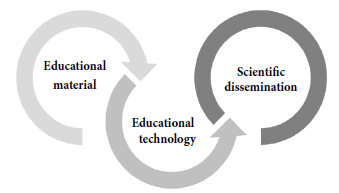
Regarding the seven articles grouped under this theme, the following analytical categories were identified: educational materials, educational technology, and scientific education (Figure 3).
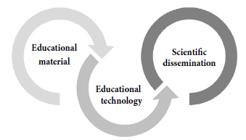
Across the board, communication was explored as a central element in the dissemination of information based on scientific evidence. In the scientific communication category, one of the articles explored the challenges of this type of dissemination, focusing on Brazilian publications in Collective Health. Aspects related to funding, journal rankings, the impact of published works, and the increasing difficulty in obtaining voluntary reviewers for scientific publications were highlighted24.
The other articles on this topic focused on health communication aimed at lay people, exploring educational materials and technologies25-28, including those whose objective was expert validation of these materials29 or the analysis of internet algorithms to support developers of disease prevention campaigns30.
Health promotion and a preventive approach were the predominant emphases, regardless of the topic addressed. Methods included descriptive exploratory approaches, literature reviews, and content validation of educational materials. In the discussions, the different cultural contexts of the target populations in the communications, the choice of resources and media used, and the desired outcome were identified as the main challenges in producing educational materials, health campaigns, and educational technology.
The identified thinking style considers that health communication should not be merely a matter of transmitting information. Although questions were raised about the content chosen and omitted in the communications investigated, and the effectiveness of materials and technologies in changing health practices, exploring the symbolic component of language was a borderline in the production of knowledge in this field. Minayo says31:
The dialectical interpretative stance recognizes social events as always having the results and effects of immediate and institutionalized creative activity. Therefore, it places social practice, human action, at the center of analysis, and considers it as a result of prior, external conditions, but also as praxis. That is, the human act that traverses the social environment preserves the determinations, but also transforms the world under the given conditions31 (p.232).
Considering the identified frontier of knowledge, the intersection and dialogue with perspectives linked to linguistics, historical materialism, and psychoanalysis could broaden the interpretation in future research on this topic. In this sense, investigative hypotheses could be formulated regarding the meaning of discourse and the educational intentionality revealed by the choice of signifiers that favor the construction of specific meanings32-34. Through these perspectives, the analysis process would advance descriptive findings and emphasize the relationships between discourse, power, ideology, and the unconscious that influence the process of producing meaning, not only as an individual product, but as a social and historical process35-37.
Popular Education
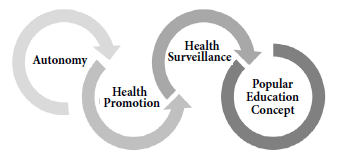
Considering the six articles grouped under this theme, four analytical categories were identified: concept of popular education, health promotion, health surveillance, and autonomy, with several articles addressing more than one category (Figure 4).

Three articles conducted theoretical investigations, two analyzed data from exploratory research, and one conducted a narrative review. Four were by Brazilian authors and two were international. In these articles, the concept of popular education was developed in conjunction with health education practices, aimed at the emancipation and awareness of individuals and social groups, and is often linked to the notion of health promotion38-40. Two of the articles grouped under this theme explored the concept of health literacy40,41.
The concept of literacy has gained greater depth over the last two decades and currently refers to:
[...] knowledge and personal skills that accumulate through daily activities, social interactions, and across generations. Knowledge and personal skills are mediated by organizational structures and the availability of resources that enable people to access, understand, evaluate, and use information and services in ways that promote and maintain good health and well-being for themselves and those around them42 (p.1582).
From the 2010s onwards, health literacy began to be explored in a way linked to the creation of educational and culturally relevant materials, and this approach was highlighted in the category of Health Communication, and more recently, articulated by Brazilian authors with the concept of popular education.
In three of the six articles, popular education was discussed as a response to community learning needs, emphasizing dialogue and the collective construction of health knowledge that should reflect cultural values and differences resulting from the socioeconomic inclusion of people in societies38-40.
Regarding the methodologies adopted to achieve goals as ambitious as they are necessary for health production, active teaching and learning methods predominated, aiming to debate experiences and reality toward constructing experiences through critique and reflection. The recognition and appreciation of the subjects’ prior knowledge and popular culture were considered strategic in this type of educational interaction, structuring the construction and deconstruction of meanings41,43.
In particular, for health surveillance38, the shift from prescriptive education to emancipatory approaches was considered a critical and co-responsible action between health professionals and people under care. Thus, normative, verticalized models based on techniques decontextualized from the values, interests, history, and culture of individuals and societies were insufficient and inefficient in the face of the Health Education challenge.
References to Paulo Freire44 are prominent in almost all national and international articles and consolidate a style of thought that attributes a role of liberation and social transformation to education. Freire emphasizes that:
Education as a practice of freedom, unlike that which is a practice of domination, implies denying the abstract, isolated, loose man, disconnected from the world, as well as the world as a reality absent from men44 (p.81).
We should consider here that the concept of education encompasses the reproduction and transformation of reality. Thus, the style of thought associated with popular education and advocated in all the articles grouped here is a critical perspective on education, focused on transforming reality through a problematizing and sensitizing approach45-48.
In this context, the interventions focused on by the authors on this topic were considered challenging, regarding the population’s active participation in producing health and pursuing social justice. Thus, the development of autonomy in health promotion was identified as a structuring axis for the individuation of subjects and for the experience of situations that result in learning and the development of reflective capacities49 that can transform social and political processes41. In the words of Freire47, also highlighted by authors of an article on this topic:
Autonomy is shaped through the experience of countless decisions that are made [...]. No one is subject to anyone else’s autonomy. On the other hand, no one matures suddenly at twenty-five. We mature every day, or not. Autonomy, as the maturation of the being for itself, is a process: it is becoming47 (p.105).
Relationships between subjects, knowledge, and practices in health
The three articles grouped under this theme identified the following categories: doctor-patient relationship, interprofessional education, and education of attitudes and values (Figure 5). The discussions developed by the authors problematized these categories in the contexts of health training and work.

The analysis of interactions between subjects focused on encounters between patients and health professionals, preceptors and students from different professions, as well as other relationships permeated by moral judgments in health care50-52. The methods used in these publications included two integrative reviews50,52 and one exploratory study51.
Regarding the relationship between doctors and patients, the thinking style found aligns with reflections already explored in the “Health Training” and “Popular Education” categories, regarding the insufficient technical approach to quality healthcare. Complex relationships were analyzed from complementary perspectives. From the patients’ perspective, poor listening, lack of interest, and prejudiced attitudes among healthcare professionals were factors that hindered healthcare delivery. From the professionals’ perspective, problems obtaining and sharing information, and patient adherence to care plans, psychosomatic and chronic illnesses, symptoms such as pain or strong emotions, and specific sociodemographic and vulnerability characteristics of patients also hindered the doctor-patient relationship50.
Regarding interprofessional education, although interprofessionality has been identified as an essential element for the effectiveness of health actions and improving the quality of care for health service users, barriers to this practice have been identified in the educational and professional systems. The following challenges were highlighted: the occasional interprofessional work in the daily lives of professionals and health services; a mix of misinformation and lack of availability; and the difficult task of combining teaching and assistance in the work of field preceptors52.
Regarding the education of attitudes and values, the differences that exclude, isolate, or hinder healthcare based on a moral judgment were analyzed according to the educational level of the subjects investigated. In this context, education was considered a characteristic that can reduce prejudice and social harms associated with situations involving stigmatizing health conditions51 and, more broadly, diverse gender, race, ethnicity, sexual orientation, disability, religion, and other characteristics. Empathy and inclusion values, when considered as belonging to the attitudinal domain and, in this sense, teaching-learning content, were linked to education focused on transforming reality and relationships between individuals.
Final considerations
Based on the selected articles, the analysis of the themes reveals the complex events involving social relations and their implications for the production of meanings in health education processes. Through a hermeneutic-dialectical approach, the need to broaden the problematization of these events points to a field for further exploration. In the concluding reflections of these articles, several authors highlighted the need for research that advances the diagnoses already established.
Thus, a broad exploration of the historical, social, and economic contexts and power relations expressed in the production and dissemination of culture, language, scientific facts, and the values that sustain and define societies may represent one of the alternatives for the necessary in-depth study. In this sense, a greater mastery of the semantic aspects of language and the social and cultural nature in the production of health communication requires theoretical frameworks and methodological approaches that explore the historical, economic, social, ideological, and even unconscious tensions that influence or determine social relations.
As a style of thought of the group of authors who published in Health Education in the C&SC Journal in the last decade, the identification of the insufficient and ineffective educational and health care models based on diseases, biomedical rationality, and the uniprofessional approach permeated the identified themes.
In a transformative way regarding this hegemonic style of thinking in the 20th century, although still found in contemporary educational and health systems, the authors advocate shifting the focus from diseases to identifying the health needs of individuals and populations. To support and instrumentalize this shift, they suggest significant changes in educational processes: the valorization of critical-reflective thinking and active learning methodologies, as well as interprofessional work and bio-psychosocial rationality, aiming at comprehensive care. Whether based on theoretical arguments or data obtained from exploratory research, the authors advocate for more effective, high-quality, inclusive, and transformative Health Education. The synthesis of research conducted in Health Education reveals frontiers for future publications, especially for those who, belonging to the collective thought of Collective Health, can take on a share of this responsibility.
References
- 1 Kuhn TS. O caminho desde a estrutura. São Paulo: Editora UNESP; 2006.
- 2 Fleck L. Gênese e desenvolvimento de um fato científico. Belo Horizonte: Fabrefactum; 2010.
- 3 Donnangelo MC, Pereira L. Saúde e sociedade. São Paulo: Duas Cidades; 1976.
- 4 Paim JS, Almeida Filho N. Saúde coletiva: uma "nova saúde pública" ou campo aberto a novos paradigmas? Rev Saude Publica 1998; 32(4):299-316.
- 5 Nunes ED. Pós-graduação em Saúde Coletiva no Brasil: Histórico e Perspectivas. Physis 2005; 15(1):13-38.
- 6 Camargo Júnior KR. Biomedicina, saber e ciência: uma abordagem crítica. São Paulo: Editora Hucitec; 2003.
- 7 Morin E. Introdução ao pensamento complexo. 3ª ed. Porto Alegre: Sulina; 2007.
- 8 Minayo MCS, Deslandes SF, organizadores. Caminhos do pensamento: epistemologia e método. Rio de Janeiro: Editora Fiocruz; 2002.
- 9 Gomes R. Análise e interpretação de dados de pesquisa qualitativa. In: Minayo MCS, Deslandes SF, Gomes R, organizadores. Pesquisa Social: teoria, método e criatividade. Petrópolis: Vozes; 2007. p. 79-108.
- 10 Llorent-Bedmar V, Cobano-Delgado V. La formación en educación para la salud del alumnado universitario del grado de educación infantil en España. Cien Saude Colet 2019; 24(8):3067-3078.
- 11 Mendonça PBS, Castro JL. O ensino da graduação em saúde coletiva: o que dizem os Projetos Pedagógicos. Cien Saude Colet 2023; 28(6):1729-1742.
- 12 Medeiros RHA. O momento cultural como Introdução de elementos estéticos na formação de profissionais do campo da saúde. Cien Saude Colet 2020; 25(11):4379-4388.
- 13 Gomes R, Lima VV. Narrativas sobre processos educacionais na saúde. Cien Saude Colet 2019; 24(12):4687-4697.
- 14 Magalhães CG, Machado VC, Ceccim RB, Amparo-Santos L, Santos VM, Cassimiro AIDN, Martins PC, Santana MLP. Obesidade, educação e mudança: deslocamentos dos sentidos e significados para profissionais de saúde da atenção básica. Cien Saude Colet 2025; 30(Supl. 1):e01312023.
- 15 Santos EAP, Zambenedetti G. O PlanificaSUS enquanto estratégia de Educação Permanente em Saúde (EPS) para o Sistema Único de Saúde (SUS). Cien Saude Colet 2025; 30(Supl. 1):e08762023.
- 16 Ferreira TPS, Noro LRA. Residências Multiprofissionais em Saúde Mental no Brasil: projetos pedagógicos e diálogos com a práxis antimanicomial. Cien Saude Colet 2025; 30(4):e17332023.
- 17 Flor TBM, Cirilo ET, Lima RRT, Sette-de-Souza PH, Noro LRA. Formação na Residência Multiprofissional em Atenção Básica: revisão sistemática da literatura. Cien Saude Colet 2022; 27(3):921-936.
- 18 Davini MC. Enfoques, Problemas e Perspectivas na Educação Permanente dos Recursos Humanos de Saúde. In: Brasil. Ministério da Saúde (MS). Secretaria de Gestão do Trabalho e da Educação na Saúde. Departamento de Gestão da Educação em Saúde. Política Nacional de Educação Permanente em Saúde. Brasília: MS; 2009. p. 39-63.
- 19 Campos GWS, Amaral MA. A clínica ampliada e compartilhada, a gestão democrática e redes de atenção como referenciais teórico-operacionais para a reforma do hospital. Cien Saude Colet 2007; 12(4):849-859.
- 20 Higashijima MNS, Slomp Junior H, Ferla AA, Feuerwerker LCM, Merhy EE, Ceccim RB, Vasconcelos J, Carli AD, Santos MLMD. Princípios e características da Educação Permanente em Saúde: resgate e resistência em favor de um SUS potente e em defesa da vida. Cien Saude Colet 2025; 30(Supl. 1):e05902023.
- 21 Peduzzi M, Guerra DAD, Braga CP, Lucena FS, Silva JAM. Atividades educativas de trabalhadores na atenção primária: concepções de educação permanente e de educação continuada em saúde presentes no cotidiano de Unidades Básicas de Saúde em São Paulo. Interface (Botucatu) 2009; 13(30):121-134.
- 22 Haddad J, Roschke MAC, Davini MC. Educación permanente de personal de salud. Washington D.C.: Organización Panamericana da la Salud; 1994.
- 23 Rozal JF, Monteiro EMLM, Marinus MWLC, Santos TA. Círculo de cultura e educação permanente para transformação da prática profissional para transformação da prática profissional: uma revisão integrativa. Cien Saude Colet 2023; 28(11):3215-3229.
- 24 Goldbaum M, Antunes JLF, Camargo Júnior KR. Relevância dos periódicos de saúde coletiva em informar a pesquisa, a educação, os serviços de saúde e a cidadania. Cien Saude Colet 2021; 26(4):1401-1405.
-
25 Albarado A, Ruy MB, Mendonça AVM. Que abordagens e tecnologias de prevenção estamos usando? Análise de campanhas de comunicação de HIV e aids no Brasil. Cien Saude Colet [periódico na internet]; 2024 [acessado 2025 maio 29]. Disponível em: http://cienciaesaudecoletiva.com.br/artigos/que-abordagens-e-tecnologias-de-prevencao-estamos-usando-analise-de-campanhas-de-comunicacao-de-hiv-e-aids-no-brasil/19400
» http://cienciaesaudecoletiva.com.br/artigos/que-abordagens-e-tecnologias-de-prevencao-estamos-usando-analise-de-campanhas-de-comunicacao-de-hiv-e-aids-no-brasil/19400 - 26 Silva NVN, Pontes CM, Sousa NFC, Vasconcelos MGL. Tecnologias em saúde e suas contribuições para a promoção do aleitamento materno: revisão integrativa da literatura. Cien Saude Colet 2019; 24(2):589-602.
- 27 Koury RDMS, Monteiro EMLM, Lima LS. Validação de brinquedo terapêutico sobre cateterismo cardíaco. Cien Saude Colet 2023; 28(6):1799-1808.
- 28 Lima PDC, Parreira CMSF, Escalda J, Sacco RDCCES, Cabral AS, Venturelli Y, Mendonça AVM, Escalda PMF. Enfrentamento de epidemias de ISTs em população jovem: caracterização da linguagem dos materiais educativos. Cien Saude Colet 2024; 29(2):e13762022.
- 29 Teixeira AR, Camanho JSP, Miguel FDS, Mega HC, Slater B. Materiais educativos digitais sobre habilidades culinárias como estratégia de promoção na atenção primária. Cien Saude Colet 2024; 29(6):e02062023.
- 30 Vasconcelos-Silva PR, Araújo-Jorge TC. Ciclos de interesse coletivo e tendências das buscas no Google relacionadas a campanhas institucionais sobre o câncer de próstata: promovendo saúde ou doenças? Cien Saude Colet 2021; 26(Supl. 2):3517-3525.
- 31 Minayo MCS. O desafio do conhecimento: pesquisa qualitativa em saúde. Rio de Janeiro: Editora Hucite-Abrasco; 1994.
- 32 Suassure F. Curso de linguística geral. 28ª ed. São Paulo: Cultrix; 2012.
- 33 Gadamer H. Verdade e Método. Petrópolis: Vozes; 1999.
- 34 Habermans J. Dialética e Hermenêutica. São Paulo: L± 1987.
- 35 Bourdieu P. Razões práticas: sobre a teoria da ação. Campinas: Papirus; 1996.
- 36 Foucault M. Microfísica do poder. 14ª ed. Rio de Janeiro: Edições Graal; 1999.
- 37 Lacan J. O seminário, livro 5: as formações do inconsciente. Rio de janeiro: Zahar; 1999.
- 38 Arjona FBS, Meneses MN, Cárcamo MIC, Rocha CMF, Dias AP, Machado JMH, Carneiro FF. A contribuição do pensamento de Paulo Freire para a vigilância popular em saúde. Cien Saude Colet 2024; 29(6):e12312023.
- 39 Brito PNA, Santana ELP, Moraes OA, Silva JCD, Cruz PJSC. O que se tem discutido sobre educação popular em saúde nos últimos anos: uma revisão narrativa da literatura. Cien Saude Colet 2024; 29(6):e12542023.
-
40 Akerman M, Castro AM, Santos CA, Cruz PJSC, Rego NRP, Peres F. Aproximações entre promoção da saúde, educação popular em saúde, comunicação e literacia em saúde: costurando linhas do tempo. Cien Saude Colet [periódico na internet]; 2024 [acessado 2025 maio 29]. Disponível em: http://cienciaesaudecoletiva.com.br/artigos/aproximacoes-entre-promocao-da-saude-educacao-popular-em-saude-educomunicacao-e-literacia-em-saude-costurando-linhas-do-tempo/19425?id=19425
» http://cienciaesaudecoletiva.com.br/artigos/aproximacoes-entre-promocao-da-saude-educacao-popular-em-saude-educomunicacao-e-literacia-em-saude-costurando-linhas-do-tempo/19425?id=19425 - 41 Villa-Vélez L. Educación para la salud y justicia social basada en el enfoque de las capacidades: una oportunidad para el desarrollo de la salud pública. Cien Saude Colet 2020; 25(4):1539-1546.
- 42 Nutbeam D, Muscat DM. Health Promotion Glossary 2021. Health Promot Int 2021; 36(6):1811.
- 43 Rico-Sapena N, Galiana-Sanchez ME, Bernabeu-Mestre J, Trescastro-López EM, Vasallo JM. Efectos de un programa alternativo de promoción de la alimentación saludable en comedor escolar. Cien Saude Colet 2019; 24(11):4071-4082.
- 44 Freire P. Pedagogia da Esperança: um reencontro com a Pedagogia do Oprimido. São Paulo: Paz e Terra; 1994.
- 45 Apple MW. Educação e poder. Poro Alegre: Artes Médicas; 1989.
- 46 Girox HA. Os professores como intelectuais: rumo a uma pedagogia crítica. Porto Alegre: Artes Médicas; 1997.
- 47 Freire P. Pedagogia da Autonomia. São Paulo: Paz e Terra; 2002.
- 48 Saviani D. Educação, pedagogia histórico-crítica e BNCC. São Paulo: Expressão popular; 2025.
- 49 Cerrón MM, Mayer FB, Arantes-Costa FM, Tempski PZ. O desenvolvimento da autonomia em adolescentes com síndrome de Down a partir da pedagogia de Paulo Freire. Cien Saude Colet 2021; 26(8):3019-3030.
- 50 Cruvinel PVQ, Grosseman S. Afinal, quem é "difícil"? Revisão integrativa sobre pacientes, médicos e relações difíceis. Cien Saude Colet 2023; 28(6):1685-1701.
- 51 Gallassi AD, Oliveira KD, Silva MNRMO, Machado IA, Wagner GA. The relationship between level of education and moral judgment toward who abuse drugs. Cien Saude Colet 2021; 26(6):2335-2343.
- 52 Souza CMS, Oliveira ACM, Leonello VM. Barreiras para a preceptoria na educação interprofissional: uma revisão integrativa. Cien Saude Colet 2025; 30(Supl. 1):e11472023.

 Source: Adapted from Camargo Júnior
 Source: Author.
 Source: Author.
 Source: Author.
 Source: Author.