person Iolanda Karla Santana dos Santos
concepção e desenho do estudo · análise e interpretação dos dados · elaboração da primeira versão · revisão crítica do texto · aprovação da versão final
schoolFaculdade de Saúde Pública, Universidade de São Paulo. Av. Dr. Arnaldo 715, Cerqueira César. 01246-904 São Paulo SP Brasil. iosantanasantos@gmail.comUniversidade de São PauloBrasilSão Paulo, SP, BrasilFaculdade de Saúde Pública, Universidade de São Paulo. Av. Dr. Arnaldo 715, Cerqueira César. 01246-904 São Paulo SP Brasil. iosantanasantos@gmail.com
person Camila Medeiros da Silva Mazzeti
análise e interpretação dos dados · revisão crítica do texto · aprovação da versão final
schoolFaculdade de Ciências Farmacêuticas, Alimentos e Nutrição, Universidade Federal de Mato Grosso do Sul. Campo Grande MS Brasil.Universidade Federal de Mato Grosso do SulBrasilCampo Grande, MS, BrasilFaculdade de Ciências Farmacêuticas, Alimentos e Nutrição, Universidade Federal de Mato Grosso do Sul. Campo Grande MS Brasil.
person Débora Borges dos Santos Pereira
análise e interpretação dos dados · revisão crítica do texto · aprovação da versão final
schoolFaculdade de Saúde Pública, Universidade de São Paulo. Av. Dr. Arnaldo 715, Cerqueira César. 01246-904 São Paulo SP Brasil. iosantanasantos@gmail.comUniversidade de São PauloBrasilSão Paulo, SP, BrasilFaculdade de Saúde Pública, Universidade de São Paulo. Av. Dr. Arnaldo 715, Cerqueira César. 01246-904 São Paulo SP Brasil. iosantanasantos@gmail.com
person Claudia Cristina Gonçalves Pastorello
análise e interpretação dos dados · revisão crítica do texto · aprovação da versão final
schoolFaculdade de Saúde Pública, Universidade de São Paulo. Av. Dr. Arnaldo 715, Cerqueira César. 01246-904 São Paulo SP Brasil. iosantanasantos@gmail.comUniversidade de São PauloBrasilSão Paulo, SP, BrasilFaculdade de Saúde Pública, Universidade de São Paulo. Av. Dr. Arnaldo 715, Cerqueira César. 01246-904 São Paulo SP Brasil. iosantanasantos@gmail.com
person Mariane Helen de Oliveira
análise e interpretação dos dados · revisão crítica do texto · aprovação da versão final
schoolFaculdade de Saúde Pública, Universidade de São Paulo. Av. Dr. Arnaldo 715, Cerqueira César. 01246-904 São Paulo SP Brasil. iosantanasantos@gmail.comUniversidade de São PauloBrasilSão Paulo, SP, BrasilFaculdade de Saúde Pública, Universidade de São Paulo. Av. Dr. Arnaldo 715, Cerqueira César. 01246-904 São Paulo SP Brasil. iosantanasantos@gmail.com
person Wolney Lisbôa Conde
concepção e desenho do estudo · análise e interpretação dos dados · elaboração da primeira versão · revisão crítica do texto · aprovação da versão final
schoolFaculdade de Saúde Pública, Universidade de São Paulo. Av. Dr. Arnaldo 715, Cerqueira César. 01246-904 São Paulo SP Brasil. iosantanasantos@gmail.comUniversidade de São PauloBrasilSão Paulo, SP, BrasilFaculdade de Saúde Pública, Universidade de São Paulo. Av. Dr. Arnaldo 715, Cerqueira César. 01246-904 São Paulo SP Brasil. iosantanasantos@gmail.com
Editores-chefes:
Maria Cecília de Souza Minayo, Romeu Gomes, Antônio Augusto Moura da Silva

 Inequalities in the adequacy to consultation calendar for children under 5 years old in the Food and Nutritional Surveillance
 Thumbnail
 Thumbnail
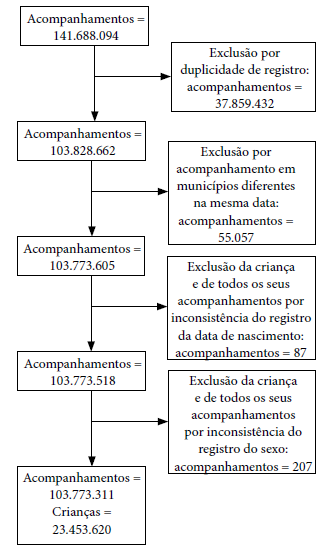 SISVAN, 2008-2020.Fonte: Autores.
 SISVAN, 2008-2020.Fonte: Autores.