person Carla Elane Silva dos Santos
made important contributions and met the criteria for authorship of this study · all phases of the study design · data analysis · preparation of graphical representations · literature search · interpretation of results · writing of the manuscript
schoolPrograma de Pós-Graduação em Educação Física, Universidade Federal de Santa Catarina. Campus Universitário Reitor João David Ferreira Lima, Prédio administrativo, Centro de Desportos, sala 200, 2º andar, Trindade. 88040-900 Florianópolis SC Brasil. carlaef_uesb@hotmail.comUniversidade Federal de Santa CatarinaBrasilFlorianópolis, SC, BrasilPrograma de Pós-Graduação em Educação Física, Universidade Federal de Santa Catarina. Campus Universitário Reitor João David Ferreira Lima, Prédio administrativo, Centro de Desportos, sala 200, 2º andar, Trindade. 88040-900 Florianópolis SC Brasil. carlaef_uesb@hotmail.com
person Adalberto Aparecido dos Santos Lopes
made important contributions and met the criteria for authorship of this study · data analysis writing · critical manuscript review · critical review of the manuscript
schoolPrograma de Pós-Graduação em Ambiente e Saúde, Universidade do Planalto Catarinense. Lages SC Brasil.Universidade do Planalto CatarinenseBrasilLages, SC, BrasilPrograma de Pós-Graduação em Ambiente e Saúde, Universidade do Planalto Catarinense. Lages SC Brasil.
person Joel de Almeida Siqueira Junior
made important contributions and met the criteria for authorship of this study · writing of the manuscript · critical manuscript review at all stages
schoolPrograma de Pós-Graduação em Educação Física, Universidade Federal de Santa Catarina. Campus Universitário Reitor João David Ferreira Lima, Prédio administrativo, Centro de Desportos, sala 200, 2º andar, Trindade. 88040-900 Florianópolis SC Brasil. carlaef_uesb@hotmail.comUniversidade Federal de Santa CatarinaBrasilFlorianópolis, SC, BrasilPrograma de Pós-Graduação em Educação Física, Universidade Federal de Santa Catarina. Campus Universitário Reitor João David Ferreira Lima, Prédio administrativo, Centro de Desportos, sala 200, 2º andar, Trindade. 88040-900 Florianópolis SC Brasil. carlaef_uesb@hotmail.com
person Eleonora d’Orsi
made important contributions and met the criteria for authorship of this study · acted as senior reviewer · critical manuscript review at all stages · responsible for the organization · coordination of the EpiFloripa Aging study
schoolPrograma de Pós-Graduação em Saúde Coletiva, Universidade Federal de Santa Catarina. Florianópolis SC Brasil.Universidade Federal de Santa CatarinaBrasilFlorianópolis, SC, BrasilPrograma de Pós-Graduação em Saúde Coletiva, Universidade Federal de Santa Catarina. Florianópolis SC Brasil.
person Thiago Sousa Matias
made important contributions and met the criteria for authorship of this study · all phases of the study design · data analysis · preparation of graphical representations and interpretation of results
schoolPrograma de Pós-Graduação em Educação Física, Universidade Federal de Santa Catarina. Campus Universitário Reitor João David Ferreira Lima, Prédio administrativo, Centro de Desportos, sala 200, 2º andar, Trindade. 88040-900 Florianópolis SC Brasil. carlaef_uesb@hotmail.comUniversidade Federal de Santa CatarinaBrasilFlorianópolis, SC, BrasilPrograma de Pós-Graduação em Educação Física, Universidade Federal de Santa Catarina. Campus Universitário Reitor João David Ferreira Lima, Prédio administrativo, Centro de Desportos, sala 200, 2º andar, Trindade. 88040-900 Florianópolis SC Brasil. carlaef_uesb@hotmail.com
person Cassiano Ricardo Rech
made important contributions and met the criteria for authorship of this study · acted as mentor and senior reviewer · conceptualization and initial design of the study · critically reviewed the manuscript throughout all stages
schoolPrograma de Pós-Graduação em Educação Física, Universidade Federal de Santa Catarina. Campus Universitário Reitor João David Ferreira Lima, Prédio administrativo, Centro de Desportos, sala 200, 2º andar, Trindade. 88040-900 Florianópolis SC Brasil. carlaef_uesb@hotmail.comUniversidade Federal de Santa CatarinaBrasilFlorianópolis, SC, BrasilPrograma de Pós-Graduação em Educação Física, Universidade Federal de Santa Catarina. Campus Universitário Reitor João David Ferreira Lima, Prédio administrativo, Centro de Desportos, sala 200, 2º andar, Trindade. 88040-900 Florianópolis SC Brasil. carlaef_uesb@hotmail.com
Chief editors:
Maria Cecília de Souza Minayo, Romeu Gomes, Antônio Augusto Moura da Silva, Vania de Matos Fonseca

 Are clusters of physical activity, diet and sedentary behavior associated with mental health in Brazilian older adults?
 Thumbnail
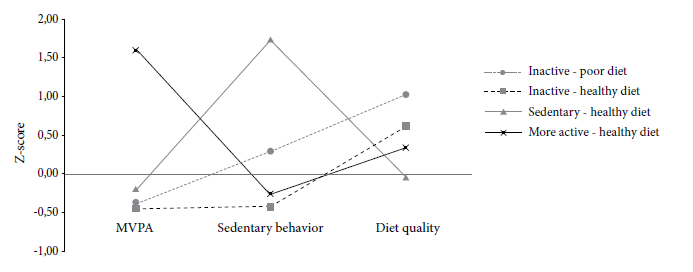 Note: MVPA: moderate to vigorous physical activity. Source: Authors.