
 Are clusters of physical activity, diet and sedentary behavior associated with mental health in Brazilian older adults?
Abstract
This study described the clustering of physical activity (PA), diet quality and sedentary behavior (SB), and examined the associations between these clusters and depressive symptoms and Mild Cognitive Impairment (MCI) in Brazilian older adults. The sample consisted of 1,261 subjects (≥60 years; 63% women) of EpiFloripa Aging Study (2017-2019). Depressive symptoms e MCI were screened by the Geriatric Depression Scale and Mini Mental State Examination, respectively. Weekly frequency of moderate-to-vigorous PA, diet and time spent on SB, were assessed by questionnaires. Two-step cluster analysis was used to identify patterns of behavior, and binary logistic regression was used to test the association between variables. Four clusters were identified: inactive/poor diet; inactive/healthy diet; sedentary/healthy diet and more active/healthy diet. Older adults with a “more active/healthy diet” profile were less likely to have mild cognitive impairment (OR: 0.48; 95%CI: 0.24-0.97) and depressive symptoms (OR: 0.36; 95%CI: 0.16-0.78) compared to the “inactive/poor diet” cluster. The analytical and conceptual cluster model suggested a beneficial association between the “more active/healthy diet” profile and mental health.
Key words:
Mental health; Aged; Healthy lifestyle
Resumo
Este estudo descreveu agrupamentos de atividade física (AF), qualidade da dieta e comportamento sedentário (CS), e analisou as associações entre os agrupamentos e sintomas depressivos e comprometimento cognitivo (CCL) em idosos brasileiros. A amostra foi composta de 1.261 participantes (≥60 anos; 63mulheres) do estudo EpiFloripa Idoso. Sintomas depressivos e CCL foram rastreados pela Escala de Depressão Geriátrica e Mini Exame do Estado Mental, respectivamente. A frequência semanal de atividade física moderada-a-vigorosa, qualidade da dieta e tempo despendido em CS foram mensurados por questionários. Análise de agrupamento em duas etapas foi usada para identificar os padrões do estilo de vida, e a regressão logística binária foi usada para testar as associações entre as variáveis. Quatro agrupamentos foram identificados: inativo/dieta pobre; inativo/dieta saudável; sedentário/dieta saudável e mais ativo/dieta saudável. Idosos com perfil “mais ativo/dieta saudável” tiveram menos chance de CCL (OR: 0,48; IC95%: 0,24-0,97) e sintomas depressivos (OR: 0,36; IC95%: 0,16-0,78) quando comparados ao agrupamento “inativo/dieta pobre”. O modelo de agrupamento analítico e conceitual sugeriu associação benéfica entre o perfil “mais ativo/dieta saudável” e saúde mental.
Palavras-chave:
Saúde mental; Idoso; Estilo de vida saudável
Resumen
Este estudio describió grupos de actividad física (AF), calidad de la dieta y comportamiento sedentario (CS), y analizó las asociaciones entre estos grupos y los síntomas depresivos y el deterioro cognitivo (DC) en brasileños mayores. La muestra consistió en 1.261 participantes (≥60 años; 63 mujeres) del estudio EpiFloripa Idoso. Los síntomas depresivos y el DC se evaluaron utilizando la Escala de Depresión Geriátrica y el Mini-Examen del Estado Mental, respectivamente. La frecuencia semanal de actividad física moderada a vigorosa, la calidad de la dieta y el tiempo dedicado al CS se midieron mediante cuestionarios. Se utilizó un análisis de grupos de dos etapas para identificar patrones de estilo de vida, y se utilizó una regresión logística binaria para probar las asociaciones entre las variables. Se identificaron cuatro grupos: dieta inactiva/mala; dieta inactiva/saludable; dieta sedentaria/saludable; y dieta más activa/saludable. Los adultos mayores con una dieta más activa/saludable presentaron una menor probabilidad de deterioro cognitivo leve (OR: 0,48; IC del 95 %: 0,24-0,97) y síntomas depresivos (OR: 0,36; IC del 95 %: 0,16-0,78) en comparación con el grupo con una dieta inactiva/mala. El modelo de agrupamiento analítico y conceptual sugirió una asociación beneficiosa entre la dieta más activa/saludable y la salud mental.
Palabras clave:
Salud mental; Adultos mayores; Estilo de vida saludable
Background
The world’s population is aging rapidly, and with it the concern for the mental health of older people is growing1. It is estimated that depressive symptoms affect around 28.4% of the older population worldwide2, while the prevalence of mild cognitive impairment (MCI) ranges from 5% to 41%3. Evidence indicates that adopting healthy behaviors, including regular physical activity (PA), consuming a healthy diet and reducing time sedentary behavior (SB), contributes to reducing the risks of depressive symptoms4,5 and MCI in older adults6,7.
While the underlying mechanisms of these mental conditions are not fully understood, studies show that engaging in physical activity alone improves cognitive outcomes by reducing pro-inflammatory cytokines, such as tumor necrosis factor-alpha and interleukin-6, commonly known in neurodegenerative diseases8. PA triggers an increase in levels of brain-derived neurotrophic factor and contributes to the release of hormones associated with well-being, such as noradrenaline and serotonin9. This process promotes improvement in depression symptoms9. Additionally, physical activity can boost self-esteem and self-confidence among older adults9.
The literature also observes gains in memory and attention with the intake of nutritious foods10. Consuming fish11, flavonols, and monomeric teaflavins, mainly from teas12, as well as having a higher dietary quality, is related to a lower likelihood of depressive symptoms in older adults13. There’s potential synergy between consuming antioxidant-rich foods and engaging in physical activity for cognitive health14.
On the other hand, sedentary behavior (SB) is associated with elevated inflammatory status indicated by biomarkers such as C-reactive protein15,16 and interleukin-616, as well as white matter hyperintensity17. These factors are considered causal influencers of depressive symptoms18 and MCI19. However, older adults who spend less than four hours per day in sedentary behavior show less cognitive impairment20.
It’s important to consider that PA, dietary habits and SB don’t occur in isolation in the lives of older adults but may depend on a lifestyle that interrelates favorable and unfavorable behaviors. Generally, behavioral patterns characterized by higher levels of PA and less time spent in SB are associated with a lower risk of metabolic syndrome21,22 and a body composition more conducive to health23. Furthermore, older adults who habitually consume fruits and vegetables most days of the week and engage in regular PA are more likely to report life satisfaction24. Specifically, regarding mental health, greater involvement in PA compared to SB has shown significant benefits in cognitive function25,26. However, there’s no evidence of synergy between PA and a healthy diet in cognitive function27. In terms of depressive symptoms, the unfavorable combination of not meeting PA guidelines and spending excessive time in SB increased the chances of adverse outcomes in older adults4.
Studies investigating the synergy between PA, diet and SB in the mental health of older adults have been limited to analyzing only two of these components, either the relationship between PA and diet27 or between PA and SB4. However, considering that PA, SB, and dietary habits are behaviors shaped over a lifetime and susceptible to modifications28, exploring these aspects collectively may provide valuable insights for mental health care29.
The development of interventions considering multiple health behaviors requires a thorough understanding of how these behaviors cluster in different individual profiles. In this regard, cluster analysis is considered a multivariate data method recommended for its ability to group individuals into mutually exclusive sets, considering similar characteristics and behaviors30. Previous studies with older adults have also employed cluster analysis as a clustering method22,23. However, it is still not clear how lifestyle behaviors naturally cluster and whether they influence the risk of MCI and depressive symptoms in older adults.
Therefore, considering the potential of cluster analyses and the possibility of providing an integrated understanding of elderly care, the present study aimed to describe clusters of PA, dietary quality and SB, and examine the associations between these clusters and depressive symptoms and MCI in Brazilian older adults.
Methods
This is a cross-sectional study conducted by face-to-face interviews at the older adult’s home, using data from the third wave (2017-2019) of the population-based cohort study entitled “EpiFloripa Aging Study - Health Conditions of Older Adults in Florianópolis, SC” (https://epifloripaidoso.paginas.ufsc.br/#). The sample consisted of older adults (≥60 years old) of both sexes, living in the urban area of the city, capital of Santa Catarina state, southern Brazil. The city has a high Human Development Index (HDI) compared to the national average (0.847 versus 0.755), with the longevity dimension being the one that most contributed to the HDI, followed by income and education, with indices of 0.873, 0.870 and 0.800, respectively31. The study was approved by the Federal University of Santa Catarina’s Research Ethics Committee involving human beings (approval No. 16731313.0.0000.0121).
Sampling and selection of participants
The sampling plan of the third wave carried out in 2017/2019 (1,335 older adults) was based on the sampling technique used in the first wave of the study, in 2009/2010 (1,702 older adults), then in 2013/2014 follow-up (1,197 older adults)32, as well as on demographic census data to guarantee the representativeness of the older adults residing in the urban area of the city. With the third wave, the cohort became open and included new older adults belonging to the census sectors of the first wave, and those who participated in the Epifloripa Adult (EpiFloripa Adulto) study (2009-2010), and who turned 60 years of age as of July 201833. Were included older adults (≥60 years) and were excluded institutionalized.
Outcomes
Presence of depressive symptoms was obtained by applying the Geriatric Depression Scale (GDS), validated and adequate for the Brazilian older adults34.The original English version35 was translated into Portuguese and then back-translated into English by an independent translator. The English back-translation was compared to the original instrument, and minor adjustments were made to produce the final Brazilian version of the scale34. This instrument is composed of 15 questions and with answer options (yes/no). The instrument has a score that varies from zero (absence of depressive symptoms) to fifteen (maximum score of depressive symptoms). The cutoff point ≥6 points was considered indicative of the presence of depressive symptoms in older adults34.
Mild cognitive impairment was assessed using the Mini-Mental State Examination (MMSE), which is considered a cognitive assessment test that covers the domains of temporal and spatial orientation, recent and recall memory, calculation, comprehension and writing36. The MMSE score can range from 0 to 30 points, and the presence of cognitive decline was considered when the older adults without schooling achieved scores <19, while <24 points were considered among those with some educational level37. The MMSE presented a sensitivity of 80.0% and a specificity of 70.9% for the diagnosis of dementia among older adults without schooling; and 77.8% and 75.4% of sensitivity and specificity, respectively, for those with school history37.
Exposure
The behavioral cluster, considered as the exposure variable, was built taking the following variables into account: 1) the weekly frequency of moderate to vigorous physical activity (MVPA) during leisure time, measured with the long version of the International Physical Activity Questionnaire (IPAQ), adapted and validated for Brazil’s older population (36 women and 29 men)38,39; 2) sedentary behavior (min/day), operationally obtained by self-reporting of average screen time (watching television or using the computer), performed in the sitting, lying or reclining position40. The instrument used to measure sedentary behavior (Measure of Older Sedentary Time) demonstrated consistent test-retest reliability, making it suitable for use with older adults40. The cross-culturally adapted for Brazilian older adults also showed appropriate psychometric properties for assessing sedentary behavior41; and 3) food consumption (weekly frequency)42, obtained by self-reporting of the frequency of days of the week (0-7 days) in which the following foods are consumed: 3.1) vegetables (raw or cooked with food or in soup, except for potatoes, cassava or yam); 3.2) fruits (fresh); 3.3) beans; 3.4) whole grains (containing ingredients such as oatmeal, flaxseed, quinoa, granola, brown rice, whole wheat pasta, etc.); 3.5) fried foods (foods with a lot of fat in their preparation); 3.6) sugary drinks (soda and artificial juice), and 3.7) sweets (ice cream, cake, chocolates, cookies and pastries). The first four food groups were considered unprocessed/minimally processed43, and the other items, as ultra-processed. A score was created based on the frequency of consumption of the seven types of food to identify the nutritional diet quality. For the group of unprocessed/minimally processed foods, the scale ranged from 0 (no consumption) to 7 (every day); and for the ultra-processed group, the scale ranged from 7 (no consumption) to 0 (every day). Thus, the total score can range from 0 to 49 points, being that the higher the score the better the nutritional quality of the diet44.
Control variables
We selected covariates identified in the literature as relevant to the relationship between outcomes and exposure45-51: sex (male and female), age (completed in years), education (completed years) and living alone (yes/no) variables were included. Self-reported presence of diabetes and history of stroke were identified by the question “Has any doctor or health professional ever said that you currently have/have had?”, with yes/no as answer options. Functional dependence was assessed using the Brazilian Multidimensional Functional Assessment Questionnaire, adapted from the Old Americans Resources and Services, validated for Brazil52. The variable was categorized into no functional dependence (absence of dependence), mild dependence (dependence in one to three activities) and moderate/severe (dependence in four or more activities) within a set of 15 activities52.
Statistical analysis
Descriptive analyses were performed, including mean and standard deviation, relative and absolute frequencies, and 95% confidence intervals. Two-step cluster analysis30 was used to form a cluster based on three variables: 1) MVPA (frequency/week); 2) sedentary behavior (min/week), and 3) diet (consumption/no consumption of unprocessed, minimally processed and ultra-processed foods). The number of clusters was based on the best combination of low Bayesian Information Criterion (BIC), the high proportion of distance measures, and the high proportion of BIC changes, as well as significant conceptual considerations. Cluster quality in the total dataset was analyzed by silhouette coefficient indicating cohesion and separation (silhouette ranging from -1 to +1; a high value indicates that the object matches well with its own cluster and poorly with neighboring clusters). The relative importance of each variable in the model was also observed. The importance of the predictor ranges from 0 to 1 (values close to 1 mean relatively greater importance). All three variables reached values equal to 1. Four clusters were identified in the sample of this study and labeled in accordance with the most pronounced behavioral profile.
Crude and adjusted logistic regression by covariates considered relevant in the literature45-51 and their respective 95% confidence intervals (95%CI) were used to test the association between the outcomes (depressive symptoms and mild cognitive impairment) and the identified clusters (exposure). The significance level was set as p<0.05 in all inferential statistics, considering the sample weights. Statistical analyses were performed using the Stata Statistical software (version 13; StatCorp LLC, College Station, TX), except for cluster analysis, which was performed using the Statistical Package for the Social Sciences software for Windows (version 23; SPSS Inc., Chicago, IL).
Results
A total of 1,335 older adults (between 60 and 108 years old) participated in the study. Of these, 53 interviews were considered losses because they were answered by caregivers, and 21 were due to incomplete data, an important condition for Two-Step cluster analysis. Thus, the final sample consisted of 1,261 older adults (age: 73.1±7.7, 63.1% women). In general, the older adults had 9.0±6.1 years of schooling; 22.2% lived alone (95%CI: 19.6-24.1); performed MVPA less than one day/week (0.3±0.8); spent >3 hours/day on sedentary behavior (220.6±154.4); consumed vegetables (5.4±2.2), fruits (6.3±1.6), and beans (4.2±2.5) most days of the week, and the average diet quality score was 26.5 (±12.5). Among the older adults, 26% reported having diabetes (95%CI: 23.3-28.1), 8% had a history of stroke (95%CI: 7.6-10.8), and 38% had mild functional dependency (95%CI: 34.7-40.1). Presence of depressive symptoms and mild cognitive impairment stood at 14.7% (95%CI: 11.9-17.8) and 17.3% (95%CI: 14.1-21.1), respectively (Table 1).
Cluster profile description
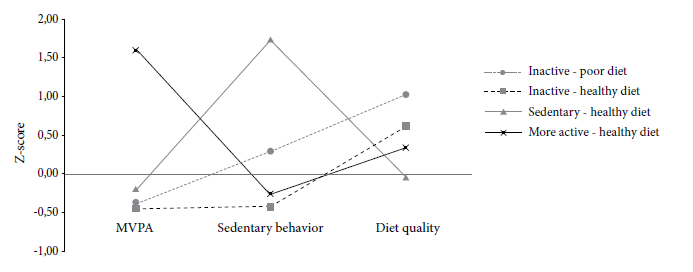
Four behavioral clusters were identified in the sample of older adults and defined as “inactive/poor diet” (Cluster 1), “inactive/healthy diet” (Cluster 2), “sedentary/healthy diet” (Cluster 3), “more active/healthy diet” (Cluster 4), as shown in Figure 1. The “inactive/poor diet” profile (Cluster 1) profile represented a quarter of the sample (25.4%; 95%CI: 22.3-28.9) and was characterized by engagement in MVPA less than once/week; daily expenditure on sedentary behavior of approximately two hours, and worse diet quality score. The “inactive/healthy diet” profile (Cluster 2) has the highest percentage of older adults (39.5%; 95%CI: 35.9-43.2), the lowest average weekly frequency of MVPA; high sedentary behavior (>3 hours/day), and better diet quality. The third cluster, “sedentary/healthy diet”, comprised 17.2% and included a weekly MVPA frequency of less than one day/week; more time spent on sedentary behavior (>8 hours/day), and a score of 25.3 points for diet quality. The “more active/healthy diet” profile (Cluster 4) accounted for 17.9 (95%CI: 15.4-20.6) of the sample and had the highest average weekly frequency of MVPA (1.7 days/week), daily expenditure of more than three hours/day on sedentary behavior, in addition to scoring 29.9 points on diet quality, which is above the group median (Table 2).
Mean z-score of moderate-to-vigorous physical activity, sedentary behavior and diet quality according to cluster profiles in older adults Brazilians. EpiFloripa Aging Study, 2017-2019 (n=1,261).
Association of cluster patterns and mental health
Table 3 shows that the older adults with a “more active/healthy diet” profile are less likely to have mild cognitive impairment (OR: 0.48; 95%CI: 0.24-0.97) and depressive symptoms (OR: 0.36; 95%CI: 0.16-0.78) compared to the “inactive/poor diet” risk cluster, after adjustment for confounding variables.
Discussion
This study described clusters of PA, SB, and dietary quality, and analyzed their association with depressive symptoms and MCI in older adults. Four lifestyle profiles were identified, encompassing different behaviors in their compositions. The majority of older adults were grouped into subgroups recognized as more negative (inactive/poor diet and inactive/healthy diet), while a smaller proportion (35.1%) exhibited more positive profiles: “sedentary/healthy diet” and “more active/healthy diet”.
Indeed, older adults are one of the age groups facing significant socioeconomic challenges, exposed to low levels of adherence to healthy behaviors, and consequently more susceptible to the onset of non-communicable chronic diseases, including mental health issues53. At least two risk factors are present in the lifestyle of older adults54,55. However, previous studies have emphasized the importance of considering both the presence of positive and negative behaviors in analytical models, as they coexist among older adults22,23. Additionally, a combination of multiple behaviors will better predict the overall lifestyle of older adults, providing a more realistic view for healthcare interventions22,23.
In this study, only the older adults with a “more active/healthy diet” profile were less likely to have MCI. Although the mechanisms underlying these mental conditions are not fully understood, studies show that adopting a diet rich in healthy foods not only reduces the presence of inflammatory markers7, but also regulates BDNF56, leading to significant improvements in memory and attention10. In addition, MVPA recognized as an ally in maintaining cognitive function50,57, has been shown to increase brain cortical plasticity, improve neurological connectivity58 and enhance cognitive performance over time59. In addition, there appears to be a potential synergy between the consumption of antioxidant-rich foods and physical activity for cognitive health14. Despite the presence of sedentary behavior (score below the sample average) that may reduce cognitive function50 in the “more active/healthy diet” cluster, a reduction in the likelihood of MCI was observed. In this sense, a lifestyle associated with more positive factors seems to protect mental health. Therefore, healthcare should pay more attention to valuing different behaviors60 to reduce the likelihood of MCI in older adults.
In this study, the older people with the “more active/healthy diet” profile also had a lower risk of depressive symptoms. Although there are no specific studies on the behavioral synergy of lifestyle in relation to depressive symptoms, it is known that regular physical activity is an ally in reducing depressive symptoms in the older adults. Apparently, physical activity triggers an increase in BDNF levels and, together with the release of hormones associated with well-being, such as noradrenaline and serotonin, contributes to an improvement in depressive symptoms9. PA can also increase self-esteem and self-confidence in older people9.
When performed in groups, PA still promotes the formation of bonds and a broader support network, leading to a reduction in depressive symptoms61,62. On the other hand, the unfavorable combination of non-compliance with physical activity guidelines and excessive sedentary behavior increases the risk of negative outcomes in older adults4. Fish consumption11 and a high-quality diet are associated with a lower likelihood of depressive symptoms in older adults13. Considering lifestyle behavioral synergy in the development of public policies may be an effective strategy to promote mental health in older adults.
Given the significant influence that lifestyle clusters exert on MCI and depressive symptoms among older adults, the development of health interventions with an interprofessional team and a multi-component approach appears promising. Initiatives such as memory workshops63 and cognitive stimulation programs64 not only stimulate cognition but also promote socialization63,64 and engagement in PA63 among older adults. Organizing social groups for older adults in Primary Health Care with a focus on various leisure activities can foster the building of bonds and autonomy in living65. Additionally, interventions with participatory approaches can guide lifestyle changes, including diet and physical activity, providing mental health benefits for older adults66.
When interpreting the results of this study, some limitations must be considered and extrapolations should be made with caution. Due to the continental characteristics of Brazil, the findings may differ from the national scenario, as they reflect the contextual characteristics of a single city in the southern region of Brazil, which has a high HDI31. Survivorship bias may have reduced the prevalence of MCI and depressive symptoms, as these are directly related to mortality67,68. Given that the sample predominantly consisted of older adults who self-identified as white (88%), the race/color variable was not considered in the study analysis due to its limited contribution. The lack of research on the relationship between lifestyle clusters and mental health made it difficult to compare the findings. Furthermore, due to the cross-sectional design, it was not possible to draw causal conclusions between lifestyle clusters and MCI and depressive symptoms.
On the other hand, the methodology using representative data from the older adult population of a large city with over 485 thousand inhabitants31 allowed for greater statistical certainty in the formation of the clusters and the identification of coexisting lifestyle behaviors30. We selected a set of behavioral variables relevant to mild cognitive impairment (MCI) and depressive symptoms. In addition, the organization of the design and data collection, including the standardized training of interviewers and the use of validated questionnaires for older adults33, is considered a strength of the present study.
Conclusion
The lifestyle cluster characterized by a higher weekly frequency of MVPA, moderate time of sedentary behavior, and higher diet quality was inversely associated with MCI and depressive symptoms in older adults. The analytical and conceptual cluster model suggested a beneficial association between the “more active/healthy diet” profile and mental health. These findings reflect the need to value mental health interventions focused on a person-centered analysis rather than isolated behavioral patterns.
References
- 1 World Health Organization (WHO). Decade of Healthy Ageing 2020-2030. Geneva: WHO; 2020.
- 2 Hu T, Zhao YX, Wu H, Li ZY, Luo L, Yang C, Yang F. Prevalence of depression in older adults: A systematic review and meta-analysis. Psychiatry Res2022; 311:114511.
- 3 Pais R, Ruano LP, Carvalho O, Barros H. Global cognitive impairment prevalence and incidence in community dwelling older adults - a systematic review. Geriatrics (Basel) 2020; 5(4):84.
- 4 Santos DAT, Virtuoso JS, Meneguci J, Sasaki JE, Tribess S. Combined associations of physical activity and sedentary behavior with depressive symptoms in older adults. Issues Ment Health Nurs 2017; 38(3):272-276.
- 5 Yan J, Ren Q, Lin H, Liu Q, Fu J, Sun C, Li W, Ma F, Zhu Y, Li Z, Zhang G, Du Y, Liu H, Zhang X, Chen Y, Wang G, Huang G. Association between dietary patterns and the risk of depressive symptoms in the older adults in rural China. Nutrients 2022; 14(17):3538.
- 6 Falck RS, Landry GJ, Best JR, Davis JC, Chiu BK, Liu-Ambrose T. Cross-sectional relationships of physical activity and sedentary behavior with cognitive function in older adults with probable mild cognitive impairment. Phys Ther 2017; 97(10):975-984.
- 7 Tangney CC, Li H, Wang Y, Barnes L, Schneider JA, Bennett DA, Morris MC. Relation of DASH- and Mediterranean-like dietary patterns to cognitive decline in older persons. Neurology 2014; 83(16):1410-1416.
- 8 Jensen CS, Hasselbalch SG, Waldemar G, Simonsen AH. Biochemical markers of physical exercise on mild cognitive impairment and dementia: Systematic Review and Perspectives. Front Neurol 2015; 6:187.
- 9 Gujral S, Aizenstein H, Reynolds CF, Butters MA, Erickson KI. Exercise effects on depression: possible neural mechanisms. Gen Hosp Psychiatry 2017; 49:2-10.
- 10 Chen YC, Jung CC, Chen JH, Chiou JM, Chen TF, Chen YF, Tang SC, Yeh SJ, Lee MS. Association of dietary patterns with global and domain-specific cognitive decline in Chinese elderly. J Am Geriatr Soc 2017; 65(6):1159-1167.
- 11 Wu D, Feng L, Gao Q, Li JL, Rajendran KS, Wong JCM, Kua EH, Ng TP. Association between fish intake and depressive symptoms among community-living older Chinese adults in Singapore: a cross-sectional study. J Nutr Health Aging 2016; 20(4):404-407.
- 12 Bardinet J, Pouchieu C, Pellay H, Lefèvre-Arbogast S, Chuy V, Galéra C, Helmer C, Gaudout D, Samieri C, Delcourt C, Cougnard-Grégoire A, Féart C. Patterns of polyphenol intake and risk of depressive symptomatology in a population-based cohort of older adults. Clin Nutr 2022; 41(12):2628-2636.
- 13 Chegini M, Shirani P, Omidvar N, Eini-Zinab H, Pour-Ebrahim F, Rezazadeh A. Relationship between diet quality and depression among Iranian older adults in Tehran. BMC Geriatr 2022; 22(1):708.
- 14 Praag H. Exercise and the brain: something to chew on. Trends Neurosci 2009; 32(5):283-290.
- 15 Hamer M, Poole L, Messerli-Bürgy N. Television viewing, C-reactive protein, and depressive symptoms in older adults. Brain Behav Immun 2013; 33:29-32.
- 16 Parsons TJ, Sartini C, Welsh P, Sattar N, Ash S, Lennon LT, Wannamethee SG, Lee IM, Whincup PH, Jefferis BJ. Physical Activity, Sedentary Behavior, and Inflammatory and Hemostatic Markers in Men. Med Sci Sports Exerc 2017; 49(3):459-465.
- 17 Olanrewaju O, Stockwell S, Stubbs B, Smith L. Sedentary behaviours, cognitive function, and possible mechanisms in older adults: a systematic review. Aging Clin Exp Res 2020; 32(6):969-984.
- 18 Bondy E, Norton SA, Voss M, Marks RB, Boudreaux MJ, Treadway MT, Oltmanns TF, Bogdan R. Inflammation is associated with future depressive symptoms among older adults. Brain Behav Immun Health 2021; 13:100226.
- 19 Boyle PA, Yu L, Fleischman DA, Leurgans S, Yang J, Wilson RS, Schneider JA, Arvanitakis Z, Arfanakis K, Bennett DA. White matter hyperintensities, incident mild cognitive impairment, and cognitive decline in old age. Ann Clin Transl Neurol 2016; 3(10):791-800.
- 20 Tsutsumimoto K, Makizako H, Doi T, Hotta R, Nakakubo S, Shimada H, Suzuki T. Prospective associations between sedentary behaviour and incident depressive symptoms in older people: a 15-month longitudinal cohort study. Int J Geriatr Psychiatry 2017; 32(2):193-200.
- 21 De la Cámara MA, Pardos-Sevilla AI, Jiménez-Fuente A, Hubler-Figueiró T, d'Orsi E, Rech CR. Associations of Mutually Exclusive Categories of Physical Activity and Sedentary Time with Metabolic Syndrome in Older Adults: An Isotemporal Substitution Approach. J Aging Phys Act 2022; 30(2):323-331.
- 22 Manta SW, Sandreschi PF, Matias TS, Tomicki C, Benedetti TRB. Clustering of Physical Activity and Sedentary Behavior Associated to Risk for Metabolic Syndrome in Older Adults. J Aging Phys Act 2019; 27(4):781-786.
- 23 Christofoletti M, Sandreschi PF, Manta SW, Confortin SC, Delevatti RS, d'Orsi E, Benedetti TRB, Rech CR, Matias TS. Clustering of physical activity and sedentary behavior associated with body composition in Brazilian older adults. J Aging Phys Act 2022; 30(1):107-113.
- 24 Wang RS, Huang YN, Wahlqvist ML, Wan TTH, Tung TH, Wang BL. The combination of physical activity with fruit and vegetable intake associated with life satisfaction among middle-aged and older adults: a 16-year population-based cohort study. BMC Geriatr 2024; 24:41.
- 25 Amagasa S, Inoue S, Murayama H, Fujiwara T, Kikuchi H, Fukushima N, Machida M, Chastin S, Owen N, Shobugawa Y. Associations of sedentary and physically-active behaviors with cognitive-function decline in community-dwelling older adults: compositional data analysis from the NEIGE study.. 2020; 30(11):503-508.
- 26 Mellow ML, Crozier AJ, Dumuid D, Wade AT, Goldsworthy MR, Dorrian J, Smith AE. How are combinations of physical activity, sedentary behaviour and sleep related to cognitive function in older adults? A systematic review. Exp Gerontol 2022; 159:111698.
- 27 Nijholt W, Jager-Wittenaar H, Visser M, van der Schans CP, Hobbelen JS. Are a healthy diet and physical activity synergistically associated with cognitive functioning in older adults? J Nutr Health Aging 2016; 20(5):525-532.
- 28 Oliveira BLCA, Pinheiro AKB. Changes in health behaviors in elderly Brazilians: data from the 2013 and 2019 National Health Surveys. Cien Saude Colet 2023; 28(11):3111-3122.
- 29 Lee Y, Kim J, Back JH. The influence of multiple lifestyle behaviors on cognitive function in older persons living in the community. Prev Med 2009; 48(1):86-90.
- 30 Bacher J, Wenzig K, Vogler M. SPSS TwoStep Cluster - a first evaluation. 2ª ed. Vol. Arbeitsund Diskussionspapiere/Universität Erlangen-Nürnberg, Sozialwissenschaftliches Institut, Lehrstuhl für Soziologie; 2004.
-
31 United Nations Development Program. Atlas of human development in Brazil [Internet]. [cited 2024 fev 18]. Disponível em: http://www.atlasbrasil.org.br/ranking
» http://www.atlasbrasil.org.br/ranking - 32 Schneider IJC, Confortin SC, Bernardo CO, Bolsoni CC, Antes DL, Pereira KG, Ono LM, Marques LP, Borges LJ, Giehl MWC, Krug RR, Goes VF, Boing AC, Boing AF, d'Orsi E. EpiFloripa Aging cohort study: methods, operational aspects, and follow-up strategies. Rev Saude Publica 2017; 51:104.
-
33 d'Orsi, E, Rech CR, Paiva, KM. Estudo de coorte EpiFloripa Idoso: 3a onda (2017-2019): relatório técnico-científico [Internet]. 2020 [cited 2024 fev 18]. Disponível em: https://repositorio.ufsc.br/handle/123456789/219631?show=full
» https://repositorio.ufsc.br/handle/123456789/219631?show=full - 34 Almeida OP, Almeida SA. Confiabilidade da versão brasileira da Escala de Depressão em Geriatria (GDS) versão reduzida. Arq Neuro-Psiquiatr1999; 57:421-426.
- 35 Sheikh JI, Yesavage JA. Geriatric Depression Scale (GDS): Recent evidence and development of a shorter version. Clin Gerontol Aging Mental Health 1986; 5(1-2):165-173.
- 36 Folstein MF, Folstein SE, McHugh PR. "Mini-mental state". A practical method for grading the cognitive state of patients for the clinician. J Psychiatr Res 1975; 12(3):189-198.
- 37 Almeida OP. Mini exame dos estado mental e o diagnóstico de demência no Brasil. Arq Neuro Psiquiatr 1998; 56:605-612.
- 38 Benedetti TB, Mazo GZ, Barros MVG. Aplicação do questionário internacional de atividades físicas para avaliação do nível de atividades física de mulheres idosas: Validade concorrente e reprodutibilidade teste-reteste. Rev Bras Cien Movimento 2004; 12(1):25-34.
- 39 Benedetti TRB, Antunes PC, Rodriguez-Añez CR, Mazo GZ, Petroski ÉL. Reprodutibilidade e validade do Questionário Internacional de Atividade Física (IPAQ) em homens idosos. Rev Bras Med Esporte 2007; 13:11-16.
- 40 Gardiner PA, Clark BK, Healy GN, Eakin EG, Winkler EAH, Owen N. Measuring older adults' sedentary time: reliability, validity, and responsiveness. Med Sci Sports Exerc 2011; 43(11):2127-2133.
- 41 Magno FAL, Hélio Júnior J, Lourenço CLM, Pereira KR, Meneguci J, Sasaki JE, Virtuoso Júnior JS. Translation, adaptation and validation of the "Measure of older adults sedentary time" questionnaire in Brazilian older adults. Rev Bras Cineantropom Desempenho Hum 2018; 20(6):491-503.
- 42 Brasil. Ministério da Saúde (MS). VIGITEL 2014: Vigilância de fatores de Risco para doenças crônicas por inquérito telefônico [Internet]. Brasília: MS; 2015 [cited 2024 fev 18]. Disponível em: https://bvsms.saude.gov.br/bvs/publicacoes/vigitel_brasil_2015.pdf.
- 43 Brasil. Ministério da Saúde (MS). Secretaria de Atenção à Saúde. Departamento de Atenção Básica. Guia alimentar para a população brasileira. 2ª ed. Brasília: MS; 2014.
- 44 Sousa KT, Marques ES, Levy RB, Azeredo CM. Food consumption and depression among Brazilian adults: results from the Brazilian National Health Survey, 2013. Cad Saude Publica 2019; 36(1):e00245818.
- 45 Hellwig N, Munhoz TN, Tomasi E. Sintomas depressivos em idosos: estudo transversal de base populacional. Cien Saude Colet 2016; 21:3575-3584.
- 46 Borges LJ, Benedetti TRB, Xavier AJ, d'Orsi E. Fatores associados aos sintomas depressivos em idosos: estudo EpiFloripa. Rev Saude Publica 2013; 47:701-710.
- 47 Gomes AP, Oliveira Bierhals I, Gonçalves Soares AL, Hellwig N, Tomasi E, Assunção MCA, Gonçalves H. Interrelatioship between Diet Quality and Depressive Symptoms in Elderly. J Nutr Health Aging 2018; 22(3):387-392.
- 48 Lampert CDT, Ferreira VRT. Fatores associados à sintomatologia depressiva em idosos. Avali Psicol 2018; 17(2):205-212.
- 49 Hamer M, Stamatakis E. Prospective study of sedentary behavior, risk of depression, and cognitive impairment. Med Sci Sports Exerc 2014; 46(4):718-723.
- 50 Wu Z jian, Wang Z ying, Hu B qian, Zhang X hui, Zhang F, Wang HL, Li FH. Relationships of accelerometer-based measured objective physical activity and sedentary behaviour with cognitive function: a comparative cross-sectional study of China's elderly population. BMC Geriatrics 2020; 20(1):149.
- 51 Wu MS, Lan TH, Chen CM, Chiu HC, Lan TY. Socio-demographic and health-related factors associated with cognitive impairment in the elderly in Taiwan. BMC Public Health 2011; 11:22.
- 52 Blay SL, Ramos LR, Mari JJ. Resources and Services (OARS) mental health screening questionnaire. J Am Geriatr Soc 1998; 56(3):605-612.
- 53 Szwarcwald CL, Almeida WDS, Souza Júnior PRB, Rodrigues JM, Romero DE. Socio-spatial inequalities in healthy life expectancy in the elderly, Brazil, 2013 and 2019. Cad Saude Publica 2022; 38(Supl. 1):e00124421.
- 54 Francisco PMSB, Assumpção D, Borim FSA, Senicato C, Malta DC. Prevalência e coocorrência de fatores de risco modificáveis em adultos e idosos. Rev Saude Publica 2019; 53:86.
- 55 Cruz MF, Ramires VV, Wendt A, Mielke GI, Martinez-Mesa J, Wehrmeister FC. Simultaneidade de fatores de risco para doenças crônicas não transmissíveis entre idosos da zona urbana de Pelotas, Rio Grande do Sul, Brasil. Cad Saude Publica 2017; 33:e00021916.
- 56 Praag H. Exercise and the brain: something to chew on. Trends Neurosci 2009; 32(5):283-290.
- 57 Jin J, Wu Y, Li S, Jin S, Wang L, Zhang J, Zhou C, Gao Y, Wang Z. Effect of 1 year of qigong exercise on cognitive function among older Chinese adults at risk of cognitive decline: a cluster randomized controlled Trial. Front Psychol 2020; 11:546834.
- 58 Mora F, Segovia G, Arco A. Aging, plasticity and environmental enrichment: structural changes and neurotransmitter dynamics in several areas of the brain. Brain Res Rev 2007; 55(1):78-88.
- 59 Josefsson M, Luna X, Pudas S, Nilsson LG, Nyberg L. Genetic and lifestyle predictors of 15-year longitudinal change in episodic memory. J Am Geriatr Soc 2012; 60(12):2308-2312.
- 60 Noble N, Paul C, Turon H, Oldmeadow C. Which modifiable health risk behaviours are related? A systematic review of the clustering of Smoking, Nutrition, Alcohol and Physical activity ('SNAP') health risk factors. Prev Med 2015; 81:16-41.
- 61 Belvederi Murri M, Ekkekakis P, Magagnoli M, Zampogna D, Cattedra S, Capobianco L, Serafini G, Calcagno P, Zanetidou S, Amore M. Physical exercise in major depression: reducing the mortality gap while improving clinical outcomes. Front Psychiatry 2019; 9:762.
- 62 Alegría M, NeMoyer A, Falgas I, Wang Y, Alvarez K. Social determinants of mental health: where we are and where we need to go. Curr Psychiatry Rep 2018; 20(11):95.
- 63 Krug R, Ono L, Quialheiro A, d'Orsi E, Ramos L, Xavier A. A Stimulation and rehabilitation program: Oficina da Lembrança. Rev Bras Ativ Fis Saude 2015; 20(5):534.
- 64 Wanderbroocke AC, Folly PP, Maba PC, Carvalho T. Oficina de memória para idosos em uma unidade básica de saúde: um relato de experiência. Psicol Rev 2015; 24(2):253-263.
- 65 Previato GF, Nogueira IS, Mincoff RCL, Jaques AE, Carreira L, Baldissera VDA. Grupo de convivência para idosos na atenção primária à saúde: contribuições para o envelhecimento ativo. R Pesq Cuidado Fundamental Online 2019; 11(1):173-180.
- 66 Dantas BAS, Miranda JMA, Cavalcante ACV, Toscano GAS, Torres LSS, Rossignolo SCO, Nobre TTX, Maia EMC, Miranda FAN, Torres GV. Impact of multidimensional interventions on quality of life and depression among older adults in a primary care setting in Brazil: a quasi-experimental study. Braz J Psychiatry 2019; 42(2):201-208.
- 67 Yaffe K, Lindquist K, Vittinghoff E, Barnes D, Simonsick EM, Newman A, Satterfield S, Rosano C, Rubin SM, Ayonayon HN, Harris T; Health, Aging and Body Compsition Study. The effect of maintaining cognition on risk of disability and death. J Am Geriatr Soc 2010; 58(5):889-894.
- 68 White J, Zaninotto P, Walters K, Kivimäki M, Demakakos P, Biddulph J, Kumari M, De Oliveira C, Gallacher J, Batty GD. Duration of depressive symptoms and mortality risk: the English Longitudinal Study of Ageing (ELSA). Br J Psychiatry 2016; 208(4):337-342.
-
Funding
This research work counted on the support of the Economic and Social Research Council (ESRC) of the United Kingdom through the Promoting Independence in Dementia (PRIDE) multicenter project. And the authors CES Santos and JA Siqueira-Junior are funded, respectively, by grants No. 471/SED/2021, from UNIEDU/FUMDES, and from the Coordination for the Improvement of Higher Education Personnel.
-
Data availability statement
The data sources adopted in the research are indicated in the article’s body.
The data sources adopted in the research are indicated in the article’s body.

 Note: MVPA: moderate to vigorous physical activity. Source: Authors.