 Health surveillance in tackling COVID-19 in Brazil: a scope review
Abstract
The management of the COVID-19 pandemic in Brazil was marked by contradictory statements and controversial decisions by the head of the executive branch and the Ministry of Health, creating uncertainty about the effective implementation of federal actions to control the disease. This study aims to describe the main health surveillance strategies adopted by the federal government to combat COVID-19, with a focus on actions aimed at preventing SARS-CoV-2 infection. This is a scoping review conducted between November 2019 and January 2021, using DECS and MeSH descriptors in four databases, in addition to consulting 85 legislative documents available on the Brazilian government’s legislation portal. The analysis included ten scientific articles and identified federal actions related to non-pharmacological and pharmacological measures, decisions on international borders, procurement of supplies, and essential services. The results point to the presence of sporadic strategies for pandemic containment but reveal insufficient surveillance in the face of the number of cases and deaths recorded. The study highlights the lack of robust federal support, which hindered the coordination and planning.
Key words:
Brazil; Ministry of Health; Public Health Surveillance; COVID-19
Resumo
O manejo da pandemia de COVID-19 no Brasil foi marcado por discursos contraditórios e decisões controversas por parte do chefe do poder executivo e do Ministério da Saúde, o que gerou incertezas quanto à implantação e implementação de ações federais eficazes no controle da doença. O presente estudo tem como objetivo descrever as principais estratégias de vigilância em saúde adotadas pelo governo federal para o enfrentamento da COVID-19, com foco nas ações para prevenção da infecção pelo SARS-CoV-2. Trata-se de uma scoping review, realizada entre novembro de 2019 e janeiro de 2021, utilizando descritores DECS e MeSH em quatro bases de dados, além da consulta a 85 legislações disponíveis no Portal Legislação do governo brasileiro. A análise incluiu dez artigos científicos e identificou ações federais relacionadas a medidas não farmacológicas e farmacológicas, decisões sobre fronteiras internacionais, aquisição de insumos e serviços essenciais. Os resultados indicam a presença de estratégias pontuais para contenção da pandemia e vigilância insuficiente diante da magnitude de casos e óbitos registrados. Destaca-se ainda a ausência de suporte robusto do nível federal como fator que prejudicou a articulação e o planejamento.
Palavras-chave:
Brasil; Ministério da Saúde; Vigilância em Saúde Pública; COVID-19
Resumen
La gestión de la pandemia de COVID-19 en Brasil estuvo marcada por discursos contradictorios y decisiones controvertidas por parte del jefe del poder ejecutivo y el Ministerio de Salud, lo que generó incertidumbres respecto a la implantación e implementación de acciones federales eficaces en el control de la enfermedad. El objetivo de este estudio es describir las principales estrategias de vigilancia en salud adoptadas por el gobierno federal para hacer frente a la COVID-19, con un enfoque en las acciones para prevenir la infección por SARS-CoV-2. Se trata de una revisión de alcance, realizada entre noviembre de 2019 y enero de 2021, utilizando descriptores DECS y MeSH en cuatro bases de datos, además de la consulta a 85 normativas disponibles en el Portal de Legislación del gobierno brasileño. El análisis incluyó diez artículos científicos e identificó acciones federales relacionadas con medidas no farmacológicas y farmacológicas, decisiones sobre fronteras internacionales, adquisición de insumos y servicios esenciales. Los resultados indican la presencia de estrategias puntuales para contener la pandemia y una vigilancia insuficiente frente a la magnitud de los casos y muertes registrados. También se destaca la ausencia de un apoyo robusto a nivel federal como un factor que perjudicó la articulación y planificación.
Palabras clave:
Brasil; Ministerio de Salud; Vigilancia en Salud Pública; COVID-19
Introduction
In December 2019, scientists identified a new coronavirus that was associated with an outbreak of pneumonia in Wuhan, China1. Within weeks, more than 100,000 cases and thousands of deaths were confirmed globally, with numbers increasing rapidly daily2. In view of this scenario, the World Health Organization (WHO) declared the outbreak a public health emergency of international concern on January 30, 2020. From that moment on, public health authorities mobilized to communicate critical information to the public, aiming to provide decision-making power for communities, organizations and individuals, so that they could take the necessary and appropriate precautions and governments could develop plans that could respond to the situation3.
Several countries adopted strategies to face and control the COVID-19 pandemic, such as mass testing, contact tracing, social isolation and other public health and social measures. These were crucial to slow down disease transmission and reduce mortality. Minimizing the transmission of the virus, through the implementation of lockdowns, social distancing and isolation of those infected, was a major focus in most developed countries4.
In fact, the main objective was to promote the so-called flattening of the curve5. These measures were expected to reduce the burden on health systems, allowing the successful treatment of severe cases and thus reducing mortality in general6.
In a historical context, the first confirmed case of COVID-19 in Brazil was on recorded on February 26, 20207. From then on, the number of cases increased and the disease spread rapidly8. Although the scientific community declared a global public health emergency situation, this was minimized by the administration of the President of the Republic in Brazil, thus causing the delay of health measures aimed at preventing the disease in the country9.
In this scenario of weak management and insecurity with the dissemination of fake news, society was plagued by incoherent discussions of information about the pandemic that were disconnected from the guidelines of Brazilian health surveillance10.
This scoping review addresses topics on control measures and the strategies and actions announced by the Brazilian government, along a timeline, from the first case of the disease detected in the country to January 2021. It is expected that this review can contribute to reflection on the subject, regarding the course of the new coronavirus pandemic in the country amid contradictions between the federal government and scientific evidence. Therefore, the article aims to describe the main health surveillance strategies in the control of the COVID-19 pandemic in Brazil, with emphasis on decisions and actions taken at the federal level to prevent the infection caused by SARS-CoV-2.
Method
The present is a scoping review study. This study also represents the extended version of the text published in the Proceedings of the Ibero-American Congress of Qualitative Research (CIAIQ 2024)11. This article also has a preprint version published12. To carry out this review, a search strategy was carried out through the construction of concept mapping, in Portuguese and in English, using the acronym PCC with problem elements contained in the following research question: What are the actions to control COVID-19 and the measures adopted by the Federal Government of Brazil to control the disease? In this acronym, “P” represents the population under study, that is, people with COVID-19; the letter “C” includes the concept terms related to the research phenomenon, in this case, health surveillance actions; and “C” refers to terms related to the context, that is, Brazil.
The terms were defined and identified in the DeCS and MeSH databases through concept mapping, and a search strategy was defined for each of the databases, which included: PubMed, Embase, Scopus and Virtual Health Library (VHL). The health descriptors used in the search comprised: Brazil, Ministry of Health (MoH), Health Surveillance Secretariat (SVS, Secretaria de Vigilância de Saúde), Public Health Surveillance, Epidemiological Monitoring, Epidemiology, Health Services Research, Prevention and Control, Communicable Disease Control, Health Police, Coronavirus infections, Beta Coronavirus, COVID-19, in Portuguese and English. The inclusion criteria were documents that dealt with Brazil, addressing health surveillance measures in COVID-19 and were within the pre-established period, with no language restriction.
Together with the descriptors, Boolean operators AND and OR were used to constitute the search keys to be used for searches in the databases. First, we used AND within the same category (P, C and C) and then OR among them, to obtain the results.
The search syntax, combining the descriptors, keywords and their variants are described in Chart 1.
The identified articles were sent to the Mendeley platform to have duplicates removed and then were exported to the Rayyan platform. This tool was used to read the titles and abstracts of the articles and categorize the included, excluded and “doubtful” references. The blind reading of titles and abstracts of the articles was performed by two researchers. The articles selected according to the inclusion criteria were read in full.
The search for articles was also carried out in the gray literature on the Federal Government legislation portal, in the period between February 4, 2020 and January 31, 2021. Within this period, the following were included in the study: laws, decrees, ordinances, resolutions related to COVID-19. The reading of the title and caput of the laws was carried out by two researchers blindly. The legislation that fit the definition of health surveillance measures in the fight against the new coronavirus were included. Discrepancies regarding the selection of documents were resolved by consensus. For data extraction, an instrument on the RedCap platform was created, including variables about the studies and for the identification of surveillance measures. After this step, the data were exported to a spreadsheet constructed using Microsoft Office® Excel®, generated by RedCap® itself to verify discrepancies in the data extraction. To describe the results, we used the flowchart proposed by the PRISMA guide13. And for the writing of this article, we followed the PRISMA Extension for Scoping Reviews (PRISMA-ScR).
Results
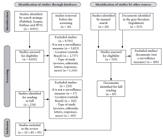
The search strategy resulted in the identification of 9,951 articles in the four searched databases and after excluding the duplicates, a total of 9,935 articles remained, to which the two researchers applied the exclusion criteria. After this step, 234 articles were selected to be read in full. Of these, only ten were included in this review, as they met the inclusion criteria. Regarding the gray literature, it was searched manually, totaling in 535 documents. Of these, 85 entered the scope review. These data are illustrated in the flowchart (Figure 1).
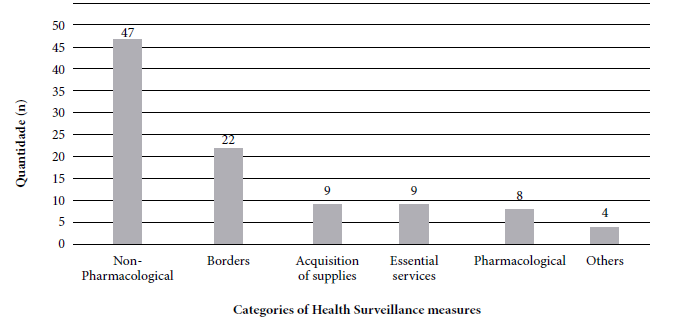
The documents related to legislations published by the Federal Government by categories of surveillance measures aimed to fight COVID-19 are shown in Figure 2.
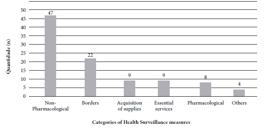
Legislation on health surveillance measures for COVID-19, according to categories, February 2020 to January 2021, Brazil.
Based on the analysis of the documents, according to the inclusion criteria, 55 legislative documents describe non-pharmacological measures. Next, 25 legislative publications are related to decisions regarding the closure and opening of international borders. Only nine official Executive Branch documents refer to pharmacological measures. The measures related to the acquisition of supplies totaled 12 legislative documents. Finally, only nine laws, resolutions, and decrees refer to essential services.
Non-Pharmacological Measures
On February 3, 2020, the government declared a Public Health Emergency of National Concern (PHENC), establishing the Public Health Emergency Operations Center (COE-NCoV, Centro de Operações de Emergências em Saúde Pública) as a national mechanism for the coordinated management in response to the emergency at national level14.
On February 6, 2020, Law No. 13,989 was enacted, which provides for measures to fight the COVID-19 epidemic and lists the community Non-Pharmacological Interventions (NPI) that could be adopted15. In this legal instrument, the federal government points out that it could adopt a series of measures to face the public health emergency, including: social isolation, quarantine, compulsory examinations, tests, vaccination, treatments, studies or epidemiological investigations, restrictions on entering and leaving the country, among others. Additionally, this law provided for the importation of materials, medications, equipment and supplies considered essential to help fight the coronavirus pandemic. This legislation also lists all professionals considered essential for disease control and maintenance of public order.
Also, in February 2020, the MoH published the National Contingency Plan for Human Infection by the new Coronavirus (COVID-19); this plan subsequently had two more versions. On March 11, 2020, the Government issued Ordinance No. 356, regulating and implementing measures to face the public health emergency caused by the new coronavirus (COVID-19). This document established how social isolation and quarantine measures would be adopted. For the application of isolation and quarantine measures, the clinical protocols for the coronavirus (COVID-19) and the guidelines established in the National Contingency Plan for Human Infection by the new Coronavirus (COVID-19) should be observed, aiming to guarantee the performance of prophylactic measures and the necessary treatment16. Moreover, it established that the conditions for carrying out the measures to face the public health emergency are provided for in the aforementioned Epidemiological Bulletin and National Contingency Plan17.
On March 14, the MoH issued a publication that contained recommendations on non-pharmacological intervention measures to be adopted. Overall, it included recommendations to promote personal and public hygiene; the isolation of people with symptoms for 14 days and the use of personal protective equipment (PPE) for patients and health professionals.
On March 16, 2020, Ordinance 59 was published, establishing the Integrated Office for the Monitoring of the Coronavirus-19 Epidemic (GIAC-COVID19, Gabinete Integrado de Acompanhamento à Epidemia do Coronavírus-19). The mission of the GIAC-COVID19 was to support the Attorney General’s Office to ensure, from an administrative perspective, the operation of the Federal Public Ministry Office bodies and, from the ultimate perspective of defending the general interests of society, to promote the integration of the Brazilian Federal Public Ministry during the exercise of its functions in the fight against the COVID-19 epidemic18.
At the same time, the Crisis Committee for Supervising and Monitoring the Impacts of COVID-19 was established, through Decree No. 10,277. This governmental body aimed at articulating government actions, advising the President of the Republic on the situational awareness of issues arising from the COVID-19 pandemic and the discussion of priorities, guidelines and strategic aspects related to the impacts of COVID-1919.
On March 17, 2020, The Ministry of Education (MEC) published Ordinance No. 343, which provided for the replacement of in-person classes by remote ones using digital media classes (DE, distance education), while the pandemic situation lasted20.
However, on March 19, the MoH legislated on those protective measures to deal with the public health emergency of international importance caused by the coronavirus (COVID-19) within the scope of the MoH units in the Federal District and in the federation states. This Ordinance characterized which public servants and employees should work remotely, aiming to safeguard the health of the so-called risk groups: the elderly, individuals with immunodeficiency, people with comorbidities, pregnant and lactating women21.
On March 23, Ordinance No. 492 was published, establishing the Strategic Action “Brazil is Counting on Me”, aimed at students of courses in the health area, to face the coronavirus pandemic (COVID-19). This Ordinance aimed to optimize the availability of health services within the scope of the Brazilian Unified Health System (SUS, Sistema Único de Saúde) to contain the COVID-19 pandemic, in an integrated manner with undergraduate activities in the health area22.
On April 7, Decree No. 10,316 was published, which establishes exceptional social protection measures to be adopted during the period of coping with the public health emergency of international importance resulting from the coronavirus (COVID-19). It established an emergency cash transfer program that paid R$ 600.00 (six hundred reais), which at that time would be granted for a period of three months23.
On April 8, Provisional Measure No. 948 was enacted, which addressed events in the tourism and culture sectors during the pandemic; this measure was revoked and converted into Law No. 14,046 in August of the same year24. Law No. 13,989 of April 15 provided for the authorization of the use of telemedicine during the pandemic. Telemedicine is understood, among others, as the practice of Medicine mediated by technologies for the purposes of assistance, research, prevention of diseases and injuries and health promotion15.
On July 2, Law No. 14,019 established the mandatory use of individual face masks to circulate in public and private spaces, on public streets and in public transport. The obligation provided for in the caput of this article was waived in the case of people in the autism spectrum disorder, those with intellectual disabilities, sensory impairments or any other disabilities that prevented them from adequately using a face mask for protection against COVID-19, provided through a medical declaration of exemption, which could be obtained digitally, as well as in the case of children under 3 years of age25.
Up to the 6th of July, there were no technical recommendations provided by the MoH regarding people under precarious living conditions, such as in slums and with no access to water, and Brazilian indigenous communities.
It was only on July 7, through Law No. 14,021, that the social protection of indigenous territories was described for the first time, also specifying measures to support quilombola communities, artisanal fishermen and other peoples and traditional communities to face COVID-19. Although it mentions traditional communities, the document does not specifically describe slums or specific actions for the reality in these places26.
Seven long months after the establishment of the emergency cash transfer through Resolution N. 11 of November 25, 2020, a working group was implemented to coordinate the protection measures and provide the accountability of the benefits. This group was also responsible for proposing a coordination strategy among the social protection measures, proposing accountability mechanisms for recipients of social programs and evaluating and proposing, where applicable, the development of a simplified mechanism for the monthly registration updating by recipients of federal social programs27.
Measures related to international borders
On March 19, Ordinance No. 125 was published, which addressed the exceptional and temporary restrictions on the entry of foreigners in Brazil, originating from the following countries: Argentina, Bolivia, Colombia, French Guiana, Guyana, Paraguay, Peru and Suriname28.
Ordinance No. 126, published on the same day, restricted the entry into the country, by air, of foreigners from the following countries for 30 days: China, European Union, Iceland, Norway, Switzerland, United Kingdom of Great Britain and Northern Ireland, Australia, Japan, Malaysia and Korea29. The disembarkation of foreigners at a port or point in the Brazilian territory, by waterway, was restricted for a period of thirty days, regardless of their nationality, through Ordinance No. 47, of March 26, 202030. On March 31, 2020, Ordinance No. 158 restricted, for a period of thirty days, the entry into the country, by road or land, of foreigners from the Bolivarian Republic of Venezuela31.
By the end of 2020, these restrictions had been updated 25 times by Anvisa, temporarily restricting the entry of foreigners into the country. These ordinances often dealt with countries in Latin America, which share borders with Brazil, but also with foreigners from anywhere in the world. In April 2020, the Executive Office of the President of Brazil started to publish ordinances that restricted the entry of foreigners of any nationality, by road, by other land or waterway transport, and in some periods, by air. In January 2021, this Ordinance was updated, highlighting this restriction due to the new variants of SARS-CoV-2 that were circulating.
On March 26, 2020, the Office of the Vice President of Brazil signed an Ordinance restricting the entry of foreigners into the country by waterway transport. This Ordinance was revoked and updated several times during the year. These also established rules for foreigners who were on Brazilian soil and wanted to return to their countries of origin.
Pharmacological Measures
On March 20, Anvisa published Resolution No. 351, which provides for the update of Annex I (Lists of Narcotic, Psychotropic, Precursor and Other Substances under Special Control), and this Differentiated Contract Regime (RDC, Regime Diferenciado de Contratação) includes Chloroquine and Hydroxychloroquine in the list of special control drugs in category C. Chloroquine and hydroxychloroquine-based drugs are subject to the Special Control Prescription requiring two copies, the 1st copy being retained at the pharmaceutical establishment and the 2nd copy returned to the patient32.
On the same day, Resolution No. 352 was also published, which provides for prior authorization for the purpose of exporting chloroquine and hydroxychloroquine, and products subject to health surveillance intended to fight COVID-19. The export of chloroquine, hydroxychloroquine, azithromycin, fentanyl, midazolam, ethosuximide, propofol, pancuronium, vecuronium, rocuronium, succinylcholine and ivermectin in the form of raw material, semi-finished product, bulk product or finished product would temporarily require prior authorization from Anvisa. For the purposes of this Resolution, exports were considered as the exportation of the product in any form or for any export purpose33.
The Anvisa published another RDC providing for the importation of products for the in vitro diagnosis of the Coronavirus, and on the ban on exports of medical, hospital and hygiene products essential to fight the pandemic32.
In September 2020, a provisional measure was signed, authorizing the Federal Executive Branch to adhere to the Instrument for Global Access to COVID-19 Vaccines - COVAX Facility, with the purpose of acquiring vaccines against COVID-19. This Ordinance was converted into Law No. 14,121 in March 2021, which established guidelines for the immunization of the population34.
In January 2021, a provisional measure was published, which dealt with exceptional measures regarding the acquisition of vaccines, supplies, goods and logistics services and the national plan for implementing the vaccination against COVID-1935.
Measures related to supply acquisition
On March 18, Ordinance No. 414 was published authorizing the opening of beds in the Adult and Pediatric Intensive Care Units, for the exclusive care of COVID-19 patients36. The following day, the Ministry of Health granted federal financial incentives to Primary Health Care, on an exceptional basis, to support the extended operation of Family Health Units or Basic Health Units in the country in the fight against the pandemic37.
On April 7, the Ministry of Economy established an additional measure regarding the sale of respiratory protection PPE. This Ordinance established that PPE classified as Air-Purifying Respirators (APRs) of the one-quarter face or half-face type, with a P2 or P3 particulate matter filter, whose Certificates of Approval (CA) that had expired in the period from January 1, 2018 to the date of publication of this Ordinance and which, perhaps, did not yet have new updated evaluation tests, could be sold upon presentation of the test report contained in the Certificate of Approval. This use of expired materials reflects the scarcity of materials for the protection of health professionals that occurred at the beginning of the pandemic38.
Through Resolution No. 3, of April 15, 2020, a working group was set up for the construction of federal field hospitals and international logistics of medical equipment and health supplies. This group consisted of the following representatives: one from the Executive Office of the President of the Republic, who coordinates it; two from the MoH; and two from the Ministry of Infrastructure39.
In June, Decree No. 10,407 regulated the law that provided for the prohibition of exports of essential medical, hospital and hygiene products in the fight against COVID-19 in the country40. On August 4, 2020, the competence for the acquisition of medications, equipment, immunobiologicals, and other health supplies was delegated to the Secretary of Specialized Health Care41. This Ordinance was revoked by Ordinance No. 197 of February 2021, delegating this competence to the director of the Department of Logistics in Health42.
This Ordinance was repealed by Ordinance No. 199 of February 10, 2021, which provided for the deadlines regarding the processes and procedures related to Government bodies and entities of the National Transit system and public and private entities providing services related to transit, to face the COVID-19 pandemic in the state of Amazonas. It had no relation with the purchase of medications and health supplies, not being at the federal level, which demonstrates the disorganization of the MoH management related to the acquisition of these medications and supplies, as well as the publication of laws and ordinances in the fight against COVID-1943.
On August 11, 2020, Law No. 14,035 was published to provide for procedures related to the acquisition of goods and supplies or the hiring of services to fight the pandemic. This law brought some flexibility regarding purchasing processes44. In cases of electronic or in-person bidding, whose object is the acquisition of goods and supplies or hiring of services necessary to face the public health emergency of international importance addressed in this Law, the terms of the bidding procedures were reduced by half. The contracts rules by this Law will have a duration of up to six months and may be extended for successive periods.
Discussion
On February 6, 2020, Law No. 13,979 was published, which provided some basic definitions and emphasized the actions the authorities could take to control the pandemic. Among these actions, the following were described: social isolation, quarantine, compulsory examinations, tests, collections, vaccination, epidemiological studies and travel restrictions on roads, ports and airports45.
With the publication of this law, it seemed that Brazil would take a meticulous and firm posture regarding the pandemic, which did not occur. The President of the Republic, from the beginning, showed contempt for the pandemic, refuting control measures and urging the population to “face the virus”. The fact is that three types of non-pharmacological interventions, namely, greater surveillance and hygiene measures; identification and isolation of infected individuals and their contacts; and lockdowns could have been adopted from the beginning to mitigate the impacts of the pandemic. Greater surveillance and hygiene measures aimed at increasing the state of alert, aimed at the entire population, urging everyone to avoid crowds, restrict physical contact and adopt frequent hand washing, cleaning of objects and the use of face masks were expected. However, for these measures to take place, some factors would be required, such as: a population with a good level of schooling, cooperation, discipline and trust in its leaders and authorities.
In an attempt to contain the pandemic and enforce rules, on March 17, an Ordinance46 was published that provided for the compulsory nature of measures to deal with the public health emergency provided for in Law No. 13,97945. That said, on June 2, through Resolution No. 6, a working group was created to consolidate the governance and risk management strategies of the federal government in response to the impacts related to the coronavirus47. A somewhat late event, given that in June 2020 the pandemic reached its record high in Brazil48, even though these figures would later reach new records.
Law No. 14,01925 was published only on July 2, 2020, providing for the mandatory use of individual face masks as a requirement for people to circulate in society. It should also be noted that the president himself always appeared without a mask at events, interviews and press conferences49. These conflicting messages between the president and health authorities caused a decline in the population’s trust in social institutions, leaving the Brazilian people unsure about the merits of protective measures to prevent the spread of the virus50.
Another non-pharmacological measure would be the identification and isolation of infected individuals and their contacts, through the so-called mass testing. This intervention consists of identifying infected individuals and their contacts through diagnostic tests and isolation. This intervention is considered to be a high-cost one and requires a great deal of effort to recruit and train workers to perform the tests. In addition, support from the population would also be required, to adhere to the constant testing. The experiences of Asian countries show us that testing should be carried out frequently and on a large scale51,52.
In Brazil, the decentralization of testing would be a crucial strategy for increasing the detection of new cases. However, since the beginning of the pandemic, the country has faced some challenges, such as socioeconomic inequalities in the distribution of equipment and in the infrastructure available for this diagnosis53,54.
The main issues comprised the limited access and the capacity to screen SARS-CoV-2 cases using Real-Time Polymerase Chain Reaction (RT-PCR). As an example of a successful experience, South Korea55 offered tests to all suspected cases, being considered an example of how to deal with the COVID-19 pandemic. New Zealand56 is also an example of successful control of the disease, having managed to control the pandemic in its territory and eliminate community transmission by combining social isolation measures with large-scale testing for contact tracing and rapid detection of cases, in addition to the implementation of quarantine. In Brazil, as described in the literature, factors associated with the low number of SARS-CoV-2 RT-PCR tests performed in the country included: a) difficulty in acquiring supplies to perform the RT-PCR of SARS-CoV-2 due to the high market demand; b) increase in the price of materials and equipment for carrying out the SARS-CoV-2 RT-PCR; c) low availability of equipment; d) number of qualified people available to perform the RT-PCR technique; e) number of centers or laboratories able to carry out the exam; and f) transportation of the material to the locations where the test could be performed57.
The other non-pharmacological intervention would be the so-called lockdown, which includes interventions such as the closure of commerce and services, restrictions in transport and closure of schools, up to the recommended or forced confinement of the entire population, with the exception of essential workers (for instance, health professionals, food-related activities and the police)58. The publication of an Ordinance in March 202059 authorizing the replacement of in-person classes by remote ones during the pandemic situation was undoubtedly an essential measure for expanding social distancing.
Moreover, there were only two decrees at the federal level regarding the definition of essential services. The first was Decree No. 10,28260 of March 20, 2020, which regulated Law No. 13,97915 and defined public services and essential activities. This decree initially listed 57 essential services, of which 22 were later revoked by other decrees. The other legal instrument dealing with this issue brought changes to the description of essential services. In fact, it reinforces that the federal government did not position itself on a lockdown intervention61.
Contrary to the president’s denialist attitude, some state governors adopted lockdown policies to prevent the spread of the SARS-CoV-2 pandemic, with specific measures to restrict social contact being introduced for the first time in the North and Northeast regions. On May 5, 2020, the State of Maranhão, in the Northeast Region, implemented strict rules enforcing social distancing. After this experience, other state governors and city mayors also adopted stricter social distancing measures. A heated debate accompanied the implementation of stringent lockdown measures on how stringent they could be, how much they would cost and how long they should last51.
As for pharmacological interventions, the federal government first included Chloroquine and Hydroxychloroquine in the list of special control drugs in category C1, in an attempt to control the sale of these drugs. In March 2020, the World Health Organization (WHO) actually approved studies with these drugs for the treatment of patients with COVID-19. Some world leaders were enthusiastic about these drugs and argued that they would be the cure for COVID-19 infection; this caused a frantic search for these drugs in pharmacies. In vitro studies with preliminary results of clinical trials with inadequate methods led to a distorted view of reality, making many doctors, the media and the population believe in this “miracle drug”62.
Another pharmacological measure worth mentioning was Brazil’s adherence to the Covax Facility, aiming to acquire vaccines against COVID-195. This adherence took place as a provisional measure in September 202034. However, it was only in January 202135 that it culminated in the national plan for implementing vaccination against COVID-19, albeit with a delay, when compared to other countries. On December 8, 2020, the United Kingdom became the first country in the West to vaccinate the population against the new coronavirus. The vaccine approved for emergency use was developed by the partnership between the American pharmaceutical company Pfizer and the German biotechnology company BioNTech. The situation was aggravated in August 2020 by successive denials and lack of responses from the MoH to Pfizer pharmaceutical contacts aimed to establish the supply of vaccines. Meanwhile, in Brazil, on October 21, 2020, the President of the Republic deauthorized the MoH to purchase a batch of 46 million doses of the vaccine, with the President’s emphasis “any and all vaccines are ruled out”63.
Only after great popular pressure, in January 2021, the federal government signed the first purchase contract for 46 million doses of CoronaVac64.
Regarding measures related to the acquisition of supplies, we highlight the legislation that brought new rules such as the waiver of tenders in an attempt to speed up the arrival of supplies used to face the pandemic. As for hospital beds, SUS controls 44% of the total number of beds in Intensive Care Units (ICUs) in the country, while the private sector holds 56%, which highlights a disproportion, since only 24.6% of Brazilian citizens have a private health insurance plan65. The pandemic put enormous pressure on health systems, especially regarding the availability of beds, equipment and human resources in the ICUs.
In Brazil, where the number of beds in the private sector, especially in the ICUs, is known to be higher than in the public sector, the prioritized strategy was not using the existing resources, even with the construction of field hospitals through Resolution No. 3, aimed at increasing the number of beds39. It can be said that the implementation of public beds occurred late and was not enough to guarantee full care and the right to health in different municipalities62. There was also the contrast represented by the waiting time in the SUS versus unoccupied and closed beds in the private sector, which made clear the inequalities in health care access65.
Conclusion
In response to the research question, health surveillance in Brazil for controlling the pandemic caused by the SARS-CoV-2 coronavirus, as seen in the documents reviewed, focused on non-pharmacological measures. These interventions were the most recommended for controlling the pandemic contrasting with the extensive set of articles criticizing the delay in decision-making, the discrepancy between the WHO recommendations and those dictated by the President of the Republic, in addition to the constant changes of Health Ministers and the instability and lack of confidence that ministerial authorities conveyed to the population.
In order to control the pandemic and preserve the economy, the country would need a leadership that would centralize and coordinate actions with states and municipalities. Unfortunately, the federal government did not fulfill this role, becoming one more obstacle in controlling the pandemic. This negative leadership and lack of coordination caused many deaths and seriously impaired the lives of survivors by delaying the resumption of economic and social activities. As limitations, we had to face the fact that there were very few studies on health surveillance on COVID-19 in Brazil, and that’s why we had to resort to access the federal government’s legislation portal.
The main effort of the federal government in the fight against the virus was centered on the use of antimalarial and anti-parasitic drugs and disregard for non-pharmacological interventions. While there was a surplus of medications without scientific proof of being effective, there was a lack of beds and coordination. Many Brazilian citizens could not breathe due to the lack of compassion by government authorities, questioning the principles of universality of the SUS: the guarantee to life and social rights.
Considering that health surveillance exists, in addition to its relevance in the policies of a country and in reducing vulnerability and health risks, this study brings data from a period related to the catastrophic historical line in the context of the COVID-19 pandemic in Brazil. These data reveal contradictory, distorted measures, which were in opposition to science, taken by the Brazilian government in the 2019-2022 administration, which culminated in a tragedy foretold of almost 700,000 deaths in the country. And that it is necessary to prioritize science, education and support for scientific advancement.
References
- 1 Garfin DR, Silver RC, Holman EA. The novel coronavirus (COVID-2019) outbreak: Amplification of public health consequences by media exposure. Health Psychol 2020; 39(5):355-357.
- 2 World Health Organization (WHO). Relatório da situação 11. Geneva: WHO; 2020.
- 3 Perlman S. Another Decade, Another Coronavirus. N Engl J Med 2020; 382(8):760-762.
- 4 Paterlini M. On the front lines of coronavirus: the Italian response to covid-19. BMJ 2020; 368:m1065.
- 5 Block P, Hoffman M, Raabe IJ, Dowd JB, Rahal C, Kashyap R, Mills MC. Social network-based distancing strategies to flatten the COVID-19 curve in a post-lockdown world. Nat Hum Behav 2020; 4(6):588-596.
- 6 Arshed N, Meo MS, Farooq F. Empirical assessment of government policies and flattening of the COVID19 curve. J Public Aff 2020; 20(4):e2333.
- 7 Jesus JG, Sacchi C, Candido DS, Claro IM, Sales FCS, Manuli ER, Silva DBBD, Paiva TM, Pinho MAB, Santos KCO, Hill SC, Aguiar RS, Romero F, Santos FCPD, Gonçalves CR, Timenetsky MDC, Quick J, Croda JHR, Oliveira W, Rambaut A, Pybus OG, Loman NJ, Sabino EC, Faria NR. Importation and early local transmission of COVID-19 in Brazil, 2020. Rev Inst Med trop S Paulo 2020; 62:e30.
- 8 Croda J, Oliveira WK de, Frutuoso RL, Mandetta LH, Baia-da-Silva DC, Brito-Sousa JD, Monteiro WM, Lacerda MVG. COVID-19 in Brazil: advantages of a socialized unified health system and preparation to contain cases. Rev Soc Bras Med Trop 2020; 53:e20200167.
- 9 Freitas CM, Silva IVM, Cidade NC. COVID-19 as a global disaster: Challenges to risk governance and social vulnerability in Brazil. Ambient Soc 2020; 23:e0115.
- 10 Aquino EML. Medidas de distanciamento social no controle da pandemia de COVID-19: potenciais impactos e desafios no Brasil. Cien Saude Colet 2020; 25(Supl. 1):2423-2446.
- 11 Borges L et al. Vigilância em saúde para Covid-19 no Brasil. In: 13º Congreso Iberoamericano de Investigación Cualitativa [Internet]. Campinas: Galoá; 2024 [acessado 2024 jun 10]. Disponível em: https://proceedings.science.
- 12 Borges LA, Silva PHBD, Baixinho CRSL, Zara ALDSA, Oliveira ESFD. Health Surveillance Actions in the Context of Covid-19 in Brazil: A Scoping Review. Preprints; 2023. doi: doi.org/10.20944/preprints202310.0582.v1.
- 13 Liberati A, Altman DG, Tetzlaff J, Mulrow C, Gotzsche P, Ioannidis JPA, Clarke M, Devereaux PJ, Kleijnen J, Moher D. The PRISMA statement for reporting systematic reviews and meta-analyses of studies that evaluate health care interventions: explanation and elaboration. PLoS Med 2009; 6(7):e1000100.
- 14 Brasil. Ministério da Saúde (MS). Portaria nº 188, de 3 de fevereiro de 2020. Declara Emergência em Saúde Pública de importância Nacional (ESPIN) em decorrência da Infecção Humana pelo novo Coronavírus (2019-nCoV). Diário Oficial da União; 2020.
- 15 Brasil. Ministério da Saúde (MS). Lei nº 13.979, de 6 de fevereiro de 2020. Dispõe sobre as medidas para enfrentamento da emergência de saúde pública de importância internacional decorrente do coronavírus responsável pelo surto de 2019. Diário Oficial da União; 2020.
- 16 Brasil. Ministério da Saúde (MS). Portaria nº 356, de 11 de março de 2020. Dispõe sobre a regulamentação e operacionalização do disposto na Lei nº 13.979, de 6 de fevereiro de 2020, que estabelece as medidas para enfrentamento da emergência de saúde pública de importância internacional decorrente do coronavírus (COVID-19). Diário Oficial da União; 2020.
- 17 Brasil. Ministério da Saúde (MS). Plano de Contingência Nacional para Infecção Humana pelo novo Coronavírus COVID-19. Brasília: MS; 2020.
- 18 Brasil. Ministério da Saúde (MS). Portaria nº 59, de 16 de março de 2020. Instituição do Gabinete Integrado de Acompanhamento à Epidemia do Coronavírus-19 (GIAC-COVID19). Diário Oficial da União; 2020.
- 19 Brasil. Ministério da Saúde (MS). Decreto nº 10.277, de 16 de março de 2020. Institui o Comitê de Crise para Supervisão e Monitoramento dos Impactos da Covid-19. Diário Oficial da União; 2020.
- 20 Brasil. Ministério da Educação (MEC). Portaria nº 343, de 17 de março de 2020. Dispõe sobre a substituição das aulas presenciais por aulas em meios digitais enquanto durar a situação de pandemia do Novo Coronavírus - COVID-19. Diário Oficial da União; 2020.
- 21 Brasil. Ministério da Saúde (MS). Portaria nº 428, de 19 de março de 2020. Dispõe sobre as medidas de proteção para enfrentamento da emergência de saúde pública de importância internacional decorrente do coronavírus (covid-19) no âmbito das unidades do Ministério da Saúde no Distrito Federal e nos Estados. Diário Oficial da União; 2020.
- 22 Brasil. Ministério da Saúde (MS). Portaria nº 492, de 23 de março de 2020. Institui a Ação Estratégica "O Brasil Conta Comigo", voltada aos alunos dos cursos da área de saúde, para o enfrentamento à pandemia do coronavírus (COVID-19). Diário Oficial da União; 2020.
- 23 Brasil. Ministério da Saúde (MS). Decreto nº 10.316, de 7 de abril de 2020. Regulamenta a Lei nº 13.982, de 2 de abril de 2020, que estabelece medidas excepcionais de proteção social a serem adotadas durante o período de enfrentamento da emergência de saúde pública de importância internacional decorrente do coronavírus (covid-19). Diário Oficial da União; 2020.
- 24 Brasil. Lei nº 14.046, de 24 de agosto de 2020. Dispõe sobre o adiamento e o cancelamento de serviços, de reservas e de eventos dos setores de turismo e de cultura em razão do estado de calamidade pública reconhecido pelo Decreto Legislativo nº 6, de 20 de março de 2020, e da emergência de saúde pública de importância internacional decorrente da pandemia da Covid-19. Diário Oficial da União; 2020.
- 25 Brasil. Ministério da Saúde (MS). Lei nº 14.019, de 2 de julho de 2020. Altera a Lei nº 13.979, de 6 de fevereiro de 2020, para dispor sobre a obrigatoriedade do uso de máscaras de proteção individual para circulação em espaços públicos e privados acessíveis ao público, em vias públicas e em transportes públicos, sobre a adoção de medidas de assepsia de locais de acesso público, inclusive transportes públicos, e sobre a disponibilização de produtos saneantes aos usuários durante a vigência das medidas para enfrentamento da emergência de saúde pública de importância internacional decorrente da pandemia da Covid-19. Diário Oficial da União; 2020.
- 26 Brasil. Ministério da Saúde (MS). Lei nº 14.021, de 7 de julho de 2020. Dispõe sobre medidas de proteção social para prevenção do contágio e da disseminação da Covid-19 nos territórios indígenas; cria o Plano Emergencial para Enfrentamento à Covid-19 nos territórios indígenas; estipula medidas de apoio às comunidades quilombolas, aos pescadores artesanais e aos demais povos e comunidades tradicionais para o enfrentamento à Covid-19; e altera a Lei nº 8.080, de 19 de setembro de 1990, a fim de assegurar aporte de recursos adicionais nas situações emergenciais e de calamidade pública. Diário Oficial da União; 2020.
- 27 Brasil. Ministério da Saúde (MS). Resolução nº 11, de 25 de novembro de 2020. Institui Grupo de Trabalho para a coordenação das medidas de proteção e a prestação de contas de benefícios, em resposta aos impactos relacionados ao coronavírus, no âmbito do Comitê de Crise da covid-19. Diário Oficial da União; 2020.
- 28 Brasil. Ministério da Saúde (MS). Portaria nº 125, de 19 de março de 2020. Dispõe sobre a restrição excepcional e temporária de entrada no País de estrangeiros oriundos dos países que relaciona, conforme recomendação da Agência Nacional de Vigilância Sanitária - Anvisa. Diário Oficial da União; 2020.
- 29 Brasil. Ministério da Saúde. Portaria nº 126, de 19 de março de 2020. Dispõe sobre a restrição excepcional e temporária de entrada no País de estrangeiros provenientes dos países que relaciona, conforme recomendação da Agência Nacional de Vigilância Sanitária - Anvisa. Diário Oficial da União; 2020.
- 30 Brasil. Ministério da Saúde (MS). Portaria nº 47, de 26 de março de 2020. Dispõe sobre a restrição excepcional e temporária de entrada no País de estrangeiros por transporte aquaviário, conforme recomendação da Agência Nacional de Vigilância Sanitária - Anvisa. Diário Oficial da União; 2020.
- 31 Brasil. Ministério da Saúde (MS). Portaria nº 158, de 31 de março de 2020. Dispõe sobre a restrição excepcional e temporária de entrada no País de estrangeiros provenientes da República Bolivariana da Venezuela, conforme recomendação da Agência Nacional de Vigilância Sanitária - Anvisa. Diário Oficial da União; 2020.
- 32 Brasil. Ministério da Saúde (MS). Resolução - RDC nº 351, de 20 de março de 2020. Dispõe sobre a atualização do Anexo I (Listas de Substâncias Entorpecentes, Psicotrópicas, Precursoras e Outras sob Controle Especial) da Portaria SVS/MS nº 344, de 12 de maio de 1998, e dá outras providências. Diário Oficial da União; 2020.
- 33 Brasil. Ministério da Saúde (MS). Portaria nº 352, de 20 de março de 2020. Dispõe sobre a autorização prévia para fins de exportação de cloroquina e hidroxicloroquina e de produtos sujeitos à vigilância sanitária destinados ao combate da Covid-19. Diário Oficial da União; 2020.
- 34 Brasil. Medida Provisória nº 1.003, de 24 de setembro de 2020. Autoriza o Poder Executivo federal a aderir ao Instrumento de Acesso Global de Vacinas Covid-19 - Covax Facility. Diário Oficial da União; 2020.
- 35 Brasil. Ministério da Saúde (MS). Medida Provisória nº 1.026, de 6 de janeiro de 2021. Dispõe sobre as medidas excepcionais relativas à aquisição de vacinas, insumos, bens e serviços de logística, tecnologia da informação e comunicação, comunicação social e publicitária e treinamentos destinados à vacinação contra a covid-19 e sobre o Plano Nacional de Operacionalização da Vacinação contra a Covid-19. Diário Oficial da União; 2021.
- 36 Brasil. Ministério da Saúde (MS). Portaria nº 414, de 18 de março de 2020. Autoriza a habilitação de leitos de Unidade de Terapia Intensiva Adulto e Pediátrico, para atendimento exclusivo dos pacientes COVID-19. Diário Oficial da União; 2020.
- 37 Brasil. Ministério da Saúde (MS). Portaria nº 430, de 19 de março de 2020. Estabelece incentivo financeiro federal de custeio no âmbito da Atenção Primária à Saúde, em caráter excepcional e temporário, com o objetivo de apoiar o funcionamento em horário estendido das Unidades de Saúde da Família (USF) ou Unidades Básicas de Saúde (UBS) no país, para enfrentamento da emergência de saúde pública de importância internacional decorrente do coronavírus (covid-19). Diário Oficial da União; 2020.
- 38 Brasil. Ministério da Saúde (MS). Portaria nº 9.471, de 7 de abril de 2020. Estabelece medida extraordinária e temporária quanto à comercialização de Equipamentos de Proteção Individual - EPI de proteção respiratória para o enfrentamento da emergência de saúde pública decorrente do Coronavírus (COVID-19). (Processo nº 19966.100318/2020-61). Diário Oficial da União; 2020.
- 39 Brasil. Ministério da Saúde (MS). Resolução nº 3, de 15 de abril de 2020. Institui Grupo de Trabalho para a Coordenação de Ações Estratégicas para Construção de Hospitais de Campanha Federais e Logística Internacional de Equipamentos Médicos e Insumos de Saúde, em resposta aos impactos relacionados ao coronavírus, no âmbito do Comitê de Crise da Covid-19. Diário Oficial da União; 2020.
- 40 Brasil. Decreto nº 10.407, de 29 de junho de 2020. Regulamenta a Lei nº 13.993, de 23 de abril de 2020, que dispõe sobre a proibição de exportações de produtos médicos, hospitalares e de higiene essenciais ao combate à epidemia da covid-19 no País. Diário Oficial da União; 2020.
- 41 Brasil. Lei nº 14.046, de 24 de agosto de 2020. Dispõe sobre o adiamento e o cancelamento de serviços, de reservas e de eventos dos setores de turismo e de cultura em razão do estado de calamidade pública reconhecido pelo Decreto Legislativo nº 6, de 20 de março de 2020, e da emergência de saúde pública de importância internacional decorrente da pandemia da Covid-19. Diário Oficial da União; 2020.
- 42 Brasil. Ministério da Saúde (MS). Portaria GM/MS nº 197, de 1º de fevereiro de 2021. Delega competência ao Diretor do Departamento de Logística em Saúde do Ministério da Saúde, para realizar requisição de medicamentos, equipamentos, imunobiológicos e outros insumos de interesse para saúde, durante a vigência da declaração de emergência em saúde pública de importância internacional decorrente do coronavírus (COVID-19). Diário Oficial da União; 2021.
- 43 Brasil. Ministério da Infraestrutura. Portaria nº 199, de 10 de fevereiro de 2021. Dispõe sobre os prazos de processos e de procedimentos afetos aos órgãos e entidades do Sistema Nacional de Trânsito e às entidades públicas e privadas prestadoras de serviços relacionados ao trânsito, por força das medidas de enfrentamento da pandemia de Covid-19 no Estado do Amazonas. Diário Oficial da União; 2021.
- 44 Brasil. Ministério da Saúde (MS). Lei nº 14.035, de 11 de agosto de 2020. Altera a Lei nº 13.979, de 6 de fevereiro de 2020, para dispor sobre procedimentos para a aquisição ou contratação de bens, serviços e insumos destinados ao enfrentamento da emergência de saúde pública de importância internacional decorrente do coronavírus responsável pelo surto de 2019. Diário Oficial da União; 2020.
- 45 Brasil. Lei nº 13.979, de 6 de fevereiro de 2020. Dispõe sobre as medidas para enfrentamento da emergência de saúde pública de importância internacional decorrente do coronavírus responsável pelo surto de 2019. Diário Oficial da União; 2020.
- 46 Brasil. Portaria Interministerial nº 5, de 17 de março de 2020. Dispõe sobre a compulsoriedade das medidas de enfrentamento da emergência de saúde pública previstas na Lei nº 13.979, de 06 de fevereiro de 2020. Diário Oficial da União; 2020.
- 47 Brasil. Resolução nº 6, de 2 de junho de 2020. Institui Grupo de Trabalho para a Consolidação das Estratégias de Governança e Gestão de Riscos do Governo federal em resposta aos impactos relacionados ao coronavírus, no âmbito do Comitê de Crise da covid-19. Diário Oficial da União; 2020.
- 48 Marson FAL. Covid-19 - Six million cases worldwide and an overview of the diagnosis in Brazil: A tragedy to be announced. Diagn Microbiol Infect Dis 2020; 98(2):115113.
- 49 The Lancet. Covid-19 in Brazil: "So what?". Lancet 2020; 395(10235):1461.
- 50 Ortega F, Orsini M. Governing Covid-19 without government in Brazil: Ignorance, neoliberal authoritarianism, and the collapse of public health leadership. Glob Public Health 2020; 15(9):1257-1277.
- 51 Garcia LP, Duarte E. Intervenções não farmacológicas para o enfrentamento à epidemia da Covid-19 no Brasil. Epidemiol Serv Saude 2020; 29:e2020222.
-
52 World Health Organization (WHO). Advice on the use of masks in the community, during home care and in healthcare settings in the context of the novel coronavirus (Covid-19) outbreak [Internet]. 2020 [cited 2024 jun 10]. Available from: https://www.who.int/docs/default-source/documents/advice-on-the-use-of-masks-2019-ncov.pdf
» https://www.who.int/docs/default-source/documents/advice-on-the-use-of-masks-2019-ncov.pdf - 53 Nadanovsky P, Santos APP. Strategies to deal with the Covid-19 pandemic. Braz Oral Res. 2020; 34:e068.
-
54 Cornwall W. Can you put a price on Covid-19 options? Experts weigh lives versus economics [Internet]. 2020 [cited 2024 jun 10]. Available from: https://www.science.org/content/article/modelers-weigh-value-lives-and-lockdown-costs-put-price-covid-19
» https://www.science.org/content/article/modelers-weigh-value-lives-and-lockdown-costs-put-price-covid-19 - 55 Rossi TRA, Soares CLM, Silva GA, Paim JS, Vieira-da-Silva LM. A resposta da Coreia do Sul à pandemia de Covid-19: lições aprendidas e recomendações a gestores. Cad Saude Publica 2022; 38(1):e00118621.
- 56 Oliveira AB, Chaves SCL. A estratégia de resposta da Nova Zelândia à Covid-19: lições aprendidas. Cien Saude Colet 2023; 28(12):3573-3586.
- 57 Magno L, Rossi TA, Mendonça-Lima FW, Santos CC, Campos GB, Marques LM, Pereira M, Prado NMBL, Dourado I. Desafios e propostas para ampliação da testagem e diagnóstico para Covid-19 no Brasil. Cien Saude Colet 2020; 25(9):3355-3364.
- 58 Vokó Z, Pitter JG. The effect of social distance measures on Covid-19 epidemics in Europe: an interrupted time series analysis. GeroScience 2020; 42:1075-1082.
- 59 Brasil. Portaria nº 1.272 GM-MD, de 20 de março de 2020. Aprovação da Diretriz Ministerial de Execução nº 7/2020, que autoriza a execução das ações de apoio para mitigar os impactos do COVID-19. Diário Oficial da União; 2020.
- 60 Brasil. Decreto nº 10.282, de 20 de março de 2020. Regulamenta a Lei nº 13.979, de 6 de fevereiro de 2020, para definir os serviços públicos e as atividades essenciais. Diário Oficial da União; 2020.
- 61 Lima LD, Pereira AMM, Machado CV. Crise, condicionantes e desafios de coordenação do Estado federativo brasileiro no contexto da Covid-19. Cad Saude Publica 2020; 36(7):e00185220.
- 62 Tang W, Cao Z, Han M, Wang Z, Chen J, Sun W, Wu Y, Xiao W, Liu S, Chen E, Chen W, Wang X, Yang J, Lin J, Zhao Q, Yan Y, Xie Z, Li D, Yang Y, Liu L, Qu J, Ning G, Shi G, Xie Q. Hydroxychloroquine in patients with mainly mild to moderate coronavirus disease 2019: open label, randomized controlled trial. BMJ 2020; 369:m1849.
-
63 Andrade H. Toda e qualquer vacina está descartada [Internet]. 2020 [acessado 2024 jun 10]. Disponível em: https://noticias.uol.com.br/saude/ultimas-noticias/redacao/2020/10/21/bolsonaro-cancela-acordo-por-coronavac-nao-abro-mao-da-minha-autoridade.htm
» https://noticias.uol.com.br/saude/ultimas-noticias/redacao/2020/10/21/bolsonaro-cancela-acordo-por-coronavac-nao-abro-mao-da-minha-autoridade.htm -
64 Homero V. Butantan entregará 46 milhões de doses da CoronaVac até abril, diz Pazuello [Internet]. 2021 [acessado 2022 mar 4]. Disponível em: https://www.poder360.com.br/coronavirus/butantan-entregara-46-milhoes-de-doses-da-coronavac-ate-abril-diz-pazuello/.
» https://www.poder360.com.br/coronavirus/butantan-entregara-46-milhoes-de-doses-da-coronavac-ate-abril-diz-pazuello - 65 Costa DCAR, Bahia L, Carvalho EMCL, Cardoso AM, Souza PMS. Oferta pública e privada de leitos e acesso aos cuidados à saúde na pandemia de Covid-19 no Brasil. Saude Debate 2020; 44(n. esp. 4):232-247.

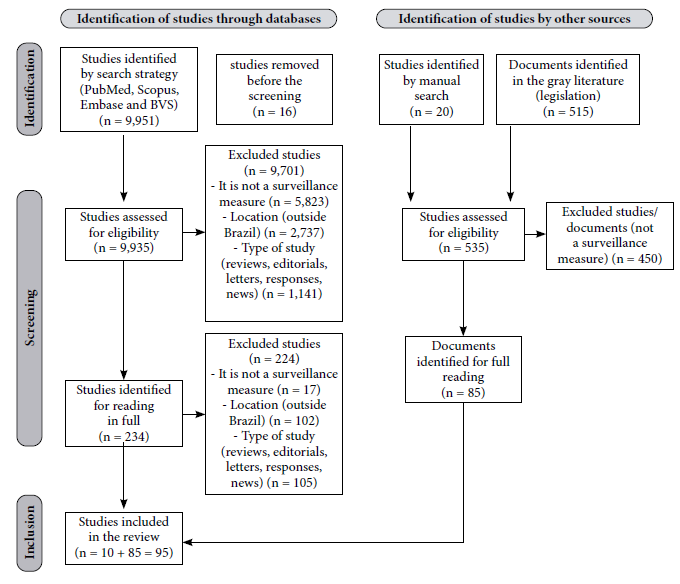 Source: Authors, made using PRISMA
 Source: Authors.