
 Determinants of physical violence by intimate partners against indigenous women: a multi-level analysis
Abstract
The aim is to evaluate the occurrence of physical violence by an intimate partner among indigenous women in the macro-region of Dourados, Mato Grosso do Sul, and its association with the individual factors of the women and the context of the municipalities in which the violent acts occurred. This work is a cross-sectional study carried out with reports registered in SINAN of indigenous women who suffered physical violence by an intimate partner in the Dourados macro-region, between the years 2009 to 2020. Descriptive statistics of the variables and multilevel logistic regression with random effects of the municipalities of occurrence were performed to determine the factors associated with physical violence by an intimate partner. Age (20 to 29 years and 30 to 39 years) and use of alcohol by the aggressor were positively associated with the occurrence of physical violence by an intimate partner. Pregnancy and the Gini Index were negatively associated. This study demonstrated that, in the Dourados macro-region, physical intimate partner violence against indigenous women occurs at different levels of society in the region. For the improvement of social relations, actions that reaffirm traditional culture and land regularization are important.
Key words:
Violence against indigenous women; Multilevel analysis; Intimate partner violence; Social inequality
Resumo
O objetivo é avaliar a ocorrência da violência física por parceiro íntimo em mulheres indígenas da macrorregião de Dourados, Mato Grosso do Sul, e sua associação com os fatores individuais das mulheres e contextuais dos municípios em que ocorreram os atos violentos. Realizou-se um estudo transversal com notificações registradas no SINAN de mulheres indígenas que sofreram violência física por parceiro íntimo na macrorregião de Dourados, entre os os anos de 2009 a 2020. Foi feita a estatística descritiva das variáveis e a regressão logística multinível com efeitos aleatórios dos municípios de ocorrência para determinar os fatores associados à violência física por parceiro íntimo. Estiveram associados positivamente à ocorrência de violência física por parceiro íntimo a idade (20 a 29 anos e 30 a 39 anos) e o uso de bebida alcoólica por parte do agressor. Estiveram associados negativamente a gestação e o Índice de Gini. Este estudo demonstrou que, na macrorregião de Dourados, a violência física por parceiro íntimo em mulheres indígenas ocorre em diferentes níveis da sociedade. Para a melhoria das relações sociais, são importantes ações que reafirmem a cultura tradicional e a regularização das terras.
Palavras-chave:
Violência contra as mulheres indígenas; Análise multinível; Violência por parceiro íÍntimo; Desigualdade social
Resumen
El objetivo es evaluar la ocurrencia de violencia física por parte de un compañero íntimo entre mujeres indígenas de la macrorregión de Dourados, Mato Grosso do Sul, y su asociación con factores individuales de las mujeres y factores contextuales de los municipios en que ocurrieron los hechos violentos. Se realizó un estudio transversal con notificaciones registradas en el SINAN de mujeres indígenas que sufrieron violencia física por parte de un compañero íntimo en la macrorregión de Dourados, entre 2009 y 2020. Se realizó estadística descriptiva de las variables y regresión logística multinivel con efectos aleatorios de los municipios de ocurrencia para determinar los factores asociados a la violencia física por parte de un compañero íntimo. La edad (20 a 29 años y 30 a 39 años) y el consumo de alcohol por parte del agresor se asociaron positivamente con la ocurrencia de violencia física por parte de la pareja. El embarazo y el Índice de Gini se asociaron negativamente. Este estudio demostró que en la macrorregión de Dourados la violencia física por parte de la pareja contra las mujeres indígenas ocurre en diferentes niveles de la sociedad de la región. Para mejorar las relaciones sociales son importantes las acciones que reafirmen la cultura tradicional y la regularización de tierras.
Palabras clave:
Violencia contra las mujeres indígenas; Análisis multinivel; Violencia de pareja; Desigualdad social
Introduction
Intimate partner violence (IPV) refers to any behavior within an intimate relationship that causes physical, psychological, or sexual harm to the victim1. Among women worldwide, approximately 30% of all women have experienced physical and/or sexual violence perpetrated by their partners over the course of their lives2.
The occurrence of IPV is a complex phenomenon, and within a given location, it is necessary to consider the context and social and cultural norms that permeate the act3. According to several IPV researchers, individual factors related to the violent act (age, education, among others) partially explain the process. Therefore, it is necessary to analyze the interaction of IPV with factors related to the family, society, community, and culture in which individuals are inserted to identify the conditions related to the occurrence of the violent act4.
Among indigenous peoples, violence is impacted by European domination during the colonial period, which influenced the cultural practices of various peoples, suppressing language and religion, in addition to modifying the traditional family structure. This history of violence has made indigenous peoples vulnerable in relation to other peoples, causing socioeconomic and health inequalities that span several generations5.
Indigenous peoples are more likely to experience violence than non-Indigenous people, especially women. In some countries, such as Canada, women are disproportionately victims of violence. IPV is one of the main forms of violence experienced by Indigenous Canadian women, impacting victims, their families, and their communities6,7. In a study conducted in Canada, six in ten Indigenous women have experienced IPV in their lifetime5.
The state of Mato Grosso do Sul has the second-largest Indigenous population in Brazil, with more than 116,000 Indigenous people who, in some regions, live in extreme poverty and violence both within and outside their communities8,9. In this context, Indigenous women are affected by multiple forms of violence, particularly IPV10.
There is currently a lack of studies assessing the occurrence of IPV among Indigenous women and its associated factors. Addressing the contextual factors that permeate Indigenous lands is extremely important in order to understand the influence of non-Indigenous culture on the occurrence of IPV affecting women in Indigenous territories. Therefore, this study aims to evaluate the occurrence of physical IPV among Indigenous women, reported by the health sector, in the macro-region of Dourados, Mato Grosso do Sul, and its association with the individual factors of the women and contextual factors of the municipalities in which the violent acts occurred.
Methodology
This is a cross-sectional study that analyzed secondary data from Indigenous women, aged 10 years and over, living in the Dourados macro-region, Mato Grosso do Sul, who experienced IPV and were reported to the National Notifiable Diseases Information System (Sistema de Nacional de Agravos de Notificação - SINAN) between 2009 and 2020. The data were provided by the Strategic Information Center for Health Surveillance (Centro de Informações Estratégicas de Vigilância em Saúde - CIEVS) of the state of Mato Grosso do Sul. A total of 1,384 reports from Indigenous women were analyzed.
The Dourados macro-region is located in the southern region of the state of Mato Grosso do Sul and consists of a population of nearly one million inhabitants distributed across 33 municipalities11. Among Indigenous peoples, the region is predominantly inhabited by the Guarani and Kaiowá ethnic groups. The Terena Indigenous people, who are fewer in number in this region, are concentrated only in the municipality of Dourados12.
The variables were structured hierarchically, with the first level being individual characteristics, characteristics of the aggressor, and characteristics of the violent act, and the second level being the contextual characteristics of the municipalities in which the acts of violence occurred (socioeconomic and level of violence in society).
The outcome variable was categorized as physical IPV (yes), with physical violence potentially associated with other types of violence. The comparison group consisted of other types of IPV (psychological, sexual, or other) (no), for which there was no record of physical violence. An affirmative response could be given for one or more types of violence. The first-level explanatory variables were divided into three groups:
-
Characteristics of women: age range (10-19, 20-29, 30-39, 40-49, > 50 years); pregnant (yes; no); marital status (with partner; without partner);
-
Characteristics of the perpetrator: alcohol consumption by the perpetrator (yes; no);
-
Characteristics of the violent act: repeated violence (yes; no); place of occurrence (residence, other location);
The contextual variables of illiteracy rate, unemployment rate, average per capita household income, and proportion of low-income individuals were extracted from the 2010 demographic census by the Brazilian Institute of Geography and Statistics (IBGE)8.
The Gini Index and Municipal Human Development Index (MHDI) variables for 2010 were collected from the Human Development Atlas (United Nations Development Program - UNDP)13.
The male homicide rate was used to determine community-based violence. Data were collected from the Ministry of Health’s Mortality Information System (SIM/MS). Codes X85-Y09 from Chapter XX - External causes of morbidity and mortality of the International Statistical Classification of Diseases and Related Health Problems (ICD) - 10th Edition were used to determine male homicides. The male homicide rate in each municipality was calculated as follows:
For statistical analysis, a descriptive analysis of the variables was first performed, presenting the frequencies and proportions of the categorical variables. The chi-square test was used to compare proportions according to the type of violence (physical and other forms of violence). Missing data, unfilled values, and unknown data were not evaluated. Because the values obtained presented diverse scales, the continuous variables underwent a normalization process using the following methodology:
Where: for each i ? {1, · · · , n}. Here, Xmax is the largest entry of the vector X and Xmin the smallest entry.
For data analysis, a multilevel logistic regression model was used, expanded by including random effects (municipality of occurrence). This modeling aimed to estimate the likelihood of Indigenous women experiencing physical intimate partner violence, considering the effect of municipalities.
For the multilevel analysis, the model was constructed according to the following five steps:
Step 1: construction of the model with no explanatory variables, using only the intercept (null model). This model indicated the likelihood of Indigenous women experiencing physical IPV, as compared to Indigenous women who experienced other types of IPV. This initial model served as the basis for the analyses of subsequent models.
Step 2: construction of a bivariate model with individual and contextual characteristics.
Statistically significant variables were entered into the multivariate model.
Step 3: all explanatory variables from the first level (individual) were introduced. This model assumed that the coefficients of the explanatory variables are fixed for all municipalities, that is, the individual characteristics of indigenous women are the same for all municipalities.
Step 4: the second-level (aggregate) explanatory variables were entered. This model aimed to quantify the influence of municipal characteristics on the likelihood of Indigenous women being victims of physical IPV.
Step 5: all coefficients were evaluated as to whether or not the first-level variables had significant variance components among the second-level units14.
To assess model fit, the Akaike Information Criterion (AIC) and Bayesian Information Criterion (BIC) were used. To estimate the variance of IPV against Indigenous women at the community level, the intraclass correlation coefficient (ICC) of the multilevel logistic regression was calculated, as follows:
Where: is the variance of the residual error at the aggregate level (level 2) e (π = 3.1415926) is the individual-level variance in the logistic model.
Fixed effects with their 95% confidence intervals (95%CI) and random effects were calculated and presented. The significance of including the random effect was assessed by comparing the models with and without the presence of the random effect of municipalities, using analysis of variance (ANOVA). R software, version 4.1.2, was used for statistical analyses. The R software libraries used were lmer for multilevel logistic regression and lattice to generate the random effects graph. A 5% significance level was adopted for all statistical tests.
The study was approved by the Research Ethics Committee of the Sergio Arouca National School of Public Health of the Oswaldo Cruz Foundation (CEP/ENSP-FIOCRUZ - opinion no. 5,274,177) and by the National Research Ethics Commission (CONEP - opinion no. 5,469,695). The State Health Department of the State of Mato Grosso do Sul signed the letter of consent for the research to be carried out, and the CIEVS provided the de-identified data from SINAN.
Results
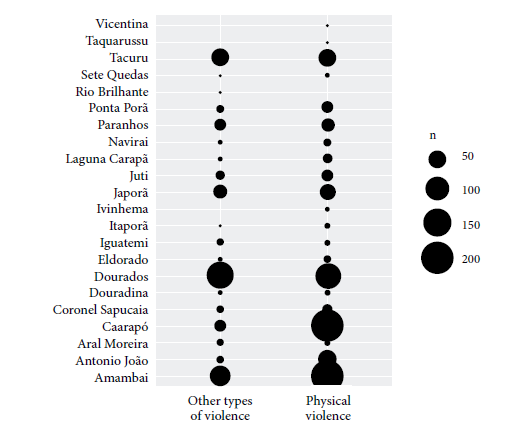
Of the 33 municipalities in the Dourados macro-region, 22 municipalities reported violence against Indigenous women in the SINAN (Figure 1).
Intimate partner violence among Indigenous women in the Dourados macro-region, according to municipality of occurrence and nature of violence, 2009 to 2020.
Table 1 shows that 68.2% of the Indigenous women experienced physical violence by an intimate partner. Of these, 33.9% were between 20 and 29 years of age, 14.1% were pregnant, and 86.3% had a partner. Regarding the perpetrator, 88.3% (p < 0.001) were under the influence of alcohol. In the analysis of violent acts, repeated violence was present in 63.4% of the reports of physical violence. According to the place of occurrence, 90% of cases occurred at home. The differences in proportions were not significant for the variables of repeated violence (p = 0.262) and place of occurrence (p = 0.437) (Table 1). Table 2 presents the results of the multilevel logistic regression analysis, demonstrating the extent to which individual variables, the perpetrator, the violent act, and contextual characteristics are associated with IPV violence, including the random effect of the municipality of occurrence. The intraclass correlation coefficient (ICC) showed that 10.9% of the variation is related to the city of occurrence.
In model 1, bivariate analysis of the first-level variables was performed, and in the second level, the variables of age, 20 to 29 years (OR 2.03, 95%CI 1.39; 2.97), 30 to 39 years (OR 2.43, 95%CI 1.61; 3.66), 40 to 49 years (OR 2.85, 95%CI 1.61; 4.80), pregnant (OR 0.42, 95%CI 0.29; 0.60), alcohol intake (OR 2.75, 95%CI 1.90; 3.97), and Gini Index (OR 0.72, 95%CI 0.54; 0.96) were statistically associated with physical IPV and were added to the multiple analysis (Table 2). In model 2, a multiple model with level 1 variables of age, pregnancy, and alcohol consumption remained statistically significant. In this model, 10.9% of the violent acts were attributed to municipalities. In model 3, in the random effect analysis of municipalities with the inclusion of the Gini index variable, 7.9% of violence was attributed to municipalities. In model 4, a multivariate analysis was performed with level 1 variables and the level 2 Gini index. The results demonstrate that age, with the age range between 20 and 29 years (OR 1.59, 95%CI 1.07; 2.37), 30 and 39 years (OR 1.75, 95%CI 1.13; 2.70), and 40 and 49 years (OR 1.98, 95%CI 1.15; 3.42) continued to be associated with the occurrence of physical IPV. They also demonstrated the protective effect of pregnancy compared to non-pregnant women (OR 0.56, 95%CI 0.38; 0.83), an increased chance of experiencing violence when the aggressor consumed alcohol (OR 2.08, 95%CI 1.40; 3.09), and a Gini coefficient (OR 0.69, 95%CI 0.53; 0.92), representing a lower chance of experiencing violence for women living in municipalities with greater inequality. In this model, 6.7% of the violent acts were attributed to municipalities. The inclusion of the random effect was significant in all models (Table 2).
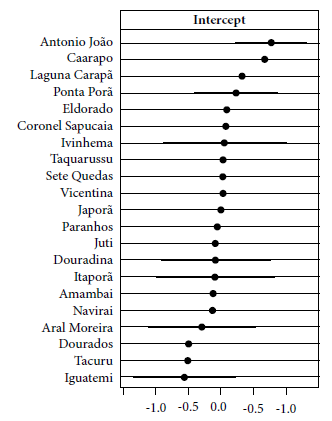
Figure 2 shows that two municipalities (Dourados and Tacuru) have a negative random effect, decreasing the chance of Indigenous women experiencing physical IPV, while two municipalities have a positive random effect, increasing the chance of Indigenous women experiencing physical IPV (Caarapó and Antônio João).
Random effects related to the municipalities where acts of physical violence by an intimate partner occurred and their respective confidence intervals. Dourados Macroregion, 2009 to 2020.
Discusion
The historical process of rights violations and violence to which Indigenous peoples have been subjected over the years is influenced by contact with non-Indigenous populations, the loss of territory, and the exploitation of labor. This entire process of social, economic, and cultural change has influenced gender relations, making them conflictual and contributing to gender-based violence within communities15.
The percentage of physical violence in this study corroborates the results of other studies that analyzed reports of IPV from SINAN. In a study that analyzed IPV reports between 2011 and 2017 in Brazil, the percentage of physical violence was 86.6%16.
At the individual level, Indigenous women, aged 20 to 29, 30 to 39, and 40 to 49 years, were more likely to experience physical IPV compared to women aged 10 to 19. In a study that analyzed the trend of physical IPV in the state of Paraná, between 2009 and 2012, the highest percentage of physical violence was among women, aged between 30 and 39 years, while between 2013 and 2016 it was among women, aged 20 to 29 years17.
In Guarani and Kaiowá communities, changes in social relations can influence the occurrence of gender-based violence, including IPV. In these ethnic groups, social relations are based on the unit called “home fire,” controlled by women, who play an important role in maintaining traditional culture. However, there has been a reallocation of gender activities within the home fire, observed when women leave their territories to engage in paid work or when they consume excessive amounts of alcohol. Among men, this reallocation process is observed when they also seek urban environments for paid work due to the difficulty in carrying out traditional subsistence activities18. This change in social relations, experienced by women, who are of childbearing age and economically active, can contribute to the weakening of gender relations and an increase in the occurrence of IPV, including physical violence.
In this study, pregnant Indigenous women were less likely to experience physical IPV, when compared to non-pregnant women. During pregnancy, women become increasingly concerned about their bodies and the management of the pregnancy, reducing their physical and emotional availability, which can lead to gender conflict19. In a cohort study of pregnant women in Recife in 2011, 40.7% of women experienced some type of IPV. In the state of Maranhão, in the city of São Luís, a study of 971 pregnant women showed that 50.2% experienced some type of violence (physical, sexual, and/or psychological) perpetrated by their intimate partners20, with psychological violence being the most prevalent, at 49.2%21. In a study conducted in Rio de Janeiro with 526 postpartum women, physical violence during pregnancy occurred primarily among women with less education, who did not work outside the home, and who had fewer prenatal appointments22. Factors that may possibly contribute to the protective factor of pregnancy against physical IPV are: greater sensitivity of the woman during pregnancy, the risk of miscarriage, and the possibility of identification of physical violence by the health professional during the prenatal consultation.
Alcohol is heavily consumed by men, potentially causing mood swings and increased aggression, leading to gender-based violence and being associated with the occurrence of IPV23. A study conducted with 12,300 women in Canada highlighted the association between alcohol and IPV. Canadian women were five-fold more likely to experience violence when their partner consumed alcohol24. In an analysis of IPV and alcohol consumption in Brazil, 44.6% of men consumed alcohol during the violent episode25.
For the Brazilian Indigenous population, alcohol consumption on Indigenous lands is a problem, exacerbated by the vulnerability of these people26. Consumption in Indigenous territories and reservations is associated with the ease with which alcohol enters the land, making it an accessible consumer good. A study conducted with indigenous people of the Karitiana ethnic group, located in the state of Rondônia, indicates that contact with the non-indigenous population in this ethnic group has favored an increase in alcohol consumption in the community, especially during festivities27. Alcoholism has weakened the organizational structure of indigenous communities, increasing the prevalence of mental disorders, physical aggression, and gender-based violence28.
In the bivariate multilevel model with variables relating to the municipalities’ contextual characteristics, there was no association with the occurrence of physical intimate partner violence, except for the Gini coefficient variable. Violence is related to the socioeconomic characteristics of municipalities, as the increase in urban violence is associated with social inequality, unemployment, urban segregation, a culture of masculinity, drug trafficking, alcohol and other drug use, and the availability of firearms29. The Dourados macroregion has municipalities on the border with Paraguay with high crime rates and high homicide rates, primarily associated with drug trafficking30. The result was similar to that of a study conducted in the municipality of São Paulo, in which, through multilevel analysis, IPV was not associated with the male homicide rate in the neighborhood where the woman lives31.
Social inequalities are responsible for the feedback loop of structural violence, the increase in alcohol and illicit drug use, and the increase in violence against women32. The Gini coefficient is an indicator that analyzes inequality and is associated with the occurrence of violence against women, as rates of violence tend to be higher in more unequal societies, with higher levels of poverty and fragile social relations33. In the present study, women living in municipalities with lower inequality rates are more likely to experience IPV, which disagrees with the findings of other studies. In a study that analyzed the temporal trend of femicide by assault between 2002 and 2012 in Brazil, it was observed that mortality by assault was higher in states with greater inequality34. The likely explanation for the association of the Gini coefficient with the occurrence of physical IPV found in this study may lie in the historical context of the creation and location of Indigenous Reservations in the southern region of Mato Grosso do Sul. However, further studies are needed to investigate this hypothesis.
In the Dourados macro-region, the Indigenous struggle for traditional territories has generated conflicts between farmers, Indigenous people, and police forces. These conflicts are most intense in the region’s largest municipalities, which have lower levels of inequality and the largest Indigenous populations confined to reservations35.
A common characteristic of these municipalities is the creation of reservations for the confinement of Indigenous people36. Understandably, Indigenous people in the region face an organizational dilemma, generating social unrest, especially in the most populated villages, with high rates of violence, delinquency, and other social problems18. Therefore, this scenario of territorial conflict, coupled with high population density and marginalization, especially in the largest municipalities of the Dourados macro-region, contributes to the modification of gender relations among Indigenous people and the increase in physical IPV.
In the analysis of the random effect of municipalities on the occurrence of physical violence by an intimate partner, Dourados and Tacuru showed a negative random effect, with a smaller variation in physical IPV, while Caarapó and Antônio João showed a positive random effect. In these municipalities, the Indigenous population lives confined to reservations, Indigenous lands, and reclaimed areas, the latter of which is not recognized by the state. Despite these inequities, due to the social determinants in which the municipality’s Indigenous population lives, the municipality of Dourados offers specialized health services, which serve as a reference for the macro-region, and a support network in cases of violence. The Dourados Indigenous Reservation has two Social Assistance Reference Centers (CRAS). The Military Police and the Civil Police, through the Women’s Assistance Police Station (DEAM), carry out actions with women and leaders to prevent IPV on the Dourados Indigenous Reservation. The municipality also provides booklets on the Maria da Penha Law in the region’s native Indigenous language to raise awareness about violence against women37.
Therefore, although the Indigenous population is living in high population density and marginalized conditions in some territories, the presence of the state, implementing actions tailored to the specificities of each territory, is important in order to prevent and reduce the occurrence of violence against Indigenous women. However, caution is needed in this analysis, as difficulties in notifications and reporting violence due to logistical and intercultural issues, such as the lack of translators in reporting units, can lead to underreporting and the perception of a low percentage of physical violence in some municipalities.
This study had some limitations. By using SINAN data, only women notified by health services were analyzed. Because these are secondary data, important variables for determining the association with IPV were not analyzed due to incompleteness. Furthermore, it was also not possible to analyze disparities between ethnicities. The number of reports was also a limiting factor. Due to underreporting and incorrect reporting of the race/color variable, the number of cases may have been higher, which directly influenced the multilevel analysis. Due to the ethnic diversity of Indigenous peoples, the results of this study cannot be applied to people from other regions.
Another limitation of the study was the comparison group used, as women victims of physical violence were compared with women who experienced other types of violence. This comparison was made due to the use of a secondary database composed solely of cases of violence, and the high percentage of physical IPV. However, other studies that also used secondary data have compared two groups exposed to different types and natures of violence38.
This study is relevant to public health, as it identified the profile of women victims of physical IPV reported by health services and the association of this violence with contextual factors. Furthermore, it can also serve as a basis for studies in other populations.
Conclusion
IPV among Indigenous people is a complex phenomenon that requires consideration of historical, cultural, social, and economic aspects. Changes in traditional relationships and intense contact with non-Indigenous people have contributed to the occurrence of violent acts within Indigenous lands and reservations. This study demonstrated that, in the Dourados macro-region, physical IPV against Indigenous women occurs at different levels within the Indigenous society of the region.
Therefore, public policies are needed to raise awareness and reduce IPV within and outside Indigenous territories, in addition to establishing a support network for victims of violence, taking into account the cultural characteristics of the Indigenous population. Actions that reaffirm traditional culture and legalize traditional lands are also needed, which can contribute to improving social relations and reducing IPV among this population.
References
- 1 World Health Organization (WHO). Understanding and addressing violence against women: Intimate partner violence. Geneva: WHO; 2012.
- 2 Butchart A, Mikton C, Dahlberg LL, Krug EG. Global status report on violence prevention 2014. Geneva: WHO; 2015.
- 3 Gracia E, Lila M. Attitudes towards violence against women in the EU. Luxembourg: Publications Office of the European Union; 2015.
- 4 Garcia-Moreno C, Heise L, Jansen H, Ellsberg M, Watts C, editors. The Millennium development goals commit the 191 member states of the United Nations to sustainable, human development and recognize that equal rights and opportunities for women and men are critical for social and economic. New York: Policy Forum; 2005.
- 5 Heidinger L. Intimate partner violence: experiences of first nations, Métis and Inuit women in Canada, 2018 [Internet]. 2021 [cited 2024 out 13]. Available from: https://www150.statcan.gc.ca/n1/pub/85-002-x/2021001/article/00007-eng.htm
-
6 Allen M. Crime reported by police serving areas where the majority of the population is Indigenous, 2018 [Internet]. 2021 [cited 2024 out 13]. Available from: https://www150.statcan.gc.ca/n1/pub/85-002-x/2020001/article/00013-eng.htm
» https://www150.statcan.gc.ca/n1/pub/85-002-x/2020001/article/00013-eng.htm - 7 Boyce J. Victimization of Aboriginal people in Canada, 2014. Ottawa: Statistics Canada; 2016.
- 8 Instituto Brasileiro de Geografia e Estatística (IBGE). Censo demográfico do Brasil 2022 Brasília: IBGE; 2022
-
9 Aylwin J. Os direitos dos povos indígenas em Mato Grosso do Sul, Brasil: confinamento e tutela no século XXI [Internet]. 2009 [acessado 2023 jan 4]. Disponível em: https://www.iwgia.org/doclink/iwgia-informe3/eyJ0eXAiOiJKV1QiLCJhbGciOiJIUzI1NiJ9.eyJzdWIiOiJpd2dpYS1pbmZvcm1lMyIsImlhdCI6MTYxMzM3OTU3NCwiZXhwIjoxNjEzNDY1OTc0fQ.ChLlgjGfTyVUS9JaE3RhVjrb2RxBRq3No7wfs5xjaKs
» https://www.iwgia.org/doclink/iwgia-informe3/eyJ0eXAiOiJKV1QiLCJhbGciOiJIUzI1NiJ9.eyJzdWIiOiJpd2dpYS1pbmZvcm1lMyIsImlhdCI6MTYxMzM3OTU3NCwiZXhwIjoxNjEzNDY1OTc0fQ.ChLlgjGfTyVUS9JaE3RhVjrb2RxBRq3No7wfs5xjaKs - 10 Zimmermann TR, Viana AEA. Apontamentos sobre gênero e violência contra mulheres indígenas em Amambai-MS (2007-2014). Tellus 2014; 14(27):117-28.
- 11 Castro MGS. Teoria do estado de coisas inconstitucional na efetivação da saúde na macroregião de Dourados/MS [monografia]. Dourados: Universidade Federal da Grande Dourados, Faculdade de Direito e Relações Internacionais; 2018.
-
12 Troquez MCC. Reserva Indígena de Dourados (1917-2017): composição multiétnica, apropriações culturais e desafios da subsistência [Internet]. 2019 [acessado 2023 jan 25]. Disponível em: https://acervo.socioambiental.org/sites/default/files/documents/prov0103.pdf
» https://acervo.socioambiental.org/sites/default/files/documents/prov0103.pdf - 13 Programa das Nações Unidas para o Desenvolvimento (PNUD). Atlas Brasil 2010. Rio de Janeiro: PNUD; 2010.
- 14 Hox J, Moerbeek M, van de Schoot R. The basic two-level regression model: introduction. In: Multilevel Analysis. London: Routledge; 2002. p. 20-43.
- 15 Castanhel IR. Guerreiras na fronteira - histórias de mulheres guarani e kaiowá que resistem em terras indígenas entre o Brasil e o Paraguai [monografia]. Florianópolis: UFSC; 2016.
- 16 Mascarenhas MM, Tomaz GR, Meneses GMS, Rodrigues MTP, Pereira VOM, Corassa RB. Análise das notificações de violência por parceiro íntimo contra mulheres, Brasil, 2011-2017. Rev Bras Epidemiol 2020; 23(Supl. 1):e200033.
- 17 Moroskoski M, Brito FAM, Queiroz RO, Higarashi IH, Oliveira RR. Aumento da violência física contra a mulher perpetrada pelo parceiro íntimo: uma análise de tendência. Cien Saude Colet 2021; 26(12):4993-5002.
- 18 Pereira LM. A criança kaiowa, o fogo doméstico e o mundo dos parentes: espaços de sociabilidade infantil. In: 32º Encontro Anual da ANPOC. Caxambu, São Paulo: ANPOCS; 2008.
- 19 Brownridge DA, Taillieu TL, Tyler KA, Tiwari A, Chan KL, Santos SC. Pregnancy and intimate partner violence: risk factors, severity, and health effects. Violence Against Women 2011; 17(7):858-881.
- 20 Silva EP, Ludermir AB, Araújo TVB, Valongueiro SA. Freqüência e padrão da violência por parceiro íntimo antes, durante e depois da gravidez. Rev Saude Publica 2011; 45(6):1044-1053.
- 21 Ribeiro MRC. Violência contra gestantes: taxas, tipos, perpetradores e fatores associados, em São Luís, no ano de 2010 [tese]. São Luís: Universidade Federal do Maranhão; 2011.
- 22 Moraes CL, Reichenheim ME. Domestic violence during pregnancy in Rio de Janeiro, Brazil. Int J Gynaecol Obstet 2002; 79(3):269-277.
- 23 Pires VMMM, Morais RLGL, Santos LS, Machado JC, Guedes CA, Rodrigues VP. Violência por parceiro íntimo em abuso de álcool perpetrada contra mulheres no climatério. Rev Enferm UFSM 2019; 9(1):20-34.
- 24 Rodgers K. Wife assault: the findings of a national survey. Juristat 1994; 14(9):1-21.
- 25 Zaleski M, Pinsky I, Laranjeira R, Ramisetty-Mikler S, Caetano R. Violência entre parceiros íntimos e consumo de álcool. Rev Saude Publica 2010; 44(1):53-59.
- 26 Castelo Branco FMF, Miwa MJ, Vargas D. Consumo de álcool em comunidades indígenas brasileiras: uma revisão literária. Enferm Foco 2018; 9(3):8-12.
- 27 Vianna JJB, Cedaro JJ, Ott AMT. Aspectos psicológicos na utilização de bebidas alcoólicas entre os Karitiana. Psicol Soc 2012; 24(1):94-103.
- 28 Guimarães LA, Grubits S. Alcoolismo e violência em etnias indígenas: uma visão crítica da situação brasileira. Psicol Soc 2007; 19(1):45-51.
- 29 Briceño-León R, Villaveces A, Concha-Eastman A. Understanding the uneven distribution of the incidence of homicide in Latin America. Int J Epidemiol 2008; 37(4):751-757.
-
30 Nunes M. Dinâmicas transfronteiriças e o avanço da violência na fronteira sul-mato-grossense [Internet]. 2017 [acessado 2022 dez 14]. Disponível em: https://repositorio.ipea.gov.br/entities/publication/1bb89ea6-afef-49a2-9c16-7881319af056
» https://repositorio.ipea.gov.br/entities/publication/1bb89ea6-afef-49a2-9c16-7881319af056 - 31 Kiss LB. Violência contra mulheres no contexto urbano: estudo sobre a distribuição espacial das violências no Município de São Paulo [tese]. São Paulo: USP; 2009.
- 32 Moura LBA, Gandolfi L, Vasconcelos AMN, Pratesi R. Violências contra mulheres por parceiro íntimo em área urbana economicamente vulnerável, Brasília, DF. Rev Saude Publica 2009; 43(6):944-953.
- 33 Diniz CFIO. Macrossistema e medo do crime nas relações de intimidade: contributo para análise multinível em contexto brasileiro [dissertação]. Porto: Universidade do Porto; 2018.
- 34 Leite FMC, Mascarello KC, Almeida APSC, Fávero JL, Santos AS, Silva ICM, Rodrigues LS, Souto RMC, Silva GDM. Análise da tendência da mortalidade feminina por agressão no Brasil, estados e regiões. Cien Saude Colet 2017; 22(9):2971-2978.
- 35 Mondardo M, Serejo AAC, Staliano P. Conflitos na luta pela terra e território em áreas de agronegócio: das violências, negligências e precariedades às manifestações e conquistas dos Guarani e Kaiowá. Geosul 2019; 34(71):573-598.
-
36 Monteiro DMLV. Terra, poder e violência: conflitos no Mato Grosso do Sul e a relação do agronegócio com os Kaiowá e Guarani. Rev Franco-Bras Geogr 2020; 45. DOI:10.4000/confins.27901
» https://doi.org/10.4000/confins.27901 - 37 Oliveira KJ. Políticas públicas para o enfrentamento da violência doméstica e familiar indígena na região de fronteira: efetivação dos direitos humanos das mulheres indígenas nas Aldeias Bororó e Jaguapiru de Dourados/MS [dissertação]. Dourados: UFGD; 2020.
- 38 Silva SM, Andrade ACS, Melanda FN, Oliveira LR. Fatores associados à recorrência de violência em crianças e adolescentes. Mato Grosso - Brasil, 2013 a 2019. Cien Saude Colet 2024; 29(7):e02912024.

 Source: SINAN.
 Source: Authors.