 Counseling strategies on the physical activity practice received by adults in Primary Health Care
Abstract
This study analyzed the association between sociodemographic characteristics, health conditions, stages of change behavior, and the different counseling strategies on the physical activity (PA) practice received by users of Primary Health Care (PHC) of the Unified Health System. A cross-sectional study was conducted with a representative sample of 779 adults treated at the 15 Basic Health Units in São José dos Pinhais, Brazil. The variables were measured with valid instruments, and the counseling strategies were evaluated based on the “5 As” method. As main results, the two most frequently reported strategies were “receiving information about PA benefits” (91%) and “assessing the PA level” (84%). Age group, hypertension, number of comorbidities, and the medication consumed were consistently associated with at least 50% of the counseling strategies received (p < 0.05). No associations were observed between the variables analyzed and the two most frequently reported strategies. It is concluded that the counseling strategies received vary according to the some analyzed variables.
Key words:
Health strategies; Motor activity; Behavior control; Biobehavioral sciences; Unified Health System
Resumo
O objetivo do estudo foi analisar a associação entre características sociodemográficas, condições de saúde, estágios de mudança de comportamento e as diferentes estratégias de aconselhamento breve sobre a prática de atividade física (AF) recebidas por usuários da Atenção Primária à Saúde (APS) do Sistema Único de Saúde. Realizou-se um estudo transversal com amostra representativa de 779 adultos atendidos nas 15 Unidades Básicas de Saúde de São José dos Pinhais, Paraná. As variáveis foram mensuradas com instrumentos válidos, e as estratégias de aconselhamento, avaliadas com base no método dos “5 As”. Como principais resultados, as duas estratégias relatadas com maior frequência foram “receber informações sobre os benefícios da AF” (91%) e a “avaliação do nível de AF” (84%). Faixa etária, hipertensão, número de comorbidades e de medicamentos consumidos apresentaram consistente associação com ao menos 50% das estratégias de aconselhamento recebidas (p < 0,05). Não foram observadas associações entre as variáveis analisadas e as duas estratégias reportadas com maior frequência. Conclui-se que as estratégias de aconselhamento recebidas variam de acordo com algumas das variáveis analisadas.
Palavras-chave:
Estratégias de saúde; Atividade motora; Controle comportamental; Ciências biocomportamentais; Sistema Único de Saúde
Resumen
Este estudio tuvo como objetivo analizar la asociación entre las características sociodemográficas, las condiciones de salud, las etapas de cambio de comportamiento y las diferentes estrategias de asesoramiento breve sobre la práctica de actividad física (AF) recibidas por usuarios de la Atención Primaria de Salud (APS) del Sistema Único de Salud. Se realizó un estudio transversal con una muestra representativa de 779 adultos atendidos en las 15 Unidades Básicas de Salud de São José dos Pinhais, Paraná, Brasil. Las variables se midieron con instrumentos válidos y las estrategias de consejería se evaluaron con base en el método de las “5 A”. Como resultados principales, las dos estrategias más frecuentemente reportadas fueron “recibir información sobre los beneficios de la AF” (91%) y “evaluar el nivel de AF” (84%). El grupo etario, la hipertensión, el número de comorbilidades y los medicamentos consumidos mostraron una asociación consistente con al menos el 50% de las estrategias de consejería recibidas (p < 0,05). No se observaron asociaciones entre las variables analizadas y las dos estrategias reportadas con mayor frecuencia. Se concluye que las estrategias de consejería recibidas varían según algunas de las variables analizadas.
Palabras clave:
Estrategias de salud; Actividad motora; Control del comportamiento; Ciencias bioconductuales; Sistema Unificado de Salud
Introduction
The World Health Organization (WHO) underscores the multiple benefits of physical activity (PA) for health maintenance, improvement, and reducing risk factors for chronic diseases1. It is estimated that 15% of premature deaths globally could be avoided annually with a physically active lifestyle2. In Brazil, despite widespread acknowledgment of PA’s importance3, about 59% of adults in capital cities are insufficiently active during their leisure time4. Numerous factors influence PA participation, indicating that motivations beyond mere awareness and benefits affect this behavior5.
The Brazilian National Health Promotion Policy prioritizes PA within the Unified Health System (SUS, in Portuguese)6, requiring implementation and expansion of community intervention programs across different population groups6,7. Currently, PA interventions in Primary Health Care (PHC) range from health education to supervised exercise programs7, with some employing counseling strategies7 proven effective in increasing PA8-10.
In Brazil, studies report that 50-86% of PHC professionals provide brief PA counseling11-13, with physicians being the most frequent counselors, followed by nurses and community health workers11,12. However, PHC users report lower counseling rates, between 35-43%11,12,14. Internationally, health professionals’ PA counseling rates vary from 11-95%, with user-reported rates between 5-62%12, mostly targeting individuals with chronic diseases15,16.
Health professionals use various counseling strategies, such as explaining PA benefits, assessing PA levels, and supplying educational materials17-22. Brief counseling can encourage discussions on healthy behaviors in individual or group sessions9,10. All health professionals can counsel PHC users on PA, and systematic, specific interventions are suggested to be more effective than brief or generic ones23-25. The five “As” (5As) model is a systematic, evidence-based counseling method grounded in behavior change theories applicable to various health behaviors, including PA18,20,23,24,26,27.
The behavior change process involves stages related to an individual’s interest, availability, and ability to change their behavior28-30. Thus, counseling interventions should be tailored to the individual’s stage of change behavior (SCB)23,26,28,29. Strategies such as emphasizing PA benefits and identifying barriers are more proper for individuals in the early SCB (pre-contemplation and contemplation)19,20,23,27,28.
Three SUS-based studies identified common counseling strategies used by PHC professionals: “providing information on PA benefits”, “assessing PA levels”, “recommending PA types”, “identifying barriers”, and “offering solutions to reduce these barriers”17,22,31. However, no studies have explored PHC users’ perceptions of the counseling strategies employed by professionals. Understanding user perceptions could enhance dialogue between professionals and SUS users, enabling the provision of comprehensible and far-reaching information based on users’ sociodemographic characteristics, health conditions, and SCB for PA18-20,30. Therefore, this study aims to analyze associations between sociodemographic characteristics, health conditions, SCB, and the different brief PA counseling strategies received by PHC users.
Methods
This study draws on data from the project “Effectiveness of Community Programs for Promoting Physical Activity and Reducing Sedentary Behavior”14,32. The study report was prepared following the Strengthening the Reporting of Observational Studies in Epidemiology (STROBE) guidelines.
Study design, location, and ethical aspects
From April to October 2019, before the COVID-19 pandemic, a cross-sectional observational study with quantitative data collection was conducted. This study included a representative sample of adults from all Basic Healthcare Units (BHUs) in the urban area of São José dos Pinhais, Paraná, southern Brazil.
São José dos Pinhais is a medium-sized city in the metropolitan area of Curitiba, the state capital. It spans 946 km² (79% rural) with a population of 329,000. The city’s Human Development Index (HDI) is 0.758, and its Gini Index is 0.459, both close to national averages of 0.727 and 0.460, respectively33. In 2019, the city had 413 health establishments, including 27 BHUs (56%), with 15 located in urban areas. Although most of the city is rural, 90% of the population lives in urban areas, leading to the selection of the 15 urban BHUs for the study14,32.
The study received approval from the Ethics Committee of PUCPR (approval #2.882.260/2018). Participants were informed about the study’s voluntary nature and provided written consent to take part.
Sample size and selection of participants
The sample size was estimated based on the average number of appointments from January to February 2019 (N = 34,275), as reported on the “Transparent Health” website34. To represent the sample accurately, we considered a 30% prevalence of PA counseling at BHU35 (based on literature and a pilot study), a 95% confidence level, a four-percentage point margin of error, and a design effect of 1.5. The minimum required sample size was 745 participants. Accounting for a 10% allowance for losses and refusals, the target was increased to 820 users. To enhance the accuracy of future multivariate analyses, we added an extra 100 participants, bringing the total to 920. The sample size was proportionally distributed based on the number of appointments at each BHU, ranging from 31 to 92 users.
Only adults (≥ 18 years) were invited to participate. Exclusions included individuals not living in the city, first-time BHU visitors, those with physical limitations preventing leisure-time PA (LTPA), and those with cognitive or speech impairments hindering questionnaire comprehension. Nine individuals were excluded in total.
Participants were systematically selected based on their positions in the BHU waiting room. Interviewers positioned themselves at the BHU entrance to identify the first five individuals, counting them from left to right. The third user was selected and invited to participate. If the individual refused or did not meet the inclusion criteria, the next person to the left was selected.
Data collection
Ten trained interviewers conducted face-to-face interviews with users in a private room, either before or after their consultations with healthcare professionals, to prevent external influences on responses. The average time to complete the questionnaire was 18 minutes (± 5 minutes, ranging from 9 to 55 minutes).
Outcome variable
Strategies for PA counseling
Brief PA counseling was assessed using a question: “In the past year (12 months), during any visit to the BHU, did you receive any counseling on PA from a healthcare professional? (tips or guidance on walking, exercises, or sports to maintain or improve your health) (no, yes).” This measure was adapted from similar studies to fit the local context12,35.
Users who received counseling answered questions about the strategies used by healthcare professionals, based on the 5As model (Assess: evaluate/ask; Advise: counsel; Agree: agree; Assist: help; Arrange: organize)19-21,26,27. Originally developed for smoking cessation, the 5As model has been adapted for other health behaviors, including physical inactivity19,26,27. The questions identified PA counseling strategies using a dichotomous response for eight independent questions22. The total number of strategies received was calculated by summing the eight options and categorizing them into two groups (1-3 and ≥ 4 strategies). Users also reported which professional provided the counseling and when it was received, with the option to select multiple responses.
Independent Variables (potential predictors)
Independent variables were identified and selected based on a literature review on associated factors with brief PA counseling received by PHC users11,12,14. These variables are described below.
Socio-demographic characteristics
Gender (female, male) was determined by observing physical characteristics. Age was categorized into three groups: 18-39 years, 40-59 years, and ≥ 60 years. Marital status was classified as either “without a partner” (single, divorced, widowed) or “with a partner” (married, in a stable union). Skin color was self-reported and initially categorized as white, yellow, black, brown, or indigenous; then grouped for analysis into white (white and yellow) and non-white (black and brown). Education level was assessed with five categories: 1) illiterate or incomplete elementary school, 2) complete elementary school or incomplete middle school, 3) complete middle school or incomplete high school, 4) complete high school or incomplete higher education, and 5) complete higher education. These were then recoded into three categories: incomplete elementary, complete elementary, and complete high school or higher. The economic class was determined using a standardized questionnaire36 and categorized into seven groups (A1, A2, B1, B2, C, D, E), which were then grouped into lower class (C+D+E) and upper class (A+B).
Health conditions
Body Mass Index (BMI) was calculated using self-reported weight and height (weight/height²) and categorized as underweight (≤ 24.9 kg/m²), normal weight (25.0-29.9 kg/m²), and overweight (≥ 30.0 kg/m²)37. The presence of comorbidities was determined by dichotomous self-reported medical diagnoses for hypertension, diabetes, dyslipidemia, and coronary disease4, and participants were categorized by the number of comorbidities (0, 1, ≥ 2). Continuous medication use for chronic diseases was reported35 and classified by the number of medications (0, 1-3, ≥ 4).
Healthcare access was characterized by the number of visits to BHU in the past 12 months (1-3, 4-7, ≥ 8).
Stages of change behavior (SCB) for leisure-time physical activity (LTPA)
The SCB for LTPA was assessed using a standardized questionnaire29, with participants being classified into five categories based on a recommended algorithm28,38: 1) pre-contemplation: not engaging in regular PA and not planning to start within the next six months, 2) contemplation: not engaging in regular PA but planning to start within the next six months, 3) preparation: not engaging in regular PA but planning to start within the next 30 days, 4) action: engaging in regular PA for less than six months, and 5) maintenance: engaging in regular PA for six months or more.
“Regular PA” was defined according to WHO guidelines1,39, which recommend at least six months of meeting the criteria (≥ 150 minutes/week of moderate to vigorous PA or ≥ 75 minutes/week of vigorous PA). Only intentional PA during leisure time, such as recreational activities, sports, or exercise, was considered29.
Data quality control
Data quality control was ensured and was described in other studies14,40.
Data analysis
Data were analyzed using absolute and relative frequency distributions. The “select cases” function isolated data from participants who reported receiving PA counseling. The frequency of each counseling strategy was then determined across categories of independent variables: sociodemographic characteristics, health conditions, and SCB. Associations were analyzed using chi-square (χ²) tests for heterogeneity, linear trend, or Fisher’s exact test. SPSS version 26.0 software was used, with a significance level of 5%.
Results
Out of 935 users approached, the refusal rate was 14% (n=134), and the loss rate was 2% (n=22), resulting in 779 respondents. Most participants were female (69.8%), aged 18-39 years (45.2%), living with a partner (64.0%), white (73.0%), had completed high school or higher education (50.5%), and were from a lower economic class (71.2%) (Table 1).
In terms of health conditions, 67.3% were overweight (BMI ≥25 kg/m²), 35.9% had hypertension, 15.7% had diabetes, 15.9% had dyslipidemia, and 6.5% had been diagnosed with coronary artery disease. Most participants had no comorbidities (54.8%) and were taking one or more medications (51.3%). About 61% of participants were in the early SCB for LTPA (pre-contemplation, contemplation, preparation) (Table 1).
Forty-three percent of respondents reported receiving PA counseling. The most frequently reported strategies were healthcare professionals “commented on the benefits of PA” (90.7%) and “asked about the PA level” (84.2%) (Table 2). About half of the users (51.0%) received 1-3 counseling strategies (data not shown in Table). Physicians were the most reported providers of counseling (97.3%), and consultations were the most common time for counseling (98.8%) (Table 2).
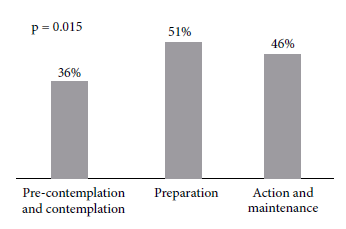
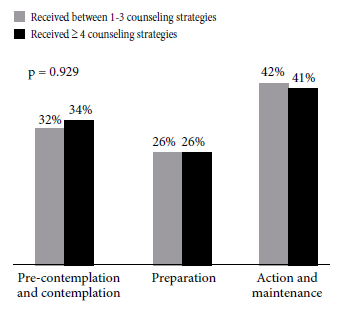
Counseling prevalence was higher among users during the preparation, action, and maintenance of SCB for LTPA (p = 0.015) (Figure 1). Among those who received counseling, the number of strategies used did not significantly associate with SCB (p = 0.929) (Figure 2).
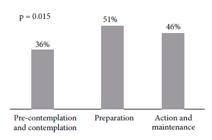
Association between prevalence of counseling received and stages of change behavior (SCB) for leisure-time physical activity (LTPA) in adults treated in primary health care. São José dos Pinhais, Brazil, 2019 (n = 779).
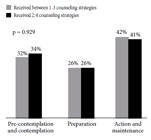
Association between the number of counseling strategies received and stages of change (SCB) for leisure-time physical activity (LTPA) in adults treated in primary health care. São José dos Pinhais, Brazil, 2019 (n = 335).
Regarding the association between sociodemographic characteristics, health conditions, SCB, and the counseling strategies received, the female sex showed a significant positive association with the professionals’ strategy of “advised PA based on individual characteristics” (61.6% vs. 49.0%; p = 0.033). “Identified PA barriers” were more common among users in the SCB pre-contemplation and contemplation (36.7% vs. 24.1% and 23.0%; p = 0.020). Age, hypertension, number of comorbidities, and number of medications showed consistent significant associations with at least 50% (n = 4) of the counseling strategies received (p < 0.05) (Table 3). No significant associations were found between the analyzed variables and the strategies of “commented on the PA benefits” and “asked about PA level” (p > 0.05). Further results from the analysis of associations between variables and brief PA counseling strategies are detailed in Table 3.
Discussion
This study examined potential predictors of brief PA counseling strategies received by users of BHU in the PHC based on the SUS context. The most frequently reported strategies were professionals “commented on the PA benefits” and “asked about PA level”. The sex (female) was associated with the professionals’ strategy of “advised PA based on individual characteristics”, while “identified PA barriers” was more common among users in the pre-contemplation and contemplation SCB for LTPA. Age, hypertension, number of comorbidities, and number of medications were significantly associated with at least 50% of the counseling strategies.
The quantitative approach of this study allowed for the examination of associations between sociodemographic variables, health conditions, SCB, and the prevalence of each counseling strategy in a representative sample of adults and elderly individuals. According to the literature, no earlier studies have explored the prevalence of counseling strategies received by PHC users, highlighting the novelty and strengths of this study. The variables were measured using standardized procedures and valid instruments, ensuring comparability with similar studies.
The lack of similar studies on counseling strategies received by PHC users limits the comparison and discussion of our results. However, three studies have examined brief PA counseling strategies used by health professionals in PHC17,22,31. Two studies in Florianópolis, Santa Catarina State, used a quantitative approach17,22, while one study in the countryside of São Paulo State used a qualitative approach31. Health professionals reported that the main strategies were “providing information about the benefits of PA”, “assessing PA levels”, “recommending types of PA”, “identifying PA barriers”, and “offering solutions to reduce barriers”. Some of these strategies are consistent with the results based on users’ perceptions in our study.
In this study, the most often reported strategies were health professionals “commented on the PA benefits” (90.7%) and “asked about PA level” (84.2%). While this study focuses on users’ feelings, similar strategies were noted in the Florianópolis-SC research, which focused on professionals’ feelings17,22. The widespread dissemination of PA benefits through media and health professionals3, likely explains the high prevalence of knowledge among adults (81%). Despite significant associations between some sociodemographic characteristics and PA knowledge, it is essential to promote brief PA counseling on benefits widely in BHU and PHC3,23. According to the principles of PHC in Brazil, the focus should extend beyond curative and medicinal actions to include preventive health promotion actions, ensuring universality, comprehensiveness, and equity41.
The two most often received PA counseling strategies, “commented on the PA benefits” and “asked about PA level”, were not associated with any analyzed variables. It is hypothesized that these strategies might be more common among older individuals, those with lower education and income, higher numbers of comorbidities and medications, and those in the preliminary stages of the SCB (pre-contemplation and contemplation)14,23. The literature suggests reinforcing PA benefits for individuals in these SCB20,23,27. Similarly, counseling on “offered solutions to barriers” should be more frequent for users in the preparation stage20,23,27. To ensure individuals receive proper counseling strategies, they should be screened and classified into the relevant SCB, with this information available to healthcare professionals supplying the counseling.
The nonspecific nature of counseling can partly be attributed to healthcare professionals’ limited knowledge of “PA and public health.”42. Continuous and enhanced education, along with practical experience in PHC, could improve the quality of counseling. Professionals specializing in public health are 3.7 times more likely to provide PA counseling13. Additionally, counseling can be considered any information given to the user.
Regarding sociodemographic variables, age group over 60 were positively associated with receiving 50% of the counseling strategies (1: PA recommendations, 2: counseling based on individual characteristics, 3: identifying barriers, and 4: solutions to reduce barriers). These findings are consistent with evidence that older adults receive more PA counseling12,14. The higher number of strategies for older adults is beneficial, as they are more susceptible to physical inactivity, especially in lower-income countries like Brazil4,5. The most reported barriers to PA among PHC users are fatigue and lack of time40. However, older adults commonly report barriers such as existing injuries or illnesses, fear of injury during PA, and feeling too old for PA40. Therefore, increased attention from healthcare professionals using various counseling strategies could encourage or facilitate PA among older adults30.
Hypertension, number of comorbidities, and number of medications were positively associated with at least 50% of the counseling strategies. These results are expected and are beneficial, especially in PHC, where health conditions are the main barriers to PA40. It is crucial to focus more on individuals with comorbidities, as these barriers can negatively affect PA, particularly LTPA30,43.
The transtheoretical model guides behavioral health interventions, like PA, by identifying the most proper actions based on an individual’s stage in the SCB19-21,23,28. Although SCB is crucial for tailoring counseling strategies, it was associated with only two (25%) of the strategies received (“identifying PA barriers” and “identifying the start of PA”). The inverse association between those in the pre-contemplation and contemplation stages and the identification of barriers is concerning. At these stages, health professionals should use impartial counseling to engage users in future consultations and highlight the benefits of starting PA19-21,23. While the strategies used may not align with the behavioral stage, any counseling could encourage the initiation of PA14,30. This suggests that professionals might not know users’ SCB or the most suitable counseling strategies for each stage.
In Brazil, the prevalence of counseling by PHC professionals is high, ranging from 50-86%11-13. However, the quality of information used during counseling is more important than the number of strategies employed42. This underscores the need for PHC professionals to be trained in “epidemiology, PA, and public health” to enhance their skills and supply effective, high-quality PA counseling18,27,42,44,45. Professionals must also be proficient in using proper tools, methodologies, and counseling strategies tailored to patients’ sociodemographic profiles, health conditions, and SCB19-21,23,25,27. The Brazilian Ministry of Health’s documents, “Physical Activity Guide for the Brazilian Population”39 and “Guide on Brief Counseling for PA in PHC in SUS”46, offer recommendations on PA and implementing counseling in both individual and group settings, facilitating these actions.
Our findings, showing low specificity in counseling strategies based on sociodemographic characteristics, health conditions, and SCB, underscore the need for Physical Education professionals in PHC teams. Users counseled by other health professionals to start or increase PA could consult these specialists for detailed activity guidance based on SCB (frequency, intensity, duration, and type of activities)47. Counseling could also be tailored to promote active commuting (walking and bicycling) or reduce sedentary behavior30,48,49, considering each user’s sociodemographic characteristics, health conditions, and PA levels. Physical Education professionals could further support ongoing training and education during BHU team meetings47.
This study has five key limitations. First, the sample was limited to adult and elderly users of BHU in the urban area of a medium-sized city in southern Brazil, which lacked Physical Education professionals on their health teams. This absence may have affected users’ perceptions of the counseling strategies. Second, participants’ perceptions could be influenced by memory bias, especially among the elderly, who may not recognize the information as professional guidance but rather as informal counseling. Third, the reported prevalence of comorbidities was high compared to surveys using related questions (e.g., Risk and Protective Factors Surveillance System for Chronic Diseases by Telephone Interviews - VIGITEL4), likely due to the higher proportion of people with diseases seeking health services. Fourth, the quantitative approach, using a short and standardized questionnaire to assess brief counseling strategies, did not allow for an in-depth exploration of interpersonal aspects crucial for implementing community PA programs. Therefore, this approach may have failed to capture contextual information related to the counseling strategies, which would require qualitative or mixed methods. Finally, the cross-sectional design’s lack of temporality means that caution is needed in interpreting the results, as causal relationships cannot be proved.
Conclusion
The most often received PA counseling strategies were “providing information about the PA benefits” and “assessing the PA level”. The prevalence of different strategies varied based on sociodemographic characteristics (gender, age, marital status, skin color), health conditions (type and number of comorbidities and medications), and SCB.
Analyzing BHU users helps understand how individual characteristics influence the PA counseling they receive. Our findings supply key insights for planning, implementing, and maintaining integrated PA counseling in PHC. Counseling strategies should be tailored to users’ sociodemographic characteristics, health conditions, and SCB, following PHC guidelines and employing shared care, interprofessional approaches, and individualized therapeutic plans. Additionally, it is crucial to adopt a broad perspective on health and PA, considering both benefits and strategies to overcome barriers limiting PA practice. Further studies should assess the effectiveness of counseling by trained professionals using evidence-based protocols to promote PA among PHC users.
Acknowledgments
The authors would like to thank the members of the Grupo de Pesquisa em Ambiente, Atividade Física e Saúde (GPAAFS) for their assistance in data collection and the Secretaria Municipal de Saúde (SMS) and the Secretaria Municipal de Esporte Lazer (SEMEL) of São José dos Pinhais-PR for making this research possible.
References
- 1 Bull FC, Al-Ansari SS, Biddle S, Borodulin K, Buman MP, Cardon G, et al. World Health Organization 2020 guidelines on physical activity and sedentary behaviour. Br J Sports Med 2020; 54(24):1451-1462.
- 2 Strain T, Brage S, Sharp SJ, Richards J, Tainio M, Ding D, et al. Use of the prevented fraction for the population to determine deaths averted by existing prevalence of physical activity: a descriptive study. Lancet Glob Health 2020; 8(7):e920-30.
- 3 Domingues MR, Araújo CLP, Gigante DP. Conhecimento e percepção sobre exercício físico em uma população adulta urbana do sul do Brasil. Cad Saude Publica 2004; 20(1):204-15.
- 4 Brasil. Ministério da Saúde (MS). Secretaria de Vigilância em Saúde. Departamento de Análise em Saúde e Vigilância de Doenças Não Transmissíveis. VIGITEL Brasil 2023. Brasília: MS; 2023.
- 5 Sallis JF, Bull F, Guthold R, Heath GW, Inoue S, Kelly P, Oyeyemi AL, Perez LG, Richards J, Hallal PC; Lancet Physical Activity Series 2 Executive Committee. Progress in physical activity over the Olympic quadrennium. Lancet 2016; 388(10051):1325-1336.
- 6 Brasil. Ministério da Saúde (MS). Secretaria de Vigilância em Saúde. Política Nacional de Promoção da Saúde. Brasília: MS; 2018.
- 7 Becker L, Gonçalves P, Reis R. Programas de promoção da atividade física no Sistema Único de Saúde brasileiro: revisão sistemática. Rev Bras Ativ Fis Saude 2016; 21(2):110-122.
- 8 Orrow G, Kinmonth AL, Sanderson S, Sutton S. Effectiveness of physical activity promotion based in primary care: systematic review and meta-analysis of randomised controlled trials. Br Med J 2012; 344:e1389.
- 9 GC V, Wilson ECF, Suhrcke M, Hardeman W, Sutton S. Are brief interventions to increase physical activity cost-effective? a systematic review. Br J Sports Med 2016; 50(7):408-417.
- 10 Sposito LAC, Nakamura PM, Moteiro HL, Papinni CB, Benedetti TRB, Kokubun E. Evaluation of strategies for the physical activity promotion: coast-utility study. Rev Int Med Cien Activ Fis Deporte 2021; 21(84):607-621.
- 11 Souza-Neto JM, Brito GEG, Loch MR, Silva SS, Costa FF. Aconselhamento para atividade física na Atenção Primária à Saúde: uma revisão integrativa. Movimento 2020; 26:e26075.
- 12 Moraes SQ, Souza JH, Araújo PAB, Rech CR. Prevalence of physical activity counseling in Primary Health Care: a systematic review. Rev Bras Ativ Fis Saude 2019; 24:1-12.
- 13 Moraes SQ, Santos ACB, Fermino RC, Rech CR. Physical activity counseling in Primary Health Care. Cien Saude Colet 2022; 27(9):3603-3614.
- 14 Santos LP, Silva AT, Rech CR, Fermino RC. Physical activity counseling among adults in Primary Health Care centers in Brazil. Int J Environ Res Public Health 2021; 18(10):579.
- 15 Barnes PM, Schoenborn CA. Trends in adults receiving a recommendation for exercise or other physical activity from a physician or other health professional. NCHS Data Brief 2012; 86:1-8.
- 16 Andersen P, Holmberg S, Lendahls L, Nilsen P, Kristenson M. Physical activity on prescription with counsellor support: A 4-year registry-based study in routine health care in Sweden. Healthcare 2018; 6(2):34.
- 17 Moraes SQ, Loch MR, Rech CR. Counseling strategies for physical activity used by the Expanded Nucleus of Family Health in Florianópolis. J Phys Educ 2021; 32:e3210.
- 18 Coombes JS, Williams A, Radford J. Training health professionals to provide physical activity counselling. Prog Cardiovasc Dis 2021; 64:72-76.
- 19 AuYoung M, Linke SE, Pagoto S, Buman MP, Craft LL, Richardson CR, Hutber A, Marcus BH, Estabrooks P, Gorin SS. Integrating physical activity in primary care practice. Am J Med 2016; 129(10):1022-1029.
- 20 Shuval K, Leonard T, Drope J, Katz DL, Patel AV, Maitin-Shepard M, Amir O, Grinstein A. Physical activity counseling in primary care: insights from public health and behavioral economics. CA Cancer J Clin 2017; 67(3):233-244.
- 21 Meriwether RA, Lee JA, Lafleur AS, Wiseman P. Physical activity counseling. Am Fam Physician 2008; 77(8):1129-1136.
- 22 Moraes SQ, Paiva-Neto FT, Loch MR, Fermino RC, Rech CR. Characteristics and counseling strategies for physical activity used by Primary Health Care professionals. Cien Saude Colet 2024; 29(1):e00692023
- 23 American College of Sports Medicine (ACSM). ACSM's guidelines for exercise testing and prescription. Philadelphia-PA: ACSM; 2022.
- 24 Wang J, Yin G, Li G, Liang W, Wei Q. Efficacy of physical activity counseling plus sleep restriction therapy on the patients with chronic insomnia. Neuropsychiatr Dis Treat 2015; 11:2771-2778.
- 25 Lobelo F, Rohm Young D, Sallis R, Garber MD, Billinger SA, Duperly J, Hutber A, Pate RR, Thomas RJ, Widlansky ME, McConnell MV, Joy EA; American Heart Association Physical Activity Committee of the Council on Lifestyle and Cardiometabolic Health; Council on Epidemiology and Prevention; Council on Clinical Cardiology; Council on Genomic and Precision Medicine; Council on Cardiovascular Surgery and Anesthesia; and Stroke Council. Routine Assessment and Promotion of Physical Activity in Healthcare Settings: A Scientific Statement From the American Heart Association. Circulation 2018; 137(18):e495-e522.
- 26 Glasgow RE, Emont S, Miller DC. Assessing delivery of the five "As" for patient-centered counseling. Health Promot Int 2006; 21(3):245-255.
- 27 Estabrooks PA, Glasgow RE, Dzewaltowski DA. Physical activity promotion through primary care. JAMA 2003; 289(22):2913-2916.
- 28 Marcus BH, Simkin LR. The transtheoretical model: applications to exercise behavior. Med Sci Sports Exerc 1994; 26(11):1400-1404.
- 29 Dumith SC, Gigante DP, Domingues MR. Stages of change for physical activity in adults from Southern Brazil: a population-based survey. Int J Behav Nutr Phys Act 2007; 4:25.
- 30 Dogra S, Copeland JL, Altenburg TM, Heyland DK, Owen N, Dunstan DW. Start with reducing sedentary behavior: a stepwise approach to physical activity counseling in clinical practice. Patient Educ Couns 2022; 105(6):1353-1361.
- 31 Sposito LAC, Guerra PH, Kokubun E. Estratégias de aconselhamento breve sobre atividade física desenvolvidas por profissionais de saúde. Rev Bras Promoç Saude 2023; 36:12.
- 32 Silva AT, Santos LP, Rodriguez-Añez CR, Fermino RC. Logic Model of "Cidade Ativa, Cidade Saudável Program" in São José dos Pinhais, Brazil. Rev Bras Ativ Fis Saude 2021; 26:e0193.
- 33 Instituto Brasileiro de Geografia e Estatística (IBGE). Síntese de indicadores sociais: uma análise das condições de vida da população brasileira. Rio de Janeiro: IBGE; 2016.
-
34 Prefeitura Municipal de São José dos Pinhais. Saúde transparente [Internet]. [acessado 2024 out 13]. Disponível em: http://saudetransparente.sjp.pr.gov.br
» http://saudetransparente.sjp.pr.gov.br - 35 Häfele V, Siqueira F. Physical activity counseling and change of behavior in Basic Health Units. Rev Bras Ativ Fis Saude 2016; 21(6):581-592.
- 36 Associação Brasileira de Empresas de Pesquisa (ABEP). Critério de Classificação Econômica Brasil. São Paulo: ABEP; 2019.
- 37 World Health Organization (WHO). Physical status: the use and interpretation of anthropometry. Geneva: WHO; 1995.
- 38 Nigg CN. There is more to stages of exercise than just exercise. Exerc Sport Sci Rev 2005; 33(1):32-35.
- 39 Brasil. Ministério da Saúde (MS). Secretaria de Atenção Primária à Saúde. Guia de Atividade Física para a População Brasileira. Brasília: MS; 2021.
- 40 Souza ALK, Santos LPD, Rech CR, Rodriguez-Añez CR, Alberico C, Borges LJ, Fermino RC. Barriers to physical activity among adults in primary healthcare units in the National Health System: a cross-sectional study in Brazil. Sao Paulo Med J 2022; 140(5):658-667.
- 41 Paim J, Travassos C, Almeida C, Bahia L, Macinko J. The Brazilian health system: history, advances, and challenges. Lancet 2011; 377(9779):1778-1797.
- 42 Burdick L, Mielke GI, Parra DC, Gomes G, Florindo A, Bracco M, Lobelo F, Simoes EJ, Pratt M, Ramos LR, Moura L, Brownson RC, Hallal PC. Physicians', nurses' and community health workers' knowledge about physical activity in Brazil: a cross-sectional study. Prev Med Rep 2015; 2:467-472.
- 43 Garcia L, Mendonça G, Benedetti TRB, Borges LJ, Streit IA, Christofoletti M, et al. Barriers and facilitators of domain-specific physical activity: a systematic review of reviews. BMC Public Health 2022; 22(1):1964.
- 44 Malta MB, Carvalhaes MABL, Takito MY, Tonete VLP, Barros AJD, Parada CMGL, Benício MH. Educational intervention regarding diet and physical activity for pregnant women: changes in knowledge and practices among health professionals. BMC Pregnancy Childbirth 2016; 16(1):175.
- 45 Malta MB, Gomes CB, Barros AJD, Baraldi LG, Takito MY, Benício MHD, Carvalhaes MABL. Effectiveness of an intervention focusing on diet and walking during pregnancy in the primary health care service. Cad Saude Publica 2021; 37(5):e00010320.
- 46 Brasil. Ministério da Saúde (MS). Secretaria de Atenção Primária à Saúde. Guia de Orientação para o Aconselhamento Breve sobre Atividade Física na Atenção Primária à Saúde do Sistema Único de Saúde. Brasília: MS; 2022.
- 47 Rodrigues JD, Ferreira DKS, Silva PA, Caminha IO, Farias-Junior JC. Integration and performance of Physical Education Professional on primary health care in Brazil: systematic review. Rev Bras Ativ Fis Saude 2013; 18(1):5-15.
- 48 Shuval K, DiPietro L, Sugg Skinner C, Barlow CE, Morrow J, Goldsteen R, Kohl HW 3rd. 'Sedentary behaviour counselling': the next step in lifestyle counselling in primary care. Pilot findings from the Rapid Assessment Disuse Index (RADI) study. Br J Sports Med 2014; 48(19):1451-1455.
- 49 Snége A, Silva AAP, Mielke GI, Rech CR, Siqueira FCV, Rodriguez-Añez CR, Fermino RC. Sedentary behavior counseling received from healthcare professionals: an exploratory analysis in adults at primary health care in Brazil. Int J Environ Res Public Health 2022; 19(16):9963-9977.

 Source: Authors.
 Source: Authors.