 Assessment of movement asymmetry in horses without saddle, saddled, and ridden by different riders in a straight line
ABSTRACT:
Lameness is one of the main causes of clinical manifestations of injuries in horses, and is characterized by an asymmetry of movement. This study assessed the influence of the saddle and two different riders on the symmetry of movements in Criollo horses. We used twenty Criollo horses in training for the Freio de Ouro competitions. An objective evaluation was carried out when moving at a trot in a straight line, in order to compare the saddle and rider effects in the asymmetry of horses trotting in a straight line. We evaluated inertial measurement units, obtaining data from the asymmetric side, as well as the amplitude of the asymmetry, using inertial sensor software. There was no significant difference in the objective measurements between the groups assessed in the VECTOR SUM, DIFF MIN of the head, DIFF MAX and DIFF MIN of the pelvis, but one of the riders showed a statistical difference in the DIFF MAX of the head compared to the situations. In this study, it was observed that one of the riders influenced the horse’s head movement, suggesting the possibility that riders can indeed impact the movements and asymmetries of horses during riding.
Key words:
objective assessment; lameness; Criollo; gait; mounted; saddle
RESUMO:
A claudicação é uma das principais causas de manifestação clínica de lesões em equinos, e é caracterizada por ser uma assimetria do movimento. O objetivo deste trabalho é avaliar a influência da sela e de dois diferentes cavaleiros na simetria dos movimentos de equinos da raça Crioula. Foram utilizados 20 equinos da raça Crioula em treinamento para competições de Freio de Ouro. Foi realizada uma avaliação objetiva ao se deslocar em trote em linha reta, a fim de comparar o efeito da sela e do cavaleiro na simetria do movimento, modificando os parâmetros avaliados pela avaliação objetiva, obtendo dados do lado assimétrico, bem como a amplitude da assimetria, utilizando software de sensor inercial. Não houve diferença significativa nas medidas objetivas entre os grupos avaliados no VECTOR SUM, DIFF MIN da cabeça, DIFF MAX e DIFF MIN da pelve, porém um dos cavaleiros apresentou diferença estatística no DIFF MAX da cabeça comparado às demais situações. Nesse estudo, observou-se que um dos cavaleiros teve influência no movimento da cabeça do cavalo, sugerindo a possibilidade que os cavaleiros podem, de fato, impactar os movimentos e as assimetrias dos cavalos durante a montaria.
Palavras-chave:
avaliação objetiva; claudicação; crioulo; marcha; montado; sela
INTRODUCTION
Lameness is defined as an asymmetry of movement during locomotion and can be classified as primary, secondary, or compensatory. It can also be classified based on the phase of the stride, such as impact, push-off, or support lameness (BAXTER & STASHAK, 2020). The fore limb is more susceptible to injuries than the hind limb, as it bears 60% of the load, contrasting with 40% load on the hind limb. This load distribution can reach up to 70%/30% fore limb/hind limb when the horse is ridden by a rider (ROSS, 2011).
Movement examination can be carried out through subjective assessment using scales lameness or objective assessment methods (BAXTER & STASHAK, 2020). Wireless inertial sensors represent one of the widely accepted forms of objective assessment, employed both to assist in clinical evaluations and in different studies with flexion tests, anesthetic blocks, and treatments (KEEGAN et al., 2011; MARSHALL et al., 2012; SILVA et al., 2015; JÚNIOR et al., 2022; MARUNOVA et al., 2022; PFAU et al., 2023).
The Freio de Ouro is a morphological and functional evaluation test for Criollo horses promoted and organized entirely by the Brazilian Association of Criollo Horse Breeders - ABCCC, the animals are subjected to a morphological test and eight functional tests (ABCCC, 2023).
The saddle and rider significantly impact the horse’s performance. While the range of spinal movement remains consistent regardless of the presence of the saddle and rider, the movement of the strides becomes long with the additional mass (CLAYTON & HOBBS, 2017). One study demonstrated decreased three-dimensional range of motion in saddled horses compared to in-hand trotting (HEIM et al., 2016). Experienced riders help to stabilizing the horse’s movements, thereby enhancing the animal’s performance (EGENVALL et al., 2013). Studies regarding these aspects have been developed in some breeds and sports (LICKA et al., 2004; PFAU et al., 2022), but limited reports are available regarding western performance horses.
Therefore, this study assessed whether differences exist in the symmetry of movements among Criollo horses participating in the Freio de Ouro sport modality when examined on a straight line under different conditions: without a saddle, with a saddle, and ridden by two different riders.
MATERIALS AND METHODS
Twenty Criollo horses, approximately 6.6 years old (± 2.19), with an average body mass of 456.40 kg (± 29.31), were included in the study, comprising seven males and thirteen females. These animals were undergoing training for the Freio de Ouro modality, a specific competition for the breed. Initial evaluation involved a comprehensive physical examination to assess the locomotor system, followed by objective movement assessment. The riders involved in the study possessed equivalent equestrian skills but exhibited varying riding techniques. The riding equipment included a saddle, blankets, and belly bands.
Step 1: Firstly, the weighing of the tack ensemble (11.11 kg) and the riders, both using a digital scale, was performed before the start of the assessment. Subsequently, data on the animals such as age and mass (mass tape) were collected.
Step 2: General and specific physical examination of the locomotor system, anamnesis, inspection and palpation examination were carried out.
Step 3: The order next steps (treatments) was randomly assigned for the animals. This allowed that only five animals started the study in one of those steps below.
Step 4: Placement of the objective assessment equipment on the animals. Assessment in dismounted motion (led in-hand without saddle) (Figure 1A): The animals were led in-hand at trot, in a straight line, for a distance of 30 meters, back and forth. This step was conducted with the animals equipped with the wireless inertial sensor system for objective movement assessment. The surface used in this case was a packed dirt.
Step 5: Assessment in saddled motion (saddled, mass 11.11 kg) (Figure 1B): It was conducted as described in step 4, where the animal was only equipped with the riding ensemble.
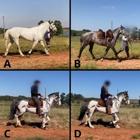
(A) Dismounted led in-hand movement examination. (B) Saddled pulled movement examination. (C) Examination in movement ridden by rider A. (D) Examination in movement ridden by rider B.
Step 6: Assessment in mounted motion (Rider A, mass 70.58 kg) (Figure 1C): It was conducted sitting trot with the reins promoting light contact on the bit, as described in step 4, except that the animal was not led in-hand but mounted by Rider A.
Step 7: Assessment in mounted motion (Rider B, mass 87.45 kg) (Figure 1D): It was conducted sitting trot with the reins promoting light contact on the bitas described in step 4, except that the animal was not led in-hand but mounted by Rider B.
The order of execution of steps 4, 5, 6, and 7 was randomly distributed through a prior draw before the examination of each animal.
Objective assessment
The animals were equipped with wireless inertial sensors (Lameness Locator® - 20/20, v2, Equinosis, LLC), comprising two accelerometers: one positioned on the head (midline, slightly behind the ears) and the other on the pelvis (at the highest level, along the midline between the sacral tubercles), along with a gyroscope placed on the right fore limb (along the dorsal midline of the phalanges). Subsequently, they underwent evaluation according to the procedures outlined in steps 4, 5, 6, and 7.
Thus, the system software conducted the assessment and quantified asymmetry through graphical and numerical representations for both fore and hind limbs. Quantitative lameness data were calculated by the program itself, including head DIFF MAX (the difference in maximum head height between the right and left fore limbs), head DIFF MIN (the difference in minimum head height between the right and left fore limbs), and VECTOR SUM (the vector sum of head DIFF MAX and DIFF MIN) for the fore limbs. For the hind limbs, DIFF MAX of the pelvis (the difference in maximum hind height between the right and left hind limbs) and DIFF MIN (the difference in minimum hind height between the right and left hind limbs) values were determined, alongside standard deviations for each DIFF MAX and DIFF MIN (KEEGAN et al., 2004; KEEGAN et al., 2011; MCCRACKEN et al., 2012).
These variables enable the determination of lameness intensity (ranging from mild to severe) and the phase of the stride in which it occurs (impact, support, or push-off), as well as identification of the affected limb, facilitating automated interpretation of the data.
The data tabulated for subsequent statistical analysis included the absolute values of VECTOR SUM, DIFF MAX, and DIFF MIN for the head, as well as DIFF MAX and DIFF MIN for the pelvis. Additionally, information regarding lameness intensity, affected limb, and type of lameness was documented.
Statistical analysis
Analyses were conducted to compare the parameters evaluated under different treatments: without saddle, with saddle, ridden by Rider A, and ridden by Rider B. All datas were analyzed using a Latin square design employing the SAS Mixed Procedure (version 9.3; SAS Institute, Inc., Cary, NC), with animal as a random effect, and treatment and period as fixed effects. The period was the order of execution of steps 4, 5, 6, and 7.
RESULTS AND DISCUSSION
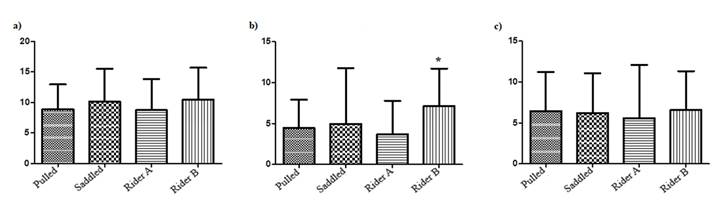
The 25 to 30 strides were used in the moving examination of each horse and conditions. For Vector Sum values, asymmetry was considered above 8.5 mm, for DIFF MAX and DIFF MIN of the head above 6 mm, and for DIFF MAX and DIFF MIN of the pelvis above 3 mm. In the DIFF MAX values of the head, rider B demonstrated a greater statistical difference compared to the led in-hand and rider A interventions (P = 0.02) (Table 1 and Table 2) (Figure 2B). PERSSON-SJODIN et al. (2018) concluded in their study evaluating changes between straight line and circular exercises during hand/lunge and mounted exercises, that there was no discernible influence on symmetry in the vertical movement of the head and pelvis with the symmetrical seating style, both in animals with pre-existing asymmetries and those without pre-existing asymmetry, additionally, there was an increase in DIFF MAX of the head during limb push-off when the rider was sitting. Furthermore, LICKA et al. (2004) mentioned that the asymmetries of the head and sacrum can be influenced by changes in the distribution of mass and forces on the limb, given that the weight of the riders has not changed. Another study, involving objective and subjective assessment of gait changes in horses with riders of different body mass but equal abilities, demonstrated that heavier riders can induce musculoskeletal pain or temporary lameness (DYSON et al., 2020a). Similarly, in our study, it was observed that horses ridden by rider B (50%) (87.45 kg) exhibited a slightly higher prevalence of lameness in the hind limbs compared to those ridden by rider A (45%) (70.58 kg). Furthermore, in the present study, the riders possessed similar skills but utilized different riding techniques, by the use of the reins and these characteristics warrant further investigation regarding their influence on the symmetry of the animals, particularly those involved in western-type modalities. In contrast, DYSON et al. (2020b), using warmblood dressage horses who evaluated the gait of horses ridden by riders with differing skill levels, observed variability in their data, with 27% of the animals displaying low-grade lameness with the skilled rider, and 13% exhibiting more apparent lameness when ridden by the most skilled rider. In one study, the presence of a rider was associated with a reduction in the amplitude of the horse’s vertebral movement, both dorsoventrally and mediolaterally, compared to without a rider (HEIM et al., 2016).

Means and standard deviations among the evaluated moments: pulled led in-hand, saddled, ridden by rider A and ridden by rider B. (A) Vector Sum. (B) DIFF MAX of the head. (C) DIFF MIN of the head. *significant difference.
There was no statistical difference in the VECTOR SUM values (P = 0.18) among the animals evaluated together (Figure 2A). Similarly, LICKA et al. (2004) did not observe a statistical difference in the lameness of the fore limbs between unridden and ridden horses. The kinematics of the horse’s limb change when a saddle and the rider’s mass are applied, increasing the retraction of the fore limb (DE COCQ et al., 2004). However, MARTIN et al. (2017) observed an increase in the range of motion, protraction, and retraction of the metacarpus/metatarsus in ridden horses; however, these kinetics parameters were not evaluated in our study.
There was no statistical difference in the DIFF MIN values of the head (P = 0.98) (Figure 2C) between different examination moments. This result is similar to that found by PFAU et al. (2022), who studied Quarter Horses, both straight line and circular exercise, where none of the head parameters were affected by mounted exercise.
Regarding the evaluation of DIFF MAX and DIFF MIN parameters of the pelvis, there was no statistical difference (P = 0.63 and P = 0.61) between the evaluated moments (Figure 3A and 3B). In our study, the mean DIFF MAX of the led in-hand horses (without a saddle) was lower compared to the other evaluated moments; however, this difference was not statistically significant. A study evaluating the gait variability of horses on a treadmill, with riders or only a saddle, using a kinematic motion analysis system and sensors under the saddle, demonstrated that the rider can have a stabilizing effect on the gait when horses are adapting to the treadmill, and a poorly fitted saddle leads to communication failure between horse and rider, influencing the horse’s movement (PEHAM et al., 2004). In research conducted by PFAU et al. (2022), DIFF MIN of the pelvis values showed an increase in asymmetry when the animal was evaluated at the sitting trot, which differs from our study where the highest values were found only in the saddled group. MARQUÉS et al. (2014) also demonstrated that there was no association between the rider and the increase in lameness score during subjective lameness evaluation, which is more in line with the findings of our study.
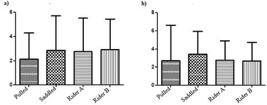
Means and standard deviations among the moments: pulled led in-hand, saddled, ridden by rider A and ridden by rider B. (A) DIFF MAX of the pelvis. (B) DIFF MIN of the pelvis.
The moment of bareback evaluation revealed a higher percentage of asymmetry in the fore limb (40%), similar to the findings of JOHNSON et al. (2021), who conducted a retrospective study with Quarter Horses, where the highest prevalence of lameness was observed in the fore limb.
Conversely, the other conditions (saddled, Rider A, and Rider B) exhibited a greater presence of asymmetry in the hind limbs (60% saddled, 45% ridden by Rider A, and 50% ridden by Rider B) (Table 3). This can be explained in this study, as most exercises in the Freio de Ouro modality demand greater support on the hind limbs, especially during maneuvers such as sliding stop, which results in increased load on these limbs; and consequently, a higher likelihood of injuries. It is important to conduct further studies to better understand the influence of the saddle and the rider on lameness in both fore and hind limbs. Other studies have already demonstrated a higher prevalence of lameness in hind limbs in Criollo horses (ABREU et al., 2011) and in horses used in equine therapy (TASCHETTO et al., 2021), typically assessing the horse guided bareback as usual. According to LICKA et al. (2004), the degree of lameness may escalate when the animal is mounted, especially concerning hind limbs. In the present study, the presence of the saddle and the riders changed the percentage of lameness from the front limb to the hind limbs.
Regarding lameness intensity, it was possible to observe a greater number of animals with mild lameness, followed by mild to moderate and moderate lameness in all evaluated groups (Table 4). An important point is that this present study was carried out on animals that were in training and not specifically on animals where the veterinarian was called to perform the lameness examination; this may also explain the low intensity of lameness. One study showed that 72.5% of horses in training had asymmetry by the objective assessment, but were judged to be free of lameness by their owners (RHODIN et al., 2017).
Lameness studies in the Criollo breed of the Freio de Ouro modality using inertial sensors, and primarily assessing the symmetry of horses when ridden or simply saddled, are scarce.This study had some limitations, including the lack of warm-up (training) of the animals before evaluations, horses in different training phases, a small number of animals in the study, and injuries were not diagnosed. However, important data related to potential influences on horse movement were obtained. Therefore, it is important to emphasize the need for further studies evaluating asymmetries in these groups of horses, especially those participating in “western” events, for a better understanding of alterations and influences on animal locomotion.
CONCLUSION
In this study, we assessed the influence of different factors on the movement of Criollos for the Freio de Ouro which resembles of horses in the “western” sports discipline, mainly, where we observed an influence of one of the riders on the head movement, but the saddle and the other rider did not affect the movement of these animals during straight line trot only. Despite the limitations, important data on asymmetry and its influences on movement were obtained, and the rider factor appears to be relevant. Further studies of this nature should be conducted in different horse breeds and sport specific disciplines, aiding veterinarians in the lameness examination of these animals; and consequently, in horses welfare.
ACKNOWLEDGEMENTS
This study was financed in part by the Coordenação de Aperfeiçoamento de Pessoal de Nível Superior - Brasil (CAPES) - Finance Code 001 and by the Conselho Nacional de Desenvolvimento Científico e Tecnológico (CNPq) -, Brazil. Reconquista Agropecuária LTDA for providing the animals. To the veterinarian Renato Icart, Sacha Oliveira and Gabriel Trindade for all their commitment and willingness to carry out the work. To the interns who followed the work for all their dedication and willingness.
REFERENCES
-
ASSOCIAÇÃO BRASILEIRA DE CRIADORES DE CAVALOS CRIOULOS. ABCCC. Freio de Ouro - História. Pelotas/RS. 2023. Available from: <https://www.cavalocrioulo.org.br/eventos/historia/freio-de-ouro>.
» https://www.cavalocrioulo.org.br/eventos/historia/freio-de-ouro -
ABREU, H. C. et al. Lameness in athletic Criollo horses/Claudicacao em cavalos Crioulos atletas. Ciência Rural, v.41, n.12, p.2114-2120, 2011. Available from: <Available from: https://www.scielo.br/j/cr/a/xmHX7zhJP3Trd698hCvDzJF/abstract/?lang=en >. Accessed: Nov. 16, 2022. doi: 10.1590/S0103-84782011001200013.
» https://doi.org/10.1590/S0103-84782011001200013.» https://www.scielo.br/j/cr/a/xmHX7zhJP3Trd698hCvDzJF/abstract/?lang=en - BAXTER, G. M.; STASHAK, T. S. Examination for Lameness: History, Visual Exam, And Conformation. In: Adams and Stashak’s Lameness in Horses, p.67-188, 2020.
-
CLAYTON, H. M.; HOBBS, S. The role of biomechanical analysis of horse and rider in equitation science. Applied Animal Behaviour Science, v.190, p.123-132, 2017. Available from: <Available from: https://www.sciencedirect.com/science/article/pii/S016815911730062X?casa_token=4_WCjgP6WZcAAAAA:EeywbTBvYpmEYN6K6V8X9-tVbKaMQdMfbY1hRZxE-JbJQLObHqcPAeqD9wfXMJVO2kc2zpIcdfQA >. Accessed: Nov. 03, 2022. doi: 10.1016/j.applanim.2017.02.011.
» https://doi.org/10.1016/j.applanim.2017.02.011.» https://www.sciencedirect.com/science/article/pii/S016815911730062X?casa_token=4_WCjgP6WZcAAAAA:EeywbTBvYpmEYN6K6V8X9-tVbKaMQdMfbY1hRZxE-JbJQLObHqcPAeqD9wfXMJVO2kc2zpIcdfQA -
DE COCQ, P. et al. Effects of girth, saddle and weight on movements of the horse. Equine Veterinary Journal, v.36, n.8. p.758-763, 2004. Available from: <Available from: https://beva.onlinelibrary.wiley.com/doi/full/10.2746/0425164044848000 >. Accessed: Dec. 15, 2022. doi: 10.2746/0425164044848000.
» https://doi.org/10.2746/0425164044848000.» https://beva.onlinelibrary.wiley.com/doi/full/10.2746/0425164044848000 -
DYSON, S. et al. The influence of rider: horse bodyweight ratio and rider-horse-saddle fit on equine gait and behaviour: A pilot study. Equine Veterinary Education, v.32, n.10, p.527-539, 2020a. Available from: <Available from: https://beva.onlinelibrary.wiley.com/doi/full/10.1111/eve.13085 >. Accessed: Dec. 06, 2022. doi: 10.1111/eve.13085.
» https://doi.org/10.1111/eve.13085.» https://beva.onlinelibrary.wiley.com/doi/full/10.1111/eve.13085 -
DYSON, S. et al. The influence of rider skill on ridden horse behaviour, assessed using the Ridden Horse Pain Ethogram, and gait quality. Equine Veterinary Education, v.34, n.7, p.e308-e317, 2020b. Available from: <Available from: https://beva.onlinelibrary.wiley.com/doi/full/10.1111/eve.13434?casa_token=1iKOn3Mc4y4AAAAA%3AF0W7rlsDN15183yE9yMNnXzOARedprCYdyC5xfIDbSQOt7ZdimqlVb0_s-JfXfRX6678OdckIWAYo-oT5A >. Accessed: Dec. 15, 2022. doi: 10.1111/eve.13434.
» https://doi.org/10.1111/eve.13434.» https://beva.onlinelibrary.wiley.com/doi/full/10.1111/eve.13434?casa_token=1iKOn3Mc4y4AAAAA%3AF0W7rlsDN15183yE9yMNnXzOARedprCYdyC5xfIDbSQOt7ZdimqlVb0_s-JfXfRX6678OdckIWAYo-oT5A - EGENVALL, A. et al. Horse-rider interaction. In: Equine locomotion, p.341-368, 2013.
-
HEIM, C. et al. Determination of vertebral range of motion using inertial measurement units in 27 Franches‐Montagnes stallions and comparison between conditions and with a mixed population. Equine veterinary journal, v.48, n.4, p.509-516, 2016. Available from: <Available from: https://beva.onlinelibrary.wiley.com/doi/full/10.1111/evj.12455?casa_token=ZYu4nxi_VEMAAAAA%3ApbHPmnAHZ6kkCOLOTgF YB3JTLlAr39GphJqTzxo7ditgLWRs7hC22hsirMWk_Wh8IpaDvPnXF4agKxV9 >. Accessed: Sept. 19, 2024. doi: 10.1111/evj.12455.
» https://doi.org/10.1111/evj.12455.» https://beva.onlinelibrary.wiley.com/doi/full/10.1111/evj.12455?casa_token=ZYu4nxi_VEMAAAAA%3ApbHPmnAHZ6kkCOLOTgF YB3JTLlAr39GphJqTzxo7ditgLWRs7hC22hsirMWk_Wh8IpaDvPnXF4agKxV9 -
JOHNSON, S. A. et al. Retrospective analysis of lameness localisation in Western Performance Horses: A ten‐year review. Equine Veterinary Journal, v.53, n.6, p.1150-1158, 2021. Available from: <Available from: https://beva.onlinelibrary.wiley.com/doi/full/10.1111/evj.13397?casa_token=6m-1Zmt_DJoAAAAA%3AIODUlEDySyv6D6SEaz9j-V5nZJIRnvHpCghzWuz_YpmRB-w4eeT61Kmt5NfHrTtAsPIfsa1lRPztMR-N >. Accessed: Nov. 16, 2022. doi: 10.1111/evj.13397.
» https://doi.org/10.1111/evj.13397.» https://beva.onlinelibrary.wiley.com/doi/full/10.1111/evj.13397?casa_token=6m-1Zmt_DJoAAAAA%3AIODUlEDySyv6D6SEaz9j-V5nZJIRnvHpCghzWuz_YpmRB-w4eeT61Kmt5NfHrTtAsPIfsa1lRPztMR-N -
JÚNIOR, A. A. B. et al. Safety and Synovial Inflammatory Response After Intra-articular Injection of Botulinum Toxin Type A in Healthy Horses. Journal of Equine Veterinary Science, v.110, p.103865, 2022. Available from: <Available from: https://www.sciencedirect.com/science/article/pii/S073708062200003X?casa_token=UFaARxbUnIMAAAAA:TpyW60vDvKNJ6RDNiwF51tkUcsGq38J7DDi4sD4EOSttS63EwMEjtiVPfNa9Pgd96nct-Av9LDUH >. Accessed: Nov. 10, 2022. doi: 10.1016/j.jevs.2022.103865.
» https://doi.org/10.1016/j.jevs.2022.103865.» https://www.sciencedirect.com/science/article/pii/S073708062200003X?casa_token=UFaARxbUnIMAAAAA:TpyW60vDvKNJ6RDNiwF51tkUcsGq38J7DDi4sD4EOSttS63EwMEjtiVPfNa9Pgd96nct-Av9LDUH -
KEEGAN, K. G. et al. Evaluation of a sensor-based system of motion analysis for detection and quantification of forelimb and hind limb lameness in horses. American journal of veterinary research, v.65, n.5, p.665-670, 2004. Available from: <Available from: https://avmajournals.avma.org/view/journals/ajvr/65/5/ajvr.65.5.665.xml >. Accessed: Sept. 19, 2024. doi: 10.2460/ajvr.2004.65.665.
» https://doi.org/10.2460/ajvr.2004.65.665.» https://avmajournals.avma.org/view/journals/ajvr/65/5/ajvr.65.5.665.xml -
KEEGAN, K. G. et al. Assessment of repeatability of a wireless, inertial sensor-based lameness evaluation system for horses. American journal of veterinary research, v.72, n.9, p.1156-1163, 2011. Available from: <Available from: https://avmajournals.avma.org/view/journals/ajvr/72/9/ajvr.72.9.1156.xml >. Accessed: Nov. 08, 2022. doi: 10.2460/ajvr.72.9.1156.
» https://doi.org/10.2460/ajvr.72.9.1156.» https://avmajournals.avma.org/view/journals/ajvr/72/9/ajvr.72.9.1156.xml -
LICKA, T. et al. Influence of rider on lameness in trotting horses. Equine veterinary journal, v.36, n.8, p.734-736, 2004. Available from: <Available from: https://beva.onlinelibrary.wiley.com/doi/abs/10.2746/0425164044848028 >. Accessed: Nov. 30, 2022. doi: 10.2746/0425164044848028.
» https://doi.org/10.2746/0425164044848028.» https://beva.onlinelibrary.wiley.com/doi/abs/10.2746/0425164044848028 -
MARUNOVA, E. et al. Changes in head, withers, and pelvis movement asymmetry in lame horses as a function of diagnostic anesthesia outcome, surface and direction. Journal of Equine Veterinary Science, v.118, p.104136, 2022. Available from: <Available from: https://www.sciencedirect.com/science/article/pii/S0737080622002726 >. Accessed: Sept. 19, 2024. doi: 10.1016/j.jevs.2022.104136.
» https://doi.org/10.1016/j.jevs.2022.104136.» https://www.sciencedirect.com/science/article/pii/S0737080622002726 - MARQUÉS, F. J. et al. Effect of rider experience and evaluator expertise on subjective grading of lameness in sound and unsound sports horses under saddle. Canadian Journal of Veterinary Research, v.78, n.2, p.89-96, 2014.
-
MARSHALL, J. F. et al. Use of a wireless, inertial sensor‐based system to objectively evaluate flexion tests in the horse. Equine Veterinary Journal, v.44, p.8-11, 2012. Available from: <Available from: https://beva.onlinelibrary.wiley.com/doi/full/10.1111/j.2042-3306.2012.00611.x?casa_token=lthkgdCeu-8AAAAA%3Ae6ueANlKUjou6ZMfOjvBHV1tAoX6F19cxzhghG9k5HAp6cuVpQsDDNaxL9tm6ojiv-gnZa7Y6O37dT0W >. Accessed: Nov. 08, 2022. doi: 10.1111/j.2042-3306.2012.00611.x.
» https://doi.org/10.1111/j.2042-3306.2012.00611.x.» https://beva.onlinelibrary.wiley.com/doi/full/10.1111/j.2042-3306.2012.00611.x?casa_token=lthkgdCeu-8AAAAA%3Ae6ueANlKUjou6ZMfOjvBHV1tAoX6F19cxzhghG9k5HAp6cuVpQsDDNaxL9tm6ojiv-gnZa7Y6O37dT0W -
MARTIN, P. et al. Effects of the rider on the kinematics of the equine spine under the saddle during the trot using inertial measurement units: Methodological study and preliminary results. The Veterinary Journal, v.221, p.6-10, 2017. Available from: <Available from: https://www.sciencedirect.com/science/article/pii/S1090023317300035 >. Accessed: Nov. 30, 2022. doi: 10.1016/j.tvjl.2016.12.018.
» https://doi.org/10.1016/j.tvjl.2016.12.018.» https://www.sciencedirect.com/science/article/pii/S1090023317300035 -
MCCRACKEN, M. J. et al. Comparison of an inertial sensor system of lameness quantification with subjective lameness evaluation. Equine veterinary journal, v.44, n.6, p.652-656, 2012. Available from: <Available from: https://beva.onlinelibrary.wiley.com/doi/full/10.1111/j.2042-3306.2012.00571.x?casa_ _token=655NUmiRb1oAAAAA%3AVZM UtqxdocRVI5XYEIRn60SsMjxh3Ztc 0D1rzFiqQqRLiQNmWxA7ve28iRCJYu9SWnk8Xmls794jQ3J6 >. Accessed: Sept. 19, 2024. doi: 10.1111/j.2042-3306.2012.00571.x.
» https://doi.org/10.1111/j.2042-3306.2012.00571.x.» https://beva.onlinelibrary.wiley.com/doi/full/10.1111/j.2042-3306.2012.00571.x?casa_ _token=655NUmiRb1oAAAAA%3AVZM UtqxdocRVI5XYEIRn60SsMjxh3Ztc 0D1rzFiqQqRLiQNmWxA7ve28iRCJYu9SWnk8Xmls794jQ3J6 -
PEHAM, C. et al. Influence of the rider on the variability of the equine gait. Human Movement Science, v.23, n.5, p.663-671, 2004. Available from: <Available from: https://www.sciencedirect.com/science/article/pii/S0167945704000843?casa_token=n_X5CPG-nmkAAAAA:R8tFMjp818ozyXoN-uiTCCk3NAXAAqTNj0QcMLQaba5QG_ho_5Hxsl675jcrkqPdVuge_TaU7Jyv >. Accessed: Dec. 15, 2022. doi: 10.1016/j.humov.2004.10.006.
» https://doi.org/10.1016/j.humov.2004.10.006.» https://www.sciencedirect.com/science/article/pii/S0167945704000843?casa_token=n_X5CPG-nmkAAAAA:R8tFMjp818ozyXoN-uiTCCk3NAXAAqTNj0QcMLQaba5QG_ho_5Hxsl675jcrkqPdVuge_TaU7Jyv -
PERSSON-SJODIN, E. et al. Influence of seating styles on head and pelvic vertical movement symmetry in horses ridden at trot. PLoS One, v.13, n.4, p.e0195341, 2018. Available from: <Available from: https://journals.plos.org/plosone/article?id=10.1371/journal.pone.0195341 >. Accessed: Dec. 01, 2022. doi: 10.1371/journal.pone.0195341.
» https://doi.org/10.1371/journal.pone.0195341.» https://journals.plos.org/plosone/article?id=10.1371/journal.pone.0195341 -
PFAU, T. et al. Upper Body Movement Symmetry in Reining Quarter Horses during Trot In-Hand, on the Lunge and during Ridden Exercise. Animals, v.12, n.5, p.596, 2022. Available from: <Available from: https://www.mdpi.com/2076-2615/12/5/596 >. Accessed: Nov. 16, 2022. doi: 10.3390/ani12050596.
» https://doi.org/10.3390/ani12050596.» https://www.mdpi.com/2076-2615/12/5/596 -
PFAU, T. et al. Changes in Head and Pelvic Movement Symmetry after Diagnostic Anaesthesia: Interactions between Subjective Judgement Categories and Commonly Applied Blocks. Animals, v.13, n.24, p.3769, 2023. Available from: <Available from: https://www.mdpi.com/2076-2615/13/24/3769 >. Accessed: Sept. 19, 2024. doi: 10.3390/ani13243769.
» https://doi.org/10.3390/ani13243769.» https://www.mdpi.com/2076-2615/13/24/3769 -
RHODIN, M. et al. Head and pelvic movement asymmetries at trot in riding horses in training and perceived as free from lameness by the owner. PloS one, v.12, n.4, p.e0176253, 2017. Available from: <Available from: https://journals.plos.org/plosone/article?id=10.1371/journal.pone.0176253 >. Accessed: Sept. 19, 2024. doi: 10.1371/journal.pone.0176253.
» https://doi.org/10.1371/journal.pone.0176253.» https://journals.plos.org/plosone/article?id=10.1371/journal.pone.0176253 - ROSS, M. W. Movement. In: ROSS, M. W.; DYSON, S. J. (Eds.). In: Diagnosis and management of lameness in the horse. Missouri: Elsevier Saunders, p.64-80, 2011.
-
SILVA, G. B. et al. Duration and efficacy of different local anesthetics on the palmar digital nerve block in horses. Journal of Equine Veterinary Science, v.35, n.9, p.749-755, 2015. Available from: <Available from: https://www.sciencedirect.com/science/article/pii/S0737080615004852 >. Accessed: Nov. 08, 2022. doi: 10.1016/j.jevs.2015.07.013.
» https://doi.org/10.1016/j.jevs.2015.07.013.» https://www.sciencedirect.com/science/article/pii/S0737080615004852
BIOETHICS AND BIOSECURITY COMMITTEE APPROVAL
-
CR-2024-0270.R2
-
This study was approved by the Committee on the Ethics of Animal Use of the Universidade Federal do Pampa (No. 032/2021).
-
DATA AVAILABILITY
All data generated or analysed during this study are included in this published article
-
DECLARATION OF USE OF ARTIFICIAL INTELLIGENCE
It is declared that no artificial intelligence resources were used in the writing or development of this manuscript.
Edited by
-
Editors
Rudi Weiblen (0000-0002-1737-9817)Gustavo Miranda Zanotto (0000-0001-8498-5246)
All data generated or analysed during this study are included in this published article