 Multivariable analysis of factors associated with postoperative outcomes of fractures in horses in Brazil: a single-center study
ABSTRACT:
Fractures in horses are frequently associated with complications and poor prognosis, and identifying the factors that influence these variables can contribute to the development of strategies to improve the success rate. This study identified the factors associated with postoperative outcomes of fractures in horses in a Veterinary Hospital in Brazil, through multivariable analysis. The records of 93 horses with fractures referred to the Veterinary Hospital of the School of Veterinary Medicine and Animal Science of the Universidade de São Paulo were analyzed (between 1997 and 2023). The results of univariable logistic regression to identify factors associated with the outcome (discharge or death/euthanasia) and the occurrence of postoperative complications showed that cases treated less than 10 years ago had a greater chance of hospital discharge (OR = 16.2; CI = [3.47; 75.60]; P < 0.001) and of not presenting complications (OR = 6.55; CI = [2.27; 18.84]; P < 0.001). The use of locking plates was associated with greater chances of hospital discharge (OR = 7.11; CI = [1.40; 36.12]; p = 0.018) and of not presenting complications (OR = 4.76; CI = [1.04; 21.77]; P = 0.044). Regarding multivariable logistic regression, greater chances of hospital discharge were associated with cases that occurred less than 10 years ago (OR = 5.14; CI = [0.91; 28.97]; P = 0.063), when no complications were recorded (OR = 12.41; CI = [2.32; 66.45]; P = 0.003) and with fractures in forelimbs (OR = 3.18; CI = [1.02; 9.91]; P = 0.070). Greater chances of non-postoperative complications were associated with fractures located in the distal limb (OR = 3.04; CI = [0.92; 10.10]; P = 0.070). It is concluded that the use of locking plates, cases treated less than 10 years ago, lower occurrence of postoperative complications, fractures located in the distal portion and in forelimbs promoted greater chances of positive outcomes in horses with fracture.
Key words:
orthopedic trauma; retrospective study; horses; evolution; complications; prognosis
RESUMO:
As fraturas nos equinos são frequentemente associadas com complicações e prognóstico reservado, sendo que identificar os fatores que influenciam essas variáveis pode contribuir na elaboração de estratégias que visam a melhora da taxa de sucesso. O objetivo deste estudo foi identificar os fatores associados aos desfechos pós-operatórios das fraturas em equinos em um Hospital Veterinário no Brasil, por meio de análise multivariada. Os registros de 93 equinos fraturados encaminhados ao Hospital Veterinário da Faculdade de Medicina Veterinária e Zootecnia da Universidade de São Paulo foram analisados (entre 1997 à 2023). Os resultados da regressão logística univariada para identificação dos fatores associados com a evolução (alta ou óbito/eutanásia) e com a ocorrência de complicações pós-operatórias mostraram que nos casos atendidos há menos de 10 anos, tiveram maiores chances de alta hospitalar (OR = 16.2; IC = [3.47; 75.60]; P < 0.001) e de não apresentarem complicações (OR = 6.55; IC = [2.27; 18.84]; P < 0.001). O uso de placas bloqueadas foi associado a maiores chances de alta hospitalar (OR = 7.11; IC = [1.40; 36.12]; P = 0.018) e de não apresentarem complicações (OR = 4.76; IC = [1.04; 21.77]; P = 0.044). Em relação a regressão logística multivariada, maiores chances de alta hospitalar foi associada aos casos que ocorreram há menos de 10 anos (OR = 5.14; IC = [0.91; 28.97]; P = 0.063), quando não foram registradas complicações (OR = 12.41; IC = [2.32; 66.45]; P = 0.003) e às fraturas em membros torácicos (OR = 3.18; IC = [1.02; 9.91]; P = 0.070). Maiores chances de não complicações pós-operatórias, foram associadas as fraturas localizadas na porção distal do membro (OR = 3.04; IC = [0.92; 10.10]; P = 0.070). Conclui-se que o uso de placas bloqueadas, casos atendidos há menos de 10 anos, menor ocorrência de complicações pós-operatórias, fraturas localizadas na porção distal e em membros torácicos promoveram maiores chances de desfechos positivos em equinos fraturados.
Palavras-chave:
trauma ortopédico; estudo retrospectivo; equinos; evolução; complicações; prognóstico
INTRODUCTION
Musculoskeletal injuries are among the most prevalent problems affecting horses, impacting on their well-being and quality of life, and also resulting in economic losses. Fractures in horses are common and can affect animals of all ages and breeds, and can involve almost any bone (NIXON, 2019a). Unfortunately, many horses with simple fractures are euthanized without the possibility of treatment through surgical intervention (AUER & GRAINGER, 2015).
A study of 13 racehorse trainers in the United Kingdom between 1998 and 2000 found that 148 fractures were diagnosed in 1,178 horses (12.5%) (VERHEYEN & WOOD, 2004). Two epidemiological studies focused on racehorses under the authority of the Hong Kong Jockey Club. In one of them, a retrospective analysis of all racehorses in training between August 2003 and July 2014 showed that tibia fractures were the second most common fractured bone (35/119; 29.4%), second only to humerus fractures (59/119; 49.6%) (MCGLINCHEY et al., 2017). In another study, a data analysis using the same population database of racehorses between January 2006 and June 2018 identified that stress fractures were diagnosed, based on nuclear scintigraphy, in the humerus (42%) and tibia (26.9%) most frequently (JOHNSTON et al., 2021).
Fracture repair in horses can be performed through conservative treatment with immobilization or surgical treatment through different osteosynthesis techniques, which are similar and follow the concepts of the techniques used to repair fractures in humans and small animals (NIXON et al., 2019b). The approach to horses with fractures in Brazil has shown considerable advances in recent decades, with more qualified professionals, better structure, and more resources. However, the Brazilian reality in this specialty still lacks adequate technology and professionals with technical capacity (SOUZA et al., 2020).
Complications are potentially present in any type of surgical intervention. Unfortunately, the margin for error in equine orthopedic surgery is low, meaning that small errors can lead to major problems (ORTVED & RICHARDSON, 2021). Important goals of epidemiological studies of fractures in horses should include determining risk factors that affect treatment outcome. This information could help prevent exposure of horses to risk factors, improve surgeons’ decision-making regarding treatment, and provide owners with a more accurate prognosis (DONATI et al., 2018).
This study identified the association between patient characteristics and procedures performed on the risk of complications and death in horses with fractures in a Veterinary Hospital in Brazil. The hypothesis is that the location of the affected bone, exposure of the fracture focus, and type of implants used affect the chances of complications and postoperative death.
MATERIALS AND METHODS
Study design, population and case selection
Clinical records of horses of any breed, sex, and age referred to the Veterinary Hospital of the School of Veterinary Medicine and Animal Science of the Universidade de São Paulo with a history of fracture between January 1997 and December 2023 were reviewed. Animals with the presence of intra-articular fragments were not considered in this study. Some of the cases included in this study come from two other previously published articles: SOUZA et al. 2020 and ZOPPA et al. 2020.
Diagnosis
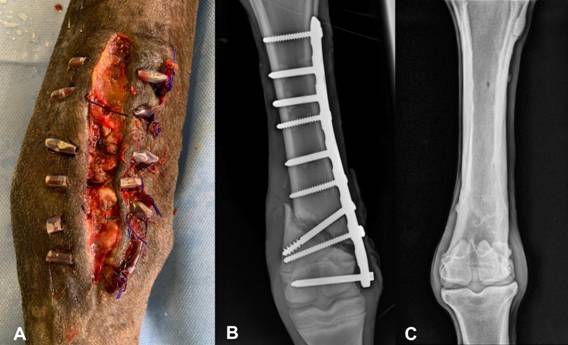
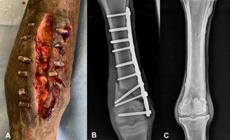
Fracture diagnoses were obtained through radiographic examinations, where it was possible to identify the location in the bone (proximal or distal) and classification of the fracture according to its exposure, being classified as exposed (there is a communication of the bone tissue of the fracture to the surface of the skin) (Figure 1) or non-exposed (where there is no communication of the fracture site with the surface of the skin).
Field-collected samples of healthy flower bud, flower and young fruit of the clone ‘BRS 189’ protected with sulfur-based fungicide.
Treatment
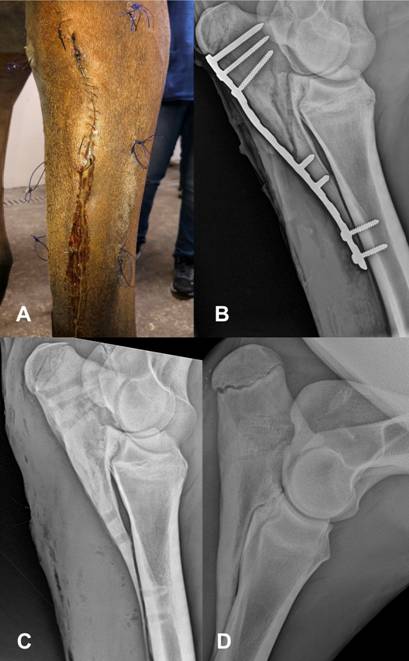
The treatments were divided into two groups: “surgical cases with fracture fixation” and “cases with conservative fracture treatment.” The group “surgical cases for fracture fixation” was subdivided into seven other groups: partial ostectomy, FEE (external skeletal fixation), LCP (locking compression plate), DCP (dynamic compression plate) (Figure 2), lag screw, transfixation casting and the group that had no information regarding the fixation method. The group “cases with conservative fracture treatment” was subdivided into two other groups: closed reduction with casting and rest. The “Euthanasia” group was assigned to cases in which no type of treatment was prescribed, and euthanasia of the animal was chosen.
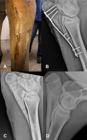
Type V fracture of the right ulna in a one-year-old filly. (A) Surgical wound showing mucopurulent drainage 13 days after the surgical procedure. (B) Mediolateral radiographic image of the immediate postoperative period of osteosynthesis performed with a 4.5-mm LCP and 11 holes. (C) Mediolateral radiographic image after implant removal two months after the surgical procedure. (D) Mediolateral radiographic image after 4 months, demonstrating complete consolidation of the fracture.
In addition to the treatments recommended for fracture stabilization, the therapeutic approach used in these cases included the application of casting, wound management, administration of anti-inflammatories and analgesics, as well as the administration of antibiotics via local, intravenous, and regional routes.
Complications
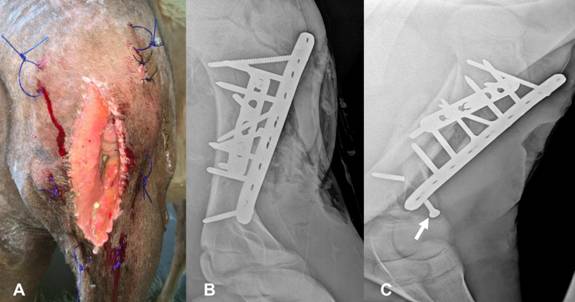
The complications found in the study were classified as follows: (i) trauma during anesthetic recovery, attributed to animals that presented some complication while recovering from anesthesia, evolving to bone fracture and/or implant failure (Figure 3); (ii) osteomyelitis, were the cases that evolved with clinical manifestations compatible with bone infection; (iii) death during surgery, was attributed to cases in which, due to some complication during the surgical procedure, the animals died or were euthanized; (iv) “implant failure”, “non-union” and “implant exposure” were attributed to animals that did not obtain a satisfactory result regarding implant fixation, bone consolidation and implant exposure, respectively; (v) refracture, were the cases of animals that presented bone continuity failures after the consolidation attempt; (vi) acute abdomen that required exploratory celiotomy after osteosynthesis.
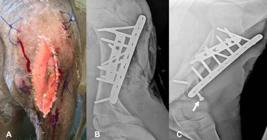
Complete spiral fracture in the middle third of the left humerus shaft in a four-month-old filly. (A) Image of the surgical wound after dehiscence, probable infection, and drainage of mucopurulent secretion. (B) Radiographic image of the immediate postoperative period of osteosynthesis performed with two 4.5 mm cortical screws using the lag screw technique, a 4.5 mm LCP with 9 holes, and a 4.5 mm LCP with 5 holes. (C) Mediolateral radiographic image demonstrating implant failure (arrow) and loss of fracture line reduction.
Data analysis
Statistical analyses were performed using Jamovi software (version 2.3.21) (THE JAMOVI PROJECT, 2022; R CORE TEAM, 2021). Values of P < 0.05 were considered statistically significant and P < 0.10 were considered as a trend. Continuous variables (age and weight) were presented as median, minimum, and maximum. The frequencies of information related to the categorization of included patients, fractures and outcomes were presented as percentages and analyzed as nominal categorical variables. For statistical analyses, information on the analyzed variables was categorized as follows: (i) period, in less than 10 years (for cases treated between 2014 and 2023) or more than 10 years (for cases treated before 2014); (ii) category, in young (aged five years or less) or adults (aged over 5 years); (iii) sex, in male or female; (iv) location of the bone, in distal (for affected bones below the carpus and tarsus), proximal (for affected bones above the carpus and tarsus) or head; (v) limb, in hind or forelimbs; (vi) classification of the fracture, in exposed or non-exposed; (vii) implants, in LCP, DCP or others (cerclage, screw, external skeletal fixator, etc.); (viii) complication, in no or yes (refracture, implant failure, osteomyelitis, non-union, surgical site infection, etc.) and (ix) outcome, in discharge or death/euthanasia. The Chi-square test of association was used to compare the frequencies of nominal categorical variables, according to the “outcomes” and “complications”.
Logistic regression was used to analyze the effect of predictor factors on the odds ratio of the outcomes of the dependent variables “outcome” and “complications” using the car package: Companion to Applied Regression (FOX & WEISBERG, 2020). Initially, univariable logistic regression was performed with all predictor factors (i to viii) for each dependent variable. The initial multivariable logistic regression model included all variables from the univariable analysis with P ≤ 0.25. The final multivariable model was determined using a manual forward selection process so that the likelihood ratio was P ≤ 0.1 (DOHOO et al., 2009).
Nagelkerke’s pseudo R2 (R2N) was used to assess the predictive factors regarding the association with the chance of occurrence of the outcomes. The variance inflation factor (VIF) was used to assess multicollinearity.
RESULTS
Descriptive statistics
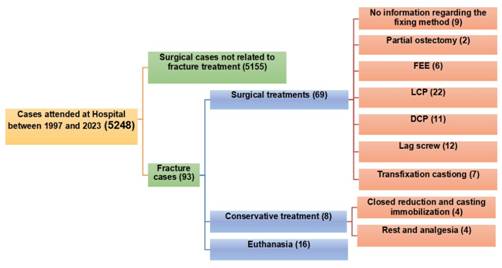
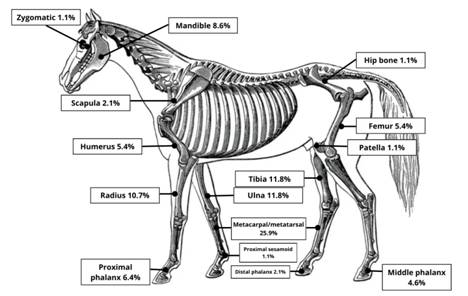
A total of 93 medical records were analyzed, of which 90 contained information regarding the outcome of the case, 88 contained information regarding the category of the animal (young or adult), 90 contained information regarding the location of the bone (proximal or distal), 73 contained information regarding the affected limb (fore or hindlimb) and 64 contained information regarding the type of implant used (Figure 4). Median age 6 years old (range 1-27 years). The median weight was 413 kg (range 25-575 kg). Regarding the affected bones, the majority occurred in the metacarpus/metatarsus, corresponding to 25.9% (24/93), followed by the tibia and ulna, representing 11.8% of the cases each (11/93) and the radius, representing 10.7% (10/93). The number of cases of mandible and proximal phalanx fractures were similar, being 8.6% (8/93) and 6.4% (6/93) respectively. The number of cases of femur and middle phalanx fractures were also similar, being 5.4% (5/93) and 4.6% (4/93) respectively. Next, scapula and distal phalanx fractures represented the same number, representing 2.1% each (2/93). The grouping of fractures in proximal sesamoid, patella, pelvis, and zygomatic bones were rarer, each fracture in these bones represented only 1.1% (1/93) of the total (Figure 5).
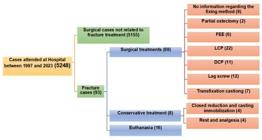
Flowchart showing the medical records included in the study. Cases of horses treated at the Veterinary Hospital, between 1997 and 2023. FEE: external skeletal fixation; LCP: locking compression plate; DCP: dynamic compression plate.
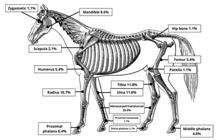
Representation of the case series of fractures in horses according to the affected bone, treated at the HOVET FMVZ/USP, between 1997 and 2023.
Through descriptive statistics, it was possible to analyze 90 medical records, since 3 of them did not contain information about the outcome of the case. Of all 90 medical records analyzed, 20 (22.2%) cases were treated in a period of more than 10 years, where two (10%) were discharged and 18 (90%) evolved to death/euthanasia and 70 (77.7%) cases treated in a period of less than 10 years, where 45 (64.3%) were discharged and 25 (35.7%) evolved to death/euthanasia. Among the medical records, 42 (46.6%) animals were females, and 48 (53.3%) animals were males, where, among all animals, 47 (52.2%) were discharged and 43 (47.7%) animals evolved to death/euthanasia.
Among the 90 cases evaluated, 88 (97.7%) medical records had information regarding the animal category (young or adult), with 44 (50%) cases being five years old or older, of which 22 (50%) were discharged and 22 (50%) died/euthanasia, and 44 (50%) cases of animals under five years old, of which 25 (56.8%) were discharged and 19 (43.2%) died/euthanasia. The fractures were classified as exposed or non-exposed, of which 69 (76.6%) were non-exposed and five (5.5%) were exposed. Among the 69 non-exposed fractures, 33 (47.8%) animals were discharged and 36 (52.17%) died/euthanasia. Among the six exposed fractures, two (33.3%) animals were discharged and four (66.7%) died/euthanasia.
Of the 90 medical records evaluated, all contained information on the location of the fracture (proximal, distal, or head) and 73 (81.1%) on the affected limb. Of these, 45 (50%) animals had proximal fractures, 19 (42.2%) were discharged and 36 (40%) animals had distal fractures, 19 (52.8%) were discharged; 34 (46.5%) animals had hindlimb fractures, 21 (61.8%) of which evolved to death/euthanasia; 38 (52%) animals had forelimb fractures, of which 17 (43.6%) evolved to death/euthanasia; 68 (93.1%) animals did not present complications, of which 45 (66.2%) were discharged and 23 (33.8%) evolved to death/euthanasia.
Among the 90 patients, 64 (71.1%) had information regarding the type of implant used in osteosynthesis. Of these, 11 (17.2%) used DCP, of which three (27.3%) were discharged; 22 (34.3%) used LCP, of which 16 (72.7%) were discharged; and 31 (48.4%) used another type of implant, of which 18 (58.1%) were discharged (Table 1).
Variables analyzed in 93 cases of horses with fractures as a function of complications and outcomes. Probability values from the Chi square test.
Of all the 90 medical records that presented the outcome of the case, 22 (24.4%) animals presented complications and 20/22 (90.9%) evolved to death/euthanasia.
Univariable analysis
The univariable analysis according to the outcome (discharge or death/euthanasia) is presented in table 2. We identified that animals with fractures treated in the last 10 years were 16 times more likely to be discharged from hospital than cases treated more than 10 years ago (OR = 16.20; CI = [3.47; 75.60]; P = 0.001), in addition, animals with LCP were seven times more likely to be discharged from hospital than animals with DCP (OR = 7.11; CI = [1.40; 36.12]; P = 0.018), and animals with another type of implant tended to be three times more likely to be discharged from hospital than animals with DCP (OR = 3.69; CI = [0.82; 16.66]; P = 0.089). It was also possible to identify that animals that did not present any type of complication had 19 times more chance of being discharged from hospital than animals that presented some type of complication (OR = 19.57; CI = [4.20; 91.05]; P = 0.001).
Results of univariable logistic regression to identify factors associated with outcome (discharge or death/euthanasia) in 90 cases of fracture in horses.
The univariable analysis according to postoperative complications is presented in table 3. We identified that animals with fractures treated less than 10 years ago were six times more likely to have no hospital complications than cases treated more than 10 years ago (OR: 6.55 CI [2.27-18.84]; P = 0.001). Furthermore, it was identified that animals treated with LCP were four times more likely to have no hospital complications than cases treated with DCP (OR: 4.76 CI [1.04-21.77], P = 0.044). It was also possible to identify those animals with other types of implants that tended to be three times more likely to not have hospital complications than cases treated with DCP (OR = 3.22; CI = [0.82; 12.63]; P = 0.094).
Multivariable analysis
Table 4 shows the results of the multivariable analysis associated with the outcome (discharge or death/euthanasia). We identified that animals with fractures treated in the last 10 years tended to have a five times greater chance of being discharged from hospital than cases treated more than 10 years ago (OR = 5.14; CI = [0.91; 28.97]; P = 0.063). In addition, animals that did not present complications were 12 times more likely to be discharged from hospital than animals that had some type of complication (OR = 12.41; CI = [2.32; 66.45]; P = 0.003). It was also possible to identify that animals with the forelimb affected were three times more likely to be discharged than animals with hindlimb involvement (OR = 3.18; CI = [1.02; 9.91]; P = 0.046). These factors together accounted for 41% of the factors associated with outcome (R2N = 0.41).
Table 5 shows the results of the multivariable analysis associated with complications. We identified that animals with distal fractures tended to have a three times greater chance of not developing hospital complications when compared with cases of proximal fractures (OR = 3.04; CI = [0.92; 10.10]; P = 0.070). This predictor associated with the period and the type of implants used accounted for 31% of the factors associated with complications (R2N = 0.31).
DISCUSSION
In this study, we identified the factors and odds ratios associated with the absence of complications and hospital discharge in horses with fractures referred to a veterinary hospital in Brazil. By identifying all this information, as well as the location of the affected bone, the exposure of the fracture focus and the type of implant used, it is possible to adapt the approaches in future cases to try to reduce the chances of complications and postoperative death.
Equine orthopedic surgery in Brazil has been evolving steadily and solidly, expanded by treatment options and surgical techniques (SOUZA et al., 2020), which corroborates the present survey, where cases in the period of less than 10 years had a higher chance of discharge and a lower chance of complications (SOUZA et al., 2020).
The use of locking plates was also related to a higher rate of hospital discharge and a lower chance of complications when compared to the DCP plate. In addition, the use of other types of implants was also associated with a higher rate of hospital discharge and a lower chance of complications when compared to the DCP plate.
The benefits attributed to the use of locking implants are based on the fact that ensuring axial and angular stability reduces the need for precise anatomical reconstruction or contouring of the plate and eliminates the generation of forces and friction between the plate and the bone (KUBIAK et al., 2006). The advantages of locking plate application in the horse included the formation of a stable fixation with less invasive techniques and a resulting construct that is inherently more stable in simple or complex fractures compared to DCP (MARKEL, 2019).
The occurrence of complications is also related to the outcome of the case, where 90.9% of the animals that presented some complication evolved to death or euthanasia. Complications of orthopedic surgery can be minimized by limiting errors during preparation/planning, intraoperative technique, and postoperative management. Infection is the most common and arguably the most important postoperative complication in orthopedic surgery. Meticulous aseptic technique, appropriate antimicrobial prophylaxis (selected drugs, timing, and dosage), preservation of blood supply and careful handling of tissues are essential elements of orthopedic surgery (ORTVED & RICHARDSON, 2021). Despite appropriate precautions being taken, orthopedic infections in horses undergoing major orthopedic procedures occur with a reported incidence of 10-28% (MACDONALD et al., 1994; AHERN et al., 2010). Timely recognition of clinical manifestations is critical to success in orthopedic infections, and the treatment of patients who present with infection after orthopedic implant placement is highly individualized (SILVA et al., 2023). At best, infection usually leads to increased costs, the need for implant removal, decreased cosmetic outcome, and a suboptimal functional outcome. At worst, infection can lead to fracture instability, mechanical failure, delayed consolidation, and euthanasia (ORTVED & RICHARDSON, 2021).
The factors associated with the outcome to hospital discharge were cases that occurred less than 10 years ago, cases that did not have complications and cases involving the forelimb, while the factor associated with the occurrence of no postoperative complications was significant when the fracture occurred in a distal location. With advances in veterinary care, procedures and surgical implants, many fractures that were previously considered “untreatable” in adult horses can now be repaired with satisfactory results. However, there are some types of fractures in long bones that are still considered difficult to approach or with little probability of success in adult horses, since the biomechanical characteristics of the implants routinely used may not provide the necessary resistance to cyclic loading (NIXON, 2019a). In foals, the smaller size and a faster bone regeneration process translate into successful results for many of these long bone fractures (GLASS & WATTS, 2017).
The bones located in the proximal region of the limb (humerus, radius, femur, and tibia) are under high tensions and lever forces, causing the implants and available materials, sometimes, not to support the imposed load (SOUZA et al., 2020). In the study by STEWART et al. (2015), 25% of horses with radius fractures were euthanized without attempted treatment due to the severity of the type of fracture; of the horses treated surgically in this study, 56% survived to hospital discharge, where 80% of successful repairs occurred in horses less than one year of age, with only three adult horses treated surgically surviving to discharge. Of the 13 adult horses treated surgically, 62% were euthanized due to a combination of surgical site infection and subsequent construct failure. The other two horses had catastrophic fixation failure during anesthetic recovery.
The treatment of most fractures requires an assessment of both medical and surgical considerations and should be conducted in a systematic and thorough manner. A careful review of the history of injury, post-injury appearance, and animal care are important to establish the severity of the fracture and potential complications (NIXON, 2019a). In this current study, it was possible to analyze the relationship between patient characteristics, measures taken to prevent complications and death, and factors related to outcomes after fractures in horses, through a comprehensive statistical analysis. Based on this analysis, together with the location and exposure of the fracture and the type of implants used, it is feasible to customize approaches in future cases aimed at decreasing the risks of complications and death after surgery. The study included data from an extended period, involving a relevant number of cases when compared with the Brazilian reality for equine orthopedic surgery. However, some medical records involved in the analysis were incomplete and the records analyzed in this survey came from a single hospital and, therefore, should be interpreted with caution when considering other populations. Multicenter studies may help to improve and complement the results of this study.
CONCLUSION
It is concluded that the use of locking plates, cases treated less than 10 years ago, lower occurrence of postoperative complications, fractures located in the distal portion and in forelimbs directly influenced positive outcomes in horses with fractures treated at the Veterinary Hospital of the Faculty of Veterinary Medicine and Animal Science of the Universidade de São Paulo.
ACKNOWLEDGEMENTS
The T.R.T. was partial funded by the Brazilian Federal Agencies: Coordenação de Aperfeiçoamento de Pessoal de Nível Superior (CAPES), Brazil - Finance Code 001.
REFERENCES
-
AHERN, B. J. et al. Orthopedic infections in equine long bone fractures and arthrodesis treated by internal fixation: 192 cases (1990-2006): equine orthopedic infection. Veterinary Surgery, v.39, n.5, p.588-593, 2010. Available from: <Available from: https://onlinelibrary.wiley.com/doi/10.1111/j.1532-950X.2010.00705.x >. Accessed: May, 20, 2023. doi: 10.1111/j.1532-950X.2010.00705.x.
» https://doi.org/10.1111/j.1532-950X.2010.00705.x.» https://onlinelibrary.wiley.com/doi/10.1111/j.1532-950X.2010.00705.x -
AUER, J. A.; GRAINGER, D. W. Fracture management in horses: Where have we been and where are we going? The Veterinary Journal, v.206, n.1, p.5-14, 2015. Available from: <Available from: https://www.sciencedirect.com/science/article/abs/pii/S1090023315002312 >. Accessed: May, 20, 2023. doi: 10.1016/j.tvjl.2015.06.002.
» https://doi.org/10.1016/j.tvjl.2015.06.002.» https://www.sciencedirect.com/science/article/abs/pii/S1090023315002312 -
DONATI, B. et al. Epidemiology of fractures: The role of kick injuries in equine fractures. Equine Veterinary Journal, v.50, n.5, p.580-586, 2018. Available from: <Available from: https://beva.onlinelibrary.wiley.com/doi/10.1111/evj.12819 >. Accessed: May, 20, 2023. doi: 10.1111/evj.12819.
» https://doi.org/10.1111/evj.12819.» https://beva.onlinelibrary.wiley.com/doi/10.1111/evj.12819 -
DOHOO, I. et al. Logistic regression, In: DOHOO, I.; MARTIN, W.; STRYHN, H. (eds): Veterinary epidemiologic research, 2nd ed. Charlottetown, PEI, AVC Inc., p.395-426, 2009. Available from: <Available from: https://www.sciencedirect.com/science/article/abs/pii/S0167587704002211?via%3Dihub >. Accessed: May, 20, 2023. doi: 10.1016/j.prevetmed.2004.11.001.
» https://doi.org/10.1016/j.prevetmed.2004.11.001.» https://www.sciencedirect.com/science/article/abs/pii/S0167587704002211?via%3Dihub -
FOX, J.; WEISBERG, S. car: Companion to Applied Regression. [R package]. 2020. Available from: <Available from: https://cran.rproject.org/package=car >. Accessed: May, 20, 2023.
» https://cran.rproject.org/package=car -
GLASS, K.; WATTS, A. E. Diagnosis and treatment considerations for nonphyseal long bone fractures in the foal. Veterinary Clinics of North America: Equine Practice, v.33, n.2, p.431-438, 2017. Available from: <Available from: https://www.sciencedirect.com/science/article/abs/pii/S074907391730038X?via%3Dihub >. Accessed: May, 20, 2023. doi: 10.1016/j.cveq.2017.03.013.
» https://doi.org/10.1016/j.cveq.2017.03.013.» https://www.sciencedirect.com/science/article/abs/pii/S074907391730038X?via%3Dihub -
JOHNSTON, A. S. et al. The effect of stress fracture occurring within the first 12 months of training on subsequent race performance in Thoroughbreds in Hong Kong. Equine Veterinary Journal, v.53, n.3, p.460-468, 2021. Available from: <Available from: https://beva.onlinelibrary.wiley.com/doi/10.1111/evj.13324 >. Accessed: May, 20, 2023. doi: 10.1111/evj.13324.
» https://doi.org/10.1111/evj.13324.» https://beva.onlinelibrary.wiley.com/doi/10.1111/evj.13324 -
KUBIAK, E. N. et al. The evolution of locked plates. Journal of Bone and Joint Surgery, v.88, n.suppl_4, p.189-200, 2006. Available from: <Available from: https://journals.lww.com/jbjsjournal/citation/2006/12001/the_evolution_of_locked_plates.20.aspx >. Accessed: May, 20, 2023. doi: 10.2106/JBJS.F.00703.
» https://doi.org/10.2106/JBJS.F.00703.» https://journals.lww.com/jbjsjournal/citation/2006/12001/the_evolution_of_locked_plates.20.aspx -
MACDONALD, D. G. et al. An examination of the occurrence of surgical wound infection following equine orthopaedic surgery (1981-1990). Equine Veterinary Journal, v.26, n.4, p.323-326, 1994. Available from: <Available from: https://beva.onlinelibrary.wiley.com/doi/abs/10.1111/j.2042-3306.1994.tb04394.x >. Accessed: May, 20, 2023. doi: 10.1111/j.2042-3306.1994.tb04394.x.
» https://doi.org/10.1111/j.2042-3306.1994.tb04394.x.» https://beva.onlinelibrary.wiley.com/doi/abs/10.1111/j.2042-3306.1994.tb04394.x -
MARKEL, M. D. Fracture biomechanics. In: NIXON, A. J. (Ed.). Equine Fracture Repair. 1. ed. Hoboken: Wiley, p.12-23, 2019. Available from: <Available from: https://onlinelibrary.wiley.com/doi/10.1002/9781119108757.ch2 >. Accessed: May, 20, 2023. doi: 10.1002/9781119108757.ch2.
» https://doi.org/10.1002/9781119108757.ch2.» https://onlinelibrary.wiley.com/doi/10.1002/9781119108757.ch2 -
MCGLINCHEY, L. et al. Description of the incidence, clinical presentation and outcome of proximal limb and pelvic fractures in Hong Kong racehorses during 2003-2014. Equine Veterinary Journal, v.49, n.6, p.789-794, 2017. Available from: <Available from: https://beva.onlinelibrary.wiley.com/doi/10.1111/evj.12696 >. Accessed: May, 20, 2023. doi: 10.1111/evj.12696.
» https://doi.org/10.1111/evj.12696.» https://beva.onlinelibrary.wiley.com/doi/10.1111/evj.12696 -
NIXON, A. J. General considerations for fracture repair. In: NIXON, A. J. (Ed.). Equine Fracture Repair. 1. ed. Hoboken: Wiley, p.35-43, 2019a. Available from: <Available from: https://onlinelibrary.wiley.com/doi/10.1002/9781119108757.ch4 >. Accessed: May, 20, 2023. doi: 10.1002/9781119108757.ch4.
» https://doi.org/10.1002/9781119108757.ch4.» https://onlinelibrary.wiley.com/doi/10.1002/9781119108757.ch4 -
NIXON, A. J. et al. Principles of fracture fixation. In: NIXON, A. J. (Ed.). Equine Fracture Repair. 1. ed. Hoboken: Wiley, p.127-155, 2019b. Available from: <Available from: https://onlinelibrary.wiley.com/doi/book/10.1002/9781119108757 >. Accessed: May, 20, 2023. doi: 10.1002/9781119108757.
» https://doi.org/10.1002/9781119108757.» https://onlinelibrary.wiley.com/doi/book/10.1002/9781119108757 -
ORTVED, K. F.; RICHARDSON, D. W. Complications of equine orthopedic surgery. In: RUBIO-MARTINEZ, L. M.; HENDRICKSON, D. A. (Eds.). Complications in Equine Surgery. 1. ed. Hoboken: Wiley, 2021. p.629-666. Available from: <Available from: https://onlinelibrary.wiley.com/doi/abs/10.1002/9781119190332.ch46 >. Accessed: May, 20, 2023. doi: 10.1002/9781119190332.ch46.
» https://doi.org/10.1002/9781119190332.ch46.» https://onlinelibrary.wiley.com/doi/abs/10.1002/9781119190332.ch46 -
R CORE TEAM. R: A Language and environment for statistical computing. (Version 4.1) (Computer software), 2021. (R packages retrieved from MRAN snapshot 2022-01-01). Available from: <Available from: https://cran.r-project.org >. Accessed: May, 20, 2023.
» https://cran.r-project.org -
SILVA, C. M. D. et al. Infecções no sítio cirúrgico em cirurgias ortopédicas de equinos com a utilização de implantes: estudo retrospectivo (2009-2021). Revista de Educação Continuada em Medicina Veterinária e Zootecnia do CRMV-SP, v.21, 2023. Available from: <Available from: https://191.252.1.94/index.php/recmvz/article/view/38434 >. Accessed: May, 20, 2023. doi: 10.36440/recmvz.v21.38434.
» https://doi.org/10.36440/recmvz.v21.38434.» https://191.252.1.94/index.php/recmvz/article/view/38434 -
SOUZA, A. F. et al. Cirurgia ortopédica em equinos no Brasil: evolução e estudo retrospectivo dos casos de fraturas no serviço de cirurgia de grandes animais da Universidade de São Paulo (1997-2019). ARS Veterinaria, v.36, n.2, p.98-108, 2020. Available from: <Available from: https://arsveterinaria.org.br/index.php/ars/article/view/1288 >. Accessed: May, 20, 2023. doi: 10.15361/2175-0106.2020v36n2p98-108.
» https://doi.org/10.15361/2175-0106.2020v36n2p98-108.» https://arsveterinaria.org.br/index.php/ars/article/view/1288 -
STEWART, S. et al. Risk factors associated with survival to hospital discharge of 54 horses with fractures of the radius. Veterinary Surgery, v.44, n.8, p.1036-1041, 2015. Available from: <Available from: https://onlinelibrary.wiley.com/doi/10.1111/vsu.12412 >. Accessed: May, 20, 2023. doi: 10.1111/vsu.12412.
» https://doi.org/10.1111/vsu.12412.» https://onlinelibrary.wiley.com/doi/10.1111/vsu.12412 -
THE JAMOVI PROJECT. Jamovi. (Version 2.3), 2022 [Computer Software]. Available from: <Available from: https://www.jamovi.org >. Accessed: May, 20, 2023.
» https://www.jamovi.org -
VERHEYEN, K. L. P.; WOOD, J. L. N. Descriptive epidemiology of fractures occurring in British Thoroughbred racehorses in training. Equine Veterinary Journal, v.36, n.2, p.167-173, 2004. Available from: <Available from: https://beva.onlinelibrary.wiley.com/doi/abs/10.2746/0425164044868684?sid=nlm%3Apubmed >. Accessed: May, 20, 2023. doi: 10.2746/0425164044868684.
» https://doi.org/10.2746/0425164044868684.» https://beva.onlinelibrary.wiley.com/doi/abs/10.2746/0425164044868684?sid=nlm%3Apubmed -
ZOPPA, A. L. V. et al. Fraturas em potros: Estudo retrospectivo de 31 casos (2008 -2019). Brazilian Journal of Animal and Environmental Research, v.3, n.2, p.358-371, 2020. Available from: <Available from: https://ojs.brazilianjournals.com.br/ojs/index.php/BJAER/article/view/8948/7639 >. Accessed: May, 20, 2023. doi: 10.34188/bjaerv3n2-005.
» https://doi.org/10.34188/bjaerv3n2-005.» https://ojs.brazilianjournals.com.br/ojs/index.php/BJAER/article/view/8948/7639
Edited by
-
ASSOCIATE EDITOR:
Rudi Weiblen (0000-0002-1737-9817)
-
SCIENTIFIC EDITOR:
Roberta Blake (0000-0003-0037-5286)
Not applicable.