 Sausage of panga (Pangasius hypophthalmus): physicochemical, microbiological and sensory analyses
ABSTRACT:
In recent years, panga fish has gained prominence in Brazil, sparking significant interest in the development of fish-based products. Among these, fresh sausage stands out as one of the most produced meat products. This research developed and evaluated fresh sausages made from panga fish fillets. Three formulations were developed with different concentrations of fillet and pork fat. Physicochemical, microbiological and sensory analyzes were carried out on the sausage samples. The proximate composition results showed significant differences (P < 0.05) between the three formulations for moisture, lipids and crude protein. All formulations showed acceptability index above 80 %, with appearance and texture being highlighted. Sample with fillet:pork fat ratio of 65:25 was most preferred by tasters. All microorganisms investigated were absent or showed growth below the limits recommended by current Brazilian legislation. The study showed a favorable potential for using panga fish to make fresh sausage, highlighting their nutritional value.
Key words:
processing; acceptance test; foodborne microorganisms
RESUMO:
Nos últimos anos, o peixe panga ganhou destaque no Brasil, despertando grande interesse no desenvolvimento de produtos à base de peixe. Dentre estes, a linguiça frescal se destaca como um dos produtos cárneos mais produzidos. Este trabalho teve como objetivo desenvolver e avaliar linguiças tipo frescal elaboradas a partir de filés de peixe panga. Foram desenvolvidas três formulações com diferentes concentrações de filé e gordura suína. Foram realizadas análises físico-químicas, microbiológicas e sensoriais nas amostras de linguiça. A composição centesimal apresentou diferenças significativas (P < 0,05) entre as três formulações para umidade, lipídios e proteína bruta. Todas as formulações apresentaram índice de aceitabilidade acima de 80%, com destaque para aparência e textura. A amostra com proporção filé:gordura suína de 65:25 foi a mais preferida pelos provadores. Todos os microrganismos investigados estavam ausentes ou apresentaram crescimento abaixo dos limites recomendados pela legislação brasileira vigente. Este estudo mostrou potencial favorável para utilização do peixe panga na elaboração de linguiças tipo frescal, destacando seu valor nutricional.
Palavras-chave:
processamento; teste de aceitação; microrganismos de alimentos.
INTRODUCTION
The production of fish-based products plays a crucial role in the diversification of the food industry, allowing the full use of fish and adding value to the product (ABEROUMAND et al., 2024). One alternative is the use of surimi as a raw material to produce different products, such as sausages, hamburgers, nuggets, etc. These processed products have recently gained a lot of popularity due to their nutritional quality and dietary benefits (ABEROUMAND & BAESI, 2021).
The Panga (Pangasius hypophthalmus), is a freshwater fish of Asian origin, native to the Mekong River Delta in Vietnam. It reached global production of 3.1 million tons in 2022 and Vietnam was the main producer, followed by India and Bangladesh (FAO, 2024). Regarding its cultivation in Brazil, panga has gained prominence, mainly due to its dissemination and production in the northeast region. In 2020, the states of Piauí and Maranhão led the growth in production of the species, demonstrating an increase of 3,734 tons (PEIXE BR, 2021).
The panga is a fish species with a lot of potential for aquaculture and stands out for its interesting zootechnical characteristics, such as rapid growth, 1kg in six months of cultivation, high fillet yield, ranging from 35 to 45 %, absence of intermuscular Y-shaped spines and an affordable price compared to other freshwater fish, in addition to having a low fat content in the fillet and a high level of protein and essential amino acids (ORBAN et al., 2008), making this species well accepted in both the national and international markets (BROL, 2018).
Fish, among products of animal origin, is the most susceptible to the deterioration process due to the action of microorganisms and enzymes, making it necessary to use technologies that extend its shelf life (MOURA et al., 2022). The production of sausage products from fish meat extends their shelf life and adds value to the raw material (LINS, 2016). Fresh sausage is one of the most manufactured meat products in Brazil, its preparation requires low technological knowledge and the use of a few items of equipment, which tends to be accessible (CARVALHO et al., 2010). It is a popular and versatile product, purchased by a large portion of consumers, who are aware of the preservatives, additives, sodium and fat in the formulations, but are attracted by characteristics such as flavor and texture (ROSSI, 2017). Innovation in the production of sausage with panga fillet emerges as a promising alternative to meet the demand for practical, nutritious and differentiated foods, especially considering the apparent lack of published scientific studies on this type of product with this species (SURASANI et al., 2022). This research developed and evaluated fresh sausages made from the inclusion of different proportions of panga fish fillet.
MATERIALS AND METHODS
Raw material
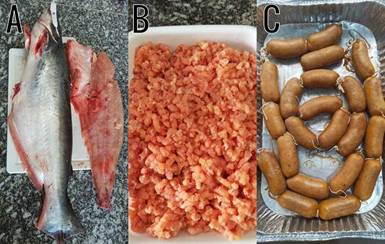
Specimens of panga fish (Pangasius hypophthalmus) were purchased from the municipal market in the city of Pinheiro - MA/Brazil. The fish were transported in isothermal boxes to the Fish Technology and Processing Laboratory - LATEPPE, located at the Universidade Federal do Maranhão/Pinheiro Campus. The specimens were weighed, gutted, washed and then filleted. Figure 1 represents the appearance of the fillets obtained, which had a natural orange color. Sausage condiment (Conamix toscana C-25 plus, CONATRIL) and spices were purchased in bulk from a natural products store.
External appearance of the panga and natural color of the fillet (A), ground panga meat (B), and panga fresh sausage (C).
Sausage processing
The fish fillets and pork fat were separately ground twice in a manual meat grinder with an 8 mm disc and the proportions were divided into the three formulations, where: F1 (sausage formulation with 65 % fillet and 25 % pork fat); F2 (sausage formulation with 70 % fillet and 20 % pork fat) and F3 (sausage formulation with 75 % fillet and 15 % pork fat). The remaining ingredients were then weighed (Table 1). The formulations were homogenized for 5 min and kept in a refrigerator at 7 ºC for approximately 2 h for the curing reaction.
Before the stuffing process, the dried natural bovine intestine casing was washed and hydrated in acetic acid solution (5 %). After soaking for 30 min, the casings were rinsed under running water. After the curing time, the three formulations were stuffed using a manual meat grinder (BOTINI B10) coupled to the 8 mm disc and stuffing cannon. The sausages were shaped and tied into 10 cm segments and packed into polyethylene bags for storage. At the end of the process, they were cooled in a refrigerator (6 ºC) for 24 hours to continue the curing process and then frozen at (-18 ºC) until further analyses were carried out.
Physicochemical analysis
The proximate composition analysis of the sausages was carried out at the Fish Technology and Processing Laboratory - LABTEP, at the Universidade Estadual do Maranhão (UEMA). Crude protein (CP) was quantified using the micro Kjeldahl method, which determined total nitrogen, according to (HORWITZ, 2000). The moisture was quantified by the gravimetric method through oven drying with forced air circulation at 105 ºC for 16h, according to the INSTITUTO ADOLFO LUTZ (2008). The lipid analysis was extracted using an adapted Bligh Dyer method (BLIGH & DYER, 1959). Ash contents were quantified by incineration in a muffle furnace at 550 ºC.
Sensory analysis
The sensory analysis was carried out with 86 selected tasters, 48 were female and 38 were male, aged between 18 and 55 years. The tasters were selected according to their regular fish consumption habit. The sausages were baked in an Airfryer for 30 minutes, sliced, and immediately presented to each taster on a disposable plate with random codes for each sample to avoid inference to the taster. Two sessions were held, the first with 46 students from the Food Technology Course at the Universidade Estadual do Maranhão (UEMA/Campus São Bento - MA), and the second session with 40 students from the Fisheries Engineering Course at the Universidade Federal University do Maranhão (UFMA/Campus Pinheiro).
The analysis consisted of applying acceptance, attributes, rank and attitude tests, used to evaluate consumer satisfaction, identify key sensory attributes and profile, rank product variations by preference, and understand consumer perceptions, guiding future product optimization and market positioning. To carry out the acceptance test, the panelists were provided with a form containing a hedonic scale of seven structured points ranging from 1 = I really disliked it to 7 = I really liked it, according to DUTCOSKY (2011). To calculate the product’s Acceptability Index, the expression was adopted: AI (%) = A x 100/B, where A = average score obtained for the product, and B = maximum score given to the product. The AI with good impact has been considered ≥ 70 %.
In the attribute test, it was considered appearance, color, odor, flavor, and texture, using a verbal and numerical scale, where 1 = Disliked it very much, 2 = Disliked it moderately, 3 = Disliked it moderately, I disliked it slightly, 4 = Indifferent and 5 = I liked it slightly, 6 = I liked it moderately and 7 = I liked it a lot. In the rank test, each taster was asked to check the order of preference of the sausage samples, and order them in ascending order of preference, where (1) Most, (2) Average and (3) Less. In the attitude test, the evaluator expressed his intention to consume the product he indicated as his favorite.
Microbiological analyses
Microbiological analyses were carried out on 25 g of samples from each formulation, collected immediately after refrigerated storage. The samples were transported in isothermal boxes to the Laboratory of Oceanography and Aquatic Microbiology - LABOMAQUA, at the Universidade Estadual do Maranhão (UEMA/Campus Universitário Paulo VI), for investigation of Escherichia coli, Coagulase Positive Staphylococcus and Salmonella sp.
The determination of coliforms at 45 ºC (MPN/g) was done using the Multiple Tube Technique, where 25 g of the sample was homogenized in 225 mL of sterilized saline solution (0.85% NaCl), followed by serial dilutions (10-1, 10-2 and 10-3) and inoculation of 1mL in tubes containing Lauryl Sulfate Tryptose Broth, incubated at 35 ºC for 24 h. After turbidity and gas retention in the Durham tube, the test for coliforms was carried out at 45 ºC, using the E.C. Broth in a water bath at 45 ºC for up to 48 h. The values for NMP/g were determined using the Hoskis table (SILVA et al., 2017).
From the tubes testing positive in the confirmatory test for coliforms at 45 ºC, aliquots were transferred to the surface of Petri dishes containing Eosin Methylene Blue (EMB) Agar and incubated at 35 ºC for 24 hours. Colonies with a black nucleated center, with or without a characteristic metallic green sheen, were considered suggestive of E. coli. These colonies were selected and inoculated for biochemical identification through the tests of Methyl Red and Voges-Proskauer (MRVP), Citrate, and Motility-Indole-Hydrogen Sulfide Production (SIM) (SILVA et al., 2017).
To count Coagulase Positive Staphylococcus, 0.1 mL aliquots of each dilution were inoculated on the surface of plates with Baird-Parker Agar (BP), with the aid of a properly sterilized drigalski loop. The plates were incubated at 37 ºC for 24-48 h (SILVA et al., 2017).
For Salmonella sp, 25 g of sample was macerated, added to 225 mL of Lactosed Broth incubated at 37 ºC for 24 h. After this period, aliquots of 0.1 mL and 1.0 mL were inoculated in tubes containing 10 mL of Rappaport Broth (RV-Difco) and Tetrationate Broth (TT-Difco) and incubated at 42 ºC and 43 ºC, respectively, for 24 h in a water bath. With microbial growth in both tubes, aliquots were removed and streaked on Hektoen agar (Merk) and MacConkey agar (Difco) plates in duplicate. The colonies that showed growth characteristic of Salmonella were isolated and then inoculated on Triple Iron Sugar agar (TSI-Difco) and Lysine Iron agar (LIA - Difco) and incubated at 37 ºC for 24 h. Based on positive growth in the tubes, a portion of the inoculum was removed to perform the serology test. The results were expressed as Absence/Presence in 25 g of sausage sample and Colony Forming Unit per gram (CFU/g) (SILVA et al., 2017).
Statistical analysis
The results of proximal composition, acceptance and attributes tests were subjected to analysis of variance and, when significant differences were detected between formulations, they were subjected to the Tukey test at a 5% probability level. The results of the rank test were analyzed using the Newell and MacFarlane table (NEWELL & MACFARLANE, 1987). The results were presented as mean and standard deviation, with the exception of the microbiological results.
RESULTS AND DISCUSSION
Yield
The whole fish had an average weight of 1,772.2 ± 134.0 g, the fillet with skin had an average weight of 1,093.6 ± 115.8 g. The average weight of skinless fillets was 720.8 ± 87.56 g, so the fillet yield was 40.6%. This fillet yield result was higher than those reported for tambaqui (Colossoma macropomum) 30.2% (LIMA et al., 2018), similar to Nile tilapia (Oreochromis niloticus) 38.42% (REIS et al., 2023), and lower than that of mapará (Hypophthalmus spp.) 53.04 % (DA COSTA et al., 2010).
Physicochemical analysis
The proximate composition results of panga grown and sold in Maranhão are presented in table 2. There were significant differences (P < 0.05) between the three formulations, for the parameters of moisture, crude protein, lipids and ash. The fillet muscles had a moisture content of 75.25 ± 2.39%, crude protein 16.21 ± 0.24%, lipids 6.29 ± 0.27% and ash 1.13 ± 0.10%. Regarding lipid content, the classification of ACKMAN (1990) considers that panga (P. hypophthalmus) falls into the category of semi-fatty fish, presenting 4 to 8 % of body lipids.
Values very similar to those found in a study with wild and cultivated panga (Pangasius hypophthalmus) for moisture (79.49 ± 0.09 and 75.05 ± 0.09) and protein (14.36 ± 0.06 and 20. 19 ± 0.6) (CHAKMA et al., 2022); however, the values of lipids (3.74 ± 0.09 and 2.11 ± 0.4) and ash (0.73 ± 0.02 and 0.52 ± 0.3) in this same study were lower than the reported values for panga cultivated in Maranhão.
The results of the proximate composition of the panga sausage showed that the moisture values for formulations F1, F2 and F3 were 57.45 ± 0.49, 58.40 ± 1.01 and 61.50 ± 0.23 %, respectively; and lipid content of 15.26 ± 0.35, 12.78 ± 0.3 and 11.34 ± 0.66 % for F1, F2 and F3, respectively. Moisture presents an inversely proportional relationship to lipid content, where, as different proportions of fat were incorporated into the formulations and it was observed that the water content was reduced. This result is due to the fact that the greater amount of fat in the sausage competes with water, reducing the space available for its retention in the product matrix. This reduces the ability of proteins to retain moisture and favors exudation during thermal processing, resulting in a lower moisture content in the final product (LORENZO & FRANCO, 2012).
In a study with panga (P. hypophthalmus) produced in an organic system in Germany, the moisture content of the fillets was 75.3 ± 3.2%, crude protein 17.2 ± 1.6%, lipids 7.8 ± 3.6% and ash 1.4 ± 3.2% (KARL et al., 2009), data very similar to those found for panga in the present study. Panga fish of the same species produced in Vietnam and sold in Brazil had moisture content ranging from 83.83 % to 85.59%, crude protein 12.51% to 14.52% and lipids 1.09% to 1.65 % (GUIMARÃES et al., 2016).
In a study with smoked tambaqui sausage (Colossoma macropomum), values of 65.36% moisture, 14.9% crude protein, 14.43% lipids and 1.25% ash were observed (OLIVEIRA et al., 2019). For the same species, SLEDER et al. (2015) observed a percentage reduction in moisture content as the fat concentration in sausage formulations increased.
The mineral matter content for formulations F1, F2 and F3 were 1.07%, 1.81% and 1.56%, respectively. These values were very similar to those reported by BARBOSA et al. (2015), who found 2.06% of ash in fresh Barbado fish (Pirinampus Pirinampu) sausage. In another study with tilapia (O. niloticus) the ash content varied from 1 to 5% (OLIVEIRA FILHO, 2009). The added ingredients, type of raw material and additives used in product formulation alter the mineral matter, which may influence the amount of ash (OLIVEIRA FILHO et al., 2012).
The crude protein values for F1, F2 and F3 (24.38 ± 0.72; 27.16 ± 0.67; 28.77 ± 0.65%) showed that in the F3 formulation, with a higher proportion of fillet (75%), the crude protein content was higher than the others, a behavior also expected, since the more protein is added, the higher the protein content quantified in the product. These results were higher than those reported in a study of salmon sausage (Oncorhynchus gorbuscha) with 21.26% protein (OLIVEIRA et al., 2014); snapper sausage (Lutjanus erythropterus) with 19.7% (AL-BULUSHI et al., 2013) and cooked sausage Nile tilapia sausage (O. niloticus) with 16.29% (OLIVEIRA FILHO et al., 2012).
The three formulations met the regulations on the identity and quality requirements that the seasoned meat product must meet, establishing a maximum moisture content of 70%, fat 30% and crude protein, a minimum of 12% (BRASIL, 2000); however, it is important to remember that there is still no specific legislation in Brazil for sausages made from fish.
Sensory global acceptance test
It was found that the formulations with the addition of 65 % (F1) and 75% (F3) of fillet were the best accepted among the tasters. Significant differences (P < 0.05) were observed regarding the acceptability of formulations F1 and F2, whose averages were 6.07 and 5.62, respectively, varying between (5) “I liked it slightly” and (6) “I liked it moderately” on a 7-point hedonic scale.
The results of the acceptance test were better for formulation F1, which showed 86.7% acceptance, then F3 had 83.2% acceptance, and F2 had 80.2% acceptance. A product must have a minimum acceptability index of 70% to be considered accepted, in terms of sensory characteristics (DUTCOSKY, 2011). In the present study, it was observed that all formulations had an acceptance level greater than 70%.
Similar results were observed in other studies, with a tambaqui-based sausage (C. macropomum) showing acceptance rates above 80% in the various formulations developed (SLEDER et al., 2015).
Sensory attribute test
In the attribute test there were significant differences (P < 0.05) between formulations F1, F2 and F3. For the attributes appearance, flavor, color and texture, were obtained; 5.85; 5.78; 5.96, respectively, corresponding on the hedonic scale: (5) I liked it slightly and (6) I liked it moderately on a 7-point scale, as shown in table 3.
Formulations F1 and F3 showed better approval in the appearance attribute, with 89% and 87%, respectively, according to the tasters’ response, F2 had lower approval compared to the others with an approval of 80%. Results similar to those of a study with fish sausage of low commercial value from trawling, the overall appearance of the product was 77%, with an average of 5.43 ± 1.39 (GUIMARÃES et al., 2019).
When evaluating the color attribute, F3 presented the best result with an average of 5.97 and 85% acceptance compared to F2 (5.58), with 79% acceptance. The use of natural dye associated with the orange color of farmed panga, made the appearance of the fish sausage closer to commercial red meat sausages. The orange color also indicates that the muscles may be rich in fat-soluble carotenoids. Formulations with a higher percentage of panga meat obtained better results. In other fish species that have white flesh, the use of added carotenoids intensified the pink color in Nile tilapia (O. niloticus), CMS mortadella, which influences the acceptance of the product (BERNADINO FILHO et al., 2019).
For the odor attribute, no significant differences were observed between the formulations, this attribute presented the lowest average acceptance of 82%, with a score of 5.78, possibly because the tasters were not accustomed to the fish odor in the type of product produced. In an experiment with Nile tilapia (O. niloticus) CMS sausage, the preference was for samples with a less pronounced fishy odor (OLIVEIRA FILHO, 2009).
Regarding flavor, the best score was given to F1 with an average of 6.08 and 86 % acceptance. Conversely, the texture attribute presented 87%, 82% and 86% of acceptance, for formulations F1, F2 and F3, respectively, above the values obtained for Nile tilapia (O. niloticus) in other studies, 75% and 78% (LAGO et al., 2017; OLIVEIRA FILHO, 2009). Textural properties are dependent on other characteristics of the meat, including water retention capacity and fat content, as they contribute to the lubrication required during chewing (JUÁREZ et al., 2012). The result for texture highlights other positive points accepted by tasters such as the proportion of fat and the resulting flavor.
Sensory rank and attitude test
In the rank test, the evaluators expressed their preference for a sample. Formulation F1 was preferred by 50% of evaluators, while formulation F2 was the least preferred by 38% of evaluators. However, for the male public there was no statistical difference in preference between the formulations; and the preferred sample among the female public was formulation 1.
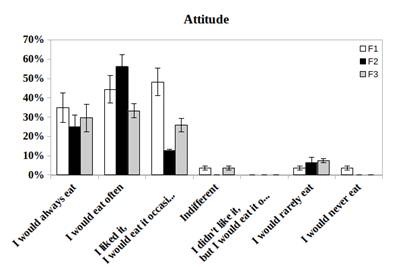
Overall, F2 stands out as the most popular choice, with most respondents expressing that they would eat it frequently (Figure 2). F1 and F3 show similar patterns, though slightly more respondents indicated they would eat these items occasionally rather than regularly. Across all three options, there was minimal indifference or aversion.
Attitude test (consumption intention) for the different formulations of fresh panga sausage. F1 (sausage formulation with 65% fillet and 25% pork fat); F2 (sausage formulation with 70% fillet and 20% pork fat) and F3 (sausage formulation with 75% fillet and 15% pork fat). Bars indicate standard deviation.
Even though the consumption of fish is commonplace within the dietary pattern of people from Maranhão, the consumption of processed products derived from it is not usual (PEREIRA et al., 2020). In general terms, the consumption intention was higher than expected, the 92% intention profile for an unusual product opens an excellent perspective for the fish production chain. It must be considered that the local population’s diet is based on fish and that the supply of a popular product such as sausage are factors that may have favored these positive results. However, the positive points presented for the study region are endowed with a certain subjectivity as several aspects influence acceptance, and especially the intention to consume a product, including the standard of living, cultural basis and quality of the product (MORAES, 1993).
Microbiological analysis
For coliforms at 45 ºC, Brazilian legislation establishes a limit of 100 MPN/g, the sausage samples investigated showed negative results, as showed in table 4. In the investigation of Escherichia coli, the count was lower than 1.8 MPN/g in the three samples analyzed. For Coagulase Positive Staphylococci, the acceptable limit according to current legislation is 500 CFU/g, therefore, there was no growth of typical strains. These results show that the origin of the raw material was adequate and the handling steps were carried out ensuring maximum hygiene of the handlers and equipment to process the sausages. Similar results were found for sausage Arapaima gigas (DE ROSA et al., 2020).
The investigation of microorganisms was based on the microbiological standards for ready-to-eat foods, established by the National Health Surveillance Agency (ANVISA) for chilled or frozen fish sausage, set out in Normative Instruction No. 60, of December 23, 2019 (BRASIL, 2019). Investigation of Salmonella sp. was absent in 25 g of analyzed samples, demonstrating that there was no contamination of the fish and sausages after handling. The presence of Salmonella sp in a study of tilapia sausage resulted in samples being discarded, making it impossible to carry out sensory analysis (REZENDE et al., 2020).
In general, microorganisms were absent or well below the limits established by Brazilian legislation (BRASIL, 2019), which denotes satisfactory hygiene and conservation standards at all stages of sausage preparation.
CONCLUSION
The study showed a favorable potential for using panga fish to make fresh sausage, highlighting the proximate composition of the product which showed high levels of crude protein and lipids in all formulations. Sensory analysis signaled high acceptance of the product. Future research should be directed towards evaluating the fatty acid profile, microbiological and oxidative stability to determine the shelf life under refrigerated or frozen storage.
ACKNOWLEDGEMENTS
The authors would like to thank the members of GETEPPE for their contribution to carrying out the analyses, and FAPEMA for the CHCF postdoctoral fellowship (number BPD-02398/23). Was financed in part by the Coordenação de Aperfeiçoamento de Pessoal de Nível Superior (CAPES), Brasil - Finance code 001
REFERENCES
-
ABEROUMAND, A.; BAESI, F. The effects of surimi process on amino acids profile of Sphyraena jello Fish. Journal of Aquatic Food Product Technology, v.30, n.3, p.315-322, 2021. Available from: <Available from: https://www.tandfonline.com/doi/full/10.1080/10498850.2021.1882634 >. Accessed: Dec. 05, 2024. doi: 10.1080/10498850.2021.1882634
» https://doi.org/10.1080/10498850.2021.1882634» https://www.tandfonline.com/doi/full/10.1080/10498850.2021.1882634 -
ABEROUMAND, A. et al. Effect of different processes to nutrient profile of dead fresh fish Carangoides armatus as potential protein-rich seafood. Natural Product Communications, v.19, n.7, 2024. Available from: <Available from: https://journals.sagepub.com/doi/10.1177/1934578X241264468 >. Accessed: Dec. 05, 2024. doi: 10.1177/1934578X241264468.
» https://doi.org/10.1177/1934578X241264468.» https://journals.sagepub.com/doi/10.1177/1934578X241264468 -
ACKMAN, R. G. Seafood lipids and fatty acids. Food Reviews International, v.6, n. 4, p.617-646, 1990. Available from: <Available from: https://www.tandfonline.com/doi/abs/10.1080/87559129009540896 >. Accessed: Sept. 11, 2024. doi: 10.1080/87559129009540896.
» https://doi.org/10.1080/87559129009540896.» https://www.tandfonline.com/doi/abs/10.1080/87559129009540896 -
AL-BULUSHI, I. M. et al. Effect of frozen storage on the characteristics of a developed and commercial fish sausages. Journal of Food Science and Technology, v.50, n.6, p.1158-1164, 2013. Available from: <Available from: https://doi.org/10.1007/s13197-011-0441-x >. Accessed: Nov. 10, 2023.
» https://doi.org/10.1007/s13197-011-0441-x -
BARBOSA, R. D. et al. Development of fresh sausage from “barbado” fish with the addition of oat flour: physicochemical and sensory characteristics. Connection Line, v.0(12), p.69-76, 2015. Available from: <Available from: http://periodicos.univag.com.br/index.php/CONNECTIONLINE/article/view/203 >. Accessed: Jul. 10, 2023.
» http://periodicos.univag.com.br/index.php/CONNECTIONLINE/article/view/203 -
BERNADINO FILHO, R. et al. Sensory evaluation of shrimp flavored Nile tilapia mortadella. Journal of Experimental Agriculture International, v.38, n.5, p.1-8, 2019. Available from: <Available from: https://journaljeai.com/index.php/JEAI/article/view/1510>. Accessed: May, 02, 2023. doi: 10.9734/jeai/2019/v38i530310
» https://doi.org/10.9734/jeai/2019/v38i530310» https://journaljeai.com/index.php/JEAI/article/view/1510>. -
BLIGH, E. G.; DYER, W. J. A rapid method of total lipid extraction and purification. Canadian Journal of Biochemistry and Physiology, v.37, n.8, p.911-917, 1959. Available from: <Available from: https://cdnsciencepub.com/doi/pdf/10.1139/o59-099 >. Accessed: Dec. 10, 2023.
» https://cdnsciencepub.com/doi/pdf/10.1139/o59-099 -
BRASIL, AGÊNCIA NACIONAL DE VIGILÂNCIA SANITÁRIA. Instrução Normativa no 60, de 23 de dezembro de 2019. Estabelece as listas de padrões microbiológicos para alimentos. Diário Oficial da República Federativa do Brasil, 2019. Available from: <Available from: https://www.in.gov.br/en/web/dou/-/instrucao-normativa-n-60-de-23-de-dezembro-de-2019-235332356 >. Accessed: Dec. 10, 2024.
» https://www.in.gov.br/en/web/dou/-/instrucao-normativa-n-60-de-23-de-dezembro-de-2019-235332356 -
BRASIL, MINISTÉRIO DA AGRICULTURA. Instrução Normativa nº 4, de 31 de março de 2000. Aprova os Regulamentos Técnicos de Identidade e Qualidade de Carne Mecanicamente Separada, de Mortadela, de Linguiça e de Salsicha. Diário Oficial da República Federativa do Brasil, 2000. Available from: <Available from: https://pesquisa.in.gov.br/imprensa/jsp/visualiza/index.jsp?data=05/04/2000&jornal=1&pagina=54&totalArquivos=73 >. Accessed: Dec. 10, 2024.
» https://pesquisa.in.gov.br/imprensa/jsp/visualiza/index.jsp?data=05/04/2000&jornal=1&pagina=54&totalArquivos=73 -
BROL, J. A nova aposta da Aquicultura brasileira - muito prazer, Panga BR. In: Aquaculture Brasil, 2018. Available from: <Available from: https://www.aquaculturebrasil.com/artigo/104/a-nova-aposta-da-aquicultura-brasileira-muito-prazer,-panga-br >. Accessed: May, 09, 2024.
» https://www.aquaculturebrasil.com/artigo/104/a-nova-aposta-da-aquicultura-brasileira-muito-prazer,-panga-br -
CARVALHO, C. C. P. et al. Histórico e aspectos tecnológicos do processamento da linguiça cuiabana. Revista do Instituto Adolfo Lutz, v.69, n.3, p.428-433, 2010. Available from: <Available from: https://periodicoshomolog.saude.sp.gov.br/index.php/RIAL/article/view/32648 >. Accessed: Out. 15, 2023.
» https://periodicoshomolog.saude.sp.gov.br/index.php/RIAL/article/view/32648 -
CHAKMA, S. et al. Nutritional profiling of wild (Pangasius pangasius) and farmed (Pangasius hypophthalmus) pangasius catfish with implications to human health. Fishes, v.7, n.6, p.309, 2022. Available from: <Available from: https://www.mdpi.com/2410-3888/7/6/309 >. Accessed: Sept. 09, 2023. doi: 10.3390/fishes7060309.
» https://doi.org/10.3390/fishes7060309.» https://www.mdpi.com/2410-3888/7/6/309 -
DA COSTA, T. et al. The potential of the mapará Hypophthalmus spp. (Osteichthyes, Siluriformes) as alternative species for fish culture in Amazon. Boletim do Instituto de Pesca, São Paulo, v.36, n.3, p.165-174, 2010. Available from: <Available from: https://institutodepesca.org/index.php/bip/article/view/912 >. Accessed: Dec.09, 2023.
» https://institutodepesca.org/index.php/bip/article/view/912 -
DE ROSA, K. R. et al. Elaboration, physical-chemical and microbiological characterization of Pirarucu products. Brazilian Journal of Development, v.6, n.3, p.10566-10585, 2020. Available from: <Available from: https://doi.org/10.34117/bjdv6n3-074 >. Accessed: Aug. 05, 2023.
» https://doi.org/10.34117/bjdv6n3-074 - DUTCOSKY, S. D. Análise sensorial de alimentos. In: Coleção Exatas: Vol. 4. Análise sensorial de alimentos, 3. ed. revista e ampliada, p.426-426, Curitiba: Champagnat, 2011.
-
FAO. The State of World Fisheries and Aquaculture 2024 - Blue Transformation in action. Rome, 2024. Available from: <Available from: https://openknowledge.fao.org/items/06690fd0-d133-424c-9673-1849e414543d >. Accessed: Aug. 05, 2024. doi: 10.4060/cd0683en.
» https://doi.org/10.4060/cd0683en.» https://openknowledge.fao.org/items/06690fd0-d133-424c-9673-1849e414543d -
GUIMARÃES, C. F. M. et al. The chemical quality of frozen vietnamese Pangasius hypophthalmus fillets. Food Science & Nutrition, v.4, v.3, p.398-408, 2016. Available from: <Available from: https://onlinelibrary.wiley.com/doi/10.1002/fsn3.302 >. Accessed: Aug. 10, 2023. doi: 10.1002/fsn3.302.
» https://doi.org/10.1002/fsn3.302.» https://onlinelibrary.wiley.com/doi/10.1002/fsn3.302 -
GUIMARÃES, J. L. B. et al. Development of a low commercial value fish-sausage from the fish trawling “mix” category. Food Science and Technology, v.39, p.115-121, 2019. Available from: <Available from: https://www.scielo.br/j/cta/a/L3Dvtz4MFLjqVRpXVTcT67P/?lang=en >. Accessed: Nov. 10, 2023. doi: 10.1590/fst.38317.
» https://doi.org/10.1590/fst.38317.» https://www.scielo.br/j/cta/a/L3Dvtz4MFLjqVRpXVTcT67P/?lang=en - HORWITZ, W. Food composition, additives, natural contaminants. Association of Official Analytical Chemists, 2000.
-
INSTITUTO ADOLFO LUTZ. Métodos físico-químicos para análise de alimentos. São Paulo: Instituto Adolfo Lutz, 2008. Available from: <Available from: http://www.ial.sp.gov.br/ial/publicacoes/livros/metodos-fisico-quimicos-para-analise-de-alimentos >. Accessed: Aug. 01, 2023.
» http://www.ial.sp.gov.br/ial/publicacoes/livros/metodos-fisico-quimicos-para-analise-de-alimentos - JUÁREZ, M. et al. Beef texture and juiciness. In: Handbook of meat and meat processing. Boca Raton: CRC Press, 2nd ed, p.177-206, 2012.
-
KARL, H. et al. Composition and quality attributes of conventionally and organically farmed Pangasius fillets (Pangasius hypophthalmus) on the German market: pangasius quality. International Journal of Food Science & Technology, v.45, n.1, p.56-66, 2009. Available from: <Available from: https://academic.oup.com/ijfst/article/45/1/56/7865401 >. Accessed: Jun. 10, 2024. doi: 10.1111/j.1365-2621.2009.02103.x.
» https://doi.org/10.1111/j.1365-2621.2009.02103.x.» https://academic.oup.com/ijfst/article/45/1/56/7865401 -
LAGO, A. M. T. et al. Influence of the addition of minced fish on the preparation of fish sausage: effects on sensory properties. Journal of Food Science, v.82, p.492-499, 2017. Available from: <Available from: https://ift.onlinelibrary.wiley.com/doi/10.1111/1750-3841.13586 >. Accessed: Jan. 5, 2025. doi: 10.1111/1750-3841.13586.
» https://doi.org/10.1111/1750-3841.13586.» https://ift.onlinelibrary.wiley.com/doi/10.1111/1750-3841.13586 -
LIMA, L. K. F. et al. Yield and centesimal composition of tambaqui (Colossoma macropomum) by different processing forms and weight categories, Revista Brasileira de Higiene e Sanidade Animal, v.12(2), p.223-235, 2018. Available from: <Available from: http://www.alice.cnptia.embrapa.br/handle/doc/1094232 >. Accessed: Nov. 15, 2023.
» http://www.alice.cnptia.embrapa.br/handle/doc/1094232 -
LINS, P. M. O. Beneficiamento do pescado, 2016. Available from: <Available from: http://proedu.rnp.br/handle/123456789/274 >. Accessed: Aug. 20, 2023.
» http://proedu.rnp.br/handle/123456789/274 -
LORENZO, J. M.; FRANCO, D. Fat effect on physico-chemical, microbial and textural changes through the manufactured of dry-cured foal sausage lipolysis, proteolysis and sensory properties. Meat Science, v.92(4), p.704-714, 2012. Available from: <Available from: https://www.sciencedirect.com/science/article/pii/S0309174012002380?via%3Dihub >. Accessed: Apr. 27, 2024. doi: 10.1016/j.meatsci.2012.06.026.
» https://doi.org/10.1016/j.meatsci.2012.06.026.» https://www.sciencedirect.com/science/article/pii/S0309174012002380?via%3Dihub - MORAES, M. A. C. Métodos para avaliação sensorial dos alimentos (8th ed). Campinas: UNICAMP, 1993.
-
MOURA, G. F. et al. Salting in fish: Review. Brazilian Journal of Development, v.7, n.12, p.121831-121849, 2022. Available from: <Available from: https://ojs.brazilianjournals.com.br/ojs/index.php/BRJD/article/view/42175/pdf >. Accessed: Dec. 03, 2023. doi: 10.34117/bjdv7n12-784.
» https://doi.org/10.34117/bjdv7n12-784.» https://ojs.brazilianjournals.com.br/ojs/index.php/BRJD/article/view/42175/pdf -
NEWELL, G. J.; MAC FARLANE, J. D. Expanded tables for multiple comparison procedures in the analysis of ranked data. Journal of Food Science, v.52, n.6, p.1721-1725, 1987. Available from: <Available from: https://ift.onlinelibrary.wiley.com/doi/10.1111/j.1365-2621.1987.tb05913.x >. Accessed: Feb. 10, 2024. doi: 10.1111/j.1365-2621.1987.tb05913.x.
» https://doi.org/10.1111/j.1365-2621.1987.tb05913.x.» https://ift.onlinelibrary.wiley.com/doi/10.1111/j.1365-2621.1987.tb05913.x -
OLIVEIRA, A. C. M. et al. Development and characterization of fish sausages supplemented with salmon oil: development of fish sausages. Journal of Food Processing and Preservation, v.38, n.4, p.1641-1652, 2014. Available from: <Available from: https://onlinelibrary.wiley.com/doi/10.1111/jfpp.12126 >. Accessed: Aug. 10, 2024. doi: 10.1111/jfpp.12126.
» https://doi.org/10.1111/jfpp.12126.» https://onlinelibrary.wiley.com/doi/10.1111/jfpp.12126 -
OLIVEIRA, A. C. D. T. et al. Características físico químicas de duas formulações de linguiça de tambaqui (Colossoma macropomum). Higiene Alimentar, v.33, p.945-949, 2019. Available from: <Available from: https://www.higienealimentar.com.br/wp-content/uploads/2019/06/Anais-Higienistas-2019_web-2.pdf >. Accessed: Feb. 09, 2024.
» https://www.higienealimentar.com.br/wp-content/uploads/2019/06/Anais-Higienistas-2019_web-2.pdf -
OLIVEIRA FILHO, P. R. C. Elaboração de embutido cozido tipo salsicha com carne mecanicamente separada de resíduos de filetagem de tilápias do Nilo. Doctoral thesis, Universidade Estadual Paulista, BR, 2009. Available from: <Available from: https://repositorio.unesp.br/handle/11449/100241 >. Accessed: Aug. 05, 2024.
» https://repositorio.unesp.br/handle/11449/100241 -
OLIVEIRA FILHO, P. R. C. et al. Evaluation of physicochemical and sensory properties of sausages made with washed and unwashed mince from Nile tilapia by-products. Journal of Aquatic Food Product Technology, v.21, n.3, p.222-237, 2012. Available from: <Available from: https://www.tandfonline.com/doi/full/10.1080/10498850.2011.590270 >. Accessed: Jun. 20, 2024. doi: 10.1080/10498850.2011.590270.
» https://doi.org/10.1080/10498850.2011.590270.» https://www.tandfonline.com/doi/full/10.1080/10498850.2011.590270 -
ORBAN, E. et al. New trends in the seafood market. Sutchi catfish (Pangasius hypophthalmus) fillets from Vietnam: nutritional quality and safety aspects. Food Chemistry, v.110(2), p.383-389, 2008. Available from: <Available from: https://www.sciencedirect.com/science/article/pii/S0308814608001787?via%3Dihub >. Accessed: Jul. 02, 2024. doi: 10.1016/j.foodchem.2008.02.014.
» https://doi.org/10.1016/j.foodchem.2008.02.014.» https://www.sciencedirect.com/science/article/pii/S0308814608001787?via%3Dihub -
PEIXE BR. Associação Brasileira da Piscicultura. Anuário Peixe BR da Piscicultura. 2021. São Paulo, BR, 2021. Available from: <Available from: https://www.peixebr.com.br/anuario-2021/ >. Accessed: Jul. 02, 2023.
» https://www.peixebr.com.br/anuario-2021/ -
PEREIRA, K. et al. Perfil dos comerciantes de pescado no município de Pinheiro, Maranhão, Brasil. In: Engenharia de pesca: produtividade e sustentabilidade. 1.ed. Piracanjuba-GO: Editora Conhecimento Livre, cap.8, p.111-119, 2020. Available from: <Available from: https://app.conhecimentolivre.org/book/37/Engenharia%20de%20pesca:%20produtividade%20e%20sustentabilidade >. Accessed: Dec. 10, 2024.
» https://app.conhecimentolivre.org/book/37/Engenharia%20de%20pesca:%20produtividade%20e%20sustentabilidade -
REIS, E. et al. Nile tilapia filleting methods in two fish slaughterhouses: fillet yield and waste. Revista Research, Society and Development, v.12(1), p.e27812135831, 2023. Available from: <Available from: https://rsdjournal.org/index.php/rsd/article/view/35831/32608 >. Accessed: Jul. 26, 2024.
» https://rsdjournal.org/index.php/rsd/article/view/35831/32608 -
REZENDE, A. N. V. et al. Nile tilapia sousage prepared with soy texturized protein. Revista Científica Agropampa, v.3(3), p.80-89, 2020. Available from: <Available from: https://periodicos.unipampa.edu.br/index.php/Agropampa/article/view/103343 >. Accessed: Jan. 20, 2024.
» https://periodicos.unipampa.edu.br/index.php/Agropampa/article/view/103343 - ROSSI, S. Perfil do consumidor de linguiça frescal no município de Rio Claro-SP. Dissertation (Master in Science), Universidade de São Paulo, BR, 2017.
- SILVA, N. et al. Manual de métodos de análise microbiológica de alimentos e água. Blucher, 2017.
-
SLEDER, F. et al. Development and characterization of a tambaqui sausage. Ciência e Agrotecnologia, v.39, n.6, p.604-612, 2015. Available from: <Available from: https://www.scielo.br/j/cagro/a/66NVhr6FS9MvtDzDnNQ3fSC/?lang=en >. Accessed: Jan. 05, 2025. doi: 10.1590/S1413-70542015000600007.
» https://doi.org/10.1590/S1413-70542015000600007.» https://www.scielo.br/j/cagro/a/66NVhr6FS9MvtDzDnNQ3fSC/?lang=en -
SURASANI, V. K. R. et al. Utilization of pangas protein isolates and by-products in fish sausages: effect on quality attributes and acceptability. Journal of Food Processing and Preservation, v.46, n.8, p.e16798, 2022. Available from: <Available from: https://onlinelibrary.wiley.com/doi/10.1111/jfpp.16798 >. Accessed: Dec. 05, 2024. doi: 10.1111/jfpp.16798.
» https://doi.org/10.1111/jfpp.16798.» https://onlinelibrary.wiley.com/doi/10.1111/jfpp.16798
Edited by
-
Editors
Rudi Weiblen (0000-0002-1737-9817) Rubén Domínguez-Valencia (0000-0002-2764-504X)