
 Nutrition-enriched nanobubble oxygen and red-blue light spectrum enhanced plantlet growth and in vitro Dendrobium development
ABSTRACT:
An effective micropropagation system for Dendrobium is required to support seedling production. The effects of light quality with nutrition-enriched nanobubble (NB) and oxygen on Dendrobium plantlet growth and development were evaluated. Plantlets were placed on a growth medium (enriched or without NB oxygen) with vermiculite-perlite (1:1) and irradiated by fluorescent, red-blue spectrum ratio of (3:1, 1:1, 1:3), and red. The NB and dissolved oxygen in liquid nutrition and red-blue spectrum enhanced Dendrobium’s morphological and physiological characteristics in vitro sugar-free. The TF-NB-1R1B increased fresh weight and plantlet growth rate, but TF-NB-1R3B increased pigments. The shift from heterotrophic to autotrophic micropropagation is indicated by stomatal closer and upregulated CAT, PEPCK, and RBC genes.
Key words:
Dendrobium; LED lighting; micropropagation; nanobubble oxygenation; photomorphogenesis
RESUMO:
Um sistema de micropropagação eficaz para o Dendrobium é necessário para suportar a produção de plântulas. Foram avaliados os efeitos da qualidade da luz com nanobolhas (NB) enriquecidas com nutrientes e oxigênio no crescimento e desenvolvimento de plântulas de Dendrobium. As plântulas foram colocadas em meio de crescimento (enriquecido ou sem oxigênio NB) com vermiculite-perlite (1:1) e irradiadas por fluorescência, rácio do espectro vermelho-azul de (3:1, 1:1, 1:3) e vermelho. O NB e o oxigênio dissolvido em nutrição líquida e espectro vermelho-azul melhoraram as características morfológicas e fisiológicas do Dendrobium in vitro sem açúcar. O TF-NB-1R1B aumentou o peso fresco e a taxa de crescimento das plântulas, mas o TF-NB-1R3B aumentou os pigmentos. A mudança da micropropagação heterotrófica para a autotrófica é indicada pelo fecho estomático e pelos genes CAT, PEPCK e RBC regulados positivamente.
Palavras-chave:
Dendrobium; iluminação LED; micropropagação; oxigenação por nanobolhas; fotomorfogênese
INTRODUCTION
The micropropagation of Dendrobium orchids plays a vital role in supporting large-scale seedling production for the horticultural industry. Achieving efficient and robust plantlet development in vitro depends on carefully optimizing both the growth medium and environmental conditions, particularly light quality. Traditionally, micropropagation media are formulated with a balanced mix of macro- and micronutrients, vitamins, sugars, growth regulators, and various additives, all of which must be finely tuned to meet the physiological needs of the developing plantlets. The method of nutrient delivery-whether via solid or liquid media-further influences nutrient absorption and plantlet performance (MOREIRA et al., 2013).
Liquid media have gained attention for their ability to provide greater dissolved oxygen and improved contact with explants, thereby enhancing nutrient uptake and growth compared to solid media (AGISIMANTO et al., 2023; OSHITA et al., 2023). Recent innovations in this area include the use of nanobubble (NB) technology, which introduces ultra-fine bubbles (less than 200 nm in diameter) into liquid media. These nanobubbles are notable for their physicochemical stability and exceptional capacity to transport oxygen, offering new opportunities to improve plant growth in both in vitro and hydroponic systems (AGARWAL et al., 2011; TANAKA et al., 2021; AHMED et al., 2018). The NBs have been successfully used in water treatment (AGARWAL et al., 2011), aquaculture (EBINA et al., 2013), seed germination (AHMED et al., 2018), lettuce hydroponics (KOBAYASHI et al., 2022), and barley (OSHITA et al., 2023). Unfortunately, the provision of liquid nutrients containing NBs and dissolved oxygen for in vitro plantlet growth has not been reported.
Light, as a fundamental environmental factor, not only provides the energy required for photosynthesis but also regulates key developmental processes in plants (GUPTA et al., 2013; NADAL et al., 2023). Plants are particularly responsive to light in the 400-700 nm range, which influences both their morphology and the accumulation of functional compounds (HANUS-FAJERSKA et al., 2017). While fluorescent lamps have been widely used in plant tissue culture, the advent of light-emitting diode (LED) technology offers significant advantages, including spectral customization, lower heat output, greater energy efficiency, and precise control over light intensity and quality (GUPTA et al., 2013; NADAL et al., 2023), improved plant growth and quality accumulation (GUPTA et al., 2013; SORGATO et al., 2015), and allows for easy control of light intensity and quality (HANUS-FAJERSKA et al., 2017). Red light stimulates cell division and extension, shoot and stem elongation, plant anatomical changes, and regulates carbohydrate mobilization (LUAN et al., 2015; TRIVELLINI et al., 2023), whereas blue light influences chlorophyll biosynthesis, stomatal opening, chloroplast maturation, photosynthesis, carotenoids, and anthocyanins accumulation (KO et al., 2020).
Despite these advances, there is a notable gap in the literature regarding the combined application of nutrition-enriched nanobubble oxygen and tailored light spectra for in vitro micropropagation-particularly under sugar-free conditions that encourage autotrophic growth. This study addressed this gap by investigating the effects of liquid nutrition enriched with nanobubble oxygen, in combination with various red-blue light spectra, on the growth and physiological development of Dendrobium plantlets cultivated in vitro without supplemental sugar. The findings are expected to provide new insights into optimizing micropropagation protocols for improved plantlet quality and sustainability.
MATERIALS AND METHODS
Dendrobium-B30 ( Dendrobium enobi x Dendrobium taurinum ) plantlets from Taman Arjuno Research Center were grown on solidified Murashige and Skoog (MS), 88 mM sugar, 12.5% coconut water, and 10% banana extract. The uniform plantlets with two completed leaf development were selected, washed, and roots removed.
MS nutrients and vitamins, myo-inositol 100 mg/L, nicotinic acid 0.5 mg/L, pyridoxine HCl 0.5 mg/L, thiamine HCl 0.1 mg/L, and glycine 2 mg/L were mixed, and the pH was adjusted to 5.6 ± 0.2 before autoclaving at 121 °C for 20 minutes. The sterilized liquid medium was enriched with NBs and dissolved oxygen at 15 mg/L, using an NBs generator (Qwater) and an oxygen concentrator (Yuwell 8F-3AW). Liquid nutrition was mixed evenly with vermiculite-perlite (VP) (1:1), with a small amount of liquid media (TF) at the bottom of the jar. Explants were planted in a growth medium (TF-liquid nutrition enriched or without NB-oxygen mixed with VP) (Figure 1A) and subjected to light included FL (cool daylight Philips LED; 16W), a single super-bright LED lamp of red (R), and a red-blue (B) combo at 1:1, 3:1, and 1:3 for 16/8 (day/night) photoperiod.

Dendrobium hybrid B30 plantlets grown in nutrition enriched NB oxygen and vermiculite-perlite (a), representative plantlet in a TF-NB-1R1B (b), TF-NB-1R3B (c), TF-0-FL (d), leaf stomata of TF-NB-1R1B (e), tissue culture under FL (f). Bar: a-d= 1 cm, e-f=200 μm (500x magnification).
The chlorophyll from the leaf was homogenized in 95% ethanol and centrifuged at 10,000 rpm for 15 minutes. The supernatant was collected, diluted 10 times, and measured using a UV-Vis spectrophotometer at 664 nm, 649 nm, and 470 nm. Chlorophyll-a concentrations (13.36 A664 - 5.19 A649), chlorophyll-b (27.43 A649 - 8.12 A664) and carotenoid ([(1000A470 - 2.13 Chlorophyll a - 97.64 Chlorophyll b)]/209) were determined (LICHTENTHALER, 1987). The RibospinTM Plant (Gene All) procedure was used to isolate total RNA from 100 mg of leaf tissue in each sample, which was then quantified using agarose gel electrophoresis. Double-stranded cDNA was created using the BioRad iScriptTM cDNA Synthesis Kit technique. Gene expression was measured by PCR with 1x SYBR Green (Taq polymerase, dNTPs, and SYBRGreen dye) and 200 nM forward and reverse primers (SUT2-F/R 5’-TACTCAACATTTCCATCGTCATCCC-3’/5’-AGTTAG AGCGAGAGAGCCTTGGAA-3’; CAT-F/R 5’-GGATGATGAAGCTGTGATTGTTGG-3’/5’-CAGGCTGAAGAGGCAGGATGTC-3’; D1-F/R 5’-TATCATTGCCTTCATTGTT GCCC-3’/5’-AAGTTCATAAGGACCGCCATTGTAC-3’; RBCs-F/R 5’-TGATGATCTC ATCCGCTACCGC’-3’/5’-CAGGGAGGTATGACAGTGTCTCAAAC-3’; PEPCK-F 5’-GCTTCCTACCCTATCGAGTACATTCC-3’ PEPCK-R 5’-TGGCTTGCGGCTCCTTG AT-3’) and amplified by the MiniOpticon™-RT-PCR System programmed of 95 °C for 10 minutes, 40 cycles at 95 °C for 15 seconds, 60 °C for 1 minute with melting curve at 65 to 95 °C, increasing of 5 °C on fluorescence measurement. Expression level was calculated based on primer efficiency and normalization based on housekeeping genes Ubiquitin (Ubi) (F/R 5’-TGAACTC CATCGCCTTCCTCTTC-3’/5’-TGAAGCATGGCATCAATTTC-3’).
The experiment was designed in a completely randomized design, with four replicates. Leaf number (LN), root length (RL), number (RN), fresh weight (FW), growth rate (GR), chlorophyll a and b, carotenoid content, CAT, SUT2, D1, RBCs, and PEPCK, gene expression were measured at 90 days of culture. The XLSTAT software was used to analyze the data at a 1% probability level. The Bio-Rad CFX Maestro software was used to measure gene expression in RBCs, PEPCK, CAT, D1, and SUT2.
RESULTS AND DISCUSSION
Plantlet development in sugar-free in vitro culture with nutrition-enriched NB-oxygen and a red-blue spectrum ratio is described. The treatments had a substantial influence on all variables except RL (Table 1). Liquid nutrition-enriched NB-oxygen stimulated plantlet growth and increased mean LN, RN, RL, FW, and GR values across light sources and spectrums. TF-NB-1R3B had considerably higher LN and RN (3.25 leaf/plantlet and 3.06 root/plantlet, respectively) than TF-0-FL (2.31 leaf and 2.44 root/plantlet). Interestingly, TF-NB-1R1B produced a maximum RL of 3.82 cm, but this was not significantly different across all treatments. TF-NB-1R1B had a significant impact on FW and GR, reaching 369.31 mg and 4.10 mg/day, respectively, which was 5.10% greater than TF-0-FL (351.38 mg) but was not different from the other treatments except TF-0-R. The study reported that under red-blue light, NB treatments increased GR more than non-NB cells. When using NBs in nutrition, red-blue light outperformed FL light in shoot development (Figure 1B-D). TF conditions serve multiple functions, including nutrient supply (AFREEN, 2008), gas management (O2 and CO2), long-term NB stability in liquid, humidity balance, and avoidance of hyperhydricity. Specifically in VP medium, nutrition-enriched NB-oxygen was maintained in the porosity of VP, continuously transferring nutrients and oxygen to the plantlets. In this static system, the TF layer is crucial because gases can only exist on the liquid surfaces (SILVA et al., 2020). The phenomenon of liquid nutrition enriched with NB oxygen, which continuously delivered O₂ to plantlets to enable aerobic metabolism, was comparable to bioreactor conditions. Bioreactor superiority over solid culture is due to its provision of more dissolved oxygen to plants (AGISIMANTO et al., 2023). While NB-enriched oxygen has much more dissolved oxygen, as their long shelf life (TANAKA et al., 2021). Red and blue light representing sunlight spectral of photomorphogenesis, increased shoot elongation by 91.1-388.9% compared to the control in ex vitro potted Paphiopedilum delenatii (LUAN et al., 2015) and regulated photomorphogenesis (KO et al., 2020).
The effect of light source, red-blue light ratio, and liquid nutrition-enriched nanobubble on leave number (LN), root length (RL), root number (RN), fresh weight (FW), and growth rate (GR) of Dendrobium B30 at 90 days of incubation.
Nutrition-enriched NB oxygen and red-blue light significantly influenced chlorophyll a, b, and carotenoid pigment contents. Chlorophyll-a levels peaked at 1.87 μg/mL under TF-NB-3R1B, 11.94% greater than TF-0-FL (1.67 μg/mL). However, levels decreased by 7.33% and 10.88% under TF-NB-1R3B and TF-NB-1R1B, respectively. TF-NB-1R3B had a maximum mean chlorophyll-b of 0.7 μg/mL, which was 10.83% greater than TF-0-FL (2.40 μg/mL). The TF-NB-1R3B also produced a greater carotenoid content than TF-0-FL with a 21.86% increase. Cluster analysis revealed that TF-NB-3R1B, TF-NB-1R1B, and TF-NB-R stimulated FW, GR, RL, and RN, while the dominating blue light in TF-NB-1R3B increased chlorophyll-b, LN, and carotenoid content (Figure 2A). Blue light has a crucial role in plant development, including chloroplasts, chlorophyll, stomatal opening, photomorphogenesis (KO et al., 2020), enhancing growth rate, and pigment content (NAZNIN et al., 2019). Chlorophyll-b correlates strongly with LN but not with carotenoid concentration. The RN is highly correlated with FW and GR (Figure 2B). KO et al. (2020) previously described physiological alterations impacted by a red-blue spectrum and nanobubbles in terms of leaf color expression and stomatal characteristics. Nutrition-enriched NB oxygen with a red-blue spectrum improved color uniformity in mature leaves. According to the data, the leaves exhibited a strong yellow-green color range at first (143A, 143B, 144A, and 144B); however, in 90 days of incubation, the leaf color changed to moderate olive green, as shown in the RHS color chart. Microscopic examinations after 5 weeks of culture demonstrated that TF-NB-3R1B has stomatal closeness, while TF-0-FL has none (Figure 1E-F). Chlorophyll-a absorbs light mostly at 430 nm (blue) and 662 nm (red). Chlorophyll is necessary for light harvesting because it absorbs light of various wavelengths, allowing photosynthetic organisms to grow. Carotenoids regulate light capture and serve as important antioxidants, lowering photodamage and photoinhibition (SIMKIN et al., 2022). TF-NB-1R3B stimulated upregulating CAT, PEPCK, and RBCs genes and peaked at 34.19, higher than the D1 and SUT2 genes, indicating the importance of the CAT, PEPCK, and RBCs genes in photosynthesis (HUANG et al., 2015; YAMADA et al., 2019). TF-NB-1R1B, TF-NB-3R1B, and TF-NB-Red had reduced gene expression (Figure 3A). The clustergram analysis separated the CAT, PEPCK, SUT2, and RBCs genes from the D1 gene (Figure 3B).

Distribution effect of nutrition-enriched NB oxygen and light spectrum on Dendrobium hybrid B30 plantlet variables of growth and pigments content (A) and their correlation (B) at 90 days after culture. (NB-nanobubble; LN-leaf number; RL-root length; RN-root number; FW-fresh weight; GR-growth rate; Ch-a-Chlorophyll a; Ch-b-Chlorophyll b, Car-total carotene, TF-liquid nutrition enriched or without NB-oxygen mixed with VP; FL-cool daylight Philips LED; 16W, a single super-bright LED lamp of red (R), and a red-blue (B) combo at 1:1, 3:1, and 1:3 for 16/8 (day/night) photoperiod).
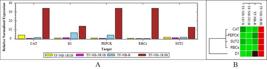
The gene expression (A) and the clustergram pattern (B) of Dendrobium hybrid B30 plantlets as a response to nutrition-enriched NB oxygen and light spectrum (CAT-catalase; D1-D1 protein; PEPCK-Phosphoenolpyruvate Carboxykinase); RBCs- Ribulose-1,5-bisphosphate carboxylase/oxygenase small subunit; SUT2- Sucrose Transporter 2).
The upregulation of CAT, PEPCK, and RBCs genes provides compelling molecular evidence for the establishment of functional photosynthetic machinery in cultured plantlets. The RBCs gene encodes the small subunit of ribulose-1,5-bisphosphate carboxylase/oxygenase (RuBisCO), the primary enzyme responsible for carbon fixation in the Calvin cycle. This enzyme complex is crucial for converting atmospheric CO2 into organic compounds, representing the fundamental biochemical process that distinguishes autotrophic from heterotrophic metabolism (WANG et al., 2018). PEPCK (phosphoenolpyruvate carboxylase kinase) regulation is particularly significant in C4 photosynthetic pathways, where it modulates the initial CO2 fixation reaction through reversible phosphorylation. The enhanced expression of this gene suggested that the nanobubble-treated plantlets developed more sophisticated carbon concentrating mechanisms, potentially improving photosynthetic efficiency under controlled culture conditions. CAT (catalase) upregulation indicated enhanced antioxidant capacity, which is essential for managing reactive oxygen species generated during increased photosynthetic activity (KO et al., 2020).
This study verified the discovery that providing nutrition-enriched NB oxygen and red-blue light to in vitro sugar-free plantlet development improved plantlet growth and development, as indicated by GR, chlorophyll, and carotenoid content. The growing medium contains NB oxygen, and the light spectrum provided an appropriate physicochemical growth medium, resulting in enhanced organs and photosynthetic apparatus. Plantlets grew photo autotrophically, as evidenced by TF-NB-1R3B upregulating the CAT, PEPCK, and RBC genes.
CONCLUSION
Nanobubbles and dissolved oxygen in liquid nutrition combined with red blue spectrum enhanced morphological and physiological characteristics of Dendrobium grown in sugar-free in vitro conditions. The TF-NB-1R1B increased fresh weight and plantlet growth rate, but TF-NB-1R3B increased pigments. The shift from heterotrophic to autotrophic micropropagation is indicated by stomatal closer and upregulated CAT, PEPCK, and RBCs genes.
ACKNOWLEDGMENTS
The project has been funded by the Indonesian Government through a BRIN-LPDP research grant (contract B-1744/II.7.5/FR/11/2022, Nomor B-14145/III.11/ KS.00.00/11/2022, Dita Agisimanto and Taman Arjuno Research Center.
REFERENCES
-
AFREEN, F. Temporary immersion bioreactor. Plant tissue culture engineering, Springer, p.187-201, 2008. Available from: <Available from: https://doi.org/10.1007/978-1-4020-3694-1_11 >. Accessed: Apr. 22, 2019. doi: 10.1007/978-1-4020-3694-1_11.
» https://doi.org/10.1007/978-1-4020-3694-1_11.» https://doi.org/10.1007/978-1-4020-3694-1_11 -
AGARWAL, A. et al. Principle and applications of microbubble and nanobubble technology for water treatment. Chemosphere, v.84, n.9, p.1175-1180, 2011. Available from: <Available from: https://doi.org/10.1016/j.chemosphere.2011.05.054 >. Accessed: Aug. 08, 2022. doi: 10.1016/j.chemosphere.2011.05.054.
» https://doi.org/10.1016/j.chemosphere.2011.05.054.» https://doi.org/10.1016/j.chemosphere.2011.05.054 -
AGISIMANTO, D. et al. High frequencies repetitive shoots Conference High frequencies repetitive shoots organogenesis of potato (solanum tuberosum L.) under partial immersion bioreactor culture organogenesis of potato (solanum tuberosum L.) under partial immersion bioreactor culture. In: Jogjakarta, p.01026, 2023. Available from: <Available from: http://dx.doi.org/10.1051/bioconf/20236901026 >. Accessed: Feb. 04, 2024. doi: 10.151/bioconf/20236901026.
» https://doi.org/10.151/bioconf/20236901026.» http://dx.doi.org/10.1051/bioconf/20236901026 -
AHMED, A. K. A. et al. Influences of air, oxygen, nitrogen, and carbon dioxide nanobubbles on seed germination and plant growth. Journal of Agricultural and Food Chemistry, v.66, n.20, p.5117-5124, 2018. Available from: <Available from: https://doi.org/10.1021/acs.jafc.8b00333 >. Accessed: Jan. 10, 2022. doi: 10.1021/acs.jafc.8b00333.
» https://doi.org/10.1021/acs.jafc.8b00333.» https://doi.org/10.1021/acs.jafc.8b00333 -
EBINA, K. et al. Oxygen and air nanobubble water solution promote the growth of plants, fishes, and mice. PLoS One, v.8, n.6, p.e65339, 2013. Available from: <Available from: https://doi.org/10.1371/journal.pone.0065339 >. Accessed: Jan. 10, 2022. doi: 10.1371/journal.pone.0065339.
» https://doi.org/10.1371/journal.pone.0065339.» https://doi.org/10.1371/journal.pone.0065339 -
GUPTA, S. D. et al. Fundamentals and applications of light-emitting diodes (leds) in vitro plant growth and morphogenesis. Plant Biotechnology Reports, v.7, n.3, p.211-220, 2013. Available from: <Available from: https://doi.org/10.1007/s11816-013-0277-0 >. Accessed: Jan. 10, 2022. doi: 10.1007/s11816-013-0277-0.
» https://doi.org/10.1007/s11816-013-0277-0.» https://doi.org/10.1007/s11816-013-0277-0 -
HANUS-FAJERSKA, E. et al. Impact of light-emitting diodes (leds) on propagation of orchids in tissue culture. In: DUTTA GUPTA, S. ed. eds. Light emitting diodes for agriculture: Smart lighting Singapore, Springer Singapore, p.305-320, 2017. Available from: <Available from: https://doi.org/10.1007/978-981-10-5807-3_13 >. Accessed: Apr. 03, 2023. doi: 10.1007/978-981-10-5807-3_13.
» https://doi.org/10.1007/978-981-10-5807-3_13.» https://doi.org/10.1007/978-981-10-5807-3_13 -
HUANG, Y. X. et al. Phosphoenolpyruvate carboxykinase (pepck) deficiency affects the germination, growth and fruit sugar content in tomato (solanum lycopersicum L.). Plant physiology and biochemistry, v.96, p.417-425, 2015. Available from: <Available from: https://www.sciencedirect.com/science/article/pii/S0981942815301017?via%3Dihub >. Accessed: Apr. 03, 2023. doi: 10.1016/j.plaphy.2015.08.021.
» https://doi.org/10.1016/j.plaphy.2015.08.021.» https://www.sciencedirect.com/science/article/pii/S0981942815301017?via%3Dihub -
KO, S. S. et al. Blue light acclimation reduces the photoinhibition of phalaenopsis aphrodite (moth orchid). International Journal of Molecular Sciences, v.21, n.17, p.6167, 2020. Available from: <Available from: https://doi.org/10.3390%2Fijms21176167 >. Accessed: Apr. 03, 2023. doi: 10.3390/ijms21176167.
» https://doi.org/10.3390/ijms21176167.» https://doi.org/10.3390%2Fijms21176167 -
KOBAYASHI, N. et al. Leaf lettuce (lactuca sativa L.‘L-121’) growth in hydroponics with different nutrient solutions used to generate ultrafine bubbles. Journal of Plant Nutrition, v.45, n.6, p.816-827, 2022. Available from: <Available from: https://doi.org/10.1080/01904167.2021.2006227 >. Accessed: Apr. 07, 2023. doi: 10.1080/01904167.2021.2006227.
» https://doi.org/10.1080/01904167.2021.2006227.» https://doi.org/10.1080/01904167.2021.2006227 -
LICHTENTHALER, H. K. Chlorophylls and carotenoids: Pigments of photosynthetic biomembranes. Methods in enzymology, p.350-382, 1987. Available from: <Available from: https://www.sciencedirect.com/science/article/pii/0076687987480361 >. Accessed: Apr. 03, 2023. doi: 10.1016/0076-6879(87)48036-1.
» https://doi.org/10.1016/0076-6879(87)48036-1.» https://www.sciencedirect.com/science/article/pii/0076687987480361 -
LUAN, V.Q. et al. Ex vitro and in vitro paphiopedilum delenatii guillaumin stem elongation under light-emitting diodes and shoot regeneration via stem node culture. Acta Physiologiae Plantarum, v.37, n.7, p.136, 2015. Available from: <Available from: https://doi.org/10.1007/s11738-015-1886-8 >. Accessed: Apr. 03, 2023. doi: 10.1007/s11738-015-1886-8.
» https://doi.org/10.1007/s11738-015-1886-8.» https://doi.org/10.1007/s11738-015-1886-8 -
MOREIRA, A. et al. Cattleya walkeriana growth in different micropropagation systems. Ciência Rural, v.43, p.1804-1810, 2013. Available from: <Available from: https://doi.org/10.1590/S0103-84782013001000012 >. Accessed: Jul. 25, 2024. doi: 10.1590/S0103-84782013001000012.
» https://doi.org/10.1590/S0103-84782013001000012.» https://doi.org/10.1590/S0103-84782013001000012 -
NADAL, M. C. et al. Impact of monochromatic lights on the in vitro development of cattleya walkeriana and effects on acclimatization. Ornamental Horticulture, v.29, n.2, p.238-248, 2023. Available from: <Available from: https://doi.org/10.1590/2447-536X.v29i2.2610 >. Accessed: Jul. 21, 2024. doi: 10.1590/2447-536X.v29i2.2610.
» https://doi.org/10.1590/2447-536X.v29i2.2610.» https://doi.org/10.1590/2447-536X.v29i2.2610 -
NAZNIN, M. T. et al. Blue light added with red leds enhance growth characteristics, pigments content, and antioxidant capacity in lettuce, spinach, kale, basil, and sweet pepper in a controlled environment. Plants, v.8, n.4, p.93, 2019. Available from: <Available from: https://doi.org/10.3390/plants8040093 >. Accessed: Apr. 05, 2022. doi: 10.3390/plants8040093.
» https://doi.org/10.3390/plants8040093.» https://doi.org/10.3390/plants8040093 -
OSHITA, S. et al. Promotion effects of ultrafine bubbles/nanobubbles on seed germination. Nanomaterials (Basel, Switzerland), v.13, n.10, 2023, 1677 p. Available from: <Available from: https://www.mdpi.com/2079-4991/13/10/1677 >. Accessed: Jan. 23, 2024. doi: 10.3390/nano13101677.
» https://doi.org/10.3390/nano13101677.» https://www.mdpi.com/2079-4991/13/10/1677 -
SILVA, M. D. et al. Growth, production and water consumption of coriander grown under different recirculation intervals and nutrient solution depths in hydroponic channels. Emirates Journal of Food and Agriculture, v.32, n.4, p.281-294, 2020. Available from: <Available from: https://doi.org/10.9755/ejfa.2020.v32.i4.2094 >. Accessed: Jul. 20, 2023. doi: 10.9755/ejfa.2020.v32.i4.2094.
» https://doi.org/10.9755/ejfa.2020.v32.i4.2094.» https://doi.org/10.9755/ejfa.2020.v32.i4.2094 -
SIMKIN, A. et al. The role of photosynthesis related pigments in light harvesting, photoprotection and enhancement of photosynthetic yield in planta. Photosynthesis Research, v.152, p.23-42, 2022. Available from: <Available from: https://doi.org/10.1007/s11120-021-00892-6 >. Accessed: Dec. 15, 2023. doi: 10.1007/s11120-021-00892-6.
» https://doi.org/10.1007/s11120-021-00892-6.» https://doi.org/10.1007/s11120-021-00892-6 -
SORGATO, J. et al. Light in intermediate acclimatization of in vitro germinated seedlings of dendrobium phalaenopsis deang suree. Ciência Rural, v.45, n.2, p.231-237, 2015. Available from: <Available from: https://www.scielo.br/j/cr/a/nkh7xWkrJxKSsYy84jXDLRd/?lang=en >. Accessed: Jul. 20, 2023. doi: 10.1590/0103-8478cr20131619.
» https://doi.org/10.1590/0103-8478cr20131619.» https://www.scielo.br/j/cr/a/nkh7xWkrJxKSsYy84jXDLRd/?lang=en -
TANAKA, S., et al. Destabilization of ultrafine bubbles in water using indirect ultrasonic irradiation. Ultrasonics Sonochemistry, v.71, p.105366, 2021. Available from: <Available from: https://www.sciencedirect.com/science/article/pii/S1350417720316709 >. Accessed: Jul. 20, 2023. doi: 10.1016/j.ultsonch.2020.105366.
» https://doi.org/10.1016/j.ultsonch.2020.105366.» https://www.sciencedirect.com/science/article/pii/S1350417720316709 -
TRIVELLINI, A. et al. The role of blue and red light in the orchestration of secondary metabolites, nutrient transport and plant quality. Plants, v.12, n.10, p.2026, 2023. Available from: <Available from: https://pmc.ncbi.nlm.nih.gov/articles/PMC10223693/ >. Accessed: Jan. 23, 2024. doi: 10.3390/plants12102026.
» https://doi.org/10.3390/plants12102026.» https://pmc.ncbi.nlm.nih.gov/articles/PMC10223693/ -
WANG, L. et al. Genetic variation in transcription factors and photosynthesis light-reaction genes regulates photosynthetic traits. Tree Physiol, v.38, p.1871-1885, 2018. Available from: <Available from: https://doi.org/10.1093/treephys/tpy079 >. Accessed: Jun. 15, 2025. doi: 10.1093/treephys/tpy079.
» https://doi.org/10.1093/treephys/tpy079.» https://doi.org/10.1093/treephys/tpy079 -
YAMADA, K. et al. Duplication history and molecular evolution of the rbcs multigene family in angiosperms. Journal of Experimental Botany, v.70, n.21, p.6127-6139, 2019. Available from: <Available from: https://doi.org/10.1093/jxb/erz363 >. Accessed: Nov. 01, 2024. doi: 10.1093/jxb/erz363.
» https://doi.org/10.1093/jxb/erz363.» https://doi.org/10.1093/jxb/erz363
-
CR-2024-0463.R2
-
DATA AVAILABILITY STATEMENT
The datasets generated during the current study are available in the <https://s.brin.go.id/l/WEjqoXiJnL>.
-
DECLARATION OF USE OF ARTIFICIAL INTELLIGENCE
We declare that this manuscript was created by the authors, without the use of artificial intelligence for writing, preparing the abstract, defining keywords, hypotheses or conclusions of the study. The other topics of the study were carefully monitored by the authors, ensuring the integrity and originality of the work.
Edited by
-
ASSOCIATE EDITOR:
Leandro Souza da Silva (0000-0002-1636-6643)
-
SCIENTIFIC EDITOR:
Ana da Silva Ledo (0000-0002-4353-4788)
The datasets generated during the current study are available in the <https://s.brin.go.id/l/WEjqoXiJnL>.


