 Prediction models for mint residue drying kinetics and extraction of volatile compounds
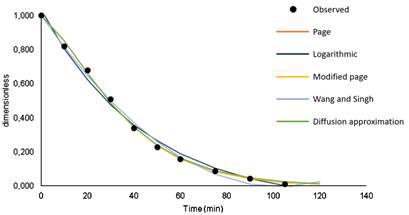
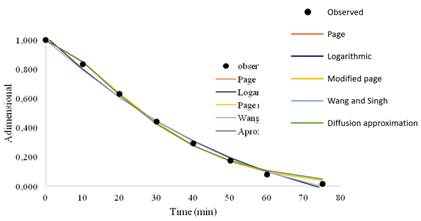
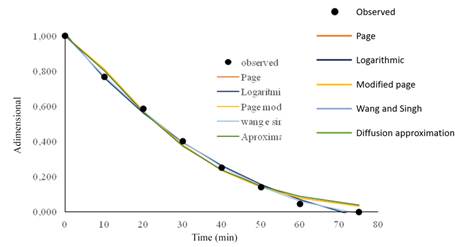
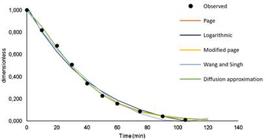
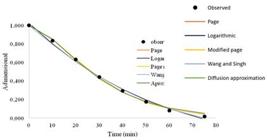
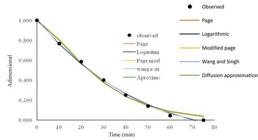
Residue generated in the food industry can be a source of raw material for the extraction of bioactive compounds, avoiding disposal and obtaining a product with higher added value. The study determined the drying conditions and extraction of volatile substances from mint residue. Start with the drying kinetics of mint residue at different temperatures, using the mathematical models of Page, Verna, Henderson, Wang and Singh, Two-term, Logarithmic, Lewis, Henderson and Pabis, modified Henderson and Pabis and modified-Page, to fit the experimental data and evaluated according to the coefficients of determination (R2) and root mean square deviation. The drying kinetics were performed in triplicate in a dehydrator with air circulation at an average speed of 0.5 m/s, at temperatures of 50 ºC, 60 ºC and 70 ºC, for determined times until constant mass. Nonlinear regression analysis using the Quasi Newton method was performed using the Statistica 8.0 program, where the values of the parameters of the mathematical models were estimated as a function of the drying air temperature. In all process conditions, the mathematical models tested for the experimental data presented satisfactory adjustments to the drying kinetics data. It was observed that increasing the drying air temperature reduced the drying time to reach thermodynamic equilibrium and the final water content of the product. The material extracted from the hydrodistillation did not present phase separation, resulting in an aromatic hydrolate with chemical components similar to those of the essential oil of mint leaves, with menthol standing out as the major component.
Key words:
mathematical modeling; Mentha ssp.; extraction of volatile compounds.
 Thumbnail
 Thumbnail
 Thumbnail