 Prediction models for mint residue drying kinetics and extraction of volatile compounds
ABSTRACT:
Residue generated in the food industry can be a source of raw material for the extraction of bioactive compounds, avoiding disposal and obtaining a product with higher added value. The study determined the drying conditions and extraction of volatile substances from mint residue. Start with the drying kinetics of mint residue at different temperatures, using the mathematical models of Page, Verna, Henderson, Wang and Singh, Two-term, Logarithmic, Lewis, Henderson and Pabis, modified Henderson and Pabis and modified-Page, to fit the experimental data and evaluated according to the coefficients of determination (R2) and root mean square deviation. The drying kinetics were performed in triplicate in a dehydrator with air circulation at an average speed of 0.5 m/s, at temperatures of 50 ºC, 60 ºC and 70 ºC, for determined times until constant mass. Nonlinear regression analysis using the Quasi Newton method was performed using the Statistica 8.0 program, where the values of the parameters of the mathematical models were estimated as a function of the drying air temperature. In all process conditions, the mathematical models tested for the experimental data presented satisfactory adjustments to the drying kinetics data. It was observed that increasing the drying air temperature reduced the drying time to reach thermodynamic equilibrium and the final water content of the product. The material extracted from the hydrodistillation did not present phase separation, resulting in an aromatic hydrolate with chemical components similar to those of the essential oil of mint leaves, with menthol standing out as the major component.
Key words:
mathematical modeling; Mentha ssp.; extraction of volatile compounds.
RESUMO:
Resíduos gerados na indústria alimentícia podem ser fonte de matéria-prima para extração de compostos bioativos, evitando descarte e obtendo um produto com maior valor agregado. O objetivo do estudo foi determinar as condições de secagem e extração de substâncias voláteis de resíduos de menta. A partir da cinética de secagem de resíduos de menta em diferentes temperaturas, utilizando os modelos matemáticos de Page, Verna, Henderson, Wang e Singh, Two-term, Logarithmic, Lewis, Henderson e Pabis, Henderson e Pabis modificado e Page modificado, para ajuste dos dados experimentais e avaliados segundo os coeficientes de determinação (R2) e desvio quadrático médio. As cinéticas de secagem foram realizadas em triplicata em desidratador com circulação de ar a uma velocidade média de 0,5 m/s, nas temperaturas de 50 ºC, 60 ºC e 70 ºC, por tempos determinados até massa constante. Foi realizada análise de regressão não linear pelo método Quasi Newton utilizando o programa Statistica 8.0, em que os valores dos parâmetros dos modelos matemáticos foram estimados em função da temperatura do ar de secagem. Em todas as condições de processo, os modelos matemáticos testados para os dados experimentais apresentaram ajustes satisfatórios aos dados de cinética de secagem. Observou-se que o aumento da temperatura do ar de secagem reduziu o tempo de secagem para atingir o equilíbrio termodinâmico e o teor final de água do produto. O material extraído da hidrodestilação não apresentou separação de fases, resultando em um hidrolato aromático com componentes químicos semelhantes aos do óleo essencial de folhas de hortelã, destacando-se o mentol como componente majoritário.
Palavras-chave:
modelagem matemática; Mentha ssp.; extração de compostos voláteis.
INTRODUCTION
The drying process is a method of removing excess water through evaporation, with simultaneous transfer of mass and heat between the air and the product, commonly resulting from the application of hot air (SUN et al., 2024). Drying products is the most widely used process to ensure the quality of some agricultural materials, considering that reducing the amount of water in the material reduces biological activity and the chemical and physical changes that occur during storage (JOHN et al., 2024). Removing part of the water from a product is important to prevent contamination by the proliferation of microorganisms and maintain the durability and quality of the product (SILVEIRA et al., 2013). Drying kinetics, also understood as the study of the rate of moisture loss during the drying process at which a given product loses water, is influenced by the intrinsic characteristics of the material, as well as by temperature, relative humidity, air speed and the geometry of the material to be dried (SILVA et al., 2015). Drying kinetics is often described by means of mathematical models that described the variation in the moisture content of the material over time. These models are important for predicting drying kinetics under different conditions and for optimizing the process (SIMANJUNTAK et al., 2024).
There are several mathematical models to describe drying kinetics. Choosing the most appropriate mathematical model to describe drying kinetics depends on the characteristics of the material and the operating conditions. Therefore, knowledge of drying kinetics is important for determining the ideal drying conditions and obtaining maximum efficiency and quality of the final product (REIS et al., 2015). Mint (Mentha spp.) is a herbaceous plant of the Lamiaceae family with numerous cultivated varieties. Originating from Asia, it is currently cultivated worldwide. The genus is characterized by being a medicinal and aromatic plant with antifungal, antiseptic, diuretic and analgesic properties, due to its bioactive compounds such as phenolic compounds, phytosterols and terpenes (NAZEM et al., 2019) traditionally used in folk medicine for the treatment of bronchitis, nausea, flatulence (MAHBOUBI, 2021).
In addition, it is used as a flavoring agent in food, beverages, confectionery, perfumery, oral hygiene and medicines (FERREIRA et al., 2020), mint leaves are commonly inserted into fruit pulps such as pineapple juice, and are very well-received by consumers, which represents a considerable percentage of the frozen pulp market. During the processing of frozen pineapple pulp with mint, only the larger leaves are incorporated into the pulp; the stems and smaller leaves are residue from the process and are currently discarded. The use of this residue can generate raw materials with great industrial employability, such as essential oils, which have high commercial value and wide-ranging uses, in addition to saving resources, avoiding residue, reducing pollution and damage to the environment.
Essential oils can be used in foods to impart aroma, taste and color (AITBOULAHSEN et al., 2018), in addition to their antioxidant (BONILLA et al., 2018; FREITAS & CATTELAN, 2018) and antimicrobial (DABROWSKA et al., 2020; GONÇALVES et al., 2017) properties. However, because they are very unstable, it is necessary to preserve aromatic compounds to prevent or minimize changes caused by the presence of air, light or when exposed to high temperatures. Thus, ideal drying and handling conditions for natural products can help preserve bioactive compounds. Specifically in the case of obtaining volatile oils, it is necessary to establish the best drying conditions for the material and oil extraction to increase yield and preserve active substances (MATTANA et al., 2015; OLIVEIRA et al., 2017; SIMANJUNTAK et al., 2024).
To minimize the environmental impacts and production costs caused by the inadequate disposal of agro-industrial residue, it is of great interest to establish the best drying conditions so that essential oil can be obtained later, without major losses due to dehydration. Based on the above, the study adjusted mathematical models to the experimental data of drying mint residue at different temperatures for subsequent extraction of the essential oil.
MATERIALS AND METHODS
The study was developed in the laboratory of the Study Group on Agroindustrial Products and Processes of the Cerrado (LabGEPPAC), at the Universidade Federal da Grande Dourados (UFGD). Mint residue (stems and small leaves) from the processing of frozen pineapple/mint pulp was donated by the company Polpa Real, from the city of Itaporã, Mato Grosso do Sul, Brazil. The material was kept at a frozen temperature of -20 ºC until drying.
Drying
The material was dried in a conventional fixed bed dryer using forced air convection. The residue was cut (stems with leaves) and placed in a thin layer on stainless steel mesh trays (8 mesh) with a rectangular area of 49 cm2. The drying kinetics were determined at temperatures of 50, 60 and 70 ºC, with the hot air velocity being kept constant at 0.5 m/s. The relative humidity of the environment was determined in each test.
The mass loss of the samples was performed in triplicate, weighing at 10 min intervals during the first hour of drying and every 15 min during the remainder of the process, until reaching dynamic equilibrium with the drying air (constant weight). The dry mass was then determined in an oven at 105 ± 3 ºC for a period until constant mass was achieved, according to the methodology AOAC (2003). Using the experimental data, the moisture ratio (RU) of the samples was calculated according to equation 1.
(1)
Where, RU is the moisture ratio of the sample (dimensionless), Ui, U and Ue are the water contents of the initial sample, at a given drying time and at equilibrium (gH2O.gss-1), respectively.
To describe the drying kinetics, the mathematical models of Page, Verna, Henderson, Wang and Singh, Two-term, Logarithmic, Lewis, Henderson and Pabis, Henderson and Pabis modified and Page modified (Table 1) were used, using non-linear regression analysis, by the Quasi-Newton method, with the computer program STATISTICA version 8.0.
The selection criteria for the best fit of the models to the experimental data were the coefficient of determination (R2) and the mean square deviation (MSD) calculated by equation 2 and equation 3.
(2)
Where: R2 - coefficient of determination (dimensionless).
(3)
Where: DQM - mean square deviation; RUPred - water ratio predicted by the model; RUexp - experimental water ratio; n - number of observations made during the experiment.
Essential oil extraction
To establish the ideal conditions for extracting essential oil from dry mint residues, a comparison was made between the extraction of essential oil from mint residues using two methods: distillation using the Clevenger apparatus and distillation using a large-scale essential oil extraction equipment.
Extraction using the clevenger apparatus
The essential oil and hydrosol were extracted from the dehydrated residue using the hydrodistillation method in a Clevenger apparatus. The previously crushed dry residue (80 g) was incorporated into a flask containing 1200 mL of distilled water, then coupled to the Clevenger extraction system, where the volatile substances were extracted, as described by VISCARDI (2017).
The extraction time was approximately 210 minutes. The hydrosol was collected together with the essential oil, the components were separated using a separatory funnel, and then transferred to Eppendorf bottles and stored under refrigeration.
Semi-industrial essential oil distiller
The extraction of volatile substances was performed using the hydrodistillation method in a semi-industrial essential oil distiller (model 2511, Tecnal, Brazil). The distiller was fed with dry material in different proportions of mass (mint byproduct) and volume of water, namely: A) 250 g: 11 L; B) 200 g: 8.5 L; and C) 150 g: 6.5 L, with the aim of evaluating the best process condition for obtaining essential oil. After the extraction time, the entire contents of the collecting glass were collected, in the same amount of material for each of the process conditions (A, B, and C). The extracted material was transferred to a separation flask in order to collect the hydrolate with the highest content of oil particles (upper part of the flask). The collected hydrolate was stored in Eppendorf tubes for later analysis.
Chromatographic analysis
The chromatographic profile of the obtained product was performed in the Chemistry Laboratory of the Universidade Estadual do Mato Grosso do Sul. The samples were prepared by partitioning 1 mL of the sample with 1 mL of hexane and after phase formation the hexane fraction was removed and analyzed. The analysis was performed using a gas chromatograph equipped with a mass spectrometer detector (GCMS-QP2010 Ultra, Shimadzu, Kyoto, Japan). A DB-5 column (30 m long, 0.25 mm inner diameter, 0.25 μm film thickness) was used, with helium (99.99% purity) as carrier gas, at a flow rate of 1.0 mL/min and an injection volume of 1 μL (in split mode, 1:10). The initial oven temperature was 50 ºC, with heating to 280 ºC at 3 ºC/min. The injector temperature was 220 ºC, and the transfer line and quadrupole detector temperatures were 280 ºC.
MS scanning parameters included an electron impact ionization voltage of 70 V, a mass range of 50 to 600 Daltons, and a scan interval of 0.3 s. The retention index was calculated using a mixture of linear alkanes (C7-C40) as an external reference. Compound identification was obtained by comparing the mass spectra of the samples with the spectra available in the Nist21 and Wiley229 libraries, as well as with data reported in the literature (ADAMS, 2001).
RESULTS AND DISCUSSION
Table 2 shows the parameters obtained for the mathematical models adjusted to the experimental data of the drying kinetics of mint residue at temperatures of 50, 60 and 70 ºC. The models with the best fit were selected based on the coefficient of determination (R2) close to one and the root mean square deviation (MSD) close to zero (MARTINS et al., 2014).
Adjustment parameters, coefficients of determination (R²) and root mean square deviations (MSD) of mathematical models adjusted to the drying data of mint residue at temperatures of 50, 60 and 70 ºC.
All models presented R2 values greater than 0.97 and MSD values less than 0.06. According to ARAUJO et al. (2017), R2 values greater than 0.98 indicated that the mathematical models satisfactorily represent the drying behavior. In view of this, the Page, Wang and Singh, Logarithmic, modified Page and diffusion models presented the best adjustments applied to the drying kinetics of mint residue with R2 greater than 0.99 and DQM less than 0.03, for drying carried out at temperatures of 50, 60 and 70 ºC.
According to MARTINS et al. (2015), the “k” parameter represents the effective diffusivity in the drying process and increases with the increase in temperature, as was observed in the present study. The “n” parameter of the modified Page and Page models is related to the internal resistance of the drying material (PEREZ et al., 2013) and no direct relationship with the increase in temperature was observed. SANTOS et al. (2017) - in the drying of pitaya peel (Hylocereus undatus), also did not observe any influence of temperature on the “n” parameter. The other parameters of the models also did not show a direct relationship with the increase in temperature. The models with the greatest convergence with the experimental data were the Page, modified Page, diffusion and Wang and Singh models. However, the Page and modified Page models presented the highest R² (0.998) for the drying kinetics at 50 and 60 ºC and R² of 0.994 for the kinetics at 70 ºC. The DQM values were lower (0.0086 to 0.0199), which indicated that these models are the ones that best represent the drying kinetics of mint residue under the conditions studied. Analysis of variance was applied using the Tukey test (>0.05), and was used for all models applied in this study.
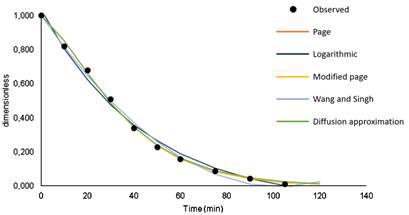
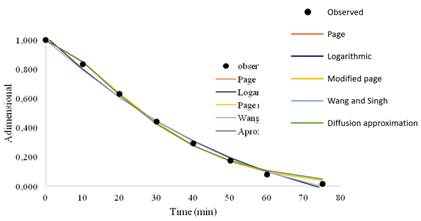
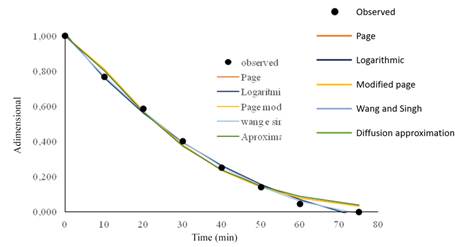
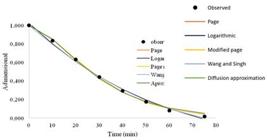
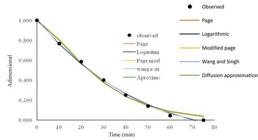
The drying curves (Figure 1, Figure 2 and Figure 3) showed that the drying rate increased with increasing air temperature, and water loss was greater at the beginning of the process, due to the water available or weakly bound to the material constituents, tending to stabilize after 60 minutes. MARTINS et al. (2014) reported that at the end of drying, the water is intrinsically bound to the sample, requiring more energy for its evaporation. Thus, the process occurs more slowly, resulting in lower drying rate values. Therefore, with the increase in temperature from 50 ºC to 60 ºC, there was a decrease in drying time. However, the kinetics at 70 ºC did not show a significant difference (P > 0.05) in drying time and final water content of drying performed at 60 ºC.
Drying curve at a temperature of 50 ºC for mint residues and adjustment of mathematical models.
It was observed that there was no separation of phases (oily and aqueous) during the condensation of the mint residue extract (small leaves and stems) in both methods. That is, visually the separation of the (Essential oil) EO from the condensed water was not observed, but the characteristic aroma of mint was perceived in the water carrying the steam. During the essential oil extraction process, the water that carries the volatile constituents becomes aromatized, which is called hydrolate (RAJESWARA R et al., 2016) and; although, it is considered an extraction effluent, it can have several applications, such as in the preparation of syrups and in cosmetology (TESKE & TRENTINI, 1997). According to FRANZENER (2007), the use of the hydrolate extracted from canela-de-veado, in low concentrations, demonstrated potential in antibacterial, antifungal and elicitor compounds (molecules that stimulate any defense response in plants) of phytoalexins.
The amount of condensed oil/water was removed after 210 min of extraction to check for the presence of essential oil particles, since there was no visible separation of the oil. According to GASPARIN et al. (2014), the extraction time for essential oil from mint leaves is 300 minutes, justifying the time of extraction and collection of condensed oil/water in the present study.
Among the various factors that can influence the amount of oil, special attention should be paid, since it is a residue, influences such as the way it is processed, in addition to the incorporation of different temperatures in obtaining it, are also associated with this influence. In addition, it is important to identify which part of the plant will be used for extraction, the type of extraction and the time of collection of the material. SILVA et al. (2021) classify the class of secondary metabolites and define conditions that relate the best time to harvest according to the physiologies of the plant.
The harvest time influences the concentration of bioactive substances found in the plant and the yield of essential oils, which are highest in the morning (REIS & MARIOT, 2000). In the morning, there is greater photosynthetic radiation, which directly influences the production of terpenes present in the plants (FERREIRA et al., 2020). Thus, the way in which the mint was treated during pre-harvest and post-harvest, as well as the way in which the residues were stored, may be factors that justify, in part, the insufficient quantity of essential oil extracted, with no visible phase separation between the EO and the hydrolate.
Table 3 presents the chemical composition and the main substances present in the condensed oil/water compound obtained from the dehydrated mint residue; as well as the commercial essential oil of Menta piperita reported by NILO (2015). The substances identified for the mint residue show that Menthol is the major component, followed by Menthone and Isomenthone. According to DEY & HARBORNE (1997), the menthol compound is responsible for the sensation of refreshing, being used in the cosmetics, cigarette, and lozenge industries and in the production of liqueurs and in medicines acting with curative, analgesic, and therapeutic action, which represents the greatest commercial value within the Mentha genus (TAVISH & HARRIS, 2002).
Chemical composition of the condensed oil/water compound obtained by hydrodistillation of the dehydrated mint residue.
In the condensed oil/water compound, substances that are part of the composition of mint essential oil were identified and, according to the literature (SUN et al., 2024), these substances have the potential to control the proliferation of microorganisms. The essential oil of M. piperita is formed by a high content of monoterpene compounds and a low presence of pulegone. The major compounds reported for the EO are: menthol (20 - 60%); followed by menthone (14 - 32%); and compounds with low levels of pulegone (<4%), menthofuran (1 - 9%) and menthyl acetate (2.8 - 10%) (BEHN et al., 2010).
Caryophyllene and Germacrene D were not reported in the composition of the commercial essential oil, but were identified in small amounts in the hydrolate. Caryophyllene is considered an anti-inflammatory (PEREIRA et al., 2022) and Germacrene D an antibacterial (SUN et al., 2024). This suggested biological activities that may contribute to the aggregation of value of mint residues, avoiding residue and disposal in the environment. Several studies with hydrolates from the extraction of essential oils have shown larvicidal and fungicidal activity (BONILLA et al., 2018; PEREZ et al., 2013). These studies informed that the product obtained from the hydrodistillation of mint residues has potential for microbiological control and possible application as a natural antifungal in the preservation of food and food products.
The importance of using this residue in the environmental impact is also highlighted, since it will no longer be discarded and will be reused. The properties obtained here showed that it is no longer necessary to treat this waste as waste but rather to intensify its technological use.
CONCLUSION
The Page, Wang and Singh, Logarithmic, Modified Page and Diffusion models presented the best statistical coefficients to describe the drying kinetics of mint residue at all temperatures studied and among the models tested. Therefore, any of these models efficiently represents the drying kinetics of mint residue.
The hydrodistillation of dry mint residues did not show the separation of the essential oil from the hydrolate. However, the chromatographic profile of the hydrolate showed substances similar to those of the essential oil of mint leaves, with a predominance of the chemical component menthol, with potential for use in food, cosmetics and therapeutic products, in addition to reducing environmental impacts.
ACKNOWLEDGMENTS
The authors thank for their financial support: 1. Fundação de Apoio ao Desenvolvimento do Ensino, Ciência e Tecnologia do Estado de Mato Grosso do Sul (FUNDECT); 2. Conselho Nacional de Desenvolvimento Científico e Tecnológico (CNPq).
REFERENCES
- ADAMS, R. Identification of essential oil components by gas chromatography/mass spectrometry. 4ºed. Allured Publishing Corporation, Illinois, 2001.
-
AITBOULAHSEN, M. et al. Gelatin-Based Edible Coating Combined with Mentha pulegium Essential Oil as Bioactive Packaging for StrawberrieS. Journal of Food Quality, v.25, p.1-7, 2018. Available from: <Available from: https://onlinelibrary.wiley.com/doi/10.1155/2018/8408915 >. Accessed: May, 05, 2025. doi: 10.1155/2018/8408915.
» https://doi.org/10.1155/2018/8408915.» https://onlinelibrary.wiley.com/doi/10.1155/2018/8408915 -
ARAUJO, W. D. et al. Mathematical modelling of thin-layer drying in peanut fruit Revista Ciência Agronômica, v.48, p.448-457, 2017. Available from: <Available from: https://www.scielo.br/j/rca/a/79SMDYrqZKTW7rYfYx5p5GN/ >. Accessed: Jan. 07, 2025. doi: 10.1590/1983-21252015V28N419RC.
» https://doi.org/10.1590/1983-21252015V28N419RC.» https://www.scielo.br/j/rca/a/79SMDYrqZKTW7rYfYx5p5GN/ -
BEHN, H. et al. Ultraviolet-B and photosynthetically active radiation interactively affect yield and pattern of monoterpenes in leaves of peppermint (Mentha x piperita L.). Journal of Agricultural and Food Chemistry, v.58, p.7361-7367, 2010. Available from: <Available from: https://pubs.acs.org/doi/10.1021/jf9046072 >. Accessed: Jan. 11, 2025. doi: 10.1021/jf9046072.
» https://doi.org/10.1021/jf9046072.» https://pubs.acs.org/doi/10.1021/jf9046072 - BONILLA, J. et al. Antioxidant potential of eugenol and ginger essential oils with gelatin/chitosan films. Food Bioscience, v.23, p.107-114, 2018.
-
DABROWSKA, J. A. et al. Biological, chemical, and aroma profiles of essential oil from waste celery seeds (Apium graveolens L.). Journal of Essential Oil Research, v.14, p.85-98, 2020. Available from: <Available from: https://www.tandfonline.com/doi/full/10.1080/10412905.2020.1754937 >. Accessed: Jan. 13, 2025. doi: 10.1016/j.fbio.2018.03.007.
» https://doi.org/10.1016/j.fbio.2018.03.007.» https://www.tandfonline.com/doi/full/10.1080/10412905.2020.1754937 - DEY, P. M.; HARBORNE, J. B. Plant biochemistry. San Diego: Academic Press, p.554, 1997.
-
FERREIRA, T. H. B. et al. Production and Physical, Chemical, Microbiological, and Sensory Characterization of Extra Fruit Jam. Journal of Culinary Science & Technology, v.20, p.453-462, 2021. Available from: <https://www.tandfonline.com/doi/abs/10.1080/15428052.2020.1862009?tab=permissions&scroll=top&role=tab>. Accessed: Jan. 07, 2025. doi: 10.1080/15428052.2020.1862009.
» https://www.tandfonline.com/doi/abs/10.1080/15428052.2020.1862009?tab=permissions&scroll=top&role=tab -
FERREIRA, T. H. B. et al. Elaboration of biscuits type cookies with pre-treated baru (Dipteryx alata Vog.) pulp flour. Food Measure, v.14, p.3156-3162, 2020. Available from: <Available from: https://link.springer.com/article/10.1007/s11694-020-00557-3 >. Accessed: Jan. 07, 2025. doi: 10.1007/s11694-020-00557-3.
» https://doi.org/10.1007/s11694-020-00557-3.» https://link.springer.com/article/10.1007/s11694-020-00557-3 -
FRANZENER, G. et al. Atividades antibacteriana, antifúngica e indutora de fitoalexinas de hidrolatos de plantas medicinais. Semina: Ciências Agrárias, v.28, p.29-38, 2007. Available from: <Available from: https://ojs.uel.br/revistas/uel/index.php/semagrarias/article/view/2545 >. Accessed: Jan. 07, 2025. doi: 10.5433/1679-0359.2007v28n1p29.
» https://doi.org/10.5433/1679-0359.2007v28n1p29.» https://ojs.uel.br/revistas/uel/index.php/semagrarias/article/view/2545 -
FREITAS, I. R.; CATTELAN, M. G. Antimicrobial and antioxidante properties of essential oils in food systems, an overview. Microbial Contamination and Food Degradation, v.13, p.443-470, 2018. Available from: <Available from: https://www.sciencedirect.com/science/article/abs/pii/B9780128115152000159?via%3Dihub >. Accessed: Jan. 07, 2025. doi: 10.1016/B978-0-12-811515-2.00015-9.
» https://doi.org/10.1016/B978-0-12-811515-2.00015-9.» https://www.sciencedirect.com/science/article/abs/pii/B9780128115152000159?via%3Dihub -
GASPARIN, P. P. et al. Qualidade de folhas e rendimento de óleo essencial em hortelã pimenta (Mentha x Piperita L.) submetida ao processo de secagem em secador de leito fixo. Revista Brasileira de Plantas Medicinais, v.16, p.337-344, 2014. Available from: <Available from: https://www.scielo.br/j/rbpm/a/XfXShs34VjMBqdLrMqW33dM/?lang=pt >. Accessed: Jan. 07, 2025. doi: 10.1590/1983-084X/12_003.
» https://doi.org/10.1590/1983-084X/12_003.» https://www.scielo.br/j/rbpm/a/XfXShs34VjMBqdLrMqW33dM/?lang=pt -
GONÇALVES, N. D. et al. Encapsulated thyme (Thymus vulgaris) essential oil used as a natural preservative in bakery product. Food Research International, v.96, p.154-60, 2017. Available from: <Available from: https://www.sciencedirect.com/science/article/pii/S0963996917300947?via%3Dihub >. Accessed: Jan. 07, 2025. doi: 10.1016/j.foodres.2017.03.006.
» https://doi.org/10.1016/j.foodres.2017.03.006.» https://www.sciencedirect.com/science/article/pii/S0963996917300947?via%3Dihub -
JOHN, N. et al. Physical Conversion of Biomass: Dewatering, Drying, Size Reduction, Densification, and Separation. In: THOMAS, S. et al. (eds) Handbook of Biomass. Springer, Singapore, 2024. Available from: <Available from: https://link.springer.com/rwe/10.1007/978-981-19-6772-6_37-1 >. Accessed Jan. 07, 2025. doi: 10.1007/978-981-99-6727-837.
» https://doi.org/10.1007/978-981-99-6727-837.» https://link.springer.com/rwe/10.1007/978-981-19-6772-6_37-1 -
MARTINS, E. A. S. et al. Cinética de secagem de folhas de timbó (Serjania marginata Casar). Revista Brasileira de Engenharia Agrícola e Ambiental, v.19, p.238-244, 2015. Available from: <Available from: https://www.scielo.br/j/rbeaa/a/mqhJF3dm5S9JLL93yvwq9VG/?lang=pt >. Accessed: Jan. 07, 2025. doi: 10.1590/1807-1929/agriambi.v19n3p238-244.
» https://doi.org/10.1590/1807-1929/agriambi.v19n3p238-244.» https://www.scielo.br/j/rbeaa/a/mqhJF3dm5S9JLL93yvwq9VG/?lang=pt -
MARTINS, J. J. A. et al. Modelagem matemática da secagem de cascas de mulungu. Bioscience Journal, v.30, p.1652-1660, 2014. Available from: <Available from: https://seer.ufu.br/index.php/biosciencejournal/article/download/21956/15602/112060 >. Accessed: Jan. 07, 2025.
» https://seer.ufu.br/index.php/biosciencejournal/article/download/21956/15602/112060 -
MATTANA, R. S. et al. Efeitos de diferentes tempos de extração no teor e composição química do óleo essencial de folhas de pariparoba (Pothomorphe umbellata (L.) Miq). Revista Brasileira de Plantas Medicinais, v.17, p.150-156,2015. Available from: <Available from: https://www.scielo.br/j/rbpm/a/FWV8Td787tpvQbqyVVCtFds/?lang=pt >. Accessed: Jan. 07, 2025. doi: 10.1590/1983-084X/09_119.
» https://doi.org/10.1590/1983-084X/09_119.» https://www.scielo.br/j/rbpm/a/FWV8Td787tpvQbqyVVCtFds/?lang=pt - MAHBOUBI, M. Óleo essencial de Mentha spicata L., fitoquímica e sua eficácia na flatulência. Revista de medicina tradicional e complementar, v.11, p.75-81, 2021.
-
NAZEM, V. et al. Essential oil yield and composition and secondary metabolites in self- and open-pollinated populations of mint (Mentha spp.). Industrial Crops and Products, v.130, p.332-340, 2019. Available from: <Available from: https://www.sciencedirect.com/science/article/pii/S0926669018310707?via%3Dihub >. Accessed: Jan. 07, 2025. doi: 10.1016/j.indcrop.2018.12.018.
» https://doi.org/10.1016/j.indcrop.2018.12.018.» https://www.sciencedirect.com/science/article/pii/S0926669018310707?via%3Dihub - NILO, M. C. S. S. Composição química e atividade antioxidante da hortelã pimenta (Mentha piperita). Dissertação de mestrado, Universidade Federal do Estado do Rio de Janeiro, 2015.
-
OLIVEIRA, J. D. et al. Chemical composition of essential oil extracted from leaves of Campomanesia adamantium subjected to different hydrodistillation times. Ciência Rural, v.47, e20151131, 2017. Available from: <Available from: https://www.scielo.br/j/cr/a/XWNTv7dYJ5mJDqck7QXsTzS/?lang=en >. Accessed: Jan. 07, 2025. doi: 10.1590/0103-8478cr20151131.
» https://doi.org/10.1590/0103-8478cr20151131.» https://www.scielo.br/j/cr/a/XWNTv7dYJ5mJDqck7QXsTzS/?lang=en - PAGE, G. E. Factors Influencing the Maximum Rate of Air-Drying Shelled Corn in Thin Layers. M.S. Thesis, Purdue University, West Lafayette, 1949.
- PEREIRA, A. M. B. et al. Estudo da atividade anticariogênica de óleos essenciais brasileiros para utilização em dentifrício. Ensaios USF, v.4, p.2-11,2022.
-
PEREZ, L. G. et al. Cinética de secagem da polpa cupuaçu (Theobroma grandiflorum) pré desidratada por imersãoimpregnação. Revista Ciência Agronômica, v.44, p.1-14, 2013. Available from: <Available from: https://www.scielo.br/j/rca/a/4W4FdtXHVddrs9Wy4wVkBxz/?lang=pt >. Accessed: Jan. 07, 2025. doi: 10.1590/S1806-66902013000100013.
» https://doi.org/10.1590/S1806-66902013000100013.» https://www.scielo.br/j/rca/a/4W4FdtXHVddrs9Wy4wVkBxz/?lang=pt -
RAJESWARA R. B. R. et al. Chemical-profile variations in essential oils isolated from lemongrass (Cymbopogon flexuosus) biomass and condensate wastewater by redistillation and solvent extraction techniques. Journal of Essential Oil Research, v.28, p.557-564, 2016. Available from: <Available from: https://www.tandfonline.com/doi/full/10.1080/10412905.2016.1167130 >. Accessed: Jan. 07, 2025. doi: 10.1080/10412905.2016.1167130.
» https://doi.org/10.1080/10412905.2016.1167130.» https://www.tandfonline.com/doi/full/10.1080/10412905.2016.1167130 - REIS, D. R. et al. Influence of air characteristics on drying kinetics of beak pepper. Brazilian Journal of Food Technology, v.18, p.146-154, 2015.
- REIS, M. S.; MARIOT, A. Diversidade natural e aspectos agronômicos de plantas medicinais. In: SIMÕES, C. M. O. Farmacognosia da planta ao medicamento. 2° ed. Porto Alegre/ Florianópolis: UFRGS/ Ed. da UFSC. p.39-60, 2000.
-
SANTOS, F. S. et al. Drying kinetics and physical and chemical characterization of white-fleshed ‘pitaya’ peels. Revista Brasileira de Engenharia Agrícola e Ambiental, v.21, p.872-877, 2017. Available from: <Available from: https://www.scielo.br/j/rbeaa/a/qqNCDF5WxHqDsDRcPsTvZNw/?lang=en >. Accessed: Jan. 07, 2025. doi: 10.1590/1807-1929/agriambi.v21n12p872-877.
» https://doi.org/10.1590/1807-1929/agriambi.v21n12p872-877.» https://www.scielo.br/j/rbeaa/a/qqNCDF5WxHqDsDRcPsTvZNw/?lang=en - SILVA, E. S. et al. Secagem de grãos e frutas: revisão bibliográfica. Revista Brasileira de Agrotecnologia, v.5, p.19-23, 2015.
- SILVA, R. B. et al. Estudo da cinética de secagem de polpa de carambola. Revista Brasileira de Tecnologia Agroindustrial, v.10, p.2069- 2080, 2016.
-
SILVA, S. R. et al. Nutritional potential and effect of the solvent on the extraction of secondary metabolites from pulp and bark of baru (Dipteryx alata). Journal of Food Measurement and Characterization, v.19, p.329-341, 2021. Available from: <Available from: https://link.springer.com/article/10.1007/s11694-021-00926-6 >. Accessed: Jan. 07, 2025. doi: 10.1007/s11694-021-00926-6.
» https://doi.org/10.1007/s11694-021-00926-6.» https://link.springer.com/article/10.1007/s11694-021-00926-6 - SILVEIRA, A. C. P. et al. Secagem por spray: Uma revisão. Revista do Instituto de Laticínios Cândido Toste, v.68, p.51-58, 2013.
-
SIMANJUNTAK, M. E. et al. Kinetic analysis and mathematical modeling of low-rank coal drying by using swirl fluidized bed dryer on varied angles of guide vane and temperatures. Energy Sources Part A: Recovery, Utilization, and Environmental Effects, p.3263-77, 2024. Available from: <Available from: https://www.tandfonline.com/doi/full/10.1080/15567036.2024.2317435 >. Accessed: Jan. 07, 2025. doi: 10.1080/15567036.2024.2317435.
» https://doi.org/10.1080/15567036.2024.2317435.» https://www.tandfonline.com/doi/full/10.1080/15567036.2024.2317435 -
SUN, Z. et al. Enhanced water removal from low-rank coal via flash evaporation: Insights into dewatering performance, upgrading effects, and energy analysis. Energy Sources, Part A: Recovery, Utilization, and Environmental Effects, v.46, p.12829-12842, 2024. Available from: <Available from: https://www.tandfonline.com/doi/full/10.1080/15567036.2024.2400304 >. Accessed: Jan. 07, 2025. doi: 10.1080/15567036.2024.2400304.
» https://doi.org/10.1080/15567036.2024.2400304.» https://www.tandfonline.com/doi/full/10.1080/15567036.2024.2400304 - TESKE, M.; TRENTINI, A. M. M. Herbarium - compêndio de fitoterapia. Curitiba: Herbarium Laboratório Botânico, 1997.
- VERNA, L. R. et al. Effects of drying air parameters on rice drying models. Transactions of the ASAE, v.28, p.296-301, 1985