 Inorganic element concentrations in honeys from different floral sources in Rio de Janeiro State (Southeast Brazil)
ABSTRACT:
The presence of inorganic elements in foods has been increasingly discussed in recent years due to their potential impacts on human health. Among foods widely consumed across all age groups, honey is recognized as a natural product derived from Apis mellifera bees, with a chemical composition that varies according to the botanical and/or geographical origin of the nectar source. Current Brazilian legislation, specifically Normative Instruction No. 160, as amended by Normative Instruction No. 351 of ANVISA (Brazilian Health Regulatory Agency), establishes maximum tolerated limits (MTLs) for inorganic contaminants in honey. This study assessed the concentrations of Ag, As, Ba, Ca, Cd, Cr, Cu, Li, Mg, Mn, Na, Ni, Pb, Se, Sr, and V in honey samples produced and marketed in Rio de Janeiro state (RJ), Brazil. A total of 58 samples from 16 municipalities were analyzed and categorized according to floral origin. The samples were prepared by microwave-assisted digestion, and inorganic constituents were quantified using inductively coupled plasma (ICP)-based techniques. Statistical analysis of the results was conducted using principal component analysis (PCA) to investigate interrelationships among elemental concentrations (variables) and sample clustering. The PCA results revealed differences in the concentration profiles of the inorganic elements among floral types. Furthermore, arsenic (AS) and lead (Pb) concentrations in some samples exceeded the limits established by Brazilian regulations. These findings highlighted the importance of monitoring honey contamination to prevent potential risks to public health.
Key words:
contaminants; inorganic elements; spectrometry; PCA
RESUMO:
A presença de elementos inorgânicos em alimentos vem sendo discutido nos últimos anos devido aos efeitos para a saúde humana. Um dos alimentos amplamente consumido em todas as faixas etárias é o mel. O mel é um produto oriundo das abelhas melíferas e tem em sua composição diferentes elementos químicos, conforme a sua flora e/ou local de origem da florada. Atualmente, a Instrução Normativa nº 160, alterada pela Instrução Normativa n° 351, da ANVISA determina o limite máximo tolerado (LMT) de contaminantes inorgânicos em méis. Sendo assim, o objetivo deste estudo foi avaliar a concentração de Ag, As, Ba, Ca, Cd, Cr, Cu, Li, Mg, Mn, Na, Ni, Pb, Se, Sr e V em amostras de méis produzidos e comercializados no Estado do Rio de Janeiro. Neste estudo, 58 amostras de méis provenientes de 16 municípios foram avaliadas e foram divididas quanto ao tipo de florada. As amostras foram preparadas com auxílio de micro-ondas e a quantificação dos constituintes inorgânicos foi realizada usando técnicas baseadas em plasma indutivamente acoplado (ICP). Em seguida, na avaliação estatística dos resultados, utilizou-se a análise de componente principal (PCA), para verificar as inter-relações entre as concentrações dos elementos químicos (variáveis) e a aglomeração das amostras. Posteriormente, a PCA indicou diferença entre a concentração dos elementos químicos e o tipo de florada. Além disso, ao final das análises, foi observado que os níveis de As e Pb ficaram acima do limite estabelecido pela legislação brasileira para algumas amostras. Desta forma, é importante monitorar a contaminação dos méis, para que não represente risco a saúde da população.
Palavras-chave:
contaminantes; elementos inorgânicos; espectrometria; PCA.
INTRODUCTION
Normative Instruction No. 11 of October 20, 2000, defines honey as a food product produced by Apis mellifera bees (BRASIL, 2000). Honey may originate from different raw materials, including exudates secreted by insects with suctorial mouthparts, such as certain bee species; flower nectar; or secretions exuded by living plant tissues. These substances are collected by bees and enzymatically transformed through the addition of their own biological compounds, then stored in honeycombs, where maturation occurs (PAVLIN, 2023; BRASIL, 2000).
The regulation further specifies that floral honey is produced from flower nectars and can originate from a single botanical family, genus, or species, in which case it is referred to as unifloral or monofloral honey. When derived from multiple plant species, it is termed multifloral or polyfloral honey. Another category described is honeydew honey, produced from living secretions or excretions of plant-sucking insects found on living plant parts (BRASIL, 2000). These honeys may vary in chemical composition and color, depending on the floral source and geographical location of the hives (BANDINI & SPISSO, 2017).
Although, the mineral content of honey is relatively low, ranging from approximately 0.1-0.2% in floral honeys to 1% or more in honeydew honeys, its mineral characterization has attracted increasing scientific attention due to its importance in determining botanical and geographical origin, as well as its nutritional and functional properties. Among the minerals, potassium (K) typically predominates, followed by smaller amounts of sodium (Na), phosphorus (P), magnesium (Mg), manganese (Mn), iron (Fe), copper (Cu), silicon (Si), and various trace elements (LOUPPIS, 2019).
Honey is widely consumed and incorporated into a variety of food products (BANDINI & SPISSO, 2017) for both its nutritional and therapeutic properties, which are recognized by the Food and Agriculture Organization of the United Nations (FAO). Some of these properties are related to the presence of vitamins and minerals such as calcium (Ca), copper (Cu), Fe, Mg, and zinc (Zn), albeit at relatively low concentrations. These minerals represent less than 5% of the recommended daily intake, yet their bioavailability in honey may contribute to important physiological effects (BANDINI & SPISSO, 2017).
In addition to its beneficial components, honey may contain substances with potential toxic effects on human health, such as arsenic (As), which is classified as a carcinogenic element (BANDINI & SPISSO, 2017). It is therefore essential to implement effective monitoring and control programs for contaminants, establishing which substances should be prioritized for surveillance. Health surveillance authorities play a crucial role in controlling contaminants in honey, particularly inorganic constituents that may pose health risks, including potentially toxic elements (PTEs) such as As, Cd, Hg, and Pb, among others (BANDINI & SPISSO, 2017).
In this context, the Brazilian Health Regulatory Agency (ANVISA), through Normative Instruction No. 160 of July 1, 2022, as amended by Normative Instruction No. 351 of March 18, 2025, establishes maximum tolerated limits (MTLs) for inorganic contaminants in foods, including As (0.10 mg kg-1), cadmium (Ca, 0.10 mg kg-1), and lead (Pb, 0.30 mg kg-1), with the aim of ensuring the safety and quality of honey consumed by the population. By comparison, the Codex Alimentarius defines an MTL only for Pb (0.1 mg kg-1), as stated in the Codex Alimentarius - General Standard for Contaminants and Toxins in Food and Feed (adopted in 1995, revised in 2023) (CODEX ALIMENTARIUS, 2023).
In Brazil, the per capita consumption of honey is 60 g per year, lower than the global average of 240 g per year. However, the country ranks 11th worldwide in honey production and has considerable potential for expansion. Given this scenario, monitoring the concentrations of essential and contaminant elements in honey is fundamental to ensuring its quality and safety.
Inductively coupled plasma (ICO)-based techniques, such as optical emission spectrometry (ICP OES) and mass spectrometry (ICP-MS), are widely used for multielemental determination (BRESSY, 2013; BALDASSINI, 2012). These methods enable the detection of numerous chemical elements at trace and ultratrace levels, offering high sensitivity, specificity, and selectivity. As such, they are powerful analytical tools for evaluating essential and toxic inorganic elements in natural or processed foods, contributing to quality control and adulteration detection. The literature underscores their importance for food safety monitoring and health surveillance (BRESSY, 2013; BALDASSINI, 2012).
Given the large datasets generated in these studies, principal component analysis (PCA) is an unsupervised multivariate statistical method frequently applied in food analysis to reduce data dimensionality and identify relevant patterns. In honey research, PCA has proven effective for differentiating samples based on physicochemical and antioxidant properties. For instance, SODRÉ et al. (2007) analyzed 121 Apis mellifera honey samples from São Paulo state using 22 physicochemical parameters, including Ca, Cu, Fe, K, Mg, Mn, Na, P, sulfur (S), and Zn. Six principal components explained 70.11% of the total data variance, indicating substantial variability among samples. These findings reinforce the relevance of PCA for ensuring honey authenticity and quality, since it enables the identification of patterns associated with botanical origin and mineral composition (SODRÉ, 2007).
Accordingly, the present study determined the concentrations of inorganic constituents (both essential elements and contaminants) in honey samples. To that end, analyses were performed using ICP-OES and ICP-MS techniques to quantify silver (Ag), As, barium (Ba), Ca, Cd, chromium (Cr), Cu, lithium (Li), Mg, Mn, Na, nickel (Ni), Pb, selenium (Se), strontium (Sr),and vanadium (V), with the goal of ensuring the quality and safety of honeys produced in different municipalities of Rio de Janeiro State, Southeast Brazil.
MATERIALS AND METHODS
Sample collection
Honey samples were obtained over a two-year period from different municipalities in Rio de Janeiro state, primarily located in the Serrana, Metropolitana, Sul Fluminense, and Costa Verde regions.
The municipalities of Teresópolis, Nova Friburgo, Petrópolis, Cachoeiras de Macacu, Trajano de Moraes, and Paty do Alferes belong to the Serrana region, characterized by mountainous relief, mild climate, and significant agricultural and beekeeping activity. Casimiro de Abreu, Rio Bonito, and Saquarema are part of the Metropolitan and Coastal Lowland regions, featuring a tropical climate and transitional vegetation between the Atlantic Forest (Mata Atlântica) and restinga ecosystems. Barra Mansa, Volta Redonda, Paracambi, Barra do Piraí, Engenheiro Paulo de Frontin, and Valença are in the Sul Fluminense region, known for its river valleys, and Atlantic Forest fragments. Finally, Angra dos Reis, located in the Costa Verde region, is distinguished by its ecological diversity and extensive forest cover.
The selection of these sites encompassed a wide range of altitudes, microclimates, and edaphoclimatic characteristics, which are essential for analyzing products of botanical and apicultural origin. In total, samples were collected from 26 registered apiaries and honey-processing units, under both state and federal inspection systems, resulting in 58 samples analyzed.
With respect to floral origin, the honeys were derived from various nectar sources, includingassa-peixe (Vernonia polyanthes), orange blossom, morrão de candeia (Eeremanthus incanus), wildflower, copaiba (Copaifera sp.), eucalyptus, multifloral, cipó-uva (Serjania lethalis), orange tree, and lantana. In this study, honeys labeled as ‘orange blossom’ and ‘orange tree’ were treated as distinct categories, as indicated on the producers’ packaging; although, both likely correspond to nectar from Citrus sinensis. Sampling from the honeycombs was carried out at different times of the year according to Apis mellifera production cycles. The floral designation of each sample was provided by the producers and appeared on the labeled containers (glass jars, plastic pots, or squeezable bottles) of all honeys obtained directly from the 26 apiaries or honey-processing facilities.
Samples were grouped by floral type and coded numerically, with their relative frequencies presented as percentages, as follows: (1) - orange blossom (3%), (2) - assa-peixe (10%), (3) - wildflower (53%), (4) - eucalyptus (14%), (5) - multifloral (2%), (6) - morrão de candeia (2%), (7) - copaíba (2%), (8) - cipó-uva (3%), (9) - lantana (2%), and (10) - orange tree (9%).
Quantification of Ag, As, Ba, Ca, Cd, Cr, Cu, Li, Mg, Mn, Na, Ni, Pb, Se, Sr, and V was carried out at the Inorganic Elements Sector of the Department of Chemistry (SELIN/DQ), National Institute for Quality Control in Health (INCQS), Oswaldo Cruz Foundation (FIOCRUZ) (SANTOS, 2022).
Sample preparation
Samples were homogenized by circular agitation. Approximately 0.5 g of each sample was weighed into TFM® flasks, transferred to Teflon digestion tubes, and mixed with 3 mL of nitric acid and 2 mL of hydrogen peroxide. The mixtures were digested in a closed-vessel microwave digestion system (Speed Wave, Berghof, Germany). After cooling, the digests were transferred to 15 mL Falcon tubes, diluted to volume with deionized water, and spiked with 10 µg L-1 of rhodium (Rh) as an internal standard.
Reagents and standards
A multielement standard solution (10 mg L-1) containing Ag, As, Ba, Ca, Cd, Cr, Cu, Li, Mg, Mn, Na, Ni, Pb, Se, Sr, and V (Perkin Elmier, USA) was used to prepare external calibration curves with working ranges of 0.25-2.0 mg L-1 and 0.5-15 μg L-1 for ICP-MS and ICP-OES analyses, respectively.
Instrumentation
Concentrations of Ca, Mg, and Na were determined using an Optima 8300 inductively coupled plasma optical emission spectrometer (ICP-OES, Perkin Elmer, USA), equipped with a GemConeTM nebulizer and a cyclonic spray chamber. Table 1 describes the operational parameters used to determine Ca, Na, and Mg.
The elements Ag, As, Ba, Cd, Cr, Cu, Li, Mn, Ni, Pb, Se, Sr, and V were analyzed using inductively coupled plasma mass spectrometry (ICP-MS) (NexION 300D, Perkin Elmer, USA). The ICP-MS operational conditions are shown in table 2. Daily instrument performance checks were performed using a 1 µg L-1 standard solution containing Be, Ce, Fe, Li, Mg, Na, and Pb, and the results were compared to the manufacturer’s specifications (Table 2). Argon gas (99.996% purity; White Martins, São Paulo, Brazil) was used as plasma, auxiliary, and nebulizer gas in both ICP techniques.
Quality control
The precision and accuracy of the analytical methods were assessed through spike-and-recovery tests. Known quantities of each analyte were added to the samples at different concentration levels, depending on the element under study. The spiking and recovery criteria followed INMETRO guidelines, with acceptable recovery values ranging from 80 to 120%. Precision was expressed as relative standard deviation (RSD), with acceptable values below 15% (INMETRO, 2020).
Data analysis
Descriptive statistics were performed using Microsoft Excel 2010, including arithmetic mean, median, standard deviation (SD), the Student’s t-test, and analysis of variance (ANOVA).
Principal component analysis (PCA) was applied to assess the clustering and similarity among honey samples. A data matrix was constructed, in which the concentrations of chemical elements were arranged as columns (variables) and the honey samples as rows, resulting in a 16 × 58 matrix. The data were auto-scaled prior to multivariate analysis to ensure equal weighting of all variables (OTTO, 2017; OLIVEIRA, 2019). All statistical analyses were performed using Statistica® software, version 6.0 (StatSft, Tulsa, USA).
RESULTS AND DISCUSSION
The analytical performance of the method was evaluated for each sample batch through spiking and recovery tests. The limits of quantification (LOQ), relative standard deviations (RSD), and precision are presented in table 3.
The LOQs were determined experimentally and defined as the lowest point of the external calibration curve. For Ca, Mg, and Na, the LOQ was 250 μg L-1 (7.5 mg kg-1), and 0.5 μg L-1 (15 µg kg-1) for Ag, As, Ba, Cd, Cr, Cu, Li, Mn, Ni, Pb, Se, Sr, and V. The RSD values were all below 15%, and the spiking and recovery results ranged from 82 to 118%, complying with INMETRO standards and demonstrating satisfactory precision and accuracy for the analytical method.
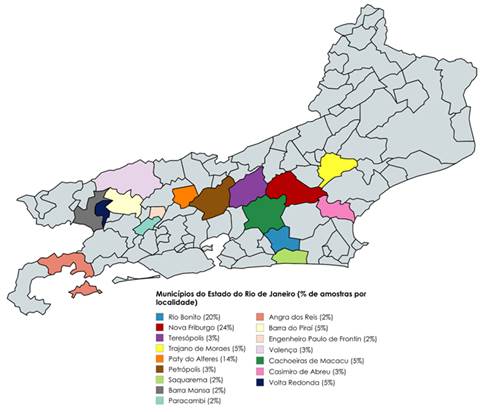
In this study, 58 honey samples originating from different municipalities in Rio de Janeiro State, Southeast Brazil, were analyzed, with the number of samples per location shown in figure 1.
Map of Rio de Janeiro state highlighting the municipalities where honey samples were collected, with a percentage representation of the number of samples per location. Source: Prepared by the authors based on research data.
All analyzed samples contained Cd concentrations below the MTL established by Brazilian legislation. However, two samples exceeded the MTL for As: one for wildflower honey (0.12 mg kg-1) from Paty do Alferes and one for orange blossom honey (0.58 mg kg-1) from Nova Friburgo, both located in the Serrana region, which has a history of intensive agricultural and apicultural activity. Additionally, a wildflower honey sample from Nova Friburgo exhibited a Pb concentration of 0.31 mg kg-1, also exceeding the MTL (BRASIL, 2021; ALVES, 2020). The minimum and maximum concentrations of all quantified inorganic elements in this study are reported in table 4.
The values obtained differ from those reported by ALVES (2020), who determined As, Cd, and Pb concentrations in national honey samples using ICP-MS and found inorganic contaminants below the MTL. Similar results were obtained in a study conducted in Slovenia by PAVLIN et al. (2023), which analyzed 173 honey samples by ICP-MS, with As, Cd, and Pb concentrations below the limits established by the European Commission (1 mg kg-1 for Pb and 0.1 mg kg-1 for Cd). However, studies by LEAL (2022) and LOUPPIS (2019) reported Pb concentrations exceeding national MTLs, consistent with the present findings.
Comparison of the available literature indicated substantial variation in elemental concentrations, likely due to the diverse floral sources and geographical origins of the samples (PAVLIN, 2023). These differences underscore the importance of investigating potential environmental contamination, which may arise from honey production practices such as the use of smokers and agrochemicals, or other industrial processes that can affect honey quality. Consequently, honey can be used as a geographical bioindicator of contamination (ANDRADE, 2014; OLIVEIRA, 2017; LEAL, 2022).
Several studies have reported that human exposure to Pb can cause serious health effects, particularly in vulnerable populations such as children (GARZA, 2006; BARATA-SILVA, 2024; ATSDR, 2020). These effects include neurological and hematological damage, impaired bone and dental integrity, and reduced intellectual performance (GARZA, 2006; BARATA-SILVA, 2024; ATSDR, 2021).
In addition to Pb, foods may contain varying concentrations of As and Cd. According to the literature, arsenic can cause adverse health effects in cases of intoxication, such as reduced production of red and white blood cells (ATSDR, 2020; DESESSO, 2001). Cadmium is a potentially toxic element, even at trace levels, and currently there is no evidence of any biological benefit to living organisms (LOYOLA, 2012; BARATA-SILVA, 2024).
The As concentration reported in this study corresponded to total arsenic, encompassing both organic and inorganic chemical species (As III or V), since no chemical separation was performed (SANTOS, 2021). Consequently, it is not possible to determine whether the detected concentration is attributable to inorganic or organic As, highlighting the need for further studies to precisely assess the consumer exposure risk associated with this type of food.
Among the honey samples analyzed (n = 58), only 3% and 2% exceeded the MTL for As and Pb, respectively. These findings suggested that these trace elements likely originate from environmental contamination at the floral source, since bees collect pollen from the surrounding plants. Accordingly, honey is increasingly recognized in the literature as a geographic bioindicator (PAVLIN, 2023; LEAL, 2022).
Mineral analysis revealed the presence of macro- and microminerals at concentrations consistent with those reported in the literature for honeys of diverse botanical and geographical origin. Among the essential elements detected, Ca (95 mg kg-1), Mh (53 mg kg-1), Na (68 mg kg-1), and Mn (8 mg kg-1) were predominant, representing metabolically and physiologically important nutrients for both Apis mellifera and human consumption.
Cu (0.30 mg kg-1), Cr (0.70 mg kg-1), and Ni (0.10 mg kg-1) concentrations were within expected ranges, consistent with PAVLIN et al. (2023), who demonstrated the relevance of mineral profiles for honey authentication using chemometric approaches. Similarly, TlakGAJGER et al. (2024) observed significant regional variation in Croatian honeys, with K, Na, and Mg as the main elements, corroborating the prevalence of these minerals in the present study.
Moreover, LOUPPIS et al. (2019) highlighted the utility of multielemental analysis via ICP-OES for botanical origin differentiation, emphasizing the influence of edaphoclimatic conditions on trace minerals such as Se (0.03 mg kg-1), vanadium (V, 0.04 mg kg-1), and Li (0.01 mg kg-1).
Considering an estimated daily honey consumption of 25 g, the average elemental concentrations in the samples analyzed were below the recommended daily intake for adults (> 19 years) as defined by RDC No. 269, of September 22, 2005, indicating that the minerals detected do not pose health risk. However, in vulnerable populations, such as children and older adults, these reference values are lower due to physiological and metabolic differences (BRASIL, 2005).
In this study, Ca, Cu, Mg, and Na concentrations were within FAO-recommended ranges (BANDINI & SPISSO, 2017). Similar findings were reported by GAJGER et al. (2024) in an analysis of 36 honeys from three regions of Croatia, where elemental concentrations varied according to whether the environment was agricultural or industrial (GAJGER, 2024).
AJIBOLA et al. (2012) compiled data from multiple analyses to establish the average mineral, vitamin, proximate, and caloric composition of honey. The authors found an average Ca concentration up to 310 mg kg-1, higher than the 95 mg kg-1 recorded in the present study. Similar trends were noted for other minerals, such as Na (average 170 mg kg-1 vs. 68 mg kg-1 in our study) and Mg (average 130 mg kg-1 vs. 53 mg kg-1). These differences likely reflect the geographical origins of the honeys, with soil mineral composition influencing the pollen composition, thereby making honey a bioindicator of environmental composition and contamination. Similar to honey, other unprocessed foods also mirror the presence of environmental contaminants, which may originate from anthropogenic activities, such as industrial operations, agrochemical use, and improper chemical waste disposal (GAJGER, 2024; ANDRADE, 2014; OLIVEIRA, 2017; LEAL, 2022).
Other metals quantified in this study are seldom reported in the literature as typical inorganic constituents of honey, including Ag, Ba, Li, Ni, Sr, and V. For instance, Ni exhibited an average concentration of 0.10 mg kg-1, which aligns with expected levels for most foods (CESTEB, 2024a). The presence of this trace metal may be attributed to packaging and processing artifacts, which are recognized as important sources of food contamination.
The alkaline earth metal barium (Ba), classified as non-essential for humans, was present in concentrations below the levels typically observed in various foods (2 mg kg-1). Ba occurs naturally in the environment, where rock leaching and the mineral composition of both soils and natural waters govern its distribution. Acute Ba intoxication can lead to gastrointestinal symptoms (e.g., o diarrhea, vomiting), muscular impairment, and blood pressure alterations, with severe exposure potentially fatal (CESTEB, 2024b).
Multivariate data analysis
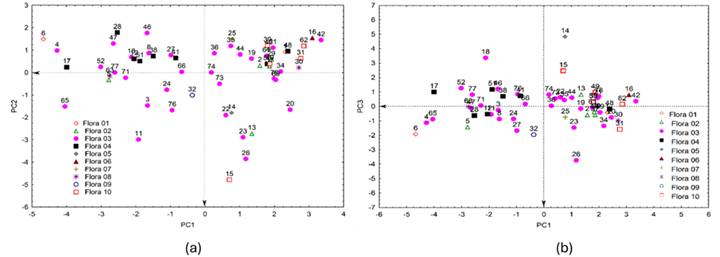
PCA revealed that the first three principal components (PCs) accounted for 52% of the total variance, adequately capturing mineral variability among the honey samples. Table 5 summarizes the loading values for the first three PCs, as well as the total and cumulative variance explained.
PC1 accounted for 29.0% of the total variance, with Ca, Ba, Mg, Mn, Na, Se, and V as the main variables, all with negative loadings, indicating a correlation among these inorganic elements. PC2 explained 13% of variance, with Cd, Cr, Cu, Ni, and Pb as the variables with significant negative loadings, suggesting co-variation among these trace metals. In PC3, Cd and Cr were the dominant variables, with opposing negative loadings, explaining 10% of the total variance.
Figures 2a and 2b display the score plots (PC2 vs. PC1 and PC3 vs. PC1) for honey samples, coded by floral origin. Wildflower samples (Flora 3) were dispersed across all quadrants of both plots, indicating predominance relative to other floral types. By contrast, assa-peixe (Flora 2), cipó-uva (Flora 8), and orange tree (Flora 10) honey samples exhibited low concentrations of elements contributing to PC1 and PC2, including Cd, Pb, Cr, Ni, and Cu. Research suggested that these inorganic contaminants may result from industrial activities and vehicular traffic, such as brake wear, which releases copper into the environment. Additionally, the presence of Cd and Pb corroborates associations with apiaries located near industrial zones or highways (LOYOLA, 2012).
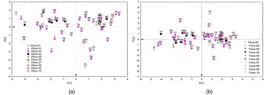
Score plots of the three principal components (PC2 vs. PC1 and PC3 vs. PC1) for honey samples identified by their floral origin.(a) Score plot of PC2 vs. PC1 for the honey samples.(a) Score plot of PC3 vs. PC1 for the honey samples. Source: Prepared by the authors based on research data.
Furthermore, eucalyptus-derived honey (Flora 4) exhibited correlations with Ba, Ca, Mg, Mn, Na, Se, and V, elements described as essential for human nutrition and naturally abundant in the Earth’s crust, including marine aerosols and soils (LOYOLA, 2012).
CONCLUSION
The presence of contaminants significantly impacts various environmental compartments, including air, soil, and water, which in turn influence food composition. Foods containing elevated concentrations of potentially toxic elements may pose health risks, triggering adverse physiological outcomes.
Research of this nature also offers a means to identify regions with high environmental contamination, since honey reflects the floral and geographic origin of its constituent trace elements. These data enable risk assessment and the development of risk management and exposure prevention strategies for human populations.
The present study provides one of the first comprehensive assessments of inorganic contamination in honey from Rio de Janeiro state, Brazil, focusing on toxic elements such as arsenic (As) and lead (Pb). These findings underscore the urgent need for systematic monitoring of inorganic contaminants in honey, particularly in tropical regions that remain underrepresented in global food safety research.
ACKNOWLEDGMENTS
The authors are grateful to the Agência Nacional de Vigilância Sanitária (ANVISA, Brasília, Brazil) and Conselho Nacional de Desenvolvimento Científico e Tecnológico (CNPq, Brasília, Brazil) for the financial support and research scholarships. This study was partially funded by the Coordenação de Aperfeiçoamento de Pessoal de Nível Superior (CAPES, Brasília, Brazil) - Funding Code 001.
We also acknowledge Thiago Bousquet Bandini for assistance with honey sample collection.
REFERENCES
-
AGENCY FOR TOXIC SUBSTANCES AND DISEASE REGISTRY- ATSDR. Public Health Statement. Arsenic. 2007. Available from: <Available from: https://www.atsdr.cdc.gov/ToxProfiles/tp2.pdf >. Accessed: Oct. 10, 2024.
» https://www.atsdr.cdc.gov/ToxProfiles/tp2.pdf -
AGENCY FOR TOXIC SUBSTANCES AND DISEASE REGISTRY- ATSDR. Public Health Statement. Lead. 2020 Available from: <Available from: https://www.atsdr.cdc.gov/ToxProfiles/tp13.pdf >. Accessed: Oct. 10, 2024.
» https://www.atsdr.cdc.gov/ToxProfiles/tp13.pdf -
AJIBOLA, A. et al. Nutraceutical values of natural honey and its contribution to human health and wealth. Nutrition & Metabolism, v.20, n.9, p.61, 2012. Available from: <Available from: https://nutritionandmetabolism.biomedcentral.com/articles/10.1186/1743-7075-9-61 >. Accessed: Nov. 05, 2024.
» https://nutritionandmetabolism.biomedcentral.com/articles/10.1186/1743-7075-9-61 -
ALVES, C. M. A. C. Determinação de As, Cd, Hg e Pb em mel empregando combustão iniciada por micro-ondas e ICP-MS. 2020. 70 f. Dissertação. (Mestrado em Química) - Universidade Federal de Santa Maria, Santa Maria, Rio Grande do Sul, 2020. Available from: <Available from: https://repositorio.ufsm.br/bitstream/handle/1/23059/DIS_PPGQUIMICA_2020_ALVES_CAMILA.pdf?sequence=1&isAllowed=y >. Accessed: Nov. 03, 2024.
» https://repositorio.ufsm.br/bitstream/handle/1/23059/DIS_PPGQUIMICA_2020_ALVES_CAMILA.pdf?sequence=1&isAllowed=y -
ANDRADE, C. K. et al. Relationship between geographical origin and contents of Pb, Cd, and Cr in honey samples from the state of Parana (Brazil) with chemometric approach. Environmental Science and Pollution Research, v.21, p.12372-12381, 2014. Available from: <Available from: https://doi.org/10.1007/s11356-014-3175-2 >. Accessed: Nov. 05, 2024. doi: 10.1007/s11356-014-3175-2.
» https://doi.org/10.1007/s11356-014-3175-2 -
BALDASSINI, W. A. et al. Determinação dos teores de minerais em sucos de frutas por espectrometria de emissão óptica em plasma indutivamente acoplado (ICP-OES). Ciência e Tecnologia de Alimentos, v.32, n.1, p.163-166, 2012. Available from: <Available from: https://www.scielo.br/j/cta/a/9d3yVqqzn4hW9YrjNcWyNKx/ >. Accessed: Nov. 05, 2024.
» https://www.scielo.br/j/cta/a/9d3yVqqzn4hW9YrjNcWyNKx/ -
BANDINI, T. B.; SPISSO, B. F. Honey health risk in Brazil related to new threats: emerging chemical residues and contaminants. Vigilância Sanitária Em Debate, v.5, n.1, p.116-126, 2017. Available from: <Available from: https://doi.org/10.3395/2317-269x.00789 >. Accessed: Nov. 05, 2024. doi: 10.3395/2317-269x.00789.
» https://doi.org/10.3395/2317-269x.00789.» https://doi.org/10.3395/2317-269x.00789 -
BARATA-SILVA, C. et al. Biomonitoramento dos bombeiros militares que trabalharam em Brumadinho-MG após o rompimento da barragem de rejeitos. Ciência Saúde Coletiva. 2024. Available from: <Available from: http://cienciaesaudecoletiva.com.br/artigos/biomonitoramento-dos-bombeiros-militares-que-trabalharam-em-brumadinhomg-apos-o-rompimento-da-barragem-de-rejeitos/19338?id=19338 >. Accessed: Dec. 16, 2024.
» http://cienciaesaudecoletiva.com.br/artigos/biomonitoramento-dos-bombeiros-militares-que-trabalharam-em-brumadinhomg-apos-o-rompimento-da-barragem-de-rejeitos/19338?id=19338 -
BRASIL. Instrução Normativa - IN nº 11, de 20 de outubro de 2000. Estabelece a identidade e os requisitos mínimos de qualidade que deve cumprir o mel destinado ao consumo humano direto. . 2000. Available from: <Available from: https://www.gov.br/agricultura/pt-br/assuntos/defesa-agropecuaria/suasa/regulamentos-tecnicos-de-identidade-e-qualidade-de-produtos-de-origem-animal-1/IN11de2000.pdf >. Accessed: Oct. 25, 2024.
» https://www.gov.br/agricultura/pt-br/assuntos/defesa-agropecuaria/suasa/regulamentos-tecnicos-de-identidade-e-qualidade-de-produtos-de-origem-animal-1/IN11de2000.pdf -
BRASIL. Resolução da Diretoria Colegiada - RDC nº 487, de 26 de março de 2021. Dispõe sobre os limites máximos tolerados (LMT) de contaminantes em alimentos, os princípios gerais para o seu estabelecimento e os métodos de análise para fins de avaliação de conformidade.2021. Available from: <Available from: https://bvsms.saude.gov.br/bvs/saudelegis/anvisa/2020/rdc0487_26_03_2021.pdf >. Accessed: Oct. 15, 2024.
» https://bvsms.saude.gov.br/bvs/saudelegis/anvisa/2020/rdc0487_26_03_2021.pdf -
BRESSY, F. C. et al. Determination of trace element concentrations in tomato samples at different stages of maturation by ICP OES and ICP-MS following microwave-assisted digestion. Microchemical Journal, v.109, p.145-9, 2013. Available from: <Available from: https://repositorio.ufba.br/handle/ri/15026 >. Accessed: Nov. 05, 2024.
» https://repositorio.ufba.br/handle/ri/15026 -
CODEX ALIMENTARIUS. General standard for contaminants and toxins in food and feed. 2023. Available from: <Available from: https://www.fao.org/fao-who-codexalimentarius/sh-proxy/fr/?lnk=1&url=https%253A%252F%252Fworkspace.fao.org%252Fsites%252Fcodex%252FStandards%252FCXS%2B193-1995%252FCXS_193e.pdf >. Accessed: Nov. 11, 2024.
» https://www.fao.org/fao-who-codexalimentarius/sh-proxy/fr/?lnk=1&url=https%253A%252F%252Fworkspace.fao.org%252Fsites%252Fcodex%252FStandards%252FCXS%2B193-1995%252FCXS_193e.pdf -
COMPANHIA AMBIENTAL DO ESTADO DE SÃO PAULO- CESTEB. Ficha de informação toxicológica do níquel. 2024a Available from: <Available from: https://cetesb.sp.gov.br/veicular/wp-content/uploads/sites/24/2021/05/Ni%CC%81quel.pdf >. Accessed: Nov. 11, 2024.
» https://cetesb.sp.gov.br/veicular/wp-content/uploads/sites/24/2021/05/Ni%CC%81quel.pdf -
COMPANHIA AMBIENTAL DO ESTADO DE SÃO PAULO- CESTEB. Ficha de informação toxicológica do bário. 2024b. Available from: <Available from: https://cetesb.sp.gov.br/laboratorios/wp-content/uploads/sites/24/2022/02/Bario.pdf >. Accessed: Nov. 11, 2024.
» https://cetesb.sp.gov.br/laboratorios/wp-content/uploads/sites/24/2022/02/Bario.pdf -
DESESSO, J. M. Teratogen updade: inorganic arsenic. Teratology, n.63, p.170-173, 2001. Available from: <Available from: https://doi.org/10.1002/tera.1060 >. Accessed: Nov. 06, 2024.
» https://doi.org/10.1002/tera.1060 -
GAJGER, T. et al. Mineral concentrations in different types of honey originating from three regions of Continental Croatia. Foods, v.13, p.2754, 2024. Available from: <Available from: https://doi.org/10.3390/foods13172754 >. Accessed: Jul. 03, 2025. doi: 10.3390/foods13172754.
» https://doi.org/10.3390/foods13172754.» https://doi.org/10.3390/foods13172754 -
GARZA, A. et al. Cellular mechanisms of lead neurotoxicity. Medical Science Monitor, n.12, p.57-65, 2006. Available from: <Available from: http://www.medscimonit.com/abstract/index/idArt/447121 >. Accessed: Nov. 06, 2024.
» http://www.medscimonit.com/abstract/index/idArt/447121 -
INSTITUTO NACIONAL DE METROLOGIA, NORMALIZAÇÃO E QUALIDADE INDUSTRIAL-INMETRO. Orientação sobre Validação de Métodos Analíticos- DOQ-CGCRE-008. Brasil; 2020. Available from: <Available from: https://app.sogi.com.br/Manager/texto/arquivo/exibir/ arquivo?ey J0eXAiOiJKV1QiL CJhbGciOiJIUzI1Ni J9AFFIjAvMTM 4ODM3NS9TR1 9SZXF1aXNpdG9 fTGVnYWxfVGV4dG8 vMC8wL0RPUS1DZ2NyZS 04XzA5LnBkZi8wLzAiAFFBc MYdNmecpDn0m0Dj 4vzJmvMJZM AYtW6mtkIlj0C7fk >. Accessed: Nov. 05, 2023.
» https://app.sogi.com.br/Manager/texto/arquivo/exibir/ arquivo?ey J0eXAiOiJKV1QiL CJhbGciOiJIUzI1Ni J9AFFIjAvMTM 4ODM3NS9TR1 9SZXF1aXNpdG9 fTGVnYWxfVGV4dG8 vMC8wL0RPUS1DZ2NyZS 04XzA5LnBkZi8wLzAiAFFBc MYdNmecpDn0m0Dj 4vzJmvMJZM AYtW6mtkIlj0C7fk -
LEAL, S. S. et al. Profile of inorganic elements in honey samples from the Maranhão state as a bioindicator of geographical origin. Química Nova, v.45, n.5, 531-536, 2022. Available from: <Available from: https://doi.org/10.21577/0100-4042.20170856 >. Accessed: Nov. 03, 2024. doi: 10.21577/0100-4042.20170856.
» https://doi.org/10.21577/0100-4042.20170856.» https://doi.org/10.21577/0100-4042.20170856 -
LOUPPIS, A. P. et al. Two-Way Characterization of Beekeepers’ Honey According to Botanical Origin on the Basis of Mineral Content Analysis Using ICP-OES Implemented with Multiple Chemometric Tools. Foods, v.8, p.210, 2019. Available from: <Available from: https://doi.org/10.3390/foods8060210 >. Accessed: Jul. 09, 2025. doi: 10.3390/foods8060210.
» https://doi.org/10.3390/foods8060210.» https://doi.org/10.3390/foods8060210 -
LOYOLA, J. et al. Trace metals in the urban aerosols of Rio de Janeiro city. Journal of the Brazilian Chemical Society, v.23, n.4, p.628-638, 2012. Available from: <Available from: https://doi.org/10.1590/S0103-50532012000400007 >. Accessed: Oct. 17, 2024. doi: 10.1590/S0103-50532012000400007.
» https://doi.org/10.1590/S0103-50532012000400007.» https://doi.org/10.1590/S0103-50532012000400007 -
OLIVEIRA, F. A. et al. Evaluation of matrix effect on the determination of rare earth elements and As, Bi, Cd, Pb, Se and In in honey and pollen of native Brazilian bees (Tetragonisca angustula - Jataí) by Q-ICP-MS. Talanta, v.162, p.488-494, 2017. Available from: <Available from: https://doi.org/10.1016/j.talanta.2016.10.058 >. Accessed: Nov. 06, 2024. doi: 10.1016/j.talanta.2016.10.058.
» https://doi.org/10.1016/j.talanta.2016.10.058.» https://doi.org/10.1016/j.talanta.2016.10.058 -
OLIVEIRA, S. S. et al. Determination of essesntial and potentially toxic elements and their estimation of bioaccessibility in honeys. Microchemical Journal, v.151, 104221, 2019. Available from: <Available from: https://doi.org/10.1016/j.microc.2019.104221 >. Accessed: Nov. 10, 2024. doi: 10.1016/j.microc.2019.104221.
» https://doi.org/10.1016/j.microc.2019.104221.» https://doi.org/10.1016/j.microc.2019.104221 - OTTO, M. Chemometrics Statistics and Computer Application in Analytical Chemistry, 3ª ed., Wiley-VCH, p.137-139, 2017.
-
PAVLIN, A. et al. Honey Origin Authentication via Mineral Profiling Combined with Chemometric Approaches. Foods, 12, 2826, 2023. Available from: <Available from: https://doi.org/10.3390/foods12152826 >. Accessed: Jul. 03, 2025. doi: 10.3390/foods12152826.
» https://doi.org/10.3390/foods12152826.» https://doi.org/10.3390/foods12152826 -
SANTOS, L. M. G. et al.Inorganic element profile of medicinal Cannabis extracts consumed by pediatric patients. Brazilian Journal of Pharmaceutical Sciences (online), v.58, p.1-9, 2022. Available from: <Available from: https://doi.org/10.1590/s2175-97902022e20176 >. Accessed: Nov. 05, 2024. doi: 10.1590/s2175-97902022e20176.
» https://doi.org/10.1590/s2175-97902022e20176.» https://doi.org/10.1590/s2175-97902022e20176 -
SODRÉ, G. S. et al. Caracterização físico-química de amostras de méis de Apis mellifera L. Ciência e Tecnologia de Alimentos. v.27, n.3, p.523-529, 2007. Available from: <Available from: https://www.scielo.br/j/cta/a/yCYnBzwfxtfN7Gg7fWpmZdx/ >. Accessed: Nov. 05, 2024.
» https://www.scielo.br/j/cta/a/yCYnBzwfxtfN7Gg7fWpmZdx/
-
CR-2025-0189.R3
-
DATA AVAILABILITY STATEMENT
The raw data are available from the authors. If necessary, they can be requested from the corresponding author (cristiane.barata@fiocruz.br).
-
DECLARATION OF USE OF ARTIFICIAL INTELLIGENCE
In the present manuscript, artificial intelligence was not used in its preparation.
Edited by
-
ASSOCIATE EDITOR:
Rudi Weiblen (0000-0002-1737-9817)
The raw data are available from the authors. If necessary, they can be requested from the corresponding author (cristiane.barata@fiocruz.br).