 Growth estimation and physiological well-being of fish species from the Baixada Maranhense, Eastern Amazon, Brazil
ABSTRACT:
The study estimated the growth parameters for fish species from the Baixada Maranhense region, Eastern Amazon, as an element for adequate use of natural resources. Specimens were collected between July 2018 and June 2019 using gill nets with mesh sizes ranging between 3 and 8 cm. Length-weight relationships (LWR) were calculated from 1,890 specimens of 11 species belonging to 10 families and three taxonomic orders. The angular coefficient b ranges from 2.76 to 3.32 and the lowest and highest values of the relative condition factor were found for the flood season ranging from 0.926 to Cichlasoma zarskei Ottoni 2011 and 1.265 to Metynnis lippincottianus (Cope 1870), respectively. We recorded for the first time the LWR parameters for the species C. zarskei. This approach is essential to contribute to the conservation of fish populations, as well as the preservation of the ecosystems by providing indispensable information for fishery management.
Key words:
growth parameter; welfare; population biology; condition factor; food security
RESUMO:
O estudo teve como objetivo estimar os parâmetros de crescimento de espécies de peixes na região da Baixada Maranhense, Amazônia Oriental, como elemento para o uso adequado dos recursos naturais. Os peixes foram coletados entre julho de 2018 e junho de 2019 com redes de emalhar com malhas variando entre 3 e 8 cm. As relações peso-comprimento (RPC) foram calculadas a partir de 1.890 exemplares de 11 espécies pertencentes a 10 famílias e três ordens taxonômicas. O coeficiente angular b variou de 2,76 a 3,32 e os menores e maiores valores do fator de condição relativo foram encontrados para a estação de cheia variando de 0,926 para Cichlasoma zarskei Ottoni 2011 a 1,265 para Metynnis lippincottianus (Cope 1870), respectivamente. Registramos pela primeira vez os parâmetros de RPC para a espécie C. zarskei. Esta abordagem é essencial para contribuir para a conservação das populações de peixes bem como a preservação dos ecossistemas, fornecendo informações indispensáveis para o manejo pesqueiro.
Palavras-chave:
parâmetro de crescimento; bem estar; biologia populacional; fator de condição; segurança alimentar
INTRODUCTION
Fishing plays a significant social and economic role in the State of Maranhão, providing essential food for supplying part of the food that makes up the population’s diet. In addition to being one of the activities that generates jobs and income in rural communities in all municipalities that compose the Baixada Maranhense (ALMEIDA et al., 2012).
Knowledge of some structural attributes of the population, as well as aspects related to the biology of species, are essential elements for understanding its needs, that is how the species perpetuates itself in new generations and its conservation within ecosystems (KING, 2007). This information forms a set for the development of models that assist in the implementation of management policies for rational exploration (SILVA, 2015). Growth estimation and physiological well-being serve as a valuable tool for assessing the conservation status of fish populations (ANDRADE et al., 2015). The growth models are useful due to converting length and/or weight in growth equations which allow comparisons between different fish species and/or populations to infer about life history of involved species (FROESE, 2006). Additionally, the condition factor in fish is a measure of the fish’s physiological condition in connection to its welfare (LE CREN, 1951). However, there is a lack of information on the population and reproductive analysis of most species that make up the ichthyofauna in the Baixada Maranhense. For most of these river basins, there is human interference, which can lead to the reduction of already known species and the extinction of species, even before they are cataloged (OLIVEIRA et al., 2011).
In this study, we estimated the length-weight relationships (LWR) and assessed the physiological well-being of 11 fish species across 10 families belonging to the Siluriformes, Characiformes, and Cichliformes orders. All are highly commercialized in the Baixada Maranhense, and the results presented here will serve as a basis for management strategies for the appropriate use of these species as natural resources.
MATERIAL AND METHODS
To carry out the present study, samples were collected in the main channel of the Pericumã River, located in the city of Pinheiro, Maranhão, Eastern Amazon. Throughout hydrological periods of low water and flood. Collections were made bimonthly from July 2018 to July 2019, with the help of local fishermen using gillnets with mesh size ranging from 3 to 8 centimeters between opposite nodes. The specimens were collected under permit number 58236 issued by the Instituto Chico Mendes de Conservação da Biodiversidade - ICMBio (Sisbio). The collection points along the route of the Pericumã River were chosen because they are fishing areas already used by fishermen in the region, popularly known as Cachoeira - P1 (upstream river), Juçareira - P2 (near the urban area of the municipality of Pinheiro) and Comporta - P3 (downstream river) (Figure 1).

Map of the location of the Pericumã River indicating the three sampling points. A) Cachoeira - P1 (upstream river), Juçareira - P2 (near the urban area of the municipality of Pinheiro), and Comporta - P3 (downstream river); B) Location of the Baixada Maranhense in Maranhão State; and C) Location of the area in the Eastern Amazon.
The specimens were captured by fishermen from the region along with students associated to the Laboratory of the Grupo de Pesquisa Ambiente, Biotecnologia e Bioeconomia (AMBio). The fish obtained were stored in thermal boxes with ice and sent to AMBio at the Universidade Federal do Maranhão, Campus Pinheiro, and were kept at -18 ºC for subsequent processing.
The fish were measured with a digital caliper in their total length (TL) and weighed with a precision scale of 0.01 g in their total weight (W). Length-weight relationships (LWR) were estimated using the equation W = a*TLb from PAULY (1984), where a is the constant and b is the allometric coefficient. Possible outliers were removed by inspection of the log-log plot according to FROESE (2006). The hypothetical isometry values (b = 3) were verified using the t-test at the 95% confidence limit level (FROESE, 2006). The physiological well-being of the species was calculated using relative condition factor according to LE CREN (1951) given by the expression Kn = W/aTLb. Where W represents the total observed weight, and aTLb the calculated weight as determined from the length-weight equations. The difference in Kn between the seasons was evaluated by Student’s t-test (P < 0.05).
RESULTS AND DISCUSSION
In this study, 1,890 specimens from three orders and 10 families were analyzed. The degree of adjustment of the data in each function was determined by the coefficient of determination (r²). Differences in population growth models were obtained by analyzing the distinction between correlation coefficients, comparing the slope and elevation of the linear regression between parameters. For all species, a confidence level greater than 95% was obtained.
This study is the first to report the growth parameters for the species C. zarskei as well as recorded its greatest length in literature (Table 1). Growth traits of fish from the Pericumã River can be used to understand biological processes (PAULY, 1980). Future studies will use these data to assess ecosystem quality from fish stocks.
The species of the order Silurifomes T. galeatus showed positive allometric growth and consequently the fish become heavier while grows, whereas the species M. thoracata demonstrated allometric growth lower than 3, which means negative allometry and hence the fish become slimmer with increasing length (ANDRADE et al., 2015). From studied species, piranha S. rhombeus was the most abundant. This species, along with others belonging to the order Characiformes, except the species H. malabaricus, showed positive allometric growth, this is, A. bimaculatus, P. lacustris, and S. notonota; and isometric growth for M. lippincottianus and L. friderici. All species of the order Cichliformes showed negative allometry (i.e., b < 3), indicating that fish grow at a higher rate in length than in weight throughout their development (GURKAN & TASKAVAK, 2007) (Table 1).
Knowledge of quantitative aspects, such as the length-weight relationships of a fish species is an important tool for studies of fisheries biology. This understanding is essential for the management and preservation of an environment, as it provides information about the autoecology of species (VAZZOLER, 1982; LIZAMA & AMBRÓSIO, 2003).
The use of LWR provides the indirect determination of weight through length, allowing the analysis of the growth rate through the allometric coefficient. In this context, the confidence intervals of the growth patterns of the analyzed species in these studies are considered, all species had allometric coefficient b within the expected values (2.5 - 3.5) according to FROESE (2006).
Seven species had the parameter a and/or b values outside the 95% confidence level according to the values derived from the Bayesian predictions that are accessible on FishBase <www.fishbase.org> (Table 1 and Table 2). However, these differences in values can be explained because the LWR estimates are based on modeling of several species of similar body shape and not of these species studied herein (FROESE et al., 2014). Nonetheless, because these species have an elongated body, for example, the species S. brasiliensis, relative to their weight, handling them out of the water for weighing can result in variations due to weight loss from evaporation and, worse, if they are later stored in alcohol for biometrics, deviations in the LWR’s inclination.
Relative condition factor (Mean Kn ± Standard Deviation) values, P-values of the t-test for Kn between low-water and flood seasons, and Bayesian LWR estimations (minimum - maximum values). P-values in bold for significant differences.
Finally, the relative condition factor ranged from the lowest value of 0.926, observed for C. zarskei to the highest condition factor value of 1.265 recorded for M. lippincottianus both in the flood season. The relative condition factor is a reliable indicator of lipid content related to the higher fatness concentrations in stronger species, and consequently to greater energy reserves which means better physiological conditions (MOZSÁR et al., 2015). The well-being of fishes, represented here by the relative condition factor, can be influenced by several factors such as season, food availability, sex, age of fish, and environmental conditions (OGUNOLA et al., 2018).
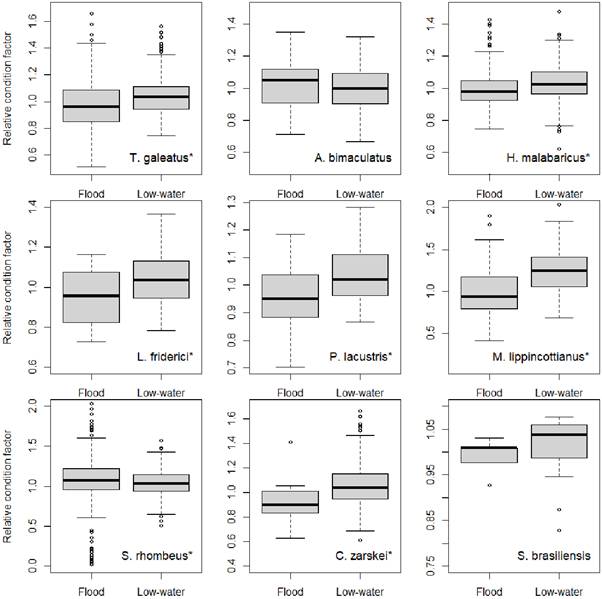
The findings on the species’ physiological well-being suggest that the species’ nutrition, which is influenced by seasonality, plays a significant role. Because the first species is a cichlid that is primarily carnivorous (MARTINEZ-PALACIOS & ROSS, 1988), its ability to catch food was expected to be hampered during the river flood period. This is demonstrated by significant changes in physiological well-being (Kn) between seasons, with a greater Kn in the lower water period, indicating a higher body fat rate. This same condition has been found for other primarily carnivorous such as T. galeatus and H. malabaricus, and omnivorous species such as L. friderici, and P. lacustris (Figure 2). This means that these species have stronger ability to collect food, or that food is more readily available in its ecology during the lower water season. The unique carnivorous species that shows no pattern like the other was S. rhombeus which despite having presented significant differences in Kn, the highest value was displayed during the flood (Figure 2). However, this species present great dietary plasticity feeding on fishes, crustaceans, mollusks, insects and others (SÁ-OLIVEIRA et al., 2017) indicating that seasonality will not be a limiting factor for the feeding condition of this species. For the species M. lippincotianus, as a herbivorous Serrasalmidae (LUDUVICE et al., 2023), it is clear that the greatest availability of food for this species would occur during the flood period (GOULDING, 1980), corroborated by the better well-being during the flood period (Kn = 1.264) than during the dry period (Kn = 1.004), proven with statistical differences (P < 0.01) where better food conditions influence energy gain and, therefore, the well-being (Figure 2). The remaining species didn’t show differences in the welfare between seasons (Figure 2).

Box plots showing seasonal variations in species’ well-being in the Pericumã River, using only species with representative individuals from flood and low-water seasons. Asterisks (*) indicate significant variations between seasons.
The captured species in the Baixada Maranhense have great socioeconomic importance, contributing significantly as a source of food, job opportunities and cultural preservation. In this way, the overexploitation of this natural resource negatively affects not only the environment, but also causes a reduction in fishing reproduction, harming the economy of the communities that depend on this activity. In summary, in the Baixada Maranhense region, these species are widely traded and consumed by a large part of the population, which results in the exploitation of stocks that boosts the local economy. In particular, the species T. galeatus popularly known as Bagrinho (= Small catfish) has great commercial and cultural value for the population (MARINHO et al., 2024) with recent evidence of overfishing (MARTINS et al., 2020). According to GUIMARÃES et al. (2021), the overexploitation of species causes stock depletion, and also the variation in the species’ dietary conditions, as well as their physiological and reproductive states.
CONCLUSION
The data reported here will be extremely useful for future studies as well as fishing stock monitoring, as some species, such as Small catfish, are highly valued by the human population in Baixada Maranhense as a traditional culinary dish. Finally, it is worth highlighting that this approach is fundamental for the conservation of these species in the region, without causing harm to the population that depends on this resource.
ACKNOWLEDGMENTS
We thank the help of all fishermen, the help of the fishermen’s association, the friends and partners of the AMBio laboratory, and to Dra. Mikele Cândida Sant’Anna de Sousa for the support. To the DFCL for developing this project on the Pericumã River. MÂ is funded by the Conselho Nacional de Desenvolvimento Científico e Tecnológico (CNPq #310522/2023-4).
REFERENCES
-
ALMEIDA, S. Z. et al. O espaço geográfico da Baixada Maranhense. In: FARIAS-FILHO, S. M. (Org.). O espaço geográfico da Baixada Maranhense. 1ed. São Luís - MA: Gráfica Editora, p.33-53, 2012. Available from: <Available from: https://www.edufma.ufma.br/index.php/produto/o-espaco-geografico-da-baixada-maranhense/ >. Accessed: Dec. 14, 2023.
» https://www.edufma.ufma.br/index.php/produto/o-espaco-geografico-da-baixada-maranhense/ -
ANDRADE, M. C. et al. Length-weight relationships and condition factor of the eaglebeak pacu Ossubtus xinguense Jégu, 1992 (Characiformes, Serrasalmidae), an endangered species from Rio Xingu rapids, northern Brazil. Brazilian Journal of Biology, v.75, p.102-105. 2015. Available from: <Available from: https://www.scielo.br/j/bjb/a/Z8tWsxwG45GDcgWvcjZTVKg/ >. Accessed: Dec. 12, 2023. doi: 10.1590/1519-6984.01214BM.
» https://doi.org/10.1590/1519-6984.01214BM.» https://www.scielo.br/j/bjb/a/Z8tWsxwG45GDcgWvcjZTVKg/ -
FROESE, R. Cube law, condition factor and weight-length relationships: history, metaanalysis and recommendations. Journal of Applied Ichthyology, v.22, n.4, p.241-253, 2006. Available from: <Available from: https://onlinelibrary.wiley.com/doi/abs/10.1111/j.1439-0426.2006.00805.x >. Accessed: Dec. 04, 2023. doi: 10.1111/j.1439-0426.2006.00805.x.
» https://doi.org/10.1111/j.1439-0426.2006.00805.x.» https://onlinelibrary.wiley.com/doi/abs/10.1111/j.1439-0426.2006.00805.x -
FROESE, R. et al. A Bayesian approach for estimating length-weight relationships in fishes. Journal of Applied Ichthyology, v.30, n.1, p.78-85, 2014. Available from: <Available from: https://onlinelibrary.wiley.com/doi/abs/10.1111/jai.12299 >. Accessed: Dec. 02, 2023. doi: 10.1111/jai.12299.
» https://doi.org/10.1111/jai.12299.» https://onlinelibrary.wiley.com/doi/abs/10.1111/jai.12299 - GOULDING, M. The fishes and the forest: explorations in Amazonian natural history. University of California Press. 280p. 1980.
- GUIMARÃES, E. C. et al. Peixes comerciais do estado do Maranhão. 1. ed. IMESC, v.1, 69. 2021.
-
GURKAN, S.; TASKAVAK, E. Length-weight relationships for syngnathid fishes of the Aegean Sea, Turkey. Belgian Journal of Zoology, v.137, n.2, p.219-222. 2007. Available from: <Available from: https://biblio.naturalsciences.be/associated_publications/bjz/bibliographic-references/137-2/volume-137-2-pp-219-222.pdf >. Accessed: Dec. 03, 2023.
» https://biblio.naturalsciences.be/associated_publications/bjz/bibliographic-references/137-2/volume-137-2-pp-219-222.pdf - KING, M. Fisheries biology, assessment and management. 2nd Ed. Oxford: Blackwell Science. 382, 2007.
-
LE CREN, E. D. The length-weight relationship and seasonal cycle in gonad weight and condition in the perch (Perca fluviatilis). Journal of Animal Ecology, v.20, p.201-219, 1951. Available from: <Available from: https://www.jstor.org/stable/1540 >. Accessed: Dec. 01, 2023. doi: 10.2307/1540.
» https://doi.org/10.2307/1540.» https://www.jstor.org/stable/1540 -
LIZAMA, M. D. L. A. P.; AMBRÓSIO, A. M. Crescimento, recrutamento e mortalidade do pequi Moenkhausia intermedia (Osteichthyes, Characidae) na planície de inundação do Alto Rio Paraná, Brasil. Acta Scientiarum. Biological Sciences, v.25, n.2, p.329-333. 2003. Available from: <Available from: https://periodicos.uem.br/ojs/index.php/ActaSciBiolSci/article/view/2020 >. Accessed: Dec. 01, 2023. doi: 10.4025/actascibiolsci.v25i2.2020.
» https://doi.org/10.4025/actascibiolsci.v25i2.2020.» https://periodicos.uem.br/ojs/index.php/ActaSciBiolSci/article/view/2020 -
MARINHO, Y. F. et al. Co-feeding using live food and feed as first feeding for the small catfish Trachelyopterus galeatus (Linnaeus 1766). Arquivo Brasileiro de Medicina Veterinária e Zootecnia, v.76, n.2, p.323-332, 2024. Available from: <Available from: https://www.scielo.br/j/abmvz/a/mBLttJHkVwLTxcy7KHgmSSp/ >. Accessed: Dec. 01, 2023. doi: 10.1590/1678-4162-13060.
» https://doi.org/10.1590/1678-4162-13060.» https://www.scielo.br/j/abmvz/a/mBLttJHkVwLTxcy7KHgmSSp/ -
MARTINEZ-PALACIOS, C. A.; ROSS, L. G. The feeding ecology of the Central American cichlid Cichlasoma urophthalmus (Gunther). Journal of Fish Biology, v.33, n.5, p.665-670. 1988. Available from: <Available from: https://onlinelibrary.wiley.com/doi/abs/10.1111/j.1095-8649.1988.tb05512.x >. Accessed: Dec. 03, 2023. doi: 10.1111/j.1095-8649.1988.tb05512.x.
» https://doi.org/10.1111/j.1095-8649.1988.tb05512.x.» https://onlinelibrary.wiley.com/doi/abs/10.1111/j.1095-8649.1988.tb05512.x -
MARTINS, M. M. et al. Main Species of siluriformes from the Flooded Fields of the Maranhão Plain with Zootechnical Potential. International Journal of Innovative Science and Research Technology, v.5, n.4, p.761-767, 2020. Available from: <Available from: https://www.ijisrt.com/main-species-of-siluriformes-from-the-flooded-fields-of-the-maranho-plain-with-zootechnical-potential >. Accessed: Dec. 03, 2023.
» https://www.ijisrt.com/main-species-of-siluriformes-from-the-flooded-fields-of-the-maranho-plain-with-zootechnical-potential -
MOZSÁR, A. et al. Relationship between Fulton’s condition factor and proximate body composition in three freshwater fish species. Journal of Applied Ichthyology, v.31, n.2, p.315-320. 2015. Available from: <Available from: https://onlinelibrary.wiley.com/doi/full/10.1111/jai.12658 >. Accessed: Dec. 02, 2023. doi: 10.1111/jai.12658.
» https://doi.org/10.1111/jai.12658.» https://onlinelibrary.wiley.com/doi/full/10.1111/jai.12658 -
OGUNOLA, O. S. et al. Preliminary evaluation of some aspects of the ecology (growth pattern, condition factor and reproductive biology) of African pike, Hepsetus odoe (Bloch 1794), in Lake Eleiyele, Ibadan, Nigeria. Fisheries and Aquatic Sciences, v.21, p.1-15. 2018. Available from: <Available from: https://fas.biomedcentral.com/articles/10.1186/s41240-018-0087-y >. Accessed: Dec. 02, 2023. doi: 10.1186/s41240-018-0087-y.
» https://doi.org/10.1186/s41240-018-0087-y.» https://fas.biomedcentral.com/articles/10.1186/s41240-018-0087-y -
OLIVEIRA, T. G. D. et al. Amazônia Maranhense: diversidade e conservação. Belém: MPEG, p.93-119. 2011. Available from: <Available from: http://ppbio.museu-goeldi.br/sites/default/files/Meu_livro.pdf >. Accessed: Dec. 18, 2023.
» http://ppbio.museu-goeldi.br/sites/default/files/Meu_livro.pdf -
PAULY, D. On the interrelationships between natural mortality, growth parameters, and mean environmental temperature in 175 fish stocks. ICES journal of Marine Science, v.39, n.2, p.175-192. 1980. Available from: <Available from: https://academic.oup.com/icesjms/article/39/2/175/647984 >. Accessed: Dec. 18, 2023. doi: 10.1093/icesjms/39.2.175.
» https://doi.org/10.1093/icesjms/39.2.175.» https://academic.oup.com/icesjms/article/39/2/175/647984 - PAULY, D. Fish population dynamics in tropical waters: a manual for use with programmable calculators. WorldFish, v.8, 1984.
-
SÁ-OLIVEIRA, J. C. et al. Resource partitioning between two piranhas (Serrasalmus gibbus and Serrasalmus rhombeus) in an Amazonian reservoir. The Scientific World Journal, v.2017, 8064126, 2017. Available from: <Available from: https://onlinelibrary.wiley.com/doi/10.1155/2017/8064126 >. Accessed: Dec. 15, 2023. doi: 10.1155/2017/8064126.
» https://doi.org/10.1155/2017/8064126.» https://onlinelibrary.wiley.com/doi/10.1155/2017/8064126 -
SILVA, J. P. D. C. Biologia reprodutiva, idade e crescimento da pescada-branca Cynoscion leiarchus (Actinopterygii, Sciaenidae) na Baía de Sepetiba, 2015. RJ. Available from: <Available from: https://rima.ufrrj.br/jspui/handle/20.500.14407/10824 >. Accessed: Dec. 03, 2023.
» https://rima.ufrrj.br/jspui/handle/20.500.14407/10824 - VAZZOLER, A. D. M. Biologia da reprodução de peixes teleósteos: teoria e prática. Maringá, EDUEM. 1982.
-
LUDUVICE, J. S. V. et al. Grazing unworried: environmental changes in a dammed river favor the diet of the invasive Metynnis lippincottianus (Characiformes, Serrasalmidae). Oecologia Australis, v.28, n.01, p.31-40, 2023. Available from: <Available from: https://scholar.archive.org/fatcat/release/vkqia6jpzzfdbjsvag53yznomi >. Accessed: Dec. 03, 2023. doi: 10.4257/oeco.2024.2801.03.
» https://doi.org/10.4257/oeco.2024.2801.03.» https://scholar.archive.org/fatcat/release/vkqia6jpzzfdbjsvag53yznomi
Edited by
-
Editors
Rudi Weiblen (0000-0002-1737-9817)Levy Gomes (0000-0001-5826-2431)