 Sous vide processing: effect of time and temperature on the tenderness of knuckle bovine cuts
ABSTRACT:
Sous vide is a processing system in which vacuum-packed food is cooked for long periods at low temperatures. The time/temperature binomial can influence the characteristics of the product. The process can affect beef’s tenderness, depending on the parameters and cuts used. This study evaluated the effect of combining different times and temperatures on the tenderness and quality parameters of beef knuckle cut (composed of the Vastus intermedius, Vastus lateralis, Vastus medialis and Rectus femoris muscles) subjected to sous vide processing. Combinations of three temperatures (65 ºC, 75 ºC and 85 ºC) and three cooking times (60, 90 and 120 minutes) were tested for the extreme and central points of a central composite design (CCD). The tenderness of meat processed by sous vide was evaluated through shear force, cooking loss and soluble and insoluble collagen quantification. The results obtained indicated that the combination of lower temperature (65 ºC) and times between 60 and 120 minutes favoured lower cooking losses (<33%) and greater tenderness of the meat (<4.8 kgf), even though it showed lower values of soluble collagen (<0.17%). It is concluded that, for the knuckle cut, cooking using the sous vide method at 65 °C with cooking times ranging from 60 to 120 minutes was the most favourable for achieving tender meat.
Key words:
vacuum; tenderness; texture; quality
RESUMO:
Sous vide é um sistema de processamento em que o alimento embalado a vácuo é cozido por longos períodos de tempo em temperaturas mais baixas. O binômio tempo/temperatura pode influenciar as características do produto. Para carne bovina, a maciez pode ser afetada pelo processo, dependendo dos parâmetros e dos cortes utilizados. Este estudo objetivou avaliar o efeito da combinação de diferentes tempos e temperaturas na maciez e em parâmetros de qualidade do corte bovino patinho (composto pelos músculos Vastus intermedius, Vastus lateralis, Vastus medialis e Rectus femoris) submetido ao processamento sous vide. Foram testadas as combinações de três temperaturas (65 ºC, 75 ºC e 85 ºC) e três tempos (60, 90 e 120 minutos) de cocção referentes aos pontos extremos e central de um delineamento composto central (DCC). A maciez da carne processada por sous vide foi avaliada por meio da força de cisalhamento, perda por cocção e quantificação de colágeno solúvel. Os resultados encontrados indicaram que a combinação de temperatura mais baixa (65 ºC) e tempos variando entre 60 e 120 minutos favoreceu menores perdas por cocção (<33%) e maior maciez da carne (<4,8 kgf), mesmo apresentando baixos valores de colágeno solúvel (<0,17%). Conclui-se que, para o corte patinho, o cozimento pelo método sous vide a 65 °C em combinações com tempos de cocção variando entre 60 a 120 minutos, foram as mais favoráveis para obtenção de uma carne mais macia.
Palavras-chave:
vácuo; maciez; textura; qualidade
INTRODUCTION
Sous Vide is a French term that means “under vacuum”. It is a processing system in which vacuum-sealed food is cooked at a controlled temperature, between 65 °C and 95 °C, rapidly cooled, stored at 0 to 3.3 °C, and reheated for consumption (BALDWIN, 2012; CYLKA, 2015). According to production standards, foods processed by the sous vide method can be classified as foods for cooking or cooking and serving, as well as cooking and cooling or cooking and freezing (STRINGER & METRIS, 2018).
Meat-based dishes are among the most prepared using the sous vide method. The meat is slowly cooked in its juices inside vacuum-sealed packaging between 65 °C and 95 °C. Sous vide cooking reduces heat-induced damage to proteins and lipids and decreases loss of liquids, aroma, and heat-sensitive nutrients while also improving the food texture compared to conventionally cooked products (SEBASTIÁ et al., 2010). The importance of the sous vide processing technique for meat, highlighting its effects on improving quality is reported in various studies (CHO et al., 2020; HAGHIGHI et al., 2021; ORTUÑO et al., 2021; YANG et al., 2020; THATHSARANI et al., 2022).
In the sous vide system with long cooking periods, there is intense collagen solubilization, resulting in intramuscular gelatin formation and increased meat tenderness (DEL PULGAR et al., 2012; AGUILERA, 2018). Due to this, to achieve the desired tenderness, it is essential to hydrolyze and solubilize the elements that constitute the connective tissue, and this can be done by adjusting the cooking time and temperature. Tenderness varies among breeds (WARNER et al., 2010) and muscles within the same carcass, depending on anatomical location and muscle functionality (RHEE et al., 2004).
Protein structure dynamics and changes associated with meat quality after sous vide cooking have been predominantly investigated in Semitendinosus muscles (BALDWIN, 2012; JAMES & YANG, 2012; SURIAATMAJA & LANIER, 2014; BOTINESTEAN et al., 2016; DOMINGUEZ-HERNANDEZ et al., 2018; NAQVI et al., 2021). Knuckle bovine cut is obtained by removing the muscle mass adhered to the anterior part of the femur, after separating it from the outside flat and topside, and removing the shoulder (EMBRAPA, 2023). This cut is popularly known for having an affordable commercial value in addition to having a high nutritional content, given that, of 100 g of the edible part, 4.5 g is represented by lipids and 21.7 g by protein (TACO, 2011), 1.0% collagen content and 5% collagen by crude protein (DELLA TORRE & BERAQUET, 2005).
The possibility of adding value to cuts with lower tenderness and low commercial value can meet consumers’ desires for cuts of better quality, greater tenderness, and easy preparation. This study aimed to evaluate the effect of combining different times and temperatures on the tenderness (shear force) and related parameters (cooking loss and soluble collagen) of knuckle bovine cuts (comprising the Vastus intermedius, Vastus lateralis, Vastus medialis, and Rectus femoris muscles) subjected to sous vide processing.
MATERIALS AND METHODS
Raw material
Knuckle bovine cuts (comprising the Vastus intermedius, Vastus lateralis, Vastus medialis, and Rectus femoris muscles) from 8 Nellore cattle, which had received the same diet and were slaughtered at 23 months of age in a commercial abattoir. After killing, the carcasses were identified and stored in cold chambers at 0 - 2 ºC for 24 hours, and after this period, the cut to be studied was removed. The study was conducted at the Embrapa Pecuária Sudeste Meat Laboratory in São Carlos, São Paulo state, Brazil.
Sous vide processing conditions
Sous vide processing was conducted using a central composite design (CCD) based on a 22 factorial, with four central points. The factors (cooking temperature and time) and levels studied (-1, 0 and 1) in this experimental design are presented in table 1.
The responses used were cooking loss, shear force, and soluble collagen. The factors (temperature and cooking time) and levels (-1, 0 and 1) chosen for experimental planning, as well as the responses used here, are described in the literature as variables that most affect the tenderness of the meat during the sous vide cooking process (BALDWIN, 2012; MORAES, 2017; CHRISTENSEN, 2013).
Raw material preparation and sous vide cooking
The knuckle bovine cut was trimmed to remove external fat and connective tissue. The meat was portioned by making a cross-sectional cut to obtain steaks of 2.5 cm thickness and approximately 450 grams each. Each steak corresponded to one sample. The samples were weighed in disposable containers and then individually packaged in Coex branded nylon-poly bags suitable for sous vide cooking, with a thickness of 12 microns and dimensions of 18 cm in width by 25 cm in height. The packages were vacuum-sealed using a Selovac model 300B sealer. Subsequently, the samples were subjected to the sous vide cooking process in a water bath, following the times and temperatures determined by the experimental plan in table 1. Cooking time was recorded after reaching the desired thermal processing temperature at the geometric centre of the meat.
The cooking temperature was monitored during processing using two waterproof digital probe thermometers fitted with alarms, inserted into the geometric centre of two samples in separate packages. After cooking, the samples were rapidly cooled in an ice bath at 3 °C for 60 minutes (BALDWIN, 2012), drained of the exudate from the packaging, weighed in a disposable container, then repackaged, sealed, and stored under refrigeration for shear force analysis. The cooked samples for collagen quantification analysis were stored in a freezer at -18 °C.
Physical-chemical analyses
Cooking loss
The cooking loss (CL) was calculated as the difference between the raw meat mass in natura after slicing it into steaks (M0) and the meat mass after sous vide cooking, cooling, and the exudate draining from the packaging (M1), using a semi-analytical scale, BEL Engineering model Mark 4100, with a precision of 0.01 g. The difference between the masses was expressed as a percentage, according to equation (1):
(1)
Shear force
After cooking, the samples were stored under refrigeration at 5 °C for 24 hours. After this period, 7 to 8 sub-samples were taken from the steaks in the form of cylinders with a diameter of 1.27 cm (half an inch) along the longitudinal direction relative to the muscle fibres of the sample, using a “coring” sampler coupled to an electric drill to performing the shear force with a calibrated texturometer, brand Stable Micro Systems, model TA.XT plus, coupled to a Warner-Bratzler blade with a thickness of 1.016 mm and a capacity of 50 kg, using the Texture Expert program. The texture analyzer was calibrated for: test speed of 200 mm/min; post-test speed of 2400 mm/min; distance of 40 mm; calibration weight of 10 kg. In the texture analyzer, the sub-samples were placed with the muscle fibres perpendicular to the Warner-Bratzler blade, and each cylinder was cut only once. The maximum force was recorded for each cylinder, observed in the curve generated by the Texture Expert program, and the mean values of the cylinders for each sample were expressed in kgf.
Soluble collagen quantification
The soluble collagen quantification was performed following the methodology described by HILL (1996), with minor modifications. Hydroxyproline was quantified according to the procedure proposed by NEUMAN & LOGAN (1950) and modified by BERGMAN & LOXLEY (1963). Hydroxyproline is the main component of collagen in meats and meat products measured in laboratory analyses (BAILEY & SIMS, 1977).
The beef samples were thawed in a refrigerator at 5 °C, drained of the exudate from the packaging, and minced in a stainless-steel grinder (Skymsen, model TA-02-N) to obtain a homogeneous meat mass. They were then weighed in triplicate, approximately 4 g each (Pa), on a semi-analytical scale (BEL Engineering brand, model Mark 4100 with precision of 0.01g) and placed in 50 mL centrifuge tubes. Afterwards, 12 mL of a saline, acidic, and alkaline extraction solution called Ringer’s solution with ¼ ionic strength was added to each tube (this solution is more effective in weakening the intermolecular forces of collagen than water). The tubes were placed in a Dubnoff water bath (model NT 232) at 77 °C for 70 minutes and were constantly stirred. They were then cooled in cold water and centrifuged in a refrigerated Eppendorf centrifuge (model 5810R) at 3000 g (4 °C) for 10 minutes. After this step, the supernatant was separated into digestion tubes.
Afterwards, 20 mL of hydrochloric acid solution (6M) was added to the tubes containing the supernatant and were then subjected to hydrolysis in a QUIMIS digestion block at 121 °C for 6 hours. After hydrolysis, the tubes were cooled to room temperature. Then, 1 g of activated charcoal was added to the hydrolysate in each tube, mixed rigorously for a few seconds on a vortex mixer, and then filtered through a quantitative filter paper into a wide-mouthed Erlenmeyer flask of 250 mL. A drop of methyl red indicator was added to the filtrate in the flasks, and they were subjected to titration with 4M NaOH solution until the hydrolysate changed from pink to yellow (pH between 6.0 and 7.0, confirmed with a BEL Engineering pH meter, model W3B).
The neutralized solution was transferred to a volumetric flask whose volume (Vd) diluted the sample to contain between 1 and 5 µg/mL of hydroxyproline in the solution. The dilution factor varies according to the amount of collagen in the sample, also depending on the type of muscle analyzed, animal age, and species, among other characteristics (RAMOS & GOMIDE, 2007). After some tests, the correct dilution was established. The supernatant was diluted with distilled water in a 200 mL volumetric flask. After this step, hydroxyproline quantification and standard curve generation for the calculations were performed. Having obtained the line equation from the standard curve, the hydroxyproline (h) quantity could be calculated according to the absorbance. The absorbance of the samples was read at 558 nm using a Pharmacia Biotech Ultrospec spectrophotometer, and the control tube was used as blank. Considering the dilutions made, the concentration of hydroxyproline in the sample (H) was obtained by equation (2):
(2)
Where:
H = The amount of hydroxyproline in the sample (g/100 g).
h = The amount of hydroxyproline calculated through the standard curve (µg).
Vd = The diluted volume after neutralization (mL).
Pa = The sample weight (g).
Determining the amount of hydroxyproline in the sample (H) through the equation above, the concentration of the soluble collagen fraction was calculated in the sample using the conversion factor of 7.52 (CROSS et al., 1973) according to equation (3):
(3)
Statistical analysis
The central composite design (CCD) data were processed and analyzed using the Statistica v.7 software (Statsoft Inc., Tulsa, OK, USA). The effect of factors such as time and temperature on the shear force, cooking loss, and soluble collagen responses was evaluated using Pareto diagrams and adjusted using response surface analysis.
RESULTS AND DISCUSSION
The knuckle bovine cut using the sous vide method showed the lowest average values of cooking loss (31.83% and 34.80%) and shear force (4.59 kgf and 4.40 kgf) in the combinations of 65 °C/60 min and 65 °C/120 min, as presented in table 2. Conversely, the highest average cooking loss values (42.48% and 42.23%) were reported in the combinations of 85 °C/60 min and 85 °C/120 min, indicating an increase in cooking loss at the higher temperature, regardless of the time. In the combination of 85 °C/120 min, the highest average value for shear force was recorded, reaching 6.98 kgf.
Means of response variables from the central composite design for the knuckle bovine cut subjected to sous vide processing.
The increase in cooking loss in sous vide processing due to temperature elevation is reported in other studies (VAUDAGNA et al., 2002; DEL PULGAR et al., 2012). Regarding shear force, a value up to 5.0 kgf (50N) is considered an acceptable limit (SHACKELFORD et al., 1999) in studies conducted using the strip loin (Longissimus dorsi) cut. This value was observed for the knuckle bovine steaks cooked at 65 °C for 60 min and 120 min (4.59 kgf and 4.40 kgf, respectively), 85 ºC/60 min (5.02 kgf), but not in the other combinations.
The soluble collagen values were similar (0.14%) in the combinations at 65 °C for 60 and 120 minutes, showing that different times at this same cooking temperature did not affect this parameter. The highest mean values of soluble collagen (0.28 % and 0.32 %) were observed at the highest temperature (85 ºC) for 60 and 120 min, respectively. The thermal solubility of intramuscular collagen increased with cooking time, as CHRISTENSEN et al. (2013) and PURSLOW (2018) observed. Collagen fibres shrink by 1/3 to 1/4 of their initial length near 60 °C (TORNBERG, 2005), contract intensely at 65 °C, and become solubilized at 80 °C. NAQVI et al. (2021) observed that a higher cooking temperature increased collagen solubility in the Biceps femoris and Semitendinosus muscles, and this solubilization contributes to improving the tenderness of these muscles in sous vide cooking. In the 85 ºC/60 min combination, a 5.02 kgf shear force value was obtained, indicating a tender meat. However, for the same temperature at 120 min; although soluble, collagen showed the highest value (0.32%), a 6.98 kgf shear force value was observed, which can be explained by the shortening of meat fibres, increased cooking losses and reduced tenderness as observed by BAILEY & LIGHT (1989) at longer cooking times. In replicates (n=4) of the 75 °C/90 min combination, the mean values of soluble collagen ranged from 0.18 % to 0.26 %.
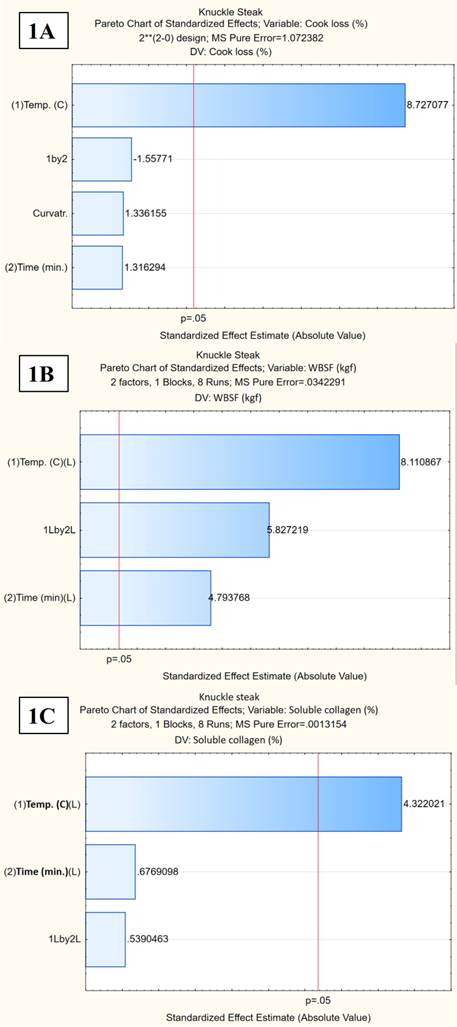
In figure 1, a Pareto diagram illustrates the results obtained through the CCD for the variables studied in the knuckle bovine cut sous vide processing. The Pareto diagram shows the main effects of the variables studied on the analyzed responses, providing important information about the relationship between cooking parameters and the characteristics of meat processed using the sous vide method. A significant effect of temperature was observed at a confidence level of 95 %, both for cooking loss (8.73) (Figure 1A) and for soluble collagen (4.32) (Figure 1C). Regarding shear force (Figure 1B), a significant effect of temperature (8.11) was observed, followed by the interaction of time x temperature (5.83) and time (4.80). The interaction implies that depending on the combination of time and temperature used in sous vide processing, desired tenderness values can be obtained, i.e., values lower than 5.0 kgf.
Pareto diagram of cooking loss (1A); Warner-Bratzler shear force (1B); and soluble collagen (1C) of the knuckle bovine cut subjected to sous vide processing.
The analysis of variance (ANOVA) results for the knuckle bovine cut processed by the sous vide method, considering the variables studied here, are shown in table 3. The calculated F value, which determines the statistical significance of the regression, is 22.38 for cooking loss, 15.36 for shear force, and 8.61 for soluble collagen. The F value is obtained by the ratio of the mean square due to regression to the residual mean square (MSR/RMS). When comparing these values with the tabulated F value for 3 and 4 degrees of freedom (6.59 for cooking loss and shear force; 9.12 for soluble collagen) at a significance level of 95 %, we observe that the calculated F value is approximately 3.40, 2.33 and 0.94 times higher, respectively. This suggests a good correlation between cooking loss and shear force and a weaker correlation for soluble collagen.
Analysis of variance using the least squares method for the parameters cooking loss (%), shear force (kgf), and soluble collagen (%) of the knuckle cut subjected to sous vide processing.
However, when analyzing the statistical significance of the lack of fit of the model, represented by the ratio of the mean square of lack of fit to the mean square of pure error (MSlof/MSpe), we observed that the calculated F value, for one and three degrees of freedom (1, 3, 95 %), is 1.79, 7.65, and 0.01, respectively. These values are lower than the tabulated F value of the F-test (10.13 for all variables). In other words, the calculated F value is approximately 0.18, 0.76 and 0.00 times smaller than the tabulated F value. Consequently, the obtained models did not show a lack of fit concerning the experimental results. This means that predictions can be made about the cooking loss (%), shear force (kgf), and soluble collagen (%) for other sous vide cooking temperatures and times within the studied parameters based on the established models. The coefficient of variation (CV%) for the cooking loss (%), shear force (kgf), and soluble collagen (%) variables during the knuckle bovine cut sous vide processing in the region of the central points of the CCD was 2.70 %, 3.41 %, and 16.59 %, respectively. These values indicated an acceptable repeatability of the methods developed under these specific conditions. The replicas at the central point reflect the magnitude of the pure error (SMpe), indicating the experiment’s inherent error. The coefficient of determination (R2) revealed that the models explained 94 %, 92 %, and 87 % of the variation in cooking loss (%), shear force (kgf), and soluble collagen (%), respectively.
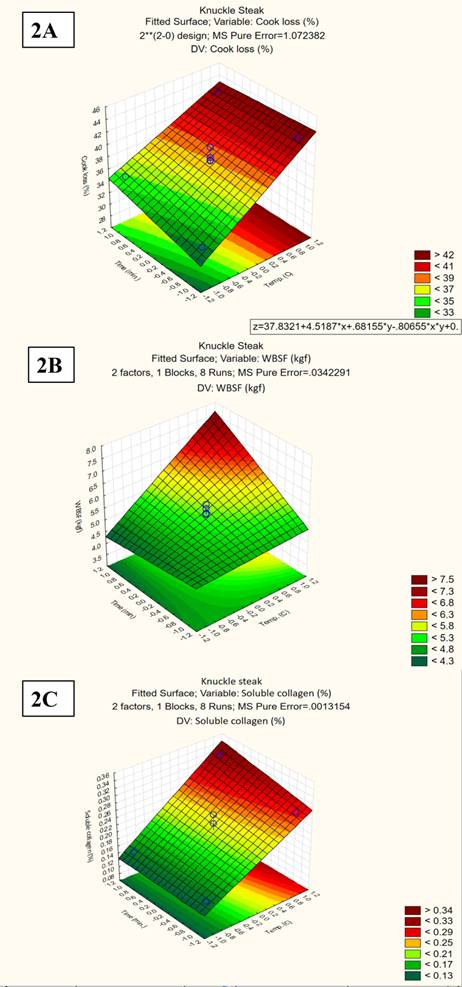
In the response surfaces generated by the CCD for the knuckle bovine cut sous vide processing (Figure 2), it was observed that the combination of temperature and time at 65 °C/60 min resulted in lower cooking loss (<33 %) (Figure 2A) and lower shear forces (green areas <4.8 kgf and <4.3 kgf) for the combinations of 65 °C/60 min and 65 °C/120 min respectively (Figure 2B). Intense collagen solubilization was observed at the highest cooking temperature and time (85 °C/120 min), a trend observed in the dark red region (<0.33 % and >0.34 %) (Figure 2C).
Response surface and linear model of cooking loss (2A); Warner-Bratzler shear force (2B); and soluble collagen (2C) of the knuckle bovine cut subjected to sous vide processing.
As indicated in table 2 and figure 2, the results suggested that with increasing temperature and cooking time, there is greater cooking loss and a decrease in the tenderness of the knuckle bovine cut processed by the sous vide method, which are undesirable characteristics in terms of meat tenderness, even though the percentage of soluble collagen may have higher values.
CONCLUSION
The combination of a lower temperature (65 °C) and times between 60 and 120 minutes favoured lower cooking loss and greater meat tenderness, even though it did not present a higher value of soluble collagen. In contrast, a higher temperature and prolonged time (85 °C/120 minutes) resulted in a higher value of soluble collagen but was associated with greater cooking loss and increased shear force. Therefore, for the knuckle cut, sous vide cooking at 65 °C combined with cooking times ranging from 60 to 120 minutes was the most favourable for obtaining more tender meat.
ACKNOWLEDGEMENTS
This study was conducted with the support of the Fundação Coordenação de Aperfeiçoamento de Pessoal de Nível Superior (CAPES) - Brazil - Financing Code 001, a master’s scholarship from the Conselho Nacional de Desenvolvimento Científico e Tecnológico (CNPq) - Brazil (process 130713/20201), and funding from the Empresa Brasileira de Pesquisa Agropecuária (Embrapa)
REFERENCES
-
AGUILERA, J. M. Relating food engineering to cooking and gastronomy. Comprehensive Reviews in Food Science and Food Safety, v.17, n.4, p.1021-1039, 2018. Available from: <Available from: https://doi.org/10.1111/1541-4337.12361 >. Accessed: Apr. 05, 2023. doi: 10.1111/1541-4337.12361.
» https://doi.org/10.1111/1541-4337.12361.» https://doi.org/10.1111/1541-4337.12361 - BAILEY, A. J.; LIGHT, N. D. Connective tissue in meat and meat products. London: Elsevier Applied Science, 1989.
-
BAILEY, A. J.; SIMS, T. J. Meat tenderness: distribution of molecular species of collagen in bovine muscle. Journal of the Science of Food and Agriculture, v.28, n.6, p.565-570, 1977. Available from: <Available from: https://doi.org/10.1002/jsfa.2740280615 >. Accessed: Apr. 05, 2023. doi: 10.1002/jsfa.2740280615.
» https://doi.org/10.1002/jsfa.2740280615.» https://doi.org/10.1002/jsfa.2740280615 -
BALDWIN, D. E. Sous vide cooking: A review. International Journal of Gastronomy and Food Science, v.1, n.1, p.15-30, 2012. Available from: <Available from: https://doi.org/10.1016/j.ijgfs.2011.11.002 >. Accessed: Apr. 05, 2023. doi: 10.1016/j.ijgfs.2011.11.002.
» https://doi.org/10.1016/j.ijgfs.2011.11.002.» https://doi.org/10.1016/j.ijgfs.2011.11.002 -
BERGMAN, I.; LOXLEY, R. Two improved and simplified methods for the spectrophotometric determination of hydroxyproline. Analytical Chemistry, v.35, n.12, p.1961-1965, 1963. Available from: <Available from: https://doi.org/10.1021/ac60205a053 >. Accessed: Apr. 05, 2023. doi: 10.1021/ac60205a053.
» https://doi.org/10.1021/ac60205a053.» https://doi.org/10.1021/ac60205a053 -
BOTINESTEAN, C. et al. The effect of thermal treatments including sous-vide, blast freezing and their combinations on beef tenderness of M. semitendinosus steaks targeted at elderly consumers. LWT, v.74, p.154-159, 2016. Available from: <Available from: https://doi.org/10.1016/j.lwt.2016.07.026 >. Accessed: Apr. 05, 2023. doi: 10.1016/j.lwt.2016.07.026.
» https://doi.org/10.1016/j.lwt.2016.07.026.» https://doi.org/10.1016/j.lwt.2016.07.026 -
CHO, D. K. et al. Effect of searing process on quality characteristics and storage stability of sous-vide cooked pork patties. Foods, v.9, n.8, p.1011, 2020. Available from: <Available from: https://doi.org/10.3390/foods9081011 >. Accessed: May, 22, 2024. doi: 10.3390/foods9081011.
» https://doi.org/10.3390/foods9081011.» https://doi.org/10.3390/foods9081011 -
CHRISTENSEN, L. et al. Relationship between meat toughness and properties of connective tissue from cows and young bulls heat treated at low temperatures for prolonged times. Meat Science, v.93, n.4, p.787-795, 2013. Available from: <Available from: https://doi.org/10.1016/j.meatsci.2012.12.001 >. Accessed: Apr. 05, 2023. doi: 10.1016/j.meatsci.2012.12.001.
» https://doi.org/10.1016/j.meatsci.2012.12.001.» https://doi.org/10.1016/j.meatsci.2012.12.001 -
CROSS, H. R. et al. Effects of intramuscular collagen and elastin on bovine muscle tenderness. Journal of Food Science, v.38, n.6, p.998-1003, 1973. Available from: <Available from: https://doi.org/10.1111/j.1365-2621.1973.tb02133.x >. Accessed: Apr. 05, 2023. doi: 10.1111/j.1365-2621.1973.tb02133.x.
» https://doi.org/10.1111/j.1365-2621.1973.tb02133.x.» https://doi.org/10.1111/j.1365-2621.1973.tb02133.x - CYLKA, S. The Everything Guide to Cooking Sous Vide: Step-by-step Instructions for Vacuum-sealed Cooking at Home. Simon and Schuster, 2015.
-
DELLA TORRE, J. C. M.; BERAQUET, N. J. Composição centesimal e teor de colágeno em carne bovina moída. Rev. Inst. Adolfo Lutz, v.64, n.2, p.223-231, 2005. Available from: <Available from: https://doi.org/10.53393/rial.2005.64.32988 >. Accessed: Apr. 05, 2023. doi: 10.53393/rial.2005.64.32988.
» https://doi.org/10.53393/rial.2005.64.32988.» https://doi.org/10.53393/rial.2005.64.32988 -
DEL PULGAR, J. S. et al. Physico-chemical, textural and structural characteristics of sous-vide cooked pork cheeks as affected by vacuum, cooking temperature, and cooking time. Meat Science, v.90, n.3, p.828-835, 2012. Available from: <Available from: https://doi.org/10.1016/j.meatsci.2011.11.024 >. Accessed: Apr. 05, 2023. doi: 10.1016/j.meatsci.2011.11.024.
» https://doi.org/10.1016/j.meatsci.2011.11.024.» https://doi.org/10.1016/j.meatsci.2011.11.024 -
DOMINGUEZ-HERNANDEZ, E. et al. Low-temperature long-time cooking of meat: Eating quality and underlying mechanisms. Meat Science, v.143, p.104-113, 2018. Available from: <Available from: https://doi.org/10.1016/j.meatsci.2018.04.032 >. Accessed: Apr. 05, 2023. doi: 10.1016/j.meatsci.2018.04.032.
» https://doi.org/10.1016/j.meatsci.2018.04.032.» https://doi.org/10.1016/j.meatsci.2018.04.032 -
EMPRESA BRASILEIRA DE PESQUISA AGROPECUÁRIA (EMBRAPA). Embrapa Gado de Corte. 2023. Available from: <Available from: https://old.cnpgc.embrapa.br/publicacoes/naoseriadas/cortes/textos/patinho.html >. Accessed: Apr. 05, 2023.
» https://old.cnpgc.embrapa.br/publicacoes/naoseriadas/cortes/textos/patinho.html -
GOLL, D. E. et al. Age‐associated changes in Muscle Composition. The Isolation and Properties of a Collagenous Residue from Bovine Muscle. Journal of Food Science, v.28, n.5, p.503-509, 1963. Available from: <Available from: https://doi.org/10.1111/j.1365-2621.1963.tb00234.x >. Accessed: Apr. 05, 2023. doi: 10.1111/j.1365-2621.1963.tb00234.x.
» https://doi.org/10.1111/j.1365-2621.1963.tb00234.x.» https://doi.org/10.1111/j.1365-2621.1963.tb00234.x -
HAGHIGHI, H. et al. Effect of time and temperature on physicochemical and microbiological properties of sous vide chicken breast fillets. Applied Sciences, v.11, n.7, p.3189, 2021. Available from: <Available from: https://doi.org/10.3390/app11073189 >. Accessed: May, 22, 2024. doi: 10.3390/app11073189.
» https://doi.org/10.3390/app11073189.» https://doi.org/10.3390/app11073189 -
HILL, F. The solubility of intramuscular collagen in meat animals of various ages. Journal of Food Science, v.31, n.2, p.161-166, 1966. Available from: <Available from: https://doi.org/10.1111/j.1365-2621.1966.tb00472.x >. Accessed: Apr. 05, 2023. doi: 10.1111/j.1365-2621.1966.tb00472.x.
» https://doi.org/10.1111/j.1365-2621.1966.tb00472.x.» https://doi.org/10.1111/j.1365-2621.1966.tb00472.x -
JAMES, B. J.; YANG, S. W. Effect of cooking method on the toughness of bovine M. semitendinosus. International Journal of Food Engineering, v.8, n.2, 2012. Available from: <Available from: https://doi.org/10.1515/1556-3758.2762 >. Accessed: Apr. 05, 2023. doi: 10.1515/1556-3758.2762.
» https://doi.org/10.1515/1556-3758.2762.» https://doi.org/10.1515/1556-3758.2762 -
MORAES, F.; RODRIGUES, N. S. S. Yield maximization in sous vide cooked beef (Semitendinosus muscle). Brazilian Journal of Food Technology, v.20, 2017. Available from: <Available from: https://doi.org/10.1590/1981-6723.4816 >. Accessed: Apr. 05, 2023. doi: 10.1590/1981-6723.4816.
» https://doi.org/10.1590/1981-6723.4816.» https://doi.org/10.1590/1981-6723.4816 -
NAQVI, Z. B. et al. Effect of sous vide cooking and ageing on tenderness and water-holding capacity of low-value beef muscles from young and older animals. Meat Science, v.175, p.108435, 2021. Available from: <Available from: https://doi.org/10.1016/j.meatsci.2021.108435 >. Accessed: Apr. 05, 2023. doi: 10.1016/j.meatsci.2021.108435.
» https://doi.org/10.1016/j.meatsci.2021.108435.» https://doi.org/10.1016/j.meatsci.2021.108435 -
NEUMAN, R. E.; LOGAN, M. A. The determination of collagen and elastin in tissues. Journal of Biological Chemistry, v.186, n.2, p.549-556, 1950. Available from: <Available from: https://doi.org/10.1016/S0021-9258(18)56248-7 >. Accessed: Apr. 05, 2023. doi: 10.1016/S0021-9258(18)56248-7.
» https://doi.org/10.1016/S0021-9258(18)56248-7.» https://doi.org/10.1016/S0021-9258(18)56248-7 -
ORTUÑO, J. et al. Effects of sous vide vs grilling methods on lamb meat colour and lipid stability during cooking and heated display. Meat Science, v.171, p.108287, 2021. Available from: <Available from: https://doi.org/10.1016/j.meatsci.2020.108287 >. Accessed: May, 22, 2024. doi: 10.1016/j.meatsci.2020.108287.
» https://doi.org/10.1016/j.meatsci.2020.108287.» https://doi.org/10.1016/j.meatsci.2020.108287 -
PURSLOW, P. P. Contribution of collagen and connective tissue to cooked meat toughness; some paradigms reviewed. Meat Science, v.144, p.127-134, 2018. Available from: <Available from: https://doi.org/10.1016/j.meatsci.2018.03.026 >. Accessed: Apr. 05, 2023. doi: 10.1016/j.meatsci.2018.03.026.
» https://doi.org/10.1016/j.meatsci.2018.03.026.» https://doi.org/10.1016/j.meatsci.2018.03.026 - RAMOS, E. M.; GOMIDE, L. M. A. Avaliação da qualidade de carnes: fundamento e metodologias. UFV, 2007.
-
RHEE, M. S. et al. Variation in palatability and biochemical traits within and among eleven beef muscles. Journal of Animal Science, v.82, n.2, p.534-550, 2004. Available from: <Available from: https://doi.org/10.2527/2004.822534x >. Accessed: Apr. 05, 2023. doi: 10.2527/2004.822534x.
» https://doi.org/10.2527/2004.822534x.» https://doi.org/10.2527/2004.822534x -
SEBASTIÁ, C. et al. Microbiological quality of sous vide cook-chill preserved food at different shelf life. Journal of Food Processing and Preservation, v.34, n.6, p.964-974, 2010. Available from: <Available from: https://doi.org/10.1111/j.1745-4549.2009.00430.x >. Accessed: Apr. 05, 2023. doi: 10.1111/j.1745-4549.2009.00430.x.
» https://doi.org/10.1111/j.1745-4549.2009.00430.x.» https://doi.org/10.1111/j.1745-4549.2009.00430.x -
SHACKELFORD, S. D. et al. Tenderness classification of beef: II. Design and analysis of a system to measure beef longissimus shear force under commercial processing conditions. Journal of Animal Science, v.77, n.6, p.1474-1481, 1999. Available from: <Available from: https://doi.org/10.2527/1999.7761474x >. Accessed: Apr. 05, 2023. doi: 10.2527/1999.7761474x.
» https://doi.org/10.2527/1999.7761474x.» https://doi.org/10.2527/1999.7761474x -
SURIAATMAJA, D.; LANIER, T. Mechanism of meat tenderization by sous vide cooking. Meat Science, v.1, n.96, p.457, 2014. Available from: <Available from: https://doi.org/10.1016/j.meatsci.2013.07.073 >. Accessed: Apr. 05, 2023. doi: 10.1016/j.meatsci.2013.07.073.
» https://doi.org/10.1016/j.meatsci.2013.07.073.» https://doi.org/10.1016/j.meatsci.2013.07.073 -
STRINGER, S. C.; METRIS, A. Predicting bacterial behaviour in sous vide food. International Journal of Gastronomy and Food Science, v.13, p.117-128, 2018. Available from: <Available from: https://doi.org/10.1016/j.ijgfs.2017.09.001 >. Accessed: May, 22, 2024. doi: 10.1016/j.ijgfs.2017.09.001.
» https://doi.org/10.1016/j.ijgfs.2017.09.001.» https://doi.org/10.1016/j.ijgfs.2017.09.001 - UNICAMP. Tabela Brasileira de Composição de Alimentos / NEPA - UNICAMP. 4. ed. rev. e ampl. Campinas: NEPA- UNICAMP, 2011. 161p.
-
THATHSARANI, A. P. K. et al. Current status and future trends of sous vide processing in meat industry; A review. Trends in Food Science & Technology, v.129, p.353-363, 2022. Available from: <Available from: https://doi.org/10.1016/j.tifs.2022.10.009 >. Accessed: May, 22, 2024. doi: 10.1016/j.tifs.2022.10.009.
» https://doi.org/10.1016/j.tifs.2022.10.009.» https://doi.org/10.1016/j.tifs.2022.10.009 -
TORNBERG, E. V. A. Effects of heat on meat proteins-Implications on structure and quality of meat products. Meat Science, v.70, n.3, p.493-508, 2005. Available from: <Available from: https://doi.org/10.1016/j.meatsci.2004.11.021 >. Accessed: Apr. 05, 2023. doi: 10.1016/j.meatsci.2004.11.021.
» https://doi.org/10.1016/j.meatsci.2004.11.021.» https://doi.org/10.1016/j.meatsci.2004.11.021 -
VAUDAGNA, S. R. et al. Sous vide cooked beef muscles: effects of low temperature-long time (LT-LT) treatments on their quality characteristics and storage stability. International Journal of Food science & Technology, v.37, n.4, p.425-441, 2002. Available from: <Available from: https://doi.org/10.1046/j.1365-2621.2002.00581.x >. Accessed: Apr. 05, 2023. doi: 10.1046/j.1365-2621.2002.00581.x.
» https://doi.org/10.1046/j.1365-2621.2002.00581.x.» https://doi.org/10.1046/j.1365-2621.2002.00581.x -
WARNER, R. D. et al. Genetic and environmental effects on meat quality. Meat Science, v.86, n.1, p.171-183, 2010. Available from: <Available from: https://doi.org/10.1016/j.meatsci.2010.04.042 >. Accessed: Apr. 05, 2023. doi: 10.1016/j.meatsci.2010.04.042.
» https://doi.org/10.1016/j.meatsci.2010.04.042.» https://doi.org/10.1016/j.meatsci.2010.04.042 -
YANG, X. et al. Effects of a novel three-step sous-vide cooking and subsequent chilled storage on the microbiota of beef steaks. Meat Science, v.159, p.107938, 2020. Available from: <Available from: https://doi.org/10.1016/j.meatsci.2019.107938 >. Accessed: May, 22, 2024. doi: 10.1016/j.meatsci.2019.107938.
» https://doi.org/10.1016/j.meatsci.2019.107938.» https://doi.org/10.1016/j.meatsci.2019.107938
Edited by
-
Editors
Rudi Weiblen (0000-0002-1737-9817)Rubén Domínguez Valencia (0000-0002-2764-504X)