
 Prevalence of swine carcass condemnations for respiratory diseases and associated risk factors
ABSTRACT:
This study evaluated the prevalence of swine carcass condemnation due to respiratory diseases at slaughter, and its association with climatic and farm-related risk factors. This study comprised a retrospective analysis of data from 156 pig growing-and-finishing farms for a period classified into years 1 (October2016 to September2017) and 2 (October2017 to September2018). These periods were then further divided into dry and rainy seasons. The impact of risk factors on carcass condemnation, such as farm production rates, was also analyzed. Swine carcass condemnations was higher during the dry seasons, with wet pleuritis accounting for 60.38% of all condemnations (P < 0.0001). In addition, carcass condemnation was higher in year 2 than in year 1 (P < 0.0001). Carcasses condemned for dry pleuritis were released for consumption, while those condemned for pleuropneumonia were redirected to grease production (P < 0.0001). Lots with piglets from two or more origins compared with a single origin, as well as a shorter cleaning and disinfection (C&D) plan, accounted for a higher prevalence of condemned carcasses. Climatic conditions, number of piglet origins, and C&D plans are associated with higher condemnation prevalence rates due to respiratory diseases in the abattoir.
Key words:
Pig; farming; pleuritis; pneumonia; season year; slaughterhouse
RESUMO:
O objetivo deste estudo foi avaliar a prevalência de condenações de carcaças de suínos por doenças respiratórias no abate e associá-las a fatores de risco climáticos e relacionados agranja. O estudo compreendeu uma análise retrospectiva de dados de 156 propriedades de crescimento e terminação de suínos por um período classificado em ano 1 (outubro/2016 a setembro/2017) e ano 2 (outubro/2017 a setembro/2018), bem como as condições climáticas classificadas em estação seca e estação chuvosa. Também foi analisado o impacto dos fatores de risco sobre as condenações, como os índices de produção das granjas. As condenações de carcaças de suínos foram maiores durante a estação seca, com pleurite úmida respondendo por 60,38 % das condenações (P < 0,0001). Além disso, as condenações de carcaças foram maiores no ano 2 em comparação com o ano 1 (P < 0,0001). As carcaças condenadas por pleurite seca foram liberadas para consumo, e as carcaças condenadas por pleuropneumonia foram destinadas para gordura (P < 0,0001). Leitões de duas ou mais origens em relação à origem única e menor plano de limpeza e desinfecção foram responsáveis pelo maior número de carcaças de suínos condenados. Condições climáticas, número de procedências de leitões, plano de limpeza e desinfecção estão associados às taxas de prevalência de condenação de carcaças de suínos por doenças respiratórias no abate.
Palavras-chave:
Abatedouro; estação do ano; pleurite; pneumonia; suinocultura.
INTRODUCTION
The main infectious agents that cause respiratory diseases in swine are widespread in herds, and some are naturally present as respiratory tract microbiota. One or more pathogens and several risk factors are involved in the onset of respiratory diseases and the worsening of pathological conditions (GEBHARDT et al., 2020). The infectious agents involved in these respiratory diseases include Mycoplasma (M.) hyopneumoniae, Pasteurella (P.) multocida, Actinobacillus (A.) pleuropneumoniae, Haemophilus (H.) parasuis, gram-positive bacteria, porcine circovirus type 2 (PCV2), swine influenza virus, and swine reproductive and respiratory syndrome viruses (PRRS), which are considered exotic in Brazil (BARCELLOS et al., 2008; MORES et al., 2016; GAVA et al., 2022).
The adoption of on-farm containment methods, such as caging, has increased the risk infectious diseases, especially respiratory diseases, and the consequences are observed in animal production losses (weight gain, feed conversion [FC], and mortality rate [MR]), expenses for vaccines and other medications, and losses in slaughter with partial or total carcass condemnation, mainly due to pneumonia, pleuritis, and abscesses (BARCELLOS et al., 2008; MORES et al., 2015). In these production systems, multiple environmental factors interfere with the balance between infection pressure and the ability of animals to overcome the health challenge, whether developing or not, and are thus determinants of disease severity (GALDEANO et al., 2019).
Respiratory diseases are considered multifactorial diseases (STARK, 2000) because their frequency and degree of severity depend on the agent’s virulence and associated risk factors (MORES et al., 2015). Non-infectious risk factors related to facilities, management, environmental conditions, and individual or herd characteristics may be involved in the development and severity of respiratory pathologies (GEBHARDT et al., 2020).
The slaughterhouse is the final point where the sanitary status of animals can be assessed to evaluate the effectiveness of sanitary control measures applied on farms (MERIALDI et al., 2012). Pig inspection at slaughter is widely used in epidemiological studies investigating the prevalence of injuries and associated risk factors. Identifying these factors is important to control respiratory problems, improve production rates on farms, and reduce economic losses associated with respiratory diseases (FABLET et al., 2012).
Depending on the degree and intensity of the injury, carcasses condemned for respiratory diseases have three possible outcomes: 1) release for production of “in natura” meat; 2) partial condemnation with heat treatment; or 3) total condemnation, following which the carcass is diverted to grease production (BRASIL, 2017). In this context, this study evaluated the prevalence of swine carcass condemnation due to respiratory diseases at slaughter, and its association with climatic and farm-related risk factors.
MATERIALS AND METHODS
The study was a retrospective data analysis that covered 156 pig growing-and-finishing farms integrated into an agribusiness, in the city of Rio Verde (17º 47′ 50″ S and 50º 54′ 0″ W with an altitude of 715 m), in the southwest of the state of Goiás, Brazil. According to the Köppen-Geiger climate classification, the tropical climate is Aw, characterized by two distinct seasons with rainy summers and dry winters (LOPES et al., 2020). The period from October 2016 to September 2017 was classified as year 1 (dry season: April to September), and the period between October 2017 and September 2018 was classified as year 2 (rainy season: October to March).
Weather data on precipitation (mm), air temperature (ºC), and relative humidity (%) (RH) were obtained from historical data of the Rio Verde weather station, code WMO A025, provided by the National Institute of Meteorology, from October 2016 to September 2018 (INMET, 2019). In year 1, the total rainfall was 1,546.4 mm compared with 1,315.0 mm in year 2. The average air temperature in year 1 was 22.89 ºC (73.20 ºF) and 23.06 ºC (73.50 ºF) in year 2. The average RH was 65.60% in year 1 and 63.21% in year 2. Rainfall in the rainy season in year 1 was 1,334.2 mm compared with 1,163 mm in year 2. During the dry season, rainfall in year 1 was 212.2 mm and 152.8 mmin year 2. Air temperature in the rainy season in year 1 averaged 23.55 ºC (74.39 ºF) with an average minimum temperature of 11.7 ºC (53.06 ºF) and maximum of 34.9 ºC (94.82 ºF), and in year 2, it averaged 24.11 ºC (75.38 ºF) with an average minimum value of 14.7 ºC (58.46 ºF) and maximum of 37.6 ºC (99.68 ºF). In the dry season of year 1, the air temperature averaged 22.27 ºC (72.08 ºF) with an average minimum of 4.8 ºC (40.64 ºF) and maximum of 34.8 ºC (94.64 ºF), and in year 2, it averaged 22.02 ºC (71.63 ºF) with an average minimum of 7.4 ºC (45.32 ºF) and maximum of 35.9 ºC (96.62 ºF). Temperatures below 12 ºC (53.6 ºF) were observed in June, July, and August in year 1 and in May, July, August, and September in year 2. The average RH in the rainy season of year 1 was 74.39% and that in year 2 was 71.28%. In the dry season of year 1, the average RH was 56.81%, and in year 2, it was 55.38%.
All animals were slaughtered in an abattoir under the purview of the Federal Inspection Service (FIS), with a slaughtering capacity of 5,400 animals/day, operating in two production shifts. Data related to condemnations for respiratory diseases were provided daily by FIS according to the degree and intensity of the injury defined in Article 1304136 of the Regulation of Industrial and Sanitary Inspection of Products of Animal Origin (RISIPAO) (BRASIL, 2017) and Ordinance No. 1304 (BRASIL, 2018). Thus, data included the number of animals slaughtered, the number of carcasses condemned for respiratory diseases (pneumonia, pleuropneumonia, and pleuritis, referred to by FIS as dry and wet pleurisy), condemnation classification (total or partial condemnation), and destination after diversion to the Final Inspection Department (FID). Carcasses could be released after partial condemnation, through the removal of affected organs and parts, or conditional condemnation through the removal and total condemnation of the affected parts, releasing the rest of the carcass for use in cooked products (canning or lard production). Total condemnation occurred when the carcass was wholly affected, causing it to be redirected towards by-products not intended for human consumption. The criteria for condemning carcasses employed by FIS met the requirements of RISIPAO (BRASIL, 2017).
The factors in the relative risk analysis included climatic season (dry or rainy). The farm-related factors were as follows: cleaning and dissection (C&D) plan in days (number of days that the facilities are empty between lots) and the number of piglet origins (1; 2-3; 4-5 and ≥ 6 origins per lot). The animal production indices included slaughter weight (SW, kg), daily weight gain (DWG, kg), MR, and FC. Data on the risk factors related to climate and animal production indices were tabulated in an Excel spreadsheet according to each batch slaughtered daily, together with data on the incidence of respiratory disease in the carcasses.
Statistical analyses were performed using SAS version 9.4 (Statistical Analysis Institute, Cary, North, USA). To compare carcass condemnations by year, climatic season, and destination, a chi-square test was applied. Wilcoxon and Kruskal-Wallis tests were applied to compare the condemnations between the 2 years of study, climatic seasons, and number of animal origins. To evaluate the impact of animal production indices on carcass condemnations, principal component analysis was used. Results were considered statistically significant at a significance level of 5%.
RESULTS AND DISCUSSION
Between October 2016 and September 2018, 2,894,481 pigs were slaughtered: 1,473,459 in year 1 and 1,421,022 in year 2. The prevalence of carcass condemnation for respiratory disease injuries was 0.90% (13,323 pigs) in year 1, and 1.76% (25,046 pigs) in year 2 (Figure 1). In year 1, the 0.90% prevalence of carcass condemnation for respiratory problems could be broken down as follows: 0.35% were condemned for pneumonia; 0.24% for wet pleuritis; 0.19% for dry pleuritis; and 0.12% for pleuropneumonia. In the subsequent year, an increase of 94.93% in the number of carcasses condemned was observed, with 1.76% of the carcasses partially or totally condemned. Wet pleuritis accounted for 0.75% of all condemnations in year 2 (Figure 1). Carcass condemnation was significantly higher in year 2 (P < 0.0001) than in year 1, with wet pleuritis accounting for 74.92% and pneumonia accounting for 61.96% of condemned pig carcasses (Table 1).
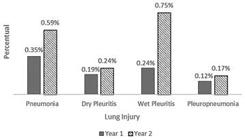
Prevalence (%) of pig carcass condemnation for lung injury according to the year, evaluated in an abattoir. Year 1: October2016 to September2017; year 2: October2017 to September2018.
In the city of Sinope in Mato Grosso State, Brazil, CASTRO et al. (2014) identified a cumulative prevalence of 26.24% of carcasses condemned for pneumonia from 2008 to 2010. Based on information from FIS, SILVA et al. (2020) reported pleuritis with adhesions as the main cause of condemnation of swine carcasses in Brazilian abattoirs. In the present study, prevalence was not influenced by the month of the year (P > 0.05); although, there was a higher percentage of condemnation in September.
Variations in the results obtained in this study, of 1.33% condemnations overall, 0.90% in year 1, and 1.76% in year 2, were due to many risk factors associated with respiratory diseases and their interactions, complicating the epidemiology (PAPATSIROS et al., 2022). According to SILVA et al. (2020). The differences in prevalence in swine carcass condemnation among Brazilian abattoirs may be linked to the management of the abattoir and the quality of employee training, which influence the results of condemnations.
Of the carcasses condemned for respiratory diseases and deviated to FID due to dry pleuritis, 99.51% were released for consumption. When deviating for wet pleuritis or pneumonia, 99.65% and 99.58%, respectively, were used in cooked products (P < 0.0001). In carcasses condemned for pleuropneumonia, 99.51% were redirected to grease owing to their total condemnation (Table 1).
Brazilian legislation was used as a reference for analyzing the condemnation criteria and carcass destinations for each cause. According to RISIPAO (BRASIL, 2017), carcasses with pleural adhesions without exudation originating from infectious processes and without lymphatic involvement can be released for consumption after the removal of the affected parts. The analysis showed that 99.51% of carcasses condemned for dry pleuritis were released for consumption after removal of the affected organs and parts, demonstrating that inspection criteria adhere to the legislation with respect to carcasses released for ‘in natura’ products.
Of the total number of carcasses with wet pleuritis and pneumonia, 99.65% and 99.58% were partially condemned. The affected parts were removed and condemned, while the rest of the carcass went for conditional use, in agreement with Article 136 of RISIPAO (BRASIL, 2017), which requires heat treatment of carcasses with infectious processes involving the lungs and pleura, with exudates, but where the rest of the carcass is unaffected. Of the animals sent to FID due to pleuropneumonia, 99.51% were consigned to grease production, corroborating RISIPAO (BRASIL, 2017) guidance, which requires that carcasses with whole-body infectious involvement are wholly condemned.
Climatic season was a significant factor in the prevalence of respiratory problems in carcasses, with higher prevalence in the dry season (1.52%) than in the rainy season (1.26%) (Table 2) (P < 0.0001). Condemnations for wet pleuritis and pneumonia were higher in the rainy season, representing 60.38% and 53.18% of condemned carcasses, respectively. The number of swine carcasses condemned for dry pleuritis was higher in the dry season than in the rainy season at 62.34% and 37.66%, respectively (Table1).
The dry season in the southwestern region of the state of Goiás, Brazil, comprises the months from April to September, when lower temperatures occur, with an average of 22.27 ºC (72.08 ºF) in year 1 and 22.02 ºC (71.63 ºF) in year 2. Minimum temperatures of 4.8 ºC (40.64 ºF) and 7.4 ºC (45,32 ºF) in years 1 and 2, respectively, were recorded. Rainfall was low during this period with 212.2 mm in year 1 and 152.8 mm in year 2 and low RH with 56.81% in year 1 and 55.38% in year 2 (INMET, 2019).
Indoor climate conditions are directly associated with respiratory infections such as pneumonia and pleuritis. Temperatures below the thermal comfort threshold influence the physiological ability of pigs to control bacteria in the respiratory tract (GEBHARDT et al., 2020).
Temperature fluctuations, such as climate-season transitions or even inadequate curtain management, cause stress in animals, leaving them less able to respond to infection (MORES et al., 2015; GEBHARDT et al., 2020). BROWNE et al. (2016) showed that M. hyopneumoniae survives outside the host for at least 8 days at low temperatures, which may explain the more extensive transmission of this agent in these periods.
VANGROENWEGHE et al. (2015) and RUNCHENG et al. (2019) also reported greater detection of lung lesions caused by M. hyopneumoniae during the slaughter of pigs during low temperature seasons. These studies suggested that high temperatures are better for the respiratory health of pigs, consistent with the results of this study. A lower prevalence of condemnation for respiratory problems was observed in the rainy season when temperatures were high, with an average of 23.55 ºC in year 1 (maximum 34.9 ºC) and an average of 24.11 ºC in year 2 (maximum 37.6 ºC) (INMET, 2019).
NOZZA et al. (2021) cited low RH as a risk factor for direct interference with the mucociliary defense mechanism owing to a reduction in mucus viscosity, impairing its transit through the respiratory tract. In addition to RH, facilities are less well-ventilated for longer periods during colder times of the year, with a greater accumulation of gases, dust, suspended particles, and aerosols, which are harmful to the non-specific defense systems of the respiratory tract (GEBHARDT et al., 2020). Excess gases in the environment, such as ammonia and and particulate matter with a diameter of 10 micrometers or less (PM10), cause inflammation of the respiratory epithelium, affecting the mucociliary defense mechanism and predisposing the respiratory tract to infections (MICHIELS et al., 2015). In a study conducted in France, FABLET et al. (2012) observed that high concentrations of CO2 in finishing rooms (> 1,600 ppm) increased the probability of pneumonia.
According to GEBHARDT et al. (2020), the internal parameters of temperature and RH in facilities are influenced by external climatic conditions, which may suggest that respiratory diseases are influenced by the seasons and explain the difference in condemnation rates between the rainy and dry seasons. In the dry season, average RH was 56.81% and 55.38% in years 1 and 2, respectively; in the rainy season, the values increased to 74.39% (year 1) and 71.28% (year 2). The ambient temperature in the dry season, meanwhile, recorded average lows of 4.8 ºC (40.64 ºF) in year 1 and 7.4 ºC (45.32 ºF) in year 2. D’ALENCAR et al. (2011) evaluated lung lesions in pigs slaughtered in the metropolitan region of Recife and Zona da Mata of Pernambuco and reported that 43.8% of the total animals evaluated (313/715) had some type of lung injury, with pneumonia being recorded in 93.0% (291/313). This region has a humid tropical climate, and as the present study found, there are more cases of pneumonia in the rainy season, which is associated with higher temperatures.
Differences were also observed in relation to the origin of the animals, where piglet lots from two or more origins had the highest number of condemned carcasses compared to single-origin lots (P < 0.0001). Prevalence rates of 1.27%, 1.46%, and 1.32% for 2-3, 4-5, and ≥ 6 origins for piglets were observed, respectively, compared to 1.07% prevalence for lots with a single origin (Table 2).
The causative agents of respiratory diseases are easily introduced to farms through live animals; therefore, herd management is an extremely important risk factor (STARK et al., 2000). The mixture of animals of different origins in the growing-finishing phase was identified as a significant risk factor for greater condemnation of carcasses in this study and had an impact on the MR and FC. The epidemiological variability related to the mixture of swine of different origins results in the appearance of distinct strains of M. hyopneumoniae in the herd (MAES et al., 2018), representing an important risk factor to be controlled to avoid disease and the consequent condemnation of carcasses at slaughter.
Lots with multiple origins had animals with different sanitary and immunological statuses, and the presence of high-shedder animals with high pathogen loads could not be ruled out. Another factor which could lead to health problems may be the diversity of microorganisms present in animals from different origins (ABCS, 2019).
In the principal component analysis shown in figure 2, components 1 and 2 explained approximately 46% of the relationship between climatic and farm-related risk factors and the frequency of carcass condemnation due to respiratory problems. Thus, longer C&D plans on the farm before the arrival of a new lot was observed to produce higher SW and DWG and lower FC, MR and frequency of carcass condemnation.
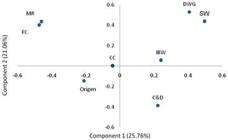
First two principal components of the climatic and farm-related risk factors for condemnation of pig carcasses due to respiratory infections in an abattoir during the 2-year study period. DWG: daily weight gain; FC feed conversion; MR: mortality rate; CC: carcass condemnation; IBW: initial body weight; SW: slaughter weight; C&D: cleaning and disinfection plan.
In this study, the absence of a C&D plan also represented a risk for carcass condemnation due to respiratory problems. For animal production indices, C&D plans showed a positive relationship with SW and DWG. GALDEANO et al. (2019) verified the inverse association between the number of empty days between lots, the adoption of C&D protocols in the facilities of growing-finishing pigs, and the presence of antibodies against M. hyopneumoniae.
FABLET et al. (2012) observed that a short emptying time interval between lots (< 4 weeks) increased the likelihood of the lots being affected by pneumonia. The authors identified the adoption of the all-in/all-out system as advantageous compared with the continuous-use system for the control of respiratory diseases (SCHEIDT et al., 1995; STARK et al., 2000). The C&D plan is one of the most important tools in the control of enzootic pneumonia to break the transmission cycle of the pathogen (MAES et al., 2008). It plays a fundamental role in the disinfection process and must allow enough time for disinfectants to reduce pathogen quantity, and consequently, improve animal performance (ABCS, 2019).
GALDEANO et al. (2019) verified the inverse association between the presence of antibodies against M. hyopneumoniae and DWG. Seropositivity for swine viral influenza was also associated with mortality in the growing-finishing phase, and this was associated with the presence of pulmonary lesions at slaughter. These results corroborated those found in this study, where high condemnation of carcasses for respiratory problems was associated with factors such as high mortality and low weight gain, along with other risk factors such as a longer C&D plan and multiple origins of piglets.
Other factors related to the host and the environment influence respiratory diseases in pigs through complex relationships with pathogenic microorganisms. Factors such as temperature fluctuation, humidity, and ventilation, as well as lot size, population density, number of piglet origins, and proximity to farms, contribute to the increased prevalence of M. hyopneumoniae pneumonia, which can function as a gateway to secondary agents, such as P. multocida (MAES et al., 2018).
The introduction of animals into lots, along with stress, overcrowding, and low immunity, are the determinants of disease outbreaks and the control of risk factors is crucial for preventing viral diseases such as swine viral influenza and circovirosis (ALARCÓN et al., 2021). Finally, SILVA et al. (2020) reported that regardless of the cause, the high condemnation rate in Brazil places a burden on production processes and casts doubton the efficiency of inspection systems for products of animal origin.
CONCLUSION
In the present study, climatic and farm-related risk factors influenced the condemnation of swine carcasses due to respiratory problems. There was greater condemnation of partial or total carcasses during the dry season than in the rainy season. The prevalence of condemnation carcasses for respiratory diseases in pigs was lower in year 1 than in year 2, which was generally drier, warmer and less humid. Carcasses affected by dry pleurisy were partially condemned, with the affected parts removed and the remainder released for consumption. Carcasses with wet pleurisy and pneumonia had the compromised areas removed, with the rest designated for the production of cooked products. In contrast, carcasses with pleuropneumonia, due to the overall impact of the infectious process, were completely condemned and redirected for the production of non-edible by-products. Lots with piglets from two or more origins showed a higher condemnation rate than that of lots from a single origin, as well as higher mortality rate and feed conversion. In addition, longer the cleaning and disinfection (C&D) plans on the farm before the entrance of a new lot led to higher slaughter weight, increased daily weight gain, lower feed conversion, reduced mortality rates, and a decreased frequency of carcass condemnation.
ACKNOWLEDGEMENTS
The authors would like to thank Brasil Foods S.A. for providing the facilities and Coordenação de Aperfeiçoamento de Pessoal de Nível Superior (CAPES), Brasil - Finance code 001.
REFERENCES
-
ALARCÓN, L. V. et al. Biosecurity in pig farms: a review. Porcine Health Management, v.7, n.5, 2021. Available from: <Available from: https://doi.org/10.1186/s40813-020-00181-z >. Accessed: Mar. 26, 2022. doi: 10.1186/s40813-020-00181-z.
» https://doi.org/10.1186/s40813-020-00181-z.» https://doi.org/10.1186/s40813-020-00181-z -
ASSOCIAÇÃO BRASILEIRA DE CRIADORES DE SUÍNOS - ABCS. Novos caminhos na suinocultura. Brasília: ABCS. 2019, 31p. Available from: <Available from: https://ainfo.cnptia.embrapa.br/digital/bitstream/item/204600/1/final9061.pdf >. Accessed: Mar. 26, 2022.
» https://ainfo.cnptia.embrapa.br/digital/bitstream/item/204600/1/final9061.pdf -
BARCELLOS, D. E. S. N. et al. Relationship between rnvironment, management, and respiratory diseases in swine. Acta Scientiae Veterinariae, v.36, n.1, p.87-93, 2008. Available from: <Available from: https://lume.ufrgs.br/bitstream/handle/10183/31088/000668646.pdf?sequence=1&isAllowed=y >. Accessed: Mar. 26, 2022.
» https://lume.ufrgs.br/bitstream/handle/10183/31088/000668646.pdf?sequence=1&isAllowed=y -
BRASIL. MINISTÉRIO DA AGRICULTURA, PECUÁRIA E ABASTECIMENTO - MAPA. Decreto n.º 9.013 de 27 mar 2017. 2017. Available from: <Available from: https://pesquisa.in.gov.br/imprensa/jsp/visualiza/index.jsp?jornal=1&data=30/03/2017&pagina=3 >. Accessed: Jul. 20, 2023.
» https://pesquisa.in.gov.br/imprensa/jsp/visualiza/index.jsp?jornal=1&data=30/03/2017&pagina=3 -
BRASIL. MINISTÉRIO DA AGRICULTURA, PECUÁRIA E ABASTECIMENTO - MAPA. Portaria nº 1.304 de 07 ago. 2018. 2018. Available from: <Available from: https://www.gov.br/agricultura/pt-br/assuntos/inspecao/produtosanimal/empresario/arquivos/Portaria7111995alteradaportarian13042018.pdf/view >. Accessed: Out. 16, 2023.
» https://www.gov.br/agricultura/pt-br/assuntos/inspecao/produtosanimal/empresario/arquivos/Portaria7111995alteradaportarian13042018.pdf/view -
BROWNE, C. et al. Low temperature and dust favour in vitro survival of Mycoplasma hyopneumoniae: time to revisit indirect transmission in pig housing. Letters in Applied Microbiology, v.64, p.2-7, 2017. Available from: <Available from: https://doi.org/10.1111/lam.12689 >. Accessed: Mar. 26, 2022. doi: 10.1111/lam.12689.
» https://doi.org/10.1111/lam.12689.» https://doi.org/10.1111/lam.12689 -
CASTRO, B. G. et al. Estudo retrospectivo de causas sanitárias de condenações de carcaças e vísceras de suínos em frigoríficos de Sinope - MT, 2008-2010. Scientific Electronic Archives, v.6, p.36-44, 2014. Available from: <Available from: https://docplayer.com.br/29378179-Estudo-retrospectivo-de-causas-sanitarias-de-condenacoes-de-carcaca-e-visceras-de-suinos-em-frigorifico-de-sinop-mt.html >. Accessed: Mar. 26, 2022.
» https://docplayer.com.br/29378179-Estudo-retrospectivo-de-causas-sanitarias-de-condenacoes-de-carcaca-e-visceras-de-suinos-em-frigorifico-de-sinop-mt.html -
D’ALENCAR, A. S. et al. Sanitary management and pulmonary lesions in pigs in Metropolitan Recife and the Coastal Zone of the state of Pernambuco, Brazil. Semina: Ciências Agrárias, v.32, n.3, p.1111-1122, 2011. Available from: <Available from: https://doi.org/10.5433/1679-0359.2011v32n3p1111 >. Accessed: Mar. 26, 2022. doi: 10.5433/1679-0359.2011V32N3P1111.
» https://doi.org/10.5433/1679-0359.2011V32N3P1111.» https://doi.org/10.5433/1679-0359.2011v32n3p1111 -
FABLET, C. et al. Noninfectious factors associated with pneumonia and pleuritis in slaughtered pigs from 143 farrow-to-finish pig farms. Preventive Veterinary Medicine, v.104, p.271-280, 2012. Available from: <Available from: https://doi.org/10.1016/j.prevetmed.2011.11.012 >. Accessed: Mar. 23, 2022. doi: 10.1016/j.prevetmed.2011.11.012.
» https://doi.org/10.1016/j.prevetmed.2011.11.012.» https://doi.org/10.1016/j.prevetmed.2011.11.012 -
GALDEANO, J. V. B. et al. Cross-sectional study of seropositivity lung lesions and associated risk factors of the main pathogens of Porcine Respiratory Diseases Complex (PRDC) in Goias, Brazil. Porcine Health Management, v.5, n.23, p.1-10, 2019. Available from: <Available from: https://doi.org/10.1186/s40813-019-0130-0 >. Accessed: Mar. 23, 2022. doi: 10.1186/s40813-019-0130-0.
» https://doi.org/10.1186/s40813-019-0130-0.» https://doi.org/10.1186/s40813-019-0130-0 -
GAVA, D. et al. A retrospective study of porcine reproductive and respiratory syndrome virus infection in Brazilian pigs from 2008 to 2020. Transboundary and Emerging Diseases, n.69, p.903-907, 2022. Available from: <Available from: https://doi.org/10.1111/tbed.14036 >. Accessed: Mar. 24, 2022. doi: 10.1111/tbed.14036.
» https://doi.org/10.1111/tbed.14036.» https://doi.org/10.1111/tbed.14036 -
GEBHARDT, J. T. et al. Postweaning mortality in commercial swine production. I: review of non-infectious contributing factors. Translational Animal Science, v.4, n.2, p.462-484, 2020. Available from: <Available from: https://doi.org/10.1093/tas/txaa068 >. Accessed: Mar. 24, 2022. doi: 10.1093/tas/txaa068.
» https://doi.org/10.1093/tas/txaa068.» https://doi.org/10.1093/tas/txaa068 -
INSTITUTO NACIONAL DE METEREOLOGIA (INMET). Banco de Dados Metereológicos, 2019. Available from: <Available from: https://bdmep.inmet.gov.br/ >. Accessed: Mar. 25, 2022.
» https://bdmep.inmet.gov.br/ -
LOPES, O. P. et al. Balanço hídrico climatológico mensal e classificação climática de Köppen e Thornthwaite para o município de Rio Verde, Goiás. Revista Brasileira de Climatologia, v.27, p.19-33, 2020. Available from: <Available from: https://doi.org/10.5380/abclima.v27i0.68692 >. Accessed: Mar. 25, 2022. doi: 10.5380/abclima.v27i0.68692.
» https://doi.org/10.5380/abclima.v27i0.68692.» https://doi.org/10.5380/abclima.v27i0.68692 -
MAES, D. et al. Control of Mycoplasma hyopneumoniae infections in pigs. Veterinary Microbiology, v.126, n.4, p.297-309, 2008. Available from: <Available from: https://doi.org/10.1016/j.vetmic.2007.09.008 >. Accessed: Mar. 25, 2022. doi: 10.1016/j.vetmic.2007.09.008.
» https://doi.org/10.1016/j.vetmic.2007.09.008.» https://doi.org/10.1016/j.vetmic.2007.09.008 -
MAES, D. et al. Update on Mycoplasma hyopneumoniae infections in pigs: Knowledge gaps for improved disease control. Transboundary and Emerging Diseases, v.65, n.1, p.110-124, 2018. Available from: <Available from: https://doi.org/10.1111/tbed.12677 >. Accessed: Mar. 25, 2022. doi: 10.1111/tbed.12677.
» https://doi.org/10.1111/tbed.12677.» https://doi.org/10.1111/tbed.12677 -
MERIALDI, G. et al. Survey of pleuritic and pulmonary lesions in pigs at abattoir with a focus on the extent of the condition and herd risk factors. The Veterinary Journal, v.193, n.1, p.234-239, 2012. Available from: <Available from: https://doi.org/10.1016/j.tvjl.2011.11.009 >. Accessed: Mar. 25, 2022. doi: 10.1016/j.tvjl.2011.11.009.
» https://doi.org/10.1016/j.tvjl.2011.11.009.» https://doi.org/10.1016/j.tvjl.2011.11.009 -
MICHIELS, A. et al. Impact of particulate matter and ammonia on average daily weight gain, mortality and lung lesions in pigs. Preventive Veterinary Medicine, v.121, p.99-107, 2015. Available from: <Available from: https://doi.org/10.1016/j.prevetmed.2015.06.011 >. Accessed: Mar. 25, 2022. doi: 10.1016/j.prevetmed.2015.06.011.
» https://doi.org/10.1016/j.prevetmed.2015.06.011.» https://doi.org/10.1016/j.prevetmed.2015.06.011 -
MORES, M. A. Z. et al. Achados patológicos e bacteriológicos em lesões pulmonares responsáveis por condenações de carcaças de suínos. Archives of Veterinary Science, v.4, p.92-100, 2016. Available from: <Available from: https://doi.org/10.1590/S0100-736X2015000800004 >. Accessed: Mar. 25, 2022. doi: 10.1590/S0100-736X2015000800004.
» https://doi.org/10.1590/S0100-736X2015000800004.» https://doi.org/10.1590/S0100-736X2015000800004 -
MORES, M. A. Z. et al. Aspectos patológicos e microbiológicos das doenças respiratórias em suínos de terminação no Brasil.Pesquisa Veterinária Brasileira, v.35, n.8, p.725-733, 2015.Available from: <Available from: https://doi.org/10.1590/S0100-736X2015000800004 >. Accessed: Mar. 25, 2022. doi: 10.1590/S0100-736X2015000800004.
» https://doi.org/10.1590/S0100-736X2015000800004.» https://doi.org/10.1590/S0100-736X2015000800004 -
NOZZA, E. et al. Advances on the immunotoxicity of outdoor particulate matter: A focus on physical and chemical properties and respiratory defence mechanisms. Science of The Total Environment, v.780, 2021. Available from: <Available from: https://doi.org/10.1016/j.scitotenv.2021.146391 >. Accessed: Mar. 24, 2022. doi: 10.1016/j.scitotenv.2021.146391.
» https://doi.org/10.1016/j.scitotenv.2021.146391.» https://doi.org/10.1016/j.scitotenv.2021.146391 -
PAPATSIROS, V. G. et al. Occurrence and Associated Risk Factors of Porcine Reproductive and Respiratory Syndrome Virus and Porcine Circovirus Type 2 Infections in Greece. Viral Immunology, v.35, n.3, p.200-211, 2022. Available from: <Available from: https://doi.org/10.1089/vim.2021.0124 >. Accessed: May, 29, 2022. doi: 10.1089/vim.2021.0124.
» https://doi.org/10.1089/vim.2021.0124.» https://doi.org/10.1089/vim.2021.0124 -
RUNCHENG, L. et al. Analysis of correlation between the detection rate of Mycoplasma hyopneumoniae in slaughter pigs and season, climate change, and presence of lung lesions. Medycyna Weterynaryjna, v.75, n.3, p.175-178, 2019. Available from: <Available from: https://doi.org/dx.doi.org/10.21521/mw.6196 >. Accessed: Mar. 25, 2022. doi: 10.21521/mw.6196.
» https://doi.org/10.21521/mw.6196.» https://doi.org/dx.doi.org/10.21521/mw.6196 -
SCHEIDT, A. B. et al. The effect of all-in-all-out growing finishing on the health of pigs. Journal of Swine Health and Production, v.3, n.5, p.202-205, 1995. Available from: <Available from: https://www.aasv.org/shap/issues/v3n5/v3n5p202.pdf >. Accessed: Mar. 25, 2022.
» https://www.aasv.org/shap/issues/v3n5/v3n5p202.pdf -
SILVA, E. C. da. et al. Análise de condenações de carcaça ao abate de suínos em abatedouros frigoríficos brasileiros registrados no Serviço Brasileiro de Inspeção Federal entre 2012 e 2017. Revista Brasileira Multidisciplinar, v.23, n.3, p.76-85, 2020. Available from: <Available from: https://doi.org/10.25061/2527-2675/ReBraM/2020.v23i3.806 >. Accessed: Mar. 25, 2022. doi: 10.25061/2527-2675/ReBraM/2020.v23i3.806.
» https://doi.org/10.25061/2527-2675/ReBraM/2020.v23i3.806.» https://doi.org/10.25061/2527-2675/ReBraM/2020.v23i3.806 -
STARK, K. D. C. Epidemiological investigation of the influence of environmental risk factors on respiratory diseases in swine - a literature review. The Veterinary Journal, v.159, n.1, p.37-56, 2000. Available from: <Available from: https://doi.org/10.1053/tvjl.1999.0421 >. Accessed: Mar. 25, 2022. doi: 10.1053/tvjl.1999.0421.
» https://doi.org/10.1053/tvjl.1999.0421.» https://doi.org/10.1053/tvjl.1999.0421 -
VANGROENWEGHE, F. A. C. J. et al. Mycoplasma hyopneumoniae infections in peri-weaned and post-weaned pigs in Belgium and The Netherlands: Prevalence and associations with climatic conditions. The Veterinary Journal, v.205, p.93-97, 2015. Available from: <Available from: https://doi.org/10.1016/j.tvjl.2015.03.028 >. Accessed: Mar. 25, 2022. doi: 10.1016/j.tvjl.2015.03.028.
» https://doi.org/10.1016/j.tvjl.2015.03.028.» https://doi.org/10.1016/j.tvjl.2015.03.028
Edited by
-
Editors
Rudi Weiblen (0000-0002-1737-9817) Juliana Felipetto Cargnelutti (0000-0002-3160-3643)


