 Combining ability in F1 and F2 generations of wheat
ABSTRACT:
The selection of combinations that include the best parents and the understanding of the genetic effects controlling the traits can be made using diallel analysis. This study selected parents with a high frequency of favorable alleles and segregating populations with the greatest potential to produce superior progenies, as well as to understand the genetic effects controlling the studied traits. For this end, 15 parents were divided into two groups and crossed in a 7×8 partial diallel scheme, resulting in a total of 56 hybrid combinations. Some of the F1 seeds were advanced to the F2 generation. The combinations in both generations (F1 and F2) were evaluated in an experimental field in a randomized complete block design, with two replicates, between June and October 2022, in Viçosa, Minas Gerais, Brazil. Days to heading, days to maturation, plant height, spike length, hundred-grain weight, and plot yield were assessed. A diallel analysis was performed using the Geraldi and Miranda-Filho model for partial diallel, adapted from Griffing’s method. Our results suggested a predominance of additive effects. The parents CD 1303, CD 151, BRS 254, ORSFEROZ, ORS Guardião and ORSSENNA exhibited favorable alleles for different traits. In total, 41 combinations were selected, 20 from F1 and 21 from F2 generations. Among these, seven populations were identified as having high genetic potential for producing superior progenies.
Key words:
Triticum aestivum L.; wheat breeding; genetic effects.
RESUMO:
A seleção de combinações que apresentem os melhores genitores e o conhecimento sobre os efeitos gênicos que controlam as características, são possibilitadas pelo uso da análise dialélica. O objetivo deste estudo, foi selecionar os genitores com alta frequência de alelos favoráveis e populações segregantes com maior potencial para produzir progênies superiores, e entender os efeitos genéticos no controle das características estudadas. Assim, 15 genitores foram divididos em dois grupos e cruzados em esquema de dialelo parcial 7×8, obtendo o total de 56 combinações híbridas. Parte das sementes F1 foram avançadas para geração F2. As combinações em duas gerações (F1 e F2) foram avaliadas em campo experimental, em delineamento em blocos ao acaso, com duas repetições, entre os meses de junho e outubro de 2022, em Viçosa, Minas Gerais, Brasil. As variáveis avaliadas foram espigamento, dias até a maturação (ciclo), altura da planta, comprimento da espiga, massa de cem grãos e produção de parcela. A análise dialélica foi realizada pelo modelo de Geraldi e Miranda-Filho, para dialelo parcial, adaptado do método de Griffing. O efeito aditivo predominou para o controle dos caracteres analisados. Os genitores CD 1303, CD 151, BRS 254, ORSFEROZ, ORS Guardião e ORSSENNA, apresentaram frequência de alelos favoráveis para diferentes características. No total, 41 combinações foram selecionadas, sendo, 20 em F1 e 21 em F2. Destas, foram identificadas sete populações de alto potencial genético para originar progênies.
Palavras-chave:
Triticum aestivum L.; melhoramento de trigo; efeitos gênicos.
INTRODUCTION
Wheat (Triticumaestivum L.) is one of the world’s most important and widely cultivated grain crops (LI et al., 2022) and accounts for about 18% of the total calories consumed (ERENSTEIN et al., 2022). In 2023, wheat production in Brazil reached 8.1 million tons (CONAB, 2024). Still, Brazil is not self-sufficient in wheat, having to import it from other wheat-producing countries (CONAB, 2024). The Southern region is the main producer, responsible for 90% of all the grain grown nationally (NÓIA JUNIOR et al., 2024). However, the ongoing expansion of wheat farming in the Brazilian Cerrado could contribute to national self-sufficiency in wheat production (PASINATO et al., 2018; CASAGRANDE et al., 2020). To achieve this, new wheat varieties adapted to Cerrado’s dry and hot climate must be developed (PASINATO et al., 2018; CASAGRANDE et al., 2020; MEZZOMO et al., 2022).
The success of a breeding program relies on selecting superior and contrasting parents carrying favorable alleles for desired traits (BORÉM et al., 2021). Several methodologies can be employed for developing superior lines; however, for a better chance of success, breeders explore combining ability of parents (CRUZ et al., 2012; PIMENTEL et al., 2013; MEZZOMO et al., 2021; SOARES et al., 2023), which could be obtained through diallel analysis.
A diallel analysis provides relevant information regarding combining abilities among parents involved in crosses, allowing a better understanding of which of them have high frequency of favorable alleles for a particular trait, as well as the identification of superior populations for selection purposes (CRUZ et al., 2012; TEODORO et al., 2019; MEZZOMO et al., 2022). The diallel analysis enables estimation of general combining ability (GCA) effects, related to additive genetic effects, and specific combining ability (SCA) effects, related to non-additive genetic effects (CRUZ et al., 2012). Studies demonstrating the use of diallel analysis in wheat have already been reported (PIMENTEL et al., 2013; PELEGRIN et al., 2020; MEZZOMO et al., 2022; SILVA et al., 2023a).
There are different diallel (CRUZ et al., 2012). Complete diallel are often limited when there is interest to evaluate a large group of parents. In turn, partial diallel based upon crossing between two groups of complementary parents for a trait of interest are more attractive when many parents are involved (CRUZ et al., 2012; PIMENTEL et al., 2013; LIMA et al., 2022).
Diallel analyses involve the F1 generation (MASOOD & KRONSTAD, 2000); however, because it is difficult to obtain large numbers of F1 seeds in self-pollinated species (BHULLAR et al., 1979; PIMENTEL et al., 2013; MEZZOMO et al., 2022; SILVA et al., 2023a), advanced generations (F2 or F3) have been used to obtain a larger volume of seeds in order to overcome this issue (PIMENTEL et al., 2013; EL-HOSARY, 2020; MEZZOMO et al., 2022; SILVA et al., 2023a). Assessing the F1 generation through diallel analysis is a viable approach in wheat breeding, particularly when it comes to grain yield improvement (JOSHI et al., 2004). Additionally, information about additive and non-additive effects in the F1 generation is often more reliable compared to that obtained in more advanced generations due to increased homozygosity in the latter. In turn, using F2 generations helps breeders to understand the potential of parents and segregating populations (PELEGRIN et al., 2020; SILVA et al., 2023a). Therefore, valuable insights can be generated by evaluating F1 and F2 generations in the same year (JOSHI et al., 2004; VERMA et al., 2016; EL-HOSARY, 2020).
There is a lack of information about the use of F1 and F2 generations in combining ability studies that involve a large number of parents and hybrid combinations. Additionally, the selection of genotypes with desirable traits in these studies is needed to strengthen the genetic progress of wheat in Brazil. Therefore, this study aims to identify parents with a high frequency of favorable alleles and segregating populations with greater potential to produce superior progenies, and to understand the genetic effects in controlling the traits.
MATERIALS AND METHODS
F 1 population
Fifteen elite wheat varieties (Table 1) were crossed in a 7×8 partial diallel design to create 56 F1 hybrids. We established two complementary groups. The first group (Group I) consisted of high-yielding genotypes, adapted to cultivation in Central Brazil, while the second group (Group II) consisted of high-yielding disease-resistant genotypes with enhanced grain quality (Table 1).
Crosses were made from June to August 2021, in a greenhouse facility located at Prof. Diogo Alves de Mello Research Unit, Universidade Federal de Viçosa (latitude 20°45’58.6”S and longitude 42°52’08.7”W, 660 meters above sea level). After maturation, wheat spikes from both crosses and parents were harvested, threshed, and stored in a cold chamber.
Generation advancement
A portion of F1 seeds was self-pollinated to produce the F2 hybrids. The 15 parents and the 56 F1 hybrids were grown in pots for seed increase and generation advancement, respectively, from February to June 2022 at the same greenhouse facility used to make the crosses. Pots of 10-liter capacity were filled with a mixture of soil, sand, and commercial potting medium in a 2:1:1 ratio. Cultivation practices followed crop information (JORIS et al., 2022).
Pots were watered manually using a hose. Watering was withheld at the grain physiological maturity stage. Spikes were manually harvested and threshed, and seeds were stored for further use in the field trial.
Field assessment
In June 2022, the 56 F1 and F2 hybrids along with the 15 parents were sown in the field. The experimental field was located at Prof. Diogo Alves de Mello’s Research Unit, Universidade Federal de Viçosa (latitude 20°46’08.4”S and longitude 42°52’11.6”W, 660 meters above sea level), subtropical Cwa climate with dry winter. The genotype plots were laid out in a randomized complete block design with two replicates. Plots consisted of two rows of 1m long each spaced 0.2 m apart. The sowing density used was fifteen seeds per linear meter.
Cultivation practices followed standard procedures for the wheat crop (JORIS et al., 2022). Fertilization was partitioned into two phenological stages (stage 20 and stage 29) (ZADOKS et al., 1974), and consisted of applying urea (46% N) as nitrogen source. A chlorpyrifos-based insecticide (480 g L-1 of active ingredient) was applied after post-anthesis to control aphids. Foliar diseases were controlled by trifloxystrobin (100 g L-1) and tebuconazole-based (200 g L-1) fungicides. Pesticide doses were adjusted as recommended for wheat.
Crop was irrigated by conventional aspersion to meet the water requirements until grain maturity stage. Temperature and precipitation data recorded throughout the growing season are shown in table 2.
Wheat traits
The following phenotypic traits were evaluated: Days to heading (DHE), days to maturation (DM), plant height (PH), spike length (SL) hundred-grain weight (HGW) and plot yield (YLD). Measuring details are described in table 3. PH and SL measurements are averages from ten randomly selected plants per plot.
Diallel analysis
The diallel analysis used to investigate general combining ability (GCA) and specific combining ability (SCA) effects of wheat genotypes was performed according to the model proposed by GERALDI & MIRANDA-FILHO (1988) for partial diallel adapted from Griffing’s method (GRIFFING, 1956) as follows:
where Y ij is the cross average for the i-th parent from Group I and the j-th parent from Group II; µ is the overall mean; d 1 and d 2 are contrasts that include averages from Group I and Group II and the overall mean; g i is the effect of general combining ability for the i-th parent from Group I (fixed); g´ j is the effect of general combining ability for the j-th parent from Group II (fixed); S ij is the specific combining ability; and ɛ´ij is the mean error (random) [ɛ´ij ~ NID (0; σ 2 ɛ)].
The quadratic variance components for the GCA and SCA effects were estimated using the method of moments, based on the expected mean squares, as follows:
K is the number of parents in group I; L is the number of parents in group II; I is the number of replications; MSGAIK and MSGCAIIL are the mean squares of GCA of groups I and II, respectively; MSSCAKL is the mean square of the SCA effect; and MSR is the residual mean square.
The relative importance of additive and no-additive effects involved in the control of the traits (), in determining the performance of crosses, was provided by the following expression (BAKER, 1978):
The model was fitted to F1 and F2 data separately. All statistical analyses were performed in the GENES software (CRUZ, 2016). Figures were created by the package “ggplot2” (WICKHAM, 2016) in R Version 4.3.2 (R CORE TEAM, 2023).
RESULTS
Diallel analysis
Results from partial diallel analysis of variance are presented in table 4. Crosses effect was significant (P < 0.05) for all traits, except for spike length (SL) in both generations, and plot yield (YLD) in F2 (Table 4). Group effect was not significant for all traits (Table 4). General combining ability (GCA I) effects in F1 were significant for all traits, except SL and YLD. Conversely, GCA I effect in F2 was only significant for DM (Table 4). GCA II effects were significant for all traits, except SL and YLD in both F1 and F2 generations(Table 4). Average specific combining ability (SCA I x II) effects were significant for all traits except for DM and SL in F1 and F2, and plant height (PH) and YLD in F2 (Table 4). The relative importance of both additive and non-additive effects on the control of the traits were shown to be close and equal to one for DHE, DM, PH and HGW, in both F1 and F2 generations, and for YLP and SL only in generation F2 (Table 5). In generation F1, YLP and SL presented estimates minor than one (Table 5).
Summary of the partial diallel analysis for six wheat traits and two generations (F1 and F2) according to GERALDI & MIRANDA-FILHO (1988) model adapted from GRIFFING (1956). Universidade Federal de Viçosa, Viçosa, MG. 2024.
GCA I Effects
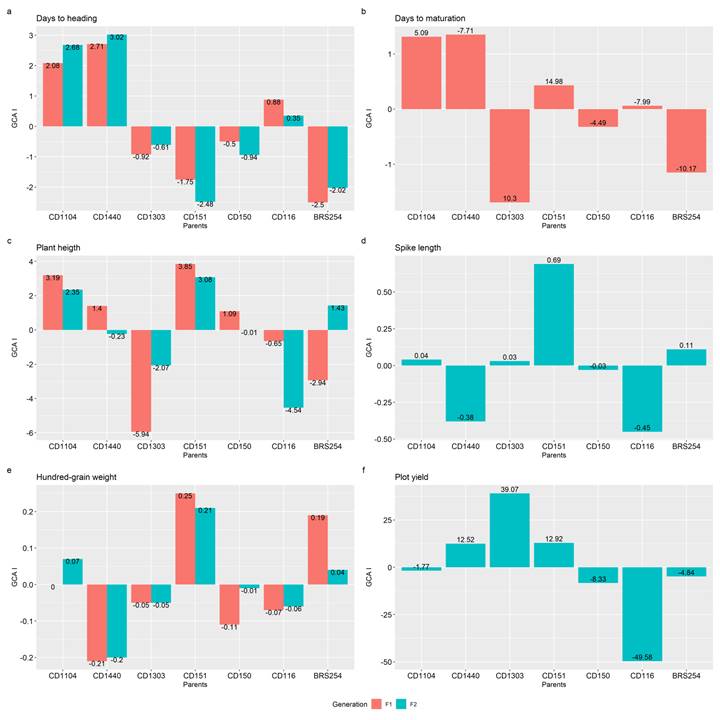
Estimates of average GCA I effects in F1 and F2 are presented in figure 1. High, positive, or negative GCA values for a particular parent indicate that this parent differs from others in the frequency of favorable alleles. Low GCA values indicate that the effect is not relevant.
Average GCA I effects for six wheat traits. a: days to heading in F1 and F2; b: days to maturation in F1; c: plant height, in F1 and F2; d: spike length in F2; e: hundred-grain weight in F1 and F2; f: grain yield in F2 populations.
GCA estimates for days to heading (DHE), days to maturation (DM), and plant height (PH) are expected to be high and negative (Figure 1A, B, C). For DHE (Figure 1A), lowest estimates were observed for CD 1303, CD 151, CD 150, and BRS 254 in both generations. Similarly, lowest estimates for DM in F1 were observed for CD 1303 and BRS 254 (Figure 1B). For PH, the parents CD 1303, CD 116 in F1 and F2, and BRS 254 in F1 had the lowest estimates (Figure 1C).
High positive GCA estimates are desired for traits such as SL, HGW, and YLD (Figure 1D, E, F). The parent CD 151 had the highest SL estimate in F2 (Figure 1D). For HGW, highest estimates in F1 and F2 were observed for CD 151 and BRS 254 (Figure 1E), and for YLD, highest estimates in F2 were observed for the parents CD 1440, CD 1303, and CD 151 (Figure 1F).
GCA II Effects
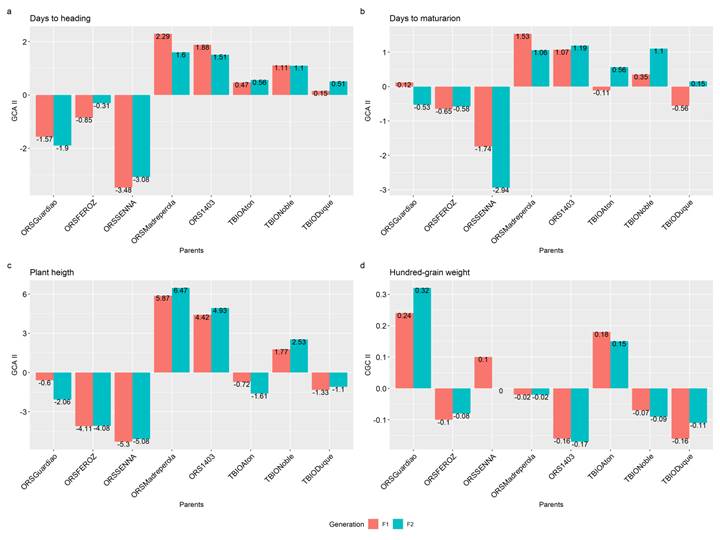
Figure 2 displays average GCA II effect estimates. Overall, the parents ORS Guardião, ORSFEROZ, and ORSSENNA contributed to a decrease in DHE (Figure 2A), DM (Figure 2B), and PH (Figure 2C). The only exception was ORS Guardião that increased DM in F1 (Figure 2B). The parents ORS Guardião and TBIO Aton increased HGW estimates (Figure 2B).
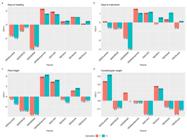
Average GCA II effects for four wheat traits. a: days to heading in F1 and F2; b: Days to maturation in F1 and F2. c: Plant height in F1 and F2. d: hundred-grain weight in F1 and F2 populations.
SCA Effects
Interpretations of SCA values among the 15 parents in both generations (F1 and F2) are presented in table 6. We selected the best combinations based on SCA values following the same criteria adopted previously for the four significant traits (high negative values for DM, DHE, and PH, and high positive values for SL, HGW, and YLD) (Table 6). The only difference is that only hybrids in which at least one of the parents exhibit high (positive or negative) GCA estimates (Figures 1 and 2), were selected.
Combinations with promising SCA estimates are shown in table 7. In total, 41 crosses were selected, 20 in F1 and 21 in F2 (Table 7). Although many of these combinations did not exhibit high SCA values for all desired traits, they exhibited high SCA for at least two. CD 1104/ORS Guardião was selected for DHE and HGW in both generations; CD 116/ORS Guardião and CD 151/ORS Madrepérola were selected for DHE and HGW in F2; CD 1440/ORSSENNA and CD 150/ORSSENNA were selected for DHE and PH in F1; CD150/TBIO Aton was selected for DHE and HGW in F1 (Table 7). CD 1303/ORS Madrepérola, CD 151/ORS Madrepérola, CD 1303/ORS1403, CD 1104/ORS Guardião, CD 150/TBIO Aton, and CD 1440/ORSFEROZ hybrids had low estimates for DHE, whereasCD 151/ORSSENNA and CD 1104/ORS Guardião had high estimates for HGW in both F1 and F2 (Table 7).
In addition, we observed that in the F1 generation, the parents CD 1303 and CD 151 (Group I), as well as ORS Guardião, ORSFEROZ, and ORSSENNA (Group II), had hybrids selected for DHE. Furthermore, CD 1303 and BRS 254 (Group I), along with ORS Guardião and ORSFEROZ (Group II), had crosses selected for PH in both groups (Table 7).
DISCUSSION
The present study was conceived and conducted to select wheat crosses suitable for cultivation under tropical conditions, in other words, short, high-yielding, early-cycle genotypes that are adapted to irrigated farming system (BECHE et al., 2018; WANG et al., 2019; CASAGRANDE et al., 2020). Therefore, we focused on investigating general combining ability (GCA) and specific combining ability (SCA) of wheat genotypes in order to decrease DHE, DM, and PH, and to increase SL, HGW and YLD.
Partial diallel analysis is an efficient strategy used to study combining ability among parents (CRUZ et al., 2012; PIMENTEL et al., 2013; SILVA et al., 2013; MOURA et al., 2018; LIMA et al., 2022). Significant crosses effects observed in the analysis of variance indicates genetic variability among genotypes for the traits of interest (TEODORO et al., 2019). Non-significant effects for the group suggested that average number of favorable alleles is similar in the two groups of parents. This may be explained by the fact that all the parents used in this study are high-yielding elite cultivars (PIMENTEL et al., 2013).
By analyzing GCA quadratic components of Group I and Group II, and the SCA quadratic component together, we noticed that GCA values were superior to those of SCA, for most traits, except for SL and YLD in F1, evidenced by the relative importance of additive and no-additive effects. The superiority of the quadratic components of GCA compared to SCA indicated the predominance of additive effects over non-additive effects (JOSHI et al., 2004; KAMALUDDIN et al., 2007; PIMENTEL et al., 2013; SILVA et al., 2023a). Additive effects are the main source of genetic variation exploited in breeding programs (ISIK et al., 2003; BHERING et al., 2017). Yield-related traits in wheat are listed as controlled by additive effects in F1 (KAMALUDDIN et al., 2007), F2 (SILVA et al., 2023a), F1 and F2 (JOSHI et al., 2004; KUMAR et al., 2017; EL-GAMMAAL & YAHYA, 2018), and F2 and F3 generations (PIMENTEL et al., 2013). However, non-additive effects for grain yield per plot (YLD) in F1, as observed in this study, are also reported for wheat (MASOOD & KRONSTAD, 2000; ZEESHAN et al., 2013), barley (SHARMA et al., 2003), common bean (SILVA et al., 2013; MOURA et al., 2018; SILVA et al., 2023b), and fava bean (EL-HOSARY, 2020).
Significant GCA effects are observed in both groups of parents. A significant effect indicates the presence of favorable alleles among the parents within each group (CRUZ et al., 2012; PIMENTEL et al., 2013; MOURA et al., 2018). The same results were observed for SCA, indicating variability for this effect (PIMENTEL et al., 2013). Furthermore, the significance of these effects allows selection of best parents based on GCA values and best hybrids based on SCA values (CRUZ et al., 2012). The significance of GCA and SCA also suggests that additive and non-additive effects are involved in the genetic control of traits (GUIMARÃES et al., 2023; SILVA et al., 2023a).
Based on our findings, we can select promising parents from each group by harnessing their combining abilities for each trait. The parent CD 1303 (Group I) reduces growing cycle length and plant height, while also increasing grain yield. The contribution of this parent (CD 1303) to reducing plant height and increasing grain yield has been observed in other studies (MEZZOMO et al., 2021, 2022; SILVA et al., 2023a). CD 151 (Group I), reduces number of days to flowering, while increasing spike length, hundred-grain weight, and grain yield. BRS 254 (Group I) reduces growing cycle length and increases hundred-grain weight. Supporting our findings, BRS 254 appeared among the top three parents for earliness (MEZZOMO et al., 2022) in a study about combining ability and selection of tropical wheat populations.
The parent ORS Guardião (Group II) exhibited a combination of traits involving short growing cycle, short plant stature, and increased hundred-grain weight. The parents ORSFEROZ and ORSSENNA (Group II) contributed to reductions in growing cycle length and plant stature. Crossing parents that contribute to reductions in these traits is important to minimize problems with early drought in rainfed farming systems (KAMALUDDIN et al., 2007; PASINATO et al., 2018), and lodging in irrigated farming systems (CASAGRANDE et al., 2020; MEZZOMO et al., 2022; SILVA et al., 2023a).
After analyzing GCA of parents, the next step is to select promising combinations. Selection is based on desirable SCA values of crosses in which at least one parent has desirable GCA values (CRUZ et al., 2012). A total of 41 wheat crosses were selected, 20 in F1 and 21 in F2. Seven combinations were selected in both F1 and F2 populations. Identifying hybrid combinations that exhibit consistent behavior across generations is considered promising in breeding programs (HEIBA et al., 2023).
The selection of superior hybrid combinations from superior parents of both groups is evident in this study. Such crosses are potentially good combiners for traits such as days to flowering and plant height. Selecting the same hybrid combinations in different generations has also been reported in studies with wheat (MASOOD & KRONSTAD, 2000; JOSHI et al., 2004; VERMA et al., 2016; ALI et al., 2020), barley (SHARMA et al., 2003), and safflower (GOLKAR et al., 2011).
Although, we could select populations from both generations, selecting from F2 is more advantageous over F1 due to the larger number of seeds, which could be used to test populations in multiple locations. Obtaining a large number of seeds in F1 generations without technologies such as male sterility makes it impractical to select populations in this generation. Additionally, different studies have found promising results when using F2 populations for crops such as wheat (BHULLAR et al., 1979; MASOOD & KRONSTAD, 2000; PIMENTEL et al., 2013; MEZZOMO et al., 2022; SILVA et al., 2023a), and common bean (MOURA et al., 2018).
Finally, this study demonstrated the predominance of the additive effects; although, it was also possible to identify non-additive effects for some quantitative traits in F1 generation. In addition, we performed the selection of potential combinations in multiple generations by exploring the genetic effects underlying several relevant traits in wheat breeding.
CONCLUSION
The parents CD 1303, CD 151, and BRS 254 from Group I, and ORSFEROZ, ORS Guardião, and ORSSENNA from Group II, demonstrated high frequency of favorable alleles for different traits. The populations CD 1303/ORS Madrepérola, CD 151/ORS Madrepérola, CD 1303/ORS1403, CD 1104/ORS Guardião, CD 150/TBIO Aton, CD 1440/ORSFEROZ and CD 151/ORSSENNA are potential breeding sources of superior progenies in terms of earliness, plant height, and hundred-grain weight. Additive effects predominantly regulated most traits in both F1 and F2 generations.
ACKNOWLEDGEMENTS
This study was financed in part by the Coordenação de Aperfeiçoamento de Pessoal de Nível Superior - Brazil (CAPES) - Finance Code 001. We are grateful to the Conselho Nacional de Desenvolvimento Científico (CNPq) and by the Fundação de Amparo à Pesquisa do Estado de Minas Gerais (FAPEMIG).
REFERENCES
-
ALI, M. A.et al.Combining ability in some genotypes of bread wheat (Triticum aestivum L.) under different sowing dates. SVU-International Journal of Agricultural Sciences, v.2, n.2, p.291-305, 2020. Available from: <Available from: https://10.21608/svuijas.2020.42033.1036 >. Accessed: Mar. 11, 2024. doi: 10.21608/svuijas.2020.42033.1036.
» https://doi.org/10.21608/svuijas.2020.42033.1036.» https://10.21608/svuijas.2020.42033.1036 -
BAKER, R. J.Issues in diallel analysis. Crop Science, v.18, p.533-536, 1978. Available from: <Available from: https://acsess.onlinelibrary.wiley.com/doi/abs/10.2135/cropsci1978.0011183X001800040001x >. Accessed: Ago. 10, 2024. doi: 10.2135/cropsci1978.0011183X001800040001x.
» https://doi.org/10.2135/cropsci1978.0011183X001800040001x.» https://acsess.onlinelibrary.wiley.com/doi/abs/10.2135/cropsci1978.0011183X001800040001x -
BECHE, E.et al.Improvement in Brazilian wheat breeding changes in developmental phases and ecophysiological traits. Euphytica, v.214, n.3, p.1-12, 2018. Available from: <Available from: https://doi.org/10.1007/s10681-018-2134-2 >. Accessed: Mar. 11, 2024. doi: 10.1007/s10681-018-2134-2.
» https://doi.org/10.1007/s10681-018-2134-2.» https://doi.org/10.1007/s10681-018-2134-2 - BHERING, L. L.et al.Seleção de genitores. In: SILVA, F.et al. (org.). Melhoramento da soja. Editora UFV, Viçosa, p.173-195, 2017.
-
BHULLAR, G. S.et al.Combining ability analysis over F1-F5 generations in diallel crosses of bread wheat. Theoretical and Applied Genetics, v.55, p.77-80, 1979. Available from: <Available from: https://doi.org/10.1007/BF00285194 >. Accessed: Mar. 23, 2024. doi: 10.1007/BF00285194.
» https://doi.org/10.1007/BF00285194.» https://doi.org/10.1007/BF00285194 - BORÉM, A.et al.Melhoramento de plantas. 8. ed.: Oficina de Textos, 384p.2021.
-
CASAGRANDE, C. R.et al.Choosing parent tropical wheat genotypes through genetic dissimilarity based on reml/ blup. Crop Breeding and Applied Biotechnology, v.20, n.3, p. 1-10, 2020. Available from: <Available from: https://doi.org/10.1590/1984-70332020v20n3a50 >. Accessed: Apr. 06, 2024. doi: 10.1590/1984-70332020v20n3a50.
» https://doi.org/10.1590/1984-70332020v20n3a50.» https://doi.org/10.1590/1984-70332020v20n3a50 -
CONAB. Acompanhamento da Safra brasileira de grãos, v.11, n.5, p.124, 2024. Available from: <Available from: https://www.conab.gov.br/info-agro/safras/graos/boletim-da-safra-de-graos/item/download/51814_c19d452a0b14ed1e74b0d45ae0b815e5 >. Accessed: Feb. 26, 2024.
» https://www.conab.gov.br/info-agro/safras/graos/boletim-da-safra-de-graos/item/download/51814_c19d452a0b14ed1e74b0d45ae0b815e5 -
CRUZ, C. D.Programa Genes - Ampliado e integrado aos aplicativos R, Matlab e Selegen. Acta Scientiarum - Agronomy, v.38, n.4, p.547-552, 2016. Available from: <Available from: https://doi.org/10.4025/actasciagron.v38i4.32629 >. Accessed: Apr. 06, 2024. doi: 10.4025/actasciagron.v38i4.32629.
» https://doi.org/10.4025/actasciagron.v38i4.32629.» https://doi.org/10.4025/actasciagron.v38i4.32629 - CRUZ, C. D.et al.Modelos biométricos aplicados ao melhoramento genético. 4. ed. Editora UFV, Viçosa, 2012.
-
EL-GAMMAAL, A. A.; YAHYA, A. I.Genetic variability and heterosis in f1 and f2 generations of diallel crosses among seven wheat genotypes. Journal of Plant Production, v.9, n.12, p.1075-1086, 2018. Available from: <Available from: https://jpp.journals.ekb.eg/article_36631_b64ff30dd52a920328cb664026877213.pdf >. Accessed: Feb. 29, 2024.
» https://jpp.journals.ekb.eg/article_36631_b64ff30dd52a920328cb664026877213.pdf -
EL-HOSARY, A.Estimation of gene action and heterosis in F1 and F2 diallel crosses among seven genotypes of field bean. Journal of Plant Production, v.11, n.12, p.1383-1391, 2020. Available from: <Available from: https://doi.org/10.21608/jpp.2020.149810 >. Accessed: Jan. 28, 2024. doi: 10.21608/jpp.2020.149810.
» https://doi.org/10.21608/jpp.2020.149810.» https://doi.org/10.21608/jpp.2020.149810 -
ERENSTEIN, O.et al.Global trends in wheat production, consumption and trade. In: REYNOLDS, M. P.; BRAUN, H-J. (org.). Wheat improvement food security in a changing climate: Springer Cham, 2022. p.657. Available from: <Available from: https://link.springer.com/book/10.1007/978-3-030-90673-3 >. Accessed: Mar. 06, 2024. doi: 10.1007/978-3-030-90673-3.
» https://doi.org/10.1007/978-3-030-90673-3.» https://link.springer.com/book/10.1007/978-3-030-90673-3 -
GERALDI, I. O.; MIRANDA-FILHO, J. B.Adapted models for the analysis of combining abilty of varieties in partial diallel crosses. Brazilian Journal of Genetics, 11:419-430, 1988. Available from: <Available from: https://www.cabidigitallibrary.org/doi/full/10.5555/19881673949 >. Accessed: Mar. 06, 2024.
» https://www.cabidigitallibrary.org/doi/full/10.5555/19881673949 -
GOLKAR, P.et al.Genetic analysis of oil content and fatty acid composition in safflower (Carthamus tinctorius L.). Journal of the American Oil Chemists’ Society, v.88, n.7, p.975-982, 2011. Available from: <Available from: https://doi.org/10.1007/s11746-011-1758-3 >. Accessed: Mar. 18, 2024. doi: 10.1007/s11746-011-1758-3.
» https://doi.org/10.1007/s11746-011-1758-3.» https://doi.org/10.1007/s11746-011-1758-3 -
GRIFFING, B.Concept of general and specific combining ability in relation to diallel crossing systems. Australian Journal of Biological Sciences,v.9, p.463-493, 1956. Available from:<Available from:https://doi.org/10.1071/BI9560463 >. Accessed: Jan. 15, 2024. doi: 10.1071/BI9560463.
» https://doi.org/10.1071/BI9560463.» https://doi.org/10.1071/BI9560463 -
GUIMARÃES, P. H. R.et al.Diallel analysis: choosing parents to introduce new variability in a recurrent selection population. Agriculture, v.13, n.1320, p.1-16, 2023. Available from: <Available from: https://doi.org/10.3390/agriculture13071320 >. Accessed: Mar. 19, 2024. doi: 10.3390/agriculture13071320.
» https://doi.org/10.3390/agriculture13071320.» https://doi.org/10.3390/agriculture13071320 -
HEIBA, H. El-S. S.et al.Combining ability and gene action controlling chocolate spot resistance and yield traits in faba bean (Vicia faba L.). Journal of Agricultural Sciences (Tarim Bilimleri Dergisi), v.29, n.1, p.77-88, 2023. Available from:<Available from:https://doi.org/10.15832/ankutbd.973781 >. Accessed: Mar. 23, 2024. doi: 10.15832/ankutbd.973781.
» https://doi.org/10.15832/ankutbd.973781.» https://doi.org/10.15832/ankutbd.973781 -
ISIK, F.et al.Estimates of additive, dominance and epistatic genetic variances from a clonally replicated test of loblolly pine. Forest Science, v.49, n.1, p.77-88, 2003. Available from: <Available from: https://doi.org/10.1093/forestscience/49.1.77 >. Accessed: Mar. 04, 2024. doi: 10.1093/forestscience/49.1.77.
» https://doi.org/10.1093/forestscience/49.1.77.» https://doi.org/10.1093/forestscience/49.1.77 -
JORIS, H. A. W.et al.Informações técnicas para trigo e triticale: safra 2023 / 15a Reunião da Comissão Brasileira de Pesquisa de Trigo e Triticale. Fundação ABC e Biotrigo Genética, Castro, PR, 2022. Available from:<Available from:https://www.conferencebr.com/conteudo/arquivo/informacoes-tecnicas-para-trigo-e-triticale--safra-2022-1649081250.pdf >. Accessed: Aug. 06, 2024.
» https://www.conferencebr.com/conteudo/arquivo/informacoes-tecnicas-para-trigo-e-triticale--safra-2022-1649081250.pdf -
JOSHI, S. K.et al.Combining ability in the F1 and F2 generations of diallel cross in hexaploid wheat (Triticum aestivum L. em. Thell). Hereditas, v.51, n.141, p.115-121, 2004. Available from: <Available from: https://doi.org/10.1111/j.1601-5223.2004.01730.x >. Accessed: Mar. 04, 2024. doi: 10.1111/j.1601-5223.2004.01730.x.
» https://doi.org/10.1111/j.1601-5223.2004.01730.x.» https://doi.org/10.1111/j.1601-5223.2004.01730.x -
KAMALUDDIN et al. Combining ability analysis for grain filling duration and yield traits in spring wheat (Triticumaestivum L. em. Thell.). Genetics and Molecular Biology, v.30, n.2, p.411-416, 2007. Available from: <Available from: https://doi.org/10.1590/S1415-47572007000300018 >. Accessed: Feb. 21, 2024. doi: 10.1590/S1415-47572007000300018.
» https://doi.org/10.1590/S1415-47572007000300018.» https://doi.org/10.1590/S1415-47572007000300018 -
KUMAR, B.et al.Estimation of Combining Ability in F1 and F2 Generations of Diallel Crosses in Winter Wheat (Triticum aestivum L. em. Thell). International Journal of Current Microbiology and Applied Sciences, v.6, n.12, p.1432-1444, 2017. Available from:<Available from:https://doi.org/10.20546/ijcmas.2017.612.161 >. Accessed: Feb. 28, 2024. doi: 10.20546/ijcmas.2017.612.161.
» https://doi.org/10.20546/ijcmas.2017.612.161.» https://doi.org/10.20546/ijcmas.2017.612.161 -
LI, N.et al.Generation of high iron content wheat mutants and expression analysis of the genes involved in iron accumulation and ethylene response. Plant Growth Regulation, n.0123456789, 2022. Available from: <Available from: https://doi.org/10.1007/s10725-022-00880-3 >. Accessed: Feb. 28, 2024. doi: 10.1007/s10725-022-00880-3.
» https://doi.org/10.1007/s10725-022-00880-3.» https://doi.org/10.1007/s10725-022-00880-3 -
LIMA, G. W.et al.Genetic diversity in tropical wheat germplasm and selection via multitrait index. Agronomy Journal, v.114, n.2, p.887-899, 2022. Available from: <Available from: https://doi.org/10.1002/agj2.20991 >. Accessed: Feb. 28, 2024. doi: 10.1002/agj2.20991.
» https://doi.org/10.1002/agj2.20991.» https://doi.org/10.1002/agj2.20991 -
MASOOD, M. S.; KRONSTAD, W. E.Combining ability analysis over various generations in a diallel cross of bread wheat. Pakistan Journal of Agricultural Research, v.16, n.1, p.1-4, 2000. Available from: <Available from: https://eurekamag.com/research/003/386/003386274.php >. Accessed: Mar. 21, 2024.
» https://eurekamag.com/research/003/386/003386274.php -
MEZZOMO, H. C.et al.Combining ability and selection of wheat populations for a tropical environment. Agronomia Colombiana, v.40, n.2, p.37-48, 2022. Available from: <Available from: https://doi.org/10.15446/agron.colomb.v40n2.99390 >. Accessed: Apr. 06, 2024. doi: 10.15446/agron.colomb.v40n2.99390.
» https://doi.org/10.15446/agron.colomb.v40n2.99390.» https://doi.org/10.15446/agron.colomb.v40n2.99390 -
MEZZOMO, H. C.et al.Mixed model-based Jinks and Pooni method to predict segregating populations in wheat breeding. Crop Breeding and Applied Biotechnology, v.21, n.4, p.1-10, 2021. Available from: <Available from: https://doi.org/10.1590/1984-70332021v21n4a52 >. Accessed: Apr. 06, 2024. doi: 10.1590/1984-70332021v21n4a52.
» https://doi.org/10.1590/1984-70332021v21n4a52.» https://doi.org/10.1590/1984-70332021v21n4a52 -
MOURA, L. M.et al.Combining ability of common bean parents in different seasons, locations and generations. Euphytica, v.214, n.181, p.1-13, 2018. Available from: <Available from: https://doi.org/10.1007/s10681-018-2259-3 >. Accessed: Mar. 23, 2024. doi: 10.1007/s10681-018-2259-3.
» https://doi.org/10.1007/s10681-018-2259-3.» https://doi.org/10.1007/s10681-018-2259-3 -
NÓIA JUNIOR, R. de S.et al.Achieving wheat self-sufficiency in Brazil. Environmental Research Letters, v.19, n.031003, 2024. Available from: <Available from: https://doi.org/10.1088/1748-9326/ad26b8 >. Accessed: Mar. 23, 2024. doi: 10.1088/1748-9326/ad26b8.
» https://doi.org/10.1088/1748-9326/ad26b8.» https://doi.org/10.1088/1748-9326/ad26b8 -
PASINATO, A.et al.Potential area and limitations for the expansion of rainfed wheat in the Cerrado biome of Central Brazil. Pesquisa Agropecuária Brasileira, v.53, n.7, p.779-790, 2018. Available from: <Available from: https://doi.org/10.1590/S0100-204X2018000700001 >. Accessed: Mar. 25, 2024. doi: 10.1590/S0100-204X2018000700001.
» https://doi.org/10.1590/S0100-204X2018000700001.» https://doi.org/10.1590/S0100-204X2018000700001 -
PELEGRIN, A. J.et al.Combining ability as a criterion for wheat parents selection. Functional Plant Breeding Journal, v.2, n.1, p.35-45, 2020. Available from: <Available from: http://dx.doi.org/10.35418/2526-4117/v2n1a4 >. Accessed: Mar. 25, 2024. doi: 10.35418/2526-4117/v2n1a4.
» https://doi.org/10.35418/2526-4117/v2n1a4.» http://dx.doi.org/10.35418/2526-4117/v2n1a4 -
PIMENTEL, A. J. B.et al.Análise dialélica parcial em gerações avançadas para seleção de populações segregantes de trigo. Pesquisa Agropecuaria Brasileira, v.48, n.12, p.1555-1561, 2013. Available from: <Available from: https://doi.org/10.1590/S0100-204X2013001200004 >. Accessed: Feb. 20, 2024. doi: 10.1590/S0100-204X2013001200004.
» https://doi.org/10.1590/S0100-204X2013001200004.» https://doi.org/10.1590/S0100-204X2013001200004 -
R CORE TEAM. R: A language and environment for statistical computing [Computer software manual]. R Foundation for Statistical Computing, Vienna, Austria, 2023. Available from: <Available from: https://www.r-project.org/ >. Accessed: Feb. 20, 2024.
» https://www.r-project.org/ - SHARMA, Y.et al.Combining ability in the F1 and F2 generations of a diallel cross in six-rowed barley (Hordeumvulgare L.). Acta Agronomica Hungarica, v.51, n.3, p.281-288, 2003.
-
SILVA, C. M.et al.Selecting tropical wheat genotypes through combining ability analysis. Anais da Academia Brasileira de Ciências, v.95, e20220760, 2023a. Available from: <Available from: https://doi.org/10.1590/0001-3765202320220760 > Accessed: Jan. 21, 2024. doi: 10.1590/0001-3765202320220760.
» https://doi.org/10.1590/0001-3765202320220760.» https://doi.org/10.1590/0001-3765202320220760 -
SILVA, A. C.et al.Selection of common bean parents and segregating populations targeting fusarium wilt resistance and grain yield. Agronomy Science and Biotechnology, v.9, p.1-20, 2023b. Available from: <Available from: https://doi.org/10.33158/ASB.r173.v9.2023 >. Accessed: Apr. 07, 2024. doi: 10.33158/ASB.r173.v9.2023.
» https://doi.org/10.33158/ASB.r173.v9.2023.» https://doi.org/10.33158/ASB.r173.v9.2023 -
SILVA, V. M. P.et al.Genetic potential of common bean parents for plant architecture improvement. Scientia Agricola, v.70, n.3, p.167-175, 2013. Available from: <Available from: https://doi.org/10.1590/S0103-90162013000300005 >. Accessed: Mar. 23, 2024. doi: 10.1590/S0103-90162013000300005.
» https://doi.org/10.1590/S0103-90162013000300005.» https://doi.org/10.1590/S0103-90162013000300005 -
SOARES, S. L.et al.Combining performance and estimated genetic diversity among soybean parents and F1 populations. Revista Ceres, Viçosa, v.70, n.2, p.81-90, 2023. Available from: <Available from: https://doi.org/10.1590/0034-737X202370020010 Accessed: Mar. 16, 2024. doi: 10.1590/0034-737X202370020010.
» https://doi.org/10.1590/0034-737X202370020010.» https://doi.org/10.1590/0034-737X202370020010 -
TEODORO, L. P. R.et al.Understanding the combining ability for physiological traits in soybean. PLoS ONE, v.14, n.12, p.1-13, 2019. Available from: <Available from: https://doi.org/10.1371/journal.pone.0226523 Accessed: Jan. 16, 2024. doi: 10.1371/journal.pone.0226523.
» https://doi.org/10.1371/journal.pone.0226523.» https://doi.org/10.1371/journal.pone.0226523 -
VERMA, S.et al.Prediction of gene action and combining ability for yield and quality traits in F1 and F2 generations of wheat (Triticum aestivum L.). Tropical Plant Research, v.3, n.2, p.449-459, 2016. Available from: <Available from: https://www.tropicalplantresearch.com/archives/2016/vol3issue2/28.pdf >. Accessed: Mar. 16, 2024.
» https://www.tropicalplantresearch.com/archives/2016/vol3issue2/28.pdf -
WANG, B.et al.Designing wheat ideotypes to cope with future changing climate in South-Eastern Australia. Agricultural Systems, v.170, p.9-18, 2019. Available from: <Available from: https://doi.org/10.1016/j.agsy.2018.12.005 >. Accessed: Feb. 19, 2024. doi: 10.1016/j.agsy.2018.12.005.
» https://doi.org/10.1016/j.agsy.2018.12.005.» https://doi.org/10.1016/j.agsy.2018.12.005 -
WICKHAM, H.ggplot2: Elegant Graphics for Data Analysis[Computer software manual]. 2016. (R Package version 3.3.5). Available from: <Available from: https://CRAN.R-project.org/web/packages/ggplot2/ >. Accessed: Feb. 19, 2024.
» https://CRAN.R-project.org/web/packages/ggplot2/ -
ZADOKS, J. C.et al.A decimal code for the growth stages of cereals. Weed Research, v.14, p.415-421, 1974. Available from: <Available from: https://doi.org/10.1111/j.1365-3180.1974.tb01084.x >. Accessed: Feb. 15, 2024. doi: 10.1111/j.1365-3180.1974.tb01084.x.
» https://doi.org/10.1111/j.1365-3180.1974.tb01084.x.» https://doi.org/10.1111/j.1365-3180.1974.tb01084.x -
ZEESHAN, M.et al.Estimation of combining ability effects for some yield related metric traits in intra-specific crosses among different spring wheat (Triticum aestivum L.) Genotypes. International Journal of Advanced Research, v.1, n.3, p.6-10, 2013. Available from: <Available from: https://www.journalijar.com/uploads/2013-05-25_110116_268.pdf >. Accessed: Feb. 21, 2024.
» https://www.journalijar.com/uploads/2013-05-25_110116_268.pdf
Edited by
-
Editors
Alessandro Dal’Col Lúcio (0000-0003-0761-4200)Luiz Antônio dos Santos Dias (0000-0002-1828-6938)