| Wenz et al, 2010 27
|
Case Report / Development of a New Approach |
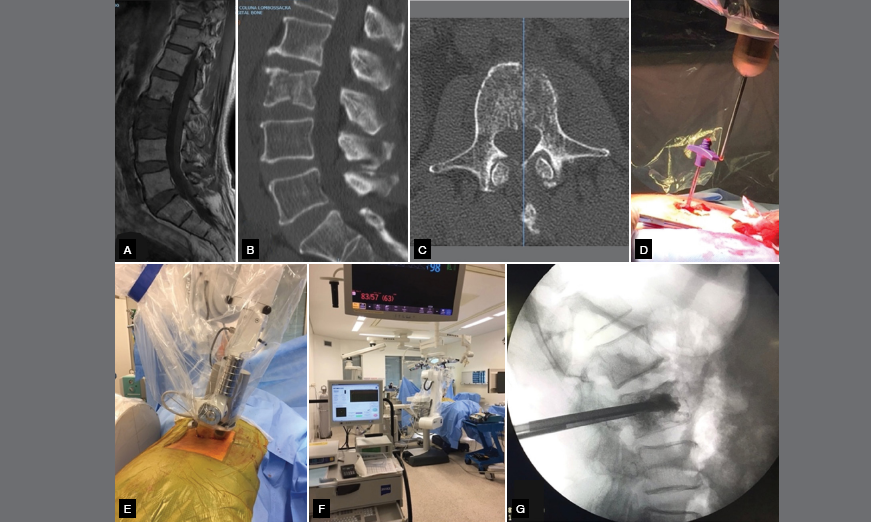
Develop and report the first application of Kypho-IORT for painful and unstable vertebral metastases. |
1 patient (60 years old) with metastasis in the 12th thoracic vertebra. |
Technical feasibility, procedure time, pain relief, skin reactions. |
- Procedure lasted less than 90 minutes. Patient reported no pain the following day. No visible skin reactions induced by radiation. Minimally invasive and can be performed in standard operating rooms. |
| Schneider et al, 201128
|
Method Development / Cadaver Study / Patient Eligibility Estimation |
Establish Kypho-IORT, estimate the percentage of eligible patients, and perform dose measurements. |
Analysis of 53 CT scans (897 vertebrae, 356 infiltrated) for eligibility; Kypho-IORT in 1 donated body. |
Eligibility estimation, additional operating time, spinal cord dose, bone dose simulation. |
Estimated eligibility of 23% to 34% of patients. Additional 15 minutes of operating time for IORT. Estimated maximum dose of 3.8 Gy to the spinal cord in cadavers. MC simulation in bone showed 68% less dose at the prescription depth vs. water. |
| Schimidt et al, 201129
|
Clinical Feasibility Study / Pilot Study |
Evaluate the clinical applicability of Kypho-IORT after theoretical and cadaver testing. |
17 patients; 20 vertebrae treated. |
Technical feasibility of radiation, surgical time, complications (especially cement leakage, bending of the shunt tube), pain reduction (VAS). |
- Kypho-IORT was technically feasible. Radiation not applied in 10% of cases due to technical difficulties. Total mean surgical time of 81 ± 28 minutes; approximately 2 minutes for radiation. No serious surgical complications requiring additional intervention. Pain (VAS) decreased from 4.9 to 2.9 on the first postoperative day. |
| Reis et al, 201230
|
First Clinical Results / Pilot Phase of Dose Escalation |
Report initial clinical results, evaluate safety, complications, pain relief, and local control. |
18 patients; 21 vertebral lesions treated. |
Technical success of IORT, complications (serious, cement leakage, tube kinking), pain relief (VAS), neurological function, local tumor control. |
Kypho-IORT was successfully performed in 86% of lesions (18 out of 21). No serious complications. The median VAS decreased from 5/10 to 2.5/10 (day 1) and to 0/10 (6 weeks). Stable disease in 93% of irradiated vertebrae. Asymptomatic cement leakage in 78%. Median surgical time of 70 minutes (total), 2 minutes for radiation. |
| Bludau et al, 201331
|
Learning Curve Analysis and Teaching Ability |
Describe the learning curve and demonstrate the teachability and safety of the technique. |
First 53 clinical applications in 43 patients. Workshops with potential users. |
Number of insertion attempts, technical failures, operating time, beam position accuracy, complications. |
- No technical failures after 25 applications. Technique that can be taught safely. Average operating time per vertebra of 42.6-61.2 min (improvement after 3rd generation of gloves). Improved accuracy from 0.22 mm to 0.17 mm in workshops. |
| Bludau et al, 201532
|
Overview of Kypho-IORT / Summary of Clinical Experience (2009-2014) |
Describe Kypho-IORT as a therapeutic alternative, present clinical data, discuss indications, and compare it with other options. |
81 patients; 102 vertebral bodies treated. |
Technical success of IORT, duration of operation, pain reduction, local tumor control, side effects. |
- Over 100 successful applications. No technical problems since case 23. Average operating time of 65 min/patient (about 40 min/vertebra after development of the method). 78% reduction in pain on day 1. Three local recurrences in 29 patients with >12 months of follow-up. Good local control. |
| Schneider et al, 201733
|
Technical Note / Development of Image-Guided IORT (igIORT) |
Demonstrate the feasibility of image-guided IORT with online treatment planning and correction of tissue heterogeneity. |
Retrospective study of data from 1 patient with vertebral metastasis (T9). |
Accuracy of treatment planning, calculation time, minimum dose to the target, maximum dose to the spinal cord, impact of CT artifacts. |
- igIORT and online treatment planning are feasible. Treatment time: 5.33 min. MChet calculations showed a minimum dose of 27.1 Gy to the target and a maximum dose of 7.2 Gy to the spinal cord (preoperative CT), representing a 40% increase in the target and a 35% reduction in the spinal cord vs. simulations in water. CT artifacts caused dose deviations of up to 50%. |
| Sedeño et al, 201834
|
Case Report |
Report the first case of aggressive vertebral hemangioma treated with Kypho-IORT. |
1 patient (56-year-old male) with aggressive hemangioma in T5. |
Immediate complications, resolution of neurological symptoms, pain relief, skin reactions, reduction in epidural mass. |
- No immediate complications. Neurological symptoms disappeared and the patient regained the ability to walk completely without pain the following day. No visible skin reaction. Reduction in anterior epidural mass at 30 months of follow-up. IORT lasted approx. Two minutes. |
| Bludal et al, 201813
|
Phase I/II Clinical Trial (Dose Escalation and Cohort Expansion) |
Test the safety (DLTs) and efficacy (pain relief, L-PFS, OS) of Kypho-IORT. |
61 patients (76 vertebrae); 9 in Phase I, 52 in Phase II. |
DLTs, pain (VAS), L-PFS, OS, cement leakage, surgical time, motor strength. |
- No DLT observed. Median pain score decreased from 5 to 2 on day 1 (p<.001). 69.8% of patients had ≥3 points of pain reduction on day 1. L-PFS at 3, 6, and 12 months: 97.5%, 93.8%, 93.8%.<br>- Median OS of 11.8 months. OS at 3, 6, 12 months: 76.9%, 64.0%, 48.4%. No deaths related to treatment. Asymptomatic cement leakage in 72%. Median surgical time of 65 minutes. |
| Bludau et al, 201935
|
Phase III Randomized Study Protocol (Kypho-IORT vs. EBRT) |
Primary: Evaluate whether Kypho-IORT is superior to standard EBRT in reducing pain (≥3 VAS points on day 1); Secondary: Local control, reinterventions, fractures, complications, PFS, OS, QoL. |
Planned: 54 patients (22 per arm + 20% dropout). |
Pain (VAS), local tumor control, reoperation rate, secondary fractures, complication rates, PFS, OS, quality of life. |
- Primary objective: 40% of patients undergoing Kypho-IORT with pain reduction on day 1 vs. 5% on EBRT. Study to generate level 1 evidence for a “one-stop” procedure with instant pain relief and long-term control. |
| Bludau et al, 202036
|
Long-Term Results of Kypho-IORT (Largest Cohort) |
Report the long-term results of the largest cohort treated with Kypho-IORT. |
Total of 104 patients; 143 vertebrae treated (2009–2019). |
Local progression, overall survival (OS), serious adverse events, vertebral fractures at adjacent levels. |
- Median follow-up of 14.5 months (0.4–109). Local progression in 10 vertebrae (median of 22.3 months). Local control rates of 97.1%, 95.9%, and 94.2% at 6, 12, and 24 months, respectively. Overall survival rates of 74.6%, 61.7%, and 50.3% at 6, 12, and 24 months, respectively. A single serious adverse event (temporary nerve irritation). No vertebral fractures at adjacent levels. Kypho-IORT provides immediate pain relief and stabilization, with excellent long-term local control and minimal side effects. |

 RADIOTERAPIA INTRAOPERATÓRIA ASSOCIADA À CIFOPLASTIA (KYPHO-IORT) EM METÁSTASES VERTEBRAIS: REVISÃO DA LITERATURA
 Thumbnail