
 The contrast between alveolar and velar stops with typical speech data: acoustic and articulatory analyses
Purpose This study used acoustic and articulatory analyses to characterize the contrast between alveolar and velar stops with typical speech data, comparing the parameters (acoustic and articulatory) of adults and children with typical speech development.
Methods The sample consisted of 20 adults and 15 children with typical speech development. The analyzed corpus was organized through five repetitions of each target-word (/’kap ə/, /‘tapə/, /‘galo/ e /‘daɾə/). These words were inserted into a carrier phrase and the participant was asked to name them spontaneously. Simultaneous audio and video data were recorded (tongue ultrasound images). The data was submitted to acoustic analyses (voice onset time; spectral peak and burst spectral moments; vowel/consonant transition and relative duration measures) and articulatory analyses (proportion of significant axes of the anterior and posterior tongue regions and description of tongue curves).
Results Acoustic and articulatory parameters were effective to indicate the contrast between alveolar and velar stops, mainly in the adult group. Both speech analyses showed statistically significant differences between the two groups.
Conclusion The acoustic and articulatory parameters provided signals to characterize the phonic contrast of speech. One of the main findings in the comparison between adult and child speech was evidence of articulatory refinement/maturation even after the period of segment acquisition.
Keywords
Speech; Ultrasonography; Speech Acoustics; Adult; Child
 Thumbnail
 Thumbnail
 Thumbnail
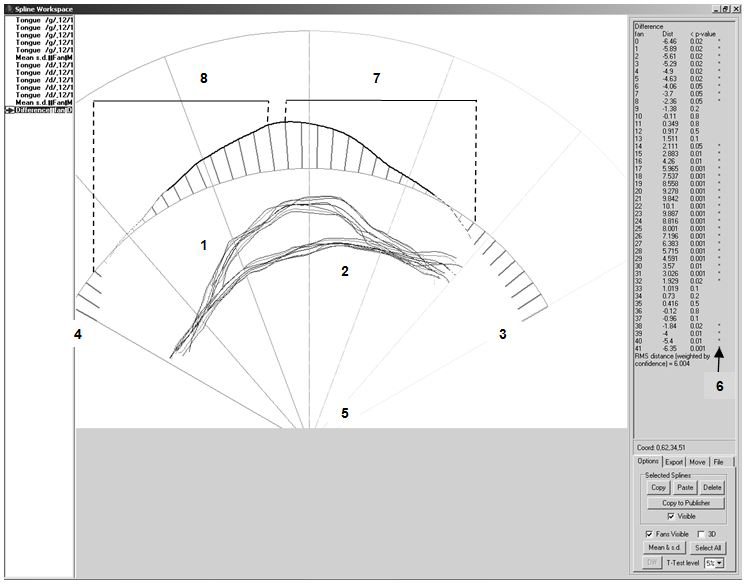 Caption: 1 – Five splines and mean spline of [g] stop; 2 – Five splines and mean spline of [d] stop; 3 – Axis “zero” of the fan spline; 4 – Axis “41” of the fan spline; 5 – Fan spline; 6 – Asterisks show significant axes; 7 – Anterior tongue region; 8 –Posterior tongue region
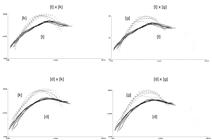
 Caption: Dotted line– velar stops [k] and [g]; continuous line: – alveolar stops [t] and [d]; to the left of images –posterior tongue region; to the right - anterior tongue region
 Caption: Dotted line– velar stops [k] and [g]; continuous line: – alveolar stops [t] and [d]; to the left of images –posterior tongue region; to the right - anterior tongue region