
 Efficacy of Transcranial Direct Current Stimulation in Developmental Dyslexia: a scoping review
ABSTRACT
Purpose This study aims to improve the existing knowledge about the application of Transcranial Direct Current Stimulation in rehabilitating Developmental Dyslexia, both alone and in conjunction with other therapeutic approaches.
Research strategies The research was carried on the PubMed, Elsevier, LILACS and ERIC – Institute of Education Science.
Selection criteria Peer-reviewed journal articles were included if published in English, Portuguese, and Spanish and be broken down from the research question devised by the PICO acronym.
Data analysis Specific data collected according to delineation, summarized by descriptive analysis.
Results Eleven articles were analyzed. Five of them associated tDCS with cognitive-linguistic or reading stimulation therapy. Assembly and application frequency parameters varied. The results indicated a positive effect on reading skills after the intervention in all of them.
Conclusion The selected studies showed an improvement in reading speed and accuracy after active transcranial direct current stimulation, whether or not it combined with other cognitive-linguistic and reading stimulation. In some cases, the positive effects persisted up to six months after the intervention, making this a tool that can be used in the treatment of individuals with dyslexia.
Keywords:
Transcranial Direct Current Stimulation; Developmental Dyslexia; Reading; Rehabilitation; Systematic Review
INTRODUCTION
Developmental Dyslexia (DD) is a neurodevelopmental disorder characterized by reading difficulties, mainly related to decoding, with possible consequences for reading comprehension(1). A multidisciplinary team performs its diagnosis and must mainly identify manifestations of deficits in processing phonological information(2). Searching for effective intervention strategies is vital given the high DD prevalence and its significant impact on education and personal and professional development.
An overview of intervention approaches for developmental dyslexia (DD) reveals that they primarily focus on the stimulation and training of cognitive skills, including phonological and reading interventions. These interventions often incorporate multisensory stimulation methods, such as auditory-visual-motor integration(3), vestibular activities(4), perceptual auditory training(5), and targeted auditory stimulation(6).
However, a systematic review study on DD pointed out the difficulty in achieving substantial positive effects in stimulation for reading rehabilitation(7). The effect size found is almost always small due to the persistent condition typical of DD, with invariably slow clinical evolution(1) and the difficulty of carrying out clinical trials with large samples(7).
As a result, direct current transcranial stimulation (tDCS) emerged as a promising technique for the treatment of DD. This is an innovative, safe and noninvasive method, which through two electrodes of different polarities and conductive sponges placed on the scalp, employs a low -intensity electric current (0.8ma to 2ma) and according to its placement (anodic electrode location, responsible for awakening the area and reducing the threshold of the action and cathode potential, responsible for inhibiting the area, ie increasing the threshold) can modulate neuronal activity in specific brain areas(8-10), and, given the above, the possibility of its use in patients with DD is questioned(11-13).
The use of tDCS in clinical practice brings new possibilities for intervention in DD, especially for speech therapists who are specialized and trained in its application. It is vital to evaluate different types of therapy and their respective effects on reading skills given the lack of consensus on combining reading stimulation with tDCS. Assessing application parameters, including the number of sessions needed, is also crucial to ensure a lasting effect.
This study aims to improve and consolidate the existing knowledge about the application of Transcranial Direct Current Stimulation (tDCS) in rehabilitating Developmental Dyslexia (DD), considering its application in isolation and combination with other therapeutic approaches. The primary objective is to clarify doubts and guide speech therapists and other professionals involved in DD rehabilitation on this therapeutic approach’s effectiveness and correct application. To achieve this, information was compiled on the procedures and effectiveness of tDCS combined with different therapeutic stimulation protocols for DD. To achieve this, information was compiled on the procedures and effectiveness of tDCS combined with different therapeutic stimulation protocols for DD.
This scoping review was based on the hypothesis that knowing the tDCS application parameters in the rehabilitation of DD will provide some necessary knowledge about the effect of its application and contribute to elaborating effective protocols. This scoping review’s results will also produce a solid basis for developing objective intervention strategies. Thus, this work seeks to offer significant inputs to the field of DD rehabilitation, promoting advances in scientific knowledge and clinical practice.
METHODS
This scoping review aimed to map and explore research on this subject in the literature, following the recommendations of the Preferred Reporting Items for Systematic Reviews and Meta-Analyses extension for Scoping Reviews (PRISMA-ScR)(14) and the framework to accomplish this effectively(15-17). This framework consists of five steps: 1) identification of the research question; 2) identification of relevant studies; 3) selection of studies for review; 4) data mapping; and 5) collection, summary, and reporting of results. The steps were performed as described below:
Identification of the research question
The research question was formulated based on the PICO (Population, Intervention, Comparison, and Outcome) structure, which helps focus the question and determine the relevant aspects of the topic that will be examined. In this case, our PICO question was: In patients with Developmental Dyslexia (P), therapies such as Transcranial Direct Current Stimulation (tDCS) (I), compared qualitatively regarding arrangements, protocols and effects (C), affects the effectiveness of reading rehabilitation (O)?”
Identification of relevant studies
A high-sensitivity search was performed in the following databases to identify potentially relevant papers: PubMed via NLM – 1954 to 2023, Embase via Elsevier – 1966 to 2023, LILACS – via BVS, from 1980 to 2023, and ERIC – Institute of Education Science – 1994 to 2023. The elaboration of the search strategy followed the recommendation of the Peer Review of Electronic Search – PRESS(18), assisted by an experienced professional. Initially, words found in the titles and abstracts of relevant articles and the indexing terms adopted to describe them were used to develop a comprehensive search strategy. The search strategy, including all identified keywords and indexing terms, was adapted for each database. The search terms were “transcranial direct current stimulation” [Title/Abstract], AND dyslexia [Title/Abstract], and “transcranial direct current”. Moreover, the reference list of all included sources of evidence was examined for additional studies.
Different types of studies were analyzed: experimental and quasi-experimental studies, including randomized clinical trials, non-randomized clinical trials, before-and-after studies, and interrupted time series studies, analytical observational studies, including prospective and retrospective cohort studies, case-control studies, and analytical cross-sectional studies, descriptive observational studies, such as case series, individual case reports, descriptive cross-sectional studies, and systematic reviews that meet the inclusion criteria, depending on the research question.
Selection of studies for review
Peer-reviewed journal articles were included if published in English, Portuguese, and Spanish.
The eligible criteria can be broken down as follows from the research question devised by the PICO acronym:
-
Population (P): Patients diagnosed with Developmental Dyslexia. This group may include children, adolescents, and adults with a confirmed diagnosis of DD;
-
Intervention (I): Studies using Transcranial Direct Current Stimulation (tDCS) as an intervention method. The established criterion is that the intervention must be carried out through tDCS, regardless of the specific application protocol or the duration of treatment;
-
Comparison (C): studies that compared active and sham groups, different cerebral areas stimulated, and longitudinal studies that compared outcomes at different times;
-
Outcome (O): The main inclusion criterion is reading rehabilitation effectiveness. Eligible studies must have evaluated and reported the effects of tDCS (or the comparative intervention) on reading or reading-related skills. They include measures of reading fluency, reading comprehension, reading speed, decoding accuracy, phonological processing skills, and other related outcomes.
Data mapping
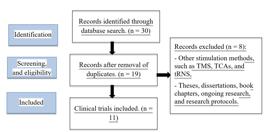
After the search, all identified citations were collected and entered into Rayyan Systematic Review, removing duplicates. After a pilot test, two or more independent reviewers analyzed the titles and abstracts according to the inclusion criteria established for the review. Two or more independent reviewers assessed the full text of selected citations in detail against the inclusion criteria. The reasons for excluding sources of evidence that do not meet the inclusion criteria were recorded and reported in the scoping review. Any disagreement between reviewers at each stage of the selection process was resolved through discussion or with the participation of an additional reviewer. The results of the search and the inclusion process of the studies were fully reported in the final scoping review and presented in a flowchart (Figure 1) of the PRISMA-ScR (Preferred Reporting Items for Systematic Reviews and Meta-Analyses Extension for Scoping Review)(14).
Collection, summary, and reporting of results
The results were summarized and reported descriptively, and are presented in Table 1. Implications for clinical practice and future research were also discussed.
RESULTS
Population
Only one of the eleven analyzed studies investigated the stimulation’s effects in 19 adults(11). In the remaining work, the studied population consisted of 207 children and adolescents, with ages ranging from 7.08 to 18 years.
Electrode setup – brain location and currents’ polarity
The initial study, conducted in 2015(11), positioned the anode electrode, responsible for promoting cortical excitability, in the left visual cortex region (V5), while the cathode, responsible for reducing cortical excitability, was positioned in the right orbitofrontal cortex region and compared with a sham group.
Three studies replicated this setup and compared active and sham groups(24-26), the anode electrode was placed in the left temporoparietal and parietal region, and the cathode in the right temporal and parietal region.
Four studies positioned the electrode in the left temporoparietal region, with the cathode in the right temporoparietal region (contralateral region)(19,21,22,28). One of these studies implemented the setup described previously and compared it with a placebo group(21); Study 1 compared this setup with another group in which the cathode electrode was placed in the right shoulder region; another study(22) compared the effects of polarity in two groups, one with the setup with the anode in the left region and cathode in the homologous right region, and another group with the inverse setup (anode in the right region); yet another study(28) also performed the comparison to observe the effects of polarities and hemispheres, but also added a third placebo group.
A cross-over methodology study positioned the anode electrode between the left occipitotemporal and left temporoparietal regions, with the cathode in the homologous contralateral region, comparing the active and sham conditions(20).
Another study using the cross-over methodology examined the effects of setting up the anode electrode in the left occipitoparietal region and the cathode in the contralateral region, comparing the active and sham groups(23).
Number of sessions
The studies varied in the number of sessions performed: two had a single session(22,28), while three had five consecutive sessions(20,23,27). One specific study(11) had five sessions spread over two weeks without specifying the intervals. Furthermore, one study had five sessions, with one-week intervals between them(19); one had 15 sessions distributed over three weekly sessions(21), and yet another had 18 sessions, three weekly sessions for six weeks, with a minimum interval of 48 hours between them(24-26).
THERAPY COMBINED WITH TDCS
Most studies did not combine Transcranial direct current stimulation with other therapies. Only five clinical trials did so, using stimulation and reading and cognition training(20,21,24-26).
Reading rate and accuracy outcomes
Detailed outcome results can be viewed in the results table. However, it is crucial to interpret them cautiously due to methodological variations in clinical trials, including electrode setup, number of sessions, and whether or not combined therapy is used. In general, the groups subjected to active and anodal stimulation on the left showed better results in reading rate and accuracy tasks. We summarize the outcomes below:
-
Improved text reading accuracy: observed in 5 studies(11,19,22,27,28);
-
Improved word reading speed: observed in 3 studies(19,24,26);
-
Improved word reading accuracy: observed in 6 studies(19,21,24-27);
-
Improved pseudoword reading speed: observed in 4 studies(19,20,23);
-
Improved pseudoword reading accuracy: observed in 5 studies(19,21,25-27).
Other outcomes
Besides reading outcomes, improvements were observed in other aspects:
-
Temporal resolution, speech perception, and auditory memory(19);
-
Working memory and phoneme combination task(20);
-
Phonological awareness tasks(21);
-
Lexical decision, movement perception, and attentional focus(22);
-
Time spent performing phoneme combination tasks and improved skills in the n-back verbal task(28);
-
Improvement in quickly naming numbers and letters(11).
DISCUSSION
Historically, cognitive-linguistic and reading skills were stimulated in Developmental Dyslexia (DD) cases(6,7), mainly to adapt decoding and reading fluency to facilitate academic learning. However, in DD, the typical persistence of the phonological processing deficit tends to delay achieving positive results from clinical interventions(1,7). Furthermore, the effects of intervention programs reported in research have been minor(7,29).
From 2015 onwards, transcranial direct current stimulation (tDCS) was adopted in clinical trials, with the first study that looked at the effect of current on reading in dyslexic adults(11). Other works followed this study, with different age groups and number of participants, assembly of electrodes and application areas, combination of other therapies on application, number of sessions, and, consequently, results observed. Although they varied in all these aspects, the clinical trials with tDCS analyzed in this review reported positive effects on the speed or accuracy of reading the linguistic items presented in the immediate(11,19-23,26-28) or longitudinal assessments(24,25).
The effects reported as a result of the application of tDCS combined or not with other therapies have positively increased reading speed and accuracy and shortened the stimulation period, which ranged from two(19,22) to 18 sessions(24-26), in a maximum time of one and a half months, in order to observe positive outcomes.
This analysis also showed that they produced different outcomes even when they were identical regarding combined interventions and participant age(24-26). This result suggests that individual differences in patients must be considered, as was later demonstrated by a study(24), who retroactively verified which participants benefited the most from the therapy applied: the older people, with a higher IQ, and with low reading rate and accuracy values at the beginning of the intervention.
Considering that individual differences may have influenced the reported results, we can remember that DD theories suggest different types of dyslexia according to their manifestations and hypotheses of deficits in different cortical and subcortical areas. The literature reports(30) three main DD types, per deficit reading route: phonological dyslexia, in which we observe deficits mainly related to phonological processing, with significant difficulties in decoding new and infrequent words; visual dyslexia, in which visual processing is altered, with difficulty in automatic word recognition, slow decoding, even in high-frequency words or with possible multiple representations; the mixed type, in which phonological and lexical reading routes would be impaired. Both routes must be used efficiently for good reading(31,32). None of the studies indicated that they had considered reading routes when setting up their protocols, which may partly explain the significant variability in the results reported.
The choice of the location to receive tDCS is based on studies that highlight enhanced activation of brain areas, particularly posterior areas of the left hemisphere, in individuals with typical reading performance(33). Thus, the modulation of neuronal excitability through tDCS, promoting greater activation of these areas, can induce changes in brain plasticity(34) and modify behavioral, cognitive, and perceptual functions(35,36).
In DD protocols, studies have shown that increasing cortical excitability by applying the anode electrode to the left in areas involved in reading circuits (temporoparietal, occipitotemporal, and occipitoparietal areas) promoted positive effects on reading(11,19-28). Brain plasticity, the ability of the brain to adapt and change over time in response to external or internal stimuli, was evidenced by the results of these studies.
These studies highlighted the stimulation of posterior areas of the left hemisphere. They suggested that tDCS can be an effective complementary strategy to facilitate the activation of reading-related brain areas, enhancing reading development. Some of these studies have also reported the combination of tDCS with therapies from different stimulation approaches to improve reading(20,21,25,26,28).
The role of the cathode electrode in improving reading is still under discussion. At the same time, most studies placed the cathode electrode in the contralateral homologous region to promote greater lateralization of the function. One study in which it was placed in the contralateral shoulder did not observe significant difference in reading but brought improvements in other parameters such as temporal resolution, speech perception and auditory memory(19). The analysis of the studies consulted indicated that the neuromodulation technique alone improved the performance of individuals with DD since six of the studies did not combine tDCS with other interventions. However, all indicated some improved reading parameters studied.
When we analyzed the results of studies that combined tDCS with the stimulation of reading or cognitive-linguistic skills, we found better performance in the group that received therapy plus active tDCS, showing that this technique was a complementary tool that enhanced reading compared to sham. We did not identify studies comparing tDCS alone with the combined use of tDCS with other stimulations, which limits this discussion.
Finally, we should also think about the long-term effects produced by tDCS, especially when it comes to developing individuals, such as children and adolescents, most of whom participate in the studies mentioned here. To this end, it is essential to understand the metaplastic effects of tDCS and its ability to influence the brain’s response to future stimuli(37). The tDCS may precondition the brain to be more receptive to later stimuli, making it more susceptible to long-lasting changes in neuronal plasticity(38). The study by Constanzo et al.(25) was the first to demonstrate long-term effects, probably due to the metaplasticity caused by tDCS, after observing significant improvements in reassessment after six months, also observed later(12,24).
The analysis of the results of this review did not aim to quantify the effects achieved due to the different parameters used in the research. However, it pointed out the positive effects of tDCS on reading skills in DD. Considering the slow DD clinical development(1), the post-stimulation positive effects, combined or not, are promising in terms of results and durability. New experiments should investigate parameters such as electrode application site, number of sessions, combination of other therapies, and DD diagnostic criteria, as the varying results identified show that all these parameters are essential for studying the application of tDCS in the rehabilitation of DD.
Study limitations
Most studies have been conducted with small samples, which restricts the generalizability of results. Furthermore, the different methods described hinder the performance of a meta-analysis.
CONCLUSION
The findings of the present systematic review showed that tDCS, isolated or combined with interventions of cognitive-linguistic stimulation of phonological processing and reading training, promoted positive effects, in the short, medium, and long term, on the speed and accuracy of reading and related skills (for example, phonological awareness and visual and speech perception).
This study underscores the need for further research to allow the observation and measurement of effects, depending or not on the location of each electrode, the frequency of stimulation sessions, and the choice of the best combined intervention program in stimulations with tDCS in DD. Future studies should consider the protocols used in diagnosing DD, the specific types of DD, and the most impaired reading routes to develop and use more accurate stimulation protocols.
-
Study conducted at Escola Paulista de Medicina – EPM, Universidade Federal de São Paulo – UNIFESP - São Paulo (SP), Brasil.
-
Financial support: This study was financed, in part, by the São Paulo Research Foundation (FAPESP), Brazil - Scientific Initiation Scholarship - Process Number 2022/03580-7.
REFERENCES
- 1 APA: American Psychiatric Association. DSM-5: manual diagnóstico e estatístico de transtornos mentais. Porto Alegre: Artmed; 2014.
-
2 Roitsch J, Watson S. An overview of dyslexia: definition, characteristics, assessment, identification, and intervention. Sci J Educ. 2019;7(4):81-6. http://doi.org/10.11648/j.sjedu.20190704.11
» http://doi.org/10.11648/j.sjedu.20190704.11 - 3 Nurul Anis MY, Normah CD, Mahadir A, Norhayati I, Rogayah AR, Dzalani H. Interventions for children with dyslexia: a review on current intervention methods. Med J Malaysia. 2018;73(5):311-20. PMid:30350811.
-
4 Caldani S, Moiroud L, Miquel C, Peiffer V, Florian A, Bucci MP. Short vestibular and cognitive training improves oral reading fluency in children with Dyslexia. Brain Sci. 2021;11(11):1440. http://doi.org/10.3390/brainsci11111440 PMid:34827439.
» http://doi.org/10.3390/brainsci11111440 -
5 Fusco N, Germano GD, Capellini SA. Efficacy of a perceptual and visual-motor skill intervention program for students with dyslexia. CoDAS. 2015;27(2):128-34. http://doi.org/10.1590/2317-1782/20152014013 PMid:26107077.
» http://doi.org/10.1590/2317-1782/20152014013 -
6 Signor R, Claessen M, Leitão S. Interventions for dyslexia in Brazil: a scoping review discussed within the perspective of international best practice. Aust J Learn Difficulties. 2020;25(1):1-30. http://doi.org/10.1080/19404158.2019.1709216
» http://doi.org/10.1080/19404158.2019.1709216 -
7 Toffalini E, Giofrè D, Pastore M, Carretti B, Fraccadori F, Szűcs D. Dyslexia treatment studies: a systematic review and suggestions on testing treatment efficacy with small effects and small samples. Behav Res Methods. 2021;53(5):1954-72. http://doi.org/10.3758/s13428-021-01549-x PMid:33694077.
» http://doi.org/10.3758/s13428-021-01549-x -
8 Kenney-Jung DL, Blacker CJ, Camsari DD, Lee JC, Lewis CP. Transcranial Direct Current Stimulation: mechanisms and psychiatric applications. Child Adolesc Psychiatr Clin N Am. 2019;28(1):53-60. http://doi.org/10.1016/j.chc.2018.07.008 PMid:30389076.
» http://doi.org/10.1016/j.chc.2018.07.008 -
9 Barbati SA, Podda MV, Grassi C. Tuning brain networks: the emerging role of transcranial direct current stimulation on structural plasticity. Front Cell Neurosci. 2022;16:945777. http://doi.org/10.3389/fncel.2022.945777 PMid:35936497.
» http://doi.org/10.3389/fncel.2022.945777 -
10 Buchanan DM, Bogdanowicz T, Khanna N, Lockman-Dufour G, Robaey P, D’Angiulli A. Systematic review on the safety and tolerability of transcranial direct current stimulation in children and adolescents. Brain Sci. 2021;11(2):212. http://doi.org/10.3390/brainsci11020212 PMid:33578648.
» http://doi.org/10.3390/brainsci11020212 -
11 Heth I, Lavidor M. Improved reading measures in adults with dyslexia following transcranial direct current stimulation treatment. Neuropsychologia. 2015;70:107-13. http://doi.org/10.1016/j.neuropsychologia.2015.02.022 PMid:25701796.
» http://doi.org/10.1016/j.neuropsychologia.2015.02.022 -
12 Castro IC, Muszkat M, Lima VC, Rizzutti S, Avila CB. Treating developmental dyslexia using transcranial stimulation combined with a reading stimulation program: a pilot study. World J Bio Phar Health Sci. 2021;7(3):80-8. http://doi.org/10.30574/wjbphs.2021.7.3.0105
» http://doi.org/10.30574/wjbphs.2021.7.3.0105 -
13 Turker S, Hartwigsen G. The use of noninvasive brain stimulation techniques to improve reading difficulties in dyslexia: a systematic review. Hum Brain Mapp. 2022;43(3):1157-73. http://doi.org/10.1002/hbm.25700 PMid:34716977.
» http://doi.org/10.1002/hbm.25700 -
14 Tricco AC, Lillie E, Zarin W, O’Brien KK, Colquhoun H, Levac D, et al. PRISMA Extension for Scoping Reviews (PRISMA-ScR): checklist and explanation. Ann Intern Med. 2018;169(7):467-73. http://doi.org/10.7326/M18-0850 PMid:30178033.
» http://doi.org/10.7326/M18-0850 -
15 Arksey H, O’Malley L. Scoping studies: towards a methodological framework. Int J Soc Res Methodol. 2005;8(1):19-32. http://doi.org/10.1080/1364557032000119616
» http://doi.org/10.1080/1364557032000119616 -
16 Levac D, Colquhoun H, O’Brien KK. Scoping studies: advancing the methodology. Implement Sci. 2010;5(1):69. http://doi.org/10.1186/1748-5908-5-69 PMid:20854677.
» http://doi.org/10.1186/1748-5908-5-69 -
17 Peterson J, Pearce PF, Ferguson LA, Langford CA. Understanding scoping reviews: definition, purpose, and process. J Am Assoc Nurse Pract. 2017;29(1):12-6. http://doi.org/10.1002/2327-6924.12380 PMid:27245885.
» http://doi.org/10.1002/2327-6924.12380 -
18 McGowan J, Sampson M, Salzwedel DM, Cogo E, Foerster V, Lefebvre C. PRESS Peer Review of Electronic Search Strategies: 2015 guideline statement. J Clin Epidemiol. 2016;75:40-6. http://doi.org/10.1016/j.jclinepi.2016.01.021 PMid:27005575.
» http://doi.org/10.1016/j.jclinepi.2016.01.021 -
19 Rahimi V, Mohammadkhani G, Alaghband Rad J, Mousavi SZ, Khalili ME. Modulation of auditory temporal processing, speech in noise perception, auditory-verbal memory, and reading efficiency by anodal tDCS in children with dyslexia. Neuropsychologia. 2022;177:108427. http://doi.org/10.1016/j.neuropsychologia.2022.108427 PMid:36410540.
» http://doi.org/10.1016/j.neuropsychologia.2022.108427 -
20 Battisti A, Lazzaro G, Costanzo F, Varuzza C, Rossi S, Vicari S, et al. Effects of a short and intensive transcranial direct current stimulation treatment in children and adolescents with developmental dyslexia: a crossover clinical trial. Front Psychol. 2022;13:986242. http://doi.org/10.3389/fpsyg.2022.986242 PMid:36160506.
» http://doi.org/10.3389/fpsyg.2022.986242 -
21 Mirahadi SS, Nitsche MA, Pahlavanzadeh B, Mohamadi R, Ashayeri H, Abolghasemi J. Reading and phonological awareness improvement accomplished by transcranial direct current stimulation combined with phonological awareness training: a randomized controlled trial. Appl Neuropsychol Child. 2023;12(2):137-49. http://doi.org/10.1080/21622965.2022.2051144 PMid:35298314.
» http://doi.org/10.1080/21622965.2022.2051144 -
22 Lazzaro G, Bertoni S, Menghini D, Costanzo F, Franceschini S, Varuzza C, et al. Beyond reading modulation: temporo-parietal tDCS alters visuo-spatial attention and motion perception in Dyslexia. Brain Sci. 2021;11(2):263. http://doi.org/10.3390/brainsci11020263 PMid:33669651.
» http://doi.org/10.3390/brainsci11020263 -
23 Lazzaro G, Costanzo F, Varuzza C, Rossi S, Vicari S, Menghini D. Effects of a short, intensive, multi-session tDCS treatment in developmental dyslexia: preliminary results of a sham-controlled randomized clinical trial. Prog Brain Res. 2021b;264:191-210. http://doi.org/10.1016/bs.pbr.2021.01.015 PMid:34167656.
» http://doi.org/10.1016/bs.pbr.2021.01.015 -
24 Lazzaro G, Costanzo F, Varuzza C, Rossi S, De Matteis ME, Vicari S, et al. Individual differences modulate the effects of tDCS on reading in children and adolescents with dyslexia. Sci Stud Read. 2020;25(6):470-85. http://doi.org/10.1080/10888438.2020.1842413
» http://doi.org/10.1080/10888438.2020.1842413 -
25 Costanzo F, Rossi S, Varuzza C, Varvara P, Vicari S, Menghini D. Long-lasting improvement following tDCS treatment combined with a training for reading in children and adolescents with dyslexia. Neuropsychologia. 2019;130:38-43. http://doi.org/10.1016/j.neuropsychologia.2018.03.016 PMid:29550525.
» http://doi.org/10.1016/j.neuropsychologia.2018.03.016 -
26 Costanzo F, Varuzza C, Rossi S, Sdoia S, Varvara P, Oliveri M, et al. Evidence for reading improvement following tDCS treatment in children and adolescents with dyslexia. Restor Neurol Neurosci. 2016;34(2):215-26. http://doi.org/10.3233/RNN-150561 PMid:26890096.
» http://doi.org/10.3233/RNN-150561 -
27 Rios DM, Correia Rios M, Bandeira ID, Campbell FQ, Vaz DC, Lucena R. Impact of transcranial direct current stimulation on reading skills of children and adolescents with Dyslexia. Child Neurol Open. 2018;5:X18798255. http://doi.org/10.1177/2329048X18798255 PMid:30306098.
» http://doi.org/10.1177/2329048X18798255 -
28 Costanzo F, Varuzza C, Rossi S, Sdoia S, Varvara P, Oliveri M, et al. Reading changes in children and adolescents with dyslexia after transcranial direct current stimulation. Neuroreport. 2016;27(5):295-300. http://doi.org/10.1097/WNR.0000000000000536 PMid:26848997.
» http://doi.org/10.1097/WNR.0000000000000536 -
29 Galuschka K, Ise E, Krick K, Schulte-Korne G. Effectiveness of treatment approaches for children and adolescents with reading disabilities: a meta-analysis of randomized controlled trials. PLoS One. 2014;9(2):e89900. http://doi.org/10.1371/journal.pone.0105843 PMid:24587110.
» http://doi.org/10.1371/journal.pone.0105843 -
30 Coltheart M, Rastle K, Perry C, Langdon R, Ziegler JC. DRC: A dual route cascaded model of visual word recognition and reading aloud. Psychol Rev. 2001;108(1):204-56. http://doi.org/10.1037/0033-295X.108.1.204 PMid:11212628.
» http://doi.org/10.1037/0033-295X.108.1.204 -
31 Ziegler JC, Castel C, Pech-Georgel C, George F, Alario FX, Perry C. Developmental dyslexia and the dual route model of reading: simulating individual differences and subtypes. Cognition. 2008;107(1):151-78. http://doi.org/10.1016/j.cognition.2007.09.004 PMid:17959161.
» http://doi.org/10.1016/j.cognition.2007.09.004 -
32 Chyl K, Fraga-González G, Brem S, Jednoróg K. Brain dynamics of (a)typical reading development: a review of longitudinal studies. NPJ Sci Learn. 2021;6(1):4. http://doi.org/10.1038/s41539-020-00081-5 PMid:33526791.
» http://doi.org/10.1038/s41539-020-00081-5 -
33 Richlan F. The functional neuroanatomy of developmental dyslexia across languages and writing systems. Front Psychol. 2020;11:155. http://doi.org/10.3389/fpsyg.2020.00155 PMid:32116951.
» http://doi.org/10.3389/fpsyg.2020.00155 -
34 Nitsche MA, Paulus W. Sustained excitability elevations induced by transcranial DC motor cortex stimulation in humans. Neurology. 2001;57(10):1899-901. http://doi.org/10.1212/WNL.57.10.1899 PMid:11723286.
» http://doi.org/10.1212/WNL.57.10.1899 -
35 Nitsche MA, Cohen LG, Wassermann EM, Priori A, Lang N, Antal A, et al. Transcranial direct current stimulation: state of the art 2008. Brain Stimul. 2008;1(3):206-23. http://doi.org/10.1016/j.brs.2008.06.004 PMid:20633386.
» http://doi.org/10.1016/j.brs.2008.06.004 -
36 Palm U, Segmiller FM, Epple AN, Freisleder FJ, Koutsouleris N, Schulte-Körne G, et al. Transcranial direct current stimulation in children and adolescents: a comprehensive review. J Neural Transm. 2016;123(10):1219-34. http://doi.org/10.1007/s00702-016-1572-z PMid:27173384.
» http://doi.org/10.1007/s00702-016-1572-z -
37 Yu TH, Wu YJ, Chien ME, Hsu KS. Transcranial direct current stimulation induces hippocampal metaplasticity mediated by brain-derived neurotrophic factor. Neuropharmacology. 2019;144:358-67. http://doi.org/10.1016/j.neuropharm.2018.11.012 PMid:30439417.
» http://doi.org/10.1016/j.neuropharm.2018.11.012 -
38 Hurley R, Machado L. Using tDCS priming to improve brain function: can metaplasticity provide the key to boosting outcomes? Neurosci Biobehav Rev. 2017;83:155-9. http://doi.org/10.1016/j.neubiorev.2017.09.029 PMid:29020606.
» http://doi.org/10.1016/j.neubiorev.2017.09.029

 Caption: TMS: Transcranial Magnetic Stimulation; tACS:Transcranial Alternating Current Stimulation; tRNS: Transcranial Random Noise Stimulation.