
 Thermographic analysis of the periorbital region in mouth and nasal breathing children
Purpose To verify whether the breathing mode interferes with surface periorbital temperatures and propose a thermographic analysis method for this region.
Methods Exploratory, observational, cross-sectional study. Thermographic images of 14 mouth-breathing and 14 nasal-breathing children were collected and analyzed using the Visionfy program (Thermofy®, Brazil) with breast 1 color scale. The ellipse tool delimited the region of interest (periorbital region) and a customized shape subdivided the region of interest into four arcs. The study collected maximum, mean, and minimum absolute and standardized temperatures of the arcs and performed interrater and intrarater comparisons and comparative analysis of temperatures between groups. Temperatures in the group of mouth breathers were compared with pruritus, hyperemia, tearing, and ocular edema.
Results the intrarater agreement indicated a satisfactory result for most analyzed temperatures. The interrater agreement, in general, was excellent for maximum, good for mean, and poor for minimum temperatures. The association between periorbital data and temperatures showed an association between ocular edema and temperatures in the upper and lower right arcs and between pruritus and the maximum temperature in the lower right arc.
Conclusion the method had satisfactory intrarater and interrater agreement for maximum and mean temperatures. Ocular edema was associated with temperatures in the group of mouth breathers. Breathing mode was not associated with periorbital temperature.
Keywords:
Thermography; Eyelids; Mouth Breathing; Speech, Language and Hearing Sciences; Eye
 Thumbnail
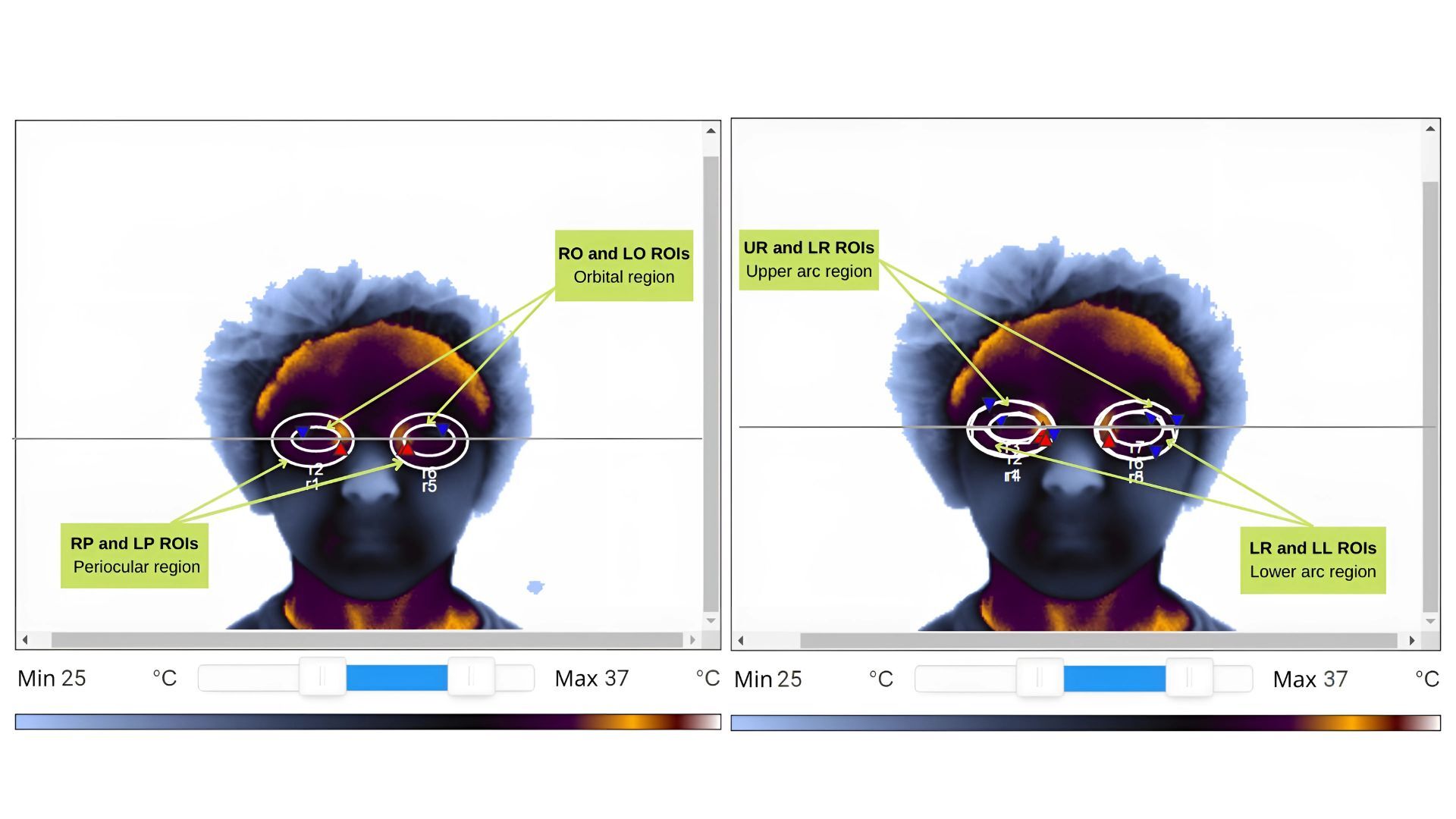 Caption: ROI = region of interest; RP = right periorbital region; LP = left periorbital region; RO = right orbital region; LO = left orbital region; UR = upper right orbital arc; UL = upper left orbital arc; LR = lower right orbital arc; LL = lower left orbital arc