| Sezin et al.(23) |
1. Acoustic measurements: fo, jitter, shimmer and HNR |
1. There was a significant reduction in shimmer (from 1.76% to 1.41%) and jitter (from 0.27% to 0.21%). The HNR increased significantly (from 25.44 to 26.76). There was no significant variation in fo
|
Beneficial results were observed from a voice education and training program designed for Islamic religious officials |
| 2. Self-evaluation: VHI-C, VFI and V-RQOL |
| 2. VHI-C and VFI - a significant decrease in the perception of vocal handicap (from 18.00 to 12.17) and in the symptoms of vocal fatigue reported (from 29.05 to 19.82) was reported. V-RQOL - Voice-related quality of life improved significantly (from 68.00 to 86.76). The CG did not present significant changes in any of the parameters evaluated, indicating that the improvements observed in the EG were attributed to the vocal training program |
| Ferreira et al.(24) |
1. Auditory-perceptual analysis: vowel /a/ emitted 3 times and spontaneous speech - pitch, loudness, resonance pneumophonoarticulatory coordination, speech rate, articulation and modulation |
1. Increased, decreased or stabilized |
The use of respiratory encouragers as a proposal to improve vocal and respiratory conditioning and the partnership with physiotherapy are presented and recommended for a better understanding and consequent care of voice and breathing issues in voice professionals |
| 2. Increased |
| 3. Greater vocal projection, better possibility of producing higher pitched sounds and more vocal flexibility. VFI - decreased fatigue and vocal restriction for 2 participants and vocal discomfort for 1 of them, VHI-10- even before there was no disadvantage. Even lower registration for 2 participants after training and EASE-BR subscale scores varied among participants |
| 2. Aerodynamic measurements: MFT |
| 3. Self-evaluation: directed questions, VAS, VFI, VHI-10 and EASE-BR |
| 4. Respiratory measures: respiratory muscle strength (MIP and MEP) and RME |
4. Considerable improvement in respiratory indices and decrease in the perception of respiratory effort |
| Ferreira et al.(25) |
1. Self-evaluation: directed questions, system for recording scores from 0 to 10 regarding voice quality and phonatory comfort, VHI and EASE-BR |
1. Improvements in self-perception, motivation, vocal and respiratory control, and phonatory comfort have been reported. There was a decrease in the feeling of fatigue. It was observed that the improvement in breathing did not have immediate repercussions on the voice |
The proposal proved to be viable and promising, especially when performed continuously and with gradual progression of exercises. The integration of the areas of speech therapy and physiotherapy is beneficial to optimize vocal and respiratory conditioning. The program presented has the potential to record positive effects |
| Sandage and Hoch(26) |
1. Self-evaluation: VFI and PPE |
1. VFI - measurements were higher after each singing attempt compared to the pre-singing measurement; however, they decreased between trials as hypothesized. PPE - did not change by more than a few points across the four trials |
The lower vocal fatigue perceived throughout rehearsals for the recital provides preliminary evidence of a conditioning training effect to meet the performance demands of this specific repertoire and recital in general |
| 2. Vocal dose measurements. |
| 2. Vocal dose - was ambiguous for the two measured moments, establishing a consistent vocal dose in the last two rehearsals (2954.56 meters during rehearsals and 3098.18 meters during the recital, with an average sound intensity of 93 dB and 94 dB) |
| Ray et al.(27) |
1. Respiratory measures: MIP and MEP |
1. There was a significant increase in MIP and MEP measurements. (IMST (phase B) MIP 37%, 101% and 118% / MEP 23%, 45% and 130% - EMST (phase C) MEP 70%, 28% and 137% / MIP 16%, 33% and 34% - IMST and EMST (phase D) MIP 63% / MEP 104%) |
The results showed that the singers increased respiratory muscle strength, both in the form of inspiratory (IMST) and expiratory (EMST) training, after completing the training program. There were no consistent changes in aerodynamics and voice measures among the subjects, although some individual changes were observed |
| 2. Acoustic measurements: Phonetogram: fo range, intensity range (SPL) and airflow for each tone |
| 2. Fo range - 3 participants showed increased pitch range. None of the participants decreased the pitch amplitude during the training. Intensity Range - both increase and decrease in SPL were recorded. Airflow - Measurements were inconsistent |
| Bengtson-Opitz(28) |
INA |
All participants experienced a clearly audible and noticeable improvement with improved articulation, flexibility, and pitch range |
"Anti-Aging for the Voice" is not a magic solution, but rather an ongoing process that requires practice and dedication. Maintaining the exercises and techniques learned is critical to sustaining the long-term benefits |
| Nam et al.(29) |
1. Aerodynamic measurements: MPT |
1. Increased significantly (from 22.3 ± 4.3sec to 31.0 ± 6.7sec) |
Specially programmed respiratory muscle training can improve respiratory muscle strength and vocal function without increasing lung function. This method can be performed easily and does not require much time |
| 2. Respiratory measures: pulmonary function tests (flow volume curve, plethysmography - FVC, FEV in 1 second, FEV1/FVC and FEF 25 - 75%, TLC and VC, and respiratory muscle strength test (MIP and MEP) |
| 2. Pulmonary function tests - were shown to be statistically similar before and after training. Respiratory muscle strength - showed a statistically significant increase (MIP from 62.2 ± 13.5 cmH2O to 78.2 ± 3.7cmH2O / MEP from 56.4 ± 7.5cmH2O to 70.0 ± 8.1cmH2O ) |
| Sabol et al.(30) |
1. Acoustic measurements: fo, jitter, and frequency range |
1. fo - There were no significant differences. Jitter – The average rate increased in comfortable tone (from 0.24 to 0.31Hz) and low (from 0.26 to 0.32Hz). Frequency range - There were no significant differences between the control and experimental groups |
Vocal function exercises containing the isometric-isotonic principle have been shown to have a positive effect on the phonatory systems of healthy young singers. The results indicate that the regular practice of these exercises can lead to an increase in glottic efficiency |
| 2. Aerodynamic measurements: MPT, phonation volume, and flow rate |
| 3. Videolaryngostroboscopy |
| 4. Self-evaluation: writings about the effects of vocal function exercises on their singing performance |
| 2. MPT - There was an increase in the experimental group (9s comfortable tone, 11s high tone and 9s low tone). Phonation volume - the experimental group had a slight increase (from 2,739 to 2,099ml). Flow rate - the experimental group had its flow rates decreased (from 205 to 133ml/s) |
| 3. There were no significant differences between the pre-and post-test |
| 4. Participants reported an increase in awareness of breath control and relaxation and improvements in glissando execution. They also reported greater awareness of laryngeal and facial tensions. The three men in the experimental group complained of tense, uncomfortable and tight sensations, especially in the first week. However, they improved their maximum phonation times over the following weeks |

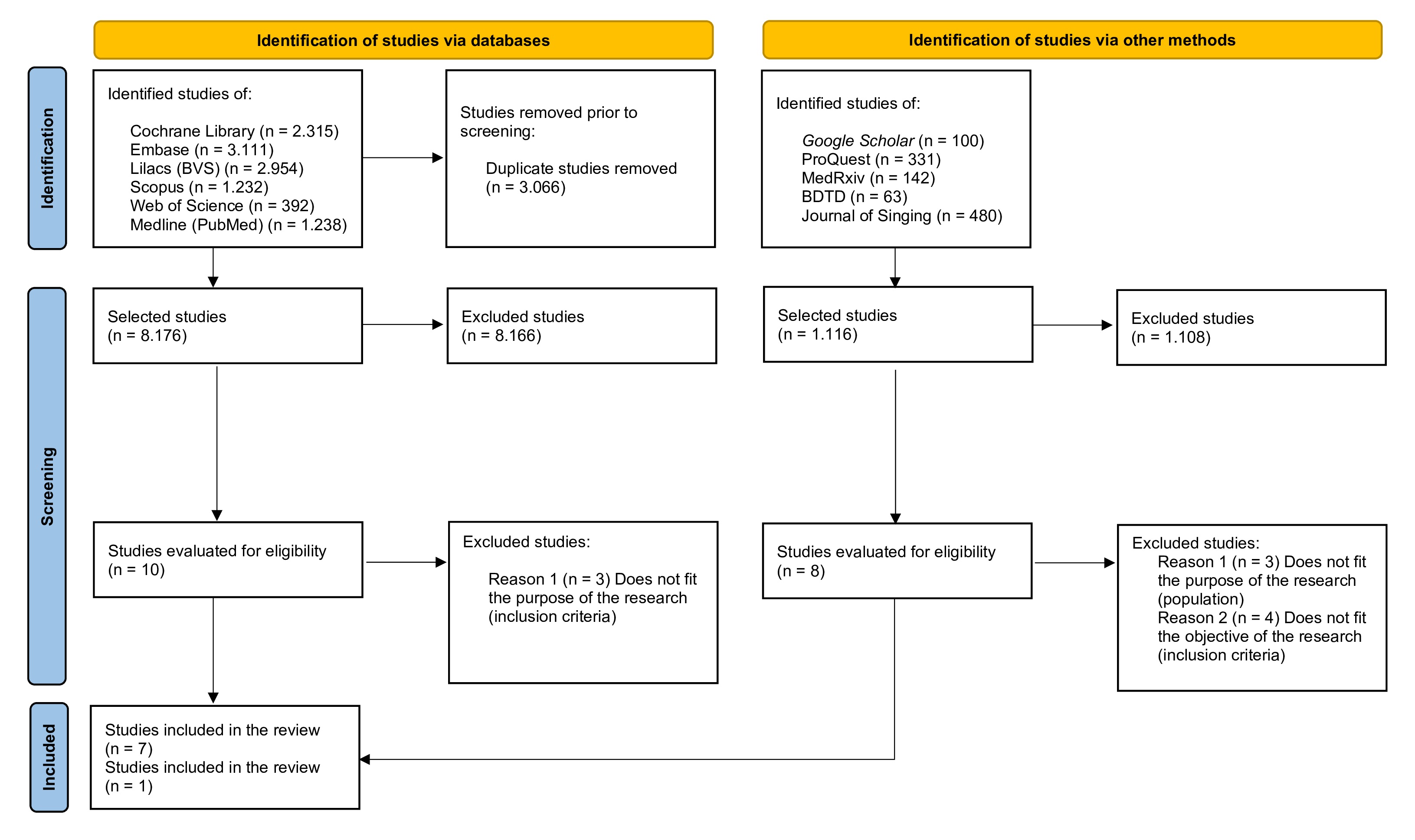
 Mapping the characteristics of training for vocal conditioning of singers: a scoping review
 Thumbnail