
 Effect of modulated masking on electrophysiological and behavioral measures
Purpose To analyze the Benefit of Modulated Masking (BMM) in electrophysiological and behavioral measurements in young and adult normal-hearing individuals.
Methods Observational and cross-sectional analytical study, with a final research sample consisted of 40 participants, 20 individuals aged 18 to 30 years (young adults) and 20 individuals aged 31 to 50 years (adults), to carry out behavioral assessment (Sentence recognition test in the presence of stable and modulated noise) and electrophysiological (Cortical Auditory Evoked Potential) for BMM investigation. The results were analyzed using the paired t-test and ANOVA for repeated measures, applied by the Bonferroni post-hoc test (p-value <0.05).
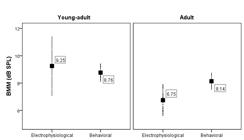
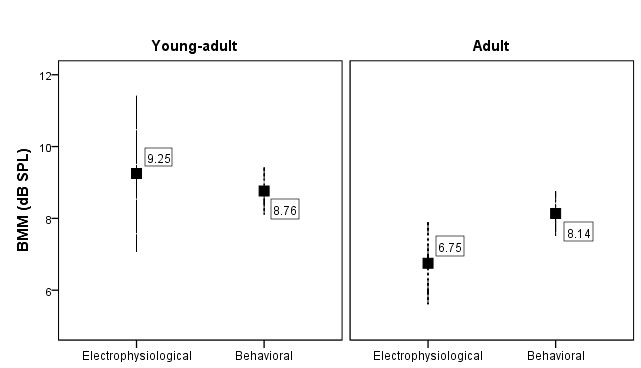
Results Less interference from modulated noise was identified in the latency and amplitude measurements of cortical components, generating a significant reduction in P1 latency and an increase in P2 amplitude in both groups of participants. Stable noise generated higher electrophysiological and behavioral thresholds compared to modulated noise. A greater magnitude of BMM was observed in the young-adult group.
Conclusion In both groups of participants, less interference from modulated noise was identified in the encoding time of the neural auditory response and in the process of neural discrimination of speech. Furthermore, behavioral and electrophysiological thresholds were typically higher in stable noise when compared to modulated noise, pointing to a correspondence between BMM measurements between hearing domains. The magnitude of the higher BMM in the young-adult group, especially in the electrophysiological domain, suggests a greater temporal resolution ability in younger individuals.
Keywords:
Electrophysiology; Evoked Potentials Auditory; Speech Perception; Psychoacoustics; Perceptual Masking; Hearing
 Thumbnail
 Thumbnail
 Thumbnail
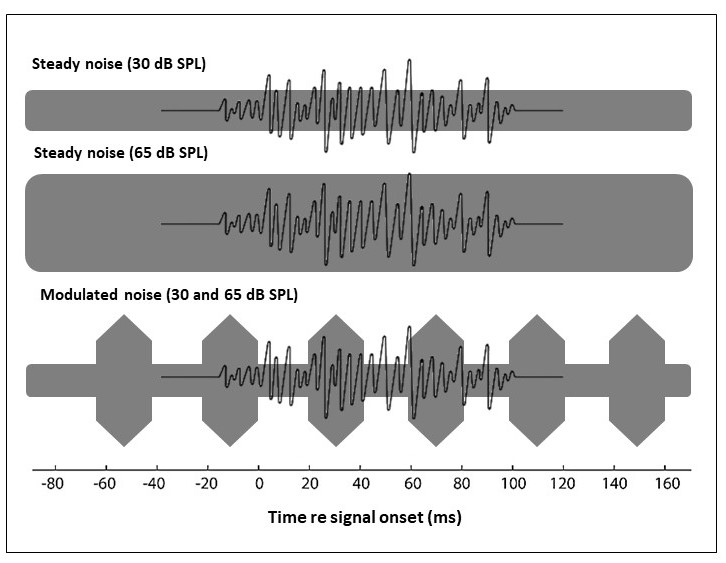 Caption: Representation of the speech stimulus /ba/ (black wave) in the three noise conditions used in the electrophysiological test
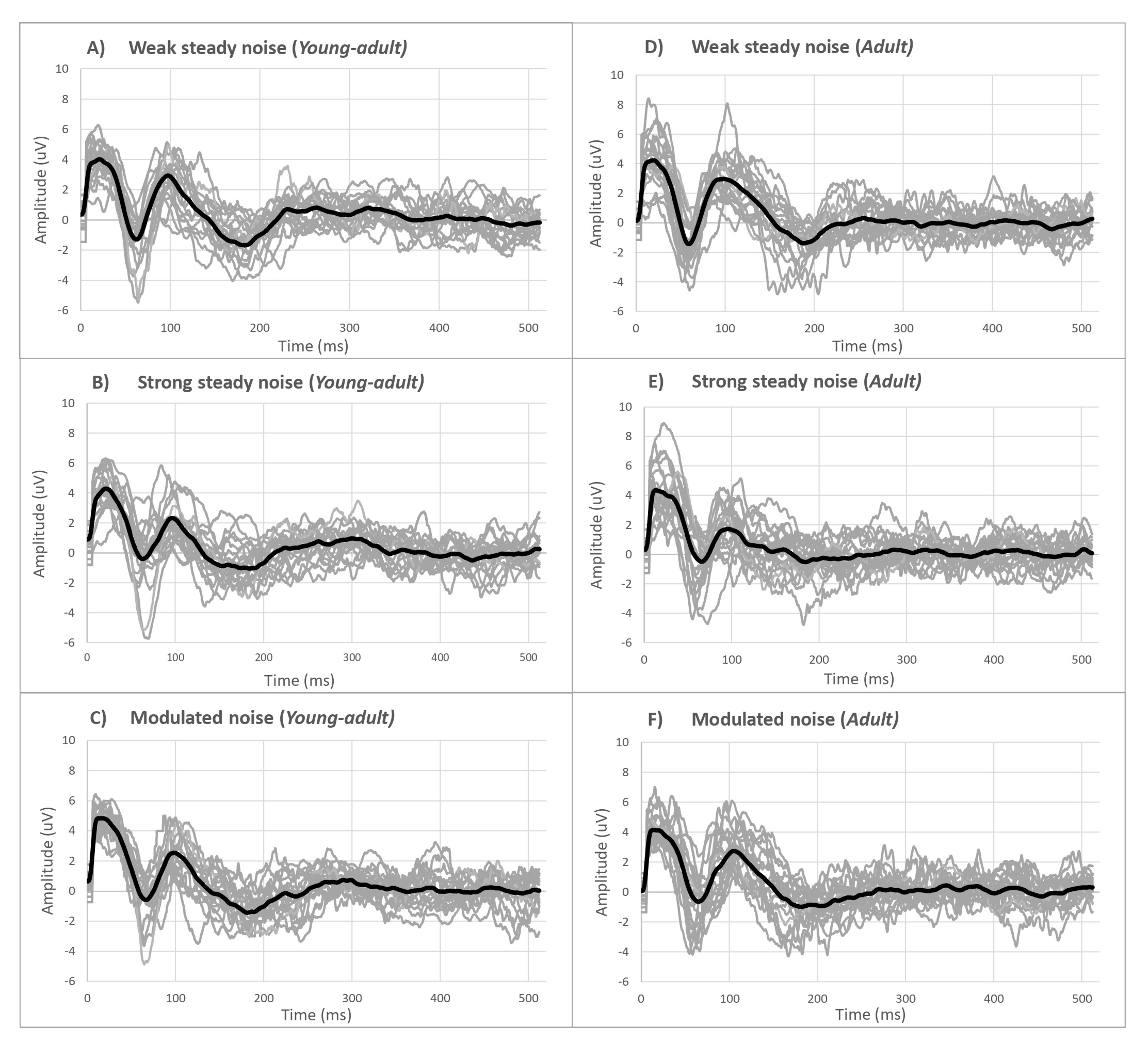
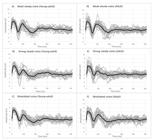
 Legend: Individual (light gray) and group average (black) CAEPs for Weak Steady Noise, Strong Steady Noise, and Modulated Noise, for each group of participants