
 Smart Porto Alegre: case study of a neoliberal urban restructuring
Abstract
This qualitative sociological research explores the impact of the smart cities agenda based on regulatory adjustments and urban projects that influenced practices and representations in Porto Alegre/state of Rio Grande do Sul between 2010 and 2024. Grounded in Urban Critical Theory, the study analyzes primary and secondary data that enabled to describe this agenda as an overview of initiatives and investigates how it has been conducted in the city through a pro-innovation coalition. This coalition appropriates the smart city agenda as a strategy to integrate the city into financial-digital flows in the new round of capital accumulation and to intensify the neoliberalization model of urban space.
Keywords:
smart city; neoliberalism; urban critical theory
Resumo
Esta pesquisa sociológica qualitativa explora a incidência da agenda das cidades inteligentes, a partir de ajustes regulatórios e projetos urbanos que têm influenciado práticas e representações em Porto Alegre/RS entre 2010 e 2024. Através de uma análise fundamentada na Teoria Crítica Urbana sobre dados primários e secundários que permitiram sua descrição como um panorama de iniciativas, o estudo explora como essa agenda tem sido conduzida na cidade a partir de uma coalizão pró-inovação que se apropria da agenda smart city como estratégia de inserção da cidade em fluxos financeiros informatizados na nova rodada de acumulação de capital e de aprofundamento do modelo de neoliberalização do espaço urbano.
Palavras-chave:
cidade inteligente; neoliberalismo; teoria crítica urbana
Introduction
A city is a laboratory, says Lefebvre (2001); in it, humanity enjoys both its recent technological discoveries and the consequences of choices that are not always predictable or desirable. Humanity transforms and re-signifies physical and symbolic spaces, reinterpreting and reconfiguring social, cultural, and economic relations. The concentration of populations in certain regions, the worsening of socio--economic and spatial inequalities, the deepening of the most varied ecological risks due to climate change, and the consequences of “natural” disasters, all put pressure on the capitalist economy and current models of urban development. In this context, hope and imagination have arisen around a hyper- -connected and technological future that could solve, or at least mitigate, some of the social and environmental problems that different cities around the world share, through innovation in areas such as mobility, sanitation, government interfaces, social participation, public safety, among others.
For Ribeiro et al. (2020), the backdrop to contemporary emergencies is the dramatic consequences of the new stage of the commodification of various areas and elements of social life, whose impacts on the production of urban space indicate the intertwining of financialization, spreading of mercantile logic and urban transformations that pave the way for new waves of capital urbanization. This process can be analyzed based on the innovations (financial, technological, scale, regulatory, products and lifestyles, and urban ideologies) that sustain it and reinforce the trend towards “[…] rationalization of the urban order, in line with the very imperatives of productive expansion” (ibid., p. 41). A fundamental political-economic phenomenon that emerges in this context is “innovation” or “intelligence”, which came through the intensive use of information and communication technologies (ICT) in the production of space and a new urban experience.
However, after decades of “technological utopianism” (Morozov, 2018), steeped in the “ideology of high technology” (Castells & Hall, 1994), we have finally arrived at an era of “digital sobriety” (Morozov, 2018), in which naivety or negligence in the face of the effects and consequences of the intensive use of ICT on our individual and collective experiences give way to the illumination of ethical and moral conflicts, privacy problems, addictions, overconsumption, exclusion, and digital crimes, as well as all the environmental and social consequences of the extraction of raw materials, the increase in toxic waste, and the concentration of power in the hands of a few transnational companies.
Given this scenario, this article explores the urban agenda of smart cities. Following the perspective of Winckler (2023), this agenda is an urban ideology (Ribeiro & Mancilla, 2020) anchored in an umbrella of strategies based on the corporate vocabulary of a market (smart city market) closely associated with the intensive use of ICT in urban management and planning, but not only since it includes the development of urban projects, regulatory adjustments, and social arrangements to legitimize them. These strategies form an agenda of spatial practices, i.e. activities that transform and maintain physical space, and representations of space, which are linked to relations of production and the order they impose, through hierarchies and class interests, codes, knowledge, and signs that create the symbolic order, shaping both the perception and use of space (Lefebvre, 2006) by the construction of certain urban problems and their solutions. However, the consequences point out that, in the current stage of neo- -liberalization and commodification of space, this agenda reproduces the logic of capitalist production of urban space, by forging consensus, checkpoints, goals, and hierarchies for cities in a context of interurban competitiveness, which feed back into the new round of capital accumulation (Ribeiro et al., 2020).
Considering that, like the process of neo--liberalization (Brenner, 2018), the smart cities agenda is a trend with nuances depending on the local context, this article presents a qualitative investigation into how the “smart” label given to certain initiatives has influenced practices and representations in the city of Porto Alegre/RS/Brazil between 2010 and 2024, especially through the presence of a coalition of agents who legitimize this process, new urban projects, and regulatory adjustments that support the emergence of this agenda at the local level.1 This study was based on primary data, obtained through observation of events related to the issue at the local level; secondary data, whose bibliographic review and documentary analysis based on official documents, was based on laws, government programs, and urban projects; and reports available on official virtual communication portals of the government and corporate media, enabling a longitudinal section that favored the observation of the phenomenon as an ongoing process (Cellard, 2010). This “opaque data” (Deslauriers & Kérist, 2010) was analyzed using concepts and reflections from Critical Urban Theory (Brenner, 2018).
This article is organized into three sections, except for this one. The first deals with an overview of the problem of the smart cities agenda in the light of Critical Urban Theory. The second presents an overview of the impact of the smart cities agenda in Porto Alegre, highlighting the main players, regulatory adjustments, and urban projects between 2010 and 2024. The third section takes a critical look at the data. Finally, concluding remarks are outlined.
Smart city and the Critical Urban Theory
One of the basic concepts of Urban Critical Theory is the notion of production and reproduction in Marx (2013), whose materiality, as Lefebvre (2006) pointed out, unfolds in the routine of human life, which produces a socio--historically situated space, that is, a continuous interaction between social reproduction and spatial form (Souza, 2022), an effect of social relations and agents that make space – product and producer – enter into relations of production and productive forces (Lefebvre, 2006, p. 7). Thus, Critical Urban Theory brings the notion of the production of urban space, emphasizing the creation of a given socio-spatial practice that reveals, in turn, contradictions, power relations, and conflicts present in a society's mode of production.
Since the capitalist economy is the dominant mode of production and its development processes are concretized in space (Gottidiener, 2016), Harvey (1980) identifies a necessary relationship between urbanization and the development of capitalism because, for the author, it is in urban space, in its tangible form, the cities, that arrangements of mobilization, extraction, and concentration of surplus products are created and produced. For the author, cities are the spaces in which capital accumulation takes place, as well as the circulation of surplus value, the exploitation of the workforce, and the reproduction of social class relations (Harvey, 2014). This economic, political, ideological, and malleable dimension seats the urban space in a “[…] (re)continuous construction as a place, a medium, and a result of socio-historically specific power relations” (Brenner, 2018, p.21). Considering that this mode of production is geared towards the incessant production of wealth, it is possible to broaden the reading of the three dimensions of Marxian political economy (production, consumption, and exchange) to include surplus value from the urban form, i.e. spatial practice (Lefebvre, 2006), which transmutes the city into a commodity to be consumed according to the laws of capital reproduction.
Authors such as Logan and Molotch (1987) emphasize the central role of a coalition of government agents, businessmen, the media, the political field, university sectors, retailers, liberal professionals, class associations – in short, a range of interested parties – in guiding the “making of the city” (Harvey, 2014) through the process of its commodification in favor of their interests. According to the authors, cities are an instrument, a “growth machine” pitched to the demands of what they call the “pro-growth coalition”. This instrumentalization takes place through the relaxation of urban regulations, the creation of economic advantages, and the dissemination of town ideologies (Ribeiro & Mancilla, 2020).
For Harvey (2008), with the acceptance of neoliberal political-economic thinking, cities have been increasingly victimized by the endless need to dispose of capital accumulation, through the expansion of urban growth regardless of its tragic consequences. Furthermore, cities have been transmuted into “subjects” of will and desire (Vainer, 2000), global players (Marx, 2011; Arantes, 2012) who, under the command of capital, seek competitive advantages and the appropriation of surplus profits (Krätke, 2011). To carry out this process, marketing strategies are developed to attract investment, ideologically legitimizing its commodification. Although this movement is not homogeneous, it represents the current trend of restructuring the urban order, in which market-disciplined projects materialize such as urban revitalization programs, privatizations, deregulations of urban planning, and the withdrawal of the State in many areas of social welfare (Harvey, 2008; Brenner, 2018).
In the field of urban management, this movement has meant orienting governance around strategies characteristic of the flexible accumulation regime, such as urban entrepreneurship (Harvey, 2005) and market-oriented planning (Souza, 2011). The first concept refers to strategies based on the principles of “efficiency”, “urban competitiveness”, “profitability” and closer ties between the public and private sectors, above all through public-private partnerships and urban policies, which focus on speculative urban projects that divert the attention of public resources from the concrete problems of the local population where they are established (Harvey, 2005). Complementing the first perspective, Souza (2011) emphasizes that, by replacing planning with more immediate and uncoordinated actions, development has become increasingly subordinate to market trends, with facilitations and incentives for private initiative through locational advantages, incorporation of private enterprise methods into planning, and delegation of responsibility for space management to the market (ibid.). In this context, a fundamental element is the attribution of adjectives to initiatives in different cities around the world. One of the main pillars of the current phase of capital accumulation is the idea of innovation as a strategy for urban growth within the framework of competition for locational advantages. It has become a key theme in the new urban question (Arantes, 2000) since innovation has been incorporated by the pro-growth coalition as a legitimizer of urban intervention agendas.
In addition, the advent of smart technologies, linked to the emergence of platform capitalism, characteristic of the current phase in the development of productive forces, has made it possible to hyper-connect systems and popularize technological artifacts, while, it has transferred power to large companies that hold data, systems, and hardware. Innovation became associated with the prefix smart and, in the field of cities, the idea of “smart cities” began to spread, roughly understood as cities capable of connecting different technological elements as a source of growth and development. As Ribeiro and Mancilla (2020) argued, this process responds to the “ideologies of urban growth” that are organized under different labels – among them, smart cities –, one of the most prominent agendas in contemporary times (Morozov & Bria, 2019).
The dissemination of this agenda dates back to the first decade of the 2000s, when the expression began to be used within the smart city market, made up of large technology companies, investors, and consultants specializing in technological innovation. The process of restructuring urban forms based on the neo-liberalization of urban management and planning was already underway in a large part of the United States and Europe, finding new spaces for expansion in Asian, Latin American, and African countries, through a hegemonic discourse on the need to provide cities with “intelligence”. This need was constructed by advertising campaigns (storytelling, as Söderström, Paashe e Klauser (2014) would say) around certain urban problems and their solutions. Thus, it is argued that problems such as sanitation, management, mobility, and infrastructure can be solved by the know-how and technologies of large transnational companies.
The contexts of formulating and expanding the business of large companies in the urban space respond to the strategy adopted to overcome the economic crisis of 2008 because, for the smart city market, the promotion of products to municipal administrations represented an extension of its “business counter” (Arantes, 2000), in which, in the “[…] contemporary language games around urban management and development” (Söderström, Paashe e Klauser, 2014, p. 308), the business logic positioned the ICT market as a successful business and an opportunity for urban growth. In this sense, for the smart city market, municipalities acquire objects, systems, and platforms that respond to the process of production and circulation of surplus value (Krätke, 2011) and also represent a privileged space for gathering potential customers. Thus, “[…] the smart market emerges as an enabling industry, offering technology both for cities and in cities” (Clark, 2020, p.11). The contours of this process indicate the hegemony of a corporate and neoliberal vision as the driver of the smart city agenda, in which the symbolic and material power linked to the smart city market is gaining momentum, even expanding the umbrella of themes that can now be seen around urban intelligence.2
For city administrations, partnerships with the smart city market, present themselves as key opportunities for urban growth. Preparing the ground for smart city urban innovation, however, requires the creation of regulatory adjustments, and the implementation of urban intervention strategies and projects – especially to attract specific classes (Silva et al., 2023). In addition, there is a need for imagery and symbolic constructions that certify that a city is smart or, in other words, that it gains recognition for being open to smart business, through integration into multi-scalar networks, obtaining some products and, above all, articulating certain agents (Halegoua, 2020). In this context, looking smart is crucial to competing in today's global economy (Townsend, 2013, p.10).
As an ideology and a political device that exerts power over urban space, impacting not only the field of representations of space but also spatial practice, a global normative hierarchy is being forged around the smart cities agenda, driving attempts to create “mandatory crossing points” in city development (Halegoua, 2020). Sown as an urban ideology on a global scale, the smart cities ideology has become one of the main development agendas for the 21st century. However, like any other ideology, its substance is fetishized and, behind the gloss of innovation, “[…] like merchandise, it tends to obscure class relations by diluting them in the content” (Novaes, 2007, p.75).
To respond to the new trend in urban planning and management aimed at bringing intelligence to cities, regulatory adjustments (financial and legislative incentives, changes and new regulations, etc.) and urban interventions (projects, urban programs, new structure and equipment, etc.) are created based on the legitimization of a coalition of agents involved in this dynamic. In the next section, we will explore this panorama in Porto Alegre.
Porto Alegre and the Smart Agenda
The city of Porto Alegre, the “Capital of the World Social Forum” or “Capital of Participatory Budgeting”, as it was known during the late 1990s and early 2000s,3 is now trying to project itself as the “capital of innovation”, the “smart city”, the “startup city” and, more recently, the “Latin American capital of the South Summit”. This rebranding – as it is called in corporate circles – symbolizes a process that has spanned three municipal administrations.
After the progressive experiences of the Frente Popular (Popular Front) administrations, a new government began in 2005, led by José Fogaça (PPS) and his vice-mayor José Fortunati (PDT). This period was marked by social-liberal ascendency (Fedozzi, 2023), whose logic of “flexibility and facilitation”, which “[…] opened the door to the entrepreneurial practices that followed”, was aligned with the recently created Lei de Parcerias Público-Privadas (Public-Private Partnerships Act) (Oliveira, 2013, p.275). In 2010, vice-mayor Fortunati took over as mayor and, winning the 2012 elections, went on to rule the city until 2016, with Sebastião Melo (PMDB) as his vice-mayor. In 2016, Marchezan Jr. (PSDB) and his vice-mayor Gustavo Paim (PP) were elected with a neoliberal slogan based on cutting down the public machine. In 2020, the mayor Sebastião Melo (MDB) and his vice--mayor Ricardo Gomes (PP/PL) were elected, further deepening the ultra-liberal policy of an authoritarian nature (Marx et al., 2022), a trend that was reinforced by the mayor's re-election, this time with Lieutenant Colonel Betina Worm (PL) as vice-mayor.
From 2010 onwards, Porto Alegre experienced a period marked by the search for and subsequent choice of the city as one of the World Cup venues. The World Cup represented an opportunity to introduce the smart cities agenda at the local level, both for local players, as exemplified by the link between themes in the reports of the Conselho Municipal de Ciência e Tecnologia de Porto Alegre (Comcet) (Porto Alegre Municipal Council for Science and Technology) (Branco et al., 2012), and for companies in the smart city market, especially IBM, which entered into partnerships with the city administration, making the municipality one of the four priority cities within the scope of its Smart Planet project (Renner, 2010).
Since then, the smart city agenda has been present in the initiatives and rhetorics of agents who mobilize instruments, strategies, and discourses related to “innovation” as a source of urban “intelligence”, above all linked to new regulatory adjustments aimed at innovative entrepreneurship and innovation in the public sector and urban projects, which were connected to flexibilization and deregulation. The first cases can be identified as the successive laws proposed by the Municipal Executive – especially from both the Mayor's and the Innovation Office – and by the City Council, aimed at encouraging and supporting the local innovation ecosystem, as exemplified by the Programa Cidade Inovadora (Innovative City Program) (2010) (Prefeitura de Porto Alegre, 2010), the Lei de Inovação (Innovation Act) (2013) (Porto Alegre, 2013), the Programa Desenvolver com Inovação (Developing with Innovation Program) (2014) (Prefeitura de Porto Alegre, 2014), the Programa Municipal de Incentivo ao Desenvolvimento de Setores Estratégicos de Alta Tecnologia (Municipal Program to Encourage the Development of Strategic High-Tech Sectors) (2021) (Porto Alegre, 2021), the Sandbox POA, the Living Lab Poa 2022 (Porto Alegre, 2022), among others.
Inspiring local entrepreneurship, however, was not solely due to the actions of the municipal executive and legislature, as alongside them we find a range of agents such as local media, local entrepreneurs, large technology companies, international consultants, and organizations such as CITE,4 the Aliança pela Inovação (Alliance for Innovation),5 and the Pacto Alegre (Alegre Pact).6 These representatives drove a change of "mindset", especially in the management of Marchezan Jr. and Sebastião Melo, by linking discussions on innovations and urban intelligence, culminating in the idea of a "startup city" (Schütz, 2021). According to this perspective, the municipal administration should absorb characteristics of both "startup" and "innovation culture" to compete in the global scenario. This idea was related to the creation of marketing that demonstrated that the city was open to innovation and technology business. Concrete examples include the Lei de Antenas (Antenna Act) (2019)7 and the Escritório de Licenciamento (Licensing Office) (2020), which aimed to simplify processes by digital means and self--licensing, as well as programs such as Start.Gov and Servidor 4.0 (Server 4.0) (2019), which brought the startup culture to administration and connected servers to innovation practices promoted by the smart city market.
However, to strengthen local innovative entrepreneurship it was also necessary to transform some territory by specific regulations, making it fit for the flourishing of the local innovation ecosystem. The 4º Distrito (4th District) of the capital, a former industrial area, was already seen as a Região de Potencial Tecnológico (Region of Technological Potential) by the Porto Alegre Tecnópole (Porto Alegre Technopole) (PAT) project in 1999,8 but began to attract attention and receive investments from 2015, especially. The region was identified as having a "vocation for innovation" and, from a strong campaign of local media, universities, secretariats, especially the Innovation Office, and, later, the Alegre Pact, it took place many reforms of deactivated factories in new enterprises characteristic of the flexible accumulation regime such as coworking spaces, technological innovation startups, investors, large technology and creative economy companies (Marx et al., 2024). In this context, successive reductions and exemptions were approved for technology-based, innovative, or creative economy companies to sustain and accelerate this process (Tavares et al., 2022).
Associated with these adjustments came proposals for revitalization projects for the 4th District, linking themes such as urban resilience, creative economy and smart cities, as exemplified by the Plano de Economia Criativa (Creative Economy Plan) (2013) (Prefeitura de Porto Alegre, 2013), the Zona de Inovação Sustentável de Porto Alegre (Porto Alegre Sustainable Innovation Zone) (2015), and the Plano de Resiliência (Resilience Plan) (2019) (Porto Alegre, 2019c). The Operações Urbanas Consorciadas (OUC) (Consortia Urban Operations), the Masterplan 4D (2016) (NTU, 2016), and the Programa +4D (Program +4D) (2022) (Porto Alegre, 2022b) were also proposed, taking as inspiration cases such as Barcelona’s District 22@ and United States’ Silicon Valley. As verified by Soares et al. (2023), the revitalizations of specific areas of the city respond to the dissemination of the use of the urban instrument Projetos Especiais (Special Projects), which alter patterns foreseen in the Plano Diretor (Master Plan) of the city, fragmenting the urban fabric, and has advanced from the Grandes Projetos Urbanos (Major Urban Projects), located in the Orla (Waterfront), 4th District and Centro Histórico (Historic Center) – the last one, grouped as the Programa Centro+4D (Centro+4D Program), whose financing will be made by loans taken from the World Bank and the French Development Agency (Silva, 2023).
On the one hand, the projects have received criticism for their alignment with the real estate market in a logic of urban restructuring through public-private partnerships (PPP), thickening and flexibilization of heights, besides the risk of eviction of residents, sanitization, and gentrification of the regions (Alfonsin et al., 2023; Soares et al., 2023). In addition, the projects prioritize the promotion of "innovative entrepreneurship", to the detriment of other important demands of the region such as social housing and urban drainage (Nazário et al., 2022; Winckler & Abalos Júnior, 2022). On the other hand, they are celebrated in innovation events as "good practice" of revitalization, as exemplified by the integration of the +4D Program into the Aliança de Distritos de Inovação (Innovation Districts Alliance) and the Associação Internacional de Parques Científicos e Áreas de Inovação (International Association of Science Parks and Innovation Areas) (IASP) (Aprato, 2023).
It was not only in the field of urban projects that the partnership strategy aligned with the smart cities’ agenda in Porto Alegre. As an approach, the use of PPP has accelerated since 2017, especially in the case of regulatory adjustments related to innovation in the public sector and neo-liberalization of management and planning. With the election of Mayor Marchezan Jr., there was the creation of a partnership program that, combined with laws that enabled the granting of public spaces (Porto Alegre, 2019b), equipment, and infrastructure (Porto Alegre, 2019a) and the search for "[…] support from the private sector to revolutionize the public structure", as defined by Marchezan Jr. (Moraes, 2017). Since the supports were created, the partnerships became central to making Porto Alegre smart, whose strategy, typical of an urban entrepreneurship regime, aimed to attract national and international financing through a "portfolio of projects" of privatizations and concessions at events with investors and technology companies. The marketing adopted was "Smart Cities – we need, and need now", as one of the mayor’s presentations titled (Moraes, 2017). Thus, different articulations were obtained financing such as one in 2018 for the 4th District, with the World Bank through a triangulation of BRDE (Borba, 2018); another, in 2019, taken from BNDES and BRDE, for modernization, de-bureaucratization, efficiency and intelligent systems (Fontoura, 2019); and, in the management of Melo, the already mentioned loan with the World Bank and the French Development Agency for the Centro+4D Program (Silva, 2023).
In addition to investments in projects, the administrations of Marchezan Jr. and Melo also won new partnerships and concessions based on the smart agenda. Some examples are the granting of public lighting – mediated with BNDES funding (Lagoas et al., 2020) –; the installation of technological devices in transport collectives at Carris, a public transport company;⁹ the fixation of digital clocks and street signs, whose counterpart is its advertising exploitation; and, in Melo’s management, the hiring of the new contact center, financed by the BNDES (Rossling, 2022), the concession of bus shelters – again, with the counterpart of advertising exploitation –, the partnership for setting up of safety totems (Silva, 2021), among others.
Besides adopting the strategy of promoting urban intelligence from PPP, these administrations also directed actions to "break the monopoly" of Procempa, the city’s public data company. Marchezan Jr. argued directly that, like Carris, the public company should be at least reduced, if not sold (Suplitz, 2018). Thus, in 2019, it proposed a bill that eliminated the requirement of technical supervision of the company for technology contracts, to seek more competitive prices in the market (Casiraghi, 2020). After the mobilization of opponents to the project, it was rejected. However, the management continued scanning Procempa through other strategies, such as attempts to hire a private company for advice on ICT and new systems for municipal departments - annulled by justice (Winckler, 2023). Since then, the Sindicato dos Trabalhadores em Processamento de Dados do Rio Grande do Sul (SINDPPD-RS) (Union of Workers in Data Processing of Rio Grande do Sul) began to accuse the municipal executive of aligning itself with the interests of the market for technological solutions.
The tension between the SINDPPD-RS and the city continued in the government of Melo. Although the management recognized that it was a strategic company for Porto Alegre to become an intelligent city, there were disputes about how this role would be given. The city management argued that hiring via PPP would be more economical, while the opponents reasoned that this strategy weakened the technological sovereignty of the municipality, the compatibility of systems, and the very cost-effectiveness of the contracted solutions (Winckler, 2023). However, the administration proposed the Lei de Liberdade Tecnológica (LLT) (Technological Freedom Act) (Porto Alegre, 2021), an unfolding of the "[…] economic freedom shock in the city", as defined by vice-mayor Ricardo Gomes (Rocha, 2020), and which had already been the subject of a campaign promise: "[…] innovation, economic freedom, smart city, and creative economy will be at the center of government decisions" (Coligação Estamos Juntos Porto Alegre, 2020, p. 11). In addition to proposing LLT, the municipal management also indicated a presidency of Procempa, as a suggestion from Alegre Pact, aligned with the business sector to work in tune with the market (Renner, 2021) – to put Procempa in touch with "[…] the best practices of smart cities" (Batistela, 2021).
Although LLT has mobilized opponents who formed the Frente em Defesa da Procempa (Front in Defense of Procempa) in the City Hall, the law was approved, having among its amendments the requirement for technical supervision of Procempa after hiring equipment or services (Winckler, 2023). The company now has a committee to monitor market trends and projects such as the Procempa Network and Procempa Tech, which brought server solutions to the smart city market. In addition, the president of the company is also linked, as director of partnerships, to the Associação Nacional das Cidades Inteligentes, Tecnológicas e Inovadoras (ANCITI) (National Association of Smart, Technological and Innovative Cities) and, more recently, established the Procempa Smart Lab, acting as a hub of innovative solutions for the improvement of technologies developed by Procempa and in integration with the market, and the Smart Cities AI HUB, a collaborative artificial intelligence hub for public services (Procempa, 2024).
As stated, Porto Alegre has been pursuing a process in search of recognition as an intelligent and innovative city, whose great milestone was given, still in 2021, by its choice as the Latin American headquarters of the Spanish event South Summit for four years. This choice was possible from the articulation between organizers, city hall, especially the Innovation Office, the government of Rio Grande do Sul, and its "[…] innovative, vibrant and disruptive ecosystem" (Melo, 2021). It has become the venue of the event represented by the opening of the city for innovation business and the incidence of the agenda of smart cities in local scope, focused on the marketing of the city as the "capital of innovation".
As seen in this section, the trajectory of initiatives was marked by regulatory adjustments, public-private partnerships, and access to investments, demonstrating the alignment of the city with the trends of urban restructuring of the current demands of financial and computerized capitalism. In the next section, we will make a critical reading about this phenomenon.
The neoliberal intelligent agenda
The brief overview presented in the previous section cited some of the initiatives and agents that are part of the dissemination of the smart cities agenda in Porto Alegre. The segment illustrated a complex process of transformations, in which the ambition to become a smart city was accompanied by the creation of supports aligned with the trend of neo-liberalization of urban space (Brenner, 2018) from urban entrepreneurship strategies (Harvey, 2005) and consolidation of a marketing plan (Souza, 2011). The agenda of smart cities did not inaugurate this process, but accompanied it and, above all, as an urban ideology of growth (Ribeiro & Mancilla, 2020), legitimized a continuous process that, between administrations, even with some specificities, followed this trend as an urban development strategy in a scenario of inter-urban competitiveness and insertion into investment flows.
Experimenting an analogy with the pro- -growth coalition, Winckler (2023) proposes the emergence of a pro-innovation partnership that, in parallel to (and within) the vision of the city as a machine for growth, can be used to reflect on the articulation between agents that organize themselves around the smart cities’ agenda as a new strategic asset in the context of inter-urban competition (Krätke, 2011). The pro-innovation coalition is formed by agents – who occupy different places in this arrangement (coordination, financing, facilitation, and promotion) such as government, technology companies, universities, local entrepreneurs, funding agencies, local media, social organizations, among others –, that mobilize and instrumentalize regulatory adjustments and specific projects, enabling the smart cities’ agenda to impact directly on spatial practice - not only through real estate valuation, well represented in the notion of the city as a growth machine - but also by the technologies and systems present in it. Thus, representations of space (as relatively "innovative" or "intelligent") contribute to the initiatives being conveyed as a-political and a-historical, ensuring the consistency of the flexible accumulation regime (Harvey, 2005).
By promoting processes of urban restructuring, the initiatives labeled as intelligent bring significant implications for the production of urban space and deepening of neoliberal politics in vogue in the city (Marx et al., 2022), because they transform elements and the urban territory, associated with the value of the use of its inhabitants, into commodities to be traded and consumed for their exchange value - an open laboratory for technological innovations, service concessions and speculative urban revitalization projects. The transmutation of the city into merchandise to be sold and consumed by certain economic agents is accompanied by the formation of associations between agents that already hold positions of power and share expectations about a given model aligned with market trends, especially to the smart city market in the case analyzed. This trend was even the trigger for the first discussions between local agents and the intelligent agenda, made by the IBM company, in 2010.
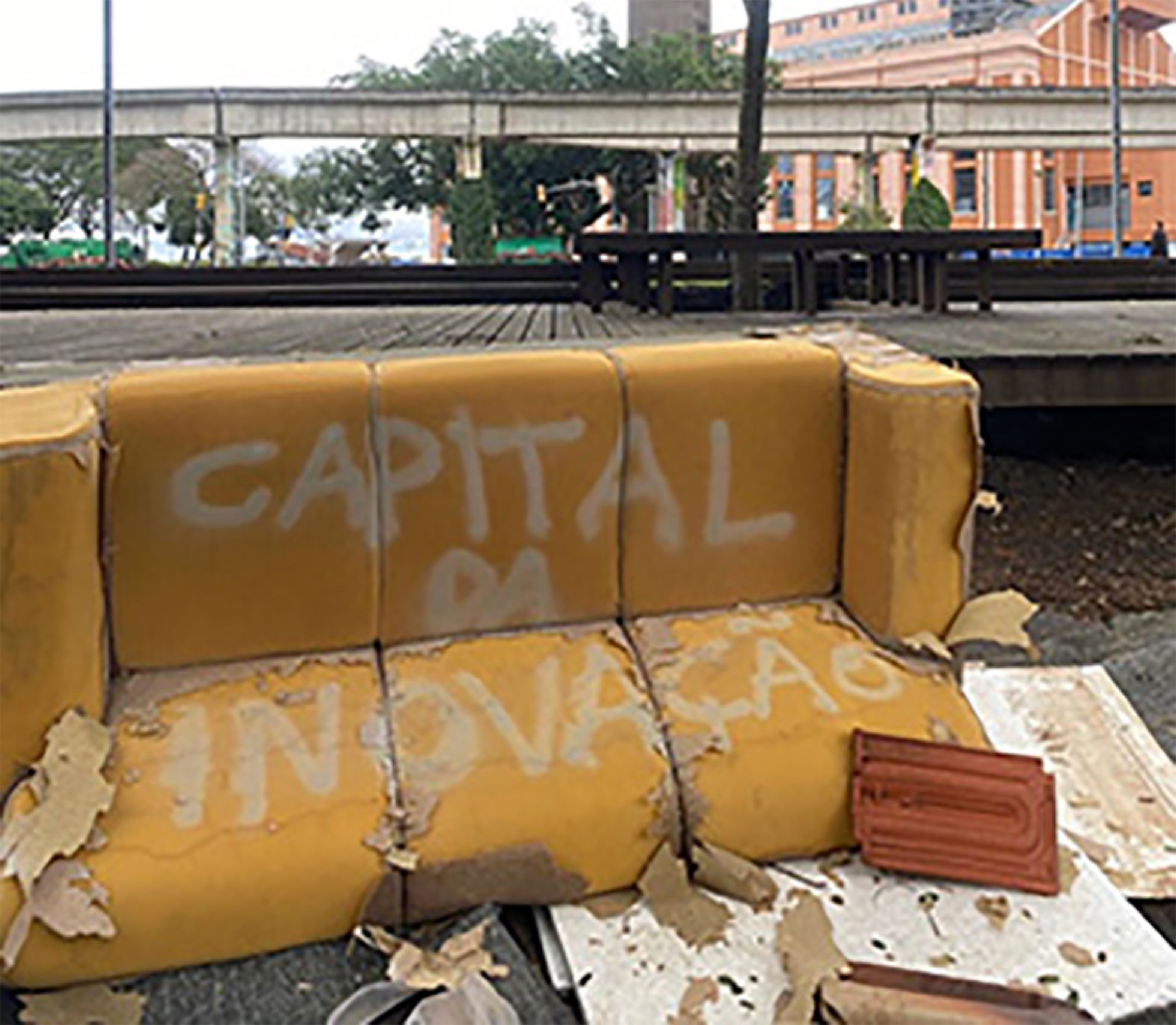
The logic of the development of new urban centralities with Special Projects, which make specific territories flexible apart from the city’s Master Plan, directly responds to a scenario of neo-liberalization of the metropolis that replaces traditional planning by pro-market design, described by Souza (2011) and Brenner (2018). The prioritization of speculative urban projects aimed at the valorization of urban land, to the detriment of projects focused on the concrete needs of resident populations, became evident during the flood of May 2024. The flood in Porto Alegre exposed, in a dramatic way, the weaknesses of planning based on market logic and the attraction of investment precisely in the territories most affected by the catastrophe, such as the Historic Center and the 4th District, areas that are taken as priorities to design the city as "smart" and "innovative".10 As a consequence, the population reacted by attacking the slogan "capital of innovation", marketing adopted by the city in the function of the South Summit Brazil 2024, held in March of that year (Vieira & Schütz, 2024).
This scenario, as already identified by Harvey (2005), does not refer to a "disorganization" of capitalism, but to an organization based on "flexibility", a characteristic aligned with a perspective of quick, immediate, and speculative policies of the current round of financial and computerized capitalism (Ribeiro et al., 2020). Flexible, the urban policies allow more space to the private sector at the expense of the public segment, as also exemplify the "portfolio of projects" of PPP and the tensions between the agents involved in the "break of the monopoly" of Procempa. In the case of Procempa, conflicts between the development of technologies owned by the company for municipal government or the acquisition of technological solutions in the market evidenced that the theme of "technological sovereignty" (Morozov & Bria, 2019) has often been marginalized or seen as a hindrance to innovation in the city. The consequence of this process is the weakening of the public power, which is seen as a difficulty to smart urban development.
It is observed that, at the city’s business pawn, the big names of local entrepreneurship – from the real estate, financial, and commercial areas – still played central roles, but young investors and entrepreneurs began to emerge alongside them. These new actors presented themselves as innovative, creative, and "disruptive", embodying a more modern and flexible version of urban capitalism. Its language is aligned with the narratives of the neoliberal intelligence agenda, antagonizing urban innovative entrepreneurship, more agile, efficient, and intelligent, with the State, accused of being backward, precarious, rigid, and inefficient. This process legitimizes the incorporation of private experience methods in public planning and management (Souza, 2011).
In the events observed throughout this research, it was possible to identify that the representations of space and spatial development practices, taken as "best practices", are usually associated with initiatives and companies coming from countries of the Global North – which illustrates one of the faces of new forms of colonialism in the context of platform capitalism (Faustino & Lippold, 2023). In addition, the PPP signed during the analyzed period indicates the primacy of partnerships with transnational companies, to the detriment of both Procempa and local innovation establishments. This process reveals a contradiction in its incidence: the public power claimed to encourage local companies, arguing that technologies could be absorbed by the city, but Porto Alegre’s firms are not included in this uptake.
In turn, the search for the modernization of the city’s equipment and infrastructure was through an urban space focused on the consumption of technological and instrumental characters, which resignified elements of the town from the market that it wanted to attract. Thus, bus shelters are no longer directed "only" to the arrival of public transport, as well as digital clocks are not "only" to inform time and weather; they become multimedia station accessories, with high exchange potential. As identified by Winckler (2023), the irony of it is that, in addition to being larger and flashier than the structures themselves, these equipment are limited to "inform" about the products of companies that buy exposure time, whose value is calculated according to their spatial location.
The agenda of smart cities in Porto Alegre is also intertwined with the privatization of companies, as in the case of Carris. The process of privatization of public enterprises responds to the transfer of responsibility to the private sector (Souza, 2011), which results in the commodification of a social right transmuted into a financial asset. Like Carris, Procempa also experienced tensions regarding the reduction of its performance. The public company has been instrumentalized in favor of the interests of the smart market, which not only depoliticizes the technological innovations contracted but also hinders social control over these agreements. In this scenario, even before opponents who claimed that there was no real "monopoly" in the technologies of the company, as well as in the cost-effectiveness of municipal technologies compared to external contracts – a choice that would already respond to a neoliberal principle and does not necessarily represent itself a good criterion –, the City Council prioritized a pro-market logic through the Technological Freedom Act.
However, as Green (2020) points out, it is very common in the smart cities’ agenda that the principle of efficiency is basic for decisions in hiring new technologies. However, as the author maintains, the issue involved in the idea of efficiency is that, as a "[…] normative objective that favors specific principles and results to the detriment of others", it becomes necessary to determine such principles, whose task is "[…] inherently political to mediate competing normative views" (ibid., p. 8). In other words, determining which external technological innovations are efficient and should be absorbed by the public service cannot be limited to its economicity but rather assume a political – and therefore socially – participatory, based on the public interest that may or may not be being served. This interest, in the context of smart cities, should go beyond the economic field to include concerns such as social control of data, transparency, and technological sovereignty, among others.
The problematization that was posed, from the scenario analyzed in Porto Alegre between 2010 and 2024, rests on the political--economic path, by which new technologies can be developed or contracted by municipal administrations, as well as on the proposals for new regulatory adjustments and urban projects. In a context of consolidation of a neoliberal intelligent agenda, the case examined indicates that initiatives can be considered "intelligent" from the technological or market point of view, but do not innovate in fact for an overcoming of the production of urban space within financial and computerized capitalism; on the contrary, they seem to accentuate this state.
Final considerations
By dealing with the agenda of smart cities, we are working with two fundamental dimensions: one, linked to the imaginary (Angelidou, 2015) and desires for cities (Harvey, 2014), that is, a design and symbolic dimension; and another, connected to the present and its materiality in the production of urban space. As Lefebvre (2006) wrote, the dissemination of imaginaries attributes capacities to spatial practice in the context of social representation spaces, substantially changing the production of urban places.
This study showed how the influence of an urban ideology built within the smart city market has the potential to impact imaginaries and practices in the field of urbanization. As a phenomenon, it is found that there is a hegemonic model disseminated by this market, which makes cities intelligent in a precise sense: from their recognition by certain agents, especially economic. Porto Alegre not only quickly aligned the trends of innovation and intelligence brought by the smart city market, but as figured an almost stereotypical example to have its first conversations mediated by one of the largest companies in this field, due to the World Cup mega event. In this scenario, the "desire" to become a smart city, by the pro- -innovation coalition, began to take hold from the corporate perspective, which reveals much of the path that was followed.
This is related to the very emergence and origin of this agenda that is constantly improved through rebranding, as exemplified by the idea of startup management, which, in essence, does not respond to "innovations" regarding the practices and representations of space; on the contrary, they seem to deepen them. Thus, we find speculative projects, urban evictions, equipment that is improved aiming at the profit of partner companies, privatizations of public goods, depoliticization of technologies, among many other elements that reveal the contradictions of a city model based on the neoliberal policy, naturalized and fetishized behind "innovation" and "intelligence". Innovation, it should be remembered, is part of the process of capitalist reproduction and, as a fundamental part of the dynamics of productive forces, expresses a collective effort to improve human life, the benefits of which are not always enjoyed by all, even more, when, at the same time, they are increasingly concentrated in the hands of a few transnational companies, such as the smart city market ones. Thus, the pro-innovation coalition reproduces the city as a growth engine, making it an instrument of insertion in investment flows and "de-bureaucratization" of the public machine, which results in the deregulation of instruments of the city’s Master Plan. In this sense, flexibilization has become central, by a "top-down" drive, through a web of regulatory adjustments and pro-market projects, aimed to make Porto Alegre smart.
In addition, the intelligent agenda was directly linked to the opposition between public power and private initiative, in which the former represented the delay and the latter, innovation. The result was transfers of isolated responsibilities that built an excessively techno-centered, instrumental, and immediate planning, besides reinforcing ideologically the over-dimensioned role of the private sector in both economic and social development processes of the city.
In this scenario, a specific "culture of innovation" appears naturalized and apolitical, and the city-company gains even more fetishized contours through the joviality involved in innovative entrepreneurship, whose content points itself to the reproduction of a city fragmented by projects, deregulated and colonized by technologies of large companies. At this point rests precisely the political and academic contribution of urban critical theory: the contestation of urban ideologies that support the same city models. It is necessary to find possibilities for its overcoming.

Acknowledgements
This study was financed in part by the Coordenação de Aperfeiçoamento de Pessoal de Nível Superior – Brasil (Capes) – Code 88887.626219/2021-00.
References
- ALFONSIN, B.; LAHORGUE, M.; MARX, V. (2023). "O Plano Diretor de Porto Alegre: entre alterações e resistências". In: MARX, V.; FEDOZZI, L.; CAMPOS, H. (org.). Reforma urbana e direito à cidade: Porto Alegre. Rio de Janeiro, Letra Capital.
- ANGELIDOU, M. (2015). Smart cities: A conjuncture of four forces. Cities Amsterdam, v. 47, pp. 95-106.
-
APRATO, H. (2023). Porto Alegre apresenta 4º Distrito em conferência mundial de inovação. Portal de Notícias da Prefeitura de Porto Alegre Disponível em: https://prefeitura.poa.br/gi/noticias/porto-alegre-apresenta-4o-distrito-em-conferencia-mundial-de-inovacao Acesso em: 8 dez 2024.
» https://prefeitura.poa.br/gi/noticias/porto-alegre-apresenta-4o-distrito-em-conferencia-mundial-de-inovacao - ARANTES, O. (2000). "Uma estratégia fatal: a cultura nas novas gestões urbanas". In: ARANTES, O.; VAINER, C; MARICATO, E. (org.). A cidade do pensamento único: desmanchando consensos Petrópolis, Vozes.
- ARANTES, O. (2012). Berlim e Barcelona: duas imagens estratégicas São Paulo, Annablume.
-
BATISTELA, L. (2021). A transformação digital de Porto Alegre passa pela Procempa. Portal de Notícias da Prefeitura Municipal de Porto Alegre Disponível em: https://prefeitura.poa.br/procempa/noticias/artigo-transformacao-digital-de-porto-alegre-passa-pela-procempa Acesso em: 10 out 2024.
» https://prefeitura.poa.br/procempa/noticias/artigo-transformacao-digital-de-porto-alegre-passa-pela-procempa -
BORBA, E. (2018). Banco Mundial confirma operação inédita para Porto Alegre. Portal da Prefeitura Municipal de Porto Alegre (PMPA) Disponível em: https://prefeitura.poa.br/gp/noticias/banco-mundial-confirma-operacao-inedita-para-porto-alegre Acesso em: 4 dez 2024.
» https://prefeitura.poa.br/gp/noticias/banco-mundial-confirma-operacao-inedita-para-porto-alegre - BRANCO, J. A.; KULCYNSKI, A.; PERES, E.; BARRETO, M. (2012). Diretrizes para as políticas públicas de ciência & tecnologia. In: PREFEITURA MUNICIPAL DE PORTO ALEGRE. 2012-2014: O Futuro da Ciência e Tecnologia em Porto Alegre Porto Alegre, PMPA.
- BRENNER, N. (2018). Espaço de urbanização: o urbano a partir da teoria crítica Rio de Janeiro, Letra Capital.
-
CASIRAGHI, R. (2020). Projeto reduz atuação da Procempa e abre brecha a empresas privadas de TI. Brasil de Fato Disponível em: https://www.brasildefators.com.br/2020/06/19/projeto-reduz-atuacao-da-procempa-abrindo-brecha-a-empresas-privadas-de-ti-denuncia Acesso em: 15 nov 2024.
» https://www.brasildefators.com.br/2020/06/19/projeto-reduz-atuacao-da-procempa-abrindo-brecha-a-empresas-privadas-de-ti-denuncia - CASTELLS, M. (1999). A sociedade em rede V. 1: a Era da Informação. São Paulo, Paz e Terra.
- CASTELLS, M.; HALL, P. (1994). Tecnópolis del mundo: la formación de los complejos industriales del siglo XXI Madrid, Alianza Editorial.
- CELLARD, A. (2010). “A análise documental”. In: POUPART, J.; DESLAURIERS, J.; GROULX, L.; LEPERRIÈRE, A.; MAYER, R.; PIRES, À. (org.). A pesquisa qualitativa: enfoques epistemológicos e metodológicos. Petrópolis, Vozes.
- CLARK, J. (2020). Uneven innovation: the work of smart cities Nova York, Columbia University Press.
-
COLIGAÇÃO ESTAMOS JUNTOS PORTO ALEGRE (2020). Serviços, inovação e desenvolvimento para fazer o futuro e o bem-estar dos porto-alegrenses. Disponível em: https://estaticog1.globo.com/2020/12/26/PORTO_ALEGRE_-_PLANO_DE_GOVERNO.pdf Acesso em: 8 dez 2024.
» https://estaticog1.globo.com/2020/12/26/PORTO_ALEGRE_-_PLANO_DE_GOVERNO.pdf - DESLAURIERS, J.; KÉRISIT, M. (2010). “O delineamento de pesquisa qualitativa”. In: POUPART, J.; DESLAURIERS, J.; GROULX, L.; LEPERRIÈRE, A.; MAYER, R.; PIRES, À. (org.). A pesquisa qualitativa: enfoques epistemológicos e metodológicos. Petrópolis, Vozes.
- FAUSTINO, D.; LIPPOLD, W. (2023). Colonialismo digital: por uma crítica hacker-fanoniana São Paulo, Boitempo.
- FEDOZZI, L. (2023). "O retrocesso da participação e a contrarreforma urbana". In: MARX, V.; FEDOZZI, L.; CAMPOS, H. (org.). Reforma urbana e direito à cidade: Porto Alegre. Rio de Janeiro, Letra Capital.
-
FONSECA, C. (2018). Nova Lei das Antenas desconsidera impasse ambiental para expandir sinal de telefonia em Porto Alegre. Zero Hora Disponível em: https://gauchazh.clicrbs.com.br/porto-alegre/noticia/2018/05/nova-lei-das-antenas-desconsidera-impasse-ambiental-para-expandir-sinal-de-telefonia-em-porto-alegre-cjhclhlha06g901pad1f01ql6.html Acesso em: 13 set 2024.
» https://gauchazh.clicrbs.com.br/porto-alegre/noticia/2018/05/nova-lei-das-antenas-desconsidera-impasse-ambiental-para-expandir-sinal-de-telefonia-em-porto-alegre-cjhclhlha06g901pad1f01ql6.html -
FONTOURA, P. (2019). Município é autorizado a buscar R$ 120 milhões do BNDES. Portal da Prefeitura de Porto Alegre (PMPA) Disponível em: https://prefeitura.poa.br/gp/noticias/municipio-e-autorizado-buscar-r-120-milhoes-do-bndes Acesso em: 4 dez 2024.
» https://prefeitura.poa.br/gp/noticias/municipio-e-autorizado-buscar-r-120-milhoes-do-bndes -
GODOY, A. L. (2021). Prejuízo da bilhetagem eletrônica e privatização da Carris pautam reunião. Portal Câmara Municipal de Porto Alegre Disponível em: https://www.camarapoa.rs.gov.br/noticias/prejuizo-da-bilhetagem-eletronica-e-privatizacao-da-carris-pautam-reuniao Acesso em: 13 set 2024.
» https://www.camarapoa.rs.gov.br/noticias/prejuizo-da-bilhetagem-eletronica-e-privatizacao-da-carris-pautam-reuniao - GOTTDIENER, M. (2016). A produção social do espaço urbano São Paulo, Editora USP.
- GREEN, B. (2020). The smart enough city: putting technology in its place to reclaim our urban future Cambridge, MIT Press.
- HALEGOUA, G. (2020). Smart Cities Cambridge, MA, The MIT Press.
- HARVEY, D. (1980). A justiça social e a cidade São Paulo, Hucitec.
- HARVEY, D. (2005). A produção capitalista do espaço São Paulo, Annablume.
- HARVEY, D. (2008). O neoliberalismo: história e implicações São Paulo, Loyola.
- HARVEY, D. (2014). Cidades rebeldes: do direito à cidade à revolução urbana São Paulo, Martins Fontes.
- KRÄTKE, S. (2011). The creative capital of cities: Interactive knowledge creation and the urbanization economies of innovation West Sussex, John Wiley & Sons.
-
LAGOAS, J.; SAMPAIO, V.; MISMAS, L. (2020). Porto Alegre: modernização do parque de iluminação pública. Portal da Prefeitura de Porto Alegre (PMPA). Disponível em: https://www.prefeitura.poa.br/gp/noticias/porto-alegre-inicia-modernizacao-do-parque-de-iluminacao-publica Acesso em: 2 dez 2024.
» https://www.prefeitura.poa.br/gp/noticias/porto-alegre-inicia-modernizacao-do-parque-de-iluminacao-publica - LEFEBVRE, H. (2001). O direito à cidade São Paulo, Centauro.
-
LEFEBVRE, H. (2006). A produção do espaço Disponível em: https://gpect.wordpress.com/wp-content/uploads/2014/06/henri_lefebvre-a-produc3a7c3a3o-do-espac3a7o.pdf Acesso em: 12 maio 2025.
» https://gpect.wordpress.com/wp-content/uploads/2014/06/henri_lefebvre-a-produc3a7c3a3o-do-espac3a7o.pdf - LOGAN, J.; MOLOTCH, H. (1987). Urban fortunes: the political economy of place Berkeley, The University of California Press.
-
MARCHEZAN JR. (2018). Marchezan: é hora de construir uma nova visão de futuro. GZH Disponível em: https://gauchazh.clicrbs.com.br/opiniao/noticia/2018/11/marchezan-e-hora-de-construir-uma-nova-visao-de-futuro-cjoq5mb8e0f9i01rxyg2d5e6h.html Acesso em: 10 out 2024.
» https://gauchazh.clicrbs.com.br/opiniao/noticia/2018/11/marchezan-e-hora-de-construir-uma-nova-visao-de-futuro-cjoq5mb8e0f9i01rxyg2d5e6h.html - MARX, K. (2013). O Capital: crítica da economia política. Livro I: o processo de produção do capital. São Paulo, Boitempo.
- MARX, V. (2011). As cidades como atores políticos nas relações internacionais. In: ENCONTRO NACIONAL DA ASSOCIAÇÃO BRASILEIRA DE RELAÇÕES INTERNACIONAIS, 3. São Paulo. Anais.
- MARX, V.; WINCKLER, J.; DA SILVEIRA, B. (2024). "Internacionalização entre cidades: estratégias para cidade inteligente em Porto Alegre, Montevidéu e Barcelona". In: BÓGUS, L.; GUIMARÃES, I.; VIANA, L. A cidade no debate contemporâneo. São Paulo, Max.
- MARX, V; FEDOZZI, L.; CAMPOS, H. (org.) (2023). Reforma urbana e direito à cidade: Porto Alegre. Rio de Janeiro, Letra Capital.
-
MELO, S. (2021). Um dos maiores eventos do mundo é de POA. Portal Prefeitura Municipal de Porto Alegre (PMPA). Disponível em: https://prefeitura.poa.br/gp/noticias/artigo-um-dos-maiores-eventos-do-mundo-e-de-poa Acesso em: 8 dez 2024.
» https://prefeitura.poa.br/gp/noticias/artigo-um-dos-maiores-eventos-do-mundo-e-de-poa -
MORAES, C. (2017). Para Marchezan, inovações devem servir ao interesse público. Portal da Prefeitura Municipal de Porto Alegre (PMPA) Disponível em: http://lproweb.procempa.com.br/pmpa/prefpoa/inovapoa/default.php?p_noticia=999191278&PARA+MARCHEZAN,+INOVACOES+DEVEM+SERVIR+AO+INTERESSE+PUBLICO Acesso em: 8 dez 2024.
» http://lproweb.procempa.com.br/pmpa/prefpoa/inovapoa/default.php?p_noticia=999191278&PARA+MARCHEZAN,+INOVACOES+DEVEM+SERVIR+AO+INTERESSE+PUBLICO - MOROZOV, E. (2018). Big Tech: a ascensão dos dados e a morte da política São Paulo, Ubu Editora.
- MOROZOV, E.; BRIA, F. (2019). A cidade inteligente - tecnologias urbanas e democracia São Paulo, Ubu.
- NAZÁRIO, S.; ARAÚJO, G.; CASTILHOS, M.; MARX, V. (2022). "Direito à cidade e relações de pertencimento com o bairro Floresta a partir do olhar dos coletivos, movimentos e organizações sociais". In: MARX, V. (org.). 4º Distrito a partir do olhar dos atores sociais no Bairro Floresta Porto Alegre, Editora da UFRGS.
- NOVAES, H. (2007). O fetiche da tecnologia: a experiência das fábricas recuperadas São Paulo, Expressão Popular.
- NTU (2016). Masterplan 4D: operação urbana consorciada para revitalização urbana e reconversão econômica do 4º Distrito de Porto Alegre. Porto Alegre, Núcleo de Tecnologia Urbana - Universidade Federal do Rio Grande do Sul.
- OLIVEIRA, C. M. (2013). Empreendedorismo urbano e práticas de planejamento: a Copa do Mundo e os grandes projetos urbanos em Porto Alegre. Dissertação de mestrado. Porto Alegre, Universidade Federal do Rio Grande do Sul.
-
PORTO ALEGRE (2013). Lei Complementar n. 721, de 29 de novembro. Disponível em: http://leismunicipa.is/kgctr Acesso em: 3 out 2024.
» http://leismunicipa.is/kgctr -
PORTO ALEGRE (2019a). Lei n. 12.51 8, de 13 de março. Disponível em: http://leismunicipa.is/nodmx Acesso em: 8 nov 2024.
» http://leismunicipa.is/nodmx -
PORTO ALEGRE (2019b). Lei n. 12.559, de 2 de julho. Disponível em: http://leismunicipa.is/xsoab Acesso em: 10 nov 2024.
» http://leismunicipa.is/xsoab -
PORTO ALEGRE (2019c). Lei Complementar n. 12.629, de 11 de novembro. Disponível em: https://www.camarapoa.rs.gov.br/draco/processos/127212/Lei_12629.pdf Acesso em: 8 dez 2024.
» https://www.camarapoa.rs.gov.br/draco/processos/127212/Lei_12629.pdf -
PORTO ALEGRE (2021a). Lei n. 12.828, de 21 de maio. Disponível em: https://dopaonlineupload.procempa.com.br/dopaonlineupload/3953_ce_324017_1.pdf Acesso em: 20 nov 2023.
» https://dopaonlineupload.procempa.com.br/dopaonlineupload/3953_ce_324017_1.pdf -
PORTO ALEGRE (2021b). Lei n. 906, de 15 de junho. Disponível em: leismunicipa.is/xwdny Acesso em: 6 dez 2024.
» leismunicipa.is/xwdny -
PORTO ALEGRE (2022a). Lei n. 13.001, de 27 de janeiro. Disponível em: http://leismunicipa.is/zqlvt Acesso em: 15 out 2024.
» http://leismunicipa.is/zqlvt -
PORTO ALEGRE (2022b). Lei n. 960, de 5 de outubro. Disponível em: https://dopaonlineupload.procempa.com.br/dopaonlineupload/4539_ce_380037_1.pdf Acesso em: 8 dez 2024.
» https://dopaonlineupload.procempa.com.br/dopaonlineupload/4539_ce_380037_1.pdf -
PREFEITURA DE PORTO ALEGRE (2010). Plano Plurianual 2010-2013 Disponível em: http://lproweb.procempa.com.br/pmpa/prefpoa/smpeo/usu_doc/ppa2010-2013_consolidado_2012_completo_11-sem_capa.pdf Acesso em: 3 ago 2024.
» http://lproweb.procempa.com.br/pmpa/prefpoa/smpeo/usu_doc/ppa2010-2013_consolidado_2012_completo_11-sem_capa.pdf -
PREFEITURA DE PORTO ALEGRE (2013). Plano Municipal de Economia Criativa de Porto Alegre Disponível em: http://lproweb.procempa.com.br/pmpa/prefpoa/inovapoa/usu_doc/poa_criativa_vweb.pdf Acesso em: 10 nov 2024.
» http://lproweb.procempa.com.br/pmpa/prefpoa/inovapoa/usu_doc/poa_criativa_vweb.pdf -
PREFEITURA DE PORTO ALEGRE (2014). Plano Plurianual 2014-2017 Disponível em: http://lproweb.procempa.com.br/pmpa/prefpoa/smpeo/usu_doc/ppa_2014_2017_segunda_atualizacao.pdf.pdf Acesso em: 15 set 2024.
» http://lproweb.procempa.com.br/pmpa/prefpoa/smpeo/usu_doc/ppa_2014_2017_segunda_atualizacao.pdf.pdf - PROCEMPA (2024). Inovar para transformar: entregas da gestão 2021-2024. Porto Alegre, Prefeitura Municipal de Porto Alegre.
-
RENNER, M. (2010). Porto Alegre no Top 4 da IBM. Portal Baguete Disponível em: https://www.baguete.com.br/noticias/negocios-e-gestao/28/05/2010/porto-alegre-no-top-4-da-ibm Acesso em: 8 dez 2024.
» https://www.baguete.com.br/noticias/negocios-e-gestao/28/05/2010/porto-alegre-no-top-4-da-ibm -
RENNER, M. (2021). Letícia Batistela assume a Procempa. Portal Baguete Disponível em: https://www.baguete.com.br/noticias/27/01/2021/leticia-batistela-assume-a-procempa Acesso em: 15 nov 2024.
» https://www.baguete.com.br/noticias/27/01/2021/leticia-batistela-assume-a-procempa - RIBEIRO, L. C.; MANCILLA, M. (2020). "Urbanización del capital y difusión de ideologías urbanas en América Latina: la ciudad como máquina de crecimiento económico". In: RIBEIRO, L. C. (org.). As metrópoles e o capitalismo financeirizado Rio de Janeiro, Letra Capital.
- RIBEIRO, L. C.; MATELA, I.; DINIZ, N.; RIBEIRO, T. (2020). "Nexos Financeirização/Urbanização: construindo um marco teórico". In: RIBEIRO, L. C. (org.). As metrópoles e o capitalismo financeirizado Rio de Janeiro, Letra Capital.
-
ROSSLING, C. (2022). Prefeitura de Porto Alegre lança edital para compra do sistema do novo 156. Zero Hora Disponível em: https://gauchazh.clicrbs.com.br/colunistas/rosane-de-oliveira/noticia/2022/12/prefeitura-de-porto-alegre-lanca-edital-para-compra-do-sistema-do-novo-156-clc3z03sw006j018217z4itz8.html Acesso em: 25 nov 2024.
» https://gauchazh.clicrbs.com.br/colunistas/rosane-de-oliveira/noticia/2022/12/prefeitura-de-porto-alegre-lanca-edital-para-compra-do-sistema-do-novo-156-clc3z03sw006j018217z4itz8.html -
SCHÜTZ, I. (2021). Porto Alegre começa a se qualificar para ser uma startup city. Portal da Prefeitura Municipal de Porto Alegre (PMPA). Disponível em: https://prefeitura.poa.br/gp/noticias/porto-alegre-comeca-se-qualificar-para-ser-uma-startup-city Acesso em: 8 dez 2024.
» https://prefeitura.poa.br/gp/noticias/porto-alegre-comeca-se-qualificar-para-ser-uma-startup-city -
SILVA, C. (2021). Prefeitura apresenta ações em curto prazo para o Centro Histórico. Portal da Prefeitura Municipal de Porto Alegre (PMPA). Disponível em: https://prefeitura.poa.br/smpae/noticias/prefeitura-apresenta-acoes-em-curto-prazo-para-o-centro-historico Acesso em: 25 nov 2024.
» https://prefeitura.poa.br/smpae/noticias/prefeitura-apresenta-acoes-em-curto-prazo-para-o-centro-historico -
SILVA, C. (2023). Banco Mundial aprova financiamento para revitalização do Centro e 4º Distrito. Portal da Prefeitura Municipal de Porto Alegre (PMPA). Disponível em: https://prefeitura.poa.br/smpae/noticias/banco-mundial-aprova-financiamento-para-revitalizacao-do-centro-e-4o-distrito Acesso em: 1º abr 2025.
» https://prefeitura.poa.br/smpae/noticias/banco-mundial-aprova-financiamento-para-revitalizacao-do-centro-e-4o-distrito - SILVA, L.; ABALOS JÚNIOR, J.; WINCKLER, J. (2023). "Criando e Inovando no 4º Distrito: contribuição das subjetividades empreendedoras em Porto Alegre". In: SOARES, M. (org.). Teias urbanas: estratégias de sobrevivência, transformação e inovação Campina Grande, Licuri.
- SOARES, P.; UGALDE, P.; CASTRO, H.; MARX, V.; WINCKLER, J.; FAGUNDES, J. (2023). "Ajustes regulatórios e projetos pró-mercado: os grandes projetos e reestruturação da metrópole". In: MARX, V.; FEDOZZI, L.; CAMPOS, H. (org.). Reforma urbana e direito à cidade: Porto Alegre. Rio de Janeiro, Letra Capital.
- SÖDERSTRÖM, O.; PAASCHE, T.; KLAUSER, F. (2014). Smart Cities as Corporate Storytelling. City Londres, v. 18, n. 3, pp. 307-320.
- SOUZA, M. (2011). Mudar a cidade: uma introdução crítica ao planejamento e à gestão urbanos Rio de Janeiro, Bertrand Brasil.
- SOUZA, M. (2022). Os conceitos fundamentais da pesquisa sócio-espacial Rio de Janeiro, Bertrand Brasil.
-
SUPTITZ, B. (2018). Marchezan quer fim de Carris e Fasc e vender Procempa. Jornal do Comércio Disponível em: https://www.jornaldocomercio.com/_conteudo/2018/02/politica/613665-marchezan-quer-fim-de-carris-e-fasc-e-vender-procempa.html Acesso em: 15 nov 2024.
» https://www.jornaldocomercio.com/_conteudo/2018/02/politica/613665-marchezan-quer-fim-de-carris-e-fasc-e-vender-procempa.html - TAVARES, S.; SOUZA, V.; WINCKLER, J. (2022). "Governança Urbana no Bairro Floresta: agentes, estratégias e planos de intervenção". In: MARX, V. (org.). 4º Distrito a partir do olhar dos atores sociais no Bairro Floresta Porto Alegre, Editora da UFRGS.
- TOWNSEND, A. (2013). Smart cities: Big data, civic hackers, and the quest for a new utopia Nova York, W.W. Norton & Company.
- VAINER, C. (2000). "Pátria, empresa e mercadoria: notas sobre a estratégia discursiva do Planejamento Estratégico Urbano". In: ARANTES, O.; VAINER, C; MARICATO, E. (org.). A cidade do pensamento único: desmanchando consensos Petrópolis, Vozes.
-
VIEIRA, C.; SCHÜTZ, I. (2024). Porto Alegre é novamente a capital latino-americana da inovação. Portal de Notícias da Prefeitura de Porto Alegre. Disponível em: https://prefeitura.poa.br/gp/noticias/porto-alegre-e-novamente-capital-latino-americana-da-inovacao Acesso em: 7 ago 2024.
» https://prefeitura.poa.br/gp/noticias/porto-alegre-e-novamente-capital-latino-americana-da-inovacao -
WEBER, J. (2018). "Tem que extinguir a Carris. Alguém quer comprar?", diz Marchezan a empresários. Zero Hora Disponível em: https://gauchazh.clicrbs.com.br/porto-alegre/noticia/2018/02/tem-que-extinguir-a-carris-alguem-quer-comprar-diz-marchezan-a-empresarios-cje69d4m702eo01qx72flxcqz.html Acesso em: 7 ago 2024.
» https://gauchazh.clicrbs.com.br/porto-alegre/noticia/2018/02/tem-que-extinguir-a-carris-alguem-quer-comprar-diz-marchezan-a-empresarios-cje69d4m702eo01qx72flxcqz.html - WINCKLER, J. (2023). Porto Alegre, cidade inteligente: análise crítica de uma agenda urbana. Dissertação de mestrado. Porto Alegre, Universidade Federal do Rio Grande do Sul.
-
WINCKLER, J. (2024). Porto Alegre à deriva: a enchente de 2024 e o fracasso da 'inteligência urbana' neoliberal. Revista Brasil de Fato Disponível em: https://www.brasildefato.com.br/colunista/observatorio-das-metropoles/2024/05/16/porto-alegre-a-deriva-a-enchente-de-2024-e-o-fracasso-da-inteligencia-urbana-neoliberal/ Acesso em: 7 ago 2024.
» https://www.brasildefato.com.br/colunista/observatorio-das-metropoles/2024/05/16/porto-alegre-a-deriva-a-enchente-de-2024-e-o-fracasso-da-inteligencia-urbana-neoliberal/

 Source: collection of Luciano Braga (2024).