 The influence of sex steroids on cognition in elderly men
Background Testosterone plays a crucial role in cognitive development and behavioral differences between sexes. However, it remains unclear whether age-related testosterone decline affects cognitive function in elderly men.
Objective To determine whether serum steroid levels influence cognitive function in elderly males.
Methods Sixty men with a mean age of 73.5 ± 5.9 years were evaluated. Global cognitive function was assessed using the Mini-Mental State Examination (MMSE), administered by a single trained examiner. To rule out the influence of depression on MMSE, the Geriatric Depression Scale (GDS) was applied. Age, BMI, education level, serum Total Testosterone (TT), Free Testosterone (FT), Estradiol (E2), and sex hormone-binding globulin levels were measured and correlated with total and subdomain MMSE scores and GDS scores. Nonparametric tests and multivariable regression analyses were performed.
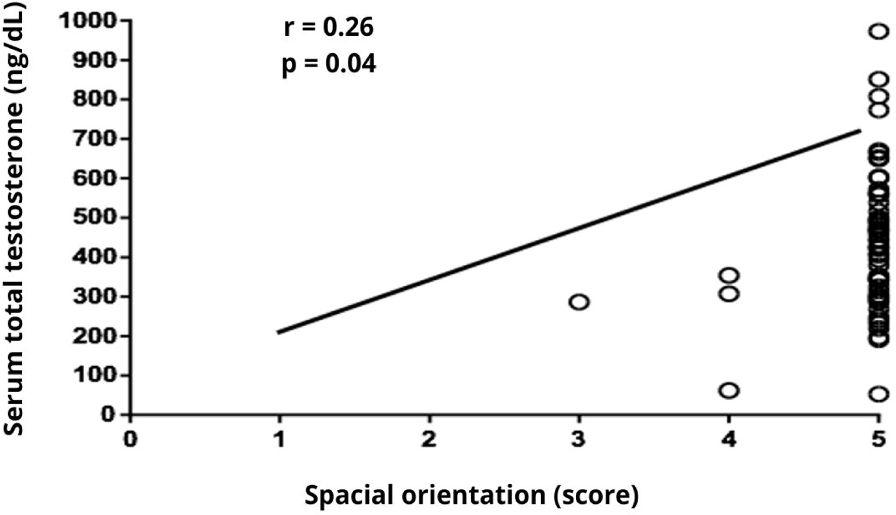
Results Age was negatively correlated with TT (r = -0.36; p = 0.003), and TT was inversely associated with BMI (r = -0.45; p < 0.001). BMI was negatively correlated with total MMSE scores (r = -0.30; p = 0.010). TT and E2 levels showed no significant associations with overall MMSE, except for a positive correlation between TT and the Spatial Orientation subdomain (r = 0.26; p = 0.040). TT and FT were both negatively correlated with GDS scores (r = -0.32; p = 0.010; and r = -0.27; p = 0.030, respectively). After adjustment, only education years remained independently associated with MMSE (β = 0.374, p = 0.013).
Conclusions Although lower serum testosterone levels were associated with depressive symptoms, no significant correlation was found with global cognitive performance; an interesting finding was the impact of years of education on MMSE score.
Keywords
Cognition; Elderly; Testosterone levels; Estradiol levels; GDS; MMSE
 Thumbnail
 Thumbnail