 The Perspectives of Conservative American Think Tanks on U.S. Leadership for Latin America and the Administration of Donald Trump
Abstract
In this article, our focus is twofold: we seek to understand how relevant conservative/libertarian think tanks perceive America’s position and policies toward Latin America in the 21st century, and their evaluation of Donald Trump’s foreign policy in Latin America. We carried out a qualitative content analysis (QCA) of the documents produced between 2016-2022 about Latin America during the Trump administration by four institutes – Heritage Foundation, Hudson Institute, American Foreign Policy Council, and the Cato Institute. Our findings reveal a consistent concern with how American leadership should advance conservative and libertarian values abroad, and a shared perception that Trump fell short in this regard — a failure seen as undermining U.S. regional leadership. This study seeks to address a gap in the literature on the perspectives of American conservative knowledge regimes toward Latin America, and to contribute to our understanding of how these political actors frame regional problems and legitimize their policy agendas.
Key words
think tanks; American foreign policy; American conservatism; Trump administration; Latin America; populism; qualitative content analysis
Resumo
Neste artigo, temos dois objetivos: compreender como think tanks conservadores e libertários proeminentes percebem o papel e as políticas dos Estados Unidos em relação à América Latina no século XXI, e como avaliam a política externa de Donald Trump para a região. Realizamos uma análise qualitativa de conteúdo (QCA) de documentos produzidos entre 2016 e 2022 por quatro importantes institutos — Heritage Foundation, Hudson Institute, American Foreign Policy Council e Cato Institute — com foco em suas interpretações sobre a América Latina durante a administração Trump. Nossos achados revelam uma preocupação recorrente com a forma como a liderança norte-americana deve promover valores conservadores e libertários no exterior, bem como uma percepção compartilhada de que Trump falhou nesse aspecto — o que é visto como um fator que enfraqueceu a liderança regional dos Estados Unidos. Este estudo busca preencher uma lacuna na literatura sobre as perspectivas dos regimes de conhecimento conservadores norte-americanos em relação à América Latina, e contribuir para a compreensão de como esses atores políticos enquadram os problemas da região e legitimam suas agendas políticas.
Palavras-chave
think tanks; política externa americana; conservadorismo americano; governo Trump; América Latina; populismo; análise qualitativa de conteúdo
Introduction
Donald Trump’s rise to the presidency of the United States (USA) in 2016 presented an important rupture point in American politics; at the discursive level, Trump acted as a committed conservative leader concerned with reaffirming American presence as a regional leader (Sarukhan 2017; Macdonald 2018; Rahajeng 2019). Our article focuses on how think tanks with conservative and libertarian leanings have interpreted and evaluated the foreign policy of Donald Trump’s administration towards Latin America, and the United States position in the region. The documents analysed are from the following institutes: The Heritage Foundation, The Hudson Institute, American Foreign Policy Council, and the Cato Institute, three conservative and one libertarian.
In this article, we propose the following questions: How do conservative institutions analyse and frame the relationship between the USA and Latin America? How in their view has Donald Trump’s administration represented a shift in US foreign policy toward Latin America from the perspective of these institutions? How have these institutions evaluated Donald Trump’s policies toward the region?
Think tanks are institutions dedicated to evaluating, analysing, and to proposing political ideas and solutions. These institutions play a particularly important role in times of transition or crisis, as one of their main functions is to help policymakers make sense of their problems and justify new policy proposals (Bertelli and Wenger 2009: 234; Campbell and Pedersen 2014: 3; Fraussen and Halpin 2017). Think tanks are also important in training public intellectuals, activists, and future policy advisers in a wide range of areas, including in foreign policy (Parmar 2004; Drezner 2015). Lastly, they are also influential in the forming of coalitions between elites, intellectuals, and political parties, therefore involved in the alignment between ideological coalitions and political parties (Noel 2014: chapter 2).
Our analysis shows that these actors consider their ideas and proposals to have little space for assimilation in the region, which they see as an obstacle a conservative American leader must overcome. As we could assess based on our analysis, these institutes mostly did not consider Trump as a figure capable of promoting conservative and libertarian ideas in Latin America. We use the term ‘Americanism’1, to refer to the ideas and values shared by libertarians and conservatives, even though they often disagree in many aspects2: the appreciation of the ideal of the historical and political experience of the United States, economic freedom, individual responsibility, constitutional limitation on State power, rejection of unwavering trust in the State (Ceaser 2006: 23-26; Continetti 2022: 24), and amongst the ‘cultural conservatives’ there is the concern with maintaining the centrality of Judeo-Christian tradition as a source of community’s social cohesion, and political purpose (Kirk 2001).
We consider that these institutes are part of the ‘conservative elite’ (Stahl 2016: 4-5), by this term we mean groups aligned with the conservative movement that remount from the early 1950’s, when specific magazines and think tanks aligned with conservatism were created in the country to oppose socialism abroad and policies that they considered threatening to the American institutional and ideational systems at home (Meyer 1964)3. Conservative think tanks have an important role in the conservative movement as advocates of political ideas, problem definition and coalition-building agents (Campbell and Pedersen 2014: 45-46; Continetti 2022; Vidal and Wietchikoski 2019).
There is a growing interest in the role of think tanks in foreign policy and international relations, especially with a focus on Latin America. For example, as Wietchikoski and Milani demonstrate, these institutes are important vehicles for promoting a vision for American foreign policy in the in light of the rise of China and its ties with Latin America (Wietchikoski and Milani 2024). As analysts have also noticed, some American institutes have sought to form networks with analogous actors in the Global South to broaden their reach at the international community level, and studies have shown that the conservative institutes stand out in this regard (Balau and Santos 2021; Stone 2013; Vidal 2023; Vidal and Lopez 2022; Vidal, Lopez and Brum 2020; Wietchikoski 2021).
Based on a constructivist approach of public policy formulation and International Relations (Campbell 2018; Gofas and Hay 2010; Hay 2010), this study examines how ideational structures – particularly political ideologies – are operationalized into concrete policy programs, aimed at informing policymakers about what their positions should be in foreign policy. Following Campbell and Pedersen’s concept of knowledge regimes, we understand conservative and libertarian think tanks not merely as research and advisory institutions but as important elements within the organizational machinery that generates, frames, and circulates conservative policy ideas.
Political ideas don’t float freely – there are spheres of actors who employ their resources and create coalitions to promote their ideas and influence public agenda. In this sense, the focus of this study is not only on the content of conservative think tanks’ proposals but also on their framing of Latin America as a field of opportunity, threat, and ideological contestation (Pautz 2018: 157)4.
By analyzing conservative and libertarian think tanks, our work contributes to the understanding of how ideological coalitions translate their worldviews into pragmatic policy proposals aimed at foreign policy. We seek to fill a gap in the literature regarding the perspectives of American conservative knowledge regimes regarding Latin America, and the transformation of American foreign policy to the region during the political transformation caused by Donald Trump’s presidential campaign and administration (2016–2021).
Our study is organised as follows: in the next section we explain the role of think tanks based on the concept of knowledge regime, and the importance of these institutes in the organized conservative movement in America. Following, we describe the material analysed and the methodology used. In the fourth section, we will look at how conservative institutes have defined the context and conditions in Latin America, what are the main problems the United States should address in its relationship with the continent, the perspectives and evaluations of Trump’s role in the region. At the end, we present our conclusion.
The American knowledge regime and the Conservative movement
Think tanks can be defined as institutes for analysing, researching, and advising on policy (McGann 2014). Even though this definition is broad, it helps us understand the significance of these institutes in the network of organisations that generate and spread policy ideas and proposals in the United States. These institutes are in the business of influencing the policy agenda and policymakers, as well as promoting their political recommendations and evaluations on public discourse (Lerner 2018).
The research developed in those institutes are usually published as short books, political reports, and articles that can be republished in specific magazines, to attract the attention of policymakers, their advisers, and the public5. In this sense, their work is, as sociologist Thomas Medvetz defined, a hybrid between research and advocacy (Medvetz 2014). Think tanks also function as training centres for political advisers, and as ‘revolving doors’ – meaning that they also are organisations where political advisers from a previous administration or politician can continue their work until a new administration or politician, more friendly to their views, is elected. Think-tank scholars are also invited to Congress and Senate hearings on different subjects, and it is very common that scholars of those think tanks become advisers for members of Congress, Senate, and Presidents6. Besides, these institutes also are relevant in the realm of public opinion formation – many scholars are called by networks, journals and magazines to give their opinions and analysis, informing the public. Of course, not every think tanks have the same access to these media outlets, usually the scholars of the most relevant institutes are more often called to present their opinions and analysis, contributing to the consolidation of their strength, prestige, and visibility (Pautz 2018; Kelstrup and Blach-Ørsten 2020).
In this article, we follow the political scientists John L. Campbell and Ove K. Pedersen who argue that the role of think tanks in the USA can be better understood by framing them as part of a ‘knowledge regime’. Knowledge regimes are the institutional structure that generates information, research, and analysis with the aim of influencing the political agenda (Campbell and Pedersen 2014: 17-18), it also functions as a ‘sense making apparatus’, in other words its institutions help politicians ‘make sense’ of the problems they encounter, especially in situations of change, crisis and uncertainty, and to help them interpret these problems and justify solutions (Stone 2007; Campbell and Pedersen 2014: 3-4). The US knowledge regime is largely fragmented, advocacy-oriented and more independent than the knowledge regimes of other central capitalist countries such as Germany and France, for example, in result of the country’s political and economic systems (Campbell and Pedersen 2014: 39-40).
In the process of organising the modern conservative movement, think tanks have had an especially important role; concisely explained, the conservative movement started to organise in the 1930s by propagating Americanist ideas, and reinforcing constitutional values through magazines and educational institutes (Nash 2014; Hoover 2016 [1922]; Vidal and Wietchikoski 2019). In other words, the first conservative think tanks were involved not only in informing policymakers but also in educating the public. Traditional institutes of this kind are the Foundation for Economic Education (FEE), the Intercollegiate Studies Institute (ISI), the American Enterprise Association – later American Enterprise Institute –, and the American Institute for Economic Research (AIER)7.
According to Phillips-Fein, ‘the rise of conservative politics in postwar America is one of the great mysteries of American political history’ (Phillips-Fein 2010: 10). The view that conservatism in America was an anomaly was reinforced after the New Deal, and with the transformation of America’s role in the world after the Second World War; for those reasons, historian Arthur M. Schlesinger Jr. affirmed in the late 1940s that ‘[...] progressives, on the whole, create our present climate of opinion’ (Schlesinger 2014 [1949]: 35).
This intellectual and political environment was challenged in the late 1960s, when organised conservatives gained ground with public intellectuals, journals, and think tanks (Bogus 2011; Grossmann and Hopkins 2016: 86). In the early 1970s, new conservative institutes pioneered the uses of different strategies to promote their recommendations: approaches more oriented toward advocacy, and more communication with the public (Rich 2005; Stahl 2016). During this later period, some of the most important conservative and libertarian institutes were created, such as the Heritage Foundation (1973) and the Cato Institute (1977), respectively. our work delves into the material produced on Latin America by these and other important institutes.
Methodology
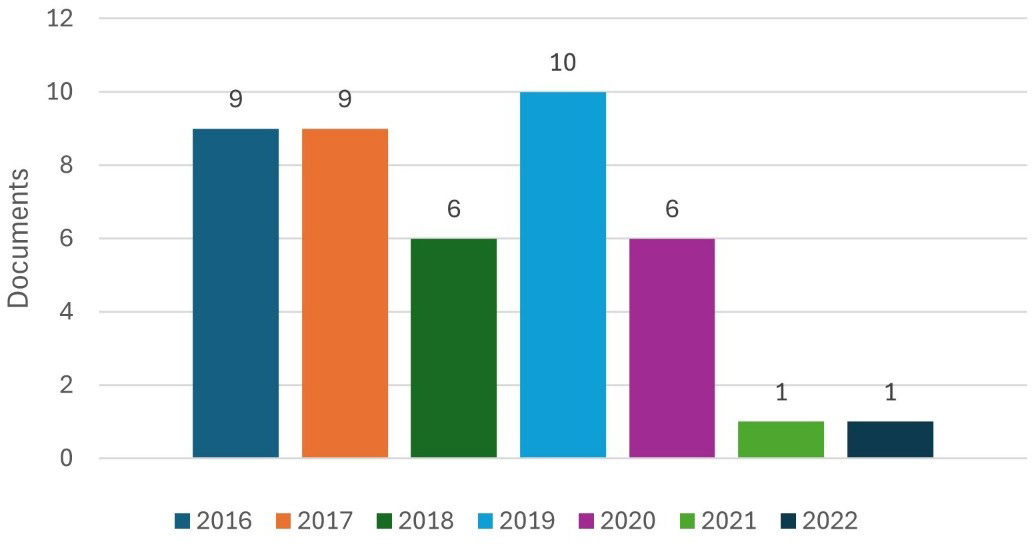
Based on the major repositories and lists of think tanks available, we created a database of the most relevant US think-tanks in activity to date (2022), comprising 985 entries. From this database, we selected conservative/libertarian institutes according to two criteria a) institutes that had considerable research on Latin America, and of those, b) relevance. In terms of relevance, the four institutes selected appear in the two main rankings of think tanks: Academic Influence and the Global to Go Index (Barham 2024; McGann 2021). According to the Academic Influence Ranking, the Heritage Foundation and the Cato Institute are among the ten most influential think tanks in the United States, with Cato ranked first among the 10 most influential libertarian institutes and Heritage ranked first among the nation’s leading conservative institutes. The Global to Go Index ranks The Heritage Foundation 6th among the top think tanks in the United States, Cato and Hudson, 13th and 14th, and AFPC, 100th8.
For the classification of the institutes as ‘conservative’, we relied on the strategy used by Rich (2005: 15-20) and Gilroy (2012), i.e. we used the institutes’ own mission and values statements as a basis for the classification, and improved it based on our own research of the conservative/libertarian tradition and trends (Berkowitz 2004; Carey 2004; Doherty 2008; Kirk 2001; Meyer 1964; Nash 2014)9. In our database, we classified conservatives and libertarians under the label ‘conservative’, considering that the libertarian movement mostly in its history have aligned politically with conservatives even though there are significant differences and disagreements between those two blocs, as we have mentioned before.
Regarding the time frame (2016 to 2022), we chose this period to include in our analysis the perspectives on Latin America and on Trump’s presidency from his election to the years immediately following the end of his mandate, to include the evaluations of the Trump administration’s policy toward Latin America.
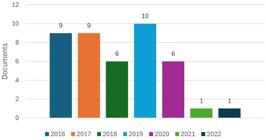
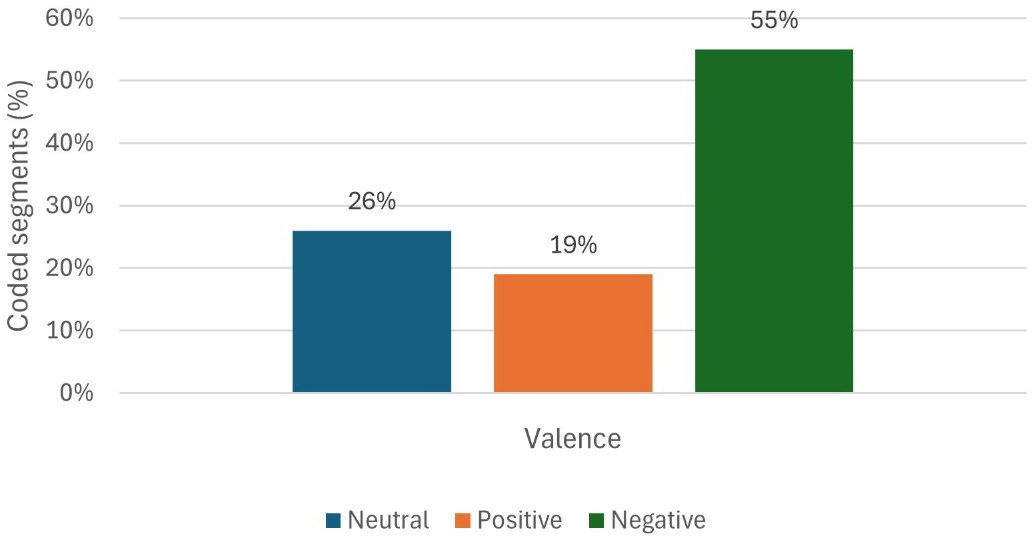
The methodology used is the qualitative content analysis (QCA) (Schreier 2012; Kekeya 2020; Sampaio and Lycarião 2021). The coding system was created and refined after an iterative process based on the reading of the documents and the identification of the major themes discussed in them; it resulted in the final 5 selected subcodes: Human Rights, Security, Economy, Governance, and Geopolitics. Note that the selection of the codes is not exhaustive, but the process of coding is – in other words, another analyst could develop more codes for analysis, but once the codes were established the same paragraph could not be coded under two different codes. Following, we conducted a qualitative valence analysis (sentiment analysis), the sub-codes are ‘negative’, ‘positive’ or ‘neutral’ – the sentiment analysis refers to the paragraphs in which Trump is directly mentioned.
Latin America during the Trump administration: perspectives and criticism of conservative institutions
Donald Trump’s electoral success in 2016 represented the apotheosis of two important processes already underway in both US domestic politics and global politics: first, the rise of populist and personalist leaders with a deeply critical rhetoric of the political, intellectual, and economic establishment, both domestically and internationally (Hetherington and Weiler 2009; Inglehart and Norris 2016; Salgado, Casarões and Zarakol 2023). The second was the consolidation of the hard-wing conservative movement in the Republican Party (Brennan 2007; Noel 2014)10.
During his presidency, Donald Trump had a leadership style rhetorically critical of globalisation and progressive ideas (Ferguson 2016; Goodheart 2018). His stance also affected foreign policy, as he proposed changes to trade agreements with regional partners (Menezes, Mariano and Contrera 2022), and raised discussions about assessing the US role in NATO ( Hall 2021; Rahajeng 2019)11. Trump also attempted to strengthen the US position in Latin America with more energetic measures than previous governments, and a more combative rhetoric (Bodemer 2023; Novak and Namihas 2018), but these measures had mixed results, not always successful, and at times even undermined local perspectives on the US role in the area and among the public opinion (Johnson 2018; Parthenay 2020; Stuenkel 2020).
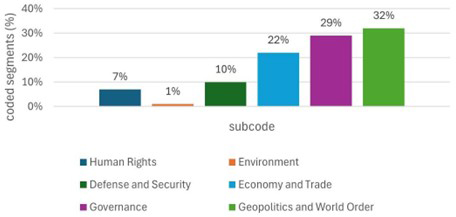
In our analysis of how conservative/libertarian institutes regard American – and Trump’s – foreign policy in Latin America, we start with our analysis under the code ‘Context and Conditions’ (Figure 2). We see a prevalence of concern about geopolitical issues, followed by governance – themes related to corruption, populism, and institutional stability. The subcode ‘Economy and Trade’ comes in third, focused on investments in infrastructure and technology, followed by ‘Security and Defence’ – with a focus on terrorism and systemic instabilities stemming from urban violence and organized crime, and populist governments. ‘Human Rights’ and ‘Environmental Issues’ come second and last, respectively. In regional terms, Central America, Venezuela, and Colombia are central, while Brazil appears occasionally – especially in security and governance.

Starting from ‘governance’, we notice two major concerns: corruption and populism –especially socialist/left-leaning populism12. Corruption is highlighted as a major political problem in the region, and there are many mentions about how the US Congress should be more proactive in helping Latin American countries implement programmes to combat corruption, and to help these countries to get embezzled money back – the theme of corruption is particularly present in the texts on Brazil (Mead 2016b; Vásquez 2016).
Populism also relates to many other preoccupations, as we will explore. Besides, there is the concern that left-wing populism is a major impediment to the development of democratic institutions, an obstacle to the implementation of projects of reform that could make the State more efficient and less corrupt, as those proposals are usually labelled as ‘foreign’, ‘neoliberal’, and ‘American’, therefore not possible to be implemented in Latin America. Finally, there are many mentions about how populist governments in the region are more open for China, Iran, and Russia, and that can be the major strategic problem for the USA in Latin America.
In this light, Venezuela is a central example of the combination of those problems. According to these institutes, the Maduro regime in Venezuela, along with Chávez before him, is seen not as an anomaly but rather as an extreme example of the central issues that affect the region; the erosion of the rule of law and economic problems in Venezuela as not only the result of corruption and personal interests of political leaders but also a consequence of socialist policies that are seen as widely heeded in the region, and prevent major economic and political reforms (Hidalgo 2018b).
That’s why these institutes are critical not only of the ‘socialism for the 21st century’ – Hugo Chávez’s policy in Venezuela in the 2000s – but also of the governments of the so-called pink wave in general; we see more pragmatic criticisms of the social and economic programmes implemented by these governments, but also a criticism of these populist governments as barriers to an alignment with the USA in the region, and fomenting political instability (Dubrowski 2019, AFPC; Hidalgo 2017, Cato Institute; Quintana 2016b, Heritage Foundation 2017b, Heritage Foundation). Therefore, these institutes see as necessary for the American leaders, especially presidents, to shed a positive light on the American values and political experience, and to bring these countries closer to the United States as political and economic partners (Hidalgo 2018b, Cato Institute; Zuluaga 2018, Cato Institute).
In the subcode ‘Human Rights’, the focus is on violence and immigration – mostly regarding the flow of migrants from Central America to the United States through Mexico. Regarding urban violence, we see concerns related to regional instability resulting from urban violence and lack of economic opportunities.
The US assistance is seen as fundamental to solving these problems (Haas 2019, AFPC). The problem is how to deal with these problems, and here too the quest of combating left-wing populism, is central. The strategy suggested is to approach these problems based on security partnership and direct investment – it is also telling that a document by the Heritage Foundation affirms that US’ aid to Central America has been following domestic (American) progressive concerns, such as gender issues and climate change, rather than being directed in a pragmatic and efficient way toward the real problems of the region: namely cartels, drug trafficking, and lack of direct investment (Quintana 2016a, Heritage Foundation).
Environmental issues are mentioned much less, in fact there are only two mentions on the topic in a 2022 AFPC document about the lasting effects of Trump’s policies and Biden’s continuation of some of them. But it is important to note that the mentions in this subcode are focused on Brazil. They emphasize that Brazil is not one of the main emitters of greenhouse gases and already gets most of its energy from renewable sources, therefore it is considered more important for the USA to focus on issues that are more urgent for Latin American countries, which we will explore in the following paragraphs.
On the subcode ‘Economics and Trade’, there is a concern about how US trade relations with Latin American countries have helped (or not) to promote the values of freedom, equality of opportunity, innovation, and entrepreneurship. A relevant example of concern is the recent discussion about the normalisation of relations between the United States and Cuba. For example, Ana Quintana, the analyst for Latin America at the Heritage Foundation at the time, emphasises the importance of the free market as a tool for improving conditions in Latin America. She argues that the values that should be predominant in relations between the two countries, such as the defence of democracy, regional security, and the free market, have not been emphasised in the normalisation proposals during the Obama administration, posing a serious problem for the US’s image in the global stage (Quintana 2016c, Heritage Foundation). Other institutes also share this same concern (Hidalgo 2018b, Cato Institute; Zuluaga 2018, Cato Institute). In this sense, for these institutes, it is central to address the issue of the primacy of socialist ideas as obstacles to local development and the advancement of regional political relations.
It is important to note that these institutions call for more public and private investments from the United States in infrastructure and technology toward Latin America. They recognise that Latin American countries have struggled to attract these resources, and China has caught the attention of the region by investing in various areas such as energy transition and even space technology. In this context, there is growing concern about how the economic difficulties and the withdrawal of the United States from Latin America have opened the door to rival powers that reinforce statist economic projects and left-wing populist leaders who promote suspicion of American ideational and economic influence (Kelly 2017, Hudson Institute; Haas 2019, AFPC).
On the issues of ‘Security’ and ‘Geopolitics’, terrorism and regional systemic instabilities are central. There is also a preoccupation of how systemic regional instabilities are increasingly the result of immigration flows – especially from Venezuelans to Colombia, Peru, and Brazil (Balling 2019, AFPC). We see other two major specific preoccupations: first, an emphasis on the dangers of terrorist groups, including groups financed by Iran, hiding and developing its forces in some Latin American countries; and second, the openness for economic and strategic incursions of rival powers of the USA in the region, and not only in Venezuela and Cuba, but also among long term partners such as Brazil, and Colombia. Also, in this code we see mentions of concern about how populist actors might be promoting their ideas and forming groups to destabilise other countries – for example, there are mentions about how the Venezuelan regime incentivises groups in other countries to promote demonstrations favourable to socialism.
As worrying as these problems are for the American diplomatic and economic relations in the region, and for regional stability, there are no suggestions of military interventions to address these threats. It is interesting to notice that there is an awareness of the negative effects of past US interventions in the region. The history of US intervention is seen as a major force that has sharpened sentiments against neoliberal ideas and political proposals, stimulating the rise of populist leaders and socialism.
In this regard, the institutes are concerned about how the lack of US economic presence is encouraging Latin America’s rapprochement with China and Russia, and even Iran (Balling, 2019, AFPC; Cropsey 2018, Hudson Institute; Mead 2016a, Hudson Institute). These institutes often affirm that rapprochement with the USA is the best way to promote Human Rights These institutes argue that the USA, with all its faults, have a consideration for Liberal and democratic values that other powers such as China and Russia do not.
Specific considerations about Brazil are important since the country is one of the main political allies in South America, and because of its relevance in the Global South. Brazil is mostly mentioned in the areas of governance, economy and trade, and security. In the sub-categories: ‘governance’ and ‘economy’, we see three main themes: criticism of cronyism, corruption and economic populism as the main problems hindering the country’s development, especially in recent decades. We also found that conservative institutes are concerned about the effects of the predominance of distrust of neoliberal proposals in Brazil. For example, according to a Hudson Institute document, the country’s ‘fatal flaw’ is the belief, ingrained since independence, that the bigger and more interventionist the state, the better (Herman 2016, Hudson Institute). Arguments from the Cato Institute are similar (Hidalgo 2016, Cato Institute; Vásquez 2016, Cato Institute).
Brazil is seen as a strategic partner in combating regional instabilities because of Brazil’s traditionally resolute and professional diplomacy. However, these institutes argue that it is essential for the United States to continue to support Brazil and keep close diplomatic relations with the country considering the rise of China. On another hand, there is a concern about polarisation in Brazil as a source of instabilities. Therefore, they argue that Brazil must not allow itself to become an even more polarised country plagued by corruption scandals, and must above all seek to recognise the similar values that bring Brazil closer to the United States – hence the importance of an American leader who can strengthen these ties (Walter Russell Mead 2017, Hudson Institute).
Donald Trump as a leader: expectations and assessments
Considering this scenario, the questions that arise in the material are: how can conservative, or ‘Americanist’, ideas be promoted in these countries, whose history with American interventionism and left-wing populism is so long? And was Trump able to recognise and deal with those questions? From the outset, the prospects for Trump’s foreign policy toward the region were negative. This is particularly evident in the material published by the Hudson Institute and the Cato Institute. For example, in a text published in June 2016, in the run-up to the US presidential election, Hudson Institute analyst Arthur Herman compares the political situation in Brazil and the United States and suggests that the United States should learn an important lesson from the Brazilian case in terms of its attachment to a populist leader. The author says that much has been said (during Trump’s campaign) about ‘making America great again’ (Trump’s campaign slogan in 2016). But, the author argues, little was said in the then Republican candidate’s campaign about what made the US ‘great’: freedom, opportunity and individual space (Herman, 2016, Hudson Institute)13.
Overall, the main issues addressed in the documents that mention Trump are: the need to re-evaluate the strategy of normalising relations with Cuba; harmonise trade relations with Mexico; confront the threats posed by the Nicolás Maduro regime in Venezuela; strengthen relations with South American countries, especially Colombia, one of the main security partners of the United States, and control the advance of Russia and China in the region.
Regarding Cuba, an important focus on those documents, we found that the general assessment was that the way in which Obama had carried out the normalisation process had strengthened the socialist regime in the country without much improvement in the living conditions and human rights of the population. At this point, the proposals were to re-evaluate this process without further harming the Cuban people. In the government’s assessment, despite his initially strong rhetoric against the Cuban regime, Trump is seen as having done little to redirect the normalization process and guarantee effective economic and political change (Radosh 2017a, Hudson Institute; 2017b, Hudson Institute); this is all the more important for conservatives because Cuba continues to be an important symbol of the continuity of socialist ideas in Latin America.
When we turn our attention to South America, we see a similar criticism of the conduct of Trump’s foreign policy towards Venezuela. Ultimately, Trump’s actions toward the Venezuelan case are seen as damaging to the diplomatic relations between the USA and Latin America (Mead 2017, Hudson Institute; Quintana 2017b, Heritage Foundation). One example is the criticism in an article published by the Cato Institute, in which the author argues that Trump does not have the necessary skills to manage a crisis, and that Trump’s threats only reinforce the negative view that part of the population of Latin American countries has of the USA, helping populist leaders to promote themselves as national defenders against American imperialism. This is important because it resumes the preoccupation with the necessity of new forms of American engagement with the region. Even though security is important, and the quest for American hegemony is not rejected (on the contrary), there is an understanding that the United States needs new approaches to guarantee its dominance and security – therefore, to promote the country and its values in a more positive light is seen as essential to these institutes.
For these institutes, Latin America would benefit from a rapprochement with the United States, and the best strategy for the United States to improve its standing and prestige in the region would be to act through the economy, direct investment, and by aiding in policies against corruption and organised crime. In other words, they argue for the United States to become a major partner and investor, especially in the areas of technology, energy, and communications – the same areas that China is currently exploiting to expand its influence. In terms of political assistance, reinforcing the idea that the USA cares about the values of democracy, human rights, and the rule of law, values that China do not actively promote because of its own political regime, is also a proposed strategy.
We highlight the importance given to the need to invest in and modernise security and intelligence networks, especially in Colombia and Mexico, to combat organised crime, which is seen as one of the main gateways for terrorist groups, including some sponsored by Iran (Balling 2018, AFPC; Berman 2020, AFPC). It is seen as extremely necessary for the United States not to alienate Colombia, given its importance for regional stability, and as a partner in conversation with Venezuela. The quest for the strengthening of commercial partnerships is also seen as a fundamental part of this process of fighting against external interference in Latin America.
Regarding the relationship with Mexico, evaluations were mixed with some positive points, such as the policy of cooperation, especially during the COVID-19 pandemic (Quintana and Carafano 2020, Heritage Foundation). But some initiatives by the Trump administration that have created tensions, such as the proposal to classify drug trafficking cartels as terrorist groups, are seen as misguided because they diverted attention from the problem of lack of local development and corruption, which in turn stimulates trafficking and organised crime, to a direct focus on terrorism, stimulating more uncertainty and fear of interventionism (Quintana 2019, Heritage Foundation).
When we consider the institutes separately, we see that the Heritage Foundation had a more positive perspective about the Trump administration. The Heritage Foundation, which rose to prominence during Ronald Reagan’s first administration (1981-1985), has become very close to Trump as a political figure (Heritage Foundation 2018; Garcia-Navarro 2024). Nevertheless, this political rapprochement has not prevented some criticism from the Heritage Foundation; its criticism is focused what they say is a constant American disengagement from Mexico and Colombia, which have been happening since the Obama administration, but diplomatic relations with those countries are considered by these institutes to be even poorly handled under the Trump administration.
Overall, our analysis shows that despite some positive mentions of Trump, his administration was seen by conservative institutions mostly as unable to strengthen USA-Latin American ties, failing to promote values dear to conservative and libertarian movements in the region, such as free markets and political reforms, and incapable to offer a new perspective about the United States as a trustworthy and involved partner in the region (Bandow 2022, Cato Institute; Mead 2020, Hudson Institute; Quintana 2019, Heritage; Wilezol 2021, AFCP).

Documents published after Trump’s administration mention concerns about how the United States can handle specific regional crises such as violence and migratory flows. The scenario that the institutes portray about Latin America is as a region relatively forgotten by US foreign policy, lacking in investment, with serious political instabilities – and in the case of Venezuela, even a certain degree of anarchy – and with major obstacles to economic growth, despite its great potential and abundant natural resources.
Conclusion
The general evaluation of the Trump administration is negative, despite occasional positive inclinations, mostly from the Heritage Foundation. There are several criticisms related to the current situation between the United States and important regional partners such as Colombia, Brazil, and Mexico.
There are four main criticisms of American foreign policy during the Trump administration made by the set of institutes analysed: First, these institutes note that there has been a lack of effort to strengthen relations between the United States and these countries; Second, they argue that there has been a failure to invest in infrastructure to compete with Chinese investment projects; Third, according to those institutes there has been a lack of dialogue and, at times, even hostile attitudes that threaten the reputation of Americanism in the region. This has made coordinated action between the United States and regional partners difficult and has only served to strengthen not only the Venezuelan regime but also a negative view of the United States. Finally, the lack of progress in resolving the ongoing humanitarian crises in Central America, particularly in the Northern Triangle.
Regarding the role of Donald Trump in Latin America as a leader, we found that these institutes were hesitant from the beginning about President Trump’s ability to reinforce conservative/liberal ideas in Latin America, and the evaluation of his policies was conducive to this initial consideration. In a more abstract level, we could also assess that for conservative / libertarian institutes, the main challenges in Latin America are rooted in the prevalence of socialist ideas and populism, and that discourses antagonists to the United States, although in cases justified, are strategies still reinforced by populists. These discourses are seen as a source of political instability, a lack of policies designed to bring innovation and productivity, and, more importantly, as responsible for opening-up space for countries like China and Russia.
Our study focused on how conservative perspectives were translated into foreign policy proposals and assessments. This is an important exercise in understanding how political ideas are translated programmatically and the extent to which such coalitions maintain internal cohesion in times of changes and uncertainty.
However, as analysts of international relations and comparative politics, we still face the challenge of studying how these actors infiltrate political agenda-setting circles and the nationally specific filters through which ideas are absorbed, adapted, and institutionalized in different political systems. We hope to continue these efforts in future research and invite colleagues to contribute to this research agenda.
-
Data Availability
The data supporting this study, including the coding spreadsheet and methodological documentation, are available in the Harvard at: https://doi.org/10.7910/DVN/ICTOZA, Harvard Dataverse.
-
1
Americanism was a term used in the beginning of the 20th century among politicians and intellectuals concerned with ‘returning to normalcy’ after the Progressive Era, and became a staple of the Conservative movement (Postell 2013: 183-185; Hoover 2016).
- 2
-
3
The Conservative movement also has a populist strain that dates back from the early 1950s with the John Birch Society (Phillips-Fein 2011: 725). However, the populist tendency became more pronounced during the 1980s, when the new conservative media on radio and television was established – and later with the internet – and the decline of the traditional ‘gatekeepers’ of the conservative movement, such as the magazines The National Review and Commentary (Hemmer 2016: chapter 14; Continetti 2022: 376-380).
-
4
Importantly, following a constructivist approach, we do not necessarily assume that these proposals serve the ‘real’ material interests of the actors who promote them, which is not necessarily objective (Hay 2010); rather, they are indicative of the worldview of certain actors – of how the world works (Kling 2017).
- 5
-
6
For example, Ana Rosa Quintana, who worked as Latin America issues analyst at the Heritage Foundation, served as the lead Republican staff for the Subcommittee on the Western Hemisphere, Civilian Security, and Trade, and in 2024 is the adviser for the Western Hemisphere on the US House Foreign Affairs Committee for the Lead Republican Representative Michael McCaul (RP-Texas).
-
7
Also relevant are the American Enterprise Institute, founded in 1938 as American Enterprise Association, and the Hoover Institution, founded in 1919 by former president and philanthropist Herbert Hoover, created to function as a research centre focused on the First World War and the Russian Revolution.
-
8
The American Enterprise Institute would be an option given its relevance in both rankings. However, the institute has no relevant production on Latin America for the selected period.
-
9
Given that many think tanks seek to emphasize the expertise and academic nature of their functions, it is possible that the number of institutes classified as ‘centre’ is overestimated in our database. Nevertheless, we believe that parsimony is the safest path for our analysis.
-
10
Even if we take into account that Trump’s rise can be framed as a consequence of a process related to the transformation of the US political-electoral structure, which has favoured political polarization by making figures like Trump increasingly present on the electoral (Masket 2011; Shafer and Wagner 2019), it is hard not to acknowledge that Trump is particularly popular and able to articulate impressive support among conservative voters (Barber and Pope 2019).
- 11
-
12
Although socialist ideas are seen as a particularly profound source of populism in Latin America, we also found criticism of right-wing populism, represented in this case by Bolsonaro, in Brazil. For example, during the 2018 elections in Brazil, a piece by the Cato Institute described candidate Bolsonaro as a populist who, far from representing a rupture, is a continuity in Latin America’s political history, stating that: ‘Populism and authoritarianism have a terrible record in Latin America. There is no reason to think that Brazil would be the exception under Jair Bolsonaro’ (Hidalgo 2018a).
-
13
In the early period of the administration, only the Heritage Foundation positioned itself more favourably to Trump. For example, while Latin American leaders viewed the possibility of a Trump administration with suspicion, fearing that one of his campaign slogans ‘America First’ meant greater US disengagement in the region, Ana Quintana, argued that the idea of ‘America First’ could mean thinking about the security of the region as a whole, therefore it should not be seen necessarily as a threat of disengagement (Quintana 2017a).
References
-
Babcock, G. 2014. ‘Against Fusionism: Why Libertarianism Should Extricate Itself from Conservative Entanglements’. Libertarianism.org [online]. 20 November. At https://www.libertarianism.org/columns/fusionism-why-libertarianism-should-extricate-itself-conservative-entanglements [Accessed on 22 July 2023].
» https://www.libertarianism.org/columns/fusionism-why-libertarianism-should-extricate-itself-conservative-entanglements - Balau, M and L A dos Santos. 2021. ‘O Papel de Think Tanks na Formulação da Política Norte-Americana para a Mudança do Clima: Uma Análise do Protocolo de Quioto’. Carta Internacional 16 (3). At https://doi.org/10.21530/ci.v16n3.2021.1107
-
Balling, C. 2018. ‘Colombia’s Political Problems Are an Opportunity for America’. The National Interest [online]. 12 April. At https://nationalinterest.org/feature/colombias-political-problems-are-opportunity-america-25324 [Accessed on 29 May 2023].
» https://nationalinterest.org/feature/colombias-political-problems-are-opportunity-america-25324 -
Balling, C. 2019. ‘The FARC Is Back: Washington Should Beware’. American Foreign Policy Council [online]. 4 September. At https://www.afpc.org/publications/articles/the-farc-is-back-washington-should-beware [Accessed on 29 May 2023].
» https://www.afpc.org/publications/articles/the-farc-is-back-washington-should-beware -
Bandow, D. 2017. ‘Socialism Is Destroying Venezuela: Its People, Not the US Military, Must Restore Democracy’. Cato Institute [online]. 14 August. At https://www.cato.org/commentary/socialism-destroying-venezuela-its-people-not-us-military-must-restore-democracy [Accessed on 23 April 2025].
» https://www.cato.org/commentary/socialism-destroying-venezuela-its-people-not-us-military-must-restore-democracy -
Bandow, D. 2022. ‘Joe Biden Clings to a Bad Trump Policy’. Cato Institute [online]. 20 January. At https://www.cato.org/commentary/joe-biden-clings-bad-trump-policy [Accessed on 15 February 2024].
» https://www.cato.org/commentary/joe-biden-clings-bad-trump-policy - Barber, M and J C Pope. 2019. ‘Conservatism in the Era of Trump’. Perspectives on Politics 17 (3): 719–736. At https://doi.org/10.1017/S153759271900077X
-
Barham, J. 2024. ‘Top Influential Think Tanks Ranked for 2024’. Academic Influence [online]. 16 October. At https://academicinfluence.com/inflection/study-guides/influential-think-tanks [Accessed on 9 February 2024].
» https://academicinfluence.com/inflection/study-guides/influential-think-tanks - Berkowitz, P. 2004. Varieties of Conservatism in America. Stanford, Calif.: Hoover Institution Press.
-
Berman, I. 2020. ‘How Iran Is Helping Venezuela Stay Afloat for Now’. American Foreign Policy Council [online]. 4 May. At https://www.afpc.org/publications/articles/how-iran-is-helping-venezuela-stay-afloat-for-now [Accessed on 15 February 2024].
» https://www.afpc.org/publications/articles/how-iran-is-helping-venezuela-stay-afloat-for-now - Bodemer, K. 2023. ‘Las Relaciones Entre Venezuela y los EE.UU. Durante el Gobierno de Donald Trump: Entre el Discurso Radical, el Pragmatismo Económico y el Garrote de las Sanciones’. Agenda Internacional 30 (41): 7–35. At https://doi.org/10.18800/agenda.202301.001
- Bogus, C T. 2011. Buckley: William F. Buckley Jr. and the Rise of American Conservatism. London: Bloomsbury Press.
- Brennan, J. 2012. Libertarianism: What Everyone Needs to Know. Oxford: Oxford University Press.
- Brennan, M C. 2007. Turning Right in the Sixties: The Conservative Capture of the GOP. Chapel Hill: University of North Carolina Press.
- Bustinduy, P. 2022. ‘A Populist Foreign Policy? The Impact of the Trump Presidency on the Transatlantic Relation’. International Studies 59 (1): 28–42. At https://doi.org/10.1177/00208817221085423
- Campbell, J L and O K Pedersen. 2014. The National Origins of Policy Ideas: Knowledge Regimes in the United States, France, Germany, and Denmark. Princeton: Princeton University Press.
- Carey, G W. 2004. Freedom and Virtue: The Conservative/Libertarian Debate. Delaware: Intercollegiate Studies Institute.
- Ceaser, J W. 2006. Nature and History in American Political Development: A Debate. Cambridge, Mass.: Harvard University Press.
- Continetti, M. 2022. The Right: The Hundred-Year War for American Conservatism. [Kindle version]. New York: Basic Books.
-
Cropsey, S. 2018. ‘China Sets Its Sights on South America’. Hudson Institute [online]. 9 April. At https://www.hudson.org/node/41367 [Accessed on 5 June 2023].
» https://www.hudson.org/node/41367 - Doherty, B. 2008. Radicals for Capitalism: A Freewheeling History of the Modern American Libertarian Movement. New York: PublicAffairs.
- Drezner, D. 2015. ‘American Think Tanks in the Twenty-First Century’. International Journal 70 (4): 8.
-
Dubrowski, D, S Peterson and H Gilmore. 2019. ‘Playing for Their Lives: How a 2001 Video Game Is Feeding Venezuela’. The National Interest [online]. 26 March. At https://nationalinterest.org/feature/playing-their-lives-how-2001-video-game-feeding-venezuela-49187 [Accessed on 30 May 2023].
» https://nationalinterest.org/feature/playing-their-lives-how-2001-video-game-feeding-venezuela-49187 - Ferguson, N. 2016. ‘Populism as a Backlash Against Globalization: Historical Perspectives’. Horizons: Journal of International Relations and Sustainable Development (8): 12–23.
- Fraussen, B and D Halpin. 2017. ‘Think Tanks and Strategic Policymaking: The Contribution of Think Tanks to Policy Advisory Systems’. Policy Sciences 50 (1): 105–124. At https://doi.org/10.1007/s11077-016-9246-0
-
Garcia-Navarro, L. 2024. ‘Inside the Heritage Foundation’s Plans for 'Institutionalizing Trumpism'. New York Times Magazine [online]. 21 January. At https://www.nytimes.com/2024/01/21/magazine/heritage-foundation-kevin-roberts.html [Accessed on 15 February 2024].
» https://www.nytimes.com/2024/01/21/magazine/heritage-foundation-kevin-roberts.html -
Gilroy, P. 2012. ‘Have Think Tanks in Washington D.C. Become Politicized?’ Hertie School of Governance, Student Paper Series [online]. At https://hal.science/hal-00817797v1/document [Accessed on 24 April 2025].
» https://hal.science/hal-00817797v1/document - Gonzalez Hernando, M, H Pautz and D Stone. 2018. ‘Think Tanks in ‘’Hard Times’’ – The Global Financial Crisis and Economic Advice’. Policy and Society 37 (2): 121–136. At https://doi.org/10.1080/14494035.2017.1397396
- Goodheart, E. 2018. ‘Trump’s Cultural Populism’. Society 55 (1): 22–24. At https://doi.org/10.1007/s12115-017-0207-9
-
Haas, L J. 2019. ‘China, Russia, Iran Rise in Latin America as US Retreats’. The Hill [online]. 24 April. At https://thehill.com/opinion/international/440348-china-russia-iran-rise-in-latin-america-as-us-retreats/ [Accessed on 29 May 2023].
» https://thehill.com/opinion/international/440348-china-russia-iran-rise-in-latin-america-as-us-retreats/ - Hall, J. 2021. ‘In Search of Enemies: Donald Trump’s Populist Foreign Policy Rhetoric’. Politics 41 (1): 48–63. At https://doi.org/10.1177/0263395720935377
- Hay, C. 2010. ‘Ideas and the Construction of Interests’. In D Béland and R H Cox (eds), Ideas and Politics in Social Science Research. Oxford: Oxford University Press, pp. x–xx0. At https://doi.org/10.1093/acprof:oso/9780199736430.003.0004
- Hazony, Y. 2022. Conservatism: A Rediscovery. Washington, D.C.: Regnery Gateway.
- Hemmer, N. 2016. Messengers of the Right: Conservative Media and the Transformation of American Politics. [Kindle e-book]. Philadelphia: University of Pennsylvania Press.
-
Heritage Foundation [online]. 2018.’’Trump Administration Embraces Heritage Foundation Policy Recommendations’. 23 January. At https://www.heritage.org/impact/trump-administration-embraces-heritage-foundation-policy-recommendations [Accessed on 15 February 2024].
» https://www.heritage.org/impact/trump-administration-embraces-heritage-foundation-policy-recommendations -
Herman, A. 2016. ‘Look at Brazil, America and Stop and Think about the 2016 Election’. Hudson Institute [online]. 8 June. At https://www.hudson.org/economics/look-at-brazil-america-and-stop-and-think-about-the-2016-election [Accessed on 31 May 2023].
» https://www.hudson.org/economics/look-at-brazil-america-and-stop-and-think-about-the-2016-election -
Hidalgo, J C. 2016. ‘Impeachment in Brazil: Myths and Facts’. Cato at Liberty Blog [online]. 19 April. At https://www.cato.org/blog/impeachment-brazil-myths-facts [Accessed on 26 May 2023].
» https://www.cato.org/blog/impeachment-brazil-myths-facts -
Hidalgo, J C. 2018a. ‘Brazil’s Bolsonaro Is No Friend of Liberty’. Cato Institute [online]. 26 October. At https://www.cato.org/commentary/brazils-bolsonaro-no-friend-liberty [Accessed on 26 May 2023].
» https://www.cato.org/commentary/brazils-bolsonaro-no-friend-liberty -
Hidalgo, J C. 2018b. ‘Venezuela Is on the Verge of a Massive Humanitarian and Economic Collapse. The Culprit? Socialism’. Cato Institute [online]. 13 August. At https://www.cato.org/commentary/venezuela-verge-massive-humanitarian-economic-collapse-culprit-socialism [Accessed on 26 May 2023].
» https://www.cato.org/commentary/venezuela-verge-massive-humanitarian-economic-collapse-culprit-socialism - Hoover, H. 2016. American Individualism. Stanford, Calif.: Hoover Institution Press.
-
Inglehart, R and P Norris. 2016. ‘Trump, Brexit, and the Rise of Populism: Economic Have-Nots and Cultural Backlash’. Harvard Kennedy School, Working Paper No. RWP16-026 [online]. At https://www.hks.harvard.edu/publications/trump-brexit-and-rise-populism-economic-have-nots-and-cultural-backlash [Accessed on 8 February 2024].
» https://www.hks.harvard.edu/publications/trump-brexit-and-rise-populism-economic-have-nots-and-cultural-backlash -
Johnson, C. 2018. ‘Fewer People in Latin America See the US Favorably Under Trump’. Pew Research Center’s Global Attitudes Project [online]. 12 April. At https://www.pewresearch.org/global/2018/04/12/fewer-people-in-latin-america-see-the-u-s-favorably-under-trump/ [Accessed on 8 February 2024].
» https://www.pewresearch.org/global/2018/04/12/fewer-people-in-latin-america-see-the-u-s-favorably-under-trump/ -
Kelly, S. 2017. ‘This Is How China Is Slowly Creeping into Latin America’. Hudson Institute [online]. 28 December. At https://www.hudson.org/technology/this-is-how-china-is-slowly-creeping-into-latin-america [Accessed on 30 May 2023].
» https://www.hudson.org/technology/this-is-how-china-is-slowly-creeping-into-latin-america -
Kelstrup, J and M Blach-Ørsten. 2020. ‘Public and Private Think Tank Visibility in the Danish Parliament and Media’. Scandinavian Political Studies 43. At https://doi.org/10.1111/1467-9477.12181.
» https://doi.org/10.1111/1467-9477.12181 - Kirk, R. 2001. The Conservative Mind: From Burke to Eliot. Washington, D.C.: Regnery Publishing.
- Kling, A. 2017. The Three Languages of Politics: Talking Across the Political Divides. Washington, D.C.: Cato Institute.
-
Lerner, J Y. 2018. ‘Getting the Message Across: Evaluating Think Tank Influence in Congress’. Public Choice 175 (3): 347–366. At https://doi.org/10.1007/s11127-018-0541-5 .
» https://doi.org/10.1007/s11127-018-0541-5 - Lloyd, G and D. Davenport. 2014. The New Deal & Modern American Conservatism: A Defining Rivalry. Stanford, Calif.: Hoover Institution Press.
-
Locatelli, A and A Carati. 2023. ‘Trump’s Legacy and the Liberal International Order: Why Trump Failed to Institutionalise an Anti-Global Agenda’. The International Spectator 58 (1): 92–108. At https://doi.org/10.1080/03932729.2022.2156226 .
» https://doi.org/10.1080/03932729.2022.2156226 -
Macdonald, P K. 2018. ‘America First? Explaining Continuity and Change in Trump’s Foreign Policy’. Political Science Quarterly 133 (3): 401–434. At https://doi.org/10.1002/polq.12804 .
» https://doi.org/10.1002/polq.12804 -
Menezes, R G, K L P Mariano and F Contrera. 2022. ‘Hard Times: The United States and Mexico in NAFTA’s “Renegotiation” Process’. Contexto Internacional 44 (2). At https://doi.org/10.1590/S0102-8529.20224402e20200112 .
» https://doi.org/10.1590/S0102-8529.20224402e20200112 - Nash, G H. 2014. The Conservative Intellectual Movement in America Since 1945. Delaware: Intercollegiate Studies Institute.
- Noel, H. 2014. Political Ideologies and Political Parties in America. [Kindle e-book]. Cambridge: Cambridge University Press.
-
Novak, F and S Namihas. 2018. ‘The Foreign Policy of President Donald Trump and Its Impact on Latin America’. Pontificia Universidad Católica del Perú, Instituto de Estudios Internacionales (IDEI) [online]. At https://repositorio.pucp.edu.pe/index/handle/123456789/134500 [Accessed on 8 February 2024].
» https://repositorio.pucp.edu.pe/index/handle/123456789/134500 - Parmar, I. 2004. Think Tanks and Power in Foreign Policy: A Comparative Study of the Role and Influence of the Council on Foreign Relations and the Royal Institute of International Affairs, 1939–1945. London: Palgrave Macmillan.
-
Parthenay, K. 2020. ‘Trump’s US Foreign Policy and Latin American Multilateralism: An Assessment of Words and Deeds’. In M Quessard, F Heurtebize and F Gagnon (eds), Alliances and Power Politics in the Trump Era: America in Retreat? Cham: Springer International Publishing, pp. 221–238. At https://doi.org/10.1007/978-3-030-37258-3_12 .
» https://doi.org/10.1007/978-3-030-37258-3_12 -
Pautz, H. 2018. ‘Think Tanks, Tories and the Austerity Discourse Coalition’. Policy and Society 37 (2): 155–169. At https://doi.org/10.1080/14494035.2017.1397395 .
» https://doi.org/10.1080/14494035.2017.1397395 -
Pautz, H. 2020. ‘Think Tanks and Policymaking’. In M Ramesh, K Howlett and S Mukherjee (eds), Handbook of Governance and Policy Diffusion. Cheltenham: Edward Elgar, pp. 242–257. At https://doi.org/10.4337/9781789900681.00026 .
» https://doi.org/10.4337/9781789900681.00026 - Phillips-Fein, K. 2010. Invisible Hands: The Businessmen’s Crusade Against the New Deal. New York and London: W. W. Norton & Company.
- Rahajeng, L P. 2019. ‘Foreign Policy in the Trump Era: Populist Rhetoric and the United States Membership in NATO’. Global Local Interactions: Journal of International Relations 1 (2): 1–9.
-
Salgado, C, G Casarões and A Zarakol. 2023. ‘Forum: Populist Radical Right & Illiberal Foreign Policymaking’. Contexto Internacional 45 (2). At https://doi.org/10.1590/S0102-8529.20234502e20220068 .
» https://doi.org/10.1590/S0102-8529.20234502e20220068 -
Sarukhan, A. 2017. ‘How Trump and Disruption Politics May Impact Latin American Elections in 2018’. The Brookings Institution [online]. 27 December. At https://www.brookings.edu/articles/how-trump-and-disruption-politics-may-impact-latin-american-elections-in-2018/ [Accessed on 6 February 2024].
» https://www.brookings.edu/articles/how-trump-and-disruption-politics-may-impact-latin-american-elections-in-2018/ - Schlesinger, J A. 2014. The Vital Center: The Politics of Freedom. New Brunswick, N.J.: Taylor & Francis.
- Schreier, M. 2012. Qualitative Content Analysis in Practice. London: SAGE Publications Ltd.
- Stahl, J. 2016. Right Moves: The Conservative Think Tank in American Political Culture Since 1945. Chapel Hill: University of North Carolina Press.
- Stone, D. 2013. Knowledge Actors and Transnational Governance: The Private-Public Policy Nexus in the Global Agora. Basingstoke, Hampshire: Palgrave Macmillan.
-
Stuenkel, O. 2020. ‘Trump Drove Latin America Into China’s Arms’. Foreign Affairs [online]. 13 November. At https://www.foreignaffairs.com/articles/south-america/2020-11-13/trump-drove-latin-america-chinas-arms [Accessed on 8 February 2024].
» https://www.foreignaffairs.com/articles/south-america/2020-11-13/trump-drove-latin-america-chinas-arms -
Vásquez, I. 2016. ‘A New Era for Brazil’. Cato at Liberty Blog [online]. 1 September. At https://www.cato.org/blog/new-era-brazil [Accessed on 26 May 2023].
» https://www.cato.org/blog/new-era-brazil -
Vidal, C F, J Lopez and L Brum. 2020. ‘The Power of Ideas: The Fórum da Liberdade, 1988–2018’. Contexto Internacional 42 (1): 55–79. At https://doi.org/10.1590/S0102-8529.2019420100003.
» https://doi.org/10.1590/S0102-8529.2019420100003 -
Vidal, C. 2023. ‘Hegemony, Consensus Building, and Pedagogical Colonization: New Ways of External Interference?’. Contexto Internacional 45 (1). At https://doi.org/10.1590/S0102-8529.20234501e20200053.
» https://doi.org/10.1590/S0102-8529.20234501e20200053 -
Wietchikoski, L and L P Milani. 2024. ‘US Hegemony in Latin America: Think Tanks and the Formation of Consensus About the Chinese Presence’. Revista Brasileira de Política Internacional 67 (1): 1–20. At https://doi.org/10.1590/0034-7329202400101.
» https://doi.org/10.1590/0034-7329202400101 -
Wietchikoski, L. 2021. ‘O Tio Sam de Olho no Brasil: Análise da Visão dos Think Tanks Estadunidenses Sobre a Política Externa Brasileira nos BRICS (2009–2016)’. Estudos Internacionais: Revista de Relações Internacionais da PUC Minas 9 (2): 57–76. At https://doi.org/10.5752/P.2317-773X.2021v9n2p57-76.
» https://doi.org/10.5752/P.2317-773X.2021v9n2p57-76 -
Wilezol, D. 2021. ‘Biden Is Losing Latin America’. American Foreign Policy Council (AFPC) [online]. 24 September. At https://www.afpc.org/publications/articles/biden-is-losing-latin-america [Accessed on 15 February 2024].
» https://www.afpc.org/publications/articles/biden-is-losing-latin-america -
Zuluaga, D. 2018. ‘Venezuela’s Petro: Fool’s Oil’. Cato at Liberty Blog [online]. 29 March. At https://www.cato.org/blog/venezuelas-petro-fools-oil [Accessed on 30 May 2023].
» https://www.cato.org/blog/venezuelas-petro-fools-oil
-
Editor-in-Chief Responsible
James Casas Klausen
The data supporting this study, including the coding spreadsheet and methodological documentation, are available in the Harvard at: https://doi.org/10.7910/DVN/ICTOZA, Harvard Dataverse.

 Source: developed by the author.
 Source: developed by the author (unit of analysis: coded segments).
 Source: developed by the author (unit of analysis: coded segments).