
 Neuro-Fuzzy modeling for optimizing thermal modification in hybrid Eucalyptus clones
ABSTRACT
Silviculture is strategic for the Brazilian economy and demands wood with stable physical and mechanical properties. Thermal modification enhances durability and dimensional stability without chemical additives. We applied an Adaptive Neuro‑Fuzzy Inference System (ANFIS) to optimize thermal treatment in two hybrid Eucalyptus urograndis clones (H77 and LW), predicting optimal time-temperature combinations and estimating apparent/basic density, mass loss, volumetric swelling, modulus of rupture (MOR) and modulus of elasticity (MOE). Twelve trees (six per clone) were sampled; experimental temperatures ranged from 100-220 °C. Lagrange polynomial interpolation generated 60 intermediate points to build continuous response surfaces, and ANFIS (six Gaussian membership functions per input; Sugeno linear output; 36 rules) was trained/validated using RMSE. Distinct clone‑specific behaviours were observed, supporting tailored strategies: densities achieved low RMSE (apparent: 0.101 g/cm3; basic: 0.087 g/cm3), volumetric swelling ~2.12 pp, while mass loss and especially mechanical properties showed higher variability (MOE ≈ 3.796 MPa; MOR with substantial error). The results indicate that intelligent modeling coupled with clone‑specific thermal parameters can maximize performance and inform sustainable industrial applications.
Keywords:
Thermal modification; ANFIS; Wood properties; Mathematical modeling; Eucalyptus urograndis
RESUMO
A silvicultura é estratégica para a economia brasileira e requer madeira com propriedades físicas e mecânicas estáveis. A termorretificação aumenta a durabilidade e a estabilidade dimensional sem aditivos químicos. Aplicamos um sistema Neuro‑Fuzzy adaptativo (ANFIS) para otimizar o tratamento térmico em dois clones híbridos de Eucalyptus urograndis (H77 e LW), prevendo combinações ótimas de tempo-temperatura e estimando densidade aparente/básica, perda de massa, inchamento volumétrico, módulo de ruptura (MOR) e módulo de elasticidade (MOE). Doze árvores (seis por clone) foram amostradas; as temperaturas experimentais variaram de 100-220 °C. A interpolação polinomial (Lagrange) gerou 60 pontos intermediários para construir superfícies de resposta contínuas, e o ANFIS (seis funções de pertinência Gaussian por entrada; saída linear Sugeno; 36 regras) foi treinado/validado com RMSE. Comportamentos específicos por clone foram observados, sustentando estratégias sob medida: densidades apresentaram baixo RMSE (aparente: 0,101 g/cm3; básica: 0,087 g/cm3), inchamento volumétrico ~2,12 pp, enquanto perda de massa e, sobretudo, propriedades mecânicas exibiram maior variabilidade (MOE ≈ 3,796 MPa; MOR com erro substancial). Os achados indicam que a modelagem inteligente, combinada a parâmetros térmicos específicos por clone, pode maximizar o desempenho e orientar aplicações industriais sustentáveis.
Palavras-chave:
Termorretificação; ANFIS; Propriedades da madeira; Modelagem matemática; Eucalyptus urograndis
1 INTRODUCTION
Wood properties are critical for industrial applications. Density influences mechanical strength and processing behaviour, while dimensional stability ensures durability under moisture variations. Porosity and hygroscopicity affect workability and resistance to biological agents (Ferreira; Rangel & Campos, 2018).
According to Barreiros et al. (2022), density directly affects mechanical strength, weight, and processing behaviour. Dimensional stability relates to volume changes due to moisture, which is crucial for durability in environments subject to climatic variations. Porosity and water absorption also influence workability, chemical impregnation, and biological resistance.
Thermal modification involves exposing wood to high temperatures (typically 140-220 °C) in an oxygen-free environment to alter its physical and chemical properties, improving durability and dimensional stability without chemical additives. Barreiros et al. (2023) reported that treatments up to 180 °C enhance Eucalyptus wood quality without compromising physicochemical properties. Pertuzzatti et al. (2016) emphasized that temperature plays a key role in wood processing, directly affecting physical and mechanical properties. Controlled heat application during thermal treatment significantly improves dimensional stability by reducing swelling and hygroscopicity (Ferreira; Rangel & Campos, 2018).
Optimizing production processes in the wood industry is essential for operational efficiency and economic sustainability, using methodologies such as Fuzzy Logic (Peluzio et al., 2023). Neuro-Fuzzy systems combine neural network learning with Fuzzy Logic, enabling adaptive control and process optimization, improving efficiency, reducing costs, and enhancing product quality (Godinho et al., 2023).
This study aimed to develop a mathematical model using Neuro-Fuzzy techniques to optimize thermal modification in two hybrid Eucalyptus clones, predicting ideal temperature and duration while evaluating density, mass loss, swelling, and mechanical properties.
2 MATERIALS AND METHODS
2.1 Material collection for the study
The wood used in this study was obtained from trees of two hybrid clones (H77 and LW) of Eucalyptus urograndis, originating from plantations 8.5 years old with a spacing of 3.00 m x 2.00 m, located under the same soil and climate conditions in the region of Buri, São Paulo, Brazil.
Initially intended for pulp production, these trees were randomly selected (12 in total, 6 from each clone), and their basal logs were sawn into boards centered on the pith, plus one on each side, planed to a thickness of 2.54 cm. After removing the ends with cracks, the pieces were standardized to 70 cm in length, identified, and sealed with silicone paste suitable for high temperatures.
Except for the control samples, all were subjected to the thermal modification process, which consists of exposing the wood to temperatures between 140 °C and 220 °C in a controlled environment without oxygen, aiming to modify its physical and chemical properties, increasing durability, dimensional stability, and resistance to moisture without the use of chemical additives (Barreiros et al., 2023).
2.2 Lagrange polynomial interpolation
In this study, the R software was used to develop a specific code to perform polynomial interpolation of the experimental data for clones LW and H77. The original dataset comprised more than 200 experimental observations; however, only the subset corresponding to the predefined temperature range (100, 140, 160, 180, 200, and 220 °C) was consistently measured and therefore effectively used as the primary input for interpolation. The dataset also contained missing values, which motivated the use of interpolation as an intermediate step to ensure data continuity and improve the robustness of subsequent analyses. Using the Lagrange method, the code generated sixty interpolated values between the measured temperatures, based on a rate of 1.34 min/°C, resulting in a refined and continuous dataset. These interpolated points were incorporated into the modeling process by complementing the original observations, enabling a higher-resolution representation of the thermal response and supporting more stable parameter estimation.
The Lagrange Polynomial Interpolation Method consists of constructing a polynomial capable of passing through a set of known data points, allowing the estimation of intermediate values with high precision. Its application in this study was technically justified by the need to accurately model the behavior of wood thermal treatment within the temperature range of 120 °C to 200 °C, which is critical for high-temperature drying and torrefaction processes. The interpolation step served to mitigate data sparsity and address gaps in the experimental matrix, thereby enhancing model reliability. For model development, the combined dataset (original and interpolated data) was partitioned into training and validation subsets following a standard proportion to ensure model generalization. The training set was used to calibrate the model parameters, while the validation set was employed to assess predictive performance, ensuring that the inclusion of interpolated data did not introduce bias but instead contributed to improved accuracy and robustness in predicting optimal process parameters.
2.3 Neuro-Fuzzy (ANFIS) modeling
An Adaptive Neuro-Fuzzy Inference System (ANFIS) was implemented in MATLAB using the Fuzzy Logic Toolbox under an institutional license from the Grupo de Pesquisa Agroenerbio (FZEA/USP). The model employed six Gaussian membership functions for each input variable: Temperature (°C) and Time (min), to ensure smooth transitions between fuzzy sets. Output variables included apparent density, basic density, mass loss, total volumetric swelling, modulus of rupture (MOR), and modulus of elasticity (MOE). A Sugeno-type inference system with linear output functions was adopted to improve regression accuracy. The rule base, automatically generated during training, comprised 36 fuzzy rules derived from the combination of input memberships. The dataset was partitioned into 30% for training and 70% for validation to prevent overfitting and assess generalization. This configuration enabled the creation of an adaptive system capable of learning and adjusting to data patterns, with performance evaluated using RMSE on the validation set.
2.4 Statistical analysis
Model performance was evaluated using the Root Mean Square Error (RMSE), a widely recognized metric for assessing prediction accuracy in mathematical modeling. RMSE was computed on the validation dataset (70% of the total data) after training with 30% of the data to ensure generalization and avoid overfitting. Units were expressed according to each property: g/cm3 for apparent and basic density, % for mass loss and volumetric swelling, MPa for MOR, and MPa (or GPa, depending on scale) for MOE. Lower RMSE values indicate higher predictive accuracy relative to observed data. This metric was applied to assess the quality of models obtained through both the Lagrange polynomial interpolation method and the Neuro-Fuzzy system (Filho, 2023).
3 RESULTS AND DISCUSSIONS
3.1 Physical properties: mass loss, volumetric swelling, and density
3.1.1 Mass loss
Figures 1 and 2 present response surfaces for mass loss (%) as a function of treatment time (min) and temperature (°C). The color scale represents interpolated values predicted by the Neuro-Fuzzy model, expressed in percentage (%).


Figures 1 and 2 show the response surfaces for mass loss (%) as a function of treatment time (min) and temperature (°C). The color scale represents interpolated values predicted by the Neuro-Fuzzy model, expressed in percentage (%). These surfaces allow visualization of the interaction between process parameters and their effect on mass loss.
For clone LW, maximum mass loss occurs at short treatment times (approximately 0-7 min) and lower temperature ranges near the beginning of the experimental interval (100-120 °C). For clone H77, the highest mass loss is observed at 0-5 min within a similar low-temperature window. These results indicate rapid thermal-induced changes early in the process for both clones.
Given that mass loss is strongly dependent on temperature and time, clone-specific parameterization is necessary to optimize thermal treatment. The model’s RMSE for mass loss prediction was 1.469% on the validation set, indicating moderate prediction error relative to observed values. This suggests that the Neuro-Fuzzy model captured the general trend but exhibited higher variability for this property compared to density-related variables.
These findings highlight that thermal treatment conditions impact each clone differently, making it essential to customize parameters to optimize process efficiency for various lignocellulosic materials. Supporting this evidence, Barreiros et al. (2023) confirmed that temperature directly influences wood coloration, demonstrating how thermal variations can alter the material’s appearance and, consequently, its market acceptance.
3.1.2 Volumetric swelling
Figure 2 presents the three-dimensional response surfaces for LW and H77 clones, illustrating the behavior of volumetric swelling as a function of time and temperature during thermal modification. It is evident that both clones exhibit distinct patterns, with more pronounced reductions occurring in specific regions of higher temperature and extended treatment time. These findings indicate that time and temperature are critical factors in ensuring dimensional stability of the wood. Such differences reinforce the need for customized thermal treatment parameters for each clone to optimize process efficiency and minimize undesirable variations in physical properties.
For clone H77, the best results were characterized by lower values of volumetric swelling, indicative of greater dimensional stability of the wood after thermal treatment. These values were concentrated in the temperature range between 100°C and 120°C, with exposure times varying from 1 to 10 minutes. This interval suggests that clone H77 shows a good response to dimensional stabilization even under moderately long treatment durations.
On the other hand, clone LW demonstrated the best performance within the range of 110°C to 120°C, but with noticeably short exposure times, between 1 and 2 minutes. This indicates greater sensitivity to time and possibly faster structural changes with increasing temperature.
These results demonstrate the direct influence of treatment conditions on the final physical properties of different lignocellulosic materials and reinforce the need for specific adjustments for each wood type to optimize thermal treatment parameters.
The RMSE for volumetric swelling prediction was approximately 2.12 (%), meaning that, on average, the model’s predictions differed from observed values by about 2 percentage points. This relatively low error indicates that the Neuro-Fuzzy system achieved reasonable accuracy for this property.
3.1.3 Apparent density
Figure 3 shows the three-dimensional response surfaces for LW and H77 clones, illustrating the variation in apparent density as a function of temperature and thermal treatment time. Both clones exhibit distinct behaviors, with more pronounced increases occurring at intermediate ranges of time and temperature, followed by stabilization or reduction under extreme conditions. These findings demonstrate that apparent density is highly sensitive to thermal variations, emphasizing the importance of precise parameter control to ensure suitable physical properties for the intended applications of the wood.

Figure 3 shows apparent density surfaces. For LW, the highest apparent density occurs at 75-90 min and temperatures in the upper part of the experimental range (e.g., 180-220 °C)-not “0.65-0.73 °C”. For H77, two regions yield high apparent density: (i) 70-90 min at higher temperatures (e.g., 180-220 °C) and (ii) 75-90 min at moderately lower temperatures (e.g., 160-180 °C). The RMSE for apparent density is 0.101 g/cm3, indicating low prediction error.
These parameters indicate that the structural stability and compactness of the LW clone wood are significantly optimized within this range of conditions, resulting in higher apparent density values a desirable characteristic for various technological applications of the material.
For clone H77, the same figures reveal two distinct ranges of ideal conditions for achieving high apparent density: the first occurs with exposure times between 70 and 90 minutes and temperatures ranging from 0.65 to 0.75 °C; the second covers exposure times between 75 and 90 minutes and temperatures from 0.55 to 0.60 °C.
These variations suggest that clone H77 exhibits greater flexibility regarding the optimal parameters of thermal treatment, being able to achieve good apparent density results both at higher temperatures when time is proportional and at moderately lower temperatures, provided that the exposure duration is longer.
In summary, these observations demonstrate that each clone responds uniquely to fine adjustments in the thermal treatment process, reinforcing the importance of customizing treatment parameters to maximize properties such as apparent density, according to the genetic and structural characteristics of each lignocellulosic material.
RMSE values for density properties (<0.11 g/cm3) indicate high predictive accuracy, while higher errors for mechanical properties (e.g., MOR: 57.83 MPa) reflect modeling challenges.
3.1.4 Basic density
Figure 4 presents the three-dimensional response surfaces for basic density in clones LW and H77, showing how this property varies as a function of temperature and time. The upper graph illustrates the surface for clone LW, while the lower graph corresponds to clone H77. Both surfaces are color-coded to represent density values, with warmer colors indicating higher density and cooler colors indicating lower density. Additionally, the figure includes a top-projection perspective that enhances the visualization of density gradients across the experimental conditions.

Figure 4 shows the response surfaces for basic density (g/cm3) in LW and H77 clones, including top-view projections to enhance visualization of density gradients across experimental conditions. For LW, optimal basic density occurs at longer treatment times (70-90 min) combined with moderate to higher temperatures (160-200 °C). For H77, two optimal regions are evident: (i) short times (7-10 min) at lower to moderate temperatures, and (ii) longer times (70-90 min) at moderate temperatures (160-190 °C). These findings confirm the direct influence of thermal parameters on basic density and highlight the more versatile behavior of H77 compared to LW.
The RMSE for basic density prediction was 0.087 g/cm3, indicating high accuracy and reliability of the Neuro-Fuzzy model for this property.
3.2 Mechanical properties (modulus of elasticity and modulus of rupture)
3.2.1 Modulus of elasticity
The evaluation of the modulus of elasticity (MOE) for clones LW and H77 reveals distinct patterns according to the time and temperature conditions of thermal treatment. For clone LW, the best performances for the modulus of elasticity occurred under two main scenarios, as shown in Figure 5.

Figure 5 shows the response surfaces for the modulus of elasticity (MOE, MPa) in LW and H77 clones. For LW, two main scenarios stand out: (i) very short exposure times (1-2 min) at higher temperatures (around 120 °C), where stiffness improves significantly, and (ii) short exposure (2 min) at lower temperatures (100 °C), indicating that rapid thermal treatment can enhance MOE without prolonged processing.
For H77, similar time ranges (1-2 min) combined with temperatures between 110 °C and 120 °C resulted in high MOE values, suggesting thermal flexibility and potential for optimization under rapid treatments.
The RMSE for MOE prediction was approximately 3.796 MPa, indicating higher variability compared to density-related properties. This suggests that mechanical properties are more challenging to model accurately.
3.2.2 Modulus of rupture
When analyzing experimental data related to the modulus of rupture (MOR) under different thermal treatment conditions for the LW and H77 wood clones (Figures 10 and 11), specific performance patterns can be observed according to the time and temperature applied in the process, as shown in Figure 6.

Figure 6 shows the response surfaces for the modulus of rupture (MOR, MPa) in LW and H77 clones under different thermal treatment conditions. For LW, the best performance occurred at short exposure times (1-2 min) combined with a temperature of approximately 120 °C, suggesting that rapid thermal treatment can maintain or enhance bending strength without prolonged processing.
For H77, optimal conditions were also observed at short times (1-2 min) within a slightly broader temperature range (110-120 °C), indicating greater flexibility in achieving high MOR values under moderate to elevated temperatures.
These findings highlight the potential for optimizing thermal treatment through short-duration processes, reducing energy consumption while preserving mechanical integrity.
The RMSE for MOR prediction was approximately 57.83 MPa, indicating substantial error compared to physical properties, which reflects the complexity of modeling mechanical strength.
4 FINAL CONSIDERATIONS
The Neuro-Fuzzy model accurately predicted physical properties, achieving low RMSE values for densities, while mechanical properties showed higher variability. These results highlight the need for customized thermal treatment strategies supported by intelligent modeling tools. The model identified critical operating regions to optimize the thermal modification process for both clones, enabling the definition of precise time-temperature combinations to maximize wood performance. This approach demonstrates the potential of mathematical modeling to foster sustainable and technically robust advances in the industrial application of thermally modified wood.
-
Evaluators in this article:
Prof. Dr. Carine Setter, Section Editor
ACKNOWLEDGMENTS
The authors thank Professor Leila Maria G. Felipini, Ph.D., from Centro Universitário Sagrado Coração, for the careful and dedicated translation of this article. Her linguistic expertise and academic insight were essential to the quality and accuracy of the content.
Data Availability Statement:
Datasets related to this article will be available upon request to the corresponding author.
REFERENCES
-
BARREIROS, R. M.; LISBOA, F. D.; GOUVEA, C. F.; REIS, A. M. F.; GODINHO, E. Z.; DIAS, K. B. Comportamento químico e físico da madeira natural e termorretificada de clones de eucalipto. Ciência Florestal, v. 33, n. 1, e67304, 2023. DOI: 10.5902/1980509867304.
» https://doi.org/10.5902/1980509867304. - BARREIROS, R. M.; LISBOA, F. D.; GOUVÊA, C. F.; ROQUE, V. G. R.; DIAS, K. B.; REIS, A. M. F.; SILVA, G. C.; GODINHO, E. Z. Efeitos da termorretificação da madeira em clones de eucalipto 9ed. São Paulo, SP: Editora Científica Digital, 2022.
- CARMO, C. R. S.; SILVA, J. R. M. Aprendizado de Máquinas e Prestação de Serviços de Armazenamento de Dados: Métricas para Análise e Validação de Algoritmos Previsores. Getec, v. 12, n. 38, p. 123-144, 2023.
-
FERREIRA, B. S.; RANGEL, E. C.; CAMPOS, C. I. de. Efeito da termorretificação na qualidade de colagem de lâminas de madeira para a produção de compensado. Ciência Florestal, v. 28, n. 1, p. 274-282, 2018. DOI: 10.5902/1980509831585.
» https://doi.org/10.5902/1980509831585. -
FILHO, M. RMSE (Raiz Do Erro Quadrático Médio) em Machine Learning. Available from: https://mariofilho.com/rmse-raiz-do-erro-quadratico-medio-em-machine-learning Accessed in: 23 out. 2025.
» https://mariofilho.com/rmse-raiz-do-erro-quadratico-medio-em-machine-learning -
GODINHO, E. Z.; CANEPPELE, F. de L.; BARREIROS, R. B.; FRIGO, M. M. Modeling in the production of biogas from swine manure using Fuzzy Logic. Sodebras, v. 18, n. 209, p. 62-72, 2023. DOI: 10.29367/issn.1809-3957.18.2023.209.62.
» https://doi.org/10.29367/issn.1809-3957.18.2023.209.62. -
GODINHO, E. Z.; FERMINO, C. D. Z. BARREIROS, R. M. Kinetic modeling and Neuro-Fuzzy application in ethanol production. Brazilian Journal of Biosystems Engineering, v. 19, 2025. DOI: 10.18011/bioeng.2025.v19.1264.
» https://doi.org/10.18011/bioeng.2025.v19.1264. -
GODINHO, E. Z.; FRIGO, M. M.; CANEPPELE, F. de L. Modelagem Neuro-Fuzzy na fermentação alcoólica. Revista Acadêmica Online, v. IX, n. 46, p. 1-12, 2023. DOI: 10.36238/2359-5787.2023.022.
» https://doi.org/10.36238/2359-5787.2023.022. -
PELUZIO, T. M. de O.; PELUZIO, J. B. E.; ABREU, K. M. P. de; FERRARI, J. L.; KUNZ, S. H.; FIEDLER, N. C.; GANDINE, Q. G. F.; PASCHOA, L. DE S. L.; MOURA, M. M.; MOREIRA, G. L.; CARVALHO, R. DE C. F.; PIMENTEL, S. M.; BRANCO, E. R. F.; PELUZIO, L. M.; SANTOS, A. R. dos. Lógica Fuzzy na determinação de fragmentos florestais potenciais para coleta de sementes. Ciência Florestal, v. 33, n. 3, e70016, 2023. DOI: 10.5902/1980509870016.
» https://doi.org/10.5902/1980509870016. -
PERTUZZATTI, A.; MISSIO, A. L.; CONTE, B.; SOUZA, S. C. de; SANTINI, E. J.; HASELEIN, C. R. Propriedades Físicas da Madeira de Pinus elliottii var. elliottii Termorretificada Sob Diferentes Atmosferas. Revista Ciência da Madeira - RCM, v. 7, n. 1, p. 7-15, 2016. DOI: 10.12953/2177-6830/rcm.v7n1p7-15.
» https://doi.org/10.12953/2177-6830/rcm.v7n1p7-15. -
SILVA, A. A. V. da; SILVA I. A. F.; TEIXEIRA FILHO, M. C. M.; BUZETTI, S.; TEIXEIRA, M. C. M. Estimativa da produtividade de trigo em função da adubação nitrogenada utilizando modelagem neuro Fuzzy Revista Brasileira de Engenharia Agrícola e Ambiental, v. 18, n. 2 p. 180-187, 2014. DOI: 10.1590/S1415-43662014000200008.
» https://doi.org/10.1590/S1415-43662014000200008.
-
Editorial Board:
Prof. Dr. Cristiane Pedrazzi, Editor-in-ChiefProf. Dr. Dalton Righi, Associate EditorMiguel Favila, Managing Editor

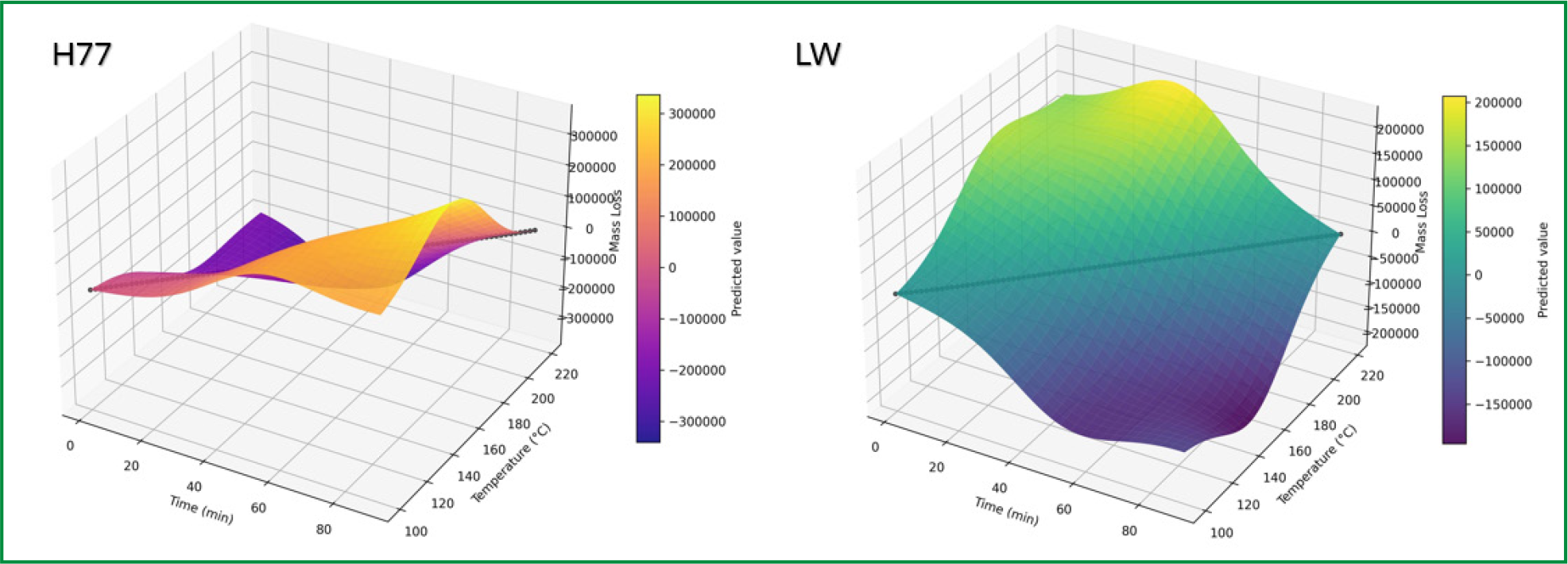 Source: Authors (2025)In where: Time (min), Temperature (°C), Mass Loss (%) - LW and H77 clones.Note: The color scale corresponds to normalized model outputs expressed in percentage (%), not raw experimental values, to highlight trends across the parameter space.
 Source: Authors (2025)In where: Time (min), Temperature (°C), Mass Loss (%) - LW and H77 clones.Note: The color scale corresponds to normalized model outputs expressed in percentage (%), not raw experimental values, to highlight trends across the parameter space.
 Source: Authors (2025)In where: Time (min). Temperature (°C). Color scale: Density (g/cm3).Note: Values adjusted to reflect actual range (e.g., 0.40-0.70 g/cm3) or normalized model outputs. LW: LW clone. H77: H77 clone.
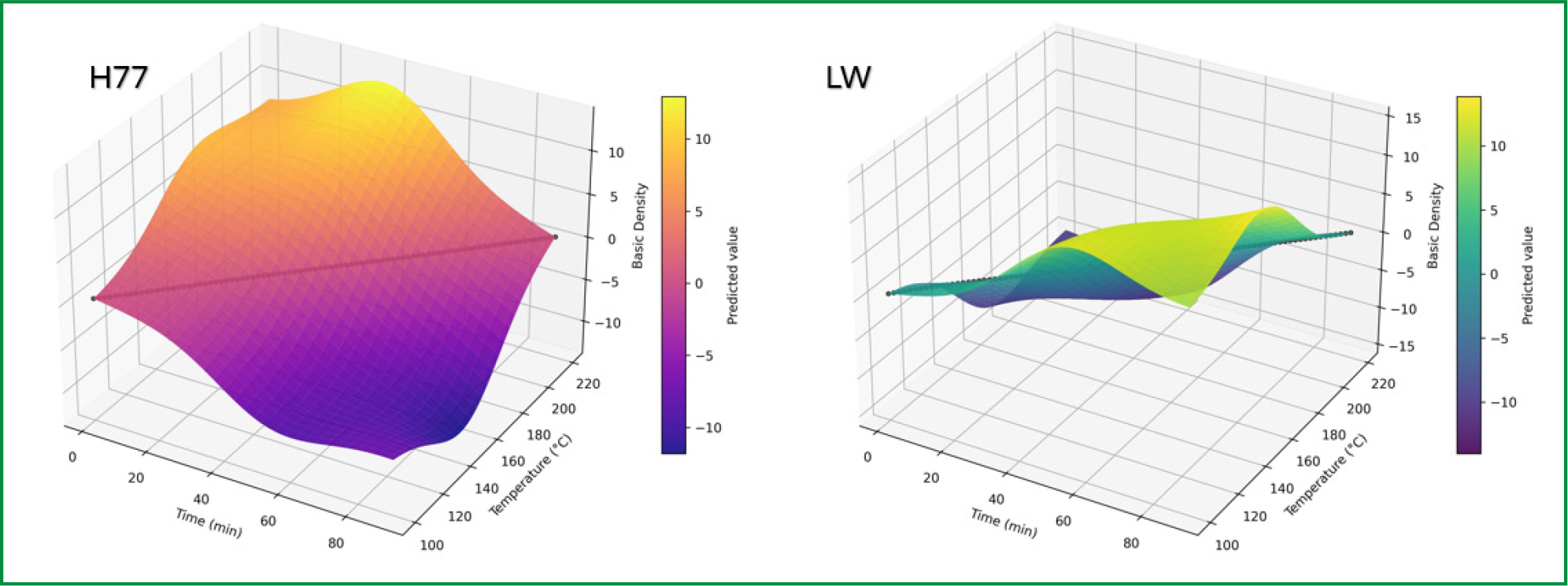 Source: Authors (2025)In where: Time (min). Temperature (°C). Color scale: Basic Density (g/cm3).Note: Values adjusted to reflect actual range (e.g., 0.40-0.70 g/cm3) or normalized model outputs. LW: LW clone. H77: H77 clone.
 Source: Authors (2025)In where: Time (min). Temperature (°C). Color scale: Modulus of Elasticity (MPa).Note: Values adjusted to reflect actual range or normalized model outputs. LW: LW clone. H77: H77 clone.
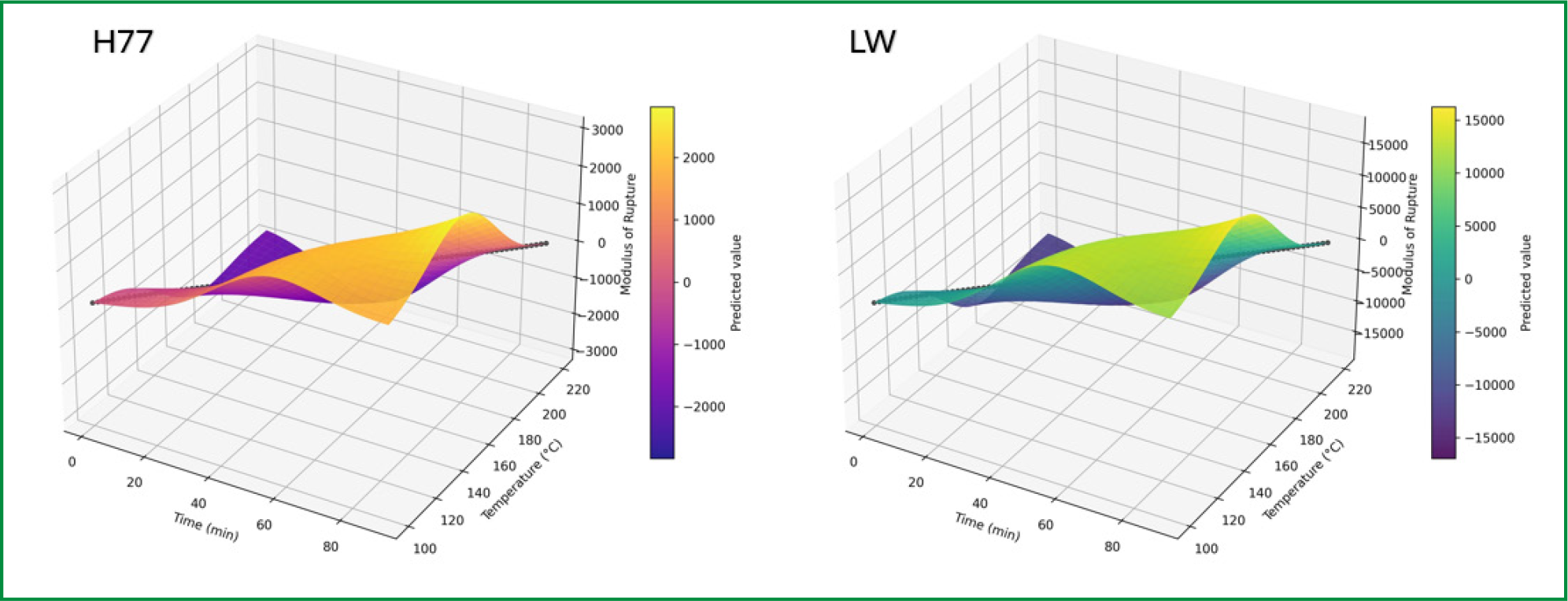 Source: Authors (2025)In where: Time (min). Temperature (°C). Color scale: Modulus of Rupture (MPa).Note: Values adjusted to reflect actual range or normalized model outputs. LW: LW clone. H77: H77 clone.