
 Seaweed-based product on the seed quality of Mimosa verrucosa Benth.
ABSTRACT
This study evaluated the effects of treating Mimosa verrucosa Benth. seeds with a seaweed-based product containing laminarin on seed health and physiological quality. The experiment was conducted under laboratory and greenhouse conditions using Vacciplant® at concentrations of 1.7, 3.3, 5.0, and 6.7 mL·L⁻1, along with a control (sterilized distilled water) and the Captan fungicide. The incidence of fungi, germination, emergence, seedling growth, and dry mass were analyzed. Fungal incidence was determined through detection and identification of the pathogens. Physiological quality was assessed through germination and emergence percentages, first count, and germination and emergence speed indices. The treatment reduced Penicillium sp., Fusarium sp., Cladosporium sp., and Aspergillus sp. incidence. No significant differences were observed for germination percentage or speed; however, the 3.3 mL·L⁻1 concentration increased root dry mass. The 6.7 mL·L⁻1 dose promoted greater emergence and faster first count, while 3.3 and 5.0 mL·L⁻1 favored root length and dry mass accumulation. The seaweed-based product enhanced early seedling growth, dry mass accumulation, and emergence rate, standing out as a promising alternative for the treatment of Mimosa verrucosa Benth. seeds.
Keywords:
Biostimulant; Alternative control; White jurema; Seed pathology
RESUMO
Este estudo avaliou os efeitos do tratamento de sementes de Mimosa verrucosa Benth com um produto à base de algas contendo laminarina na qualidade sanitária e fisiológica das sementes. O experimento foi conduzido em laboratório e casa de vegetação, utilizando Vacciplant® (1,7; 3,3; 5,0; 6,7 mL.L⁻1); controle com água destilada esterilizada e fungicida Captana. Foram analisadas a incidência de fungos, germinação, emergência, crescimento e massa seca das plântulas. A incidência deu-se pela detecção e identificação de fungos. Para a qualidade fisiológica analisou-se o percentual; primeira contagem e índice de velocidade de germinação e da emergência. O tratamento reduziu Penicillium sp., Fusarium sp., Cladosporium sp. e Aspergillus sp.. Não houve diferenças significativas na porcentagem e velocidade de germinação, mas a concentração de 3,3 mL.L⁻1 aumentou a massa seca da raiz. A dose de 6,7 mL.L⁻1 promoveu maior emergência e velocidade na primeira contagem. Já 3,3 e 5,0 mL.L⁻1 favoreceram o comprimento e acúmulo de massa seca das raízes. O produto à base de algas favoreceu o crescimento inicial das plântulas, o acúmulo de massa seca e acelerou a emergência, destacando-se como uma alternativa promissora para o tratamento de sementes de Mimosa verrucosa Benth.
Palavras-chave:
Bioestimulante; Controle alternativo; Jurema branca; Patologia de sementes
1 INTRODUCTION
The Caatinga biome contains a diverse flora composed of numerous species across multiple botanical groups, with members of the Fabaceae family being the most abundant, as reported by Dutra Júnior et al. (2022). This family comprises approximately 630 genera and around 18,000 species, with the genus Mimosa ranking as the fifth largest within Fabaceae, encompassing about 540 species distributed from Central to South America (Monção et al., 2019).
The restoration of degraded areas through the reforestation of native species has gained prominence in recente decades, driven by the increasing demand for sustainable practices (Bezerra et al., 2025). Species of the genus Mimosa are widely used in reforestation and land restoration programs due to their high genetic diversity and adaptability (Silva et al., 2021). They are also employed in agroforestry systems, providing forage for livestock and contributing to soil fertility (Xavier et al., 2020).
High-quality seeds play a fundamental role in ecological restoration and conservation projects, aiding in biodiversity recovery and the re-establishment of ecological functions in degraded ecosystems. They also ensure proper plant establishment and development, which are critical for the success of ecological interventions (Frischie et al., 2020; Quispe-Melgar et al., 2024). Assessing seed quality-including sanitary and physiological analyses-is essential for producing vigorous seedlings with high establishment potential (Frischie et al., 2020).
Several fungi have been reported to be associated with Mimosa seeds, causing significant damage during preand post-emergence stages. The main pathogens include Aspergillus niger, Aspergillus flavus, Aspergillus glaucus, and Rhizopus sp. (Silva Henrique et al., 2021). Infections by Fusarium sp. are particularly harmful, reducing germination rates and seed vigor (Pandit; Yadav, 2020). The presence of pathogens in seeds can negatively affect germination and vigor, delaying germinative processes and compromising early plant development-key aspects for successful establishment and growth (Gebeyaw, 2020; Pandit; Yadav, 2020).
The use of chemical fungicides to control plant pathogens may lead to reductions in soil microbial biodiversity, negative effects on non-target organisms, and potential risks to human health (Balla et al., 2021), in addition to promoting pathogen resistance (Sá et al., 2024). Conversely, biofungicides exhibit greater specificity toward their targets, minimizing collateral damage to other species and supporting ecosystem preservation (Santra; Banerjee, 2020; Cenobio-Galindo et al., 2024).
Alternative control methods, such as the use of seaweed-based products, have gained attention in the market due to the presence of bioactive compounds that enhance plant resistance and inhibit pathogens (Kocira et al., 2019). Among these compounds, laminarin-a polysaccharide extracted from brown algae-is widely recognized for its ability to induce plant defense mechanisms, stimulating immune responses through the activation of induced systemic resistance (ISR) and systemic acquired resistance (SAR) pathways, both of which play essential roles in strengthening immunity against pathogens (Jamiołkowska, 2020; Shukla et al., 2021).
Seaweed-based products act as biostimulants, promoting seed germination and improving the physiological status of plants, thereby increasing resistance to environmental and pathogenic stressors and enhancing productivity (Dobrojan et al., 2023). The application of laminarin has been associated with the induction of abiotic stress tolerance through modulation of the chloroplast antioxidant system and upregulation of stress-response genes (Wu et al., 2016).
There is limited information regarding the seed health of Mimosa verrucosa Benth and its associated pathogens. This knowledge gap underscores the need for further research on management strategies to improve seed quality and ensure proper germination and plant development.
Therefore, the present study aimed to evaluate the effects of treating M. verrucosa seeds with a seaweed-based product on their sanitary and physiological quality, contributing to the development of sustainable disease management strategies and enhancing seed vigor.
2 MATERIAL AND METHODS
2.1 Experiment location
The experiment was conducted at the Phytopathology Laboratory (LAFIT) of the Department of Crop Science and Environmental Sciences (DFCA), within the Center for Agricultural Sciences (CCA) of the Federal University of Paraíba (UFPB), Campus II, located in the municipality of Areia, Paraíba, Brazil (6°58'01.1"S, 35°42'48.4"W).
2.2 Seed acquisition
Seeds of Mimosa verrucosa used in this study were provided by the Nucleus for Ecology and Environmental Monitoring (NEMA) of the Federal University of Vale do São Francisco (UNIVASF), located in Petrolina, Pernambuco, Brazil. The seeds were collected from selected mother plants in Sertânia, Pernambuco, in 2022. All processing, selection, and storage procedures were carried out by NEMA following the guidelines established in the Rules for Seed Testing of Forest Species (BRASIL, 2013).
2.3 Seed treatment
Seeds were subjected to dormancy breaking by tip removal. Subsequently, surface disinfestation was performed by immersion in a 1% sodium hypochlorite solution for three minutes, followed by double rinsing with sterile distilled water (SDW) (BRASIL, 2013).
The treatments were as follows: (T1) Control (only SDW); (T2) Captan® fungicide (240 g/100 kg of seeds) applied directly onto the seed surface; and four concentrations of the seaweed-based product Vacciplant®: (T3) 1.7 mL·L⁻1, (T4) 3.3 mL·L⁻1, (T5) 5.0 mL·L⁻1, and (T6) 6.7 mL·L⁻1. The seeds were immersed in each treatment solution for five minutes and subsequently used for health, germination, and emergence tests.
2.4 Sanitary quality assessment
The seed health test consisted of 100 seeds, divided into 10 replicates of 10 seeds each, in a completely randomized design with six treatments. Seeds were placed in 9-cm Petri dishes lined with two layers of sterile filter paper moistened with SDW. Plates were incubated for seven days at room temperature (25 ± 2 °C) under a 12-hour photoperiod (BRASIL, 2009). Fungal detection and identification were performed using a stereoscopic optical microscope, and identification was based on morphological characteristics compared with descriptions in the literature (Seifert et al., 2011).
2.5 Physiological quality assessment
2.5.1 Germination test
The germination test was carried out using Germitest® paper previously sterilized in a drying oven at 160 °C for 1 hour. The paper was moistened with SDW in a ratio of 2.5 times its dry weight. The experimental design was completely randomized, with six treatments. A total of 100 seeds were used, divided into four replicates of 25 seeds per treatment, as described in section 2.3, and placed in a controlled B.O.D. (Biochemical Oxygen Demand) chamber under alternating 12-hour light/dark cycles at 25 ± 2 °C (BRASIL, 2013).
The variables evaluated included germination percentage (GE), first count (FC), germination speed index (GSI) and percentages of dead seeds (DS). Seeds were considered germinated when a radicle of at least 1 mm emerged. Evaluations were performed daily from the 7th to the 21st day after sowing (BRASIL, 2009).
The germination speed index (GSI) was determined by daily counts of germinated seeds from the beginning of germination until the seedling count stabilized, according to the equation proposed by Maguire (1962).
Seeds classified as dead were those that, at the end of the test, appeared soft but not germinated, often showing signs of microbial contamination. Hard seeds were defined as those that remained unimbibed and rigid by the end of the test.
2.5.2 Emergence test
The emergence test was conducted in a greenhouse using 100 seeds divided into four replicates of 25 seeds per treatment, as previously described. The experimental design was completely randomized with six treatments. Seeds were sown in plastic tubes filled with a commercial substrate (Mecplant®), irrigated daily, and evaluated for seedling emergence from the 7th to the 21st day after sowing. The evaluated variables were emergence percentage (EM), first count (FC), and emergence speed index (ESI).
The ESI was calculated based on daily counts of emerged seedlings. A seedling was considered emerged when the cotyledons were fully expanded. The index was determined according to the equation proposed by Maguire (1962).
2.5.3 Shoot and root length and dry mass
In both the germination and emergence tests, shoot length (SL) and root length (RL) were measured using a ruler graduated in centimeters. For dry mass determination, shoots and roots were placed in Kraft paper bags and dried in a forced-air circulation oven at 65 °C for 48 hours. After drying, samples were weighed on a semi-analytical balance to determine shoot dry mass (SDM) and root dry mass (RDM).
2.6 Statistical analysis
The data were subjected to analysis of variance (ANOVA), and means were compared using the Scott-Knott test (p ≤ 0.05). Fungal incidence data were previously transformed using (√x + 1), as described by Bartlett (1947). Statistical analyses were performed using R® software (R Core Team, 2024).
3 RESULTS AND DISCUSSION
3.1 Result of the analysis of variance (ANOVA)
The analysis of variance (Table 1) revealed a significant effect of treatments on the incidence of Aspergillus sp., Penicillium sp., Fusarium sp., and Cladosporium sp. (EPI). In the germination test, no significant differences were observed for germination percentage (GE), first germination count (FGC), germination speed index (GSI), or root length (RL).
Summary of the analysis of variance for fungal incidence and germination and emergence tests of M. verrucosa seeds treated with different concentrations of Vacciplant®.
Significant differences were found for dead seeds (DS), shoot length (SL), shoot dry mass (SDM), and root dry mass (RDM). In the emergence test, the treatments significantly affected emergence percentage (EM), first emergence count (FEC), shoot length (SL), root length (RL), shoot dry mass (SDM), and root dry mass (RDM), while no significant differences were observed for the emergence speed index (ESI) (Table 1).
3.2 Seed health quality
The health assessment revealed the presence of four fungal genera associated with M. verrucosa seeds: Penicillium (5%), Fusarium (4%), Cladosporium (16%), and Aspergillus (13%) (Figure 1).

Heatmap of fungal incidence in M. verrucosa seeds treated with different concentrations of Vacciplant®
The incidence of Penicillium sp., Fusarium sp., and Cladosporium sp. was reduced by the seaweed-based treatments, which exhibited antifungal effects compared with the control, with no significant differences relative to the fungicide Captan (Figure 1).
Farias et al. (2023), studying the genus Mimosa, reported the presence of Cladosporium sp. (16.5%), Aspergillus sp. (15.5%), Fusarium sp. (7.5%), and Penicillium sp. (4.0%), among others, and highlighted that different concentrations of Eucalyptus globulus essential oil were effective in reducing fungal incidence. It is important to emphasize that even at low incidence levels, the occurrence of Fusarium species can cause infections in seeds and seedlings of forest species, compromising their initial development (Silva et al., 2025).
Regarding the incidence of Aspergillus sp., all treatments effectively reduced fungal occurrence in the seeds, showing significant differences compared with the control (Figure 1). The concentrations of 1.7, 3.3, and 5.0 mL·L⁻1 demonstrated similar performance to the Captan fungicide, with no statistical difference between them.
Fungi such as Aspergillus sp., Penicillium sp., and Cladosporium sp. are classified as storage fungi and pose a threat to seed quality, potentially causing deterioration, reduced germination, and seedling mortality (Alomran et al., 2020). Therefore, reducing these pathogens is essential to minimize viability loss and preserve seed longevity, preventing damage resulting from high infection rates (Moura et al., 2018). The presence of fungi, such as those identified in this study, can lead to damage and abnormalities in seedlings, affecting their development and reducing germination potential and seed vigor, ultimately impacting overall productivity (Nóbrega; Nascimento, 2020).
The mechanism underlying the antifungal activity of seaweed-based products, particularly those with higher laminarin concentrations-remains not fully elucidated (Bahmani et al., 2023). However, evidence suggests that their action is related to the induction of systemic resistance mediated by peroxidases elicited by polysaccharides, as well as to the direct toxicity of fatty acids against pathogens (Corato et al., 2017).
3.3 Seed physiological quality
3.3.1 Germination test
In the germination test, regarding the percentage of dead seeds (DS) (Figure 2A), the concentrations of the seaweed-based product and the control showed lower DS rates compared with the fungicide treatment in M. verrucosa seeds, the latter showing the highest DS rate, reaching 20%.

A. Dead seeds (DS); B. Shoot length (SL); C. Shoot dry mass (SDM); D. Root dry mass (RDM) in M. verrucosa seeds treated with different concentrations of Vacciplant®
The results for shoot length (SL) of Mimosa verrucosa Benth. are presented in Figure 2B. No significant effect was observed for the concentration of 3.3 mL·L⁻1 compared with the control and the Captan fungicide. However, these treatments differed significantly from the concentrations of 1.7, 5.0 and 6.7 mL·L⁻1, indicating variations in shoot development in response to the different treatments.
Seedling performance, based on shoot and root lengths, may be associated with the period of greatest energy consumption, essential for repair and tissue expansion (Zhu et al., 2023). Seeds with higher vigor tend to produce more developed seedlings, reflecting the efficiency of repair mechanisms and the mobilization of reserves and synthesis of new tissues during germination (Marcos Filho, 2015).
Significant differences were observed for shoot dry mass (SDM) (Figure 2C), with the highest values recorded for the 5.0 mL·L⁻1 concentration and the control. In contrast, shoot dry mass accumulation decreased at concentrations of 1.7, 3.3, and 6.7 mL·L⁻1 and in the Captan treatment. This result may be attributed to the ideal conditions of the germination test, which are not always sensitive enough to detect subtle variations in physiological seed quality (Silva et al., 2023). Nevertheless, the germination test remains the most direct method for assessing seed viability (Silva Junior et al., 2024). Thus, differences in germination performance among treatments may be linked to the fact that the first signs of seed deterioration occur before complete loss of viability (Barbieri et al., 2012).
No significant differences were observed for root dry mass (RDM) (Figure 2D) among the concentrations of 1.7, 5.0, and 6.7 mL·L⁻1, the Captan fungicide, and the control, indicating similar behavior. However, the 3.3 mL·L⁻1 concentration showed the highest root dry mass accumulation, differing from the other treatments. The results for seedling length and dry mass are associated with the beneficial effects of the biostimulant, due to its ability to influence plant hormonal activity, regulating normal plant growth and environmental responses (Silva et al., 2008; Dourado et al., 2020).
3.3.2 Emergence test
In the emergence test (Figure 3A), the use of the seaweed-based product at a concentration of 6.7 mL·L⁻1 differed from the other treatments, showing the highest emergence rates. This behavior was also observed for the first emergence count (Figure 3B).

A. Emergence (EM); B. First emergence count (FEC) in M. verrucosa seeds treated with different concentrations of Vacciplant®
It can thus be inferred that the 6.7 mL·L⁻1 concentration used in this study likely influenced the rapid and higher emergence rates observed (above 75%). Studies evaluating the physiological quality of M. verrucosa, such as that by Benedito et al. (2019), reported similar emergence rates to those found in the present study.
Further research is needed to elucidate the chemical composition of the product and whether there is a direct relationship between its concentration and the emergence performance of M. verrucosa seedlings. Borba et al. (2022) demonstrated through molecular analyses that the use of Vacciplant® promoted not only the expression of genes associated with plant compounds but also protein synthesis.
Regarding the physiological quality evaluated in the emergence test (Figure 4), differences were observed for all measured variables. For shoot length (Figure 4A), except for the control, all other treatments did not differ significantly. For root growth (Figure 4B), the concentrations of 3.3 and 5.0 mL·L⁻1 did not differ from each other and presented higher means than the other treatments-a trend similar to that observed for root dry mass (Figure 4D). For shoot dry mass (Figure 4C), the concentrations of 3.3 mL·L⁻1, 5.0 mL·L⁻1, and the fungicide treatment showed the highest averages, differing from the remaining treatments.
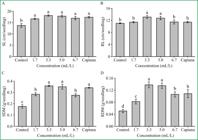
A. Shoot length (SL); B. Root length (RL); C. Shoot dry mass (SDM); D. Root dry mass (RDM) in M. verrucosa seeds treated with different concentrations of Vacciplant®
It is important to note that, beyond the antifungal activity of Vacciplant®, the observed results for shoot growth, along with the higher means for root growth at 3.3 and 5.0 mL·L⁻1, indicate a stimulatory effect on both shoot and root development in M. verrucosa seedlings.
The results obtained for SDM and RDM at 3.3 and 5.0 mL·L⁻1 are particularly relevant, as higher averages for these variables are essential for successful seedling production. These parameters are directly related to vigorous growth and development, contributing to better field establishment. Such variables reflect the plant’s photosynthetic efficiency, growth rate, and assimilate distribution among structural organs (Barbosa et al., 2013).
Seaweed-based products are widely recognized for their biostimulant action, as corroborated by the results of this study, where the product promoted plant development and biomass increase. Although most studies have focused on agricultural crops, the available evidence, together with the biochemical profile of these compounds, indicates that similar effects can be expected in forest species.
4 CONCLUSIONS
The concentrations of the seaweed-based product were effective in reducing Aspergillus sp., Penicillium sp., Fusarium sp., and Cladosporium sp. incidence;
The seaweed-based product enhanced initial seedling growth and dry mass accumulation in germination and emergence tests, in addition to promoting faster and higher emergence rates, standing out as a promising alternative for seed treatment of Mimosa verrucosa Benth.
-
Evaluators in this article:
Prof. Dr. Gilvano Ebling Brondani, Section Editor
ACKNOWLEDGMENTS
The authors thank the Graduate Program in Agronomy of the Federal University of Paraíba, the Coordination for the Improvement of Higher Education Personnel (CAPES), the National Council for Scientific and Technological Development (CNPq), and the Center for Ecology and Environmental Monitoring (NEMA) for their support in carrying out this research.
Data Availability Statement:
Datasets related to this article will be available upon request to the corresponding author.
REFERENCES
- ALOMRAN, M.; HOUBRAKEN, J.; NEWCOMBE, G. Aspergillus tubingensis is a pre-emergent pathogen of date palm seedlings. Forests, v. 11, n. 12, p. 1327, 2020.
- BAHMANI, R.; MORE, P.; BABARINDE, S.; ZHOU, M.; PRITHIVIRAJ, B. Seaweeds for plant disease management: current research advances and future perspectives. Phytoparasitica, v. 51, n. 4, p. 783-802, 2023.
- BALLA, A.; SILINI, A.; CHERIF-SILINI, H.; BOUKET, A.; MOSER, W.; NOWAKOWSKA, J.; OSZAKO, T.; BENIA, F.; BELBAHRI, L. The Threat of Pests and Pathogens and the Potential for Biological Control in Forest Ecosystems. Forests, v. 12, n. 11, p. 1579, 2021.
- BARBIERI, A. P. P.; MENEZES, N. L.; CONCEIÇÃO, G. M.; TUNES, L. M. Teste de lixiviação de potássio para a avaliação do vigor de sementes de arroz. Revista Brasileira de Sementes, v. 34, p. 117-124, 2012.
- BARBOSA, M. L.; SILVA, T. G. F.; SILVA, A. C.; ALMEIDA, M. G.; LIMA, A. L. A.; SOUZA, C. A. A. Crescimento Inicial de Espécies Ocorrentes no Semiárido Brasileiro: Biomassa, Biometria e Análise Morfogênica. Revista Brasileira de Geografia física, Recife, v. 06, n. 03, p. 522-539, 2013.
- BARTLETT, M. S. The use of transformations. Biometrics, v. 3, n. 1, p. 39-52, 1947.
- BENEDITO, C. P.; RIBEIRO, M. C. C.; PAIVA, E. P.; MEDEIROS, H. L. S. Dormancy overcoming and germination test in Piptadenia stipulacea (Benth.) Ducke seeds1, Revista Ciência Agronômica, v. 50, n. 2, p. 338-344, 2019.
- BEZERRA, J. B.; BUFALINO, L.; DE SOUZA, T. M.; GUEDES, M. C.; FIORELLI, J. Painel de partícula homogênea da madeira Tachigali vulgaris aglomerado com resinas orgânicas. Ciência Florestal, 2025.
- BORBA, M. C.; VELHO, A. C.; FREITAS, M. B.; HOLVOET, M.; MAIA-GRONDARD, A.; BALTENWECK, R.; MAGNIN-ROBERT, M.; RANDOUX, B.; HILBERT, J. L.; REIGNAULT, P.; HUGUENEY, P.; SIAH, A.; STADNIK, M., J. A laminarin-based formulation protects wheat against Zymoseptoria tritici via direct antifungal activity and elicitation of host defense-related genes. Plant Disease, v. 106, n. 5, p. 1408-1418, 2022.
- BRASIL, Mapa. Instruções para análise de sementes de espécies florestais. Ministério da Agricultura, Pecuária e Abastecimento Secretaria de Defesa Agropecuária, 2013.
- BRASIL, Mapa. Manual de análise sanitária de sementes. Ministério da Agricultura, Pecuária e Abastecimento 2009.
- CENOBIO-GALINDO, A. D. J.; HERNÁNDEZ-FUENTES, A. D.; GONZÁLEZ-LEMUS, U.; ZALDÍVAR-ORTEGA, A. K.; GONZÁLEZ-MONTIEL, L.; MADARIAGA-NAVARRETE, A.; HERNÁNDEZ-SOTO, I. Biofungicides Based on Plant Extracts: On the Road to Organic Farming. International Journal of Molecular Sciences, v. 25, n. 13, p. 6879, 2024.
- DE CORATO, U.; SALIMBENI, R.; PRETIS, A.; DE, AVELLA, N.; PATRUNO, G. Antifungal activity of crude extracts from brown and red seaweeds by a supercritical carbon dioxide technique against fruit postharvest fungal diseases. Postharvest Biology and Technology, v. 131, p. 16-30, 2017.
- DOBROJAN, S.; JIGAU, G.; DOBROJAN, G.; MELNIC, C.; CIOLACU, T.; CIOBANU, E. Perspective of the use of algae in the treatment of plant seeds. Studia Universitatis Moldaviae. Seria Ştiinţe ale Naturii, v. 171, n. 1, p. 139-145, 2023.
- DOURADO, D.; LIMA, S. F.; LIMA, A. P. L.; SORATTO, D. N.; BERNARDO, V. F.; BARBOSA, H. M. Efeito de bioestimulante em sementes de cedro-rosa. Brazilian Journal Of Development, v. 6, n. 5, p.30306-30319, 2020.
- DUTRA JÚNIOR, M. P.; MARANGON, L. C.; GONÇALVES, M. P. P.; FELICIANO, A. L. P. Análise fitossociológica e de indicadores ecológicos em duas áreas de Caatinga com históricos diferentes de uso no Sertão Paraibano. Ciência Florestal, v. 32, n. 3, p. 1439-1459, 2022.
- FARIAS, O. R.; CRUZ, J. M. F. L.; DUARTE, I. G.; VELOSO, J. S.; NASCIMENTO, L. C. Controle de fungos com óleo de eucalipto e transmissão de Fusarium sp. em sementes de Mimosa caesalpiniifolia Pesquisa Florestal Brasileira, v. 43, 2023.
- FRISCHIE, S.; MILLER, A.; PEDRINI, S.; KILDISHEVA, O. Ensuring seed quality in ecological restoration: native seed cleaning and testing. Restoration Ecology, v. 28, p. S239-S248, 2020.
- GEBEYAW, M. Review on: Impact of Seed-Borne Pathogens on Seed Quality. American Journal of Plant Biology, v. 5, p. 77-81, 2020.
- JAMIOŁKOWSKA, A. Natural Compounds as Elicitors of Plant Resistance Against Diseases and New Biocontrol Strategies. Agronomy, v. 10, n. 2, p. 173, 2020.
- KOCIRA, S.; SZPARAGA, A.; KUBÓN, M.; CZERWINSKA, E.; PISKIER, T. Morphological and biochemical responses of Glycine max (L.) Merr. to the use of seaweed extract. Agronomy, v. 9, n. 93, p. 1-23, 2019.
- MAGUIRE, J. Speed of germination: aid in selection and evaluation for seedling emergence and vigour. Crop Science, v. 2, n. 2, p. 176-177, 1962.
- MARCOS FILHO, J. Fisiologia de sementes de plantas cultivadas. 2 ed. ABRATES, p. 659, 2015.
- MONÇÃO, N. B. N.; ARAÚJO, B. Q.; CITÓ, A. M. G. L. Explorando a Química de Produtos Naturais e Propriedades Biológicas do Gênero Mimosa Linnaeus (FABACEAE-MIMOSOIDEAE). Revista virtual de química, v. 11, n. 3, p. 970-1010, 2019.
- MOURA, S. S. S.; SOARES, A. M.; URSULINO, M. M.; OLIVEIRA, R.; NASCIMENTO, L. C.; ALVES, E. U. Physiological and sanitary quality of seeds of Dimorphandra gardneriana Tul. treated with essential oils. Comunicata Scientiae, v. 9, n. 3, p. 457-464, 2018.
- NÓBREGA, J. S.; NASCIMENTO, L. C. Sanidade de sementes e sua influência no controle de fitopatógenos. Research, Society and Development, v. 9, n. 10, e649108101, 2020.
- PANDIT, S.; YADAV, L. Isolation of Fungal Pathogens From Seeds of Selected Vegetables And Study of Their Impact On Germination And Seedling Growth. Indian Journal of Scientific Research, v. 11, n. 1, p. 139-146, 2020.
- QUISPE-MELGAR, H.; HUAYTA-HINOJOSA, L.; LLACUA-TINEO, Y.; AMES-MARTÍNEZ, F.; POMA, K.; TICSE-OTAROLA, G.; TOMAZELLO-FILHO, M.; RENISON, D. Evaluating the performance of Polylepis incana seeds: reassessing their potential for restoration and conservation of high Andean forests. Restoration Ecology v. 33, n. 1, p. e14276, 2025.
-
R Core Team. R: A language and environment for statistical computing. Vienna: R Foundation for Statistical Computing, 2024. Available on: https://www.R-project.org/ Accessed in: 30 Aug. 2024.
» https://www.R-project.org/ - SÁ, C. J. C. L.; SANTOS, L. C.; LIMA, R. P. Uso positivo de fungos endofíticos para biocontrole de patógenos na cultura do tomate. Revista Multidisciplinar do Nordeste Mineiro, v. 09, p. 1-18, 2024.
- SANTRA, H. K.; BANERJEE, D. Natural products as fungicide and their role in crop protection. Natural bioactive products in sustainable agriculture, p. 131-219, 2020.
- SEIFERT, K.; MORGAN-JONES, G.; GAMS, W.; KENDRICK, B. The genera of Hyphomycetes. CBS-KNAW Fungal Biodiversity Centre, Utrecht, p. 866, 2011.
- SHUKLA, P.; BORZA, T.; CRITCHLEY, A.; PRITHIVIRAJ, B. Seaweed-Based Compounds and Products for Sustainable Protection against Plant Pathogens. Marine Drugs, v. 19, n. 2, p. 59, 2021.
- SILVA HENRIQUE, G.; SANTOS, G.; DE SOUZA, J.; LUZ, M.; LIMA, M.; DE MOURA, I.; SILVA, J. Sanity and Germination of Treated with Clove Extract Jurema-Preta and Faveleira Seeds. Journal of Experimental Agriculture International. 2021.
- SILVA JUNIOR, I.; LIMA JUNIOR, M. D. J. V.; MENDES, A. M. D. S.; BASTOS, L. L. D. S.; MENEZES, V. D. S. Parâmetros de qualidade de sementes para escolha de matrizes de Handroanthus serratifolius (Vahl) S. Grose na Amazônia Ocidental. Ciência Florestal, v. 34, p. e84834, 2024.
- SILVA, L. G. D.; BRUNO, R. D. L.; SILVA, J. G. D.; JERONIMO, R. E. D. O.; MEDEIROS, A. K. D. A.; SILVA, H. F. D.; NASCIMENTO, L. C. D. Silicon sources on Cenostigma pyramidalis seed quality. Revista Brasileira de Engenharia Agrícola e Ambiental, v. 29, n. 5, p. e287772, 2025.
- SILVA, L.; SIMPLICIO, R.; ARRUDA, S.; PEREIRA, D.; CASTRO, M.; WALDSCHMIDT, A. Genetic Diversity in Mimosa tenuiflora (Willd.) Poir.: A Multipurpose Plant Genetic Resource of Semiarid Brazil. The Journal of Agricultural Science, v. 13, p. 113. 2021.
- SILVA, P. C. D.; LIMA, N. D.; MASETTO, T. E.; GONÇALVES, M. C.; CÂNDIDO, L. S. Multivariate analysis applied to the evaluation of genetic variability for the physiological quality trait of common bean seeds. Journal of Seed Science, v. 45, p. e202345031, 2023.
- SILVA, T. T. A.; VON PINHO, E. V. R.; CARDOSO, D. L.; FERREIRA, C. A. ALVIM, P. O.; COSTA, A. A. F. Qualidade fisiológica de sementes de milho na presença de bioestimulante. Ciência e Agrotecnologia, v. 32, n. 3, p. 840-846, 2008.
- WU, Y.; LIN, Y.; CHUANG, H. Laminarin modulates the chloroplast antioxidant system to enhance abiotic stress tolerance partially through the regulation of the defensin-like gene expression. Plant science: an international journal of experimental plant biology, v. 247, p. 83-92, 2016.
- XAVIER, M.; FONSECA, A.; DE ALMEIDA, E.; DE OLIVEIRA, P. Manejo do Oncideres ocularis Thomson em Mimosa caesalpiniifolia Benth. Research, Society and Development, v. 9, n. 7, p. e787974601-e787974601, 2020.
- ZHU, M.; ZANG, Y.; ZHANG, X.; SHANG, S.; XUE, S.; CHEN, J.; TANG, X. Insights into the regulation of energy metabolism during the seed-to-seedling transition in marine angiosperm Zostera marina L.: Integrated metabolomic and transcriptomic analysis. Frontiers in Plant Science, v. 14, p. 1130292, 2023.
-
Editorial Board:
Prof. Dr. Cristiane Pedrazzi, Editor-in-ChiefProf. Dr. Dalton Righi, Associate EditorMiguel Favila, Managing Editor

 Source: Authors (2025)In where: Control (sterile distilled water) and Captan fungicide (240 g/100 kg of seeds). Means followed by the same letter in the row do not differ from each other according to the Scott-Knott test (p ≤ 0.05).
 Source: Authors (2025)In where: Control (sterile distilled water) and Captan fungicide (240 g/100 kg of seeds). Means followed by the same letter in the row do not differ from each other according to the Scott-Knott test (p ≤ 0.05).
 Source: Authors (2025)In where: Control (sterile distilled water) and Captan fungicide (240 g/100 kg of seeds). Means followed by the same letter in the row do not differ from each other according to the Scott-Knott test (p ≤ 0.05).
 Source: Authors (2025)In where: Control (sterile distilled water) and Captan fungicide (240 g/100 kg of seeds). Means followed by the same letter in the row do not differ from each other according to the Scott-Knott test (p ≤ 0.05).