person Jéssica Camile da Silva
Conceitualização · Curadoria de dados · Análise de dados · Pesquisa · Metodologia · Administração do projeto · Validação de dados · experimentos · Design da apresentação de dados · Redação do manuscrito original
Engenheira Florestal, Mestre em Ciências Agrárias, http://orcid.org/0000-0001-7935-2305 • jessika.camile5@gmail.com
schoolUniversidade Tecnológica Federal do Paraná, Dois Vizinhos, PR, BrasilUniversidade Tecnológica Federal do ParanáBrasilDois Vizinhos, PR, BrasilUniversidade Tecnológica Federal do Paraná, Dois Vizinhos, PR, Brasil
person Jéssica Maiara Viceli
Conceitualização · Curadoria de dados · Pesquisa · Metodologia · Validação de dados · experimentos · Design da apresentação de dados · Redação do manuscrito original
Engenheira Ambiental, Mestre em Ciências Agrárias, https://orcid.org/0000-0002-1407-7004 • jessicamviceli@gmail.com
schoolUniversidade Tecnológica Federal do Paraná, Dois Vizinhos, PR, BrasilUniversidade Tecnológica Federal do ParanáBrasilDois Vizinhos, PR, BrasilUniversidade Tecnológica Federal do Paraná, Dois Vizinhos, PR, Brasil
person Darlin Henrique Ramos de Oliveira
Conceitualização · Curadoria de dados · Pesquisa · Metodologia · Validação de dados · experimentos · Design da apresentação de dados · Redação do manuscrito original
Engenheiro Ambiental, Mestre em Ciências Agrárias, https://orcid.org/0000-0002-7414-8329 • darlin.agro@gmail.com
schoolUniversidade Tecnológica Federal do Paraná, Dois Vizinhos, PR, BrasilUniversidade Tecnológica Federal do ParanáBrasilDois Vizinhos, PR, BrasilUniversidade Tecnológica Federal do Paraná, Dois Vizinhos, PR, Brasil
person Miriam Fernanda Rodrigues
Análise de dados · Redação do manuscrito original · Escrita - revisão e edição
Engenheira Florestal, Doutora em Engenharia Florestal, https://orcid.org/0000-0001-5026-7887 • miriamf_rodrigues@yahoo.com.br
schoolUniversidade Tecnológica Federal do Paraná, Dois Vizinhos, PR, BrasilUniversidade Tecnológica Federal do ParanáBrasilDois Vizinhos, PR, BrasilUniversidade Tecnológica Federal do Paraná, Dois Vizinhos, PR, Brasil
person Nathalie Caroline Hirt Kessler
Análise de dados · Redação do manuscrito original · Escrita - revisão e edição
Bióloga, Doutora em Engenharia Agrícola, https://orcid.org/0000-0002-3628-9964 • nathalie.kessler@gmail.com
schoolUniversidade Federal de Santa Maria, Santa Maria, RS, BrasilUniversidade Federal de Santa MariaBrasilSanta Maria, RS, BrasilUniversidade Federal de Santa Maria, Santa Maria, RS, Brasil
person Dinéia Tessaro
Conceitualização · Pesquisa · Metodologia · Administração do projeto · Disponibilização de ferramentas · Validação de dados · experimentos · Design da apresentação de dados · Redação do manuscrito original · Escrita - revisão e edição
Bióloga, Doutora em Engenharia Agrícola, http://orcid.org/0000-0002-6079-5269 • dtessaro@utfpr.edu.br
schoolUniversidade Tecnológica Federal do Paraná, Dois Vizinhos, PR, BrasilUniversidade Tecnológica Federal do ParanáBrasilDois Vizinhos, PR, BrasilUniversidade Tecnológica Federal do Paraná, Dois Vizinhos, PR, Brasil

 Epiedaphic fauna in different agroecosystems obtained by Pitfall traps and Provid methods
 Thumbnail
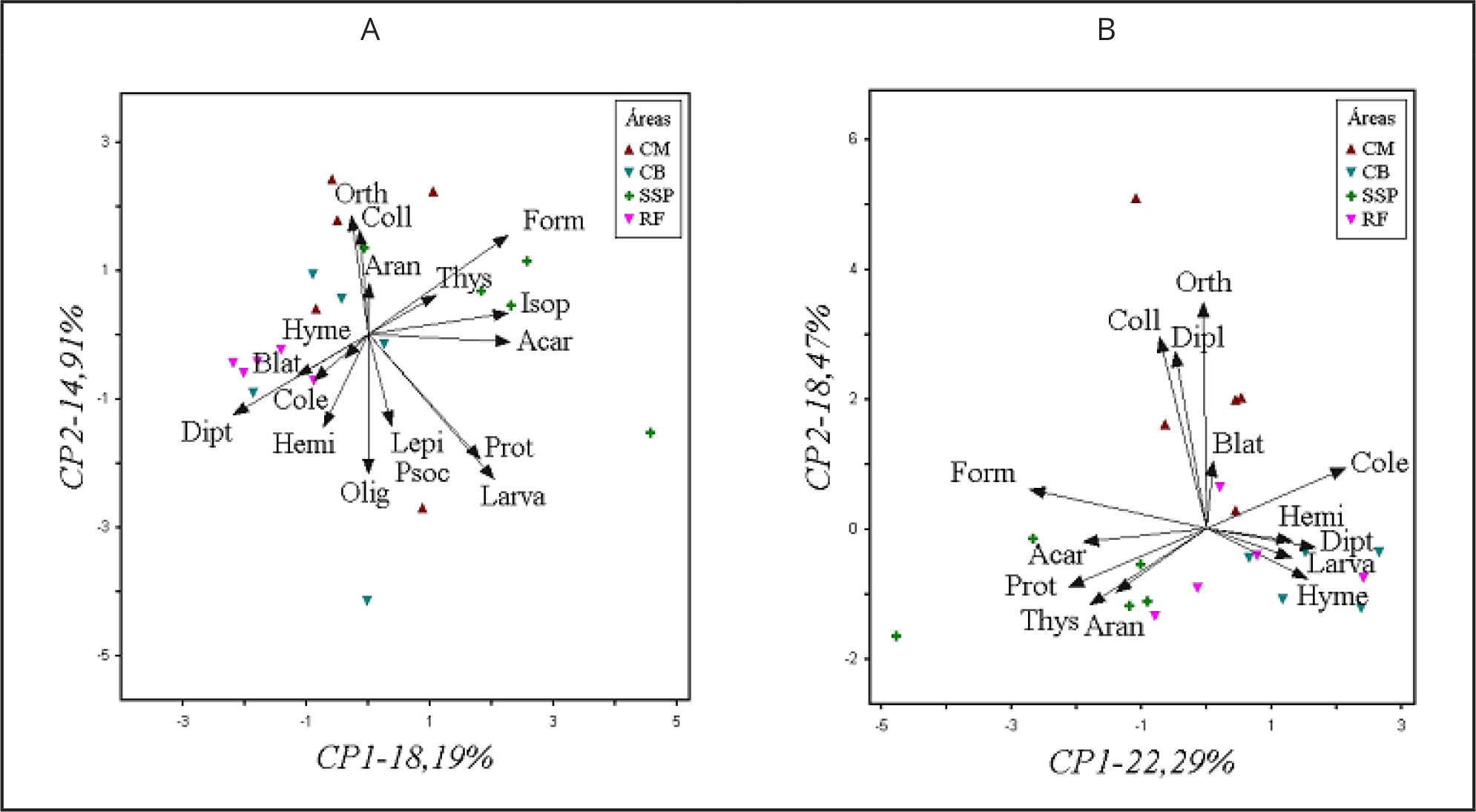 Fonte: Autores (2022)Em que: Acar - Acarina; Aran - Araneae; Blat - Blattodea; Cole - Coleoptera; Coll - Collembola; Dipl - Diplopoda; Dipt - Diptera; Form - Formicidae; Hemi - Hemiptera; Hyme - Hymenoptera; Isop - Isopoda; Lepi - Lepidoptera; Olig - Oligochaeta; Orth - Orthoptera; Prot - Protura; Pso - Psocoptera; Thysa - Thysanoptera.