
 Density management of Acacia mearnsii De Wild. seedlings inoculated with nitrogen-fixing bacteria
ABSTRACT
Acacia mearnsii is a forest species of significant economic importance, notably used in charcoal, pulp, and tannin production, as well as in silvopastoral systems. The Acacia genus naturally establishes symbiotic associations with atmospheric nitrogen-fixing bacteria which convert nitrogen into assimilable forms, substantially contributing to plant nutrition. This study aimed to evaluate the effects of Bradyrhizobium japonicum inoculation and seedling alternation on the quality of A. mearnsii seedlings in a nursery setting. Phase I of the study involved seedling production and foliar application of the inoculant 20 days after emergence. Phase II consisted of seedling acclimatization under different alternation levels. The experiment was conducted in a completely randomized design with two factors: Factor A - with and without B. japonicum inoculation, and Factor B - seedling alternation at 25% and 50%, totaling four treatments with three replicates. Morphophysiological evaluations of the seedlings were performed at 150 days. The 25% alternation promoted greater stem diameter growth and biomass accumulation in the seedlings. The Dickson Quality Index was also higher at this alternation level, regardless of B. japonicum inoculation, which may be associated with the presence of nitrogen fertilization in the substrate and the final stage of seedling production, characterized by thermal restriction.
Keywords:
Biological nitrogen fixation; Bradyrhizobium japonicum; Seedling alternation; Seedling quality
RESUMO
Acacia mearnsii é uma espécie florestal de expressiva importância econômica, destacando-se na produção de carvão vegetal, celulose e tanino, além de seu uso em sistemas silvipastoris. O gênero Acacia, de forma natural, estabelece associação simbiótica com bactérias fixadoras de nitrogênio atmosférico, que o convertem em formas assimiláveis, contribuindo significativamente para a nutrição da planta. Assim, o estudo objetivou avaliar os efeitos da inoculação de Bradyrhizobium japonicum e da alternagem na qualidade de mudas de A. mearnsii, em viveiro. A fase I do estudo consistiu na produção de mudas e aplicação do inoculante via pulverização foliar, aos 20 dias após a emergência. A fase II, compreendeu a aclimatação das mudas com diferentes alternagens. O experimento foi conduzido em delineamento inteiramente casualizado, com dois fatores: fator A - com e sem inoculação com B. japonicum e o fator B - alternagens das mudas em 25 % e 50 %, totalizando quatro tratamentos com três repetições. As avaliações morfofisiológicas das mudas foram realizadas aos 150 dias. A alternagem de 25 % promoveu maior crescimento em diâmetro do coleto e acúmulo de biomassa nas mudas. O índice de qualidade de Dickson também foi superior nesse nível de alternagem, independentemente da inoculação com B. japonicum, fato que pode estar associado a presença de adubação nitrogenada no substrato e ao período final de produção das mudas, caracterizado pela restrição térmica.
Palavras-chave:
Fixação biológica do nitrogênio; Bradyrhizobium japonicum; Alternagem de mudas; Qualidade de mudas
1 INTRODUCTION
The planted forest sector in Brazil totaled 10.23 million hectares in 2023, of which approximately 70,000 hectares were planted with Acacia mearnsii, making it the fifth largest forest production in the country (IBÁ, 2024). Furthermore, its importance is highlighted by its multiple uses, such as tannin extraction (used in leather tanning and animal feed supplementation) (Godoy, 2023), and in cellulose and charcoal production (Coldebella et al., 2023; Giesbrecht et al., 2022; Ferreira et al., 2013). The cultivation of this species also encompasses a social aspect due to its use in silvopastoral systems on small rural properties in the state of Rio Grande do Sul where it is commercially planted, diversifying production, increasing producer income, and improving animal welfare (Mora, 2002).
A. mearnsii is native to southeastern Australia (Streck; Laviola; Wendling, 2009), belongs to the Fabaceae family and forms a symbiotic association with bacteria responsible for biological nitrogen fixation (BNF), which catalyze the conversion of atmospheric N2 into forms usable by the plant (Claassens, 2023). In this context and being a non-selective species regarding symbiotic bacteria, A. mearnsii can perform BNF with Rhizobium tropici, Rhizobium leguminosarum, Bradyrhizobium elkanii, and Bradyrhizobium japonicum, with the latter being one of the most used species to promote plant-bacteria symbiosis (São José et al., 2022). This relationship can be an alternative to reduce dependence on nitrogen fertilization and the costs of seedling production, in addition to providing greater environmental balance (Mendes et al., 2013).
In parallel, the rapid expansion of forestry in Brazil has generated a growing demand for new areas and maintaining high levels of productivity. However, expansion of forest plantations into regions which are still little explored, often characterized by environmental degradation and low-fertility soils, poses significant challenges to the forestry sector (Ferrez, 2023). This reality stimulates the search for alternatives that optimize the performance of seedlings after planting.
In this scenario, studies have been conducted with the aim of improving the quality of seedlings, aiming at better adaptation and growth in the field (Cury et al., 2024; Magalhães et al., 2024; Barbosa et al., 2023; Griebeler et al., 2023). Therefore, silvicultural efforts should be directed towards aspects such as the genetic characteristics of the propagated material, the production techniques employed, the inputs used, and proper management of seedlings during the nursery phase (Araujo et al., 2018).
In this sense, seedling alternation during the growth phase is a common practice in nurseries which use polypropylene tubes placed in trays or steel grids. This activity aims to reduce competition for light between plants and increase the stem diameter, as well as promote air circulation and reduce the incidence of phytopathogenic microorganisms. In addition, proper alternation can provide greater irrigation water uptake in the root ball and greater seedling hydration (Dumroese; Luna; Landis, 2009). Furthermore, the same authors described that the density level should vary according to the seedling development stage, and therefore should be considered in the size planning of forest nurseries. This enables adequate seedling growth in a way that is compatible with the space used in the nursery. Thus, there is maximum usage of space during emergence, and a reduction to 50, 33 or 25% plant occupancy per area is necessary as seedling growth and leaf area increase (Araujo et al., 2018).
Based on the above, the objective of this study was to verify the effects of Bradyrhizobium japonicum inoculation on the growth and quality of Acacia mearnsii seedlings under different alternations in the nursery.
2 MATERIALS AND METHODS
The study was developed in two stages. Phase I was conducted at the Agroforestry Nursery of the Associação dos Fumicultores do Brasil (Afubra), located in the municipality of Rio Pardo, Rio Grande do Sul, Brazil (29º52'14.17" S and 52º22'48.48" W), from February to June 2023. The region has a Cfa climate according to the Köppen climate classification, subtropical humidity, with an average annual temperature of 18.9 ºC and an average rainfall of 1,790 mm per year (Alvares et al., 2013). The average minimum and maximum temperatures and humidities during the study period can be observed in Figure 1.

Average, minimum and maximum temperature (ºC) and relative air humidity (%) for the municipality of Rio Pardo, in Phase I of the experiment
This stage involved the production of Acacia mearnsii seedlings grown in 55 cm3 polypropylene tubes filled with a commercial substrate based on Sphagnum peat, vermiculite, and carbonized rice husk. A controlled-release fertilizer (Table 1) was added to the substrate, with a nutrient availability time of up to three months.
Chemical composition of the controlled-release fertilizer used in the production of A. mearnsii seedlings
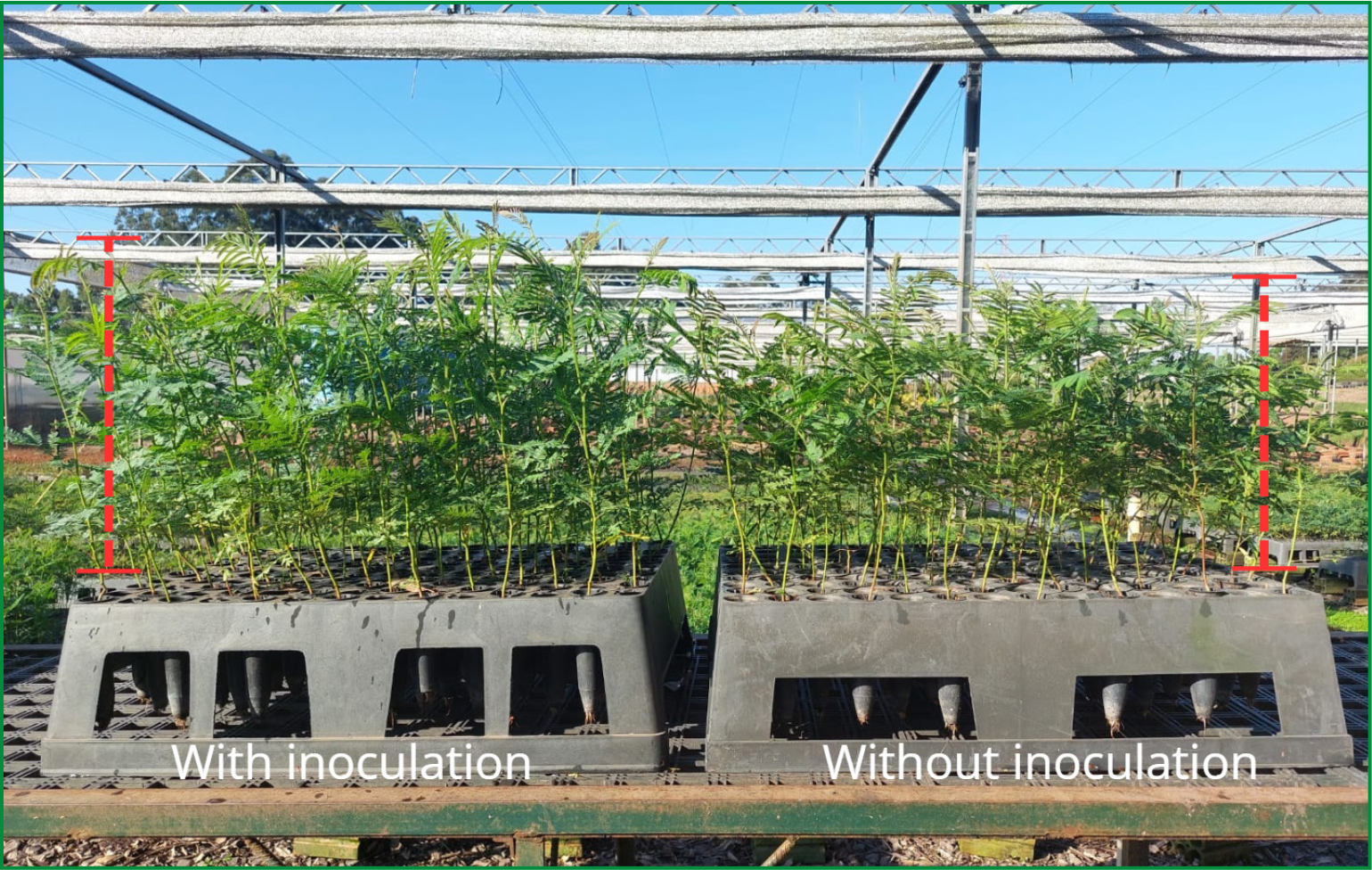
Next, an 800 mL solution (69.5 mL/m2) containing the selected SEMIA 6164 - Bradyrhizobium japonicum (SEMIA Collection of Rhizobia/SEAPI) strain was applied to a batch of 96 seedlings 20 days after sowing with approximately two to three pairs of leaves. In addition, another 96 seedlings were kept without application, corresponding to the control treatment. The material was kept in a greenhouse until 110 days, at which point the seedlings subjected to the solution application were more vigorous and had a darker green hue (Figure 2), suggesting a better physiological state. At this point, they were sent to the Forest Nursery of the Federal University of Santa Maria to develop the second phase of the study (Phase II), carried out from June to July 2023.

Appearance of A. mearnsii seedlings with and without application of B. japonicum, at 110 days
The average, minimum, and maximum temperatures and humidities during phase II can be observed in Figure 3.

Average, minimum and maximum temperature and relative humidity for the municipality of Santa Maria during Phase II of the experiment
The seedlings were characterized in phase II in terms of height (H) and stem diameter (SD) using a graduated ruler and a digital caliper, respectively. Seedlings under inoculant application presented H equal to 40.0 cm and SD of 3.16 mm, while the values without application were 37 cm and 3.25 mm, respectively. The seedlings were alternated aiming to prevent etiolation, moving to an environment with semi-controlled conditions considering a covered structure and a micro-sprinkler irrigation system, applying approximately 6 mm day-1.
A completely randomized design was adopted in executing the experiment under a 2x2 factorial scheme, with three repetitions of 16 plants, totaling 48 plants per treatment. Factor A corresponded to inoculation via foliar spraying (with and without inoculation), and factor B corresponded to the alternation of seedlings (50% and 25%) (Figure 4).

Schematic showing (A) the treatments applied to A. mearnsii seedlings with and without B. japonicum inoculation, (B) under higher and (C) lower density, in competition for light and irrigation
The seedling development in response to the studied factors was evaluated through morphophysiological variables at 150 days. Thus, the height and stem diameter were measured in four plants per replicate, obtaining the H/SD ratio. The Falker Chlorophyll a and b index (FCaI) (FCbI) was obtained using a portable optical chlorophyll meter, ClorofiLOG (Falker®, model: CFL 3010) (FALKER, 2008), with readings taken on the adaxial surface of one leaf per plant per replicate. The maximum quantum yield of photosystem II (Fv/Fm) was analyzed using a portable pulse-modulated fluorometer (JUNIOR-PAM Teaching Chlorophyll Fluorometer - Walz). For this, one plant per replicate had its leaf acclimated to darkness for approximately 30 minutes, after which the analysis was performed. Gas exchange in seedlings was measured using a portable infrared gas analyzer (AGA300 IRGA TARGAS-1, PP SYSTEMS, USA), on one plant per replicate. Thus, the maximum CO2 assimilation (A) and water use efficiency (WUE) were obtained from this analysis, calculated from the ratio between the amount of CO2 fixed by photosynthesis and the amount of water transpired. All physiological assessments were obtained from fully expanded leaves between 08:00 and 12:00 h.
The shoot and root parts of three plants per replicate were separated for the destructive analyses, and the roots were washed over sieves (2 mm mesh) with running water to facilitate removal from the substrate. The B. japonicum nodules formed in the root system were removed using clinical tweezers (Figure 5).

All material was then individually packaged in Kraft paper bags, identified, and subjected to drying in a forced-air circulation oven (65 ± 2 ºC). The samples were weighed on an analytical scale (precision 0.001 g) to obtain the shoot dry mass (SDM), root dry mass (RDM), the total dry mass (TDM) by summing the latter masses, and nodule dry mass (NDM), according to the methodology described by Assis (2022). From this, it was possible to obtain the Dickson Quality Index (DQI) (Dickson; Leaf; Hosner, 1960) (Equation 1).
The data obtained were subjected to verification of the assumptions of normality of residuals and homogeneity of variances using the Shapiro-Wilk and Bartlett tests, respectively. Analysis of variance (ANOVA) was subsequently performed and the means were compared when a significant effect was detected using Tukey’s test at a 5% probability level of error, using the ExpDes.pt package (Ferreira et al., 2018) in the R Studio statistical environment (R CORE TEAM, 2020).
3 RESULTS
The study factors did not influence the growth in height (H) of the seedlings which presented an average of 42.7 ± 4.36 cm at 150 days. On the other hand, seedlings subjected to 25% alternation showed greater diameter (SD) (3.82 mm) and root dry mass (RDM) (0.54 g plant-1) (Figures 6A and B), considering p<0.017 and p<0.001, respectively. The H/SD ratio was not influenced by the study factors, presenting an overall average of 11.59 ± 1.58.

Morphological attributes evaluated in A. mearnsii seedlings produced with and without B. japonicum inoculation and under different alternations in a nursery
The SDM, TDM, and NodDM variables were influenced in isolation by the studied factors. Seedlings not inoculated with B. japonicum tended to have higher SDM (2.75 g plant-1), TDM (3.25 g plant-1), and NodDM values (0.14 g plant-1) (Figures 6C, 6D, and 6E). Seedlings under 25% alternation showed greater accumulation of shoot dry mass (2.90 g plant-1), total dry mass (3.44 g plant-1), and nodule dry mass (0.15 g plant-1). An interaction was observed for the DQI between the study factors (inoculation x alternation), where seedlings subjected to 25% alternation, regardless of B. japonicum inoculation, showed superior quality (Figure 6F).
The physiological attributes evaluated were not influenced by the study factors (inoculation x alternation). Thus, the following overall averages were found: FCaI = 12.69 ± 3.69, FCbI = 3.89 ± 2.09, Fv/Fm = 0.514 ± 0.044, A = 17.75 ± 1.34 µmol m-2 s-1 and WUE = 9.48 ± 2.42 µmol CO2 mol-1 H2O.
4 DISCUSSIONS
The effectiveness of foliar spraying with B. japonicum on A. mearnsii seedlings at 150 days was not clearly evidenced. This possibly occurred because inoculation was only performed once, since seedlings that showed darker green leaves at 110 days (Figure 2) became indifferent to those without application over time. Inoculation did not influence the SD and RDM and reduced the SDM, TDM, and NodDM of the plants. On the other hand, the response to inoculation varied according to plant density when analyzing the DQI variable.
The variability in response to inoculation can be explained by environmental factors, especially temperature, since, according to Sadowski (2005), the ideal range for BNF occurrence varies between 25 °C and 40 °C. The seedlings were exposed to average temperatures of 15.2 °C during Phase II (June to July), typical of autumn-winter in the study region (Figure 3). This condition may have limited the efficiency of BNF, considering that the thermal restriction, with a reduction of approximately 10 °C below the optimum range, may have compromised nodulation and consequently the conversion of atmospheric N2, culminating in the absence of response to the inoculant.
Several studies demonstrate that the effects of seasonality on tree species not only interfere with morphology, but also with plant physiology and biochemistry (Stahl et al., 2025; Ballestreri et al., 2021; Aimi et al., 2017). Differences in the maximum CO2 assimilation pattern (A) in Myrcianthes punges (O.Berg) D. Legrand and Cupania vernalis Cambess during the winter and spring periods in the Southern region of Brazil were verified by Stahl et al. (2025). The variation in this attribute directly influences the production of photoassimilated compounds, which in turn affects BNF efficiency, since the activity of the symbiotic bacteria directly depends on the consumption of these compounds formed by the plant’s photosynthetic process (Neves; Hungria, 1987). Therefore, further investigations are needed to compare the BNF potential in A. mearnsii under the effect of seasonality in Southern Brazil.
Another factor which may have contributed to the inoculation inefficiency was the presence of nitrogen fertilizer in the substrate used in seedling production (Table 1). In studying the BNF behavior in leguminous trees under N application, Della Coletta (2010) observed that BNF was favored when seedlings were subjected to an environment where N availability was low, while fixation was conversely inhibited where nitrogen addition was high. According to De Polli et al. (1988), the availability of mineral nitrogen in the substrate is the main limiting factor for BNF because plants tend to absorb it as a readily assimilable form, reducing or even inhibiting nodule formation and nitrogen-fixing bacteria activity, which possibly occurred in the inoculated seedlings (Figure 6E). Furthermore, this preference occurs due to the high energy cost associated with symbiotic fixation. The plant must increase its photosynthetic capacity to obtain this energy, which did not occur in our study, given that the maximum assimilation (A) did not differ between seedlings with or without inoculation. The plant’s metabolism adjusts under these conditions to prioritize absorption of available mineral nitrogen, which leads to a decrease in the production of essential chemical signals, thereby compromising symbiosis and nodulation establishment (Chiurazzi; Frugis; Navazio, 2025).
The higher SD values and RDM found under wider seedling spacing (25%) demonstrate the importance of managing plant density in the nursery phase. These factors are fundamental to ensuring seedling survival and establishment in the field, especially in areas with more challenging characteristics for forestry production. A well-developed root system makes water and nutrient absorption more efficient, while a larger SD provides better stability against wind and rain (Grossnickle; Macdonald, 2018).
Furthermore, seedlings with higher SD are likely to have more carbohydrate reserves and essential nutrients for establishment after planting (Tsakaldimi; Ganatsas; Jacobs, 2013). Moreover, Brito et al. (2024) highlight that shoot formation is directly related to the root system, since it is through the root system that nutrient absorption from the soil occurs, which are subsequently translocated to the shoot.
Although the photosynthetic rates of A. mearnsii were not influenced by alternate planting, we emphasize that this activity is fundamental, especially in managing species with larger leaf areas. This is because overlapping leaves under high density tend to suppress smaller seedlings, reducing their light absorption capacity, photosynthetic efficiency, and growth, thus disqualifying the batch. Furthermore, high density can compromise irrigation water percolation into the substrate, seedling hydration, development, growth, and survival.
Although producers need more labor, usable space, and a greater quantity of materials such as trays or grids, seedling development is favored by alternating planting at 25%, although 50% can also be an intermediate alternative to be considered. On the other hand, production costs can be diluted by supplying higher quality seedlings, enhancing performance, reducing shipping time, and costs associated with field replanting. Thus, producers should intensify observations regarding the need to manage seedling density according to the seedling production stage.
5 CONCLUSIONS
Alternating planting at 25% enhances the development of Acacia mearnsii seedlings after 150 days in the nursery, demonstrating that less competition for resources such as light and water favors seedling development and growth.
Limiting environmental and nutritional factors, such as low temperatures and nitrogen fertilization, can compromise biological nitrogen fixation with B. japonicum in A. mearnsii seedlings.
We suggest conducting further studies to evaluate the potential of inoculation practices with nitrogen-fixing symbiotic organisms in Acacia mearnsii seedlings under seasonal conditions of higher temperatures than those observed in the present experiment, in association with nitrogen fertilization application.
ACKNOWLEDGMENTS
To all who directly or indirectly made this study possible. To the Forest Nursery of the Federal University of Santa Maria and the Associação dos Fumicultores do Brasil, for their partnership, operational support, and the availability of space and equipment.
-
Evaluators in this article:
Gilvano Ebling Brondani, Section Editor
Data Availability Statement:
Datasets related to this article will be available upon request to the corresponding author.
REFERENCES
-
AIMI, S. C.; ARAUJO, M. M.; TONETTO, T. S.; TABALDI, L. A.; SALDANHA, C. W.; FARIAS, J. G.; OLIVEIRA, G. G. Shading as a conditioning factor to forest species planting: a study with Apuleia leiocarpa Bosque, Valdivia, v. 38, n. 2, p. 371-379, 2017. DOI 10.4067/S0717-92002017000200014. Available at: https://www.scielo.cl/pdf/bosque/v38n2/art14.pdf Access in: 22 June 2025.
» https://doi.org/10.4067/S0717-92002017000200014.» https://www.scielo.cl/pdf/bosque/v38n2/art14.pdf - ALVARES, C. A. et al. Köppen’s climate classification map for Brazil. Meteorologische Zeitschrift, Germany, v. 22, n. 6, p. 711-728, 2013.
- ARAUJO, M. M.; NAVROSKI, M. C.; FILHO, E. A.; SCHORN, L. A. Produção de mudas por sementes. In: ARAUJO, M. M.; NAVROSKI, M. C.; SCHORN, L. A. (Orgs.). Produção de sementes e mudas: um enfoque à silvicultura Santa Maria: Editora UFSM, 2018. 448 p.
- ASSIS, P. H. M. S. Composto exaurido de Agaricus subrufescens como substrato na produção de mudas de Enterolobium contortisiliquum (Vell.) Morong. Monografia (Bacharelado em Engenharia Florestal) - Instituto de Florestas, Universidade Federal Rural do Rio de Janeiro. Seropédica, p. 37. 2022.
-
BALLESTRERI, A. A.; ARAUJO, M. M.; AIMI, S. C.; NASCIMENTO, N. F.; BERGHETTI, A. L. P.; GASPARIN, E.; TABALDI, L. A.; ZAVISTANOVICZ, T. C. Morphophysiological responses of forest tree species conducted under different levels of shading in the enrichment of degraded ecosystem. Forest Ecology and Management, v. 488, 2021. DOI 10.1016/j.foreco.2021.119032. Available at: 10.1016/j.foreco.2021.119032 Access in: 22 June 2025.
» https://doi.org/10.1016/j.foreco.2021.119032.» https://doi.org/10.1016/j.foreco.2021.119032 -
BARBOSA, F. M.; ARAUJO, M. M.; TURCHETTO, F.; AIMI, S. C.; GRIEBELER, A. M.; BERGHETTI, A. L. P.; FRESCURA, V. D. S. Fertilization and substrates influence Astronium balansae seedlings in the nursery: one step further for conservation. Bosque, Valdivia, v. 44, n. 3, p. 629-637, 2023. DOI 10.4067/S0717-92002023000300629. Available at: https://www.scielo.cl/pdf/bosque/v44n3/0717-9200-bosque-44-03-629.pdf Access in: 16 June 2025.
» https://doi.org/10.4067/S0717-92002023000300629.» https://www.scielo.cl/pdf/bosque/v44n3/0717-9200-bosque-44-03-629.pdf -
BRITO, M. S.; GRIEBELER, A. M.; LIMA, C. C.; JUCOSKI, G. O.; TURCHETTO, F. Efeito de diferentes fontes de adubação sobre o crescimento inicial de plantas jovens de Khaya grandifoliola C.D.C. Revista Observatorio de la Economia Latinoamericana, v. 22, n. 10, p. 1-18, 2024. DOI 10.55905/oelv22n10-247. Available at: https://doi.org/10.55905/oelv22n10-247 Access in: 5 July 2025.
» https://doi.org/10.55905/oelv22n10-247.» https://doi.org/10.55905/oelv22n10-247 -
CHIURAZZI, M.; FRUGIS, G.; NAVAZIO, L. Symbiotic nitrogen fixation: a launchpad for investigating old and new challenges. Journal of Experimental Botany, v. 76, n. 6, p. 1473-1477, 2025. DOI 10.1093/jxb/erae510. Available at: https://doi.org/10.1093/jxb/erae510 Access in: 23 June 2025.
» https://doi.org/10.1093/jxb/erae510.» https://doi.org/10.1093/jxb/erae510 -
CLAASSENS, R.; VENTER, S. N.; BEUKES, C. W.; STĘPKOWSKI, T.; CHAN, W. Y.; STEENKAMP, E. T. Bradyrhizobium xenonodulans sp. nov. isolated from nodules of Australian Acacia species invasive to South Africa. Forest Ecology and Management, v. 46, n. 5, p. 1-13, 2023. DOI 10.1016/126452. Available at: https://doi.org/10.1016/j.syapm.2023.126452 Access in: 24 Aug. 2024.
» https://doi.org/10.1016/126452.» https://doi.org/10.1016/j.syapm.2023.126452 -
COLDEBELLA, R. C.; GIESBRECHT, B. M.; PEDRAZZI, C.; MACHADO, P. F. S.; DALLA COSTA, W. D.; VIVIAN, M. A.; DENARDI, L.; GOMES, C. M. Anatomical characterization os black wattle wood for the Pulp and paper production. Ciência Rural, Santa Maria, v. 53, n. 9, p. 1-8, 2023. DOI 10.590/0103-8478cr20210865. Available at: https://doi.org/10.1590/0103-8478cr20210865 Access in: 16 June 2025.
» https://doi.org/10.590/0103-8478cr20210865.» https://doi.org/10.1590/0103-8478cr20210865 -
COMPO EXPERT. Basacote® Plus 3M 16-8-12(+2) Available at: https://www.compo-expert.com/pt-BR/produtos/basacote-plus-3m-16-8-122 Access in: 13 July 2025.
» https://www.compo-expert.com/pt-BR/produtos/basacote-plus-3m-16-8-122 -
CURY, L. D.; SILVA, L. F.; OLIVEIRA, V. C.; ARTHUR, M. M.; RODRIGUES, S. A.; SILVA, J. M. S.; GUERRA, S. P. S. Growth of Eucalyptus urophylla seedlings produced in conventional and water collection trays in degradable tube and polypropylene systems. Ciência Florestal, Santa Maria, v. 34, n. 2, p. 1-21. DOI 10.5902/1980509873734. Available at: https://doi.org/10.5902/1980509873734 Access in: 17 July 2025.
» https://doi.org/10.5902/1980509873734.» https://doi.org/10.5902/1980509873734 - DELLA COLETTA, L. Estudo da fixação biológica do nitrogênio em leguminosas (família Fabaceae) arbóreas tropicais através do enriquecimento isotópico do 15N Tese (Mestrado em Ciências) - Centro de Energia Nuclear na Agricultura, Universidade de São Paulo. Piracicaba, p. 100. 2010.
- DE POLLI, H.; CAMPELLO, E. F. C.; FRANCO, A. A. Efeitos da adubação nitrogenada sobre a fixação biológica do nitrogênio em leguminosas. In: FERREIRA, M. E.; CRUZ, M. C. P. (Org.). Micronutrientes na agricultura POTAFOS Piracicaba: 1988. p. 49-66.
-
DICKSON, A.; LEAF, A.; HOSNER, J.F. Quality appraisal of white spruce and white pine seedling stock in nurseries. The Forest Chronicle, West Mattawa, v. 36, p. 10-13, 1960. Available at: https://doi.org/10.5558/tfc36010-1 Access in: 24 Aug. 2024.
» https://doi.org/10.5558/tfc36010-1 - DUMROESE, R. K.; LUNA, T.; LANDIS, T. D. Nursery Manual for native plants: a guide for tribal nurseries (ed.). Department of Agriculture, Forest Service, v. 1, p. 95-111, 2009.
-
FALKER, Automação agrícola. Manual do medidor eletrônico de teor clorofila (ClorofiLOG/CFL 1030), Porto Alegre, 2008. 33p. Available at: http://www.falker.com.br/produto_download.php?id=4 Access in: 24 Aug. 2024.
» http://www.falker.com.br/produto_download.php?id=4 - FERREIRA, E. B.; CAVALCANTI, P. P.; NOGUEIRA. D. A. ExpDes.pt: Pacote Experimental Designs (Portuguese). R package version 1.2.0, 2018.
-
FERREIRA, H. R.; MACHADO, G. O.; SILVA, M. R.; VOGEL, F.; HILLIG, E. Análise da qualidade do carvão vegetal proveniente da região sul do Brasil. Revista Acadêmica: Ciências Agrárias e Ambientais, Curitiba, v. 11, supl. 1, p. 27-33, 2013. DOI 0.7213/academica.10.S01.AO03. Available at: https://doi.org/10.7213/academica.10.S01.AO03 Access in: 16 June 2025.
» https://doi.org/0.7213/academica.10.S01.AO03.» https://doi.org/10.7213/academica.10.S01.AO03 -
FERREZ, Alexandre de Vicente. Os desafios atuais da silvicultura brasileira. Revista Florestal Opiniões, n. 11, ano 18, 2023. Available at: https://florestal.revistaopinioes.com.br/pt-br/revista/detalhes/11-os-desafios-atuais-da-silvicultura-brasileira/ Access in: 25 June 2025.
» https://florestal.revistaopinioes.com.br/pt-br/revista/detalhes/11-os-desafios-atuais-da-silvicultura-brasileira/ -
GIESBRECHT, B. M.; COLDEBELLA, R.; GENTIL, M.; NUNES, G. R. S.; FINGER, M. R.; JARDIM, J. M.; PEDRAZZI, C.; CARDOSO, G. V. The performance of Acacia mearnsii De Wild for kraft pulping. Ciência Florestal, Santa Maria, v. 32, n. 1, p. 266-286. DOI 10.5902/1980509850295. Available at: https://doi.org/10.5902/1980509850295 Access in: 17 July 2025.
» https://doi.org/10.5902/1980509850295.» https://doi.org/10.5902/1980509850295 - GODOY, G. L. Suplementação de tanino de Acacia mearnsii em rações para frango de corte Tese (Mestrado em Zootecnia) - Centro de Ciências Rurais, Universidade Federal de Santa Maria. Santa Maria, p. 55. 2023.
-
GRIEBELER, A. M.; ARAUJO, M. M.; TRUCHETTO, F.; BERGHETTI, A. L. P.; RORATO, D. G. FERMINO, M. H.; AIMI, S. C.; COSTELLA, C. Organic waste and controlled-release fertilizer maximize the growth of Citharexylum montevidense in nursery and in the field. CERNE, Lavras, v. 29, e-103003, p. 1-13, 2023. DOI 10.1590/01047760202329013003. Available at: https://www.scielo.br/j/cerne/a/TjLdgsTjQKrXtvB5KKktgYJ/?format=pdf⟨=en Access in: 16 June 2025.
» https://doi.org/10.1590/01047760202329013003.» https://www.scielo.br/j/cerne/a/TjLdgsTjQKrXtvB5KKktgYJ/?format=pdf⟨=en -
GROSSNICKLE, S. C.; MACDONALD, J. E. Why seedlings grow: influence of plant atributes. New Forests, v. 49, p. 1-34, 2018. DOI 10.1007/s11056-017-9606-4. Available at: https://doi.org/10.1007/s11056-017-9606-4 Access in: 5 July 2025.
» https://doi.org/10.1007/s11056-017-9606-4.» https://doi.org/10.1007/s11056-017-9606-4 -
IBÁ (2025). Relatório Anual 2024 Available at: https://iba.org/datafiles/publicacoes/relatorios/relatorio2024.pdf Access in: 2 Mar. 2025.
» https://iba.org/datafiles/publicacoes/relatorios/relatorio2024.pdf -
INSTITUTO NACIONAL DE METEOROLOGIA DO BRASIL - INMET. Tabela de dados das estações Available at: https://tempo.inmet.gov.br/TabelaEstacoes/A001 Access in: 8 Aug. 2025
» https://tempo.inmet.gov.br/TabelaEstacoes/A001 -
JACOBS, D. F.; SALIFU, K. F.; DAVIS, A. S. Drought susceptibility and recovery of transplanted Quercus rubra seedlings in relation to root system morphology. Annals of Forest Science, v. 66, 504, p. 1-12, 2009. DOI 10.1051/forest/2009029. Available at: https://annforsci.biomedcentral.com/articles/10.1051/forest/2009029#citeas Access in: 25 June 2025.
» https://doi.org/10.1051/forest/2009029.» https://annforsci.biomedcentral.com/articles/10.1051/forest/2009029#citeas -
MAGALHÃES, J. B.; STUMM, J. O.; KESSLER, N. C. H.; TURCHETTO, R.; GIOVENARDI, A. R.; BASSO, C. J.; ROS, C. O.; SILVA, R. F. Organomineral fertilizers and soil remineralizer in the initial growth of mycorrhized Eucalyptus grandis W. Hill ex Maiden. Ciência Florestal, Santa Maria, v. 34, n. 2, p. 1-19. DOI 10.5902/1980509868293. Available at: https://doi.org/10.5902/1980509868293 Access in: 17 July 2025.
» https://doi.org/10.5902/1980509868293.» https://doi.org/10.5902/1980509868293 - MORA, A. L. Aumento da produção de sementes geneticamente melhoradas de Acacia mearnsii De Wild. (acácia-negra) no Rio Grande do Sul Tese (Doutorado em Ciências Florestais) - Setor de Ciências Agrárias, Universidade Federal do Paraná. Curitiba, p. 161. 2002.
-
MENDES, M. C. C.; CHAVES, L. F. C.; NETO, T. P. P.; SILVA, J. A. A.; FIGUEIREDO, M. V. B. Crescimento e sobrevivência de mudas de sabiá (Mimosa caesalpiniaefolia Benth.) inoculadas com micro-organismos simbiontes em condições de campo. Ciência Florestal, Santa Maria, v. 23, n. 2, p. 309-320, 2013. DOI 10.5902/198050989277. Available at: https://doi.org/10.5902/198050989277 Access in: 24 Aug. 2024.
» https://doi.org/10.5902/198050989277.» https://doi.org/10.5902/198050989277 - NEVES, M. C. P.; HUNGRIA, M. The physiology of nitrogen fixation in tropical grain legumes. Critical Reviews in Plant Sciences, v. 6, n. 3, p. 267-321, 1987.
-
R DEVELOPMENT CORE TEAM. R: A language and environment for statistical computing 2012. Vienna: R Foundation for Statistical Computing. Available at: https://www.rproject.org/ Access in: 24 Aug. 2024.
» https://www.rproject.org/ - SADOWSKY, M. J. Soil stress factors influencing symbiotic nitrogen fixation. In D. WERNER, D.; NEWTON, W. E. (ed.). Nitrogen Fixation in Agriculture, Forestry, Ecology, and the Environment Dordrecht, The Netherlands: Springer, 2005. p. 89-112.
-
SÃO JOSÉ, J. F. B.; HERNANDES, M. A. S.; VOLPIANO, C. G.; LISBOA, B. B.; BENEDUZI, A.; BAYER, C.; SIMON, A. A.; OLIVEIRA, J.; PASSAGLIA, L. M. P.; VARGAS, L. K. Diversity of rhizobia, symbiotic effectiveness, and potential of inoculation in Acacia mearnsii seedling production. Brazilian Journal of Microbiology, v. 54, p. 335-348, 2022. DOI 10.1007/s42770-022-00867-2. Available at: https://doi.org/10.1007/s42770-022-00867-2 Access in: 3 Mar. 2025.
» https://doi.org/10.1007/s42770-022-00867-2.» https://doi.org/10.1007/s42770-022-00867-2 -
STAHL, J. L.; ARAUJO, M. M. GRIEBELER, A. M.; AIMI, S. C.; TURCHETTO, F.; COSTELLA, C. OLIVEIRA, V. V. T. Morphophysiological responses of tree species under shading levels in the field as a function of climatic seasonality. International Journal of Biometeorology, v. 69, p. 1631-1643, 2025. Available at: https://link.springer.com/article/10.1007/s42770-022-00867-2 Access in: 3 Mar. 2025.
» https://link.springer.com/article/10.1007/s42770-022-00867-2 -
STRECK, E. A.; LAVIOLA, B. G.; WENDLING, I. Acácia-negra. Palmas: Embrapa Pesca e Aquicultura, 2009. 20 p. (Embrapa Pesca e Aquicultura Comunicado Técnico, 5). Available at: https://www.alice.cnptia.embrapa.br/alice/bitstream/doc/631216/1/CPAFAP2009Acacianegra.pdf Access in: 12 July 2025.
» https://www.alice.cnptia.embrapa.br/alice/bitstream/doc/631216/1/CPAFAP2009Acacianegra.pdf - TSAKALDIMI, M.; GANATSAS, P.; JACOBS, D. F. Prediction of planted seedling survival of five Mediterranean species based on initial seedling morphology. New Forests, Basileia, v. 44, p. 327-339, 2013.
-
Editorial Board:
Editor-in-ChiefProf. Dr. Cristiane Pedrazzi
-
Associate Editor
Prof. Dr. Dalton Righi
-
Associate Editor
Miguel Favila,

 Source: Adapted from INMET (
 Source: Authors (2023)
 Source: Adapted from INMET (
 Source: Authors (2025)
 Source: Authors (2023)
 Source: Authors (2025)In which: Means followed by the same lowercase and uppercase letter do not differ from each other by Tukey’s test at the significance level (p<0.05). Lowercase letters compare isolated factors (6A-E). Uppercase letters compare the alternate bearing percentages in the condition with and without inoculation; and lowercase letters compare the inoculation treatments in the alternate bearing percentage (6F). Vertical bars represent the standard error. In which: ns: not significant; SD: stem diameter; RDM: root dry mass; SDM: shoot dry mass; TDM: total dry mass; NodDM: nodule dry mass; DQI: Dickson Quality Index.