 Chrysopogon zizanioides(L.) Roberty essential oil as Pinus wood resistance enhancer against the action of xylophagous fungus Rhodonia placenta
ABSTRACT
Background: Plant essential oils have been tested as strategy to increase wood durability and to optimize its use. The aim of the present study is to assess the efficiency of Chrysopogon zizanioides essential oil produced in Brazil and in China to increase Pinus wood resistance against the wood-destroying fungus Rhodonia placenta. Wood specimens were exposed to fungus Rhodonia placenta and treated with these oils at concentrations 10%, 25%, 50% and 100%. Gas chromatography in combination to mass spectrometer was performed to feature the oil components.
Results: The Brazilian oil turned Pinus wood highly resistant to R. placenta and the Chinese one made it partially resistant to this fungus. Brazilian sample presented compounds typical of C. zizanioides, namely: khusimol, β-vetivone, vetiselinenol and β-vetisperene. The Chinese oil only presented few sesquiterpenes, among them, cis-thujopsene, cedrol and pachoulol. Isopropyl myristate was its major component, but it does not have plant origin.
Conclusion: Therefore, Pinus wood is highly susceptible to fungus R. placenta, but it gets resistant to it after being treated with typical C. zizanioides essential oil at concentrations of 25%, 50% and 100%. C. zizanioides essential oil added with additives, such as isopropyl myristate, loses efficiency in making Pinuswood resistant to fungus R. placenta.
Keywords:
Wood protection; wood deterioration; xylophagous organisms; natural products
HIGHLIGHTS
First study using vetiver oil to protect Pinus wood from R. placenta.
Chinese oil showed lower efficacy due to additives like isopropyl myristate.
GC-MS identified key sesquiterpenes linked to antifungal performance.
INTRODUCTION
Wood is abundant in nature, besides coming from renewable sources. It is very important for construction projects, as well as for furniture and boat manufacturing. Despite these relevant features, it is a natural polymer mainly made out of cellulose, lignin and hemicellulose. These components turn wood into food source for several wood-eating organisms, including fungi (Mariano et al., 2020). These features hinder its proper use, mainly that of wood from forest species susceptible to these organisms, such as Pinus sp. (Martin e Lopez, 2023).
The aforementioned problem and the search for optimizing this material’s use demands the application of methods aimed at increasing wood durability by improving its resistance to these organisms’ action (Cruz-Lopes et al., 2025; Trevisan et al., 2020). Wood chemical treatment is among these methods; furthermore, it has been the main method adopted by the industrial sector (Lepage et al., 2017). However, several questions, mainly those about the environmental safety of used inputs, point towards the need of research aimed at developing alternative methods to increase wood resistance. This research has been implemented, and it also seeks to reduce environmental risks (Cruz-Lopes et al., 2025; Santos et al., 2022; Appel et al., 2006).
Assessing plants’ natural substances is among the focuses of such studies and it has been a promising path to protect wood from deterioration (Wozniak, 2022). Brada (2022) pointed out several studies, according to which, these substances are capable of protecting wood against the action of xylophagous fungi. Some of these substances are found in essential oils.
Essential oils are natural, volatile and aromatic substances extracted from plants. They are non-greasy, partially soluble in water, flammable, soluble in alcohol and easily absorbed by the human body. Many of them have biological activities such as antioxidant, bactericidal, fungicidal and insecticidal functions. They comprise a whole variety of substances, including aromatic hydrocarbons, aliphatic sesquiterpenes, terpenes and oxygenated derivatives (Sousa, 2024).
Poacea Chrysopogon zizanioides (L.) Roberty is an Asian grass species native to India. Its roots’ essential oil has complex chemical composition. It is widely used by the pharmaceutical and cosmetic industries given its several biological properties, including fungicide, insecticide and antioxidant (David et al., 2023; Soidrou et al., 2013). The vetiver essential oil obtained from vetiver root is a viscous oil with brown color having a green-woody, earthy fragrance (Verma, 2019; Pfaff et al., 2019). Soidrou et al. (2013) observed that this oil inhibits the development of four wood-eating fungi species in culture medium, even at low concentrations. However, although the results presented by Soidrou et al. (2013) were promising in vitro, they emphasized the need for further studies. Thus, and by bearing in mind that Pinus wood is known for its low durability, although being extremely important as timber source, it is paramount assessing C. zizanioides essential oil ability to add fungal resistance to it. Among the decay fungi, Rhodonia placenta causes brown rot, that often have high deterioration ability. These fungi prefer cellulose and hemicellulose, and they do not affect lignin. Wood attacked by these fungi becomes dry, powdery, as well as presents dark brown color and acquires burnt and cracked appearance (Mariano et al., 2020).
From this perspective, the aim of the present study is to assess the efficiency of treating Pinus wood with C. zizanioides essential oil produced in China and in Brazil to make it resistant to the action of xylophagous fungus R. placenta.
MATERIALS AND METHODS
The Pinus wood came from two felling trees grown at the Federal Rural University of Rio de Janeiro (UFRRJ) campus. Wood boards and battens were cut from the trunk, from the log’s external region. They were used to get 90 test specimens (2.5 x 2.5 x 0.9 cm) as recommended by AWPA E10-16.
C. zizanioides essential oil was purchased from two suppliers, one from Brazil and another from China. Both the Brazilian and the Chinese oils were pure and manufactured through C. zizanioides root hydrodistillation. Five concentrations of each oil were used to treat the samples, namely: 10%, 25%, 50% and 100%. Dilutions were made in 95% P.A. (ethyl alcohol diluent) and manipulation was carried out in horizontal laminar flow hood. The diluted solutions were stored in sterilized glass vials (10 mL) sealed with stopper and cap.
All wood samples were acclimatized to 20 ± 2 ºC and 65 ± 5 %, reaching 13% moisture content. Ten specimens per concentration were treated by homogeneously brushing the whole surface of the samples, on two coats, after the respective solutions were prepared. Subsequently, the samples were left to rest inside the horizontal laminar flow hood for 30 minutes, under ultraviolet light, to reduce the possibility of contamination.
AWPA E10-16 standard guidelines were used to conduct the trial with fungus R. Placenta. In total, 45 glass bottles (500 ml) with screw caps were used; they were filled with 180 g soil and 40 ml distilled water. These bottles received two Pinus slides (3 cm x 3 cm) each and were sterilized in laboratory autoclave. Then, the Pinus slides were inoculated with fungus R. Placenta coming from pure cultures kept in PDA culture medium. This procedure was performed in horizontal laminar flow hood.
The treated specimens sterilized under ultraviolet light were placed under these slides, two per flask, after the fungus had developed on these slides for 30 days. This step was also performed in laminar flow hood. The samples remained under the action of R. placenta for four months. Then, they were cleaned and acclimated at 70°C until reaching constant weight in order to be weighed again. Mass loss percentage caused by the action of the fungus was calculated by subtracting the value measured before samples’ subjection to R. placenta from that measured after they were subjected to it. These values were used to classify wood into strength classes (Table 1).
Wood resistance classification criteria based on mass loss caused by the action of fungus R. placenta (AWPA E30-16, 2016).
Data analysis was performed in BioEstat 5.0 software (Ayres et al., 2007). Normality was assessed through Lilliefors test (5% significance). Non-parametric Kruskal-Wallis test with Dunn's post-test (5% significance) was used to analyze mean ranks’ variances due to the recorded non-normal distribution.
Identification of Compounds
The samples were prepared by diluting each volatile oil in diethyl ether at concentration of 10 mg/ml. Then, 1 µL of each sample was injected into a gas chromatograph (5890 Series II, Hewlett-Packard, USA) equipped with a flame ionization detector (GC-FID) operating in split mode (1:20). It was done to separate and quantify the constituents in the volatile oils. The observed compounds were separated in a fused silica capillary column at stationary phase comprising 5% phenyl and 95% dimethylpolysiloxane (30 m × 0.25 mm × 0.25 μm ID). Helium was the carrier gas; it was used at flow rate of 1 ml/min. Column temperature program was 40 °C for 25 min followed by increase from 2 °C/min to 250 °C, which was held for 20 min. Injector and detector temperatures were 250 °C and 290 °C, respectively.
The same sample and volume (1 µL) were injected into a gas chromatograph coupled to a mass spectrometer (GC-MS) QP-2010 Plus (Shimadzu, Japan) n order to separate and identify the volatile oil compounds. Both the column and the software were the same used for the GC-FID analysis. Injector and interface temperatures were 220 °C and 250 °C, respectively. Mass spectrum was found in quadrupole detector operating at 70 eV, with mass ranging from 40 to 4100 m/z and scan rate of 0.5 scans/second. Compounds found in the volatile oil were quantified based on GC-FID peak areas and converted into percentage values. Compound identification in the volatile oil was based on GC-MS analysis, and it took into consideration the retention index (RI) calculation. This index, in its turn, was based on a homologous series of n-alkanes (C7-C30) that were injected under the same conditions applied to the sample. Data were processed in GC-MS Solution software, v.2.53 (Shimadzu). Each compound in the volatile oil sample was identified by comparing the mass spectra to a database (NIST23s.lib) and to the literature (Adams, 2007).
RESULTS
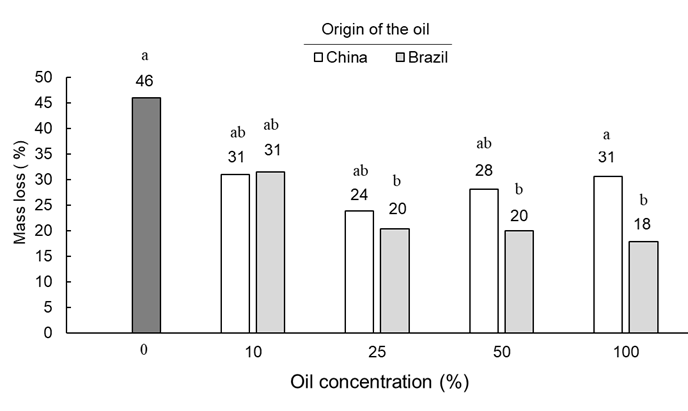
Pinus wood treatment with C. zizanioides essential oil produced in China and in Brazil reduced the wood’s mass loss caused by the action of xylophagous fungus R. placenta. However, this oils’ reduction efficiency changed depending on its origin and concentration. Therefore, all samples treated with the Chinese oil, at any adopted concentration, presented mass loss reduction statistically equivalent to that of fresh wood. On the other hand, samples treated with the Brazilian oil only recorded mass loss statistically equivalent to that of fresh wood at the concentration of 10%. The other treatments based on Brazilian oil at concentrations of 25%, 50% and 100% recorded significant reduction in comparison to the control (Figure 1).
Different letters, between bars, express statistically significant differences (Dunn, 5% significance level).
Mean mass loss (%) of Pinus sp. wood treated with Chrysopogon zizanioides oil produced in China and in Brazil, at four concentrations, subjected to the action of xylophagous fungus Rhodonia placenta, for four months, under laboratory conditions.
Fresh Pinus wood was classified as non-resistant to the action of R. placenta. However, it was classified as moderately resistant when it was treated with the Chinese C. zizanioides essential oil under all tested conditions; the same outcome was only observed for the treatment with Brazilian oil at concentration of 10%. The remarkable resistance to the fungus’ action was observed for samples subjected to treatment with Brazilian oil at concentrations of 25%, 50% and 100%, which allowed classifying the Pinus wood as resistant to R. placenta (Table 2).
Mean wood mass loss percentage and strength class of Pinus sp. wood treated with Chrysopogon zizanioides oil produced in China and in Brazil, at four concentrations and subjected to the action of xylophagous fungus Rhodonia placenta, for four months.
The GC-MS analysis applied to the Brazilian and Chinese oils showed different compositions between major components (Table 3 and Table 4).
The Brazilian oil chemical composition shows the typical presence of oil extracted from C. zizanioides. Its main markers are khusimol (18.8%), β-vetivone (5.1%), vetiselinenol (6.4%) and β-vetisperene (0.4%). The major components found at concentrations higher than 5% were khusimol (18.8%), α-vetivone (10.7%), nootkatone (6.6%), vetiselinenol (6.4%), cubenol (6.4%) and β-vetivone (5.2%) (Figure 2).
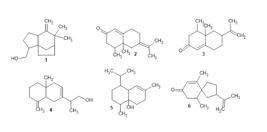
Major chemical components found in the sample of Chrysopogon zizanioides essential oil produced in Brazil: khusimol (1), α-vetivone (2), nootkatone (3), vetiselinenol (4), cubenol (5) and β-vetivone (6).
The following elements stood out in the hydrocarbon fraction of the Brazilian sample: α-muurolene (2.3%), khusimene (0.6%), β-vetisperene (0.4%) and prezizaene (0.4%). The extract presented one fraction rich in alcohols, namely: khusimol (18.8%), vetiselinenol (6.4%), cubenol (6.6%), E-isovalencenol (2.7%), selin-6-en-4α-ol (2.6%), junenol (2.0%), β-eudesmol (1.3%), zizanol (1.3%) and alocedrol (3.4%). Ketones such as α-vetivone (10.7%), nootkatone (6.6%), β-vetivone (5.2%), khusimone (1.9%) and epizyzanone (1.9%) were also identified among the oxygenate compounds.
The composition of the Chinese oil mainly counted on hydrocarbons. The major components identified in it were isopropyl myristate (38.8%), cis-thujopsene (9.8%), β-funebrene (3.6%), 2-methyltetradecane (1.7%), cedrol (4.5%) and pachoulol (2.7%).
DISCUSSION
C. zizanioides essential oil fungicidal property against fungus R. placenta in vitro was proven by Soidrou et al. (2013), according to whom, concentrations of 1%, 0.4%, 0.2%, 0.1%, 0.05%, 0.03% and 0.02% fully inhibited the fungus’ development. Based on this relevant outcome, Soidrou et al. (2013) raised the hypothesis that this oil can provide fungal resistance when it is incorporated right into the wood, and their finding was corroborated by Pinus sp. wood’s behavior under the action of R. placenta observed in the current study.
Results have shown that this fungal resistance’s contribution was less significant when the Chinese oil was applied to the wood in comparison to the treatment based on the application of the Brazilian oil. Therefore, it is worth clarifying that, although the wood treatment with Chinese oil did not lead to significant reduction in mass loss in comparison to the control, it is worth noticing that this treatment allowed classifying the wood as partially resistant to R. placenta, according to criteria by AWPA E30-16, 2016. The fresh wood and that treated with the Brazilian oil were classified as non-resistant and resistant, respectively. Therefore, both the Chinese and the Brazilian oils gave fungal resistance to the wood, but at different efficiency rates. This finding can be justified by these oils’ different chemical compositions.
Reports, such as those by Dubey et al. (2010), have shown the greater efficacy of the C. zinanoides oil produced in Southern India against fungus Rhizoctonia solani in comparison to oil produced in the Northern region of this country. This outcome evidences that variations in antifungal activity can be influenced by the plants’ geographical origin. The different chemical profile shown by this oil, when it is produced in different regions, was presented by Pandey e Tiwari (2024). Their finding corroborates information provided earlier in this section. They reported that samples from China, Turkey, Comoros, Brazil, India, Thailand, Taiwan, Egypt and Indonesia presented the following amount of compounds: 11, 26, 34, 13, 18, 35, 23, 36 and 37, respectively. According to them, this difference results from factors such as climate, soil, altitude and C. zizanioides irrigation conditions, cultivation techniques and harvest time, as well as oil extraction method. All these variables can significantly change plants’ chemical profile.
Therefore, reports by Dubey et al. (2010) and Pandey e Tiwari (2024) allow assuming that plants’ geographical origin could have had negative influence on the efficiency of the Chinese oil in inhibiting fungus R. placenta. Nevertheless, although both oils were pure and extracted through C. zizanioides roots’ hydrodistillation, the chromatographic analysis pointed towards the hypothesis that chemical composition differences derived from the manufacturing process rather than from the different geographical origin of plants used as raw material. This understanding is mainly supported by the isopropyl myristate (38.8%) mainly found in the Chinese oil, which is an ester derived from myristic acid and isopropyl alcohol widely used in cosmetic and pharmaceutical formulations. Unlike the already mentioned sesquiterpenes, this compound is not found in natural vegetal oils (Opdyke, 1976). Cebi et al. (2020) explained that isopropyl myristate compromises essential oils’ purity and authenticity, since it highlights adulterations aimed at reducing production costs. According to them, these adulterations can change oils’ natural properties. Therefore, the detection of this compound demands assessing the essential oil’s authenticity.
Furthermore, the Chinese oil presented sesquiterpenes characteristic of C. zizanioides root extracts such as cis-thujopsene (Gautam e Agrawa 2021), cedrol (Filippi et al., 2013) and pachoulol (Oliveira et al., 2022). However, this species extracts’ typical markers are khusimol, β-vetivone, vetiselinenol and β-vetisperene, and they were not detected. The Brazilian oil showed khusimol alcohol concentration slightly above the average often recoded for this compound (3.4% - 13.7%). On the other hand, sesquiterpene β-vetisperene (0.4%) rate was below the average (1.6% - 4.5%). Alcohol vetiselinenol (6.4%) and the ketone β-vetivone (5.2%) rates were within the average range reported in the literature (1.3% – 7.8% and 2.5% – 6.3%, respectively) (Champagnat et al., 2006).
Results pointed towards different chemical composition between the two oils, and it highlights the greater efficiency of the Brazilian oil in comparison to the Chinese one when it comes to giving Pinus wood fungal resistance. This finding can be closely related to the presence of three major compounds, namely: khusimol (18.6%), α-vetivone (10.7%) and E-isovalencenol alcohol (2.7%), which were not found in the Chinese oil. Powers et al. (2018) and Soidrou et al. (2013) corroborated this information.
According to Powers et al. (2018), C. zizanioides essential oil presented antifungal activity, mainly against Aspergillus niger, Candida albicans and Cryptococcus neoformans. They indicated that such an activity can be partially attributed to the presence of the following major extract constituents: (E)-isovalencenol (13.5%), khusimol (12.1%) and α-vetivone (5.4%). Soidrou et al. (2013) argued that C. zizanioides essential oil rich in khusimol (25.6%), α-vetivone (7.7%), bicyclo-vetivenol (11.4%), epi-α-cadinol (5.9%) and nootkatone (5.2%) inhibited the xylophagous fungi Gloeophyllum trabeum, R. placenta, Coniophora puteana and Coriolus versicolor. It is worth mentioning that the study by Powers et al. (2018) and that by Soidrou et al. (2013) showed the importance of khusimol and α-vetivone for fungal activity performance.
Despite evidence in the literature and in results of studies on the action of these specific compounds in fungal inhibition, the hypothesis that other compounds may have synergistically contributed to this inhibition cannot be ruled out. This assumption becomes feasible if one bears in mind that C. zizanioides essential oil has a complex chemical composition (Davi, et al., 2023). Broda (2020) makes it clear that essential oils’ antifungal efficacy often results from the combination of several compounds that can synergistically act to enhance the effect of each other. Furthermore, if one takes into account that khusimol and α-vetivone were not detected in the composition of the Chinese oil, and that antifungal activity was also noticed, although it was less significant, it is possible assuming that other compounds may have given this property to this oil.
Accordingly, compounds cis-thujopsene and cedrol found in the Chinese oil at concentrations of 9.8% and 4.5%, respectively, reinforced the aforementioned hypothesis. Therefore, they are major constituents of this oil and they may have played this role. Thus, Liu et al. (2019) observed that the Platycladus orientalis heartwood extract showed significant inhibitory effects on xylophagous fungi, which is accountable for white rot (Ipex lactenus) and brown rot (Gloeophyllus trabeum). This finding can be justified by the fact that this extract is mainly composed of cis-thujopsene and cedrol.
However, although it is not possible pinpointing the exact mechanism involved in R. placenta development’s inhibition by C. zizanioides essential oil, it is known that essential oils hold compounds that interact with cell membrane, change its permeability and lead to cell lysis (Wozniak, 2022). They reported that these compounds can interfere with the cell wall essential components synthesis and, consequently, impair cell wall ability to absorb nutrients.
It is worth noticing that, despite C. zizanioides essential oil property in giving fungal resistance to Pinus wood, Broda (2020) explains that, for a natural product to be effectively used for this purpose, advanced research must be carried out to clarify several aspects, among them one finds compounds’ leaching and biodegradation under real wood use conditions; selective toxicity to different fungi species; and natural compounds/polymers combinations, in order to enhance the effect of the natural product.
According to Chaudhari et al. (2021), the main actions to improve essential oils’ efficacy, mainly its antifungal activity, include nanoencapsulation and nanoemulsion formulations. The aim of these approaches is to improve essential oils’ stability, water solubility, controlled release and persistence, as well as to overcome their limitations such as susceptibility to oxidation and low solubility, as mentioned by David et al. (2023), since those are C. zizanioides essential oil features. Broda (2020) and Chaudhari et al. (2021) considerations point out important research lines aimed at C. zinazoides oil and at optimizing its ability to protect wood against fungal deterioration processes.
CONCLUSIONS
Fresh pine wood is highly susceptible to wood-eating fungus R. placenta. However, it became resistant to this fungus under laboratory conditions, when it was treated with the Brazilian C. zizanioides essential oil at the following concentrations: 25%, 50% and 100%. On the other hand, it only became partially resistant when it was treated with the Chinese oil. The Brazilian oil has compounds typical of C. zizanioides, namely: khusimol, β-vetivone, vetiselinenol and β-vetisperene. The Chinese oil, in its turn, only holds few sesquiterpenes, among them, cis-thujopsene, cedrol and pachoulol. Its major component is isopropyl myristate, which does not have plant origin.
ACKNOWLEDGMENTS
We gratefully acknowledge support from Central Analítica Multiusuário (CAM-IQ-UFRRJ) and postgraduate program in Plant Health and Applied Biotechnology, at the Federal Rural University of Rio de Janeiro.
AUTHORSHIP CONTRIBUTION
Project Idea: HT
Funding: HT
Database: VJF; HT
Processing: VJF; CERS; HT
Analysis: VJF; CERS; HT
Writing: HT;
Review: VJF; CERS
Data Availability
The datasets analyzed during the current study are available from the corresponding author upon reasonable request.
REFERENCES
-
ABELLA, L.; CORTELLA, A. R.; VELASCO-NEGUERUELA, A.; et al. Ethnobotany, volatile oils and secretion tissues of Werneria poposa from Argentina. Pharmaceutical Biology, v. 38, n. 3, p. 197-203, 2000. https://doi.org/10.1076/1388-0209(200007)3831-sft197
» https://doi.org/10.1076/1388-0209(200007)3831-sft197 -
ADAMS, R. P.; HABTE, M.; PARK, S.; et al. Preliminary comparison of vetiver root essential oils from cleansed (bacteria-and fungus-free) versus non-cleansed (normal) vetiver plants. Biochemical Systematics and Ecology, v. 32, n. 12, p. 1137-1144, 2004. https://doi.org/10.1016/j.bse.2004.03.013
» https://doi.org/10.1016/j.bse.2004.03.013 -
ADAMS, R. P.; MORRIS, J. A.; PANDEY R. N.; et al. Cryptic speciation between Juniperus deltoides and Juniperus oxycedrus (Cupressaceae) in the Mediterranean. Biochemical Systematics and Ecology, v. 33, n. 8, p. 771-787, 2005. https://doi.org/10.1016/j.bse.2005.01.001
» https://doi.org/10.1016/j.bse.2005.01.001 - AMERICAN WOOD PROTECTION ASSOCIATION STANDARD. AWPA E10-16. Laboratory method for evaluating the decay resistance of wood-based materials against pure basidiomycete cultures: soil/block test. EUA: AWPA, 2016.
- AMERICAN WOOD PROTECTION ASSOCIATION STANDARD. AWPA E30-16. Standard method for evaluating natural decay resistance of wood using laboratory decay tests. EUA: AWPA, 2016.
- APPEL, J. S. L.; TERESCOVA, V.; RODRIGUES, V. C. B.; et al. Aspectos toxicológicos do preservativo de madeira CCA (arseniato de cobre cromatado): revisão. Revista Brasileira de Toxicologia, v. 19, n. 1, p. 33-47, 2006.
-
BRODA, M. Natural compounds for wood protection against fungi—A review. Molecules, v. 25, n. 15, p. 3538, 2020. https://doi.org/10.3390/molecules25153538
» https://doi.org/10.3390/molecules25153538 -
CARDEAL, Z. D. L.; SILVA, M. D. R. G.; MARRIOTT, P. J. Comprehensive two‐dimensional gas chromatography/mass spectrometric analysis of pepper volatiles. Rapid Communications in Mass Spectrometry, v. 20, n. 19, p. 2823-2836, 2006. doi: 10.1002/rcm.2665.
» https://doi.org/10.1002/rcm.2665 -
CEBI, N.; TAYLAN, O.; ABUSURRAH, M.; et al. Detection of orange essential oil, isopropyl myristate, and benzyl alcohol in lemon essential oil by ftir spectroscopy combined with chemometrics. Foods, v. 10, n. 1, p. 27, 2020. https://doi.org/10.3390/foods10010027
» https://doi.org/10.3390/foods10010027 -
CHAMPAGNAT, P.; FIGUEREDO, G.; CHALCHAT, J. C.; et al. Study on the composition of commercial Vetiveria zizanioides oils from different geographical origins. Journal of Essential Oil Research, v. 18, n. 4, p. 416-422, 2006. https://doi.org/10.1080/10412905.2006.9699129
» https://doi.org/10.1080/10412905.2006.9699129 -
CHAUDHARI, A. K.; SINGH, V. K.; KEDIA, A.; et al. Essential oils and their bioactive compounds as eco-friendly novel green pesticides for management of storage insect pests: Prospects and retrospects. Environmental Science and Pollution Research Internacional, v. 28, n. 15, p. 18918-18940, 2021. https://doi.org/10.1007/s11356-021-12841-w
» https://doi.org/10.1007/s11356-021-12841-w -
CRUZ-LOPES, L.; SELL, M.; LOPES, R.; et al. Enhancing Pinus pinaster Wood Durability Through Citric Acid Impregnation. Sustainability, v. 17, n. 5, p.1979, 2025. https://doi.org/10.3390/su17051979
» https://doi.org/10.3390/su17051979 -
DAVID, A.; FĂRCAȘ, A.; SOCACI, S. A. An overview of the chemical composition and bioactivities of Vetiveria zizanioides (L.) Nash essential oil. Trends in Food Science e Technology, v. 140, p. 104153, 2023. https://doi.org/10.1016/j.tifs.2023.104153
» https://doi.org/10.1016/j.tifs.2023.104153 - DUBEY, N.; RAGHAV, C. S.; GUPTA, R. L.; et al. Chemical composition and antifungal activity of vetiver oil of North and South India against Rhizoctonia solani. Pesticide Research Journal, v. 22, n. 1, p. 63-67, 2010.
- DUQUESNOY, E.; DINH, N. H.; CASTOLA, V.; et al. Chemical composition and antifungal activity of vetiver oil of North and South India against Rhizoctonia solani. Flavour and Fragrance Journal, v. 21, n. 3, p. 453-457, 2006.
-
FILIPPI, J.J.; BELHASSEN, E.; BALDOVINI, N.; et al. Qualitative and quantitative analysis of vetiver essential oils by comprehensive two-dimensional gas chromatography and comprehensive two-dimensional gas chromatography/mass spectrometry. Journal of Chromatography A, v. 1288, p. 127-148, 2013. https://doi.org/10.1016/j.chroma.2013.03.002
» https://doi.org/10.1016/j.chroma.2013.03.002 -
GAUTAM, M.; AGRAWAL, M. Application potential of Chrysopogon zizanioides (L.) Roberty for the remediation of red mud-treated soil: an analysis via determining alterations in essential oil content and composition. International Journal of Phytoremediation, v. 23, n. 13, p. 1356-1364, 2021. https://doi.org/10.1080/15226514.2021.1896474
» https://doi.org/10.1080/15226514.2021.1896474 -
HAZZIT, M.; BAALIOUAMER, A.; FALEIRO, M. L.; et al. Composition of the essential oils of Thymus and Origanum species from Algeria and their antioxidant and antimicrobial activities. Journal of Agricultural and Food Chemistry, v. 54, n. 17, p. 6314-6321, 2006. https://doi.org/10.1021/jf0606104
» https://doi.org/10.1021/jf0606104 - KAHRIMAN, N.; TOSUN, G.; TERZIOGLU, S.; et al. Chemical composition and antimicrobial activity of the essential oils from the flower, leaf, and stem of Senecio pandurifolius. Records of Natural Products, v. 5, n. 2, p. 82, 2011.
-
KOBAISY, M.; TELLEZ, M. R.; DAYAN, F. E.; et al. Phytotoxicity and volatile constituents from leaves of Callicarpa japonica Thunb. Phytochemistry, v. 61, n. 1, p. 37-40, 2002. doi: 10.1016/s0031-9422(02)00207-8
» https://doi.org/10.1016/s0031-9422(02)00207-8 - LEPAGE, E.; SALIS, A. G.; GUEDES, E. C. R. Tecnologia de proteção da madeira. São Paulo: Montana Química, 2017. 225 p.
-
LIMA, G. M.; QUINTANS-JÚNIOR, L. J.; THOMAZZI, S. M.; et al. Phytochemical screening, antinociceptive and anti-inflammatory activities of Chrysopogon zizanioides essential oil. Revista Brasileira de Farmacognosia, v. 22, n. 2, p. 443-450, 2012. https://doi.org/10.1590/S0102-695X2012005000002
» https://doi.org/10.1590/S0102-695X2012005000002 -
MARIANO, L. G.; CARVALHO, A. G. D.; TREVISAN, H.; et al. Identification and control of wood-deteriorating fungi. Arquivos do Instituto Biológico, v. 87, p. e0082020, 2020. https://doi.org/10.1590/1808-1657000082020
» https://doi.org/10.1590/1808-1657000082020 -
MARTÍN, J. A.; LÓPEZ, R. Biological deterioration and natural durability of wood in Europe. Forests, v. 14, n. 2, p. 283, 2023. https://doi.org/10.3390/f14020283
» https://doi.org/10.3390/f14020283 -
MASSARDO, D. R.; SENATORE, F.; ALIFANO, P.; et al. Vetiver oil production correlates with early root growth. Biochemical Systematics and Ecology, v. 34, n. 5, p. 376-382, 2006. https://doi.org/10.1016/j.bse.2005.10.016
» https://doi.org/10.1016/j.bse.2005.10.016 -
NGASSOUM, M. B.; OUSMAILA, H.; NGAMO, L.T.; et al. Aroma compounds of essential oils of two varieties of the spice plant Ocimum canum Sims from northern Cameroon. Journal of Food Composition and Analysis, v. 17, n. 2, p. 197-204, 2004. https://doi.org/10.1016/j.jfca.2003.08.002
» https://doi.org/10.1016/j.jfca.2003.08.002 -
NIST (2008) National Institute of Standards and Technology. Mass Spectral Library (NIST/EPA/NIH). Available at: https://www.nist.gov/programs-projects/electron-ionization-library-component-nistepanih-mass-spectral-library-and-nist-gc Accessed in: July 07 2025.
» https://www.nist.gov/programs-projects/electron-ionization-library-component-nistepanih-mass-spectral-library-and-nist-gc -
OLIVEIRA, T. A.; VIEIRA, T. M.; ESPERANDIM, V. R.; et al. Antibacterial, antiparasitic, and cytotoxic activities of chemical characterized essential oil of Chrysopogon zizanioides roots. Pharmaceuticals, v. 15, n. 8, p. 967, 2022. https://doi.org/10.3390/ph15080967
» https://doi.org/10.3390/ph15080967 - OPDYKE, D. L. J. Fragrance raw materials monographs. Isopropyl myristate. Food Cosmet Toxicol, v. 14, p. 323-325, 1976.
- PANDEY, A.; TIWARI, S. C. A. Review on Chemical Composition, Oil Quality, and Bioactivity of Vetiver Essential Oil. Indian Journal of Pharmaceutical Sciences, v. 86, n. 4, p.1176-1186, 2024.
-
PFAFF, P.; MOUHIB, H.; KRAFT, P. Challenging the Molecular Parameters of Vetiver: Can 4, 5‐Dimethyl‐3‐(3′‐methylbut‐1′‐en‐2′‐yl)‐4‐phenylcyclopent‐2‐en‐1‐one Mimic Zizaenones in Structure and Odor? European Journal of Organic Chemistry, v. 2029, n. 15, p. 2643-2652, 2019. https://doi.org/10.1002/ejoc.201900163
» https://doi.org/10.1002/ejoc.201900163 - POWERS, C. N.; OSIER, J. L.; MCFEETERS, R. L.; et al. Antifungal and cytotoxic activities of sixty commercially-available essential oils. Molecules, v. 23, n. 7, p. 1549, 2018. 10.3390/molecules23071549
- PRIPDEEVECH, P.; SAANSOOMCHAI, J. Antibacterial activity and chemical composition of essential oil and various extracts of Fagraea fragrans Roxb. flowers.Chiang Mai Journal of Science, v. 40, n. 2, p. 214-223, 2013.
-
SANTOS, C. E.; CANDATEN, L.; DA SILVA, P. R. B.; et al. Madeira preservada com CCA: proficuidade, potencial deletério, toxicidade dos resíduos e tecnologias de recuperação. Revista em Agronegócio e Meio Ambiente, v. 15, n. 1, p. 153-166, 2022. https://doi.org/10.17765/2176-9168.2022v15n1e8871
» https://doi.org/10.17765/2176-9168.2022v15n1e8871 -
SCHWOB, I.; BESSIERE, J. M.; MASOTTI, V.; et al. Changes in essential oil composition in Saint John’s wort (Hypericum perforatum L.) aerial parts during its phenological cycle. Biochemical systematics and ecology, v. 32, n. 8, p. 735-745, 2004. https://doi.org/10.1016/j.bse.2003.12.005
» https://doi.org/10.1016/j.bse.2003.12.005 -
SOIDROU, S. H.; FARAH, A.; SATRANI, B.; et al. Fungicidal activity of four essential oils from Piper capense, Piper borbonense and Vetiveria zizanoides growing in Comoros against fungi decay wood. Journal of Essential Oil Research, v. 25, n. 3, p. 216-223, 2013. https://doi.org/10.1080/10412905.2013.767758
» https://doi.org/10.1080/10412905.2013.767758 -
SOUSA, T. C. D. A.; DA CUNHA, W. M.; ROSAS, A. L. G.; et al. Essential oils as natural sources for the control of Botrytis cinerea: Chemical composition and antifungal effect. Food Bioscience, v. 62, p. 105516, 2024. https://doi.org/10.1016/j.fbio.2024.105516
» https://doi.org/10.1016/j.fbio.2024.105516 - STEIN, S. E. NIST 1. NIST/EPA/NIH Mass Spectral LibraryNIST'98 ASCII Version. 2008.
-
SUÁREZ, A. I.; VÁSQUEZ, L. J.; MANZANO, M. A.; et al. Essential oil composition of Croton cuneatus and Croton malambo growing in Venezuela. Flavour and Fragrance Journal, v. 20, n. 6, p. 611-614, 2005. https://doi.org/10.1002/ffj.1498
» https://doi.org/10.1002/ffj.1498 - TREVISAN, H.; DE SOUZA, T. S.; DA ROCHA, N. F.; et al. Reflexões sobre o ensino em proteção e deterioração de madeiras nos cursos de Engenharia Florestal do Brasil. In: De OLIVEIRA, R. J. Engenharia florestal: desafios, limites e potencialidade. Editora Científica Digital, 2020. p. 731-758.
- VERMA, A. B. Vetiveria zizanioides (L.) Nash: A review of magic grass. Journal of Medicinal Plants Studies, V. 8, n 1. p. 58-61, 2020.
- VISWANATHAN, M. B.; MARIDASS, M. U. T. H. I. A. H.; THANGADURAI, D. E. V. A. R. A.J.A.N.; et al. Chemical constituents of the fruit essential oil of Diospyros malabarica (Desr.) Kostel (Ebenaceae). Acta Pharmaceutica-Zagreb, v. 52, n. 3, p. 207-212, 2002.
-
WEYERSTAHL, P.; MARSCHALL, H.; WOLF, D. Constituents of commercial Brazilian Cabore oil. Flavour and fragrance journal, v. 13, n. 2, p. 85-86, 1998. https://doi.org/10.1002/(SICI)1099-1026(199803/04)13:2<85::AID-FFJ697>3.0.CO;2-9
» https://doi.org/10.1002/(SICI)1099-1026(199803/04)13:2<85::AID-FFJ697>3.0.CO;2-9 -
WOŹNIAK, M. Antifungal agents in wood protection—A review. Molecules, v. 27, n. 19, p. 6392, 2022. https://doi.org/10.3390/molecules27196392
» https://doi.org/10.3390/molecules27196392 -
YUPING, Z. H. A. O.; JIMING, L. I.; YAN, X. U.; et al. Extraction, preparation and identification of volatile compounds in Changyu XO brandy. Chinese Journal of Chromatography, v. 26, n. 2, p. 212-222, 2008. https://doi.org/10.1016/S1872-2059(08)60014-0
» https://doi.org/10.1016/S1872-2059(08)60014-0