Effect of surfactant admixture on alkali-activated pastes
Abstract
Alkali-activated binders represent a promising alternative for reducing the high carbon dioxide emissions associated with the cement industry. However, the influence of chemical admixtures on the workability of these materials remains insufficiently explored. This study aimed to evaluate the effect of surfactant admixtures on alkali-activated pastes composed of fly ash, basic oxygen furnace (BOF) steel slag, sodium hydroxide, and sodium silicate. Workability was assessed using the Kantro mini-slump test, alongside measurements of setting time and compressive strength. The polycarboxylate-based admixture (ADT1) and the sulfonated salt-based admixture (ADT2) improved the consistency of the material, with optimal dosages of 3% for ADT1 and 5% for ADT2, resulting in increases in mini-slump spread of 18% and 25%, respectively. The initial setting time was reduced by up to 50 minutes with the use of 5% ADT2, acting as an accelerator, while 3% of ADT1 presented a lower impact on setting time. However, compressive strength decreased by 33% with ADT1 and 27% with ADT2. Overall, ADT2 yielded better performance across all evaluated properties compared to ADT1.
Keywords:
Alkali-activated pastes; Surfactant admixtures; Mini-slump test; Yield stress; Compressive strength
INTRODUCTION
Portland cement remains the primary binding material used in the production of mortar and concrete. According to the Cement Industry Union1, Brazil produced approximately 63.5 million tons of Portland cement in 2022. However, its manufacturing process is inherently associated with significant carbon dioxide (CO2) emissions and the intensive consumption of non-renewable raw materials. In light of these environmental challenges, extensive research has been devoted to developing alternative materials capable of partially or completely replacing Portland cement. Among the alternatives explored, alkali-activated cements have emerged as a promising solution for reducing the environmental impact of the cement industry, especially in regions where suitable raw materials, such as industrial by-products, are readily available. Studies have shown that concrete produced with alkali-activated binders can reduce CO2 emissions by 40% to 80% compared to conventional Portland cement-based systems2.
Alkali-activated cements are produced by combining aluminosilicate-rich powdered materials, known as precursors, with alkaline activators to form a binding matrix. The primary reaction product is a gel whose structure ranges from amorphous to semi-crystalline3. This technology offers several advantages, including significant reductions in carbon dioxide (CO2) emissions and the valorization of industrial by-products. As emphasized by Provis4, alkali-activated materials hold substantial potential for applications in civil infrastructure and other areas of the construction industry. Nonetheless, ensuring environmental sustainability remains a key challenge, underscoring the importance of continued development and implementation of these alternative binders.
Waste materials such as blast furnace slag and fly ash are commonly used in the production of alkali-activated cements5), (6. These materials have garnered significant attention from the scientific community in recent years, with research efforts aimed at systematically evaluating their properties to determine their suitability for use in concrete and mortar. Such studies seek to encourage the utilization of these residues by valorizing them as industrial by-products7), (8), (9. Alkali-activated pastes, mortars, and concretes have demonstrated excellent performance in terms of mechanical strength, as well as resistance to carbonation, chemical attack, and high temperatures. In addition, these materials exhibit low shrinkage and permeability, contributing to their classification as highly durable construction materials10), (11), (12), (13),.
Fly ash is already widely used as a supplementary material in Portland cement formulations and also serves as an effective precursor for the production of alkali-activated cements. Additionally, less conventional waste materials, such as basic oxygen furnace (BOF) steel slag, can also be employed for this purpose14. BOF steel slag is a by-product generated during the steel refining process in oxygen converters15) and is produced on a large scale in Brazil. In 2020 alone, over 34 million tons of BOF slag were generated, with the state of Ceará accounting for approximately 2.8 million tons16. This high production volume leads to substantial waste accumulation, much of which remains unallocated and is stockpiled without being repurposed in other industrial processes17. In the Metropolitan Region of Fortaleza (RMF), the steel industry generates between 100 and 150 kilograms of steel slag for every ton of liquid steel processed18. Although this industrial facility was recently acquired by a major multinational corporation, its production infrastructure has been preserved, indicating that the volume and proportion of waste generation are likely to remain stable.
Costa, Nogueira, and Cabral17, as well as Araújo et al.19, successfully produced alkali-activated pastes, mortars, and concretes with compressive strengths ranging from 25 MPa to 80 MPa using mixtures of BOF steel slag and fly ash sourced from the Metropolitan Region of Fortaleza (RMF). However, the workability of these compositions varied depending on adjustments to mix design parameters, such as the alkali content and the silica modulus of the alkaline activators. Such variability in performance is frequently reported in the literature5.
In Portland cement-based materials, the use of surfactant admixtures - such as plasticizers and superplasticizers - to control workability is well established20),. In contrast, the application of chemical admixtures to alkali-activated systems remains an active area of research, as these materials are still in the early stages of scientific and technological development21), (22), (23),. Existing studies have often reported results that contradict the intended effects of chemical admixtures in alkali-activated systems. In formulations based on blast furnace slag and fly ash, significant reductions in setting time and decreased workability of mortars and concretes have been observed24. However, when comparing the performance of polycarboxylate-based superplasticizers with those based on naphthalene, delayed setting times and improved workability were reported for slag-fly ash mortars25.
Keulen et al.26 reported that the compressive strength of concrete made with blast furnace slag and fly ash increased with the dosage of a polycarboxylate-based superplasticizer, reaching an optimum range between 3 and 4 kg/m3. These findings indicate that admixtures can produce not only the intended rheological effects but also unintended consequences, as demonstrated by improvements and inconsistencies documented in the literature27. For instance, reductions in workability24, along with changes in setting time and compressive strength, have been reported. Both acceleration24 and retardation28 of setting time have been observed in alkali-activated systems. Likewise, mechanical performance results have been inconsistent, with studies reporting both increases26 and decreases in compressive strength28), (29), (30.
Several explanations have been proposed to account for the observed reductions in mechanical strength associated with the use of surfactant admixtures. Keser, Ramyer, and Gültekin31 attribute the decline to the additional water incorporated by the admixture, which may compromise the integrity of the matrix. In contrast, Hita and Criado28 suggest that the chemical instability of the admixtures and their incompatibility with alkaline activators are contributing factors. Furthermore, some evidences indicate that calcium content in the precursors plays a significant role in the effectiveness of surfactant admixtures, with better performance typically reported for mixtures with higher calcium content32), (33), (34.
The effectiveness of surfactant admixtures in alkali-activated binders is influenced by several factors, including the chemical composition of the admixtures, the type of alkaline activator, and the characteristics of the precursors23. Moreover, the interactions among these parameters lead to varying outcomes in the performance of surfactant admixtures. As a result, there is currently no established consensus regarding their use in alkali-activated systems. In particular, their effects on mixtures containing steelmaking residues such as basic oxygen furnace (BOF) slag - especially in binary systems with fly ash - remain largely unexplored. Therefore, the primary objective of this study is to investigate the influence of surfactant admixtures on the fresh-state properties and mechanical performance of alkali-activated pastes formulated with fly ash and BOF slag from the Metropolitan Region of Fortaleza, using a combination of sodium silicate and sodium hydroxide as alkaline activators.
MATERIALS AND METHODS
The fly ash originated from the thermoelectric complex of Pecém, while the BOF slag was sourced from the steelmaking complex of Pécem, held by ArcelorMittal (Figure 1b), with materials collected in 2022. Additional materials used in this study included sodium hydroxide (NaOH), sodium silicate (Na2SiO3), water, and surfactant admixtures from two distinct categories.

The collected BOF slag was processed through comminution using a Los Angeles abrasion machine, followed by grinding in a ball mill for 3 h, and subsequently sieved through a No. 100 mesh (150 µm). The fly ash was used as received, without any granulometric modification. The density and specific surface area of the precursors were 2.34 g/cm3 and 4790 cm2/g for fly ash, and 2.34 g/cm3 and 3360 cm2/g for BOF slag, respectively. These parameters were determined in accordance with the procedures outlined in ABNT NBR 1660535 and ABNT NBR 1637236. The chemical composition of the materials was determined by X-ray fluorescence (XRF) using a Rigaku ZSX Mini II spectrometer, with the results presented in Table I.
The alkaline activators used in this study were sodium hydroxide (NaOH), with a purity of 97.9%, and sodium silicate (Na2SiO3), with a silica modulus (SiO2/Na2O) of 2.21; both were supplied by Gota Química. The specific densities of the activator solutions were 1.30 g/cm3 for sodium silicate and 1.58 g/cm3 for sodium hydroxide. The sodium hydroxide solution, prepared with distilled water at a concentration of 10 mol/L, was mixed at least 24 h prior to paste production to ensure thermal equilibrium and complete dissolution.
Two commercial chemical admixtures commonly used in Portland cement-based concretes were evaluated. The first (ADT1) is a high-performance superplasticizer based on polycarboxylate ether polymer technology, with a density of 1.12 kg/L. Its recommended dosage - established for Portland cement systems - ranges from 0.2% to 0.5% by binder mass. The second admixture (ADT2) is a plasticizer composed of sulfonated salts and carbohydrates in aqueous solution, primarily lignosulfonates. This product has a density of 1.06±0.02 kg/L, is chloride-free, and has a pH between 6 and 7. Its solid content is 9.5±1.0%, and the recommended dosage is 1 liter per 50 kg of cement, equivalent to approximately 2% by binder mass.
To prepare the alkali-activated pastes, the following fixed mixing parameters were adopted: a silica modulus (SiO2/Na2O) of 1.25, an alkali content (Na2O as a percentage of the total precursor mass) of 8%, and a 50:50 mass ratio of fly ash to BOF steel slag19. While these parameters remained constant, the type and dosage of admixtures were varied at 1%, 3%, and 5% by binder mass, resulting in a total of seven distinct alkali-activated paste compositions. A summary of the mixing parameters is presented in Table II.
Initially, the components were manually mixed for 1 min to promote preliminary homogenization. This was followed by mechanical mixing in a planetary mortar mixer at a low speed of 62±5 rpm for 1 min and 30 s. A 1-min resting period was then observed to ensure proper incorporation of the surfactant admixture. Mechanical mixing was subsequently resumed for an additional 1 min and 30 s using the same equipment.
In the fresh state, workability was evaluated using the Kantro mini-slump test, commonly referred to as the mini-slump test37, while setting time was determined in accordance with the procedures outlined in ABNT NBR 1660738. In the hardened state, compressive strength was assessed using cubic specimens measuring 40 mm per side. The pastes were cured under ambient conditions, and testing was conducted at 7 and 28 days. Three specimens were tested for each age. Following demolding, the specimens were immediately sealed in plastic bags to minimize moisture loss.
Based on the mini-slump test results, the flow stress was estimated using Equation 1. This property represents the minimum shear stress required to initiate flow in non-Newtonian fluids, such as those exhibiting Bingham-like behavior. The method for estimating flow stress from the spreading diameter, specific mass, and volume of the truncated cone was originally proposed by Roussel and Coussot39, and later validated for alkali-activated binders by Tan, Bernal, and Provis40.
Where, τ0: yield stress (Pa); ρ: bulk density (kg/m3); g: acceleration due to gravity (9.81 m/s2); Ω: mini-slump volume (m3); R: spreading radius (m).
RESULTS AND DISCUSSION
Mini-slump spreading test
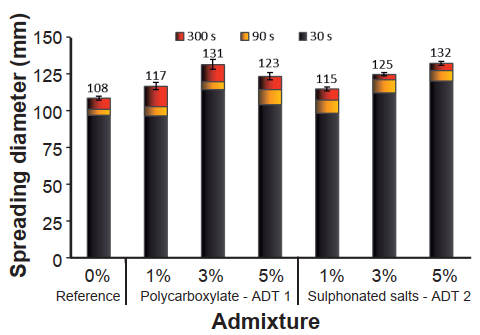
Figure 2 presents the mini-slump test results for the alkali-activated pastes incorporating Type 1 and Type 2 surfactant admixtures. Figure 2 shows the spreading diameter measured at successive time intervals (in seconds) for each paste composition. This analysis provides insight into the fresh-state behavior of the materials, highlighting the influence of the admixtures on workability and flow characteristics.

The incorporation of 1% of the polycarboxylate-based superplasticizer (ADT1) led to a moderate increase in the spreading diameter. This effect was not apparent at the beginning of the test but became noticeable after 300 s, resulting in a 7% increase compared to the reference paste.
In contrast, a more pronounced effect was observed with a 3% dosage of ADT1. In this case, the spreading diameter increased from the first measurement, culminating in an 18% gain after 300 s - more than double the improvement achieved with the 1% dosage. However, at 5% ADT1, a slight reduction in spread was noted compared to the 3% dosage, although it remained 12% higher than the reference. These results suggest the presence of an optimal dosage for this admixture.
This behavior is consistent with findings in the literature, which indicate that superplasticizers reach a saturation point beyond which no further improvements in workability occur - and may even lead to performance degradation31), (41. Under the conditions tested, the optimal dosage for ADT1 appears to fall between 3% and 5% of the binder mass. Beyond this range, the admixture may lose effectiveness or negatively affect the paste’s rheology.
The admixture based on sulfonated salts and carbohydrates (ADT2) exhibited an even greater effect on workability. A clear increasing trend in spreading diameter was observed with rising dosages, reaching a 25% increase at the highest dosage tested - surpassing the maximum improvement achieved with ADT1. This trend is in line with previous studies; Rashad27 and Lee, Bui, and Tang42, for instance, reported comparable or even superior enhancements in the flowability of alkali-activated systems modified with lignosulfonate-based admixtures.
Unlike the behavior observed with ADT1, all tested dosages of ADT2 contributed to increased spreading diameter. Moreover, the greatest spread occurred at the highest dosage, suggesting no saturation point or performance plateau within the evaluated range.
Despite these increases, the improvements in spread for both ADT1 and ADT2 are relatively modest when compared to their performance in Portland cement-based systems. This limited effect may be partially attributed to the higher free water content associated with surfactant admixtures43, indicating that the observed workability improvements may not solely result from the admixtures themselves.
It is also important to emphasize that these admixtures were originally formulated for Portland cement-based materials. As such, their behavior in alkali-activated systems may differ significantly due to differences in chemical environment and reaction mechanisms.
The yield stresses of the alkali-activated pastes, estimated using Equation 1 and mini-slump results, are presented in Figure 4.
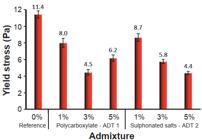
Yield stress of alkali-activated pastes calculated from the results of the mini-slump at 300 seconds.
The results presented in Figure 3 demonstrate a reduction in the yield stress of the material with the addition of both ADT1 and ADT2. Specifically, the yield stress decreased from 11.4 Pa in the reference paste to 6.2 Pa and 4.4 Pa for pastes containing 5% of ADT1 and ADT2, respectively. These values correspond to reductions of up to 60% in the yield stress due to the incorporation of surfactant admixtures.
The measured yield stress values, which ranged from 4.4 to 11.4 Pa, are consistent with those reported in the literature. For example, Tan, Bernal, and Provis32 and Lu et al.43 documented yield stress values between 1 and 75 Pa for alkali-activated binders. The relatively low values observed in this study suggest that these formulations may be suitable for use in self-compacting materials. However, further investigations into additional rheological parameters are necessary to confirm their applicability for such purposes.
Setting time
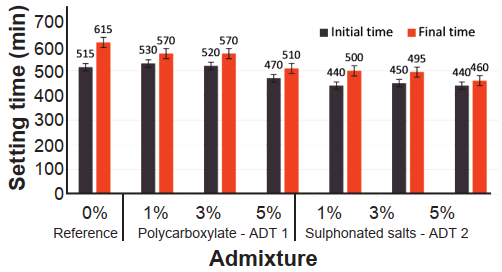
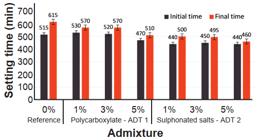
Figure 4 presents the results for the initial and final setting times of the pastes produced with surfactant admixtures of types 1 and 2.
As shown, the reference paste exhibited the longest setting time among the compositions analyzed. According to Figure 5, the incorporation of admixtures significantly influenced this property, generally accelerating the setting process. In most cases, an increase in admixture content corresponded to a decrease in both the initial and final setting times. Similar behavior was observed by21, who reported that the superplasticizer acted as a setting accelerator in alkali-activated systems. Conversely, Bong et al.34 found that the use of a superplasticizer increased both the initial and final setting times, highlighting the complex and system-dependent nature of these admixtures.

It is important to emphasize that the accelerating or retarding effects of chemical admixtures on setting time depend on multiple factors, including the chemical composition of precursors and alkaline activators, the molecular structure and stability of the admixtures, their dosage, the activator concentration, and the processing conditions44), (45. Therefore, no universally established trend has been confirmed in the literature for this property.
In this study, both ADT1 and ADT2 followed a trend of decreasing setting time with increasing dosage, with ADT2 producing the most significant reduction. The final setting time for the paste with 5% ADT2 was approximately 460 minutes - 55 min shorter than that of the paste containing 5% ADT1. A similar trend was also noted for initial setting time.
For comparison, high early strength Portland cements, such as CPV-ARI, typically exhibit initial and final setting times of around 3 to 4 h46, highlighting the extended setting periods associated with alkali-activated systems. Although prolonged setting time can be advantageous for ready-mix concrete applications - allowing for longer transportation and placement times - it also necessitates adjustments to production protocols. In particular, the transition from fresh to hardened state in alkali-activated binders involves changes in rheological behavior and safety considerations due to the presence of highly alkaline components. As a result, future industrial implementation may require process adaptations to ensure compatibility with operational and occupational safety standards.
3.1 Compressive Strength
In the hardened state, the mechanical performance of the alkali-activated pastes was assessed by means of compressive strength tests. Figure 5 shows the compressive strength results obtained at 7 and 28 days for each paste formulation incorporating different surfactant admixtures.
Firstly, Figure 5 demonstrates that extending the curing period from 7 to 28 days led to a consistent increase in compressive strength across all tested compositions. This behavior aligns with the expected evolution of alkali-activated binders, where hydration and polymerization processes continue over time, contributing to enhanced mechanical performance. The reference paste exhibited the highest compressive strength, with values of 29.0 MPa at 7 days and 49 MPa at 28 days. This increase in strength over time is typical for alkali-activated systems, as reported by Ding et al.47, who noted that strength gradually increases for samples cured at room temperature, as was the case in this study. Conversely, samples cured at elevated temperatures tend to show higher initial strengths but minimal gains over time. In general, strength improvements for alkali-activated binders based on fly ash and slag are more pronounced under ambient curing conditions than under thermal curing4), (9.
Furthermore, the results indicate a potential negative impact of incorporating ADT 1 and ADT 2 into the pastes, observed at both 7 and 28 days. As shown, the reference paste exhibited compressive strength exceeding 48 MPa. However, with increasing admixture content, a reduction in compressive strength was observed, reaching approximately 33% lower for ADT 1 and 27% lower for ADT 2 at a 5% admixture dosage. The higher the admixture content, the lower the paste’s compressive strength. Hita and Criado27 attribute this reduction in compressive strength in alkali-activated systems incorporating polycarboxylate-based admixtures to a chemical incompatibility between the admixture and the alkaline environment, with the interaction being strongly influenced by the type of activator used. On the other hand, Keser, Ramyar, and Gultekin31 suggest that the reduction in strength is due to the excess water introduced by the plasticizing admixture, particularly at higher dosages. Despite these hypotheses, there is no consensus in the literature regarding the underlying mechanisms, underscoring the need for further investigation.
Overall, it can be observed that the surfactant admixtures led to a reduction in compressive strength compared to the reference paste. This negative trend is consistent with findings in the literature. For instance, Bakharev, Sanjayan, and Cheng21 report similar reductions, suggesting that surfactant admixtures do not exert the same effects in alkali-activated mixtures as they do in Portland cement-based systems. The mechanisms through which surfactant admixtures affect alkali-activated mixtures remain unclear. In Portland cement-based systems, water plays a fundamental role in developing mechanical strength, and the use of surfactant admixtures can reduce water consumption, thereby improving mechanical strength. However, for alkali-activated systems, some authors argue that all water in the mixture serves primarily to homogenize the system and does not actively participate in the chemical reaction, eventually evaporating completely48), (49. Conversely, others propose that about 10% of the water participates in chemical reactions and does not evaporate50. Therefore, the water-reducing effects seen in Portland cement concretes were not as evident in geopolymer binders, with less pronounced gains in workability and strength. Consequently, the influence of admixtures on the mechanical properties of alkali-activated binders represents a significant research gap that warrants further exploration.
CONCLUSIONS
This study evaluated the effects of superplasticizer (ADT1) and plasticizer (ADT2) admixtures on the properties of alkali-activated pastes made from fly ash and BOF steel slag. The main findings are:
-
Workability: ADT1 improved paste workability, with the best result at 3% content, increasing the spreading diameter by 18%. At 5%, the increase dropped to 12%, indicating a saturation point around this dosage.
-
Flow Behavior: ADT2 also enhanced the spreading diameter, achieving up to a 25% improvement at 5% content. No saturation effect was observed within the tested range.
-
Setting Time: Both admixtures accelerated the setting time. ADT1 primarily reduced the final setting time, while ADT2 reduced both the initial and final setting times.
-
Alkali-activated Pastes Compressive Strength: The compressive strength increased over time in all mixtures, with the reference paste (without admixtures) showing the highest gain (from 29 MPa at 7 days to over 48 MPa at 28 days).
-
Adjuvant Effect on Compressive Strength: Higher contents of ADT1 and ADT2 led to a reduction in compressive strength, with reductions of 33% and 27%, respectively, compared to the reference paste.
In conclusion, while the use of additives commonly employed in Portland cement mixtures can enhance the fresh-state properties of alkali-activated pastes based on fly ash and BOF steel slag, they do not improve the compressive strength of these mixtures. Among the two admixtures tested, the plasticizer based on sulfonated salts (ADT2) yielded better results than the superplasticizer based on polycarboxylates (ADT1). Therefore, the selection of admixtures should be carefully considered depending on the specific properties required for the application.
ACKNOWLEDGEMENTS
The authors would like to thank the Civil Construction Materials Laboratories (LMCC) at the Federal University of Ceará for their support. The authors would also like to thank the National Council for Scientific and Technological Development (CNPq) for supporting projects 312817/2020-7, 409236/2022-5, and 308888/2020-0.
DATA AVAILABILITY
The data that support the findings of this study are available from the corresponding author, upon reasonable request.
REFERENCES
-
1 Sindicato Nacional da Indústria do Cimento (SNIC). Relatório Anual 2020 [Internet]. 2020 [citado 2023 set 19]. Disponível em: Disponível em: http://snic.org.br/assets/pdf/relatorio_anual/rel_anual_2020.pdf
» http://snic.org.br/assets/pdf/relatorio_anual/rel_anual_2020.pdf - 2 Favier A, Wolf C, Scrivener K, Guillaume H. A sustainable future for the European Cement and Concrete Industry: Technology assessment for full decarbonisation of the industry by 2050. École Polytechnique Fédérale de Lausanne; 2018.
- 3 Provis JL. Alkali-activated materials. Cem Concr Res. 2018; 114: 40-8.
-
4 Provis JL. Geopolymers and other alkali activated materials: Why, how, and what? Mater Struct. 2014; 47(1-2): 11-25. https://doi.org/10.1617/s11527-013-0211-5
» https://doi.org/10.1617/s11527-013-0211-5 -
5 Zhang P, Zheng Y, Wang K, Zhang J. A review of properties of fresh and hardened geopolymer mortar. Compos Part B Eng. 2018; 152: 79-95. https://doi.org/10.1016/j.compositesb.2018.06.031
» https://doi.org/10.1016/j.compositesb.2018.06.031 -
6 Xie T, Visintin P, Zhao X, Gravina R. Mix design and mechanical properties of geopolymer and alkali activated concrete: Review of the state-of-the-art and the development of a new unified approach. Constr Build Mater. 2020; 256: 119380. https://doi.org/10.1016/j.conbuildmat.2020.119380
» https://doi.org/10.1016/j.conbuildmat.2020.119380 -
7 Livi CN, Repette WL. Ligante geopolimérico produzido com cinza volante e hidróxido de sódio. Ambiente Construído. 2015; 15(3): 7-18. https://doi.org/10.1590/s1678-86212015000300022
» https://doi.org/10.1590/s1678-86212015000300022 - 8 Wijaya AL, Ekaputri JJ, Triwulan. Factors influencing strength and setting time of fly ash-based geopolymer paste. In: MATEC Web Conf. 2017; 138.
- 9 Provis JL, Van Deventer JSJ. Geopolymers and other alkali-activated materials. 5th ed. Elsevier; 2019.
- 10 Duxson P, Lukey GC, Separovic F, Van Deventer JSJ. Effect of alkali cations on aluminum incorporation in geopolymeric gels. Ind Eng Chem Res. 2005; 44(4): 832-9.
-
11 Zhang Z, Provis JL, Ma X, Reid A, Wang H. Efflorescence and subflorescence induced microstructural and mechanical evolution in fly ash-based geopolymers. Cem Concr Compos. 2018; 92: 165-77. https://doi.org/10.1016/j.cemconcomp.2018.06.010
» https://doi.org/10.1016/j.cemconcomp.2018.06.010 -
12 Araújo LBR, Bezerra AKL, Silva LA, Chaves ACB, Costa HN, Babadopulos LFA. Estudo das propriedades reológicas e microestruturais de ligante geopolimérico à base de cinza volante. Ambiente Construído. 2023; 23(2): 181-94. https://doi.org/10.1590/s1678-86212023000200670
» https://doi.org/10.1590/s1678-86212023000200670 -
13 Costa HN, Argonz R, Cabral AEB, Nogueira REFQ. Comportamento no estado fresco e endurecido de pastas de cimentos álcali-ativados de cinza volante e de cinza pesada e suas características microestruturais. Ambiente Construído. 2023; 23(3): 203-23. https://doi.org/10.1590/s1678-86212023000300683
» https://doi.org/10.1590/s1678-86212023000300683 -
14 Nunes VA, Borges PHR. Recent advances in the reuse of steel slags and future perspectives as binder and aggregate for alkali-activated materials. Constr Build Mater. 2021; 281: 122605. https://doi.org/10.1016/j.conbuildmat.2021.122605
» https://doi.org/10.1016/j.conbuildmat.2021.122605 -
15 Xue Y, Wu S, Hou H, Zha J. Experimental investigation of basic oxygen furnace slag used as aggregate in asphalt mixture. J Hazard Mater. 2006; 138: 261-8. https://doi.org/10.1016/j.jhazmat.2006.02.073
» https://doi.org/10.1016/j.jhazmat.2006.02.073 -
16 Instituto Aço Brasil (IAB). Anuário estatístico 2020 [Internet]. 2020 [citado 2022 jan 4]. Disponível em: Disponível em: https://acobrasil.org.br/site/wp-content/uploads/2021/06/Mini_anuario_2021_AcoBrasil-1.pdf
» https://acobrasil.org.br/site/wp-content/uploads/2021/06/Mini_anuario_2021_AcoBrasil-1.pdf -
17 Costa HN, Cabral AEB, Nogueira REFQ. Alkali-activated pastes by Basic Oxygen Furnace slag and fly ash: Mechanical and microstructural analysis. Case Stud Constr Mater. 2025; 22. https://doi.org/10.1016/j.cscm.2024.e04128
» https://doi.org/10.1016/j.cscm.2024.e04128 -
18 ArcelorMittal. ArcelorMittal Pecém [Internet]. 2024 [citado 2025 nov 12]. Disponível em: Disponível em: https://brasil.arcelormittal.com/a-arcelormittal/quem-somos/arcelormittal-pecem
» https://brasil.arcelormittal.com/a-arcelormittal/quem-somos/arcelormittal-pecem -
19 Araújo LBR, Targino DLL, Babadopulos LFAL, Cabral AEB, Chehade R, Costa HN. Impact of curing temperature and steel slag aggregates on high-strength self-compacting alkali-activated concrete. Buildings. 2025; 15(3). https://doi.org/10.3390/buildings15030457
» https://doi.org/10.3390/buildings15030457 -
20 Chandra S, Björnström J. Influence of superplasticizer type and dosage on the slump loss of Portland cement mortars. Part II. Cem Concr Res. 2002; 32(10): 1613-9. https://doi.org/10.1016/S0008-8846(02)00838-4
» https://doi.org/10.1016/S0008-8846(02)00838-4 -
21 Bakharev T, Sanjayan J, Cheng YB. Effect of admixtures on properties of alkali-activated slag concrete. Cem Concr Res. 2000; 30: 1367-74. https://doi.org/10.1016/S0008-8846(00)00349-5
» https://doi.org/10.1016/S0008-8846(00)00349-5 -
22 Puertas F, Martínez-Ramírez S, Alonso S, Vázquez T. Alkali-activated fly ash/slag cements: Strength behaviour and hydration products. Cem Concr Res. 2000; 30(10): 1625-32. https://doi.org/10.1016/S0008-8846(00)00298-2
» https://doi.org/10.1016/S0008-8846(00)00298-2 -
23 Rashad AM. A comprehensive overview about the influence of different additives on the properties of alkali-activated slag - A guide for civil engineer. Constr Build Mater. 2013; 47: 29-55. https://doi.org/10.1016/j.conbuildmat.2013.04.011
» https://doi.org/10.1016/j.conbuildmat.2013.04.011 - 24 Khattab R, Mohamed OA, Ahmed EA. Proceedings of the 2022 Advances in Science and Engineering Technology International Conferences (ASET). Dubai; 2022. p. 1-5.
-
25 Jang JG, Lee NK, Lee HK. Fresh and hardened properties of alkali-activated fly ash/slag pastes with superplasticizers. Constr Build Mater. 2014; 50: 169-76. https://doi.org/10.1016/j.conbuildmat.2013.09.048
» https://doi.org/10.1016/j.conbuildmat.2013.09.048 -
26 Keulen A, Yu QL, Zhang S, Grünewald S. Effect of admixture on pore structure refinement and enhanced performance of alkali-activated fly ash-slag concrete. Constr Build Mater. 2018; 162: 27-36. https://doi.org/10.1016/j.conbuildmat.2017.11.136
» https://doi.org/10.1016/j.conbuildmat.2017.11.136 -
27 Rashad AM. Comprehensive overview about the influence of different admixtures and additives on the properties of alkali-activated fly ash. Mater Des. 2014; 53: 1005-25. https://doi.org/10.1016/j.matdes.2013.07.074
» https://doi.org/10.1016/j.matdes.2013.07.074 -
28 Hita MJ, Criado M. Influence of superplasticizers on the workability and mechanical development of binary and ternary blended cement and alkali-activated cement. Constr Build Mater. 2023; 366: 130272. https://doi.org/10.1016/j.conbuildmat.2022.130272
» https://doi.org/10.1016/j.conbuildmat.2022.130272 -
29 Wattanasiriwech D, Yomthong K, Wattanasiriwech S. Characterisation and properties of class C-fly ash based geopolymer foams: Effects of foaming agent content, aggregates, and surfactant. Constr Build Mater. 2021; 306: 124847. https://doi.org/10.1016/j.conbuildmat.2021.124847
» https://doi.org/10.1016/j.conbuildmat.2021.124847 -
30 Alrefaei Y, Wang YS, Dai JG. The effectiveness of different superplasticizers in ambient cured one-part alkali activated pastes. Cem Concr Compos. 2019; 97: 166-74. https://doi.org/10.1016/j.cemconcomp.2018.12.027
» https://doi.org/10.1016/j.cemconcomp.2018.12.027 -
31 Keser HE, Ramyar K, Gultekin A. Effect of water-reducing admixtures and water content on rheology, workability, and mechanical properties of fly ash-based geopolymer and slag-based alkali-activated mixtures. Struct Concr. 2023; 1-15. https://doi.org/10.1002/suco.202300113
» https://doi.org/10.1002/suco.202300113 - 32 Palacios M, Puertas F. Effect of superplasticizer and shrinkage-reducing admixtures on alkali-activated slag pastes and mortars. Cem Concr Res. 2005; 35(7): 1358-67.
-
33 Xie J, Kayali O. Effect of superplasticiser on workability enhancement of Class F and Class C fly ash-based geopolymers. Constr Build Mater. 2016; 122: 36-42. https://doi.org/10.1016/j.conbuildmat.2016.06.067
» https://doi.org/10.1016/j.conbuildmat.2016.06.067 -
34 Bong SH, Nematollahi B, Nazari A, Xia M, Sanjayan J. Efficiency of different superplasticizers and retarders on properties of one-part fly ash-slag blended geopolymers with different activators. Materials (Basel). 2019; 12(20): 3410. https://doi.org/10.3390/ma12203410
» https://doi.org/10.3390/ma12203410 - 35 Associação Brasileira de Normas Técnicas (ABNT). NBR 16605: Cimento Portland e outros materiais em pó - Determinação da massa específica. Rio de Janeiro: ABNT; 2017.
- 36 Associação Brasileira de Normas Técnicas (ABNT). NBR 16372: Cimento Portland e outros materiais - Determinação da finura pelo método de permeabilidade ao ar (método Blaine). Rio de Janeiro: ABNT; 2015.
- 37 Kantro D. Influence of water-reducing admixtures on properties of cement paste - A miniature slump test. Cem Concr Aggreg. 1980; 2(2): 95.
- 38 Associação Brasileira de Normas Técnicas (ABNT). NBR 16607: Cimento Portland - Determinação dos tempos de pega. Rio de Janeiro: ABNT; 2018.
-
39 Roussel N, Coussot P. “Fifty-cent rheometer” for yield stress measurements: from slump to spreading flow. J Rheol. 2005; 49(3): 705-18. DOI: 10.1122/1.1879041
» https://doi.org/10.1122/1.1879041 -
40 Tan Z, Bernal SA, Provis JL. Reproducible mini-slump test procedure for measuring the yield stress of cementitious pastes. Mater Struct. 2017; 50: 1-12. https://doi.org/10.1617/s11527-017-1103-x
» https://doi.org/10.1617/s11527-017-1103-x -
41 Xiong G, Guo X. Effects and mechanism of superplasticizers and precursor proportions on the fresh properties of fly ash-slag powder based geopolymers. Constr Build Mater. 2022; 350: 128734. https://doi.org/10.1016/j.conbuildmat.2022.128734
» https://doi.org/10.1016/j.conbuildmat.2022.128734 -
42 Le HB, Bui QB, Tang L. Geopolymer recycled aggregate concrete: From experiments to empirical models. Materials (Basel). 2021; 14: 1180. https://doi.org/10.3390/ma14051180
» https://doi.org/10.3390/ma14051180 -
43 Lu C, Zhang Z, Shi C, Li N, Jiao D, Yuan Q. Rheology of alkali-activated materials: A review. Cem Concr Compos. 2021; 121: 104061. https://doi.org/10.1016/j.cemconcomp.2021.104061
» https://doi.org/10.1016/j.cemconcomp.2021.104061 -
44 Chen X, Sutrisno A, Struble L. Effects of calcium on setting mechanism of metakaolin-based geopolymer. J Am Ceram Soc. 2018; 101(2): 957-68. https://doi.org/10.1111/jace.15249
» https://doi.org/10.1111/jace.15249 -
45 Fang G, Ho W, Tu W, Zhang M. Workability and mechanical properties of alkali-activated fly ash-slag concrete cured at ambient temperature. Constr Build Mater. 2018; 172: 476-87. https://doi.org/10.1016/j.conbuildmat.2018.04.008
» https://doi.org/10.1016/j.conbuildmat.2018.04.008 - 46 Neville AM. Propriedades do concreto. 5ª ed. Porto Alegre: Bookman; 2015.
-
47 Ding Y, Dai J, Shi CJ. Mechanical properties of alkali-activated concrete: A state-of-the-art review. Constr Build Mater. 2016; 127: 68-79. https://doi.org/10.1016/j.conbuildmat.2016.09.121
» https://doi.org/10.1016/j.conbuildmat.2016.09.121 - 48 Davidovits J. Geopolymers. J Therm Anal. 1991; 37(8): 1633-56.
-
49 Lloyd RR, Provis JL, Smeaton KJ, Van Deventer JS. Spatial distribution of pores in fly ash-based inorganic polymer gels visualised by Wood’s metal intrusion. Microporous Mesoporous Mater. 2009; 126(1-2): 32-9. https://doi.org/10.1016/j.micromeso.2009.05.016
» https://doi.org/10.1016/j.micromeso.2009.05.016 -
50 Fang Y, Kayali O. The fate of water in fly ash-based geopolymers. Constr Build Mater. 2013; 39: 89-94. https://doi.org/10.1016/j.conbuildmat.2012.05.024
» https://doi.org/10.1016/j.conbuildmat.2012.05.024