Influence of the Addition of Eggshell Ash on the Strength of 1:3 Mortars
Abstract
This study investigates the effect of incorporating eggshell ash (ESA) into 1:3 mortars and its influence on physical, mechanical, and microstructural properties. Mortars were prepared with 0%, 5%, and 10% ESA additions relative to cement weight. Characterization techniques included XRD, SEM, compressive and flexural strength tests, modulus of elasticity, and porosity analysis. Results demonstrated that 5% ESA enhanced early and 28-day compressive strength (31.34±1.14 MPa), reduced porosity (27.95%), and improved microstructure continuity, indicating nucleation and filler effects. In contrast, 10% ESA promoted excess Ca(OH)2 and ettringite formation, increasing heterogeneity and decreasing performance (26.61±1.80 MPa). XRD confirmed secondary phase formation, and SEM images corroborated matrix densification at optimal dosage. The findings suggest that ESA is a viable, eco-friendly additive, with 5% representing an optimal content that maximizes performance without compromising durability. Excess ESA (>10%) may impair mechanical behavior due to calcium oversaturation and porosity increase, highlighting the need for dosage control.
Keywords:
mortar; eggshell; eggshell ash; incorporation; mechanical properties
INTRODUCTION
The concern about the environmental impacts generated by the construction sector has driven the development of sustainable materials capable of reducing greenhouse gas emissions and promoting the valorization of waste and by-products, thus fostering the circular economy. Portland cement, the primary binder used in mortars and concretes, is responsible for about 8% of global CO2 emissions due to the high energy consumption in its production1), (2), (3. Therefore, the incorporation or partial substitution of cement with mineral additions derived from agro-industrial waste has emerged as a viable strategy for more sustainable construction4), (5.
Eggshell is a material rich in minerals, especially calcium carbonate, and can therefore participate in various scientific uses and applications across different fields6), (7), (8. In this context, eggshell presents potential for application in mortars and concretes, but it needs to be calcined to become eggshell ash (ESA). The eggshell is mainly composed of calcium carbonate (CaCO3), which, when exposed to temperatures between 800-1000ºC, undergoes thermal decomposition, forming calcium oxide (CaO), which reacts with water to form calcium hydroxide (Ca(OH)2). This compound actively participates in cement hydration reactions, promoting the secondary formation of hydrated compounds, such as calcium silicate hydrates (C-S-H), which are primarily responsible for the mechanical strength of cementitious materials9), (10), (11.
The main compounds of Portland cement, in order of mass quantity, are tricalcium silicate (C3S - Alite), dicalcium silicate (C2S - Belite), calcium aluminate (C3A), and calcium ferrite aluminate (C4AF), along with smaller quantities of free CaO and MgO, which are highly stable but hydrate only after long periods, causing expansion and consequently damaging the mortar or concrete structure. Upon hydrolysis, C3S forms C2S and Ca(OH)2, releasing a large amount of heat, which aids the curing process. Then, C2S also hydrolyzes, forming a gel of calcium silicate hydrate (C-S-H). The Ca(OH)2 formed saturates the liquid and crystallizes in the form of portlandite, which is a stable phase even after long hydration times2), (3), (10.
The addition of eggshell ash (ESA) at levels between 5% and 10% can accelerate the initial hydration, increase the alkalinity of the medium, and promote the nucleation of hydrated products, favoring strength gain in the short term2), (3), (7. Studies involving the addition of uncalcined eggshell confirm that moderate levels (5-15%) act as effective nucleation sites for cement hydration products. Shiferaw et al.9 observed that the incorporation of 10 to 20% accelerates the transformation of ettringite into monocarboaluminate and enhances the early formation of C-S-H phases. Zhang et al.12 developed a kinetic model demonstrating an increase in the heat of hydration per gram of cement for substitutions of 7.5% and 15%, which explains the early strength gain via nucleation effects. Furthermore, Shi and Shui13 showed that additions around 10% reduce porosity and improve early-age strength. However, higher contents may lead to excessive formation of Ca(OH)2 and porosity, impairing the density of the matrix and its durability9), (12), (13), (14.
The aim of this study was to investigate the potential of incorporating eggshell ash and its effects on the strength of 1:3 mortars. The major component in eggshell ash is CaO, which is highly reactive, forming Ca(OH)2 instantly in the presence of water, unlike the free CaO contained in cement, which only hydrolyzes after the mortar or concrete hardens, causing deleterious effects on the respective materials. Thus, the CaO in the ash contributes to the immediate formation of Portlandite, generating heat for the curing system.
MATERIALS AND METHODS
The following materials were used: chicken eggshells, Portland cement CPIII, washed medium sand, and potable water. The eggshells were collected from a restaurant and soaked in water with neutral liquid detergent, undergoing several rinses until complete cleaning. The shells were then dried at 110ºC for 12 h. After drying, the shells were crushed, with a fraction being ground in a porcelain mortar and sieved through a 150 µm sieve to be subjected to thermogravimetric analysis (TGA) and X-ray diffraction (XRD).
The thermogravimetric analysis of the eggshell was performed using a NETZSCH STA 449 F3 Jupiter instrument, with a temperature range from 23ºC to 900ºC, under a nitrogen atmosphere with a flow rate of 100 cm3/min and a heating rate of 10ºC/min. X-ray diffraction analysis of the eggshell and its ash was performed on a PANalytical Empyrean XRD system, using Cu Kα radiation at 40 kV and 25 mA. The 2θ-range was 10-90º at a scan speed of 1,2º/min.
The remaining fractions of the eggshells were crushed and calcined at 950ºC for 2 hours, with a heating and cooling rate of 10ºC/min. After calcination, a fraction of the calcined eggshell powder was analyzed for its crystalline phases by X-ray diffraction under the same conditions mentioned above.
The calcined eggshell powder was ground and sieved through a 300 µm (48 mesh) sieve to obtain a pre-defined particle size for incorporation into the mortars. The fine eggshell ash (ESA) was stored in an airtight container to prevent moisture absorption or contamination until use.
With the ESA characterized, 1:3 (cement: sand) mortars were prepared, without addition (control - 0%) and with the addition of 5% (ESA5%) and 10% (ESA10%) relative to the cement mass. These values were chosen based on preliminary tests guided by the literature9), (12), (13. The amount of water added was 0.56 times the cement mass, which is commonly used for 1:3 mortars.
The mortars were prepared in a laboratory mortar mixer with a nominal capacity of 5 liters. Cylindrical specimens with a diameter of 50 mm and a height of 100 mm were produced for axial compressive strength determination. Also, prismatic bars measuring 150 mm x 25 mm x 25 mm were produced in a stainless steel mold for modulus of elasticity determination and flexural strength evaluation. The specimens were cured in an airtight box with a saturated water atmosphere. After curing for the pre-defined period, the specimens were dried for 24 h at 110ºC to stop the hydration reactions. For each geometry (cylindrical and prismatic) of each composition, 10 samples were prepared for each. To align the specimens properly in the universal testing machine, a horizontal grinder was used. The ground and dried cylindrical specimens were subjected to the compressive strength test, according to ISO 3349 (2016)15, in an EMIC DL10000 machine with a 100 kN load cell, at an actuator speed of 0.5 mm/s.
For the modulus of elasticity determination, a mechanical resonance bar equipment, ScanElastic-02, was used. The system was from ATCP, model ME-C1198-91, following ASTM C1198-91 (2002)16, with the frequency range of 1 to 22 kHz during the scan. After determining the modulus of elasticity, a three-point flexural test, determined by EN 1015-11 (2019)17, was performed to determine the flexural strength modulus using the EMIC DL universal testing machine, with a 5 kN load cell.
After the flexural test, fractured samples (5 samples of each composition) were prepared for physical property characterization and microstructural analysis. Water absorption, apparent porosity, and bulk density were determined according to ISO 1262018.
RESULTS AND DISCUSSION
Figure 1 shows the results of the thermogravimetric analysis of dried eggshell in the temperature range from 100 to 900ºC. From the thermogram, it can be observed that there was a total mass loss of approximately 46.75%. In the temperature range from 100ºC to 200ºC, a mass loss of approximately 0.84% occurred, corresponding to the loss of water content. In the range from 200ºC to 650ºC, a mass loss of approximately 5.16% was observed, which is related to the degradation of organic compounds from the eggshell’s organic film and the thermal decomposition of minerals. The highest mass loss occurred in the range from 650ºC to 850ºC, with a reduction of approximately 40.75%. In this range, calcium carbonate undergoes thermal decomposition, producing solid calcium oxide and carbon dioxide, which is carried away by the continuous flow of nitrogen gas from the equipment. Finally, above 900ºC indicates thermal stabilization, confirming the presence of CaO as the predominant phase. These results are consistent with similar findings by Lavagna and Nisticò1 and He et al.8, who reported comparable decomposition patterns in eggshell-based powders. Therefore, to determine the calcination temperature of eggshell, a temperature above this threshold should be used, as this analysis is for a small amount of material, and there is no distinct transformation plateau. For this reason, a calcination time of 2 h at 900ºC was adopted for calcining a significant amount of eggshell.

Thermogram of the eggshell, where TG is represented by the solid line and DTG by the dashed line.
The first derivative of the mass percentage with respect to temperature was also performed, which can also be observed in the dashed blue curve in Figure 1. This curve represents the rate of change in mass loss as a function of temperature, where the peaks indicate critical temperatures where rapid changes in the material’s composition occur. The most intense peak occurred in the range from 780ºC to 820ºC, corresponding to the highest rate of decomposition of CaCO3, suggesting that the ideal temperature for calcination should be above this level.
Figure 2 shows the diffractograms obtained in the analysis of the mineral phases of dried and calcined (ESA) eggshell. It can be observed that all the peaks in the diffractogram of the eggshell correspond to CaCO3 in the form of calcite. At the beginning of the diffractogram, a small halo is observed, indicating the presence of the organic fraction in the eggshell. In the diffractogram of the eggshell ash, it is evident that all the peaks represent the crystalline phase of CaO. Well-defined peaks are observed, indicating the high crystallinity of the calcined eggshell (ESA).

Figure 3 shows the X-ray diffractogram of the three mortar compositions studied, where differences in the mineralogical phases after 28 days of curing can be identified, according to the variation in the addition of eggshell ash (ESA). In the composition without addition, the following crystalline phases were identified: SiO2, corresponding to quartz (ICOD 01-087-2096); CaSiO3, calcium silicate or wollastonite (ICOD 00-003-1068); and CaAl2SiO8·4H2O, corresponding to a hibschite/hydrogrossular type phase (ICOD 00-020-0452). The quartz phase is related to the sand used as fine aggregate, being chemically inert throughout the curing period. Calcium silicate may have formed from the combination of Ca2+ ions released during cement hydration and residual amorphous silica from the clinker10. The formation of phases like CaAl2SiO8·4H2O suggests secondary reactions between aluminates and silicates, which can occur from the partial dissolution of tricalcium aluminate (C3A) and its interaction with silica and CaO in a wet environment8. Thus, this standard composition reflects a conventional hydration process, without the influence of external mineral additions, where the main hydrated products (such as C-S-H) remain mostly amorphous and, therefore, undetectable by XRD.

The composition with 5% ESA addition showed no significant changes in the crystalline phases detected, with the following phases again identified: SiO2 (ICOD 01-087-2096); CaSiO3 (ICOD 00-001-0720); and CaAl2SiO8·4H2O (ICOD 00-020-0452). The similarity to the reference composition suggests that, at this dosage, ESA acted mainly as an inert or partially reactive material, contributing slightly to the increment of Ca2+ ions and promoting the filler effect, as described by Nandhini and Karthikeyan2), (3. This effect consists of filling capillary pores and acting as a nucleation site for hydration products, which can refine the microstructure and reduce the porosity of the matrix. The absence of crystalline Ca(OH)2 indicates that the additional calcium introduced by ESA was sufficiently consumed in the initial pozzolanic reactions, resulting in amorphous hydrated products like C-S-H and possible aluminosilicate phases not detectable by XRD. These results suggest a favorable balance between the release of calcium ions from ESA and their incorporation into hydration and secondary reaction processes1.
The composition with 10% ESA addition presented two new phases: portlandite and ettringite. Therefore, the identified mineralogical phases were: SiO2 (ICOD 01-075-0443); CaSiO2 (ICOD 00-003-1068); and Ca(OH)2 or portlandite (ICOD 00-020-0452); and Ca4Al6O12SO4 or ettringite (ICOD 00-042-1478). The presence of portlandite suggests that the excess of calcium ions released by eggshell ash exceeded the pozzolanic reaction capacity of the system, accumulating in the crystalline form of Ca(OH)2. This behavior is consistent with the literature, which points out that high contents of CaO-rich residues can saturate the system and partially inhibit the consumption of calcium hydroxide10. The formation of crystalline ettringite may indicate that the system had greater availability of aluminates and sulfates, favoring the sulfoalumination reaction in an alkaline environment10), (12. While ettringite, at moderate levels, can contribute to early strength development, its excessive formation may be associated with risks of expansion and cracking under specific environmental conditions. The CaSiO3 phase, present in all compositions, reinforces the possibility of secondary wollastonite formation from the reaction between silica and CaO, which is more favored in formulations with eggshell ash (ESA) addition due to the increased availability of Ca2+ ions.
Table I shows the results for water absorption (WA), apparent porosity (AP), bulk density (BD), modulus of elasticity (E), flexural strength (σf), and compressive strength (fc) for the mortars with 28 days of curing in the three compositions studied. The variation in the eggshell ash (ESA) content promoted significant changes in the physical and mechanical properties of the mortars. The composition without the ash addition (0% ESA) showed the highest values of water absorption and apparent porosity, which can be explained by the less efficient formation of hydration products and the absence of the filler effect promoted by the ash addition. The more open porous structure and the absence of additional fine particles result in greater capillary connectivity2), (3. Similar trends were observed by He et al.8 and Kulik11, which support the observed mechanical behaviors.
Results of water absorption (WA), apparent porosity (AP), bulk density (BD), modulus of elasticity (E), flexural strength (σf), and compressive strength (fc) for 1:3 mortar with the addition of 0, 5, and 10% ESA, with 28 days of curing.
For the mortar with 5% ESA addition, there was a significant reduction in water absorption and apparent porosity, which reflects the filler effect, where the fine particles of the ash must have filled part of the matrix pores, densifying it. The presence of hydrated phases such as CaAl2SiO8·4H2O and the absence of crystalline portlandite suggest that the calcium ions released were effectively consumed in pozzolanic reactions, resulting in greater formation of C-S-H and a lower volume of pores1.
The results for bulk density showed an increase in the mortar with 5% ESA addition, which may represent a direct result of better matrix compaction and reduced voids, consistent with the formation of dense hydrated phases and the action of fine particles as fillers. This was corroborated by the absence of crystalline portlandite and the formation of CaAl2SiO8·4H2O, indicating efficient hydration. For the composition with 10% eggshell ash (ESA) addition, bulk density slightly decreased again, which can be attributed to the formation of portlandite and ettringite crystals, which have lower density and may have created more open structures, reducing overall compaction. Furthermore, excessive crystallization may cause internal discontinuities.
The results of the modulus of elasticity and flexural strength followed similar trends. The mortar with 5% ESA addition showed the highest values, which is related to a more cohesive, dense matrix with a higher proportion of efficient hydrated products contributing to mechanical performance, such as C-S-H and CaSiO3-type phases. Densification and void reduction contribute to a more efficient distribution of internal stresses. In the case of the reference mortar (0% ESA), the lower densification and higher apparent porosity resulted in lower moduli, due to the presence of weak zones and a lower amount of consolidated hydrated products. For the composition with 10% eggshell ash (ESA) addition, the results were lower than those observed for the 5% ESA composition, confirming that higher amounts of ESA may impair the mechanical behavior of cementitious materials. This behavior can be attributed to a calcium overload, which promotes excessive formation of portlandite and ettringite, potentially leading to heterogeneous nucleation, internal stresses, and the initiation of microcracks8), (9), (12. Similar results were observed by Lavagna and Nisticò1, who highlighted that excessive amounts of ESA may compromise the homogeneity of the matrix and generate porous zones due to uncontrolled precipitation. He et al.8 emphasized that ESA acts as a nucleating agent when used at moderate contents, but excessive incorporation may disturb the hydration equilibrium, altering the C-S-H microstructure. According to Zhang et al.12, strength gains plateau or even decline at contents above 10%, likely due to the disruption of the matrix compactness. Sathiparan14 also observed a reduction in durability indicators when ESA content exceeded 10%, attributing this to higher porosity and weak interfacial zones. Moreover, Nandhini and Karthikeyan2), (3 demonstrated that higher contents of eggshell powder may increase the water demand of the mix, leading to higher porosity and reduced elastic modulus. Shi and Shui13, in carbonation-cured pastes, showed that although additions around 10% improve early performance, higher dosages can reduce the packing density and cohesion of the matrix. These findings reinforce the need for controlling the dosage of ESA so that its beneficial effects on hydration and nucleation are not offset by increased porosity and mechanical degradation.
For the compressive strength results, it was observed that the maximum strength was achieved for the composition with 5% ESA addition, reinforcing the positive role of the filler effect and controlled reactivity of the ash. The moderate pozzolanic reaction, with adequate availability of calcium and silica, resulted in greater C-S-H production and a dense, strong microstructure. In the composition without addition (0% ESA), the compressive strength was lower, which corresponds to the lower densification and higher porosity, as well as the absence of additions promoting the nucleation of hydration products. The composition with 10% ESA addition did not maintain the same mechanical performance as the 5% ESA composition. This behavior may be attributed to the calcium oversaturation of the system, which promotes the excessive formation of portlandite and ettringite crystals. As supported by Shiferaw et al.9 and Lavagna and Nisticò1, an unbalanced Ca/Si ratio can lead to matrix heterogeneity, increased porosity, and the development of microcracks, ultimately reducing compressive strength. Moreover, Shi and Shui13 observed that excessive dosages of eggshell powder may impair the cohesion and packing density of the matrix, especially when used above optimal thresholds.
Figure 4 presents the compressive strength evolution of 1:3 mortar compositions incorporating 0%, 5%, and 10% of eggshell ash (ESA), evaluated at 3, 7, 14, and 28 days of curing. The reference composition without ESA (0%) exhibited a progressive increase in strength over time, reaching 27.01±1.24 MPa at 28 days. This behavior reflects the expected hydration kinetics of ordinary Portland cement, with continued formation of calcium silicate hydrate (C-S-H), portlandite [Ca(OH)2], and, in later stages, more stable crystalline phases such as calcium silicate (CaSiO3) and calcium aluminosilicate hydrates (e.g., CaAl2SiO8·4H2O). Despite the consistent strength gain, the absence of supplementary cementitious materials (SCMs) in the 0% ESA mix may limit the long-term densification and pozzolanic reactions that contribute to matrix refinement. According to Lothenbach et al.10 and Lavagna and Nisticò1, mixtures composed solely of clinker-rich binders tend to form coarser microstructures due to limited secondary hydration mechanisms. Zhang et al.12 and He et al.8 also emphasize that the incorporation of fine mineral additives, such as ESA, enhances nucleation and accelerates early hydration, producing a denser and more refined matrix when used in optimal proportions. Therefore, while the control mortar develops strength in line with classical cement hydration, its performance may not benefit from synergistic effects provided by finely divided bio-based additions, such as improved particle packing, higher nucleation sites, and the consumption of portlandite through pozzolanic reactions. This highlights the potential of ESA as a functional additive in sustainable cement-based composites, as explored in recent studies1), (2), (3), (8), (12.

Compressive strength test results of 1:3 mortars: without calcined eggshell (0% ESA), with 5% ESA, and 10% ESA relative to the cement mass.
The composition with 5% ESA addition showed the best results for all curing times. The initial strength of 19.56±1.43 MPa (3 days) may indicate the presence of the filler effect, which favors C-S-H nucleation, as well as promoting a denser microstructure from the early stages. The continuous growth of strength up to 31.34±1.14 MPa at 28 days of curing confirms eggshell ash contribution as a reactive material, and the absence of the Ca(OH)2 phase in the diffractogram of this composition at 28 days supports the hypothesis of its high reactivity. However, for the composition with 10% ESA addition, a non-linear behavior was observed. The compressive strength after 3 days of curing was the lowest among the compositions (13.85±0.57 MPa), which may be related to the water absorption by the fine ash particles, which hinder the initial hydration of the cement. However, the strength increased significantly to 25.89±1.06 MPa at 7 days of curing, demonstrating the resumption of hydration with significant formation of C-S-H. From this point, the strength gain stagnated, reaching 26.61±1.79 MPa at 28 days of curing, a value lower than the composition with 5% ESA. XRD analysis at 28 days of curing revealed the presence of Ca(OH)2 and Ca4Al6O12SO4 (secondary ettringite) in the composition with 10% eggshell ash (ESA) addition, indicating that the excess calcium promoted by the ash exceeds the system’s capacity for forming cohesive products, resulting in bulky phases that occupy space but do not contribute to mechanical performance2), (3), (7), (11.
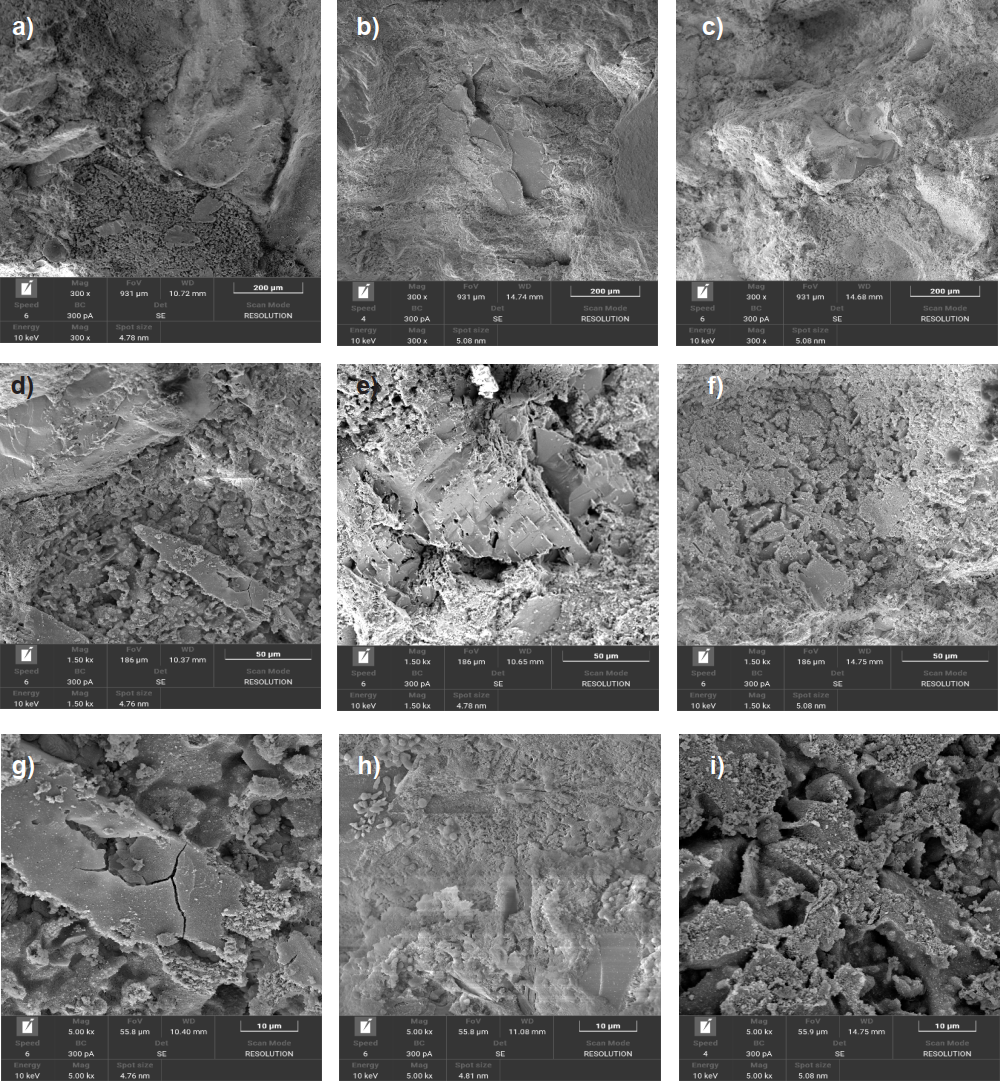
Figure 5 presents scanning electron microscopy (SEM) images of the fracture surfaces of mortars with different addition levels of eggshell ash (ESA) for the three compositions studied. The images are organized into three columns: 0% ESA, 5% ESA, and 10% ESA; and four rows, corresponding to increasing magnifications (300×, 1500×, 5000×, and 30000×). The sample without ESA addition (0% ESA) exhibited a relatively compact microstructure, with microcracks propagating through the cementitious matrix. At higher magnifications, crystals resembling needle-like ettringite and lamellar portlandite were observed, along with a moderately continuous C-S-H phase. However, the absence of fine pozzolanic additions limited the microstructural refinement. Similar behavior was reported by Lothenbach et al.10 and Khankhaje et al.4, who noted that conventional matrices without mineral additions tend to present higher porosity and reduced resistance to crack deflection mechanisms.

Fracture surface images of mortars with 0% (a, d, g, j), 5% (b, e, h, k), and 10% ESA (c, f, i, l) obtained by SEM at magnifications of 100×, 1.5 k×, 5 k×, and 30 k×.
In contrast, the sample with 5% ESA addition displayed a denser and more cohesive fracture surface, with improved packing of hydration products and fewer visible voids. At 5k× and 30k× magnifications, a more interlocked and compact microstructure was observed, suggesting enhanced nucleation of hydration phases and better bonding between paste and sand. He et al.8 and Zhang et al.12 demonstrated that moderate ESA additions (around 5%) promote the formation of secondary C-S-H and contribute to the filling of capillary pores, reducing porosity and improving mechanical performance at early curing ages. This behavior is consistent with the highest compressive strength values recorded for the 5% ESA composition.
The sample with 10% ESA addition revealed a more heterogeneous and porous fracture surface. Although some densified regions were identified, poorly connected particles, microcracks, and voids were also observed, particularly at 30k× magnification. The excessive presence of calcium hydroxide and unreacted particles may contribute to such heterogeneity, as discussed by Shiferaw et al.9 and Shi and Shui13. These authors indicate that high ESA contents may lead to an imbalance in the Ca/Si ratio, generating weak zones, increasing matrix alkalinity, and promoting the precipitation of excess portlandite, which may not effectively integrate into the hydration gel network.
Moreover, Nandhini and Karthikeyan2), (3 and Sathiparan14 reported that overdoses of ESA result in greater water demand and pore connectivity, facilitating microcrack formation. The presence of larger voids and disconnected C-S-H networks in the 10% ESA sample confirms the structural compromise associated with excessive ash content. Lavagna and Nisticò1 also highlighted that overloading with biogenic calcium sources can disrupt the hydration balance and impair long-term performance.
In summary, the SEM analysis supports the mechanical results by showing that the addition of 5% ESA promotes a more continuous and refined microstructure, while the addition of 10% ESA induces heterogeneity and porosity that impair mechanical performance. These findings reinforce the existence of an optimal ESA content that maximizes nucleation effects without compromising the microstructural integrity of the matrix.
CONCLUSIONS
The incorporation of calcined eggshell ash (ESA) into 1:3 mortars demonstrated significant potential as a sustainable and effective additive for improving physical, mechanical, and microstructural properties. The addition of 5% ESA yielded the best performance across all evaluated parameters, enhancing compressive and flexural strength, reducing porosity and water absorption, and promoting a denser, more homogeneous microstructure. XRD and SEM analyses confirmed the formation of secondary phases such as CaAl2SiO8·4H2O and CaSiO3, while the absence of portlandite at this dosage indicated efficient pozzolanic activity and calcium ion consumption.
In contrast, the 10% ESA addition led to the accumulation of crystalline Ca(OH)2 and ettringite, increasing heterogeneity and porosity, and reducing mechanical performance. These findings underscore the importance of dosage control, demonstrating that moderate ESA contents can act synergistically through filler and nucleation effects, whereas excessive contents may compromise matrix integrity. Therefore, ESA is validated as a promising eco-friendly additive for cementitious materials, particularly at optimized contents such as 5%.
ACKNOWLEDGMENTS
To Prof. Drª. Elisângela de Jesus Cândido Moraes; to postgraduate students Gabriela Machado Guimarães Ferreira and Pedro Henrique Lopes Nunes Abreu dos Santos; to technician Francisco de Paiva Reis for their collaboration; and to CNPq for the Research Productivity Scholarship, Process 313915/2021-0.
DATA AVAILABILITY
The data that support the findings of this study are available from the corresponding author, upon reasonable request.
REFERENCES
-
1 Lavagna L, Nisticò R. An insight into the chemistry of cement - An revision. Appl Sci. 2022; 13: 203. https://doi.org/10.3390/app13010203
» https://doi.org/10.3390/app13010203 -
2 Nandhini K, Karthikeyan J. Sustainable and greener concrete production by utilizing waste eggshell powder as cementitious material - A review. Constr Build Mater. 2022; 335: 127482. https://doi.org/10.1016/j.conbuildmat.2022.127482
» https://doi.org/10.1016/j.conbuildmat.2022.127482 -
3 Nandhini K, Karthikeyan J. Effective utilization of waste eggshell powder in cement mortar. Mater Today Proc. 2022; 61(2): 428. https://doi.org/10.1016/j.matpr.2021.11.328
» https://doi.org/10.1016/j.matpr.2021.11.328 -
4 Khankhaje E, Kim T, Jang H, Kim CS, Kim J, Rafieizonooz M. A review of utilization of industrial waste materials as cement replacement in pervious concrete: an alternative approach to sustainable pervious concrete production. Heliyon. 2024; 10: e026188. https://doi.org/10.1016/j.heliyon.2024.e26188
» https://doi.org/10.1016/j.heliyon.2024.e26188 -
5 Chandar SP, Santhosh R. Partial replacement of cement with alternative cementitious material in the production of concrete: A review. Mater Today Proc. 2022; 68(6): 2421-6. https://doi.org/10.1016/j.matpr.2022.09.140
» https://doi.org/10.1016/j.matpr.2022.09.140 -
6 Murthi P, Lavanya V, Poongodi K. Effect of eggshell powder on structural and durability properties of high strength green concrete for sustainability: A critical review. Mater Today. 2022; 68: 1311-8. https://doi.org/10.1016/j.matpr.2022.06.346
» https://doi.org/10.1016/j.matpr.2022.06.346 -
7 Tan Y, Doh S, Chin SC. Eggshell as a partial cement replacement in concrete development. Concr Res. 2017; 13: 662. 10.1680/jmacr.17.00003
» https://doi.org/10.1680/jmacr.17.00003 -
8 He Y, Che D, Ouyang X, Niu Y. Surface Properties of Eggshell Powder and Its Influence on Cement Hydration. Materials (Basel). 2022; 15: 7633. https://www.mdpi.com/1996-1944/15/21/7633
» https://www.mdpi.com/1996-1944/15/21/7633 -
9 Shiferaw N, Habte L, Thenepalli T, Ahn J. Effect of Eggshell Powder on the Hydration of Cement Paste. Materials. 2019; 12: 2483. https://doi.org/10.3390/ma12152483
» https://doi.org/10.3390/ma12152483 -
10 Lothenbach B, Scrivener K, Hooton RD. Supplementary cementitious materials. Cem Concr Res. 2011; 41(12): 1244. https://doi.org/10.3390/ma12152483
» https://doi.org/10.3390/ma12152483 -
11 Kulik DA, Miron GD, Lothenbach B. A structurally-consistent CASH+ sublattice solid solution model for fully hydrated C-S-H phases: Thermodynamic basis, methods, and Ca-Si-H2O core sub-model. Cem Concr Res. 2022; 151: 106585. https://doi.org/10.1016/j.cemconres.2021.106585
» https://doi.org/10.1016/j.cemconres.2021.106585 -
12 Zhang GY, Oh S, Han Y, Meng LY, Lin R, Wang XY. Influence of eggshell powder on the properties of cement-based materials. Materials (Basel). 2024; 17(7): 1705. https://doi.org/10.3390/ma17071705
» https://doi.org/10.3390/ma17071705 -
13 Shi XC, Shui Z. Effect of eggshell powder addition on the properties of cement pastes with carbonation curing. SSRN Electron J. 2024. https://doi.org/10.2139/ssrn.4371132
» https://doi.org/10.2139/ssrn.4371132 -
14 Sathiparan N. Utilization prospects of eggshell powder in sustainable construction material - A review. Constr Build Mater. 2021; 293: 123465. https://doi.org/10.1016/j.conbuildmat.2021.123465
» https://doi.org/10.1016/j.conbuildmat.2021.123465 - 15 International Organization for Standardization (ISO). ISO 3349. Concrete - Determination of compressive strength of test specimens. Geneva: ISO; 2016.
- 16 ASTM International. ASTM C1198-91. Standard Test Method for Dynamic Young’s Modulus, Shear Modulus, and Poisson’s Ratio for Advanced Ceramics by Sonic Resonance. ASTM; 2002.
- 17 European Committee for Standardization (CEN). EN 1015-11. Methods of test for mortar for masonry - Part 11: Determination of flexural and compressive strength of hardened mortar. Brussels: CEN; 2019.
- 18 International Organization for Standardization (ISO). ISO 12620. Water absorption, apparent porosity and bulk density of hardened concrete. Geneva: ISO; 2013.