Thermal conductivity study of different engobed ceramic brick
Abstract
The thermal conductivity of engobed building ceramics was studied as a function of their microstructure. The following thermal conductivity coefficients of the samples were determined: clinker bricks with 5% water absorption - 1.04 W/(m·K) and facing bricks (ordinary) with 12% water absorption - 0.48 W/(m·K) (ignoring the voids in the samples). A comparison of the thermal conductivity of brick samples of uniform thickness without engobe and with engobe showed that the latter had a slight increase in thermal conductivity of 0.3% due to forming a denser outer layer on its surface with 2.0-0.3% water absorption. However, as the engobe coating is applied as an additional layer on the top of the ceramic bricks and the product has a greater thickness, the heat flow through the engobed bricks is 0.1-0.2 % lower. The results can be applied to technologies for achieving energy-efficient decorative and protective coatings for building ceramics.
Keywords:
ceramic brick; thermal conductivity coefficient; water absorption; hardness; phase composition; firing; microstructure; durability; specific heat flow
INTRODUCTION
One of the priorities of the European Union and other countries is to improve the energy efficiency of buildings. There is a growing need to reduce energy consumption and greenhouse gas emissions. The issue of reducing energy consumption applies to buildings in different climatic zones, both with harsh cold and hot climates and in areas with dry and humid climates. In this context, appropriate thermal insulation of buildings, both newly constructed and existing buildings undergoing modernization, plays an important role. The use of suitable structural and thermal insulation materials with appropriate thermal conductivity parameters allows the reduction of heat losses or gains and the correct determination of energy requirements for heating or cooling buildings 1) (2.
In this context, ceramic bricks are an indispensable building material. Their popularity is justified by the fact that the material has high indicators for parameters such as hardness, long-term durability, and high sound and thermal insulation 3) (4) (5. Clay bricks are produced all over the world and the production volumes are constantly increasing. At present, the global production volume of brick is more than 1391 billion units 6. It provides a favorable microclimate in dwellings and is fireproof, strong, and durable.
The thermal conductivity coefficients of ceramic bricks vary within a wide range depending on the product type and structure and can range from 0.15-0.3 W/(m·K) for porous building ceramics 7 to 0.7-0.9 W/(m·K) for denser facing bricks 8. Therefore, the greater the porosity of the ceramic material, the lower the thermal conductivity 9. However, as a rule, porous materials tend to be less strong 10, so the consumer often has to choose between the thermal insulation properties and the strength of the brick.
Various pore-forming and combustible additives are usually added to the composition of clay bricks to reduce their thermal conductivity. It is proposed 11 to add sawdust, processed soil from oil filtration, compost, and marble in the amount of 5 to 15% to the ceramic mass composition for brick production. The addition of by-products makes it possible to increase the energy efficiency of bricks by increasing their porosity to 12-14% in terms of the water absorption indicator. However, such a high porosity contributes to a reduction in the mechanical resistance to crushing and reduces the durability of the bricks, which limits their use as a facing material 12.
The incorporation of organic additives into brick clays as pore-forming agents has been widely studied. The use of eggshells 13, cigarette butts 14) )15), sawdust 16, fly ash 17, rice husk ash 18, sugar cane ash 19) (20, paper waste 21) (22, sewage sludge 23, complex combustible additives 24, etc. has been proposed. The organic origin of such wastes requires energy to release their heating power during combustion in the ceramic firing process but allows for a reduction in fuel consumption during firing in general. In addition, such combustion products impart a more porous microstructure to the fired bricks. This reduces the density of the products and improves their thermal insulation values 25.
The incorporation of inorganic production waste into the composition of the mass, in particular marble dust 26 and processed steel slugs 27, also leads to an increase in the porosity of the ceramic bricks.
At the same time, increasing the porosity and thermal insulation values of ceramic bricks inevitably reduces the functionality of the products. In particular, the frost resistance of the products decreases, as does their durability, which often prevents them from being used as facing materials. Water penetrates the pores of ceramic materials and can freeze when exposed to cold weather. The localized high stress created around the pores can lead to microcracking and fracture of the material 28.
Concerning the construction materials used for thermal insulation, as well as the structural or cladding layers of external walls, it is to ensure that these materials have low permeability. The presence of moisture in materials causes an increase in thermal conductivity and accelerates their degradation 29) (30.
Another challenge is to limit the effect of thermal bridging on heat loss or gain. In this context, it is also important to use the right design solutions for structural joints in the external walls of buildings and to ensure that the building materials used there are not exposed to moisture 31.
Engobed ceramic bricks with denser facing surfaces have gained attention in recent years 32) (33) (34) (35) (36. The white engobe composition is proposed 32 to achieve a wide range of colors and to increase the performance characteristics of the bricks. In particular, the low surface water absorption in the range of 3% allows the durability of the bricks to be increased by up to 35%. Unique decorative effects, such as the imitation of antique bricks 33, can be achieved by using slip. The authors 34) (35 propose the use of engobe coating to increase the aesthetic parameters of light and dark brown ceramic bricks and to create self-cleaning building facades 36.
In this way, the presence of an engobe coating, suitably selected in terms of its composition and thermal expansion with respect to the ceramic base, makes it possible to increase the frost resistance and durability of building products and to achieve practically any color range. However, the thermophysical properties of engobed bricks must be studied, as this factor affects the creation of energy-efficient solutions in construction.
Aim of the study - To determine the effect of the presence of engobe coating on the surface of ceramic bricks of different types on their thermal conductivity coefficient.
Objectives of the study:
-
- to determine the correlation between water absorption, the strength of ceramic material samples, and their thermal conductivity, structure, and phase composition;
-
- to determine the pattern dependencies of the properties, phase composition, and microstructure of typical ceramic brick engobe coatings in relation to firing temperatures;
-
- to carry out a comparative analysis of the thermophysical properties of the ceramic brick samples studied, with and without engobe on their surface, and to correlate the data collected with the building products produced in factory environments.
EXPERIMENTAL PROCEDURES
Materials: the study of the thermophysical properties of ceramic bricks was carried out on samples of different types and manufacturers (Table 1).
In the laboratory, cube-shaped samples of 30x30x30 mm were made from factory ceramic masses by plastic molding in metal molds of appropriate size. The moisture content of the ceramic masses was 22-23.5%. Ceramic masses were placed in a metal mold and the pressure was applied to 1 MPa. The samples were fired in a laboratory furnace at industrial temperatures of Sample 1 - 1070 °C, Samples 2 and 3 - 1030 °C, Sample 4 - 1050 °C, and Sample 5 - 1000 °C (Table 1). Firing mode: heating to maximum temperature at a rate of 100°C/h, holding at maximum temperature for 2 hours, and natural cooling of the furnace for 12 hours. Next, the properties of the ceramic bricks such as shrinkage, water absorption, and mechanical strength were investigated.
For the production of engobed samples of building ceramics, engobe of the following composition 37 was used: refractory clay - 65 wt.%, bottle soda-lime glass breaker - 25 wt.%, quartz sand - 10 wt.%. The chemical composition of the engobe is given in the Table. 2.
The engobe slip was prepared by wet grinding the components in a ball mill. The residue on sieve No. 0063 (cell size 63 µm, 9428 cells per 1 cm2) after grinding was <0.5%. The slip was applied by pulverization to the faces of cleaned semi-finished parts. Non-engobed and engobed brick samples were fired in a laboratory muffle furnace at temperatures between 1000 and 1070 °C. The thickness of the engobe layer was monitored using an optical microscope at the end of the study. The indicator was 250±10 mm.
The properties of the engobe were studied on separate 30x30x5 mm plate samples. The samples were obtained by casting in plaster molds, dried in laboratory conditions, and fired at a temperature range of 950-1150 °C.
Plate samples of 300x300x10 mm were prepared to study the thermophysical properties. Ceramic samples from test masses No. 1-5 were tested both without engobe and with an engobe coating on the surface (Fig. 1). Engobe was applied by spraying using a Dnipro-MAC-48 sprayer (Dnipro-M, Ukraine) with a nozzle diameter of 1.5 mm at a working pressure of 8 bar.

The microstructure of the experimental samples was studied on the chip of carefully broken ceramic materials.
Methods: The properties of the ceramic samples and the slip were determined using standard methods.
Water absorption (W, %) - by gravimetric analysis based on the change in mass of the fired and vacuum-moistened sample (EN ISO 10545-3 38). Measurements were carried out on three parallel samples with an accuracy of W±0.5%. The samples were weighed using electronic laboratory balances TВE-0.21-0.001 of class II accuracy and 0.001 g resolution. The manufacturer is Tekhnovagy (Ukraine)
Firing shrinkage (l fire , %) - based on the change in linear dimensions of the material within a corresponding mark on its surface before and after firing (ASTM C326-09 39). Measurements were carried out on three parallel samples with an accuracy of l fire ±1%.
The mechanical compression strength (σcom , МPа) of the brick samples 30x30x30 mm was determined using the P-10 hydraulic press Standart - M (Ukraine) by measuring the destructive load per unit surface area (ASTM C773-88 40). The press load measurement range is 10-1000 MPa, and the press force during the research was increased at a rate of 50 MPa/s. Measurements were carried out on five parallel samples with an accuracy of σcom , ±1%.
The thermal conductivity coefficient (λ,W/(m·K)) of the ceramic samples was measured using the Netzsch HFM 436 Lambda instrument. In a heat flux meter, the test specimen is placed between two heated plates controlled to a user-defined mean sample temperature and temperature gradient to measure the heat flux through the specimen (ASTM C518-21 41). Measurements were made with the following assumptions: hot plate temperature 30°C, cold plate temperature 0°C. The effective thermal conductivity of the samples was determined at an average temperature of 15 °C with a temperature gradient of 30°C. Measurements were carried out on three parallel samples with an accuracy of λ±0.5%
The hardness of the engobes was evaluated using the Mohs relative hardness scale (ASTM C1895-20 42) (43). Mohs scratch hardness is a useful tool for determining the resistance of a ceramic sample to scratching. The scratch resistance is determined by visual observation of the ceramic tile surface after an attempt to scratch the surface with a pick of known hardness.
X-ray phase analysis was carried out using the DRON-3 X-ray analyzer with Co-Kα radiation. The crystal phases were identified by comparing the diffraction patterns with those in the Joint Committee on Powder Diffraction Standards (JCPDS) or the International Centre for Diffraction Data (ICDD) database (Table 3).
The study of the microstructure of the samples was carried out by the method of scanning electron microscopy on the device REM 106 and (SELMI, Ukraine) in the mode of secondary electrons with an accelerating voltage of 20 kV in the range of electron-optical magnification from 200 to 5000 times. Silver sputtering was used to impart electrical conductivity to the samples.
Calculations: heat exchange through thermal conductivity occurs through the interaction of particles that are in direct contact with each other and have different temperatures 44. Thermally excited particles of the warmer part of the body perform intense oscillatory motions, transferring kinetic energy to the particles of the colder part, which at the same time increase the intensity of the oscillations.
The ability of a body (layer of material) to prevent an increase in the thermal movement of molecules is called thermal resistance. The specific thermal resistance (R, m²·К/W) is equal to the ratio of the thickness of the layer to its thermal conductivity coefficient (other things being equal) 45:
where s - thickness of a separate layer (ceramic body and engobe), m; λ - thermal conductivity coefficient of the corresponding material, W/(m·K).
where Rbrick - specific thermal resistance of the brick, m2·K/W; Rbody - specific thermal resistance of the ceramic body, m2·K/W; Reng - specific thermal resistance of the engobe, m2·K/W; The intensity of heat loss through the wall of the house can be estimated using the specific heat flow. The calculation of the specific heat flow (Q, W/m2) through a wall with engobe bricks is carried out according to the formula 46) (47:
where (tin - tout) - temperature difference between the inner and outer surface of the brick, °С; The specific heat flow of engobed samples was compared with the specific heat flow of samples without engobe.
RESULTS
Study of the properties of brick samples without engobe
Thermal conductivity is one of the most important properties of ceramic bricks, as it makes it possible to assess the material’s ability to accumulate heat indoors and save on heating costs.
This indicator is related to the operational properties of the bricks, such as water absorption and mechanical performance. These properties are in turn determined by the chemical-mineralogical composition and particle size distribution of the raw materials, the composition of the ceramic body, the degree of compaction of the semi-finished product during shaping, the intensity of liquid phase sintering during firing, and the temperature.
Table 4 shows the firing temperatures and main properties of the non-engobed ceramic brick test specimens.
Sample No. 1 is the densest and strongest, belonging to the clinker bricks: mechanical compressive strength is 36.0 MPa, water absorption - 5%. In addition to the high values of operational properties, the coefficient of thermal conductivity of these products is the highest among the test samples - 1.04 W/(m·K).
Brick No. 5 has the lowest coefficient of thermal conductivity - 0.48 W/(m·K), and water absorption reaches 12.0%.
Fig. 2 shows the variation of the thermal conductivity coefficient with the water absorption of the test specimens. For the bricks tested, a reduction in thermal conductivity was noted with the increase in water absorption.

Figure 3 shows the microstructure of samples 1, 3, and 5.

Sample No. 1 is characterized by the lowest water absorption values (5 %) and therefore by a denser structure, which can be clearly observed in Fig. 3 a, b. The microstructure contains a high amount of glassy phase with melted segments and crystalline phase grains coated by it.
Sample 3 has a less dense structure with 8.5 % water absorption. Figures 3 c and d show clearer outlines of the crystalline phase, with the vitreous phase interspersed but in much smaller amounts than in sample 1.
Finally, sample No. 5 with 12 % water absorption showed the most porous microstructure (Fig. e, f), although signs of melting were also observed.
The results of the X-ray diffraction phase analysis of the brick samples are shown in Fig. 4.

Clinker sample No. 1 (Fig. 3 a) has the most diverse crystalline phase content. It contains quartz, pyrite, biotite, unmelted microcline, and albite grains and a phase formed during the firing of clay material - mullite. Samples 3 and 5 (Fig. 4 b, c) are less diverse in terms of crystalline phase composition.
Study of the properties of engobe coating
In order to study the influence of the engobe coating on the thermal conductivity coefficient of ceramic bricks, the engobe coating was chosen as the most universal, as determined by previous studies 37. The coating is recommended for covering ceramic bricks with different firing temperatures and different ceramic body properties.
The dependence of water absorption and shrinkage of the engobe on the firing temperature is shown in Fig. 5

Dependence of engobe properties on firing temperature: a - water absorption, b - fire shrinkage
The engobe is fired to a dense state with a <1 % water absorption index at a temperature of 1030 °C. A further increase in temperature facilitates the formation of a denser material, while linear shrinkage gradually increases with increasing firing temperature.
After firing at 1000 °C, the engobe hardness reaches a value of 7 on the Mohs scale (Table 5). As the temperature continues to increase, the engobe material becomes harder and stronger, reaching a strength of 65 MPa after firing at 1150 °C. On the other hand, there was an increase in the thermal conductivity coefficient from 0.75 to 1.24 W/(m·K).
The results of X-ray phase analysis during the study of the phase composition of engobe after firing at different temperatures are shown in Fig. 6.

After firing at 1000°C, a-quartz crystals of its diffraction peaks and devitrite nuclei crystallized in the glass melt during its cooling can be observed. At the same time, the higher the engobe firing temperature, the lower the intensity of the quartz diffraction peaks, indicating its active dissolution in the glass melt. The intensity of the devitrite peaks after heat treatment at 1100 and 1150 °C is practically identical, indicating its maximum amount in this system under these conditions.
Consequently, despite the fact that the engobe is fired at 1050-1150 °C to low water absorption values of 0.8-0.2% by the liquid phase mechanism, the crystalline phase is present in the coating in sufficient quantities. This gives the coating its hardness and strength. In turn, the combination of high strength and low water absorption of the engobe coating makes it possible to increase the durability of building ceramics.
Study of properties of brick samples with engobe coating
An engobed ceramic brick is a product whose surface is covered with a thin layer (up to 0.25 mm) of a decorative and protective coating, which is densified by firing at appropriate temperatures 37.
The results of the determination of the thermal conductivity coefficient of the engobed and non-engobed test brick samples are shown in Figure 7.

The data provided show that the presence of a vitreous coating on the surface of sample No. 1 results in an increase in the thermal conductivity coefficient from 1.04 to 1.06 W/(m·K). Analogous patterns can be observed in samples No. 2-4, where the increase in the coefficient of thermal conductivity is from 2 to 4 %. The most significant increase in the coefficient was observed in sample No. 5 - from 0.48 to 0.52 W/(m·K), i.e. 8%. At the same time, the thermal resistance of engobed specimens (of the same thickness as unengobe specimens) will decrease due to a denser outer layer that conducts heat better. The higher thermal conductivity of the engobe layer can be explained by the formation of a significant amount of glass melt during firing, due to the reduction in the number of pores and the disappearance of the layered structure of the clay 48) (49.
Such variations are related to the different outer layer structures of the samples (Fig. 8). The engobe, as a decorative and protective coating, is denser than the ceramic body in all samples under all heat curing conditions. The firing of brick sample No. 5 at 1000 °C results in the formation of an engobe layer with 2.1% water absorption and 12 % water absorption of the body (the engobe is 6 times denser). The firing of clinker ceramic sample No. 1 at 1070 °C gives a ceramic body with 5% water absorption and 0.3-0.4% water absorption of the slip. Fig. 8 a, b shows a dense, finely vitreous engobe layer on the surface of the ceramic material, which contains practically no micropores found in the ceramic body structure. With a lower firing temperature of sample No. 5 (1000 °C), the engobe is sintered less intensively and its water absorption amounts to 2.1%, therefore pores with a size of 2-5 μm are observed in the engobe structure in Fig. 7 c, d pores with a size of 2-5 μm are observed.

Microstructure of experimental ceramic brick samples: a - No. 1 with engobe on the surface, b - engobe layer on the surface of sample No. 1, c - No. 5, d - engobe layer on the surface of sample No. 5.
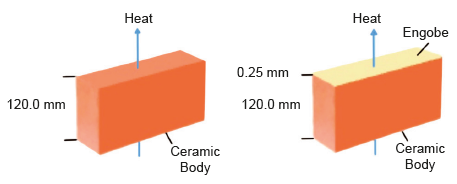
However, it should be noted that the thermophysical properties of the models and the real brick are different. This is due to the fact that the ratio of the thickness of the ceramic body to the engobe layer is different in the model (Fig. 1) and in the industrial product (Fig. 9). In the test samples, the engobe layer accounted for 2.5 % of the total thickness (ceramic to engobe layer ratio 9.750:0.250 mm), whereas in the industrial samples this value will be only 0.3 % (ceramic to engobe layer ratio 120:0.250 mm). Furthermore, in real production conditions, the thickness of the brick sample without engobe is 120 mm and the thickness of the sample with engobe is 120.25 mm (Fig. 9 b). The engobe contributes to an insignificant increase in the specific thermal resistance of the brick (Table 6) because it prevents the thermal movement of the molecules.

Schematic representation of ceramic brick and the passage of heat through the product in masonry: a - without engobe, b - with engobe
For sample No. 1 without engobe, according to formula (A):
For engobe:
For sample No. 1 with engobe, according to formula (B):
In addition, since the engobe is applied as an additional layer on the surface of a ceramic product, it acts as an additional thermal insulator and the heat flow through an engobed brick wall is reduced (Table 7). For example, the specific heat flow at a temperature difference between the inner and outer surfaces of the brick of 25°C has been calculated using formula (C). For sample No. 1 without engobe:
For sample No. 1 with engobe layer:
Similar calculations were performed for samples No. 2-4.
Therefore, the illustrated model shows that the heat flux through engobed bricks is slightly reduced. Such a pattern is observed in all tested samples with 5-12 % water absorption with dense engobe coating on their surfaces.
DISCUSSION
The performance characteristics of ceramic bricks are determined by their structure and phase composition and are the result of complex physical and chemical processes that take place throughout the technological cycle.
The study was carried out on ceramic samples from different brick manufacturers. Test specimens were made from ceramic bodies and fired at near-industrial temperatures to determine their thermal conductivity coefficients, water absorption, and strength indices.
Brick sample No. 1 has the highest compressive strength - 36.0 MPa and the lowest water absorption of the tested materials - 5.0 % (Table 4). This complex is an indispensable requirement for clinker bricks 50) (51) (52, which can be subjected to much higher mechanical loads than facing bricks. Such indices are conditioned by the formation of a dense structure (Fig. 3 a, b) during firing due to liquid phase sintering 7) (53. The fracture of the sample clearly shows melted segments with a uniformly distributed crystalline phase, which according to X-ray phase analysis (Fig. 4 a) is represented by a-quartz, microcline, albite, biotite, pyrite and mullite with coefficients of thermal conductivity ranging from 2-3 W/(m·K) for feldspathic minerals to 67 W/(m·K) for quartz and 19 W/(m·K) for pyrite 54) (55. The thermal conductivity coefficient of the glassy phase bounding the crystalline phase grains in ceramic materials is lower, in the range of 1.0-1.4 W/(m·K) 56. Therefore, it is obvious that the experimental thermal conductivity coefficient index of the least porous sample No. 1 was the highest among those tested and amounted to 1.04 W/(m·K).
Sample 3 has higher water absorption values (8.5 %) and a less dense structure (Fig. 3 c, d). The micrographs (Fig. 4 b) clearly show a coarse material structure and the presence of crystalline phases of different sizes and nature, interconnected by the vitreous phase. However, the structure of sample No. 3 has pores predominantly 10-15 µm in size, therefore facing brick sample No. 3 has a lower thermal conductivity compared to sample No. 1 - 0.64 W/(m·K). The lower coefficient of thermal conductivity in the porous samples is due to the fact that air is considered a thermal insulator and has a coefficient of 0.026 W/(m·K) 54) (57.
Samples Nos. 2, 4, and 5, with water absorption values within the range of 11.0-12.0 %, have even coarser and more porous structures. Sample No. 5, although showing signs of liquid phase sintering, is characterized by multiple pores of 10.0-20.0 µm in size. Such a porous structure of the samples can be formed already during the molding of the products in case of insufficient vacuuming of the body or burning out of organic additives 58) (59. Then, even in the presence of a liquid phase filling the gaps between the crystalline phase grains, the cells remain in the structure, which reduces the compressive strength of the samples to 15.0 MPa, but at the same time increases the thermal insulating properties of the material 60. The thermal conductivity coefficients of the porous samples are 0.48-0.52 W/(m·K).
An engobe is applied to the surface of a ceramic material in a layer whose thickness does not exceed 250 µm 37, but which makes a significant contribution to the physical and chemical properties of products. In particular, the main purpose of such a coating is to extend the color range of products and increase their service life. White colored engobes are able to reflect falling solar radiation and can provide effective protection for buildings from overheating in the summer 61.
Unlike glazes for ceramic materials 62) (63, engobes contain much less vitreous phase, but their structure is also formed because of liquid phase sintering. In ceramic bricks, the water absorption of the engobe layer must be significantly lower than the water absorption of the ceramic body. This is a fundamental difference between the engobe for ceramic bricks and the decorative coatings used for painting crockery or decorating ceramic plates 59.
Due to the particularities of firing engobes in a classical “refractory clay - quartz sand - bottle glass breaker” system, it has been found 37 that such engobes have a water absorption of 6.0 % after firing at 950 °C and <1 % after firing at 1030 °C. This is due to an increase in the liquid phase, the main source of which in the engobe is the bottle soda-lime glass breaker 64, which contributes to the convergence of the crystalline phase particles. As the temperature increases, the shrinkage of the material increases, resulting in further densification of the material. After firing at temperatures of 1050-1150 °C, the engobe has a water absorption of 0.8-0.3 %, forming a glass-ceramic material with high hardness and strength. Increasing the firing temperature results in an increase in the amount of liquid phase and a decrease in its viscosity 65) (66. This leads to a reduction in small micropores, an increase in shrinkage, and a reduction in the overall porosity of the material. Liquid phase sintering provides for a gradual removal of pores in the process of liquid phase formation, which can be seen during the firing of the engobe.
Depending on the firing temperature in the range of 950-1150 °C, the compressive strength of the engobe material increases from 45 to 65 MPa, exceeding the strength of the ceramic body by a factor of 2-4. The hardness of the engobe also increases with increasing temperature, and the index reaches 7 on the Mohs scale after firing at 1000 °C. Hardness increases with temperature, and the phase composition and structure of the material change as a result.
For example, based on X-ray phase analysis, after firing at 1000 °C the engobe generally contains crystalline phase quartz, devitrite nuclei, and a small amount of liquid phase (Fig. 6). The amount of glassy phase increases with increasing temperature and a halo can be observed on the X-ray pattern. The intensity of the quartz peaks decreases, indicating a gradual transition of quartz into the glassy phase composition, leading to an increase in the strength and hardness of the material. The amount of devitrite crystallizing as the glass melt cools also increases, which can be used as an estimate of the “maturity” of the engobe.
When the engobe is applied to the surface of a ceramic sample and solidified by firing, it retains its properties - sinterability, hardness, and strength. The main functional load is carried by the ceramic body, which is the main contributor to the thermophysical properties of the product. In turn, the hardness and density of the engobe are essential for transporting the product and ensuring its durability in changing atmospheric conditions.
As the material of the engobe coating is denser, its coefficient of thermal conductivity is higher than that of the ceramic body. As the firing temperature of the engobe is increased, a further increase in the coefficient is observed, from 0.75 to 1.24 W/(m·K). Therefore, comparing the 10 mm test brick samples in the engobed and non-engobed variants (Fig. 1), the thermal conductivity coefficient of the engobed brick samples is found to be 2-8% higher (Fig. 7). The smallest changes were observed for the dense sample of clinker No. 1, the largest - for the sample with the maximum porosity.
It should be noted that in the samples tested, through which heat was passed during laboratory studies (Fig. 1), the ratio of the ceramic body to the engobe layer was 97.5: 2.5 (with a total sample thickness of 10 mm). Therefore, the presence of a denser engobe layer compared to the ceramic body of the samples in these models did indeed lead to an insignificant increase in thermal conductivity.
When moving from the laboratory model of ceramic brick samples to the industrial model, it is also necessary to take into account the fact that the engobe is applied as an additional layer (Fig 9b). This means that the thickness of the engobed ceramic bricks increases from 0.12 m to 0.12025 m and the engobe layer, despite its higher thermal conductivity, actually becomes additional thermal insulation. At the same time, the thermal resistance of the brick increases slightly (Table 6) by 0.1-0.2%. This pattern is characteristic of all the brick samples tested, regardless of their porosity.
A much greater possibility for reducing the thermal conductivity of ceramic bricks is to create a hollow brick - according to the authors 67, it is possible to reduce the thermal conductivity by 16%. Or by varying the ratio of crystalline/vitreous/gaseous phases in a ceramic body 68.
The data collected as a result of the experiment can be used in the design of engobe compositions and technologies to achieve energy-efficient decorative and protective coatings for building ceramics. The implementation of the ceramic brick engobing process will make it possible to expand the range of products, increase their aesthetic parameters, and prolong their service life.
CONCLUSIONS
The function of decorative-protective coatings on the surface of ceramic bricks in the formation of their thermophysical properties has been established. As a result of the study of ceramic building materials of different manufacturers, a high correlation between the coefficient of thermal conductivity and the water absorption of a ceramic body was established. For a clinker sample with 5 % water absorption, the coefficient was 1.04 W/(m·K). By increasing the water absorption of the ceramic material up to 12 % for ordinary or facing bricks, this index amounts to 0.48 W/(m·K) (without taking into account the hollowness of the products). This is related both to the presence of pores in the ceramic body and to their size. In particular, the structure of the sample with higher thermal conductivity has pores up to 3-8 μm in size. As the average pore size increases to 15-20 μm, the thermal conductivity coefficient decreases significantly. The engobe used in this study at firing temperatures of 1000-1150 °C has a much denser structure than any of the ceramic brick samples tested - its water absorption after firing in the specified temperature range decreases from 2 to 0.3 %, and its mechanical performance increases from 45 to 65 MPa. However, the thermal conductivity of the engobe is higher than that of the ceramic body, ranging from 0.75 to 1.25 W/(m·K) depending on the firing temperature. The presence of an additional engobe layer on the surface of a ceramic brick results in a slight increase in the thermal resistance of the brick due to a reduction in the amount of heat that can pass through it. Therefore, the presence of a high quality engobe coating on the surface of ceramic bricks makes it possible to extend the product range and increase its service life.
REFERENCES
-
1 Lis A, Ujma A. Changes in the external environment and of interior microclimate as a consequence of energetic modernization of building. Adv Mater Res. 2014;1020:58590. doi:10.4028/www.scientific.net/AMR.1020.585.
» https://doi.org/10.4028/www.scientific.net/AMR.1020.585 -
2 Ujma A, Jura J. Thermal insulation of the tent’s heat shield in cold and hot climates. E3S Web Conf. 2021;281:03012. doi:10.1051/e3sconf/202128103012.
» https://doi.org/10.1051/e3sconf/202128103012 -
3 Lian R, Ou M, Guan H, Cui J, Piao J, Feng T, et al. Facile fabrication of multifunctional energy-saving building materials with excellent thermal insulation, robust mechanical property and ultrahigh flame retardancy. Energy. 2023;277:127773. doi:10.1016/j.energy.2023.127773.
» https://doi.org/10.1016/j.energy.2023.127773 -
4 Khomenko IS, Datsenko BM, Fomenko GV. Determination of approaches to the development of ceramic compositions for the manufacture of facial bricks. Vopr Khimii Khim Tekhnol. 2022;6:98. doi:10.32434/0321-4095-2022-145-6-98-107.
» https://doi.org/10.32434/0321-4095-2022-145-6-98-107 -
5 Anjum F, Naz MY, Ghaffar A, Kamran K, Shukrullah S, Ullah S. Sustainable insulating porous building materials for energy-saving perspective: Stones to environmentally friendly bricks. Constr Build Mater. 2022;318:125930. doi:10.1016/j.conbuildmat.2021.125930.
» https://doi.org/10.1016/j.conbuildmat.2021.125930 -
6 Rashid K, Haq EU, Kamran MS, Munir N, Shahid A, Hanif I. Experimental and finite element analysis on thermal conductivity of burnt clay bricks reinforced with fibers. Constr Build Mater . 2019;221:190. doi:10.1016/j.conbuildmat.2019.06.055.
» https://doi.org/10.1016/j.conbuildmat.2019.06.055 -
7 Ibrahim EFM, Tihtih M, Gömze LA. Environmentally-friendly ceramic bricks made from zeolite-poor rock and sawdust. Constr Build Mater . 2021;297:123715. doi:10.1016/j.conbuildmat.2021.123715.
» https://doi.org/10.1016/j.conbuildmat.2021.123715 -
8 Zhou W, Yang F, Zhu R, Dai G, Wang W, Guo X, et al. Mechanism analysis of pore structure and crystalline phase of thermal insulation bricks with high municipal sewage sludge content. Constr Build Mater . 2020;263:120021. doi:10.1016/j.conbuildmat.2020.120021.
» https://doi.org/10.1016/j.conbuildmat.2020.120021 -
9 Ozturk S. Optimization of thermal conductivity and lightweight properties of clay bricks. Eng Sci Technol Int J. 2023;48:101566. doi:10.1016/j.jestch.2023.101566.
» https://doi.org/10.1016/j.jestch.2023.101566 -
10 Adazabra AN, Viruthagiri G, Foli BY. Evaluating the technological properties of fired clay bricks incorporated with palm kernel shell. J Build Eng. 2023;72:106673. doi:10.1016/j.jobe.2023.106673.
» https://doi.org/10.1016/j.jobe.2023.106673 -
11 Eliche-Quesada D, Corpas-Iglesias FA, Pérez-Villarejo L, Iglesias-Godino FJ. Recycling of sawdust, spent earth from oil filtration, compost and marble residues for brick manufacturing. Constr Build Mater . 2012;34:275. doi:10.1016/j.conbuildmat.2012.02.079.
» https://doi.org/10.1016/j.conbuildmat.2012.02.079 -
12 Kizinievič O, Kizinievič V, Malaiškienė J. Analysis of the effect of paper sludge on the properties, microstructure and frost resistance of clay bricks. Constr Build Mater . 2018;169:689-696. doi:10.1016/j.conbuildmat.2018.03.024.
» https://doi.org/10.1016/j.conbuildmat.2018.03.024 -
13 Tangboriboon N, Moonsri S, Netthip A, Sirivat A. Innovation of embedding eggshell to enhance physical-mechanical-thermal properties in fired clay bricks via extrusion process. MATEC Web Conf. 2016;78:01003. doi:10.1051/matecconf/20167801003.
» https://doi.org/10.1051/matecconf/20167801003 -
14 Mohajerani A, Kadir AA, Larobina L. A practical proposal for solving the world’s cigarette butt problem: Recycling in fired clay bricks. Waste Manag. 2016;52:228. doi:10.1016/j.wasman.2016.03.012.
» https://doi.org/10.1016/j.wasman.2016.03.012 -
15 Kurmus H, Mohajerani A. Recycling of cigarette butts in fired clay bricks: A new laboratory investigation. Materials (Basel). 2020;13:790. doi:10.3390/ma13030790.
» https://doi.org/10.3390/ma13030790 -
16 Thalmaier G, Cobîrzan N, Balog AA, Constantinescu H, Streza M, Nasui M, et al. Influence of sawdust particle size on fired clay brick properties. Mater Constr. 2020;70:215. doi:10.3989/mc.2020.04219.
» https://doi.org/10.3989/mc.2020.04219 -
17 Beal B, Selby A, Atwater C, James C, Viens C, Almquist C. A comparison of thermal and mechanical properties of clay bricks prepared with three different pore‐forming additives: Vermiculite, wood ash, and sawdust. Environ Prog Sustain Energy. 2019;38:13150. doi:10.1002/ep.13150.
» https://doi.org/10.1002/ep.13150 -
18 Görhan G, Simsek O. Porous clay bricks manufactured with rice husks. Constr Build Mater . 2013;40:390. doi:10.1016/j.conbuildmat.2012.09.110.
» https://doi.org/10.1016/j.conbuildmat.2012.09.110 -
19 Faria KCP, Gurgel RF, Holanda JNF. Recycling of sugarcane bagasse ash waste in the production of clay bricks. J Environ Manage. 2012;101:7. doi:10.1016/j.jenvman.2012.01.032.
» https://doi.org/10.1016/j.jenvman.2012.01.032 -
20 Maza-Ignacio OT, Jiménez-Quero VG, Guerrero-Paz J, Montes-García P. Recycling untreated sugarcane bagasse ash and industrial wastes for the preparation of resistant, lightweight and ecological fired bricks. Constr Build Mater . 2020;234:117314. doi:10.1016/j.conbuildmat.2019.117314.
» https://doi.org/10.1016/j.conbuildmat.2019.117314 -
21 Yaras A. Combined effects of paper mill sludge and carbonation sludge on characteristics of fired clay bricks. Constr Build Mater . 2020;249:118722. doi:10.1016/j.conbuildmat.2020.118722.
» https://doi.org/10.1016/j.conbuildmat.2020.118722 -
22 Goel G, Vasić MV, Katiyar NK, Kirthika SK, Pezo M, Dinakar P. Potential pathway for recycling of the paper mill sludge compost for brick making. Constr Build Mater . 2021;278:122384. doi:10.1016/j.conbuildmat.2021.122384.
» https://doi.org/10.1016/j.conbuildmat.2021.122384 -
23 Mohajerani A, Ukwatta A, Jeffrey-Bailey T, Swaney M, Ahmed M, Rodwell G, et al. A proposal for recycling the world’s unused stockpiles of treated wastewater sludge (biosolids) in fired-clay bricks. Buildings. 2019;9:14. doi:10.3390/buildings9010014.
» https://doi.org/10.3390/buildings9010014 -
24 Khomenko OS, Sribniak NM, Hretsai SO, Teliushchenko IF, Ivchenko VD, Dushyn VV. Development of a complex burnable additive for manufacture of porous building ceramics with high strength. Vopr Khimii Khim Tekhnol . 2019;3:166. doi:10.32434/0321-4095-2019-124-3-166-175.
» https://doi.org/10.32434/0321-4095-2019-124-3-166-175 -
25 Maafa IM, Abutaleb A, Zouli N, Zeyad AM, Yousef A, Ahmed MM. Effect of agricultural biomass wastes on thermal insulation and self-cleaning of fired bricks. J Mater Res Technol. 2023;24:4060-4073. doi:10.1016/j.jmrt.2023.03.189.
» https://doi.org/10.1016/j.jmrt.2023.03.189 -
26 Segadães AM, Carvalho MA, Acchar W. Using marble and granite rejects to enhance the processing of clay products. Appl Clay Sci. 2005;30:42. doi:10.1016/j.clay.2005.03.004.
» https://doi.org/10.1016/j.clay.2005.03.004 -
27 Ahmadi PF, Ardeshir A, Ramezanianpour AM, Bayat H. Characteristics of heat insulating clay bricks made from zeolite, waste steel slag and expanded perlite. Ceram Int. 2018;44:7588. doi:10.1016/j.ceramint.2018.01.175.
» https://doi.org/10.1016/j.ceramint.2018.01.175 -
28 Ducman V, Škapin AS, Radeka M, Ranogajec J. Frost resistance of clay roofing tiles: Case study. Ceram Int . 2011;37:85-91. doi:10.1016/j.ceramint.2010.08.012.
» https://doi.org/10.1016/j.ceramint.2010.08.012 -
29 Cabeza-Prieto A, Camino-Olea MS, Sáez-Рérez MP, Llorente-Álvarez A, Gavilán ABR, Rodríguez-Esteban MA. Comparative analysis of the thermal conductivity of handmade and mechanical bricks used in the cultural heritage. Materials. 2022;15:4001. doi:10.3390/ma15114001.
» https://doi.org/10.3390/ma15114001 -
30 Azevedo AC, Guimarães AS, Delgado JMPQ. Hygrothermal and mechanical properties of ceramic bricks and mortars. J Mater Sci Eng. 2018;7:477. doi:10.4172/2169-0022.1000477.
» https://doi.org/10.4172/2169-0022.1000477 -
31 Ujma A, Pomada M. Analysis of the temperature distribution in the place of fixing the ventilated facade. E3S Web Conf . 2019;97:01041. doi:10.1051/e3sconf/20199701041.
» https://doi.org/10.1051/e3sconf/20199701041 -
32 Khomenko O, Datsenko B, Sribniak N, Nahornyi M, Tsyhanenko L. Development of engobe coatings based on alkaline kaolins. East Eur J Enterp Technol. 2019;6(6-102):49. doi:10.15587/1729-4061.2019.188126.
» https://doi.org/10.15587/1729-4061.2019.188126 -
33 Khomenko O, Datsenko B, Sribniak N, Zaichuk O, Nahornyi M. Development of the technology for obtaining engobed construction articles with the “antiquity” effect. East Eur J Enterp Technol . 2019;5(6-101):6. doi:10.15587/1729-4061.2019.180367.
» https://doi.org/10.15587/1729-4061.2019.180367 -
34 Zorigt S, Jadamba Ts, Tsevel S. Synthesis and structural studies of face engobe layer’s mass. 7th Int Forum Strateg Technol IFOST. 2012. doi:10.1109/IFOST.2012.6357603.
» https://doi.org/10.1109/IFOST.2012.6357603 -
35 Yatsenko ND, Rat’kova EO. Engobes for ceramic brick. Glass Ceram. 2009;66:93. doi:10.1007/s10717-009-9144-4.
» https://doi.org/10.1007/s10717-009-9144-4 -
36 Janus M, Zając K. Woodhead Publishing Series in Civil and Structural Engineering. Mater Process Appl. 2019;591. doi:10.1016/B978-0-08-102641-0.00024-4.
» https://doi.org/10.1016/B978-0-08-102641-0.00024-4 -
37 Khomenko O, Tsyhanenko L, Tsyhanenko H, Borodai A, Borodai D, Borodai S. Designing engobe coatings for ceramic bricks. East Eur J Enterp Technol . 2023;3/6(123):77. doi:10.15587/1729-4061.2023.279918.
» https://doi.org/10.15587/1729-4061.2023.279918 - 38 EN ISO 10545-3. Ceramic tiles. Determination of water absorption, apparent porosity, apparent relative density and bulk density. 2018.
- 39 ASTM C326-09. Standard test method for drying and firing shrinkages of ceramic whiteware clays. West Conshohocken, Pennsylvania: ASTM Book of Standards; 2014.
- 40 ASTM C773-88. Standard test method for compressive (crushing) strength of fired whiteware materials. West Conshohocken, Pennsylvania: ASTM Book of Standards ; 2011.
- 41 ASTM C518-21. Standard test method for steady-state thermal transmission properties by means of the heat flow meter apparatus. West Conshohocken, Pennsylvania: ASTM Book of Standards ; 2021.
- 42 ASTM C1895-20. Standard test method for determination of Mohs scratch hardness. West Conshohocken, Pennsylvania: ASTM Book of Standards ; 2022.
-
43 Kim H, Kim T. Measurement of hardness on traditional ceramics. J Eur Ceram Soc. 2002;22:1437-1445. doi:10.1016/S0955-2219(01)00457-5.
» https://doi.org/10.1016/S0955-2219(01)00457-5 -
44 Vijayan DS, Mohan A, Revathy J, Parthiban D, Varatharajan R. Evaluation of the impact of thermal performance on various building bricks and blocks: A review. Environ Technol Innov. 2021;23:101577. doi:10.1016/j.eti.2021.101577.
» https://doi.org/10.1016/j.eti.2021.101577 -
45 Lv L, Huang S, Zou Y, Wang X, Zhou H. Heat transfer and thermal resistance analysis under various heat transfer fluid flow rates based on a medium-temperature pilot-scale latent heat storage system. Int J Heat Mass Transf. 2024;220:124896. doi:10.1016/j.ijheatmasstransfer.2023.124896.
» https://doi.org/10.1016/j.ijheatmasstransfer.2023.124896 -
46 Elovenko D, Kräusel V. The study of thermal conductivity of asbestos cardboard and fire clay powder to assess the possibility of their application in prefabricated structures of cylindrical housings of pressure vessels. Mater Today Proc. 2019;19/5:2389. doi:10.1016/j.matpr.2019.08.041.
» https://doi.org/10.1016/j.matpr.2019.08.041 -
47 Paramonov AM. Heating furnaces efficiency improvement. Procedia Eng. 2015;113:181. doi:10.1016/j.proeng.2015.07.315.
» https://doi.org/10.1016/j.proeng.2015.07.315 -
48 Nigay PM, Cutard T, Nzihou A. The impact of heat treatment on the microstructure of a clay ceramic and its thermal and mechanical properties. Ceram Int . 2017;43:1747-1754. doi:10.1016/j.ceramint.2016.10.084.
» https://doi.org/10.1016/j.ceramint.2016.10.084 -
49 Michot A, Smith DS, Degot S, Gault C. Thermal conductivity and specific heat of kaolinite: Evolution with thermal treatment. J Eur Ceram Soc . 2008;28:2639-2644. doi:10.1016/j.jeurceramsoc.2008.04.007.
» https://doi.org/10.1016/j.jeurceramsoc.2008.04.007 -
50 Wesołowska M, Kaczmarek A. Dependence of capillary properties of contemporary clinker bricks on their microstructure. IOP Conf Ser Mater Sci Eng. 2017;245(2):022045. doi:10.1088/1757-899X/245/2/022045.
» https://doi.org/10.1088/1757-899X/245/2/022045 -
51 Koleda VV, Mikhailyuta ES, Аlekseev EV, Tsybul’ko ÉS. Technological particularities of clinker brick production. Glass Ceram . 2009;66:132. doi:10.1007/s10717-009-9129-3.
» https://doi.org/10.1007/s10717-009-9129-3 -
52 Fedorenko O, Prysiazhna L, Petrov S, Chyrkina M, Borysenko O. Studying the physicochemical regularities in the color- and phase formation processes of clinker ceramic materials. East Eur J Enterp Technol . 2018;6(6-96):58. doi:10.15587/1729-4061.2018.150659.
» https://doi.org/10.15587/1729-4061.2018.150659 -
53 Nicolas MF, Vlasova M, Aguilar PAM, Kakazey M, Cano MMC, Matus RA, et al. Development of an energy-saving technology for sintering of bricks from high-siliceous clay by the plastic molding method. Materials. 2020;242:118142. doi:10.1016/j.conbuildmat.2020.118142.
» https://doi.org/10.1016/j.conbuildmat.2020.118142 -
54 Lin J, Shi X, Zeng Y, Nie Y, Liu J. Estimating the thermal conductivity of granular soils based on a simplified homogenization method. Cold Reg Sci Technol. 2023;211:103855. doi:10.1016/j.coldregions.2023.103855.
» https://doi.org/10.1016/j.coldregions.2023.103855 -
55 Coletti C, Borghi A, Cossio R, Dalconi MC, Santa GD, Peruzzo L, et al. A multi-scale methods comparison to provide granitoid rocks thermal conductivity. Constr Build Mater . 2021;304:124612. doi:10.1016/j.conbuildmat.2021.124612.
» https://doi.org/10.1016/j.conbuildmat.2021.124612 -
56 Smiljanić S, Hribar U, Spreitzer M, König J. Influence of additives on the crystallization and thermal conductivity of container glass cullet for foamed glass preparation. Ceram Int . 2021;47(23):32867. doi:10.1016/j.ceramint.2021.08.183.
» https://doi.org/10.1016/j.ceramint.2021.08.183 -
57 Song J, Wang G, Xing L, Qian J, Dai L, Di H. Influencing factors of rock thermal conductivity and applicability evaluation of its mixing law predictive models. Geothermics. 2023;110:102680. doi:10.1016/j.geothermics.2023.102680.
» https://doi.org/10.1016/j.geothermics.2023.102680 -
58 Ahmada S, Iqbal Y, Muhammad R. Effects of coal and wheat husk additives on the physical, thermal and mechanical properties of clay bricks. Bol Soc Esp Ceram Vidrio. 2017;56:131. doi:10.1016/j.bsecv.2017.02.001.
» https://doi.org/10.1016/j.bsecv.2017.02.001 -
59 Sutcu M, del Coz Díaz JJ, Rabanal FPA, Gencel O, Akkurt S. Thermal performance optimization of hollow clay bricks made up of paper waste. Energy Build. 2014;75:96. doi:10.1016/j.enbuild.2014.02.006.
» https://doi.org/10.1016/j.enbuild.2014.02.006 - 60 Spiliotis X, Karayannis V, Lamprakopoulos S, Zaoutsos S, Papapolymerou G. Sustainable development of P/M ceramics from steel mill scale and lignite fly ash mixtures. J Chem Technol Metall. 2019;54/5:1028.
-
61 Ferrari C, Libbra A, Muscio A, Siligardi C. Design of ceramic tiles with high solar reflectance through the development of a functional engobe. Ceram Int . 2013;39(8):9583-9590. doi:10.1016/j.ceramint.2013.05.077.
» https://doi.org/10.1016/j.ceramint.2013.05.077 -
62 Wang S, Li X, Wang C, Bai M, Zhou X, Zhang X, et al. Anorthite-based transparent glass-ceramic glaze for ceramic tiles: Preparation and crystallization mechanism. J Eur Ceram Soc . 2022;42(3):1132. doi:10.1016/j.jeurceramsoc.2021.11.036.
» https://doi.org/10.1016/j.jeurceramsoc.2021.11.036 -
63 Yekta BE, Alizadeh P, Rezazadeh L. Floor tile glass-ceramic glaze for improvement of glaze surface properties. J Eur Ceram Soc . 2006;26(16):3809. doi: 10.1016/j.jeurceramsoc.2005.12.016.
» https://doi.org/10.1016/j.jeurceramsoc.2005.12.016. -
64 Dal Bó M, Bernardin AM, Hotza D. Formulation of ceramic engobes with recycled glass using mixture design. J Clean Prod. 2014;69:243-249. doi:10.1016/j.jclepro.2014.01.088.
» https://doi.org/10.1016/j.jclepro.2014.01.088 -
65 Nieves LJJ, Nastri S, Lot AV, Melchiades FG, Marsola GA, Flauzino IS, et al. Influence of engobe and glaze layers on the evolution of porosity and permeability of single-fired porcelain tiles. Appl Clay Sci . 2022;228:106635. doi:10.1016/j.clay.2022.106635.
» https://doi.org/10.1016/j.clay.2022.106635 -
66 Ten JG, Orts MJ, Saburit A, Silva G. Thermal conductivity of traditional ceramics. Part I: Influence of bulk density and firing temperature. Ceram Int . 2010;36(6):1951. doi:10.1016/j.ceramint.2010.05.012.
» https://doi.org/10.1016/j.ceramint.2010.05.012 -
67 Morales MP, Juárez MC, López-Ochoa LM, Doménech J. Study of the geometry of a voided clay brick using rectangular perforations to optimize its thermal properties. Appl Therm Eng. 2011;31:2063-2065. doi:10.1016/j.applthermaleng.2011.02.033.
» https://doi.org/10.1016/j.applthermaleng.2011.02.033 -
68 Dal Bó M, Gilabert FA, Boschi AO, Sánchez E, Cantavella V, Hotza D. Influence of beta-to-alpha quartz transition on residual stresses of a feldspar glass matrix composite: A relationship with catastrophic fracture due to thermal shock. J Eur Ceram Soc . 2023;43(10):4562-4572. doi:10.1016/j.jeurceramsoc.2023.03.056.
» https://doi.org/10.1016/j.jeurceramsoc.2023.03.056