Characteristics of intensive care unit registries - findings from the Global Registry ICU Datasets (GRID) survey
ABSTRACT
Background: Intensive care unit registries, which aim to improve the quality of intensive care unit care through benchmarking and quality improvement initiatives, are active worldwide, with considerable dishomogeneity. We aimed to map core datasets, additional variables, and research activities of these registries.
Methods: A cross-sectional survey was disseminated to registry leads between October 2023 and June 2024. The survey was structured into four main topics: registry characteristics and coverage, core dataset features, additional modules, and registry-enabled research.
Results: Leads of 34/42 national registries responded (response rate 81%), covering 3,337 intensive care units, with a larger representation from South America. Systematized nomenclature of medicine, clinical terms, and customized categorical classifications were the main nomenclatures used. All registries except one employed a severity of illness score/risk prediction model. The SOFA score was reported by 88% of registries. Organ support measures were often recorded, including mechanical ventilation (97%), vasopressor administration (86%) and renal replacement therapy (86%). Three out of four intensive care unit registries coded interventions such as intubations, intravenous lines and tracheostomies. Additional datasets differed, with many use cases for nosocomial infection burden, bed availability and staffing resources. Over half of intensive care unit registries had current structured quality improvement initiatives. Registry-enabled observational research was reported in 46% of registries, while interventional studies were reported in only 22%.
Conclusion: Over three thousand intensive care units in 35 countries participate in an intensive care unit registry. Despite heterogeneity in coding systems, risk models, and additional datasets, we identify several areas of convergence that may inform a future shared core dataset. There is potential for further intensive care unit registry-based research, particularly interventional.
Keywords:
Intensive care units; Registries; Dataset; Outcomes; Quality control; Quality improvement; Registry-enabled research; Data collection; Internet; Survey and questionnaires
INTRODUCTION
Intensive care unit (ICU) registries are designed to collect standardized data on patient demographics, treatments, outcomes, and resource use across different ICUs.(1) Data on case-mix, resource use, and risk-adjusted outcomes allows healthcare providers to assess and benchmark performance, identify adherence to best practices, and track trends and variations in care and resource use, which helps to identify ways to improve service provision, patient outcomes and safety.(2) Some registries have evolved to provide data to inform clinical research, enabling studies on the effectiveness of various interventions, the identification of risk factors, and the validation of predictive models.(3) Additionally, data and analytics from ICU registries support informed decision-making for policymakers and healthcare administrators by providing data on ICU utilization, cost-effectiveness, and patient outcomes.(4) Registries can also facilitate global collaboration by enabling international benchmarking and multicenter research, fostering a culture of continuous learning and improvement.(5)
Despite the growing importance of ICU registries for quality improvement (QI) and research, there is still a lack of consistency and reproducibility regarding the contents of the datasets. Different registries collect varying data sets using varied data structures, choose different predictive models, each with diverse definitions, and employ different methods for data collection and analysis. Understanding these variations is crucial to allow for the comparison of ICU practices and population outcomes between regions.(6) By gaining insight into the specific datasets deployed by ICU registries around the globe, we can better identify uniformity and disparities, harmonize practices, and enhance the effectiveness of registries as tools for advancing critical care.(7) Moreover, recent geo-economic analyses have underlined the differences in outcomes across ICUs worldwide, in different patient groups - underscoring the potential role of registries in streamlining these variations.(8-10) The coronavirus disease 2019 (COVID-19) pandemic showed the importance of standardizing datasets and models to ensure comparable and replicable comparisons among different countries and health systems. In addition, harmonized and, where possible, matched datasets for case mix and outcomes measures would benefit the growing investment in international research collaborations, specifically global platform trials, disease surveillance, and quality of care research.
The Linking of Global Intensive Care (LOGIC) network is an initiative that globally connects ICU registries to enhance patient outcomes in critical care by promoting regional, national, and international benchmarking of ICU outcomes and harmonized research methods.(5) In this study, Global mapping of ICU Registry Datasets (GRID), we aimed to map current core datasets collected by ICU registries, for benchmarking, resource utilization, service provision, QI, and clinical research.
METHODS
Study design
The study was designed as a cross-sectional survey disseminated to registry leads between October 2023 and June 2024. Ethical approval for the survey was not sought. Participating registries internationally have ethical approvals in place for the datasets they collect. The study is reported using the recommendations given in the Checklist for Reporting Results of Internet E-surveys (CHERRIES, detailed in Table 1S - Supplementary Material).(11)
Survey
A closed survey was developed by the LOGIC network. Three authors developed the first draft, with revisions by other four authors before review and approval from all co-authors. The survey was delivered using the online tool (Google Forms), and no incentives were provided. It was structured into four topics: (1) registry characteristics and coverage; (2) core dataset; (3) additional population or process-specific datasets; and (4) registry-enabled or registry-embedded research. The core dataset was defined as a set of variables collected in all ICU encounters, which enable the description of patient demographics and case mix and the benchmarking of risk-adjusted clinical outcomes. The survey responses were constructed from binary, multiple-choice questions with limited free text. Respondents had the opportunity to add narrative comments, detailing information on the QI and research initiatives. Respondents were also invited to share or signpost public links to guidance documents and data collection tools. A full version of the survey is available in table 2S (Supplementary Material). Duplicate entries from the same national registry were harmonized, and investigators were directly in contact with them in case of discrepancies.
Procedure
The closed survey was sent to registry leads in October 2023, purposely sampled through the email list comprising registries that are a part of LOGIC, and also an additional list of known ICU registries identified in a previous review,(1) with the invitation to complete the survey only once per national registry. In case of incomplete responses, the responsible registry lead was contacted, and missing information was sought. Cleaned responses were shared with registry leads for verification.
Statistical analysis
Survey results were described using percentages for categorical variables and median and interquartile range (IQR) for continuous variables, assuming non-normal distribution. Because of the study's descriptive nature, no association tests were conducted. Graphs were constructed using Graphpad Prism software (version 10.4, GraphPad Software, LLC).
RESULTS
Registries, characteristics, and coverage
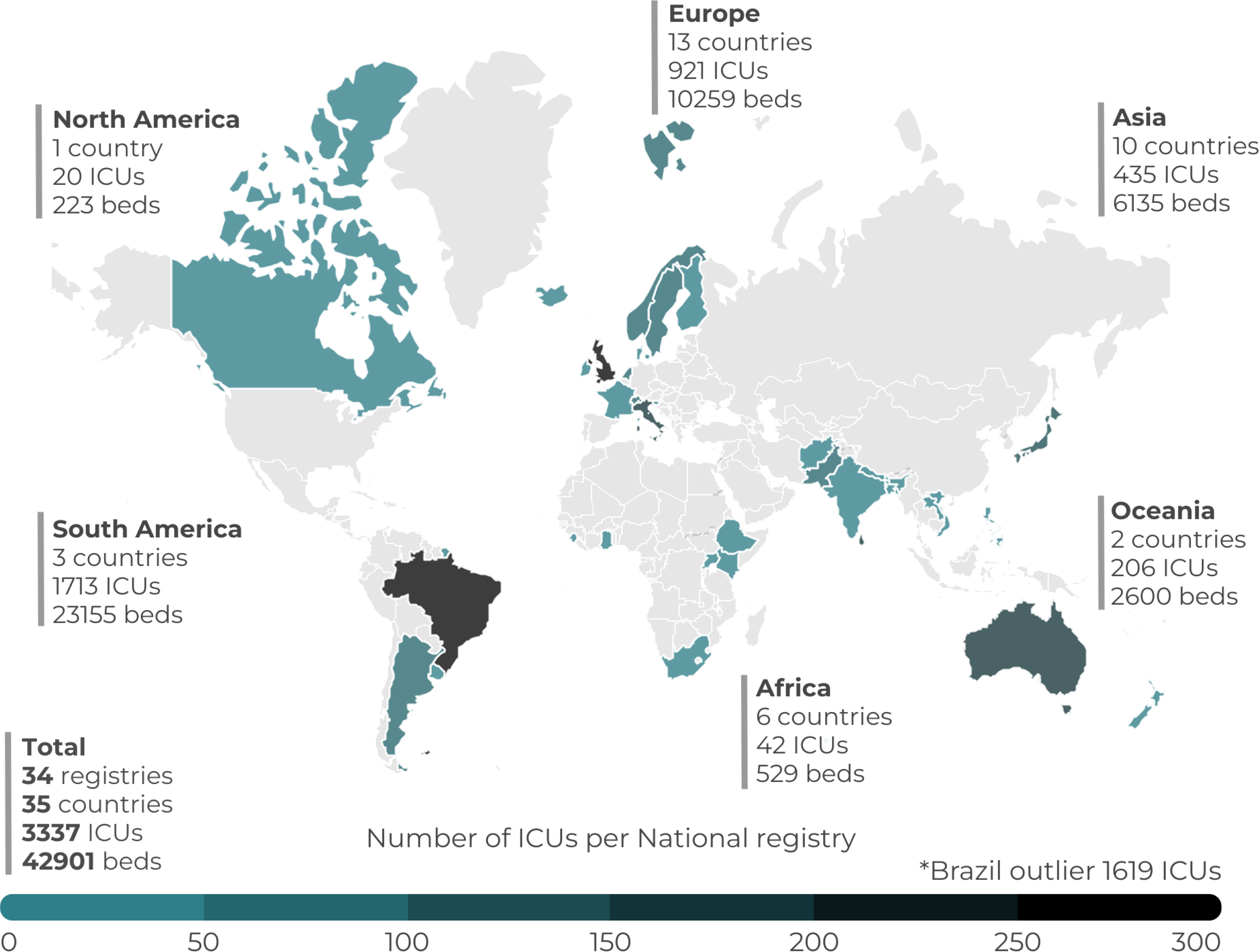
Of 42 invited registry leads, after harmonization of four duplicates, 34 registries were included in the final analysis (response rate 80%). Participating registries are operational in 35 countries, and are actively collecting data from 3,337 ICUs, accounting for more than 42,000 beds (Figure 1). Approximately half of the registries’ ICUs were in South America. There was a predominance of public ICUs (median 93% IQR 40 - 100%) with a median coverage of 50% (IQR 19 - 100%) of the country's ICUs (Table 1).
Heatmap showing the absolute number of intensive care units for the registries mapped in the current survey.
Intensive care unit registry data were submitted by dedicated data collectors or medical staff such as physicians, residents, or nurses; less than half of the data were automatically uploaded by electronic medical records integration. In most cases, patients’ consent was implied at the time of hospital admission as regulated by ethical review or national regulations (Table 2).
Severity of illness, organ dysfunction scores, additional modules implemented in national intensive care unit registries, and other registries structural characteristics
Nomenclature, diagnostic coding systems, and risk prediction models
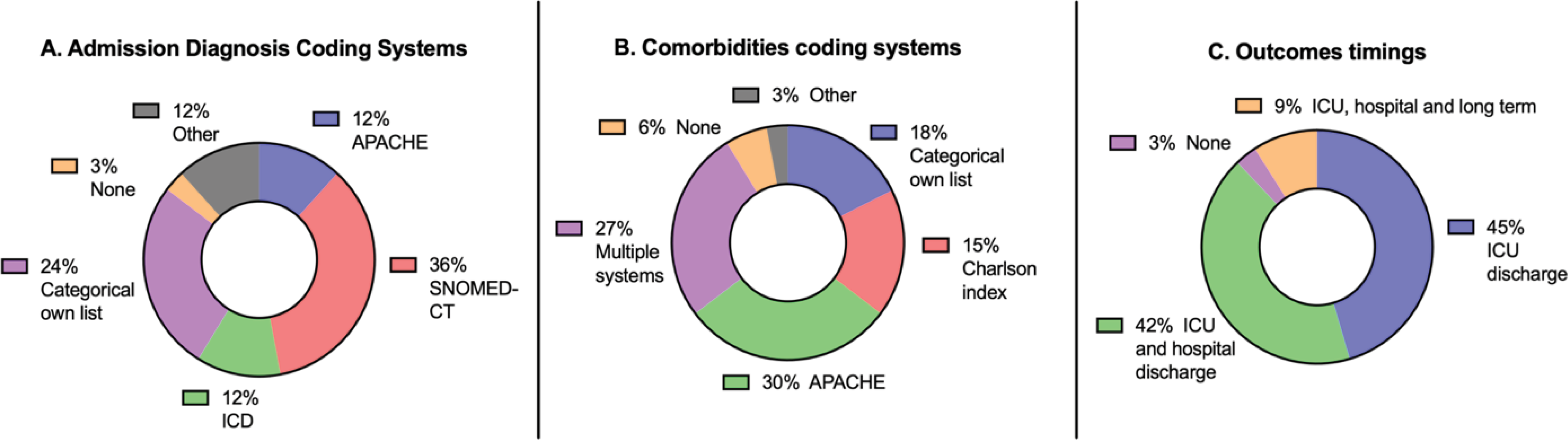
There was a significant variability in nomenclatures, diagnostic coding, and prognostic models used by the registries in their core data sets. Systematized Nomenclature of Medicine Clinical Terms (SNOMED-CT) and customized categorical classifications were the main nomenclature and diagnostic coding systems, followed by the use of the diagnostic lists of the Acute Physiology and Chronic Health Evaluation II (APACHE II) coding and International Classification of Diseases (ICD, Figure 2A). For comorbidities, the APACHE II score list of comorbidities was currently adopted in > 50% of mapped ICU registries, followed by customized lists and the conditions that constitute the Charlson comorbidity index (Figure 2B and 3). Regarding the severity of illness scores and risk prediction models, 33 out of 34 (97%) registries reported using at least one, with the APACHE II score being the most frequently used (Table 3). One out of five registries used an in-house mortality prediction model developed explicitly by their national teams. The Sequential Organ Failure Assessment (SOFA) score was collected by 30 (88%) of registries, with the remaining registries not currently measuring any organ dysfunction score.
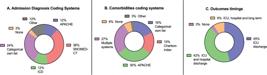
Main diagnostic coding systems (panel A), comorbidities coding systems (panel B), and timing of outcomes (panel C).
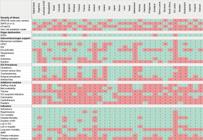
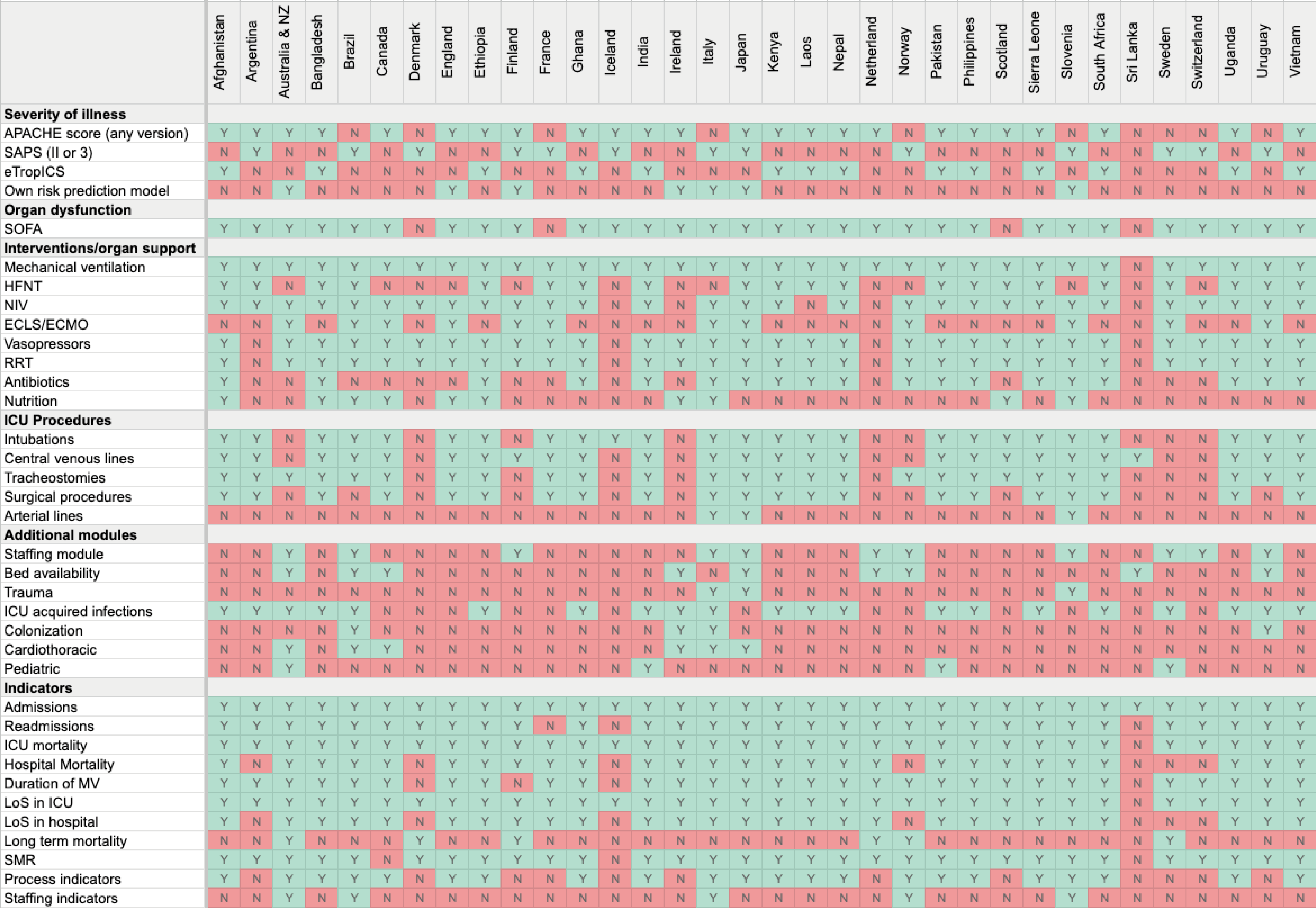
Heatmap on reported interventions, procedures, additional modules, and quality of care indicators.
Other core dataset characteristics
Intensive care unit interventions and procedures reported in ICU registries are detailed in figure 3. The use of organ support measures was widely tracked in core datasets, led by invasive mechanical ventilation (97%, with duration of ventilation reported in 88% of registries), haemodynamic support (86%), and renal replacement therapy (86%, Figure 3 and Table 3). Three out of four registries collect procedures and interventions performed on patients, including intubations, invasive lines, tracheostomies, and organ support or treatment given to patients; however, the captured procedures vary substantially among registries (Figure 3 and Table 4). When sedation assessment was performed, the Richmond Agitation-Sedation Scale (RASS) was used most commonly. In terms of ICU indicators all registries coded ICU admissions and 91% recorded readmissions. The standardized mortality rate was computed by most registries (91%), and process indicators were used in 65% of registries (Figure 3 and Table 3S [Supplementary Material]).
Additional datasets and initiatives
In addition to the core dataset, ICU registries provide several additional modules that differ widely between countries. The most frequently adopted additional modules were bed availability, surveillance of ICU-acquired infections and ICU staffing reporting (Figure 3 and Table 2). Over half of ICU registries reported structured QI initiatives guided by the registry team. Recurrent reported initiatives were QI toolkits, QI outlier programs, and data communication to government or public institutions (Table 4).
Use of intensive care unit registries for registry-enabled or registry-embedded research
The percentages of registries that use or let data be used for observational or interventional research studies are 50.0% and 17.6%, respectively.
DISCUSSION
Main findings
This study provides new information on the spread and scope of ICU registry data sets, the characteristics, nomenclature, and prediction models used, and how such data is being applied for service evaluation, research, and QI. Interestingly, we were able to identify that fewer than 20% of the world's countries appear to have an active ICU registry. However, it is possible that some may not have been captured in our assessment. The GRID survey shows that ICU registries can be used to support QI initiatives, advancing patient care and research - while highlighting substantial variability in data collection, coding systems and operational scope. This variability presents both challenges and opportunities for the global critical care community. Despite challenges, ICU registries remain an invaluable resource for understanding and improving intensive care practices worldwide.(12,13)
We record an increasing structuring of ICU registries in low and middle-income countries in Asia and Africa.(7,14,15) While some registries focus on providing case mix and outcomes for audit purposes, many ICU registries deliver additional information related to resource use, process of care, and QI initiatives, thereby collecting and processing more data.
We report a significant heterogeneity in the data collected by ICU registries, especially in terms of nomenclature, diagnostic coding systems, and comorbidities handling. Registries employ a mix of SNOMED-CT, customized classifications, and ICD-based systems. Such diversity reflects the differing priorities and resources available to registries but also underscores the necessity of harmonization to facilitate global benchmarking and collaboration. Differences in nomenclature can be overcome by strategies such as federated analysis, mapping common data models, and using established reference metadata standards. Examples of such standards are those established by the Clinical Data Interchange Standards Consortium(16) - and the standard data model proposed by the Observational Medical Outcomes Partnership (OMOP).(17) On the other hand, different definitions for outcome measures are more complex to unpick and may lead to misleading findings in benchmarking and clinical trials. Thus, promoting selected core outcome sets with standardized nomenclature, wider use of standard data models, and rigorous public availability of dictionaries and codebooks from the national registries, is important.
While some registries comprehensively capture interventions, severity scores, and procedural data, others are limited to case-mix and outcomes variables, omitting procedures or organ dysfunction metrics. For instance, although most registries use established severity scoring systems like APACHE II or SOFA, a modest portion collects no organ dysfunction score at baseline and even less do it longitudinally. This inconsistency complicates international comparisons and highlights the need for standardized data collection practices. The COVID-19 pandemic further highlighted the critical importance of standardized, high-quality data in supporting global health responses and tracking patient outcomes.(18) Future registry development must incorporate these lessons, ensuring that ICU data systems are resilient, adaptable, and capable of addressing the challenges of future health crises.(19)
Quality improvement and research
The survey also reveals the growing emphasis on QI initiatives within registries. Over half reported structured QI programs, including toolkits, outlier detection programs, and data communication to governmental bodies. These initiatives demonstrate the evolving maturity of ICU registries, which are increasingly recognized as tools for data collection that can inform systemic healthcare improvements.(20–22) While the use of registries for QI initiatives is increasingly documented, whether these tools lead to actual changes in patient care will need to be further studied and documented.(19)
The limited integration of registries into research frameworks remains a missed opportunity. Interestingly, while more than 40% of registries support observational studies, only one out of five are involved in interventional research. Expanding the role of registries in research could unlock their full potential as platforms for generating real-world evidence and guiding clinical practice.
The lack of uniformity in core datasets and coding systems creates barriers to effective international benchmarking. Moreover, the absence of a comprehensive "registry of registries" complicates efforts to ensure inclusivity in mapping studies like GRID. Legal and logistical barriers, including informed consent and data interoperability issues, further constrain some registries’ functionality, particularly in resource-limited settings. Nevertheless, the findings of the GRID survey provide a roadmap for addressing these challenges. Global initiatives like the LOGIC network are well-positioned to drive efforts toward standardization.(5) LOGIC and similar organizations can facilitate meaningful comparisons between registries and enhance their utility in global collaborations by promoting standard data models, harmonized coding systems, and interoperable frameworks. Such efforts could also support emerging registries in low- and middle-income countries, fostering their development through technical assistance and capacity building.
Strengths and limitations
The strength of this survey lies in its novelty in attempting to map core features of existing national registries worldwide. Spreading the survey through an existing consortium such as LOGIC allowed to increase the reach of the exploration. This survey had several limitations. To our knowledge, we contacted all existing National or regional ICU registries worldwide. Since there is no such thing as a registry of registries, we were unable to verify the completeness of the registries included. In this mapping study using a questionnaire sent out by mail to ICU registry leads, we were unable to verify the answers using the actual datasets of the registries. Differences in interpreting the posed questions could have led to interpretation errors in our analysis. The study's results were shared with all leads to check the answers they gave, and minor corrections were made to the data. Although we reported on consent requirements, we did not explore potential barriers to registry functionality, such as legal, cultural, and policy barriers preventing the data collection, use, sharing, or analysis. In addition, we did not explore whether organ support measures were tracked for resource utilization or care processes, although this has implications for the cadence of data collection.
CONCLUSION
While the GRID survey reveals considerable variability in intensive care unit registries, it also highlights their increasing global spread and potential as quality improvement, research, and policy development tools. Addressing the challenges of standardization, interoperability, and resource constraints will be crucial for harnessing registries’ full potential. By fostering global collaboration and advancing the integration of registries into research and quality improvement initiatives, the critical care community can drive significant improvements in patient care and outcomes worldwide.
GRID INVESTIGATORS OF THE LINKING OF GLOBAL INTENSIVE CARE (LOGIC) (18)
Christina Agvald-Öhman: Anaesthesiology and Intensive Care, Karolinska University Hospital Huddinge - Stockholm, Sweden; John Amuasi: Department of Global Health, Kwame Nkrumah University of Science and Technology - Kumasi, Ghana; Stepani Bendel: Finnish Intensive Care Consortium - Finland; Christian F. Christiansen: Danish Intensive care Database (DID) - Denmark; Arjen Dondorp: Mahidol Oxford Tropical Research Unit - Bangkok, Thailand; Guilherme Cortes Fernandes: Epimed - Brazil; Aniruddha Ghose: Department of Medicine, Chittagong Medical College Hospital - Chattogram, Bangladesh; Johnny Hillgren: Swedish Intensive Care Registry - Sweden; David Litton: Australian and New Zealand Intensive Care Society (ANZICS) Centre for Outcome and Resource Evaluation Clinical Quality Registry - Australia, New Zealand; Sruthi Mano: Indian Registry of IntenSive care (IRIS) - India; Chamira Kodippily and Dilanthi Priyadarshani: Nat-Intensive Care Surveillance, Mahidol Oxford Tropical Medicine Research Unit - Colombo, Sri Lanka; Kathy Rowan: Intensive Care National Audit & Research Centre - United Kingdom; Carolyne Njoki and Eunice Tole: Aga Khan University Hospital - Nairobi, Kenya; Adam H. Smit: Faculty of Health Sciences, Busitema University - Mbale, Uganda and William Harvey Research Institute, Queen Mary University of London - United Kingdom; Marcio Soares: Instituto D’Or de Pesquisa e Ensino - Rio de Janeiro, Brazil.
DATA AVAILABILITY STATEMENT
Data will be available upon request.
REFERENCES
- 1 Salluh JI, Quintairos A, Dongelmans DA, Aryal D, Bagshaw S, Beane A, et al.; Linking of Global Intensive Care (LOGIC) and Japanese Intensive care PAtient Database (JIPAD) Working Group. National ICU Registries as Enablers of Clinical Research and Quality Improvement. Crit Care Med. 2024;52(1):125-35.
- 2 Roos-Blom MJ, Bakhshi-Raiez F, Brinkman S, Arbous MS, van den Berg R, Bosman RJ, et al. Quality improvement of Dutch ICUs from 2009 to 2021: a registry based observational study. J Crit Care. 2024;79:154461.
- 3 Beane A, Salluh JI, Haniffa R. What intensive care registries can teach us about outcomes. Curr Opin Crit Care. 2021;27(5):537-43.
- 4 Litton E, Guidet B, de Lange D. National registries: lessons learnt from quality improvement initiatives in intensive care. J Crit Care. 2020 Dec;60:311–8.
- 5 Dongelmans DA, Pilcher D, Beane A, Soares M, Del Pilar Arias Lopez M, Fernandez A, et al. Linking of Global Intensive Care (LOGIC): an international benchmarking in critical care initiative. J Crit Care. 2020;60:305-10.
- 6 Bastos LS, Wortel SA, de Keizer NF, Bakhshi-Raiez F, Salluh JI, Dongelmans DA, et al. Comparing continuous versus categorical measures to assess and benchmark intensive care unit performance. J Crit Care. 2022;70:154063.
- 7 Njoki C, Simiyu N, Kaddu R, Mwangi W, Sulemanji D, Oduor P, et al. Epidemiolgy, clinical characteristics and outcomes of 4546 adult admissions to high dependency and ICUs in Kenya (EPOK): a multicentre registry-based observational study. Crit Care Explor. 2024;6(2):e1036.
- 8 Pisani L, Algera AG, Neto AS, Azevedo L, Pham T, Paulus F, et al.; ERICC study investigators; LUNG SAFE study investigators; PRoVENT study investigators; PRoVENT-iMiC study investigators. Geoeconomic variations in epidemiology, ventilation management, and outcomes in invasively ventilated intensive care unit patients without acute respiratory distress syndrome: a pooled analysis of four observational studies. Lancet Glob Health 2021;10(2):e227-35.
- 9 Laffey JG, Madotto F, Bellani G, Pham T, Fan E, Brochard L, et al.; LUNG SAFE Investigators; ESICM Trials Group. Geo-economic variations in epidemiology, patterns of care, and outcomes in patients with acute respiratory distress syndrome: insights from the LUNG SAFE prospective cohort study. Lancet Respir Med. 2017;5(8):627-38.
- 10 Feng SN, Diaz-Cruz C, Cinotti R, Asehnoune K, Schultz MJ, Shrestha GS, et al.; ENIO collaborators. Impact of country income level on outcomes in patients with acute brain injury requiring invasive mechanical ventilation: a secondary analysis of the ENIO Study. Neurocrit Care. 2025;43(1):243-53.
- 11 Eysenbach G. Improving the quality of web surveys: the Checklist for Reporting Results of Internet E-Surveys (CHERRIES). J Med Internet Res. 2004;6(3):e34.
- 12 Posadas-Martinez ML, Vicens J, Dawidowski AR, Martinez Von Scheidt MA, Pagotto VL, Blugerman GA, et al. The role of registries in improving health and bridging healthcare, research, education, innovation and development: a research department perspective. J Int Med Res. 2024;52(3):3000605241233140.
- 13 Kluyts HL, Biccard BM. The role of peri-operative registries in improving the quality of care in low-resource environments. Anaesthesia. 2021;76(7):888-91.
- 14 Hashmi M, Beane A, Taqi A, Memon MI, Athapattu P, Khan Z, et al. Pakistan Registry of Intensive CarE (PRICE): expanding a lower middle-income, clinician-designed critical care registry in South Asia. J Intensive Care Soc. 2019;20(3):190-5.
- 15 Crit Care Asia. Establishing a critical care network in Asia to improve care for critically ill patients in low- and middle-income countries. Crit Care. 2020;24(1):608.
- 16 Facile R, Muhlbradt EE, Gong M, Li Q, Popat V, Pétavy F, et al. Use of Clinical Data Interchange Standards Consortium (CDISC) standards for real-world data: expert perspectives from a qualitative delphi survey. JMIR Med Inform. 2022;10(1):e30363.
- 17 Hripcsak G, Duke JD, Shah NH, Reich CG, Huser V, Schuemie MJ, et al. Observational Health Data Sciences and Informatics (OHDSI): opportunities for observational researchers. Stud Health Technol Inform. 2015;216:574-8.
- 18 The Lancet Respiratory Medicine. The Lancet Respiratory Medicine null. The future of critical care: lessons from the COVID-19 crisis. Lancet Respir Med. 2020;8(6):527.
- 19 Pisani L, Quintairos A, Salluh JI. ICU registries: from tracking to fostering better outcomes. J Crit Care. 2024;79:154462.
- 20 Soares M, Salluh JI, Zampieri FG, Bozza FA, Kurtz PM. A decade of the ORCHESTRA study: organizational characteristics, patient outcomes, performance and efficiency in critical care. Crit Care Sci. 2024;36:e20240118en.
- 21 Soares M, Borges LP, Bastos LD, Zampieri FG, Miranda GA, Kurtz P, et al. Update on the Epimed Monitor Adult ICU Database: 15 years of its use in national registries, quality improvement initiatives and clinical research. Crit Care Sci. 2024;36:e20240150en.
- 22 Dos Santos TT, de Azevedo LC, Nassar Junior AP, Salluh JI. Scientific output and organizational characteristics in Brazilian intensive care units: a multicenter cross-sectional study. Crit Care Sci. 2024;36:e20240006en.
Edited by
-
Responsible editor:
Antonio Paulo Nassar Jr. https://orcid.org/0000-0002-0522-7445