| Acquiescence |
A response bias in which individuals tend to agree with survey statements without carefully considering their content, often leading to inflated correlations |
| Acronym BRUSO |
Acronym highlighting key principles for writing effective survey questions: "brief", "relevant", "unambiguous", "specific", and "objective" |
| "Ceiling" or "floor" effect |
Occur when survey responses cluster at the top ("ceiling") or bottom ("floor") of a scale, thereby reducing data variability |
| Close-ended questions |
Questions that offer respondents a fixed set of answer options to choose from |
| Construct validity |
How well a survey or test measures the theoretical concept or construct it is intended to assess |
| Content validity |
The extent to which a survey or test fully represents the entire domain of the concept being measured |
| Coverage error |
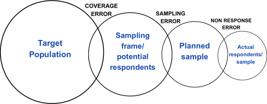
Occurs when some members of the target population are not included in or have no chance of being selected from the survey sampling frame |
| Criterion validity |
How a measure correlates with an external standard or outcome (the criterion), indicating how accurately it predicts or reflects real-world performance |
| Don't know answer |
A response option that allows participants to indicate they have no opinion, are unsure, or lack sufficient information to answer a question |
| Double-barreled question (combined questions) |
A survey item that asks about two or more issues within a single question, making it unclear which part the respondent is answering |
| Measurement error |
The difference between the true value of what is being measured and the value obtained by the survey or instrument, caused by flaws in question design, respondent interpretation, or data collection |
| Negative worded items |
Survey questions phrased with negation or in a negative form, which can be harder for respondents to interpret. They should be avoided, unless they are explicitly part of the research question (e.g., to evaluate framing effects) |
| Nonresponse error |
When individuals selected for a survey do not participate or fail to answer certain questions, the results can be biased if the nonrespondents differ systematically from respondents |
| Open form question |
Allows respondents to answer in their own words, providing detailed information but requiring more effort to analyze and code, usually with qualitative synthesis methods |
| Pilot test |
Before administering a survey, a pilot test with a small sample of the target population is necessary to identify any issues that need to be corrected before deployment. This includes the cover page, duration, formatting and any other technical issues |
| Pretesting the questionnaire |
Pretesting the survey occurs before pilot testing. During pre-testing, the other authors of the group or close colleagues should read the survey attentively, looking for questionnaire wording and formatting that may lead to incorrect answers. This includes but is not limited to possible induction of social desirability bias, double-barreled questions, acquiescence and possible ceiling and floor effects |
| Recall bias |
A type of measurement error that occurs when respondents do not accurately remember past events or experiences |
| Sampling bias |
Occurs when the sample selected for a study is not representative of the target population |
| Social desirability bias |
Occurs when respondents answer questions in a way they believe is more socially acceptable or favorable, rather than being truthful, which can distort survey results. This may be especially true for sensitive issues that the survey investigator needs to be aware of |

 Surveys in clinical research: methodological aspects and practical guidance
 Thumbnail
 Thumbnail

