Incidence of late-onset hyperlactatemia and association with clinical outcomes in intensive care patients
ABSTRACT
Objective: To perform a systematic literature review to summarise current evidence of the incidence and clinical impact of late-onset hyperlactatemia in intensive care patients about case-fatality and morbidity.
Methods: MEDLINE, EMBASE, and ClinicalTrials.gov were searched using medical subject headings from database inception to 27 November 2024. Before the search, the protocol was registered on the International Prospective Register of Systematic Reviews (PROSPERO). Two independent reviewers screened the search results, and studies were included if they were original research that assessed late-onset hyperlactatemia in critically ill patients. Risk of bias was assessed using the Newcastle-Ottawa Scale, and the data were analysed using a descriptive approach without meta-analysis.
Results: Of the 10,388 screened studies, 6 were included in the final manuscript, 5 retrospective and 1 prospective. All were assessed as good quality studies. Five were cardiac surgical patients, and one was general intensive care patients. All six studies reported the incidence of late-onset hyperlactatemia, which ranged from 8.5 to 70.8%. Two studies reported increased intensive care unit and/or hospital case-fatality with late-onset hyperlactatemia; however, small absolute numbers limited the interpretability.
Conclusion: The limited data regarding late-onset hyperlactatemia make it difficult to draw significant conclusions regarding the relationship to clinical outcomes. However, the few available studies suggest that it is a common finding and highlight the need for further research to assess the underlying aetiologies and association with clinical outcomes.
Keywords:
Lactate; Lactic acidosis; Hyperlactataemia; Shock; Critical care; Intensive care; Metabolic acidosis; Sepsis; Cardiac surgery; Adrenaline
INTRODUCTION
Elevating circulating lactate levels is frequently found in critically ill patients across various disease states. It is associated with increased case-fatality, hospital and intensive care length of stay (LOS), and morbidity.(1) Lactate is produced predominantly in skeletal muscle, skin, red blood cells, brain, and cardiac tissue as a normal byproduct of glycolysis, which crosses the mitochondrial membrane, particularly in brain and cardiac muscle, where it can be converted to pyruvate by pyruvate-lactate dehydrogenase (LDH).(1, 2) From there, lactate enters the Krebs cycle to release adenosine triphosphate (ATP), H2O, and CO2, serving as a substrate for mitochondrial respiration in brain tissue and cardiac muscle, particularly during increased metabolic demand.(1–3) Lactate is cleared primarily via hepatic and renal gluconeogenesis.(3–5)
Most studies on hyperlactatemia and lactate kinetics in critically ill patients have focused on early-onset hyperlactatemia, defined as hyperlactatemia present on admission to the hospital or intensive care unit (ICU). In the setting of sepsis, burns, cardiogenic shock, and trauma, early onset hyperlactatemia and slow or absent lactate clearance are associated with increased case-fatality and poorer outcomes.(3,4,6,7) Lactate > 2mmol/L is diagnostic for septic shock in the latest definitions, and > 4mmol/L is considered severe, with > 27% in-hospital case-fatality.(8) In the setting of trauma, early-onset hyperlactatemia is common, largely due to decreased tissue perfusion secondary to blood loss, and has an association with morbidity and case-fatality. Monitoring of lactate clearance in the setting of early-onset hyperlactatemia can guide resuscitation and potentially predict prognosis.(2,3,8,9)
However, in non-Cohen-Woods Type A settings, early-onset hyperlactatemia reflects an imbalance between production and clearance of lactate and demonstrates mixed associations with case-fatality and morbidity. Critical illness is a complex, evolving journey, and lactate production and clearance are dynamic processes, necessitating ongoing assessment throughout the course of hospital and ICU admission.(4,10) Late-onset hyperlactatemia is defined as the development of increased lactate after admission to the ICU with a normal lactate or initial clearance with a secondary rise. The epidemiology of late-onset hyperlactatemia is poorly characterised, with limited understanding of its risk factors and association with clinical outcomes.(11) It is hypothesised that the aetiologies and prognosis of late-onset hyperlactatemia would differ from early-onset hyperlactatemia, with late-onset potentially heralding the occurrence of secondary complications in the patient's journey.
This systematic review was performed to determine the incidence and associations with clinical outcomes of late-onset hyperlactatemia in critically ill patients.
METHODS
Objectives
The primary objective of this systematic review was to assess whether late-onset hyperlactatemia in intensive care patients is associated with increased landmark case-fatality. Secondary objectives were to evaluate the incidence of late-onset elevated serum lactate concentration and to determine whether late-onset hyperlactatemia (as defined by individual studies) in intensive care patients is associated with worsened clinical outcomes, such as ICU and hospital LOS.
Methods
We conducted a systematic review of published studies without meta-analysis. It has been reported here per the Preferred Reporting Items for Systematic Review and Meta-Analysis (PRISMA) statement.(12) The protocol was registered on the International Prospective Register of Systematic Reviews (PROSPERO) on 6 December 2024 (PROSPERO ID: 623118).
Inclusion and exclusion criteria
Studies were included if they were original research (cohort studies or randomised trials) that assessed adult and/or paediatric intensive care patients with either a normal lactate on ICU admission or an elevated lactate that cleared with a subsequent secondary rise. All published biochemical thresholds and temporal definitions for late-onset hyperlactatemia were included.
The primary outcome was landmark case-fatality measured at any time point. Secondary outcomes included the incidence of late-onset hyperlactatemia, risk factors for late-onset hyperlactatemia, and ICU and hospital LOS. Studies that did not assess any of the outcomes of interest or were systematic reviews, editorials, or opinion articles were excluded.
Literature search
A search strategy was designed using medical subject headings (MeSH) and relevant text words to search the online databases MEDLINE and EMBASE, and clinical trials registry ClinicalTrials.gov, from database inception until the date of search – Monday 27 November 2024. The search was supplemented by checking the references of included articles from the database and clinical trials registry search, and a grey literature search was performed to identify other research that cited any of the included articles. The search strategy was formulated in collaboration with the acknowledged medical librarian and is detailed in tables 1S, 2S, and 3S (Supplementary Material).
Study selection
The literature search results were exported and assessed using Rayyan (http://rayyan.qcri.org) and EndNote 21™. Two authors independently screened titles and abstracts of the articles identified in the literature search, obtaining full texts when necessary and comparing them to the predetermined inclusion and exclusion criteria. Discrepancies in study screening were resolved by review by a third author. Data from the relevant articles was extracted into a pre-formulated and pilot-tested extraction template.
Risk of bias assessment
The quality of individual studies was appraised using the Cochrane Risk of Bias tool Version 2 (RoB 2)(13) for randomized controlled trials and the modified Newcastle Ottawa Scale (NOS)(14) for all other study types. Two reviewers conducted the quality assessment independently, with any discrepancies resolved by a third author. The NOS was scored out of nine stars.(14)
Data analysis
It was anticipated that data pooling for meta-analysis would be challenging given the expected dearth of literature on this topic and variability in definitions for late-onset hyperlactatemia. Instead, we planned a descriptive approach to synthesis and describe the results from the included studies without meta-analysis.(15)
RESULTS
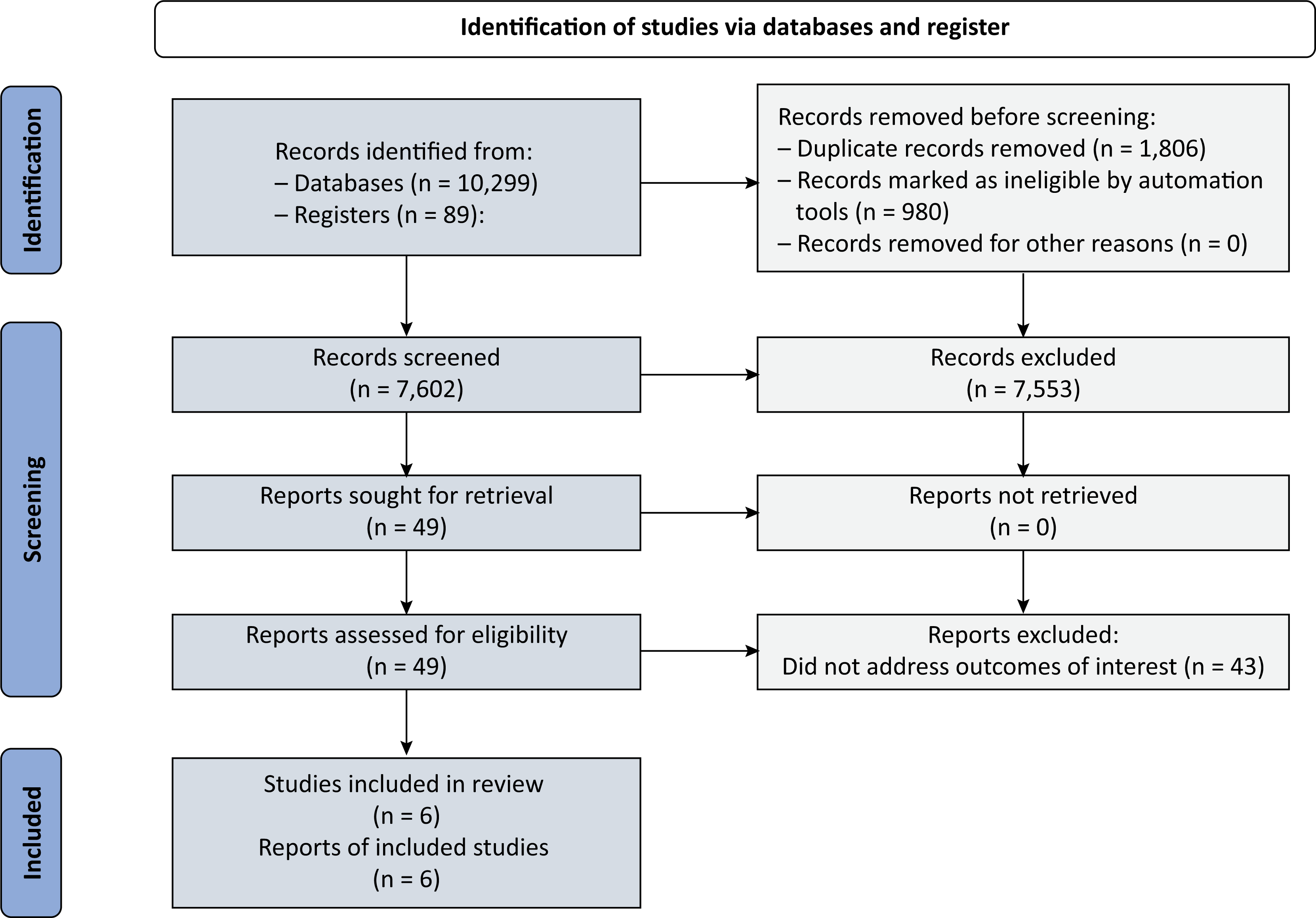
The search strategy is summarized in the PRISMA flow diagram in figure 1 and described in detail in tables 1S - 3S (Supplementary Material). Initial database search yielded 10,299 titles and abstracts for screening, with an additional 89 titles from ClinicalTrials.gov. Grey literature search did not yield any additional results. After removal of duplicates, non-English and non-human studies, 7,602 studies were screened. From these, 49 full-text articles were assessed for eligibility, of which 43 were excluded as they did not address the outcomes of interest. The remaining six studies were included in the final analysis. Due to a lack of standard primary outcome measures, descriptive data analysis was performed, and separate summaries were produced of the data about the following outcomes: ICU and hospital case-fatality, as well as risk factors for late-onset hyperlactatemia. Specific details of the search strategy and detailed characteristics of the included studies are provided in the Supplementary Material.

Preferred Reporting Items for Systematic Review and Meta-Analysis (PRISMA) diagram for incidence of late-onset hyperlactatemia and case-fatality.(12)
Study methodology and population
The study characteristics and outcomes are summarized in table 1. No studies were identified with patients with early-onset hyperlactatemia that cleared with a subsequent secondary rise. Five studies included cardiac surgery patients, and one study by Khosravani et al.(16) reviewed late-onset hyperlactatemia in critically ill adults. Studies by Jackman et al.(17) and Bowers et al.(18) assessed late-onset hyperlactatemia in paediatric cardiac surgery patients, and the other three studies were conducted in adult populations. Five studies had a retrospective, observational methodology, and one by Maillet et al.(19) prospectively reviewed late-onset hyperlactatemia in cardiac surgical patients. All six studies were assessed as being high-quality studies by the NOS, as outlined in table 4S (Supplementary Material).
Definition and incidence of late-onset hyperlactatemia
The definition of late-onset hyperlactatemia varied between the studies regarding lactate cutoff and timing of onset. Bowers et al.(18) and Khosravani et al.(16) defined late-onset hyperlactatemia as lactate > 2mmol/L after admission to intensive care. Aubourg et al.(20) and Jackman et al.(17) utilized a lactate cutoff of ≥ 3mmol/L, while Algarni(21) and Maillet et al.(19) utilized a lactate cutoff of > 3mmol/L to define hyperlactatemia. The timing of onset varied from 1 - 10 hours postoperatively in the study by Algarni,(21) to 2.6 days from ICU admission in the study by Khosravani et al.(16) All six studies reviewed the incidence of late-onset hyperlactatemia in their included populations, with the reported incidence ranging from 8.5 to 70.8%. Maillet et al.(19) included patients with early-onset hyperlactatemia in the incidence calculation, and the remaining studies excluded these patients from the calculation. The lactate cutoffs, timing and incidence data are summarized in table 1.
Intensive care unit and hospital case-fatality
Two studies reviewed case-fatality in the ICU, hospital, or both. Aubourg et al.(20) noted no statistically significant increase in case-fatality in the late-onset hyperlactatemia group (2/395 [0.5%] versus 1/37 [2.7%]; p = 0.615) in a cardiac surgical population. Khosravani et al.(16) in a critically ill population reported significantly increased hospital case-fatality for patients developing late-onset hyperlactatemia compared to those who did not (101/520 [27%] versus 188/5094 [4%]; p < 0.001).
Risk factors for late-onset hyperlactatemia
Two studies assessed risk factors for late-onset hyperlactatemia, both in post-cardiac surgery patients. Aubourg et al.(20) found risk factors for late-onset hyperlactatemia to be afternoon surgery time (OR 6.22; 95%CI 2.84 - 14.45; p < 0.001), > 300mL blood loss in the first 6 hours (OR 3.17; 95%CI 1.41 - 7.11; p = 0.005), and vascular fluid loading > 250mL in the first 6 hours (OR 2.16; 95%CI 0.99 - 4.73; p = 0.053). Maillet et al.(19) noted risk factors for late-onset hyperlactatemia to be post-operative hyperglycaemia (OR 4.4; 95%CI 2.2 - 8.9) and post-operative adrenaline administration (OR 6.0; 95%CI 2.2 - 16.4).
Other outcomes
Two cardiac surgical studies assessed post-operative complications in patients with late-onset hyperlactatemia. Aubourg et al.(20) noted a significantly increased risk of a composite criterion for severe postoperative complications, including circulatory failure, prolonged ventilation, acute kidney injury (AKI), need for red cell transfusion and increased postoperative bleeding (61/395 [8%] versus 8/37 [21%]; p < 0.001). Maillet et al.(19) noted an increased risk of a composite outcome for significant complications with late-onset hyperlactatemia (38/202 [19.2%] versus 18/56 [35.3%]; p < 0.05), including myocardial infarction, low cardiac output, neurologic complications, renal injury, and infections. Bowers et al.(18) noted higher vasoactive usage in paediatric patients with late-onset hyperlactatemia, measured as the peak vasoactive-inotropic score within the first 24 hours (median 8 [IQR 0 - 8] versus 5 [0 - 8]; p = 0.002).
DISCUSSION
Key findings
This review found a limited number of studies assessing late-onset hyperlactatemia; however, the evidence suggests that it is a common occurrence in critically ill patients, particularly in the cardiac surgical setting. Risk factors in cardiac surgical patients may include hyperglycemia, adrenaline use, surgical timing, and surgery-associated blood loss. The effect of late-onset hyperlactatemia on clinical outcomes, such as case-fatality, LOS, and post operative complications, remains uncertain. Case-fatality calculations were based on tiny absolute numbers of events, limiting their interpretability.
Importance of findings
Early-onset hyperlactatemia has a known association with increased case-fatality and poorer clinical outcomes in critically ill patients with sepsis, burns, trauma and cardiac arrest.(6,8,22–24) However, the production and clearance of lactate is a dynamic process that can evolve during an ICU stay and requires ongoing assessment.(8,10) The development and clinical significance of hyperlactatemia in critically ill patients with previously normal lactate is an unexplored area, largely limited to cardiac surgical patients.(16–20) In this setting, late-onset hyperlactatemia is believed to be due to non-pulsatile perfusion associated with cardiopulmonary bypass, independent of hypoperfusion, with potential causes including low cardiac output, systemic inflammatory response with microcirculatory failure, hepatic ischemia, and administration of exogenous catecholamines.(11,25) The results are mixed; however, most of the included studies suggest that late-onset hyperlactatemia in this setting is clinically benign.(17,19,21)
In contrast, the single study including general critically ill patients demonstrated significantly increased case-fatality for patients with late-onset hyperlactatemia. The aetiologies for late-onset hyperlactatemia in this heterogeneous group were not reported and remain unclear, with multiple potential contributing aetiologies.(16) The development of late-onset hyperlactatemia could herald the occurrence of complications in the patients’ intensive care journeys. Critically ill patients can develop complications such as bleeding, hospital-acquired sepsis, or acute coronary syndromes, which may precipitate a type A hyperlactatemia.(3,4,8,26) Alternatively, the development of organ dysfunctions such as liver and renal dysfunctions may cause Type B1 hyperlactatemia. Nutritional deficiencies, such as thiamine deficiency, are common in critically ill patients and can also contribute, along with comorbidities such as diabetes mellitus, which is associated with hyperlactatemia at baseline.(3,4,27) Larger studies are required to explore the causes and associations in this population.
Depending on the aetiology, hyperlactatemia may not consistently herald poorer outcomes.(6,9) Medications used in the intensive care unit, including salbutamol and adrenaline can be associated with a Type B2 hyperlactatemia, with adrenaline use also reported as a risk factor for hyperlactatemia by Maillet et al.(19) A study by Omar et al.(28) assessed lactate rise with the use of adrenaline in septic patients and demonstrated a paradoxically reduced case-fatality with increasing lactate to adrenaline ratio.(19,24,28) In this setting, a lactate rise may indicate pharmacological effectiveness of adrenaline, which is known to increase Na/K/ATPase activity, thereby raising cAMP production and glycogenolysis, with ensuing lactate accumulation. In this setting, lactate is part of a complex interdependent system, and the capacity for lactate production to increase in response to stimulus may paradoxically indicate health reserve.(3,4,28)
Limitations
Our study has several limitations that warrant discussion. It is limited by the small number and heterogeneity of the studies. Of the studies, all but one focused on cardiac surgery, rather than encompassing the breadth of critical care. The strict inclusion criteria for a specific systematic review question led to a high exclusion rate, as studies without a clear temporal separation of lactate rise were excluded. We acknowledge that this, along with excluding non-English language studies, raises the possibility of selection and publication bias and limits the generalizability of our findings. Furthermore, there is a possibility that not all relevant studies were found in our search. Other potential sources of bias include sampling bias.
A further limitation is that the underlying patient cohorts are heterogeneous, with potential for varying aetiologies of late-onset hyperlactatemia. The studies all had differing definitions of late-onset hyperlactatemia in terms of lactate cutoff and temporal definitions. This likely contributes to the wide variation in reported incidence of late-onset hyperlactatemia. This was further affected by non-standardized calculations of incidence, which may contribute to classification bias. Only four included studies reported data on patient outcomes, with just two reporting on the primary outcome of hospital case-fatality. In most cases, mortality data were derived from small absolute numbers, restricting the ability to draw robust conclusions.
Future directions
This review highlights the paucity of data surrounding late-onset hyperlactatemia in critical care. Early-onset hyperlactatemia has been extensively studied and is clearly associated with increased case fatality and poor clinical outcomes; however, data regarding the incidence and clinical impacts of late-onset hyperlactatemia are sparse. Further prospective research is required to standardize the definitions of late-onset hyperlactatemia, characterize the epidemiology, explore the biochemical aetiologies in multiple intensive care populations, and differentiate between benign and malignant late-onset hyperlactatemia.
CONCLUSION
Late-onset hyperlactatemia is common in critically ill patients; however, its clinical significance remains uncertain. Further research is required in this area to elucidate the aetiologies and impact, guiding prevention and treatment strategies.
Supplementary Materials
Supplementary material 1
ACKNOWLEDGMENTS
We acknowledge Jeremy Van Dorsselaer, Logan Hospital Librarian, Queensland Health, for his contribution.
AVAILABILITY OF DATA AND MATERIALS
The contents are already available.
REFERENCES
- 1 Iepsen UW, Plovsing RR, Tjelle K, Foss NB, Meyhoff CS, Ryrsø CK, et al. The role of lactate in sepsis and COVID-19: Perspective from contracting skeletal muscle metabolism. Exp Physiol. 2022;107(7):665-73.
- 2 Loo M, Iturriagagoitia X, Limmen J, Vandenheuvel M, Hert S. Lactate and hyperlactatemia revisited: an overview. Acta Anaesthesiol Belg. 2023;74(1):23-34.
- 3 Zaidi N. Hyperlactatemia and lactic acidosis-a review. Morecambe Bay Med J. 2016;7(8):194-7.
- 4 Vieira IH, Petrova M, Moura JP. Does the same hyperlactatemia cut-off in the context of acute diseases hold the same meaning in diabetes mellitus? Cureus. 2022;14(5):e25163.
- 5 Minton J, Sidebotham DA. Hyperlactatemia and cardiac surgery. J Extra Corpor Technol. 2017;49(1):7-15.
- 6 Kumar A, Doola R, Zahumensky A, Shaikh A, Tabah A, Laupland KB, et al. Association between elevated lactate and clinical outcomes in adults with diabetic ketoacidosis. J Crit Care. 2023;78:154377.
- 7 Pino RM, Singh J. Appropriate clinical use of lactate measurements. Anesthesiology. 2021;134(4):637-44.
- 8 Deulkar P, Singam A, Mudiganti V, Jain A. Lactate monitoring in intensive care: a comprehensive review of its utility and interpretation. Cureus. 2024;16(8):e66356.
- 9 Kumar A, Anstey C, Doola R, Mcllroy P, Whebell S, Shekar K, et al.; Queensland Critical Care Research Network (QCCRN). Associations between late lactate clearance and clinical outcomes in adults with hyperlactataemia in the setting of diabetic ketoacidosis. J Clin Med. 2024;13(16):4933.
- 10 Levy B, Girerd N, Baudry G, Duarte K, Cuau S, Bakker J, et al.; HYPO-ECMO trial group and the International ECMO Network (ECMONet). Serial daily lactate levels association with 30-day outcome in cardiogenic shock patients treated with VA-ECMO: a post-hoc analysis of the HYPO-ECMO study. Ann Intensive Care. 2024;14(1):43.
- 11 O’Connor E, Fraser JF. The interpretation of perioperative lactate abnormalities in patients undergoing cardiac surgery. Anaesth Intensive Care. 2012;40(4):598-603.
- 12 Moher D, Liberati A, Tetzlaff J, Altman DG; PRISMA Group. Preferred reporting items for systematic reviews and meta-analyses: the PRISMA statement. PLoS Med. 2009;6(7):e1000097.
- 13 Sterne JA, Savović J, Page MJ, Elbers RG, Blencowe NS, Boutron I, et al. RoB 2: a revised tool for assessing risk of bias in randomised trials. BMJ. 2019;366:l4898.
-
14 Wells GA, Shea B, O’Connell D, Peterson J, Welch V, Losos M, et al. The Newcastle-Ottawa quality assessment scale case control studies. Available from: https://www.ohri.ca/programs/clinical_epidemiology/nosgen.pdf
» https://www.ohri.ca/programs/clinical_epidemiology/nosgen.pdf - 15 Campbell M, McKenzie JE, Sowden A, Katikireddi SV, Brennan SE, Ellis S, et al. Synthesis without meta-analysis (SWiM) in systematic reviews: reporting guideline. BMJ. 2020;368:l6890.
- 16 Khosravani H, Shahpori R, Stelfox HT, Kirkpatrick AW, Laupland KB. Occurrence and adverse effect on outcome of hyperlactatemia in the critically ill. Crit Care. 2009;13(3):R90.
- 17 Jackman L, Shetty N, Davies P, Morris KP. Late-onset hyperlactataemia following paediatric cardiac surgery. Intensive Care Med. 2009;35(3):537-45.
- 18 Bowers PJ, Daley M, Shrimpton NY, Mattke A, Shikata F, Betts K, et al. Hyperlactataemia following crystalloid cardiopulmonary bypass priming in paediatric cardiac surgery-benign or malignant? A retrospective study. Children (Basel). 2024;11(11):1379.
- 19 Maillet JM, Le Besnerais P, Cantoni M, Nataf P, Ruffenach A, Lessana A, et al. Frequency, risk factors, and outcome of hyperlactatemia after cardiac surgery. Chest. 2003;123(5):1361-6.
- 20 Aubourg C, Collard A, Léger M, Gros A, Fouquet O, Sargentini C, et al. Risk Factors and consequences of late-onset hyperlactatemia after cardiac surgery with cardiopulmonary bypass: a single-center retrospective study. J Cardiothorac Vasc Anesth. 2022;36(11):4077-84.
- 21 Algarni KD. The effect of hyperlactatemia timing on the outcomes after cardiac surgery. Cardiothorac Surg. 2020;28(1):18.
- 22 Cetin M, Kilic TY, Yesilaras M, Uz I. Clinical utiliy of serum lactate levels in diabetic ketoacidosis in adult patients admitted to emergency department. 2022. Ann Med Res. 2022;29(8):827-30.
- 23 Cox K, Cocchi MN, Salciccioli JD, Carney E, Howell M, Donnino MW. Prevalence and significance of lactic acidosis in diabetic ketoacidosis. J Crit Care. 2012;27(2):132-7.
- 24 Masharani U, Strycker LA, Lazar AA, Wu K, Brooks GA. Hyperlactatemia in diabetic ketoacidosis. Diabet Med. 2022;39(4):e1472325.
- 25 O’Connor ED, Fraser JF. Hyperlactatemia in critical illness and cardiac surgery. Crit Care. 2010;14(3):421.
- 26 Jackson M, Cairns T. Care of the critically ill patient. Surgery (Oxford). 2021;39(1):29-36.
- 27 Morgan TJ, Scott PH, Anstey CM, Bowling FG. Hyperlactatemia in diabetic ketoacidosis is common and can be prolonged: lactate time-series from 25 intensive care admissions. J Clin Monit Comput. 2021;35(4):757-64.
- 28 Omar S, Burchard AT, Lundgren AC, Mathivha LR, Dulhunty JM. The relationship between blood lactate and survival following the use of adrenaline in the treatment of septic shock. Anaesth Intensive Care. 2011;39(3):449-55.
Edited by
-
Responsible editor:
Otavio Ranzani https://orcid.org/0000-0002-4677-6862