 Conventional breeding and industrial profile of a special Papaver somniferum L. cultivar for dual use
Abstract
This research outlines the development of a specialized cultivar of the opium poppy (Papaver somniferum L.), designed for dual purposes. The primary goal was to breed a variety well-adapted to specific environmental conditions, with a focus on producing poppy straw rich in morphine for industrial applications. Progeny evaluation was conducted using selection and pedigree methods, with morphological characteristics assessed according to UPOV TG 166/4 guidelines. Six years of selection resulted in the material becoming homogenized and stabilized. The progeny achieved an average morphine content of 1.31% to 1.55%, with the best lines reaching up to 2.00%. These stable lines formed the foundation for the approval process. Following successful evaluations in Slovak state variety trials, the cultivar Senmorteco was officially registered. This variety serves a dual purpose: producing poppy straw for morphine extraction and poppy seeds for food use.
Keywords:
Alkaloids; environmental conditions; morphine; poppy straw and seeds; selection breeding
INTRODUCTION
Poppy is cultivated worldwide for both pharmaceutical and food purposes (Bernáth 1998). Currently, the legal cultivation of poppies for alkaloid production occurs in seven countries. In 2019, the total area of legally cultivated poppy fields for alkaloid production spanned 93,661 hectares (INCB 2020). Among these, Australia (7,450 ha), France (7,541 ha), and Spain (9,452 ha) grow opium poppies rich in morphine, thebaine, and codeine. Hungary (3,100 ha) focuses on morphine and thebaine-rich varieties, while India (6,107 ha), Slovakia (3,500 ha), and Turkey (56,511 ha) cultivate opium poppies primarily for morphine production (INCB 2020). These alkaloids are extracted from the concentrate of poppy straw (CPS). Notably, in India, raw opium is legally produced for pharmaceutical use (Sharmma et al. 2002), which involves collecting latex by incising the epidermal wall of green, immature capsules to a depth of 1 to 2 mm (Mishra et al. 2013).
Slovakia is one of the seven countries authorized to grow poppies for CPS production. The cultivation and use of poppy in Slovakia are governed by the 1998 Law 139 on Narcotic and Psychotropic Ingredients and Products, along with subsequent amendments (Fejér and Šalamon 2014). Poppy has a long-standing history as a traditional crop in Slovakia, dating back to the 4th-5th centuries, when it was introduced by Slavic tribes during the migration period. Large-scale cultivation for oil production began in the early 19th century after olive plantations in southern France were catastrophically damaged (Špaldon 1982). Initially, poppy cultivation was focused on producing seeds for food, with poppy straw being a secondary by-product. The organized cultivation of poppy to utilize its straw spurred the establishment of a pharmaceutical company for morphine production in Bratislava in 1941. Between 1946 and 1949, production was relocated to Hlohovec, where it continues today under Saneca Pharmaceuticals a.s. (Fejér and Šalamon 2013).
Bernáth and Németh (2009) highlight that the varietal base of poppy cultivation varies by region. In areas with highly developed industrial production, such as Western Europe and Australia, patented varieties are commonly used without formal variety registration by Plant Variety Protection (PVP) authorities. Conversely, in Central European countries, bred varieties are registered with national variety offices. These authorities evaluate candidate varieties based on the DUS (Distinctness, Uniformity, and Stability) test guidelines for Papaver somniferum (TG 166/4, 2014; www.upov.int). Poppy breeding in Slovakia dates back to 1948 and has historically focused on developing universal (dual-purpose) varieties suited for both seed and poppy straw production. This effort has led to significant achievements, resulting in new varieties with high seed yield potential, reaching up to 2.0 t/ha (Fejér et al. 2021), and the ability to accumulate 0.4% to 0.6% morphine in dry capsules (Fejér 2007). Labanca et al. (2018) also reference the dual-purpose nature of these varieties, including those developed in Slovakia (Figure 1). However, the poppy straw produced by Slovak varieties in large-scale cultivation historically exhibited a low morphine content. From 1970 to 2005, the average morphine content of poppy straw in Slovakia was just 0.301% (Fejér and Šalamon 2013), which is insufficient for efficient alkaloid extraction. Attempts to introduce foreign varieties with higher morphine content-originating from Poland, Hungary, and France-into Slovak cultivation practices were unsuccessful. These varieties proved unsuitable for Slovak climatic conditions or could only be grown in limited regions, such as southern Slovakia.
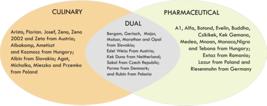
Venn diagram depicting the purposes and uses of poppy varieties (Source: Labanca et al. 2018).
Poppy breeding in Slovakia is conducted by research institutions rather than pharmaceutical companies. This has led to notable successes, including the development and registration of several food-grade varieties (Fejér 2014, Fejér et al. 2021). However, due to their medium morphine content, these varieties are not suitable for pharmaceutical purposes. To address this limitation, the pharmaceutical company Saneca Pharmaceuticals a.s., based in Hlohovec, Slovakia, initiated a breeding program aimed at developing a variety with a higher morphine content in the poppy straw. This study presents the outcome of several years of breeding efforts, culminating in the registration of a new, specialized variety named Senmorteco. Senmorteco is well-suited to the soil and climatic conditions of Slovakia and serves a dual purpose, being capable of producing both seeds and poppy straw. However, its primary focus is industrial use, as its poppy straw can accumulate up to 1.50% morphine in dry capsules. This level of morphine content is considered optimal for current extraction technologies.
MATERIAL AND METHODS
Characteristics of the experimental field
Field experiments were conducted in Kapušany (lat 49° 02' 37" N, long 21° 19' 59" E, alt 275 m asl), Slovakia. The experimental site lies in a relatively warm, moderately dry, and continental climatic region. Key climatic characteristics include a temperature sum >10 °C ranging from 2800-2500, a period of 224 days with air temperatures ≥5 °C, and an average air temperature during the growing season (April-September) of 14-15 °C.
The soil type at the experimental plot is fluvisol clay, classified as medium heavy. The terrain is flat, with potential for surface water erosion (slope 1-3°). The soil lacks significant skeletal content (less than 10% skeletal material to a depth of 0.6 m) and is considered deep (≥0.6 m). The soil is loamy, with a granular fraction content <0.01 ranging from 30-45%. These characteristics align with the ecological soil units described by Džatko and Sobocká (2009) and the Podný portal database (2024).
Plant material and breeding goals
This study utilized an opium poppy line derived from a spontaneous cross of unknown varieties in 2009 (y0). The line was selected from field trials evaluating both domestic and foreign poppy varieties. The parentage is thought to be a cross between the high-morphine Hungarian strain Botond and a Slovakian food-grade strain with medium morphine content in capsules (Major or Maraton).
The breeding program began with the progeny (F1) of the Botond variety, with the primary objective of increasing morphine content in dry capsules to a target of 1.50%. Other important breeding objectives, such as agronomic traits and adaptability, were also considered (Vašák 2010, Fejér 2014).
Methods of field experiments and plant evaluation
The selection of lines with higher morphine content began in 2010, with field trials conducted from 2013 to 2019. The selection and pedigree methods (Chloupek 2008) were employed to breed a high-morphine-content poppy variety. Annually, 200 plants were initially selected in the field. Following this, a significant proportion was excluded in the laboratory based on morphological characteristics. Ultimately, 25-52 plants (an average of 33) were evaluated each year. Due to the limited number of seeds available from each plant, offspring were evaluated in 20 m2 plots with a single replication. The breeding methods are illustrated in Figure 2.

Selected plants were further evaluated in subsequent field experiments by assessing their progeny against established breeding objectives. The evaluation used basic mathematical and statistical tools, including arithmetic mean, standard deviation, maximum and minimum values, range of variation, and variability. To identify superior plants, the standard deviation was added to the mean one, two, or three times. Plants with a higher morphine content than the better-performing parent or exceeding the mean of the evaluated group were selected (Boháč et al. 1990, Fejér et al. 2018).
Morphological and economic characteristics were assessed by using the International Union for the Protection of New Varieties of Plants (UPOV) Test Guidelines (TG 166/4, 2014) to confirm the distinctness, uniformity, and stability (DUS) of the new varieties.
HPLC analysis
Poppy straw (dried capsules) was analyzed using either a Waters Alliance 2695 or Waters Acquity system, equipped with an X-Bridge C18 column (100 mm × 4.6 mm, 3.5 μm). The mobile phase consisted of:
Phase A: 1.01 g of sodium heptane sulfonate R dissolved in 1,000 mL of water R, with the pH adjusted to 2.6 by using a 50% v/v phosphoric acid R solution;
Phase B: Methanol.
The flow rate was set to 1.5 mL/min, and UV detection was performed at 230 nm. A 2 μL sample was injected, with the column maintained at 35 °C. The total running time was 10 minutes.
Morphine content was quantified and purity assessed using an external standard. All analyses were conducted in the laboratory of Saneca Pharmaceuticals a.s., Hlohovec, Slovak Republic.
RESULTS AND DISCUSSION
Morphine content
The selected poppy line was evaluated over three years (2010-2012, y1-y3; Figure 2), achieving an average morphine content in dry capsules ranging from 0.78% to 0.94%. Variability among line populations was relatively high, ranging from 32.13% to 45.48%. The maximum morphine content observed during this period was between 1.20% and 1.50%. Lines with the highest morphine levels were prioritized for further evaluation in field trials and subsequent analysis.
The results are summarized in Table 1. Over the following three years (2013-2015, y4-y6; Figure 2), the process of homozygotization successfully stabilized the average morphine content at approximately 1.0%. In the best-performing plants, the maximum alkaloid content ranged from 1.44% to 1.87% (Table 1, Figure 3). Evaluation was based on the average morphine content of all plants tested, calculated as the mean plus the standard deviation. Despite stabilization efforts, variability in morphine content remained considerable, ranging from 23.31% to 36.80%.

Seed multiplication plots were established from stabilized lines in 2015 (y6; Figure 2) to increase seed availability. From 2016 to 2018 (y7-y9; Figure 2), the poppy line was evaluated under the designation SA-02 in state variety trials conducted by the Central Control and Testing Agency for Agriculture. During these trials, breeding efforts continued, focusing on selecting individual plants and evaluating their progeny.
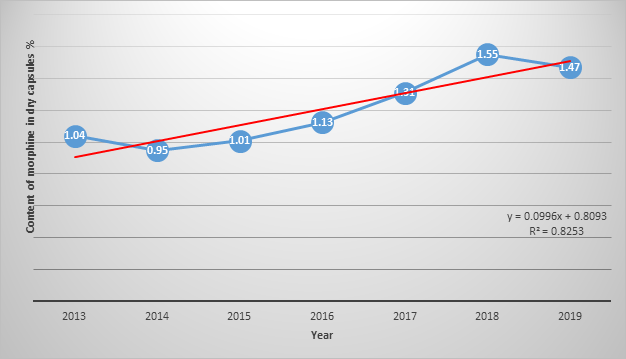
Since 2016, the average morphine content in dry capsules steadily increased, reaching 1.13% in 2016 and ultimately stabilizing between 1.50% and 1.55%, aligning with the upper target set for the breeding objectives. Maximum morphine content measured during this period ranged from 1.61% to 1.99% (Table 1, Figure 3). Repeated selection efforts effectively reduced variability in morphine content, from 27.08% in 2016 to between 15.07% and 16.26% during 2017-2019, representing a significant improvement.
Parental identity zones refer to selected material exhibiting traits identical to the better parent (P+) or worse parent (P-) for a specific characteristic. This approach is applied during the selection process in hybrid generations of poppy breeding (Boháč et al. 1990). The identity zones are calculated using the following formulas:
Where = average value and = = standard deviation.
By adding the standard deviation one, two, or three times to the average, breeders can select plants with higher performance relative to the better parent. Similarly, comparisons can be made with the average performance of the evaluated group (Fejér et al. 2018). These selections must be verified in the progeny of the selected plants to ensure the stability of the trait.
In early generations of plant breeding, breeders often work with unreplicated trials consisting of many genotypes and limited seed quantities (Clarke and Stefanova 2011). In such cases, the standard method of field trial design is the randomized complete block design (RCBD). However, alternative experimental designs have been shown to better meet specific plant breeding objectives (Zystro et al. 2019). In this study, due to the limited availability of seed, breeding trials were designed without replication.
The pedigree breeding method has proven highly effective in combining and refining desirable traits in poppy, such as increased capsule yield, improved seed and opium yields, and resistance to fungal attacks (Levy and Milo 1998). According to Chloupek (2008), one key advantage of this method is the early exclusion of unsuitable genotypes during the initial selection stages. Additionally, the genetic lineage of selected plants (lines) is preserved, enabling precise and targeted selection. Voškeruša (1965) observed that hybrid generations stabilize within 4-6 generations using pedigree selection, as heterogeneity is eliminated during this process. In the present study, morphine content stabilization occurred after six years, with subsequent increases reaching the set breeding target of 1.50%.
Various methods are employed in poppy breeding depending on specific objectives (Vašák 2010). For instance: 1) chemomutagenesis and radiomutagenesis have successfully bred varieties with specific traits, such as thebaine production (Fist 2001) and varieties devoid of opium alkaloids (Sharma et al. 1999); 2) Mutagenesis has also been used to achieve pollen sterility (Nasem and Kumar 2013); 3) in Eastern Europe, conventional breeding methods have enhanced seed yields, morphine content, and alkaloid profiles (Kapoor 1995).
Globally, two main industrial types of poppy varieties exist: those grown for poppy straw production (Europe, Australia) and those for opium production (India and other Asian countries). Since the 1950s, the focus in Europe has been on increasing the morphine content in poppy straw. This effort has progressively raised morphine levels from an initial 1.0% to over 2.0% (Bernát and Németh 2009).
Vlk et al. (2011) evaluated 30 cultivars from the Common European Catalog and identified three with morphine levels above 1.50% (Postomi, Botond, Budha), ranging from 1.73% to 2.22%. Yazici and Yilmaz (2021) conducted two-year field trials evaluating nine parent varieties and 36 breeding lines. The average morphine content in the parent varieties was 0.67% and 0.92%, respectively. Morphine levels in these varieties ranged from 0.35% to 1.30% in one group and from 0.40% to 1.85% in the other. The findings from our study are consistent with these trends. During the fourth to sixth years of homozygotization (2014), morphine content ranged from 0.47% to 1.87%. Continued selection efforts reduced the number of low-morphine plants, increased the maximum levels, and stabilized the population average at 1.44% (ranging from 1.31% to 1.55% between 2017 and 2019). By 2019, 83% of evaluated lines had morphine levels between 1.20% and 2.00%, while only 15% had levels between 1.00% and 1.20%. Remarkably, only one plant exhibited morphine content below 1.00%.
In their evaluation of 300 opium poppy accessions collected from nearly every part of the world, Dittbrenner et al. (2009) observed considerable variability in both the quantity and composition of the major alkaloids. This variability was attributed to genetic factors, environmental conditions (e.g., soil and climate), and agrotechnical measures, particularly fertilization. As noted by Fist (2001), alkaloid yield is determined by the combination of straw yield and the alkaloid content of the straw. Key factors influencing alkaloid content include genotype and nitrogen availability. In contrast, straw yield is affected by genotype, nitrogen and phosphorus nutrition, soil water balance (including rainfall), and the presence of weeds, pests, and diseases. Nastišin et al. (2022) highlighted the significant impact of seed treatment on morphine content in dry capsules. Similarly, Yadav et al. (2007) emphasized the importance of genotype-environment interactions as a critical factor in plant breeding programs before varieties are introduced into cultivation. When breeding medicinal plants, specific quality requirements must be addressed. Environmental stress can significantly inhibit growth and development while influencing the accumulation of secondary metabolites (Huang and Guo 2007). These factors underscore the need to carefully consider both genetic and environmental components in the breeding and cultivation of poppies.
Genotype and environmental conditions are key factors influencing the accumulation of morphine in poppy straw. Central European cultivars or genotypes typically accumulate between 0.4% and 0.6% morphine in dry capsules (Fejér 2007). However, industrial-type cultivars introduced from other regions have not been able to fully realize their genetic potential under Slovak environmental conditions, particularly in terms of morphine enrichment. Examples include the Polish cultivar Lazur and Hungarian cultivars such as Budha and Botond (author’s personal experience). This limitation underscored the necessity of focusing breeding efforts on developing lines with higher morphine content that are well-adapted to the soil and climatic conditions of Central Europe, including Slovakia.
Ramalho et al. (2021) emphasized the importance of breeding in expanding the range of new crop varieties, which is essential for agricultural advancement. His research highlights the significant impact of biotic and abiotic stress-exacerbated by global warming-on crop performance. Such stress influences the suitability of growing areas and necessitates the development of cultivars specifically adapted to changing environmental conditions.
Morphological traits
Morphological markers are essential tools for characterizing genetic resources and have long been utilized in breeding programs (Jiang 2013). For registering new opium poppy varieties, evaluations of distinctness, uniformity, and stability (DUS) are conducted according to UPOV guidelines (TG 166/4, 2014). The primary morphological characteristics required for variety identification are outlined in Table 2.
Dittbrenner et al. (2009) observed no significant correlation between morphological traits and alkaloid content, making these traits unsuitable as predictive tools for alkaloid levels during breeding. Furthermore, available morphological markers are limited, and many are not linked to economically important traits (Jiang 2013). Nevertheless, some studies suggest specific correlations. For instance, Kumar and Patra (2010) reported that the number of stigma rays and their area influence alkaloid content. Similarly, Pal et al. (2021) emphasized the importance of understanding epistasis effects on various traits, highlighting their role in developing effective breeding strategies for opium poppy improvement.
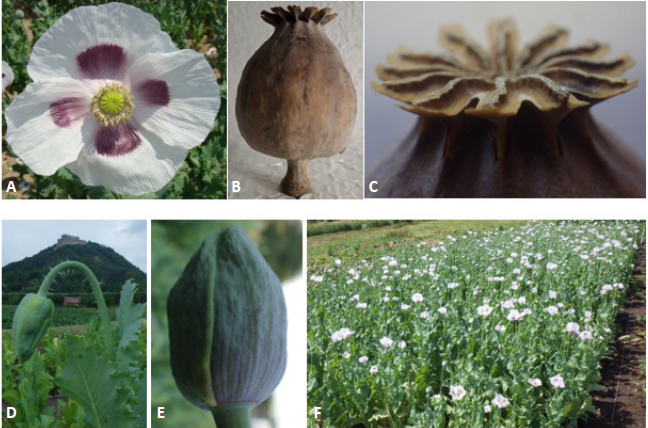
In this study, we did not investigate relationships between morphological traits and morphine accumulation. Instead, the evaluation of morphological characteristics was conducted in accordance with UPOV guidelines (TG 166/4, 2014) to fulfill the requirements for variety registration. The specific morphological traits of the Senmorteco variety, along with images of the field trials, are presented in Figures 4A-F.

Morphological descriptors of the Senmorteco variety. A. Flower: (10) petal color: white; (11) petal marking: blotch; (12) petal color of marking: medium violet; (13) petal marking extension: up to widest point; (14) petal incisions: absent. B. Capsule: (18) shape in longitudinal section: ovate; (19) shape of base: truncate; (22) ribbing: medium. C. Capsule: (23) dehiscence: indehiscent; (24) stigmatic disc shape: semi-erect; (25) stigmatic disc number of carpels: medium. D. Stem: (7) anthocyanin coloration: absent; (8) hairiness: medium. E. Bud: (9) anthocyanin coloration: present in a ring at the base only. F. Field trial.
CONCLUSION
Several years of dedicated breeding efforts have successfully resulted in the development of a new poppy variety, Senmorteco, with a higher morphine content in dry capsules and strong adaptation to the climatic conditions of Central Europe. Registered in 2019, Senmorteco is a universal (dual-purpose) variety suitable for both poppy straw and poppy seed production. Its primary purpose, however, is the production of poppy straw for morphine extraction. The variety is officially listed in the Register of Registered Varieties in the Slovak Republic and the Common European Catalogue of Varieties of Agricultural Plant Species.
ACKNOWLEDGMENTS
The present study was supported by Saneca Pharmaceuticals a.s., Hlohovec, Slovak Republic.
Data Availability
The datasets generated and/or analyzed during the current research are available from the corresponding author upon reasonable request.
REFERENCES
- Bernáth J1998 Poppy - The genus papaver. Harwood Academic Publisher, Amsterdam, 366p
- Bernáth J, Németh E1999 New trends in selection of poppy (Papaver somniferum L.). International Journal of Horticultural Science 5:69-75
- Bernáth J, Németh E2009 Poppy. In Vollman J and Rajcan I (eds) Hanbook of plant breeding. Oil crops. Springer, New York, p. 459-478
- Boháč J, Andonov I, Čermín Ľ, Vlk J1990 Šľachtenie rastlín. Príroda, Bratislava, 535p
- Chloupek O2008 Genetická diverzita, šlechtení a semenářství. Academia, Prague, 320p
- Clarke GPY, Stefanova K2011 Optimal design for early-generation plant-breeding trials with unreplicated or partially replicated test lines. Australian & New Zeland Journal of Statistics 53:461-480
- Dittbrenner A, Mock HP, Börner A, Lohwasser U2009 Variability of alkaloid content in Papaver somniferum L. Journal of Applied Botany and Food Quality 82:103-107
- Džatko M, Sobocká J2009 Príručka pre používanie máp bonitovaných pôdno-ekologických jednotiek. Výskumný ústav pôdoznalectva a ochrany pôdy, Bratislava, 101p
- Fejér J2007 Nové trendy a perspektívy šľachtenia maku siateho (Papaver somniferum L.) In Osivo a sadba, VIII. odborný a vědecký seminář, sborník referátů. Česká zemědělská univerzita, Prague, p. 122-128
- Fejér J2014 Breeding aspects of poppy in Slovakia. Acta Horticulture 1036:101-105
- Fejér J, Šalamon I2013 The tradition of poppy cultivation in Central Europe. In Šalamon I (eds) Natural sciences: Biology - ecology. Prešov University, Prešov, p. 9-22
- Fejer J, Salamon I2014 Poppy cultivation and its legalization by the governmental law in Slovakia. Acta Horticulture 1036:119-122
- Fejér J Havrlentová M, Brezinová B2018 Variabilita krajových populácii maku siateho (Papaver somniferum L.) a potenciál ich využitia pre rozšírenie genetickej diverzity pri tvorbe nových odrôd. Vydavateľstvo Prešovskej univerzity, Prešov, 102p
- Fejér J, Nastišin Ľ, Majdanová J2021 Results of oilseed poppy breeding and production potential of new varieties. Biology and Life Sciences 3:14
- Fist AJ2001 The Tasmanian poppy industry: a case study of the application of science and technology. Tasmanian Alkaloids Pty Ltd, Westbury, 10p
- Huang LQ, Guo LP2007 Secondary metabolites accumulating and geoherbs formation under environmental stress. China Journal of Chinese Materia Medica 32:277-280
-
INCB - International Narcotics Control Board2020 Supply of opiate raw materials and demand for opiates for medical and scientific purposes. Available at <Available at https://www.incb.org/incb/en/narcoticdrugs/Technical_Reports/narcotic_drugs_reports.html >. Accessed on September 13, 2024.
» https://www.incb.org/incb/en/narcoticdrugs/Technical_Reports/narcotic_drugs_reports.html - Jiang GL2013 Molecular markers and marker-assisted breeding in plants. In Anderse SB (eds) Plant breeding from laboratories to fields. IntechOpen, London, p. 45-83
- Kapoor LD1995 Opium poppy. Botany, chemistry and pharmacology. The Haworth Press, New York, 326p
- Kumar B, Patra NK2010 Genetic analysis of capsule and its associated economic traits in opium poppy (Papaver somniferum L.). Journal of Heredity 101:657-660
- Labanca F Ovesna J, Milella L2018 Papaver somniferum L. taxonomy, uses and new insight in poppy alkaloid pathways. Phytochemistry Reviews 17:853-871
- Levy A, Milo J1998 Genetics and breeding of Papaver somniferum. In Bernáth J (ed) Poppy - The genus Papaver. Harwood Academic Publishers, Amsterdam, p. 93-104
- Mishra BK Rastogi A Siddiqui A Srivastava M Verma N Pandey R Sharma NC, Shukla S2013 Opium poppy: Genetic upgradation through intervention of plant breeding techniques. In Anderse SB (ed) Plant breeding from laboratories to fields. InTechOpen, Rijeka, p. 209-238
- Nasem S, Kumar G2013 Induced desynaptic variation in poppy (Papaver somniferum L.). Crop Breeding and Applied Biotechnology 13:363-366
- Nastišin Ľ, Hozlár P, Král F, Miháliková A, Gruľová D and Fejér J2022 Influence of bio stimulants and foliar fertilizers on alkaloid accumulation in opium poppy (Papaver somniferum L.) dry capsules. In Paeratakul O (ed) Proceeding book, 5th International conference and exhibition on pharmaceutical sciences and technology (PST 2022). Thamassat university, Bangkok, p. 136-139
- Pal PK, Maurya KN, Srivastava A, Shukla S2021 Influence of epistatic effects on various traits in relation to the genetic improvement of opium poppy (Papaver somniferum L.). Journal of Applied Research on Medicinal and Aromatic Plants 25:100322
- Ramalho MAP, Marques TL, Lemos RC2021 Plant breeding in Brazil: Retrospective of the past 50 years. Crop Breeding and Applied Biotechnology 21:e382021
- Sharma JR, Lal RK, Gupta MM, Verma RK, Misra HO2002 A superior gum variety Sampada of opium poppy. Journal of Medicinal and Aromatic Plant Sciences 24:478-480
- Špaldon E1982 Rastlinná výroba. Príroda, Bratislava , 627p
-
TG 166/42014 Guidelines for the conduct of tests for distinctness, uniformity and stability. Opium/seed poppy (Papaver somniferum L.). Available at <Available at https://www.upov.int >. Accessed on September 22, 2024.
» https://www.upov.int - Vašák J2010 Mák. Powerprint, Prague, 336p
- Vlk R, Kosek Z, Šimek P2011 Výnosy máku, makoviny a obsah morfínu. In Sborník odborných seminářů “Mák v roce 2011” 10, p. 20-22
- Voškeruša J1965 Pěstování olejnin v ČSSR. Státní zemnědělské nakladatelství Praha, Prague, 327p
- Yadav HK Shukla S, Singh SP2007 Assessment of genotype ×environment iinteractions for yield and morphine content in opium poppy (Papaver somniferum L.). Acta Agronomica Hungarica 55:331-338
- Yazici L, Yilmaz G2021 Investigation of alkaloids in opium poppy (Papaver somniferum L.) varieties and hybrids. Journal of Agricultural Sciences 27:62-68
- Zystro J, Colley M, Dawson J2019 Alternative experimental designs for plant breeding. In Goldman I (eds) Plant breeding reviews. Vol. 42, John Wiley & Sons Inc, New Jersey, p. 87-117