 SNAP markers for pyramided yield and BLB resistance genes in rice
Abstract
Molecular markers are pivotal in rice breeding as they enable gene pyramiding to improve yield and disease resistance. This study reports the development and validation of Single Nucleotide Amplified Polymorphism (SNAP) markers targeting qTSN4 (yield), xa5, and Xa21 (bacterial leaf blight resistance) genes. An EF1-a primer was integrated as an internal control in multiplex PCR to enhance assay precision and distinguish allele absence from PCR failure. An annealing temperature of 60 °C and an internal control primer concentration of 0.5 µM were optimal. While the xa5-based SNAP marker failed to distinguish alleles in the tested lines, qTSN4- and Xa21-based markers successfully differentiated the parental genotypes, confirming their applicability in marker-assisted gene pyramiding. These markers were validated in 72 BC1F1 plants and showed consistent Mendelian 1:1 segregation for qTSN4 and Xa21. Markers were used to select 18 plants with positive alleles A for qTSN4 and C for Xa21.
Keywords:
Marker-assisted selection (MAS); multiplex PCR; qTSN4 gene; Xa21 gene
INTRODUCTION
Global rice production increased by 1 % from 2015 to 2024, while there was no increase in Indonesian rice production over the same period (USDA 2025). As rice is a global staple food, productivity improvement is a worldwide concern, especially as climate change diminishes productive land and increases susceptibility to diseases, such as bacterial leaf blight (BLB) caused by Xanthomonas oryzae pv. oryzae (Xoo). This disease has exacerbated significant global yield losses (Qi et al. 2025, Abdullahi et al. 2025). To bolster global food security, leveraging gene pyramiding is crucial to integrate genes that confer high productivity and robust BLB resistance. Genetic advancements depend on identifying key genes; for example, qTSN4 boosts productivity by 13-36 % in IR64 and 20 % in the Code variety (Fujita et al. 2013, Tasliah et al. 2020). Numerous Xa and xa genes exist for BLB resistance, with the national rice variety Inpari 32 (derived from IRBB64) predicted to carry vital Xa4, xa5, Xa7, and Xa21 genes (Suryadi et al. 2016, Thamrin et al. 2023, Cheng et al. 2024).
Molecular marker-assisted selection (MAS) is indispensable for efficient plant breeding, as it enables early and environmentally independent selection (Song et al. 2023). Simple sequence repeat (SSR) markers such as RM17483 and sequence tag site (STS) PTA248 have been previously used (Ashan et al. 2023, Sowmiya et al. 2024) to identify qTSN4 and Xa21, respectively. However, these markers rely on differences in DNA fragment size and require high-resolution gel electrophoresis, such as PAGE (Kristamtini et al. 2015). Moreover, many traditional markers are often distant from target genes. Recombination events can reduce the selection accuracy of such markers, leading to false-positive results (Hasan et al. 2021).
Single nucleotide amplified polymorphism (SNAP) markers offer a promising solution for detecting single nucleotide polymorphisms (SNPs), which are more abundant in the genome and are often located within or very close to target genes (Drenkard et al. 2000, Choudhury et al. 2023, Reddy et al. 2024). The SNAP marker is an allele-specific marker that can be designed for the target gene (not only in proximity, but also in the gene itself). SNAP utilizes a straightforward gel electrophoresis system based on band presence or absence, which is achieved by designing SNP-targeting primers with a specificity-enhancing mismatch near the SNP site (Drenkard et al. 2000, Reddy et al. 2024). A multiplexing approach incorporating an internal control primer pair that produces a distinguishable amplicon will ensure robust detection, confirm successful PCR, and validate the true allele-specific absence.
Three SNP locations were identified in the qTSN4 gene when comparing the IR64 and NIL-qTSN4 genotypes (Fujita et al. 2013). Additionally, two consecutive SNPs were found in the xa5 gene between the IR24, IRBB5, and Nipponbare (Iyer and McCouch 2004). To our best knowledge, while Nanayakkara et al. (2020) identified variation in the form of indels within the Xa21 gene, SNPs in the respective gene observed in resistant and susceptible rice genotypes are not available. Therefore, in developing an Xa21-based SNAP marker, identifying SNPs within the Xa21 gene from both the resistant and susceptible genotypes is a relevant step. Therefore, the objective of this study was to develop and optimize a multiplex SNAP-PCR system targeting the qTSN4 and Xa genes, and to validate its application in selecting breeding populations derived from the parental lines Inpari 32 and Code-qTSN4.
MATERIAL AND METHODS
Plant Material and DNA Isolation
The rice variety IR64 (IR5657-33-2-1 × IR2061-465 1-5-5) (Mackill and Khush 2018) served as a negative control for optimizing SNAP markers for qTSN4 and Xa21, whereas IR24 (IR8 × {(Century Patna 231 × SLO 17) × Sigadis)}) (IRRI 1972) served as the negative control for xa5. Code-qTSN4 (Code × IR64-NILs qTSN4[YP9]) (Tasliah et al. 2020) served as a positive allele control for qTSN4, IRBB21 (IR24 + Xa21) for Xa21, and IRBB5 (IR24 + xa5) for xa5 (Deng et al. 2016). The BC1F1 population (72 plants) used for SNAP marker validation was derived from 32 (male) and F1 (female) hybrids developed by Ashan et al. (2023). DNA was isolated from 100 mg of rice leaf tissue using a modified 2 % CTAB method, excluding the use of β-Mercaptoethanol and polyvinylpyrrolidone (PVP) (Aboul-Maaty and Oraby 2019). The extracted DNA quantity and quality were assessed using a Nanodrop 2000 spectrophotometer (Thermo Fisher Scientific, USA) and 1 % agarose gel electrophoresis.
SNAP Primer Design
To confirm the SNP locations in the qTSN4 gene, alignments were performed using the qTSN4 sequences from IR64 (Tanaka et al. 2020) and the Japonica group (NM_001419864) (Qi et al. 2008). Similarly, SNP confirmation for the xa5 gene involved the alignment of the IR24 (AF532975), IRBB5 (AY643716), and Nipponbare (AY643717) genotypes (Iyer and McCouch 2004). For the Xa21 gene, SNPs were identified by aligning the IR64 (Tanaka et al. 2020) and IRBB21 (U37133) genotypes (Song et al. 1995). All alignments were performed using the MUSCLE method with default parameters in the Ugene program (Okonechnikov et al. 2012). The SNP positions identified within qTSN4, xa5, and Xa21 were subsequently used to design SNAP markers.
Primers were designed to target 500 bp regions flanking each SNP using WebSNAPPER (Drenkard et al. 2000). While most parameters remained at default, the optimal amplicon length was precisely set to 325-450 bp. A critical selection criterion prioritized primers with a mismatch at the third base from the 3'-OH end. Subsequently, an OligoAnalyzer (Owczarzy et al. 2008) was employed for stringent quality control and to check for hairpin structures, self-dimers, and heterodimers. Macrogen (South Korea) was used to synthesize the primers. An additional primer, specific to the elongation factor 1 alpha (EF-1α) gene (NM_001402055.1) (Jantasuriyarat et al. 2005), was designed for PCR control in a multiplex PCR. This control primer could be used to amplify other SNAP regions of the rice genome.
PCR Optimization and Genotyping
Optimization of the PCR protocol focused on determining optimal initial concentrations of control primers (0.5 µM and 1 µM) and annealing temperatures (55, 58, 60, 65, and 68 °C). Each PCR reaction was performed in duplicate, with differences in the specific primers used for each replicate, and each reaction had a final volume of 10 µL. For each 10 µL PCR reaction, 5 ng µL-1 DNA template, 1 µM specific and universal SNP primers, and the control primer were added, along with 1× GoTaq Green Master Mix (Promega, USA). The thermal cycling protocol, consisting of 30 cycles, was structured as follows: an initial denaturation at 95 °C for 3 min; subsequent denaturation at 95 °C for 30 sec; annealing for 30 sec; elongation at 72 °C for 45 sec; and a final elongation step at 72 °C for 5 min. Amplified products were resolved by electrophoresis on a 1 % agarose gel for 30 min at 100 volts, and band sizes were estimated using a 100 bp Plus DNA Ladder (VC, Malaysia). Genotyping results in the BC1F1 population obtained using the optimization program were analyzed using the chi-square test.
RESULT AND DISCUSSION
Sequence Analysis of Target Gene and Relevant SNPs for Marker Development
SNP positions in qTSN4 and xa5 were confirmed by comparative sequence analysis, and their flanking regions were used for primer design. A comparative analysis between the qTSN4 gene sequences of IR64 and the Japonica group revealed three distinct SNP loci within the qTSN4 gene (Spike 1, Spike 2, and Spike 3) that led to amino acid substitutions (Figure 1A). Similar findings have been observed when comparing IR64 and NIL-qTSN4 (Fujita et al. 2013). Spike 1, located in exon 2, contains a histidine residue that is crucial for serine protease catalytic activity and gene expression (Li et al. 2023). Spike 2 and 3 are located in exon 4. The SNP positions in xa5 identified by Iyer and McCouch (2004) were confirmed to be located in the first exon. This exon contained three SNP loci (Figure 1B), two of which (TC/AG) differentiated the susceptible (IR24, Nipponbare) and resistant (IRBB5) varieties.
Structure of the qTSN4 (LOC_Os04g52479) (A), xa5 (LOC_Os05g01710) (B), and Xa21 (LOC_Os11g36180) (C) genes, illustrating their exon-intron organization with corresponding lengths (bp), and highlighting the specific single nucleotide polymorphisms (SNPs) used for SNAP primer design.
Sequence comparison between IR64 and IRBB21 identified numerous SNPs and indels. The SNP selected for primer design was located at position 18,644,636 bp on chromosome 11 (T/C) (Figure 1C). Although this nucleotide substitution does not result in an amino acid change, the marker resides within the gene-coding region, minimizing the likelihood of recombination. Additionally, the flanking sequence was highly conserved, facilitating the design of universal primers.
SNAP Primer Design
WebSNAPPER generates a variety of candidate SNAP primers, classifying them as either forward or reverse, and performs experiments with different additional mismatch positions. A key selection criterion involves an additional mismatch at the second position upstream of the SNP, which significantly boosts primer specificity. This particular placement improves specificity by 31 % compared to the first position and 13 % over the third position (Liu et al. 2012). Beyond this, further selection relies on standard primer parameters: a GC content between 40-60 %, avoiding an abundance of A and T bases at the primer ends, and ensuring that the ΔG for potential secondary structures like hairpins, self-dimers, and heterodimers is not less than -10 kcal mol-1 (Yuan et al. 2021, Fulghum et al. 2024).
For the qTSN4 gene, the SNAP primers designed for the Spike 1 and Spike 3 loci worked effectively without any modifications (Table 1). Conversely, the Spike 2 primer required five extra bases at its 5’end due to high GC content, which could hinder template binding and require additives like DMSO (Yang et al. 2023). Meanwhile, the xa5 gene's SNAP primers underwent several modifications. Because this gene has two consecutive SNPs, both were incorporated into specific primer ends to enhance allele differentiation. The Xa21-specific primers had 10 bases added to their 5' ends to address their low GC content, aiming to increase their Tm value and specificity (Alvarez-Fernandez 2013).
Optimization of Multiplex PCR Conditions for SNAP Marker Detection
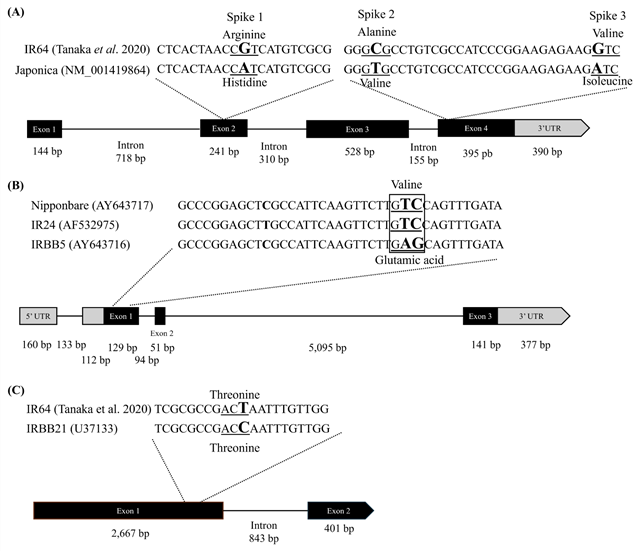
Multiplex PCR was performed using SNAP primers and EF1-α internal control primers. Multiplex PCR can reduce time and cost by avoiding the need for separate runs (Mendez-Alvarez et al. 2025). Although Almeida et al. (2024) successfully implemented allele-specific PCR, the methodology could be strengthened by including internal controls to confirm band absence. Owing to the involvement of two primer pairs, the annealing temperature was optimized. Our results showed that the SNAP gene qTSN4 loci Spike 1 and 2, were amplified successfully and consistently across all five annealing temperatures tested (Figure 2A, Figure 2B). Each tested sample produced a 716 bp PCR product from a pair of control primers. Each sample was tested using two specific primers. Sample IR64 did not produce an amplicon with primers A and T, whereas primers G and C produced an amplicon based on specific spike 1 and 2 primers. IR64 has genotypes AA and TT for spikes 1 and 2, and vice versa for Code-qTSN4.

Agarose gel electrophoresis results for annealing temperature optimization of SNAP markers. A. qTSN4 Spike 1 (IR64: GG, Code-qTSN4: AA), B. qTSN4 Spike 2 (IR64: CC, Code-qTSN4: TT), C. qTSN4 Spike 3 (IR64: GG, Code-qTSN4: AA), D. xa5 (IR24: CC, IRBB5: GG), and E. Xa21 (IR64: TT, IRBB21: CC).
Optimizing the annealing temperature is crucial for successful PCR amplification of both qTSN4 Spike 3 and xa5 SNAP genes. Excessively high temperatures above 60 °C could hinder primer binding and lead to no PCR product on the qTSN4 marker (Figure 2C). For xa5 SNAP, temperatures (55-63 °C) successfully differentiated between IR24 (CC genotype) and IRBB21 (GG genotype) (Figure 2D). Conversely, overly low temperatures led to non-specific primers preventing differentiation, as seen with Xa21 SNAP at 55 °C (Figure 2E). One strategy for obtaining a more specific product is to increase the annealing temperature during PCR (Rahmi et al. 2024). This has been demonstrated with the Xa21 gene, where the optimal annealing temperature ranges from 58-65 °C and allows for differentiation between IR64 (TT genotype) and IRBB21 (CC genotype). For mass-scale genotyping, an annealing temperature of 60 °C can be used for all SNAP primers (qTSN4, xa5, and Xa21).
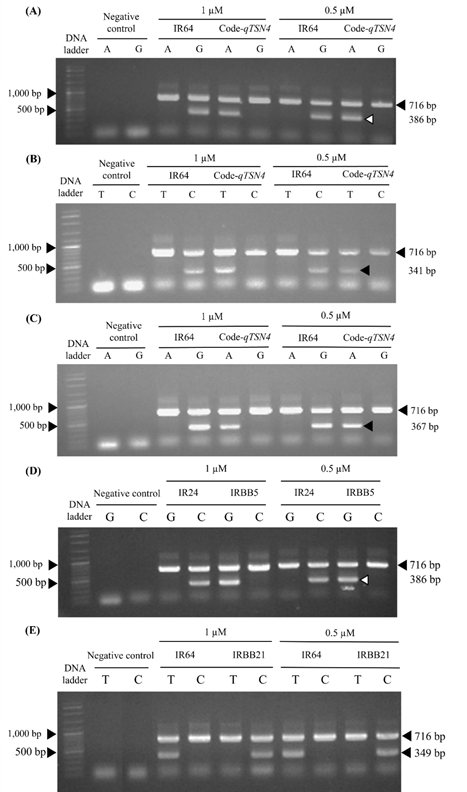
In addition to the annealing temperature, the concentration of the internal control primer is also critical for preventing competition with specific primers. Our study demonstrated that reducing the concentration of the internal control to 0.5 µM did not impact the results across all SNAP assays (Figure 3). Reducing the concentration of the control primers is beneficial if they interfere with specific primers. The xa5 gene was successfully analyzed using multiplex PCR with the tetra-amplification refractory mutation system-polymerase chain (ARMS) method, which employs internal primers near the SNP and uniform primer concentrations (Liu et al. 2021). This finding aligns with our observation that a consistent 1 µM concentration for all primers had no adverse effect in our assays. Notably, the specific control employed for xa5 in the tetra-ARMS method was not applicable to other SNAP analyses of rice. In contrast, our study provided a universal primer control applicable to all rice SNAP assays, regardless of the target gene or marker used.

Agarose gel electrophoresis results for primer internal control concentration optimization of SNAP markers. A. qTSN4 Spike 1 (IR64: GG, Code-qTSN4: AA), B. qTSN4 Spike 2 (IR64: CC, Code-qTSN4: TT), C. qTSN4 Spike 3 (IR64: GG, Code-qTSN4: AA), D. xa5 (IR24: CC, IRBB5: GG), and E. Xa21 (IR64: TT, IRBB21: CC).
Application of developed SNAP markers in parental line genotyping for pyramiding breeding
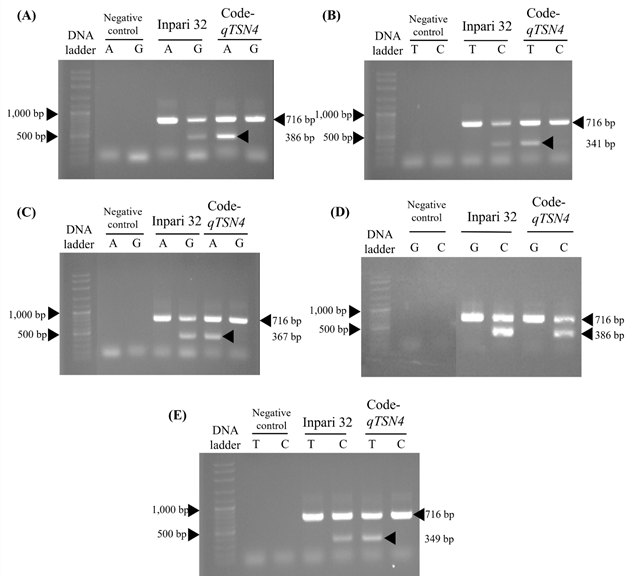
A plant breeding scheme to pyramid the Xa and qTSN4 genes was recently developed by crossing Inpari 32 with Code-qTSN4 (Ashan et al. 2023). F1 hybrid seeds were identified using SSR markers. SNAP markers, designed and optimized for qTSN4, xa5, and Xa21, were used to genotype the parental lines and assess their potential as selection tools. The SNAP qTSN4 markers for Spike 1, Spike 2, and Spike 3 confirmed that Code-qTSN4 was the donor of the qTSN4 gene, exhibiting the genotypes AA, TT, and AA, respectively (Figure 4A, 4B, and 4C). In contrast, Inpari 32 carried negative alleles for genotypes GG, CC, and GG. The positive qTSN4 genotype in Code-qTSN4 originated from Japonica rice (Fujita et al. 2013, Tasliah et al. 2020). Similarly, the SSR marker RM17483 for qTSN4 showed amplicon size differences between Inpari 32 and Code-qTSN4, further indicating that only Code-qTSN4 carried the qTSN4 gene (Ashan et al. 2023).
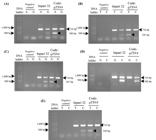
Agarose gel electrophoresis results of genotyping in parental lines of the breeding program using SNAP markers. A. qTSN4 Spike 1 (Inpari 32: GG, Code-qTSN4: AA), B. qTSN4 Spike 2 (Inpari 32: CC, Code-qTSN4: TT), C. qTSN4 Spike 3 (Inpari 32: CC, Code-qTSN4: TT), D. xa5 (Inpari 32: CC, Code-qTSN4: CC), and E. Xa21 (Inpari 32: CC, Code-qTSN4: TT).
The results for the SNAP xa5 marker showed that Inpari 32 and Code-qTSN4 displayed negative CC genotypes for xa5 (Figure 4D). This indicates that the SNAP xa5 marker cannot be used for selection in crosses involving these parents. Inpari 32 was assumed to harbor the xa5 gene from its male parent IRBB64 (Suryadi et al. 2016, Thamrin et al. 2023). However, no molecular testing has confirmed whether Inpari 32 carries the favorable allele xa5. Therefore, any assumptions regarding the presence of xa5 in Inpari 32 based solely on genetic background require further assessment.
Genotyping results for the SNAP Xa21 marker in Inpari 32 and Code-qTSN4 revealed a favorable CC genotype in Inpari 32. Meanwhile, Code-qTSN4 had a TT genotype, suggesting that it lacked a favorable allele of the Xa21 gene (Figure 4E). These SNAP marker results aligned with those of the SSR marker pTA248, which showed amplicon size differences between the two parents (Ashan et al. 2023). Individuals carrying the favorable Xa21 allele may exhibit resistance beyond BLB, as suggested by parallels with the receptor-like Cre3 gene, which responds to multiple pathogens (Moatamedi et al. 2018, Ercoli et al. 2022, Qalavand et al. 2022).
The applicability of the developed SNAP markers was validated in BC1F1 pyramided lines derived from Inpari 32, which carries the favorable allele C for Xa21, and Code-qTSN4, which carries the favorable allele A for qTSN4. Our results showed a consistent Mendelian 1:1 segregation of qTSN4 and Xa21 in the 72 BC1F1 plants (Supplementary Data). Markers without segregation distortion in Mendel's model are required for use as selection tools (Zhang et al. 2010). Among the 72 BC1F1 lines genotyped using the SNAP markers qTSN4 and Xa21, only 18 plants had favorable alleles, with a heterozygous AG genotype for qTSN4 and a homozygous CC genotype for Xa21. In conclusion, we developed and validated SNAP markers for qTSN4 and Xa21, enabling efficient gene pyramiding under optimized multiplex PCR conditions with reliable internal controls.
ACKNOWLEDGEMENTS
The authors thank PT. Wilmar Benih Indonesia, National Research and Innovation Agency Indonesia (BRIN), PT. Wilmar Padi Indonesia and the Indonesia Endowment Fund for Education (LPDP) as research funding sources.
Data Availability
The datasets generated and/or analyzed during the current research are available from the corresponding author upon reasonable request.
REFERENCES
- Abdullahi N, Shamuwa KF, Tahir BA, Abubakar I, Yekeh D2025 Climate change and its effect on plant pathogen evolution: systematic reviewDutse Journal of Pure and Applied Sciences 11:248-256
- Aboul-Maaty NAF, Oraby HAS2019 Extraction of high-quality genomic DNA from different plant orders applying a modified CTAB-based methodBulletin of the National Research Centre 43:25
- Almeida DP, Carneiro DG, Caixeta ET, Alvez DR, Zambolim L2024 New and efficient AS-PCR molecular marker for selection of coffee resistant to leaf rustCrop Breeding and Applied Biotechnology 24:e498424410
- Alvarez-Fernandez R2013 Explanatory chapter: PCR primer design. In Lorsch J (eds) Laboratory methods in enzymology. Johns Hopkins University School of Medicine, Baltimore, p. 1-21
- Ashan MA, Reflinur Reflinur, Ardie SW2023 Confirmation on gene introgression events and hybridity for BLB resistance and yield in riceIndonesian Journal of Agronomy 51:449-458
- Cheng X, Zhou G, Chen W, Tan L, Long Q, Cui F, Tan L, Zou G, Tan Y2024 Current status of molecular rice breeding for durable and broad-spectrum resistance to major diseases and insect pestsTheoretical and Applied Genetics 137:219
- Choudhury DR, Kumar R, Maurya A, Semwal DP, Rathi RS, Gautam RK, Trivedi AK, Bishnoi SK, Ahlawat SP, Singh K, Singh NK, Singh R2023 SSR and SNP marker-based investigation of Indian rice landraces in relation to their genetic diversity, population structure, and geographical isolationAgriculture 13:823
- Deng WL, Lin HA. Shih YC, Kuo CC, Tzeng JY, Liu LYD, Huang ST, Huang CM, Chung CL2016 Genotypic and pathotypic diversity of Xanthomonas oryzae pv. oryzae strains in TaiwanJournal of Phytopathology 164:745-759
- Drenkard E, Richter BG, Rozen S, Stutius LM, Angell NA, Mindrinos M, Cho RJ, Oefner PJ, Davis RW, Ausubel FM2000 A simple procedure for the analysis of single nucleotide polymorphisms facilitates map-based cloning in ArabidopsisPlant Physiology 124:1483-1492
- Ercoli MF, Luu DD, Rim EY, Shigenaga A, de Araujo Jr AT, Chern M, Jain R, Ruan R, Joe A, Ronald P2022 Plant immunity: Rice XA21-mediated resistance to bacterial infectionProceedings of the National Academy of Sciences of USA 119:e2121568119
- Fujita D, Trijatmiko KR, Tagle AG, Sapasap MV, Koide Y, Sasaki K, Tsakirpaloglou N, Gannaban RB, Nishimura T, Yanagihara S, Fukuta Y, Koshiba T, Slamet-Loedin IH, Ishimaru T, Kobayashi N2013 NAL1 allele from a rice landrace greatly increases yield in modern indica cultivarsThe Proceedings of the National Academy of Sciences 110:20431-20436
- Fulghum B, Tanker SH, White III RA2024 DeGenPrime provides robust primer design and optimization unlocking the biosphere. Bioinformatics Advances 4: vbae044.
- Hasan H, Choudhary S, Naaz N, Sharma N, Laskar RA2021 Recent advancements in molecular marker-assisted selection and applications in plant breeding programmesJournal of Genetic Engineering and Biotechnology 19:128
- IRRI - International Rice Research Institute1972 IRRI annual report 1972. International Rice Research Institute, Los Banos, 257p.
- Iyer AS, McCouch SR2004 The rice bacterial blight resistance gene Xa5 encodes a novel form of disease resistanceMolecular Plant-Microbe Interactions 17:1348-1354
- Jantasuriyarat C, Gowda M, Haller K, Hatfield J, Lu G, Stahlberg E, Zhou B, Li H, Kim H, Yu Y, Dean RA, Wing RA, Soderlund C, Wang GL2005 Large-scale identification of expressed sequence tags involved in rice and rice blast fungus interactionPlant Physiology 138:105-115
- Kristamtini Taryono, Basunanda P and Murti RH2015 High resolution microsatellites marker analysis of some rice landraces using metaphor agarose gel electrophoresisIndonesian Journal of Biotechnology 20:54-61
- Li W, Yan J, Zhang Y, Zhang F, Guan Z, Yao Y, Chang Y, Tu H, Li X, Wang H, Xiong H, Lai X, Yin P, Xiong L2023 Serine protease NAL1 exerts pleiotropic functions through degradation of TOPLESS-related corepressor in riceNature Plants 9:1130-1142
- Liu J, Huang S, Sun M, Liu S, Liu Y, Wang W, Zhang X, Wang H, Hua W2012 Improved allele-specific PCR primer design method for SNP marker analysis and its applicationPlant Methods 8:34
- Liu Y, Wang F, Zhang A, Kong D, Liu G, Luo L, Yu X2021 Development and validation of functional markers (Tetra-primer ARMS and KASP) for the bacterial blight resistance gene xa5 in riceAustralasian Plant Pathology 50:323-327
- Mackill DJ, Khush GS2018 IR64: a high-quality and high-yielding mega varietyRice 11:18
- Mendez-Alvarez D, Araya-Valverde E, Badilla-Valverde Y, Murillo-Gamboa O2025 Validated multiplex PCR of microsatellites for breeding purposes, clonal fidelity and controlled crossed in teakCrop Breeding and Applied Biotechnology 25:e51202523
- Moatamedi M, Bazgir E, Esfahani MN, Darvishnia M2018 Genetic variation of bread wheat accessions in response to the cereal cyst nematode, Heterodera filipjeviNematology 20:859-875
- Nanayakkara D, Edirisingha I, Dissanayake L, Weerasinghe D, Suriyagoda L, Herath V, Perera C, Jayatilake D2020 A novel intragenic marker targeting the ectodomain of bacterial blight-resistance gene Xa21 for marker-assisted selection in riceJournal of Crop Improvement 34:824-841
- Okonechnikov K, Golosova O, Fursov M, the UGENE team2012 Unipro UGENE: a unified bioinformatics toolkitBioinformatics 28:1166-1167
- Owczarzy R, Tataurov AV, Wu Y, Manthey JA, McQuisten KA, Almabrazi HG, Pedersen KF, Lin Y, Garretson J, McEntaggart NO, Sailor CA, Dawson RB, Peek AS2008 IDT SciTools: a suite for analysis and design of nucleic acid oligomersNucleic Acids Research 36:163-169
- Qalavand F, Nasr-Esfahani M, Vatandoost J, Azarm DA2022 Transcriptome-based analysis of resistance mechanisms to Bipolaris sorokiniana, a common wheat root-rot diseasePlant Biology 25:119-130
- Qi J, Qian Q, Bu Q, Li S, Chen Q, Sun J, Liang W, Zhou Y, Chu C, Li X, Ren F, Palme K, Zhao B, Chen J, Chen M, Li C2008 Mutation of the rice Narrow leaf1 gene, which encodes a novel protein, affects vein patterning and polar auxin transportPlant Physiology 147:1947-1959
- Qi Y, Rao Q, Lu C, Gong J, Hou Y2025 Recent progress in rice-Xanthomonas oryzae interactionsBiology 14:837
- Rahmi KA, Khotimah H, Rohman MS2024 Utilization of modified touchdown qPCR to enhance sensitivity and specificity for genes with restricted expression and low optimum temperature primersBiomedical and Biotechnology Research Journal 8:231-237
- Reddy BJ, Baradkar SM, Manogna TVSS, Bordoloi D, Bihani SC, Barua NS, Baruah AR, Das BK, Mondal S, Sarma D2024 A single-base deletion in exon 2 of Hd1 delineates monogenic recessive photoperiod insensitivity in aromatic Joha rice: a novel allele for seasonal adaptabilityBiology Research 57:94
- Song L, Wang R, Yang X, Zhang A, Liu D2023 Molecular markers and their applications in marker selection (MAS) in bread wheat (Triticum aestivum L.)Agriculture 13:642
- Song WY, Wang GL, Chen LL, Kim HS, Pi LY, Holsten T, Gardner J, Wang B, Zhai WX, Zhu LH, Fauquet C, Ronald P1995 A receptor kinase-like protein encoded by the rice disease resistance gene, Xa21Science 270:1804-1806
- Sowmiya CA, Ramalingam J, Pushpam R, Shoba D, Kumar KK, Pillai MA2024 Introgression of blast and bacterial blight disease resistance genes in a rice genotype ADT43 through marker assisted back cross breedingPhysiology and Molecular Biology of Plants 30:1003-1019
- Suryadi Y, Samudra IM, Priyatno TP, Susilowati DN, Lestari P, Fatimah Fatimah, Kadir TS2016 Determination of pathotypes from Indonesia Xanthomonas oryzae Pv. Oryzae population causing bacterial leaf blight and their reactions on differential riceMakara Journal of Science 20:109-118
- Tanaka T, Nishijima R, Teramoto S, Kitomi Y, Hayashi T, Uga Y, Kawakatsu T2020 De novo genome assembly of the indica rice variety IR64 using linked-read sequencing and nanopore sequencingG3(Bethesda) 10:1495-1501
- Tasliah, Ma’sumah and Prasetiyono J2020 Advanced yield trial of twenty-seven Code-qTSN4 and Code-qDTH8 rice linesJurnal Biologi Indonesia 16:67-79
- Thamrin M, Suprihanto Suprihanto, Hasmi I, Ardhiyanti SD, Suhartini Suhartini, Nugroho N, Wening RH, Pramudyawardani EF, Nafisah Nafisah, Usyati N, Hikmah ZM, Handoko DD, Norvyani Norvyani2023 Description of new superior rice variety. Agricultural Instrument Standardization Agency, Jakarta, 148p.
-
USDA - United States Department of Agriculture2025 Production - Rice. Available at <Available at https://www.fas.usda.gov/data/production/commodity/0422110 >. Accessed on August 10, 2025.
» https://www.fas.usda.gov/data/production/commodity/0422110 - Yang Z, Yang J, Yue L, Shen B, Wang J, Miao Y, Ouyang R, Hu Y2023 Enhancement effects and mechanism studies of two bismuth-based materials assisted by DMSO and glycerol in GC-rich PCRMolecules 28:4515
- Yuan J, Yi J, Zhan M, Xie Q, Zhen TT, Zhou J, Li Z, Li Z2021 The web-based multiplex PCR primer design software Ultiplex and the associated experimental workflow: up to 100-plex multiplicityBMC Genomics 22:835
- Zhang L, Wang S, Li H, Deng Q, Zheng A, Li S, Li P, Li Z, Wang J2010 Effects of missing marker and segregation distortion on QTL mapping in F2 populationsTheoretical and Applied Genetics 121:1071-1082