 Unemat Esmeralda: A new fusariosis-resistant spineless pineapple cultivar
Abstract
Unemat Esmeralda is a spineless pineapple cultivar notable for its resistance to fusariosis. It produces large, conical fruits with creamy-white, juicy flesh. The fruits exhibit a high soluble solids (SS) and an SS-to-total acidity ratio that exceeds fresh market standards, making Unemat Esmeralda an appealing choice for pineapple growers.
Keywords:
Ananas comosus (L.) Merril; Fusarium guttiforme; plant breeding; tropical fruits
INTRODUCTION
In 2022, Brazil produced 2,337,301 megagrams (Mg) of pineapples, cultivated over an area of 64,147 hectares, with an average yield of 24,291 kg ha-1 (IBGE 2022). This solid output places Brazil as the fourth-largest pineapple producer globally (FAO 2022). The most widely grown pineapple cultivars worldwide include MD-2, Smooth Cayenne, Singapore Canning, Queen, Española Roja, Pérola, and Manzana. In Brazil, Pérola is the leading cultivar, occupying over 85% of the commercial pineapple-growing area and dominating domestic consumption (Junghans and Souza 2022). Despite its popularity, Pérola has significant drawbacks. It features spiny leaves, which complicate handling, and is highly susceptible to fusariosis (Fusarium guttiforme) (Nirenberg and O’Donnell 1998), the most severe pineapple disease in Brazil. Fusariosis leads to reduced yields and diminished commercial value of the fruit.
In response to these challenges, pineapple breeding programs in Brazil have focused on developing spineless cultivars that are resistant to fusariosis, grow quickly, and produce cylindrical fruits with yellow flesh, high sugar content, low acidity, and strong resistance to browning during transport and storage (Paull et al. 2017, Lira Júnior et al. 2023). As a result, several cultivars have been introduced to the market, including BRS Imperial, BRS Ajubá, and BRS Vitória - developed by the Brazilian Agricultural Research Corporation (EMBRAPA) - and IAC Fantástico, developed by the Agronomic Institute of Campinas (IAC). These modern cultivars are fusariosis-resistant and feature spineless leaves. Some also boast other desirable traits, such as cylindrical fruits, yellow flesh, and high soluble solids content. However, these improved cultivars have certain limitations. Some display lower plant vigor and produce smaller fruits compared to Pérola (Ramos et al. 2020, Freitas et al. 2024). Additionally, the Brazilian market currently offers only four improved cultivars, which is insufficient given the Brazil’s significant pineapple production. Considering Brazil’s vast size and diverse environmental conditions, genotype-environment interactions vary considerably. This underscores the need for breeding programs to develop a broader range of pineapple cultivars that are well-adapted to different regions.
The Universidade do Estado de Mato Grosso (Unemat) launched a pineapple breeding program in 2012, supported by the establishment of an active germplasm bank. The program aimed to develop a pineapple cultivar that combines the fruit quality traits of Pérola - a cultivar widely favored in the Brazilian market - with the added advantages of spineless leaves, disease resistance, and high fruit weight.
ORIGIN AND DEVELOPMENT OF THE CULTIVAR
In 2014, crosses were performed between six parent cultivars: Smooth Cayenne, Pérola, Jupi, IAC Fantástico, BRS Imperial, and BRS Vitória. The crossings took place in the morning hours, between 6:00 a.m. and 9:00 a.m. Emasculation of flowers from the female parents (IAC Fantástico, BRS Imperial, and BRS Vitória) was unnecessary due to the natural incompatibility of these plants.
Cross-pollination involved collecting flowers from the male parents (Smooth Cayenne, Pérola, and Jupi) by using tweezers and placing them in Petri dishes. Anthers were then detached and used to pollinate the flowers of the female parents. To prevent insect-mediated pollination, flowers were covered with paper bags immediately after pollination. Resulting fruits were harvested at stage 4, characterized by a yellow peel. Seeds were extracted, disinfected in 70% alcohol and sodium hypochlorite for 15 minutes, and germinated in 250-mL plastic boxes (Gerbox) filled with autoclaved sand. Boxes were maintained in a growth chamber set at 24 °C with a 12-hour photoperiod and irrigated twice a week with sterile distilled water.
After three months, the seedlings were transferred to a greenhouse and planted in 310-mL cups filled with a commercial substrate (Plantmax) once they reached a length of 1.5 cm (December 2014). Four months later, the seedlings were transplanted to a greenhouse bed covered with a 50% shading screen. The bed substrate consisted of a mixture of soil and sand in a 3:1 ratio, enriched with organic soil fertilizer. Once the clones reached a height of 25 to 30 cm, they were transplanted to the field.
Clones were planted in September 2018 for the field experiment, which was conducted using a randomized block design with three replications and five plants per plot. Twenty individuals were initially selected based on quantitative traits, applying the restricted maximum likelihood (REML) and best linear unbiased prediction (BLUP) methods. Clones with leaf spines and/or multiple crowns were excluded, leaving 11 clones for further evaluation. Phenotyping for fusariosis resistance was carried out on the selected clones following the methodology proposed by Souto and Matos (1978). This process identified seven resistant clones. Among them, Clone 31, derived from a cross between BRS Vitória and Smooth Cayenne, stood out due to its high fruit weight and traits similar to the Pérola cultivar. These included conical fruits with white flesh (Silva et al. 2024). This clone was officially named Unemat Esmeralda.
EXPERIMENTAL DESIGN AND GROWTH CHARACTERISTICS
Cultivars Unemat Esmeralda, Smooth Cayenne, Pérola, Jupi, IAC Fantástico, BRS Imperial, BRS Ajubá, and BRS Vitória were cultivated in the experimental area of Unemat (lat 14° 39 'S, long 57° 25' W, alt 321 m asl), located in Tangará da Serra, Mato Grosso, Brazil. The climate of the region is classified as Aw (tropical with a dry winter), with two distinct seasons: a rainy summer and a dry winter (Köppen 1936, Alvares et al. 2013). The average annual rainfall is about 1,800 mm, with the heaviest rainfall occurring between November and March. The average annual temperature is around 25°C (Martins et al. 2010, Dallacort et al. 2011). The experiment followed a randomized block design with five replications. There were 20 plants per plot.
Planting materials (slips) measuring 25 to 35 cm in length were planted in September 2020, using a double-row spacing configuration of 1.20 × 0.40 × 0.40 m. Lime and soil fertilizers were applied both as basal and topdressing, based on the results of a soil analysis (Souza and Oliveira 2021). The soil analysis for the 0-20 cm layer revealed the following: pH(water) of 5.2; 1.48 mg dm-3 of P; 80 mg dm-3 of K; 0.12 cmolc dm-3 of Al; 0.85 cmolc dm-3 of Ca; 0.29 cmolc dm-3 of Mg; 3.75 cmolc dm-3 of H+Al; sum of bases at 1.3 cmolc dm-3; cation exchange capacity (pH 7.0) of 5.05 cmolc dm-3; base saturation at 25.75%; and 12 g dm-3 of organic matter. Irrigation was conducted according to the recommendations of Py et al. (1984).
Artificial floral induction was carried out in December 2021, 15 months after planting. A solution consisting of 20 L of water, 20 mL of Ethephon (720 g L-1), 400 g of urea, and 7 g of slaked or unslaked lime (CaO or Ca(OH)2) was applied directly to the center of the shoot apex. The application was done in the late afternoon, using 50 mL of solution per plant. Weed control initially involved manual weeding, followed by the application of the herbicide Krovar (diuron + bromacil) at a rate of 4 kg ha-1, which proved effective. Fruits were harvested five to six months after artificial floral induction, adhering to standard recommendations for pineapple plantations (Andrade Neto et al. 2018).
Vegetative traits were evaluated at the onset of inflorescence development, while fruit characteristics were assessed at harvest (green-ripe stage) at physiological maturity. The following vegetative traits were measured: 1) plant height (cm): measured from the ground to the tip of the highest leaf in its natural position; 2) D-leaf length (cm): measured from the base of the leaf on the stem to the tip of the leaf, without removing the leaf from the plant; and 3) number of planting materials (slips) per plant.
The following fruit characteristics were evaluated: fruit weight with crown (g) measured on a digital scale; soluble solids (SS; °Brix); titratable acidity (TA, in % citric acid); and SS/TA ratio. TA was determined by titration with 0.1 N sodium hydroxide (NaOH); 10 mL of fruit juice was mixed with 50 mL of distilled water, and 2 to 3 drops of 1% phenolphthalein indicator were added; the solution was shaken and then titrated with 0.1 N NaOH until the color turned slightly pink. The quantity of NaOH needed was used to calculate the percentage of citric acid in the juice (IAL 2008). SSC was determined using a digital refractometer with a scale from 0% to 95% Brix (RTD-95), and the results were expressed in °Brix. The maturation index, a measure that reflects the progression of ripening, was calculated as the SS/TA ratio.
Morphoagronomic descriptors developed for the pineapple DUS (Distinctness, Uniformity, and Stability) test, as established by the Brazilian National Service for the Protection of Cultivars (SNPC) of the Brazilian Ministry of Agriculture and Livestock (MAPA), were applied to the cultivar Unemat Esmeralda, using the cultivar Pérola as a control.
PERFORMANCE CHARACTERISTICS
Unemat Esmeralda demonstrated plant height (102.00 cm) and D-leaf length (101.00 cm) comparable to those of the cultivar Pérola, indicating high vegetative vigor (Table 1). While the number of slips produced by Unemat Esmeralda was lower than that of Pérola, it still exceeded eight slips per plant, which is considered adequate. This characteristic is significant for growers because slips are commonly used as planting material for subsequent cultivation.
The fruit weight of Unemat Esmeralda was higher than that of the other cultivars, placing it in class 5 (>2.1 to 2.4 kg) according to the Brazilian classification system established by the Brazilian Ministry of Agriculture and Livestock (MAPA) (MAPA 2002) and in class A (>1.5 kg) as defined by the São Paulo Wholesale Market pineapple identification guide (CEAGESP 2020). The small size of fruits has been a limiting factor for the commercialization of some modern cultivars, such as BRS Imperial, which has hindered their adoption by pineapple growers. Pineapple prices are directly influenced by size categories, with larger fruits commanding higher prices. Furthermore, large fruits are preferred by Brazilian consumers in fresh markets.
Regarding fruit chemical characteristics, all cultivars exhibited soluble solids (SS) above the minimum threshold of 12 °Brix, which qualifies pineapples as ripe and suitable for consumption (MAPA 2002). Unemat Esmeralda displayed an SS/TA ratio above 23, classifying it as a sweet and flavorful fruit with moderate acidity, making it ideal for fresh consumption.
The Unemat Esmeralda pineapple cultivar produces conical fruits with soft, juicy, creamy-white flesh, similar to the characteristics of Pérola pineapples (Table 2 and Figure 1). It also resembles Pérola in its harvest stage (green-ripe fruit stage), where the fruit skin remains uniformly green but indicates optimal ripeness for long-distance transport and consumption. However, Unemat Esmeralda differs from Pérola by having spineless leaves and resistance to fusariosis. The absence of leaf spines simplifies cultural practices that require movement between planting rows (Lira Júnior et al. 2021). Genetic resistance to fusariosis is a highly effective control strategy for the disease, which can cause up to 20% losses in planting material and 30% to 40% losses in fruit, significantly affecting crop production (Ventura and Costa 2010, Matos et al. 2011). Furthermore, resistance reduces the need for fungicide applications, thereby lowering production costs.
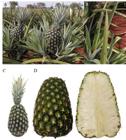
Plant and fruit morphology of Unemat Esmeralda. A: Fruit with planting material (slips) details; B: Spineless, light green leaves; C: Conical fruit with a medium-length crown and flat fruitlets; D: Cross-section of the fruit evidencing the yellowish-white flesh.
Morphoagronomic descriptors (34) used for DUS (Distinctness, Uniformity, and Stability) tests for Ananas comosus, with their respective phenotypic classes or categories, and the characterization of the example cultivar (Pérola) and Unemat Esmeralda, as established by the National Plant Variety Protection Service (SNPC)
Although the characteristics of the Unemat Esmeralda cultivar resemble those of the Pérola cultivar, its genealogy does not include Pérola. Instead, Unemat Esmeralda is derived from a cross between BRS Vitória and Smooth Cayenne. The BRS Vitória cultivar, in turn, originates from an Amazonian variety (Primavera, which has smooth leaves and white flesh) crossed with Smooth Cayenne (characterized by few spines on its leaves and yellow flesh). With 75% of its genome inherited from Smooth Cayenne, Unemat Esmeralda is indeed a backcrossed hybrid.
REGISTRATION, PRODUCTION, AND DISTRIBUTION OF SEEDLINGS
The pineapple cultivar Unemat Esmeralda was officially registered under number 56618 by MAPA following a request from Unemat. Unemat Esmeralda was maintained and propagated both under field conditions and through micropropagation, with the goal of distributing planting material to pineapple growers. Unemat Esmeralda is already being cultivated in various production areas in the state of Mato Grosso and in other Brazilian states, namely Paraná, Pará, Piauí, Maranhão, Rondônia, Minas Gerais, Tocantins, Rio de Janeiro, São Paulo, and Espírito Santo, thereby promoting broader dissemination of this new cultivar across Brazil.
ACKNOWLEDGEMENTS
The authors would like to thank the Fundação de Amparo à Pesquisa do Estado de Mato Grosso (FAPEMAT) for the financial support of this project.
Data Availability
The datasets generated and/or analyzed during the current research are available from the corresponding author upon reasonable request.
REFERENCES
- Alvares CA, Stape JL, Sentelhas PC, Gonçalves LM, Sparovek G2013 Mapa de classificação climática de Köppen para o Brasil. Meteorologische Zeitschrift 22:711-728
-
Andrade Neto RC, Nogueira SR, Nascimento GC, Negreiros JRS, Gomes FCR2018 Sistema de produção da cultura do abacaxi para o estado do Acre. Available at <Available at https://www.embrapa.br/busca-de-publicacoes/-/publicacao/1100056/sistema-de-producao-da-cultura-do-abacaxi-para-o-estado-do-acre >. Accessed on October 07, 2022.
» https://www.embrapa.br/busca-de-publicacoes/-/publicacao/1100056/sistema-de-producao-da-cultura-do-abacaxi-para-o-estado-do-acre -
CEAGESP - Companhia de Entrepostos e Armazéns Gerais de São Paulo2020 Abacaxi: guia de identificação. Available at <Available at https://ceagesp.gov.br/wp-content/uploads/2020/04/abacaxi-1.pdf >. Accessed on July 04, 2023.
» https://ceagesp.gov.br/wp-content/uploads/2020/04/abacaxi-1.pdf - Dallacort R, Martins JA, Inoue MH, Freitas PSLD, Coletti AJ2011 Distribuição das chuvas no município de Tangará da Serra, médio norte do Estado de Mato Grosso, Brasil. Acta Scientiarum Agronomy 33:193-200
-
FAO - Food and Agriculture Organization of The United Nations2022 Crops and livestock products. Available at <Available at https://www.fao.org/faostat/en/#data/QCL >. Accessed on March 16, 2024.
» https://www.fao.org/faostat/en/#data/QCL - Freitas AP, Krause W, Arantes DSO, Castro Silva DC, Santos EA, Campos RA2024 Agronomic performance and fruit sensory and quality analyses of pineapple cultivars. Comunicata Scientiae 15:e4193
- IAL - Instituto Adolfo Lutz2008 Métodos físico-químicos para análise de alimentos. Instituto Adolfo Lutz, São Paulo, 1020p
-
IBGE - Instituto Brasileiro de Geografia e Estatística: Produção agrícola municipal2022. Available at: < Available at: https://sidra.ibge.gov.br/tabela/5457 >. Accessed on March 18, 2024.
» https://sidra.ibge.gov.br/tabela/5457 - Junghans DT, Souza JS2022 Brazilian pineapple production segmented by cultivars. ISHS Pineapple News 28:22-27
- Köppen W1936 Das geographische system der klimate. In Köppen W and Geiger R (eds) Handbuch der klimatologie. Verlag von Gebruder Borntraeger, Berlin, p. 1-44
- Lira Júnior JS, Andrade DEGT, Bezerra JEF, Assunção MS, Assis TC, Junghans DT, Matos AP2023 Selection of F1 genotypes of pineapple and reaction to inoculation with a Fusarium guttiforme isolate. Crop Breeding and Applied Biotechnology 23:e43202315
- Lira Júnior JS, Bezerra JEF, Andrade DEGT2021 Genetic control of leaf spinescence in BRS Imperial, Pérola, and Pico de Rosa pineapple cultivars. Crop Breeding and Applied Biotechnology 21:e33492112
-
MAPA - Ministério da Agricultura, Pecuária e Abastecimento2002 Instrução normativa Mapa Nº 1 de 1/02/2002. Available at <Available at https://sistemasweb.agricultura.gov.br/sislegis/action/detalhaAto.do?method=visualizarAto PortalMapa&chave=661183307 >. Accessed January 28, 2022.
» https://sistemasweb.agricultura.gov.br/sislegis/action/detalhaAto.do?method=visualizarAto PortalMapa&chave=661183307 - Martins JA, Dallacort R, Inoue MH, Santi A, Coletti AJ2010 Probabilidade de precipitação para a microrregião de Tangará da Serra, Estado do Mato Grosso. Pesquisa Agropecuária Tropical 40:291-296
- Matos AP, Sanches NF, Teixeira FA, Simão AH2011 Pineapple integrated pest management - an overview. Acta Horticulturae 902:339-347
- Nirenberg HI, O’Donnell K1998 New Fusarium species and combinations within the Giberella fujikuroi species complex. Mycologia 90:434-458
- Paull RE, Bartholomew DP, Chen CC2017 Pineapple breeding and production practices. In Lobo MG and Paull RE (eds) Handbook of pineapple technology: Production, postharvest science, processing and nutrition. John Wiley & Sons, New York, p. 16-38
- Py C, Lacoeuilhe JJE, Teisson C1984 L’ananas sa culture, ses produits. G. M. Maisoneuve Et Larose, Paris.
- Ramos MJM, Campos Filho S, Ventura JA2020 Qualidade de frutos de diferentes cultivares de abacaxizeiro, em Mato Grosso. In Oliveira RJ (ed) Agricultura em foco: tópicos em manejo, fertilidade do solo e impactos ambientais. Editora Científica Digital, Londrina, p. 97-105
- Silva DC, Krause W, Arantes DSO, Freitas AP, Santos EA, Araújo DV, Silva CA2024 Pineapple breeding: development of new pineapple cultivars without leaf spines and resistant to fusariosis. Euphytica 220:1-11
- Souto GF, Matos AP1978 Método para avaliar resistência a Fusarium moniliforme var. subglutinans em abacaxi. Revista Brasileira de Fruticultura 1:23-30
- Souza LFS, Oliveira AMG2021 Calagem e adubação para o abacaxizeiro. In Borges AL (ed) Recomendações de calagem e adubação para abacaxi, acerola, banana, citros, mamão, mandioca, manga e maracujá. Embrapa, Brasília, p. 95-122
- Ventura JÁ, Costa H2010 Estratégias para o controle da fusariose do abacaxizeiro. Tropical Plant Pathology 35:104-107
- Vilela GB, Pegoraro RF, Maia VM2015 Predição de produção do abacaxizeiro Vitória por meio de características fitotécnicas e nutricionais. Revista Ciência Agronômica 46:724-732